Florita Bell Griffin, Ph.D.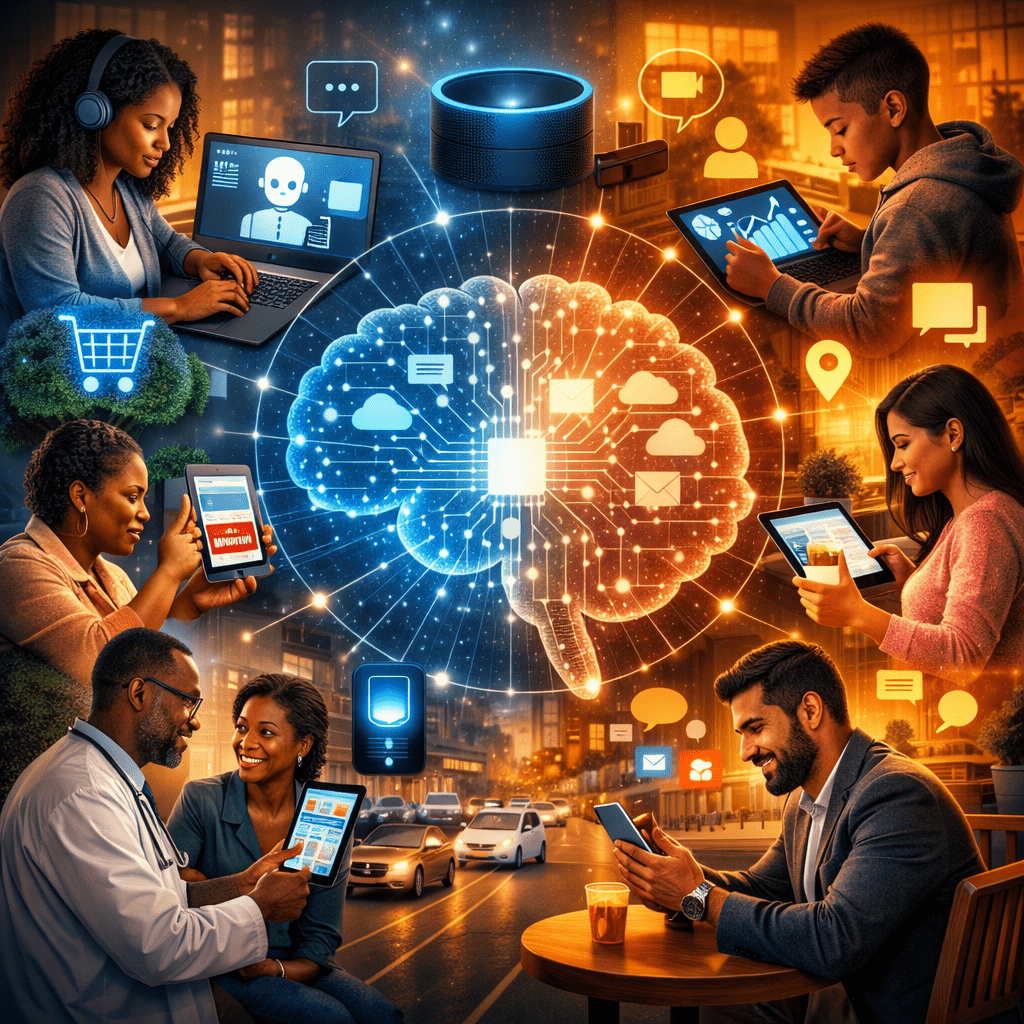
By Florita Bell Griffin | Houston, TX | July 7, 2026
The real AI revolution is unfolding in a far more intimate way than many people first expected. Early public imagination placed artificial intelligence in laboratories, robotic machines, futuristic factories, and distant corporate research centers. Today its reach is far closer, quieter, and more powerful. AI is entering the spaces where ordinary life happens every day. It is shaping how people search for information, buy products, receive recommendations, complete paperwork, communicate with institutions, manage schedules, learn new things, and move through the digital systems that now surround almost every part of modern life.
That is why the real revolution is larger than a story about technical progress. It is a story about daily life being rewritten in real time. AI changes the way people encounter choices, the way they receive guidance, the way they spend attention, and the way they experience convenience. Its influence is spreading through routines that seem familiar, which makes the change easy to underestimate. Yet the most powerful shifts in society often arrive through ordinary habits rather than dramatic announcements.
One of the clearest signs of this rewrite appears in the way people now receive information. In an earlier digital world, users often had to search, compare, read, and sort through large volumes of material on their own. That process could be tedious, yet it kept people closer to the raw act of evaluating what they found. AI increasingly changes that relationship. It summarizes, ranks, recommends, predicts, and frames. Instead of simply opening a door to information, it begins arranging the room. It decides what rises to the top, what appears relevant, what seems urgent, and what fades into the background.
That shift matters because daily decisions grow out of the environments people see. When the environment is increasingly curated by predictive systems, the character of human judgment begins to change. A person still chooses, yet the shape of that choice is influenced by an intelligence layer working quietly in the background. This is one of the deepest ways AI is rewriting life. It changes the conditions under which thought takes place.
Work offers another powerful example. Across offices, schools, logistics systems, creative industries, customer service channels, financial operations, and research environments, AI is accelerating tasks that once required more time and labor. It drafts messages, organizes notes, summarizes meetings, analyzes documents, answers routine questions, and supports decision workflows. For many workers, this feels like a gain in speed and relief. Yet every gain in speed also changes expectations. Once a task can be completed faster, institutions begin recalibrating what counts as normal productivity. The result is that AI shapes work by changing pace, pressure, and standards as much as output itself.
That transformation reaches beyond professional settings. Family life is also being rewritten. AI now influences what children watch, what parents are shown online, what products families are encouraged to buy, and what kinds of answers emerge from search tools and digital assistants. Recommendation systems shape household routines with remarkable subtlety. Entertainment choices, educational prompts, shopping patterns, and even emotional tone can all be influenced by algorithmic systems tuned to predict what will hold attention. A household may feel as though it is simply enjoying convenience, while a far more complex process of behavioral shaping is taking place underneath.
Education is changing in similar ways. Students now live in a world where AI can explain concepts, generate practice material, summarize readings, offer writing assistance, and serve as a constant academic companion. This brings real benefits, especially for learners who need quick support or another pathway into a difficult idea. At the same time, education is about more than receiving answers. It is about building concentration, reasoning, memory, authorship, patience, and confidence. When AI enters learning environments, it changes the relationship between effort and outcome. That means the revolution touches the formation of the mind itself.
Consumer life may be the area where the rewrite is most visible. AI helps determine which products appear first, which prices are shown, which ads are served, which promotions feel personal, and which paths lead most smoothly toward a purchase. Shopping becomes more tailored, more responsive, and more predictive. A person may feel seen by the system because the system seems to understand preferences so quickly. Yet the deeper reality is that the marketplace is evolving from a place of display into a place of dynamic behavioral influence. AI is helping transform commerce into a living environment that learns, adjusts, and persuades continuously.
Healthcare, banking, transportation, and public services are also experiencing this shift. AI supports scheduling, triage, fraud detection, record management, route suggestions, screening systems, and prioritization tools. Many of these applications improve responsiveness and efficiency. Yet they also show how deeply the rewrite reaches. AI is entering the back-end structures that shape how people are processed, flagged, assisted, routed, or delayed. A person may never see the full system, yet the system may already be shaping the pace and quality of their experience.
Trust sits at the center of all of this. As AI becomes more fluent, polished, and responsive, it becomes easier for people to accept its outputs as authoritative. A system that speaks clearly and smoothly can feel competent even when its reasoning is partial or its perspective is narrow. That dynamic matters because everyday life depends on trust. People trust information systems, financial systems, educational systems, medical systems, and communication systems every single day. As AI becomes more embedded within them, the question of what deserves trust grows more urgent.
The real revolution, then, is about more than automation. It is about mediation. AI sits between people and information, between consumers and markets, between workers and institutions, between students and knowledge, between citizens and systems. It increasingly helps shape what is visible, what is recommended, what is rewarded, and what is treated as meaningful. Once a technology reaches that level of influence, it becomes part of the architecture of social life.
This is why public understanding matters so deeply. Many people still speak about AI as though it were mainly a future issue. In truth, it is already part of the lived present. It is reorganizing routines through search, media, shopping, learning, work, and administration. Its effects often feel incremental because they arrive through convenience rather than disruption. Yet accumulation has power. Hundreds of small changes across ordinary life can produce a profound social transformation.
The word revolution usually suggests spectacle. In the case of AI, the more accurate image is restructuring. Daily life is being reorganized by systems that predict, guide, rank, personalize, and respond at scale. Human beings still make choices, yet those choices increasingly arise inside environments shaped by machine intelligence. That is a major civilizational development because it changes how people encounter reality itself.
The real AI revolution deserves serious attention for that reason. It is rewriting daily life through tools that feel useful, familiar, and ordinary. It is changing how people work, learn, buy, trust, communicate, and decide. It is shifting influence into the hidden layers of modern systems, where guidance can shape behavior long before people realize how much has changed. That is the true scale of this moment. AI is rewriting daily life from the inside, and the future will be shaped by how clearly society understands the depth of that rewrite.
© 2026 Truth Seekers Journal. Published with permission from the author. All rights reserved.
Support open, independent journalism. Your contribution helps us tell the stories that matter most.