
By Florita Bell Griffin, Ph.D. | Houston, TX | August 25, 2026
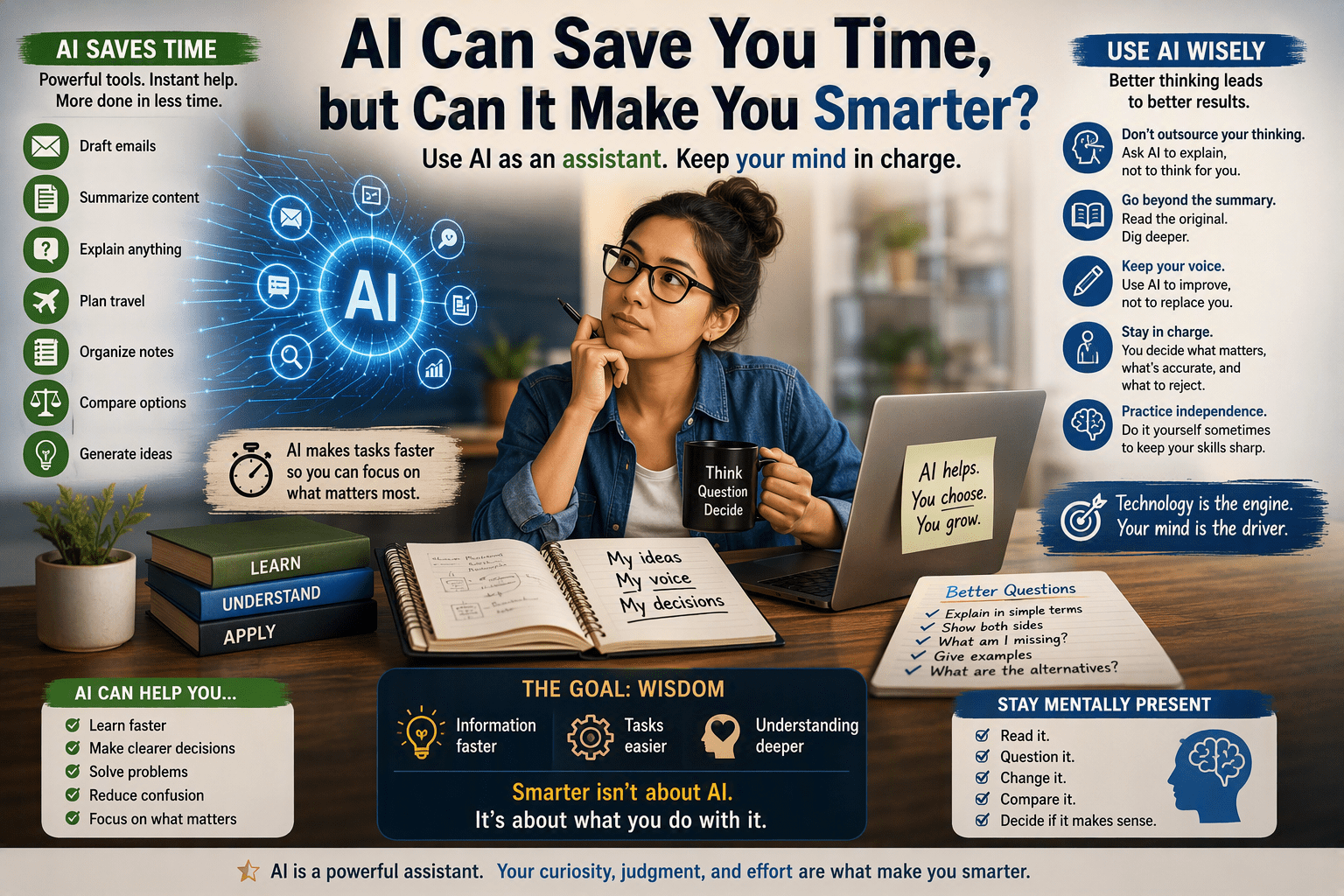
One of the biggest promises of artificial intelligence is time. AI can draft a letter in seconds, summarize a long document, explain an unfamiliar subject, create a travel plan, organize notes, compare products, and generate ideas almost instantly. Tasks that once required an hour may take only a few minutes.
That efficiency is real, and for many people it is one of the most valuable benefits of the technology. The more difficult question is what happens when people begin using AI not only to save time, but to avoid thinking.
There is an important difference between assistance and substitution. A calculator can help a person solve a difficult equation, but someone who never learns basic arithmetic becomes dependent on the calculator. GPS can help a driver reach an unfamiliar destination, but constant reliance on navigation may weaken the ability to remember routes. AI can help a person write more clearly, but if it begins producing every message, report, and idea, the user may gradually stop developing a personal voice.
This does not mean AI makes people less intelligent. Used well, it can do the opposite. A student can ask for a simpler explanation of a difficult concept. A reader can request examples that make an unfamiliar idea easier to understand. A business owner can use AI to organize scattered thoughts before making a decision. A traveler can compare several options quickly and spend more time considering which one actually fits.
The difference lies in how the technology is used. Asking AI to explain something is different from asking it to think in your place. A person who reads an AI summary and then examines the original material is using the tool to accelerate learning. A person who reads only the summary may be trading understanding for convenience.
The same issue appears in writing. AI can help someone organize ideas, improve grammar, or find a clearer way to express a thought. That can be especially useful for people who struggle with writing or who have strong ideas but difficulty putting them into words. The danger comes when the final result sounds polished but does not reflect what the person actually knows or believes.
A useful way to think about AI is as a very capable assistant who can work quickly but still needs direction. The user must decide what matters, what is accurate, what fits the situation, and what should be rejected. Those decisions require judgment, and judgment grows through use.
People can make AI more intellectually useful by asking better questions. Instead of saying, “Give me the answer,” try asking, “Explain this in a way I can understand,” “Show me the strongest arguments on both sides,” or “What am I missing?” Instead of asking AI to write an entire opinion, ask it to help organize your own ideas. Instead of accepting the first explanation, ask for examples, evidence, and alternative interpretations.
AI can also help people learn faster because it allows immediate follow-up. A person reading about economics can ask what a term means. Someone learning history can request a timeline. A homeowner can ask for an explanation of a contractor’s estimate. A patient can ask for help understanding unfamiliar medical vocabulary before speaking with a doctor. In each case, the technology can reduce confusion and make information more accessible.
The most important thing is to remain mentally present. Read what the AI produces. Question it. Change it. Compare it with other information. Decide whether it makes sense. The more actively a person engages with the answer, the more likely the technology will support thinking instead of replacing it.
There is also value in occasionally doing things without assistance. Write a paragraph before asking AI to improve it. Try to remember the route before opening navigation. Work through a problem before requesting the solution. Read the article before asking for the summary. These small practices help preserve the skills that technology is designed to support.
Artificial intelligence is likely to become more capable and more deeply integrated into everyday life. It will continue saving time, reducing routine work, and making information easier to access. The people who benefit most may not be those who ask AI to do everything for them. They may be those who learn how to combine the speed of the machine with the judgment of the human mind.
AI can make information faster. It can make tasks easier. It can make complex subjects more understandable. Whether it makes us smarter depends largely on what we choose to do after the answer appears.
© 2026 Truth Seekers Journal. Published with permission from the author. All rights reserved.
Related articles
Living With AI: How It Is Changing Work, Family, and Community
When Systems Forget Who They Were Built For
Why Familiarity Is Not the Same as Understanding
Support open, independent journalism. Your contribution helps us tell the stories that matter most.

