
By Lola Renegade | March 10, 2026
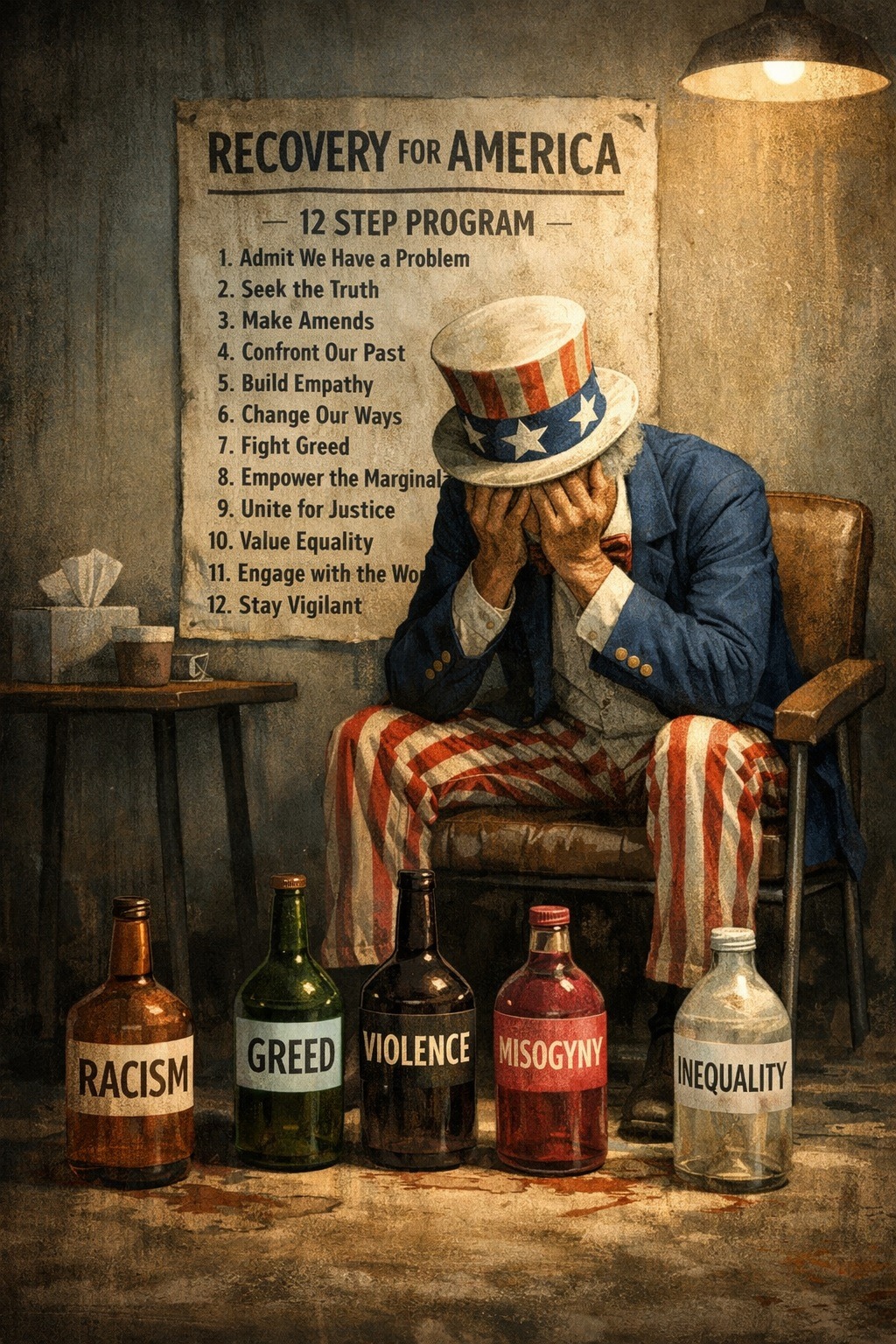
America will never be great until (S)he checks itself into rehab.
For generations, this nation has wrapped itself in the language of exceptionalism—the land of opportunity, the beacon of freedom, the greatest country in the world, blah, blah, blah, etc. But myths are powerful narcotics. They dull the pain of truth. They allow a nation to avoid confronting the damage it has done and continues to do—to others and to itself.
Strip away the mythology and the reality becomes unavoidable: America is a nation struggling with longstanding addictions—racism, violence, misogyny, inequality, and greed. These are not temporary lapses in judgment. They are structural and systemic habits, embedded in institutions, culture, and political life since the country’s violent and genocidal birth.
Like every addiction, these habits have consequences. And like every addiction, they will persist until the addict admits there is a problem.
America has experienced moments of greatness but has never been genuinely great. There have been flashes of moral clarity—Reconstruction, the New Deal, the Civil Rights Movement, notable first-time elections of President Barack Obama, Vice President Kamala Harris and other people of color—periods when the country briefly attempted to live up to its highest ideals. But those moments have often been followed by backlash, denial, retreat, and violence.
The truth is uncomfortable but unavoidable: greatness has never been America’s permanent condition. At best, it has been an aspiration.
Now the country stands at another crossroads.
The rise of Trumpism and his cult of MAGA (Make America Great Again) did not invent America’s demons; it exposed them. It pulled the curtain back on forces that had always existed but were often somewhat politely ignored, especially by the so-called mainstream media. Racial resentment, authoritarian impulses, contempt for democratic norms, and an open hostility toward women, immigrants, countries of color, and marginalized communities were no longer whispered—they were amplified from podiums and television screens.
Trumpism became less a political movement than a mirror reflecting unresolved truths about the nation itself.
And the reflection is not flattering, it is downright ugly as homemade sin because that is what it is.
To understand the depth of America’s addiction, one must begin with its historical foundation. The nation was born through the displacement and destruction of Indigenous peoples and built in large part through the forced labor of enslaved Africans. The Confederacy—an armed rebellion fought to preserve slavery—lost the Civil War but never fully lost the violent cultural war that followed.
Its symbols remain scattered across the American landscape: statues, flags, and monuments that celebrate a rebellion against democracy itself. These artifacts are not simply relics of history. They are declarations of whose history matters and whose suffering can be ignored.
Trumpism breathed new life into these symbols. The refusal to unequivocally condemn white supremacists, the defense of Confederate monuments, and the rhetorical flirtation with authoritarian nationalism revealed how unfinished America’s reckoning with its past truly remains.
But acknowledging the past is only the first step. Recovery requires transformation. In the language of addiction recovery, healing begins with admission.
Step One: Admit the problem.
America must acknowledge that racism, misogyny, inequality, and greed are not isolated incidents—they are systemic and structural forces woven into the nation’s political and economic fabric. This is best explained by Professor Tricia Rose, Ph.D. https://www.youtube.com/watch?v=X3KsVRkbnn4
Step Two: Educate honestly.
A nation cannot heal from a history it refuses to teach. Honest education about slavery, colonialism, and structural inequality is not divisive—it is necessary.
Step Three: Demand accountability.
Policies that target vulnerable populations—such as the so-called Muslim ban, family separations at the border, attacks on diversity initiatives, and efforts to erase the contributions of people of color from public narratives—illustrate how political power can be used to reinforce inequality.
Step Four: Confront the mythology.
Confederate symbols and historical distortions must be confronted, not romanticized. Nations mature when they confront their past honestly.
Step Five: Rebuild empathy.
Democracy cannot function without the ability to recognize one another’s humanity.
Step Six: Reform institutions.
Systems that perpetuate racial and gender inequality—from criminal justice to economic policy—must be fundamentally reexamined.
Step Seven: Address economic inequality.
Extreme disparities of wealth undermine democracy itself. When policy consistently favors the affluent, the social contract begins to collapse.
Step Eight: Restore public trust.
Trust cannot be demanded; it must be earned through transparency, fairness, and accountability.
Step Nine: Build coalitions for justice.
Progress has always required alliances across race, gender, and class.
Step Ten: Elevate art, culture, and truth.
Artistic expression and cultural dialogue help societies confront their deepest wounds.
Step Eleven: Reengage with the world responsibly.
Isolationism and militarized nationalism weaken moral leadership. Global cooperation strengthens it.
Step Twelve: Commit to vigilance.
Recovery is never permanent. It requires continuous effort and moral courage.
None of this will be easy. Addicts resist intervention. They deny the severity of their condition. They lash out at those who attempt to help them confront it. Nations behave no differently.
But the alternative to intervention is decline.
When societies refuse to confront injustice, inequality deepens. When greed overrides the common good, democracy erodes. When violence becomes normalized, the social fabric begins to rot.
America stands at a moment that demands honesty. The nation can continue clinging to comforting myths about its past, or it can finally confront the contradictions that have haunted it since its founding.
Rehabilitation is possible. But only if the country is willing to do the hardest thing of all: Tell the truth about itself. Until then, the slogan of greatness will remain just that—a slogan.
Because greatness is not something a nation proclaims. It is something a nation proves.