
By Lola Renegade | Atlanta, GA | May 30, 2026 |
A couple of days ago, while visiting the Atlanta History Center with my great niece and nephew – my proxy grandchildren – I noticed something that stayed with me long after I left.
Everywhere I turned, I saw several Black women caring for little white children.
Some carried babies on their hips. Others pushed strollers through the museum corridors and gardens. Some held tiny white hands as curious toddlers wandered through exhibits laughing, pointing, and exploring the world with complete innocence and trust.
At first, seeing one Black nanny seemed unremarkable.
But after witnessing it again and again, I felt history pressing against and piercing my spirit. I found myself thinking, “I know this story personally.”
I recall my mother, along with several of my aunts, and countless other Black women, worked as domestics in Mississippi during the brutal decades of Jim and Jane Crow throughout the 1950s, 1960s, and 1970s. They cared for white children whose parents were often half their age or younger, and eventually the children themselves, called them by their first names, as though these grown Black women were perpetual children themselves, undeserving of the dignity and respect automatically granted to white adults.
In the South of that era, Black women and men were rarely addressed with basic respect. White children were taught early that Black adults – even elderly Black adults – did not deserve titles such as “Miss,” “Mrs.,” or “Mr.”
Imagine the psychological violence and trauma of that. Imagine helping to raise a child, pouring love, patience, and tenderness into their life, only to see many grow into adults who embraced the same prejudices, racial hatred, and moral corrosion that had been passed down to them for generations by grandparents, parents, institutions, and an America determined to preserve racial hierarchy.
What greater tragedy is there than witnessing a child’s humanity slowly poisoned by the very parents entrusted to nurture it?
We have Child Protective Services (CPS) to rescue children from physical abuse, neglect, and dangerous homes. But who rescues children from inherited hatred? Who intervenes when racism, bigotry, and dehumanization become family heirlooms passed from one generation to the next?
Where is CPS when a child’s conscience is being corrupted, their empathy diminished, and their humanity stolen by the very parents, grandparents, and trusted adults charged with shaping their moral character?
Shouldn’t society be equally concerned and ready to remove children from their homes when they are taught to hate, fear, and to devalue the humanity of others?
Perhaps one of the greatest tragedies of racism is not only the damage it inflicts upon its victims, but the moral injury it inflicts upon the children taught to carry it forward. Teaching a child to hate another human being, not only diminishes the humanity of the hated, but also the humanity of the hater.
It was witnessing my mother and other Black women navigate those humiliations that shaped me in ways I did not fully understand at the time. Even as a child, I made a vow to myself: no matter how poor, hungry, or desperate I might ever become, I would never become a domestic worker for white America. In the words of singer Lou Rawls, “I’d rather drink muddy water and sleep out in a hollow log.”
The relationship between Black women and white children in America did not begin with modern-day nannies or domestic workers. Its roots stretch back into slavery itself, when kidnapped, enslaved Black women were often forced to nurse white babies from their breasts while their own children waited nearby, sometimes hungry, neglected, or handed off to others. Few images capture the emotional and moral contradictions of America more painfully than a Black mother coerced to using her body to nourish the child of those who claimed ownership over her body, her humanity.
That contradiction has echoed through generations of Black women in America. What struck me most at the museum was not simply the presence of Black nannies caring for white children. It was the realization that, despite all America’s claims about progress, its incestuous kinship to slavery still exists in painfully familiar ways.
At The Gathering Spot in Atlanta, I have met several young Black women – brilliant, highly educated, accomplished women with advanced degrees – who lost professional opportunities during the chaos, instability, and cruelty unleashed within the early months of President Donald Trump’s attack on diversity, equity, and inclusion (DEI). In fact, it is stated that more than 300,000 Black women lost their jobs within the first few months under this racist, tyrannical administration. One can safely bet that if America stated that number, double it. This nation has long suffered from a pathology of lies – sanitizing and erasing its history, minimizing its crimes, and demanding the oppressed to forget what these modern-day robber barons would rather not remember.
Some of these young women now work as nannies for affluent white families, not because they lack intelligence, ambition, or qualifications, but because survival leaves little room for pride. Mortgages and rents still have to be paid, car notes still arrive, and student loans still demand payment.
I understand that for many survival does not and cannot wait for justice. It never has and it never will. Especially, if you are waiting for justice to live in America with any chance of longevity. And so these women, extraordinarily gifted beyond measure, have found themselves stepping into one of the oldest labor roles historically assigned to Black women in America: caring for white children.
That reality forced me to think differently about one of Trump’s most infamous statements during the presidential campaign when he warned Black Americans about immigrants “taking your Black jobs.” At the time, many dismissed the statement as ignorance, racism, or political theater from the man who would soon become one of America’s most corrupt, greedy, heartless, stupid, ignorant, morally and intellectually bankrupt presidents. But perhaps there was an uncomfortable historical truth buried inside that language. Because throughout American history, some of the “Black jobs” this country has consistently reserved for Black women have involved caregiving, domestic labor, emotional labor, and service to white families.
America’s and Trump’s replacements for our best and brightest have been mediocre to less-than mediocre white men and women. Amazingly, it took Trump less than ten years to turn America into a truly “shithole country” – the very name he has given to countries of color who refuse to be exploited by him and will not bribe him, his family, colleagues, and administration.
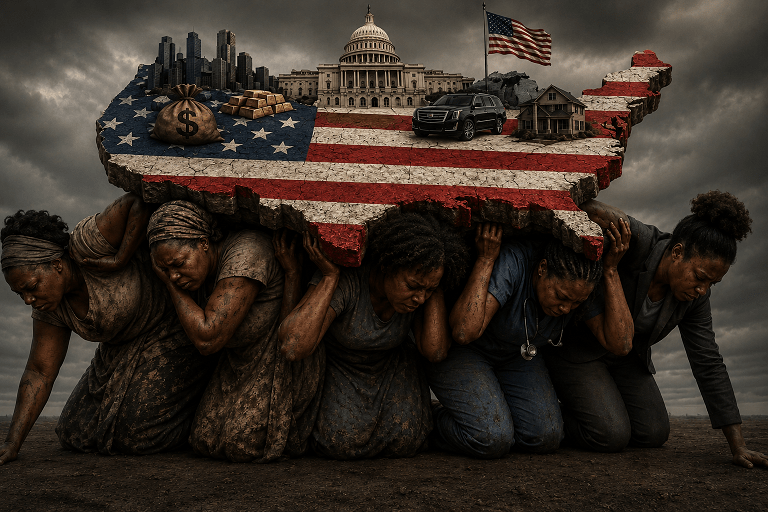
Black women have long been expected to nurture America while America simultaneously withholds full dignity from us. And what makes this history even more painful is the emotional intimacy involved. These are not distant transactions. These women rock white babies to sleep, celebrate first words, first steps, prepare meals, read bedtime stories, soothe nightmares, wipe tears, snot, and asses.
They become trusted figures in the emotional development of children who oftentimes grow up absorbing the same racial animus and systemic biases that diminishes the very women caring for them. How do Black women continue loving the soon to be unlovable under those conditions? How do you pour tenderness into children who may, more than likely, eventually inherit a worldview that sees you as inferior, threatening, or invisible?
Perhaps the answer lies in something both heartbreaking and extraordinary about Black women in America: despite centuries of degradation, exploitation, exclusion, and disrespect, many have refused to surrender their humanity and capacity to love unconditionally.
We all know that babies are not born racist. No infant instinctively hates Black people. Hatred is learned carefully and intentionally over time. It comes through family attitudes, political rhetoric, segregated systems, coded language, media imagery, fear, silence, and societal conditioning.
For a brief and innocent season of life, many white children experience unconditional safety, affection, and nurturing through Black hands before the world begins teaching them racial hierarchy and hate.
That truth sat heavily with me as I walked through the museum with my late sister’s grandchildren, thinking about her boundless capacity to love. She was a hospital executive and registered nurse. She, too, belonged to a long line of Black women who gave of themselves freely to family, work, community, and often to a nation that rarely returned the favor. Her capacity to love the unlovable was so much greater than mine. I can count on one hand, with fingers remaining, the number of white people I can or have called “friend” in my sixty-nine years on the planet.
In the movie, The Help, I am constantly reminded of a nation that never grows tired of exploiting the labor of Black women who are still carrying America’s children and America itself on our hips and our backs.
And if this America truly is the greatest country in the world – the very best the planet has to offer – then Lord knows the world is in desperate need of a better alternative.
Truth Seekers Journal thrives because of readers like you. Join us in sustaining independent voices.
Not much has changed since the days of Jim Crow! Racism is still prevalent but it is not as overt. We still have segregation, just look at our neighborhoods and schools. I am a little confused, was the author surprised that there were black nannies at the Atlanta History museum? Nothing has changed. I live in a predominantly white neighborhood with young 30 year olds. Many mothers do not work and yet they have black nannies taking care of their children during the day. I see older black women walking the kids in our parks and playing grounds which are private only to be used by the residents of the subdivision. I saw some black kids playing in one of our parks and I knew that they did not live in our neighborhood. It was not long before I looked out of my window and saw a police car. Apparently a neighbor had called the police on the black family using our park. We have never dealt with the issue of race and racism in this country. Unfortunately, Trump and his supporters are trying to take us back to the “good” old days.