
By Milton Kirby | Atlanta, GA | July 23, 2026
Every generation has places where movements take shape.
Some begin in churches. Others start in classrooms, neighborhood barbershops, or around kitchen tables where stories are shared long before they are ever written down.
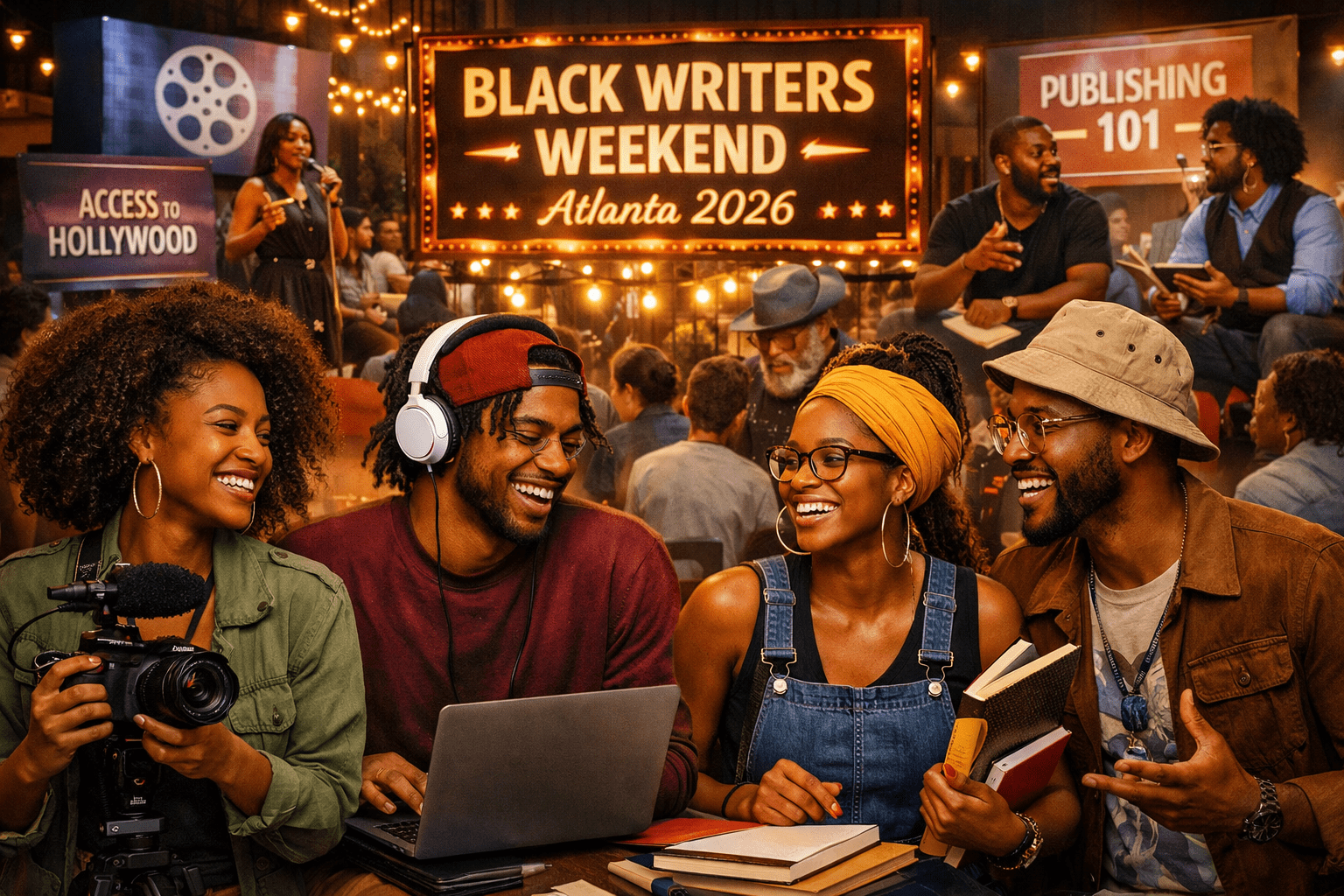
For thousands of Black writers, readers, filmmakers, publishers, and creative entrepreneurs across the country, one of those places has become Black Writers Weekend.
What started nearly two decades ago as a gathering for Black authors has grown into a national movement that celebrates storytelling while helping creatives build careers, expand their audiences, and take greater ownership of their work. After stops this year in Dallas, Newark, Los Angeles, Chicago, and Washington, D.C., the 2026 tour concludes in Atlanta from July 31 through August 2 with three days of conversations, workshops, film screenings, networking, and celebration.
For anyone still wondering whether the event is worth attending, organizers believe the answer lies in understanding that Black Writers Weekend is no longer simply about books.
It is about building the future of Black storytelling.
More Than a Festival
The publishing industry has changed dramatically over the past decade.
Writers today are no longer limited to traditional publishing houses. Independent publishing, digital platforms, podcasts, streaming services, audiobooks, newsletters, and social media have opened new pathways for creative voices to reach audiences directly.
Those opportunities, however, come with new challenges.
Authors must learn marketing, branding, distribution, intellectual property, audience development, and business strategy in addition to mastering the craft of writing.
Black Writers Weekend was designed to help bridge those gaps.
Produced by AAMBC Inc., the nonprofit organization behind the festival, the event has spent 18 seasons creating opportunities for Black creatives to learn from experienced professionals while building relationships that often continue long after the weekend ends.
“BWW is about making sure Black storytelling isn’t treated as a moment, it’s a movement,” said Delphine of Legacy Media.
“After 18 seasons and over 30,000 readers and creatives touched, I see BWW as infrastructure. We’re building the pipeline. The future of Black storytelling depends on us controlling more of our own distribution, our own narratives, and our own platforms.”
Her words capture what many attendees say separates Black Writers Weekend from a traditional literary festival.
It is not simply a place to showcase completed work.
It is a place where careers begin.
Where Stories Meet Opportunity
This year’s Atlanta finale reflects how much the festival has evolved.
The weekend opens Friday at the historic Auburn Avenue Research Library with the Black Writers Weekend Film Festival, featuring more than 20 independent films created by Black filmmakers. The evening concludes with a screening of Dear Black Writers, a documentary exploring the artists and storytellers fueling today’s Black literary movement. Later that evening, poets and spoken-word artists will gather for Open Mic in the Garden at The Darwin Hotel, one of the festival’s most anticipated community traditions.
The focus shifts Saturday and Sunday to the Loudermilk Conference Center, where more than 80 speakers will lead discussions ranging from publishing and digital marketing to filmmaking, branding, entertainment, and entrepreneurship.
Among the featured sessions are the BookFunnel Workshop, designed to help authors expand their readership through digital distribution, the “I Am Creative” conversation with bestselling author Zane and filmmaker Trey Haley, and the Access to Hollywood panel featuring Jonathan Curtiss, Lamont Pete, Imani Nia Robinson, and Lynette Blackwell. Other sessions will explore how attorneys, publicists, talent managers, and financial advisors help creatives protect and grow their brands.
For aspiring writers and filmmakers, the weekend offers something that cannot be downloaded from the internet.
Access.
Beyond Amazon
Delphine believes one of the biggest mistakes new authors make is assuming success begins and ends with publishing a book online.
“The biggest mistake I see debut authors make is thinking distribution is just about getting a listing on Amazon and calling it a day,” she said.
Instead, she encourages writers to build relationships with bookstores, festivals, community organizations, and media outlets that already serve Black readers.
“Distribution isn’t just logistics,” she said. “It’s visibility. You have to be seen and remembered before someone picks up your book in a market where nobody knows your name yet.”
That philosophy explains why Black Writers Weekend has expanded into multiple cities across the country.
Each stop introduces writers to new readers, new collaborators, and new opportunities.
“My advice to new authors is don’t treat a festival stop like a one-off event,” Delphine said. “Treat it like the first domino.”
The Power of Honest Stories
While publishing strategies and marketing workshops are important, organizers never lose sight of why people write in the first place.
Stories change lives.
Asked about memoirs rooted in trauma and resilience, such as Little Miracles of Katrina by M. V. Despenza, Delphine said authenticity remains a writer’s greatest strength.
“Your story doesn’t need to be polished to be powerful,” she said.
She believes readers recognize honesty immediately, especially when writers refuse to sanitize painful experiences.
“Don’t rush the healing to finish the book,” she said. “Let the book carry the healing as it happens.”
For many aspiring writers attending Black Writers Weekend, those words may prove just as valuable as any publishing contract.
Why Community Media Matters
Another recurring theme throughout Black Writers Weekend is the importance of community-centered journalism.
While major media organizations often determine which stories receive national attention, Delphine believes local and independent outlets frequently discover important voices long before they become household names.
“They’re everything,” she said of community media.
“Community-centered outlets don’t wait for permission. They cover us because we matter to them, not because we’re trending.”
That relationship between independent journalism and emerging writers has become an important part of the festival’s identity, helping connect authors with readers who may never encounter their work through traditional publishing channels.
Atlanta’s Growing Literary Legacy
Anyone who attended Black Writers Weekend in Atlanta last year already understands why so many people return.
The 2025 festival brought together bestselling authors, filmmakers, podcasters, publishing professionals, and emerging writers for conversations on everything from world-building and memoir writing to Hollywood opportunities, banned books, and the future of Black storytelling. Those sessions sparked collaborations, mentorships, and professional relationships that extended well beyond the closing ceremony.
This year’s finale aims to build on that momentum.
Saturday evening’s Book Swap Party at Buckhead Art & Gallery will once again invite attendees to exchange books while meeting fellow readers in a relaxed, art-filled setting. Throughout the weekend, informal conversations in hallways, networking events, and community gatherings may prove just as meaningful as the scheduled programming.
Often, the most important story begins after the panel discussion ends.
More Than a Weekend
Black Writers Weekend is not asking people to attend another conference.
It is inviting them into a community built on stories.
Some attendees will leave with signed books.
Others will leave with publishing contacts, business partnerships, or the confidence to finally finish the manuscript sitting on their computer.
Some may discover a new favorite author.
Others may discover their own voice.
That is why Black Writers Weekend has grown from a literary gathering into one of the nation’s most important celebrations of Black creativity.
And for one weekend this summer, that movement comes home to Atlanta.
Support open, independent journalism, your contribution helps us tell the stories that matter most.