
By Milton Kirby | Atlanta, GA | August 18, 2026
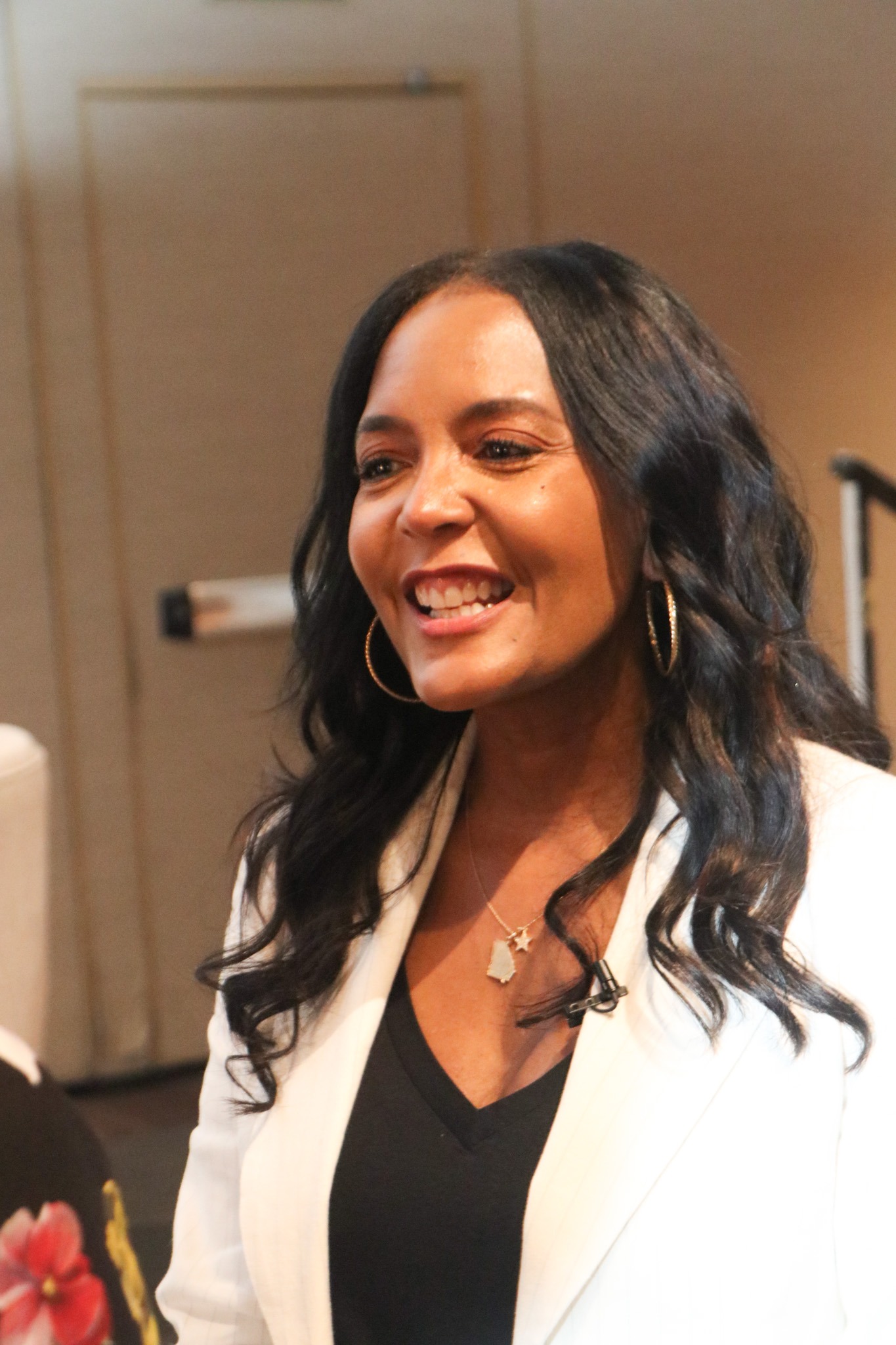
Keisha Lance Bottoms walked onto the stage at the 2026 National Association of Black Journalists Convention Friday looking and sounding like a candidate comfortable with who she is.
The Democratic nominee for governor of Georgia spoke about politics, race, election security and the challenge of campaigning across a state where voters may share concerns even when they do not share political labels.
But some of the most revealing moments came when Bottoms stopped talking about the campaign and talked about herself.
During a fireside chat with Dateline NBC correspondent Blayne Alexander, Bottoms discussed painful chapters of her life that she revealed in her recently published memoir, The Rough Side of the Mountain: A Memoir.
She spoke about her father’s incarceration. Infertility. An eating disorder. Being molested as a child. Therapy.
“I’ve laid it all out,” Bottoms told the audience.
It was a strikingly personal conversation for a candidate less than three months from Election Day.
Yet Bottoms appeared confident and at ease as she moved between the personal and political, making the case that the experiences that shaped her life also shaped the public servant she has become.
From the Back Door to the Front Door
Before Bottoms talked about becoming governor, she talked about her grandfather.
She recalled how he and relatives started a business and came into what the family called “uptown,” now downtown Atlanta, to haul paper and trash from buildings and recycle it.
Eventually, she said, her grandfather bought a truck and traveled along Peachtree Street.
For Bottoms, walking into a downtown Atlanta hotel carries a meaning that goes beyond attending another political event.
She said she thinks about how her grandfather once came downtown to work and how she now has the opportunity to “walk in the front door.”
That history, she said, is always present with her.
Generations later, his granddaughter was sitting onstage at a national gathering of Black journalists as the Democratic nominee for governor of Georgia.
Bottoms did not dwell on the historic nature of her candidacy.
Instead, she pointed to the sacrifices that made it possible.
“My Message Doesn’t Change”
Alexander pressed Bottoms on one of the central questions facing any Democrat seeking statewide office in Georgia: How does a former Atlanta mayor connect with voters far beyond metro Atlanta?
Bottoms rejected the idea that she becomes a different candidate depending on where she campaigns.
“My message doesn’t change,” she said. “The landscape, the geography may be different.”
Whether she is speaking in Macon, Albany, Jesup or Atlanta, Bottoms said voters want many of the same things: strong communities, good schools, access to health care and opportunities for economic prosperity.
The starting points may be different, she said, but the needs often are not.
Bottoms also challenged the notion that she is known only in Atlanta, saying her campaign has been doing the work statewide.
Campaigning outside metro Atlanta can actually make it easier to break through, she argued. In smaller media markets, a gubernatorial candidate’s visit may become one of the biggest local stories of the day.
“You can’t run for a statewide office with fear, or apprehension,” Bottoms said.
She said face-to-face encounters also can break down assumptions. When people sit together one-on-one, they begin to see one another as human beings and sometimes discover that their concerns and beliefs overlap.
For Bottoms, the strategy comes back to authenticity.
“It’s about being who I am, wherever I am, speaking the truth, in whatever room I am in.”
The Rough Side of the Mountain
That theme of authenticity became even more pronounced when Alexander asked what voters might not know about Bottoms.
Her answer was essentially: read the book.
The Rough Side of the Mountain: A Memoir was published in April.
Bottoms told the NABJ audience that she wrote the book while outside public life, after leaving the mayor’s office and the White House, when she had no intention of running for office again.
That mattered.
She suggested she may have been more forthcoming because she was not writing while viewing every revelation through the lens of a future campaign.
Bottoms said she wrote about her father’s incarceration, her infertility, her eating disorder, being molested as a child and her therapy sessions.
The memoir, she explained, was not initially supposed to become the book that ultimately reached stores.
She envisioned something closer to a collection of essays and a love letter to her family, particularly the people and experiences she sometimes felt she had to tuck away as she climbed professionally.
Writing it became cathartic.
The response from readers also surprised her.
Bottoms said people have approached her and shared experiences they had rarely, if ever, discussed publicly. Her willingness to talk about subjects such as incarceration, infertility and childhood sexual abuse opened a door for others to talk about their own lives.
For a gubernatorial candidate, those disclosures carry political risk.
On Friday, Bottoms did not appear burdened by them.
She appeared to have incorporated them into the story she now tells about herself.
Martha’s Vineyard and an Attack From Jackson
The conversation eventually moved directly into the general-election campaign.
Alexander gave Bottoms an opportunity to respond to an attack from Republican nominee Rick Jackson criticizing her travel to Martha’s Vineyard.
Bottoms did not retreat.
She noted Martha’s Vineyard’s long history as a destination for Black families and described it as a place of refuge, community and renewal.
She also connected her ownership of property there to her family’s history and economic progress.
“I find it as a badge of honor that I own land in Martha’s Vineyard and in Georgia,” Bottoms said.
The exchange offered a preview of what Georgians are likely to see much more of before November: Jackson attempting to define Bottoms, and Bottoms trying to prevent him from doing so.
And Jackson has extraordinary resources with which to make that attempt.
The $87 Million Challenge
One subject received surprisingly little examination during the fireside chat: money.
Jackson has committed $87 million to television and digital advertising in the general election after spending more than $100 million of his own money pursuing the Republican nomination.
That financial advantage presents Bottoms with a challenge unlike anything she faced in her campaigns for Atlanta mayor.
It raises a fundamental question:
How does Bottoms prevent Jackson from defining her when he can spend tens of millions of dollars delivering his version of her record to Georgia voters?
Alexander covered considerable territory during the limited conversation, including Bottoms’ personal life, campaigning outside metro Atlanta, Martha’s Vineyard, election security and the state of American democracy.
But the financial disparity between the candidates received little examination.
The issue is particularly significant because the race remains competitive.
A recent Quantus Insights survey of 815 likely Georgia voters, sponsored by the Natural Gas Association of Georgia, put Bottoms at 46.4% and Jackson at 44.9%, with 7.7% undecided.
The poll should be viewed for what it is: one snapshot of the electorate, commissioned by an organization with its own policy interests.
Still, its narrow margin illustrates what is at stake.
If the race remains close, the ability to reach undecided and persuadable voters repeatedly could become decisive.
Jackson can buy an extraordinary amount of that communication.
Bottoms will have to find other ways to compete.
Concerns About Georgia’s Elections
Bottoms also used the NABJ stage to express concern about Georgia’s election system.
Asked whether she believes Georgia’s elections are safe and secure, Bottoms said they are as safe and secure as elections can be in America right now, but she remains concerned about interference and restrictions on voting access.
Her answer quickly moved from concern to strategy.
“We’ve got to show up in the millions,” she said.
Bottoms called for making Election Day a state holiday and expanding early voting opportunities and hours.
Her message was that voters should not wait until Election Day.
Vote early. Vote in large numbers. Create margins large enough that the outcome cannot easily be questioned.
Alexander also asked Bottoms about the possibility of federal intervention surrounding Georgia’s election.
Bottoms said candidates and voters have to be prepared for the unexpected.
She then invoked Atlanta’s civil rights history and argued that Georgia has an opportunity to lead.
Who Does the Governor Work For?
Near the conclusion, Bottoms brought the conversation back to the distinction she wants voters to see between herself and Jackson.
She pointed to her experience as a judge, Atlanta City Council member, mayor and senior White House adviser.
Then she described the people she wants to represent.
The single mother working in the city.
The father trying to pay his rent.
The person struggling to pay for a parent’s medical treatment.
People who need someone in government to speak for them.
Jackson, Bottoms argued, can focus on distractions.
She wants to focus on people’s lives.
It was the campaign message she carried throughout the conversation: biography, hardship and public service presented not as separate chapters, but as parts of the same story.
Confidence Is Not the Question
Bottoms did not look like a candidate searching for her identity Friday.
She appeared confident.
She was willing to discuss the painful parts of her childhood, her family and deeply personal experiences. She defended her success rather than apologizing for it. And she insisted that she can walk into communities across Georgia without changing who she is or what she believes.
The question confronting her campaign is whether that confidence can translate into enough votes to win statewide.
Jackson has the money to make his case again and again.
Bottoms has a different proposition.
She is asking Georgians to look at the whole of her life, including the rough side of the mountain, and decide whether the journey qualifies her to lead the state.
Between now and November, she will have to make sure enough of them hear that story.
Related articles
Support open, independent journalism. Your contribution helps us tell the stories that matter most.