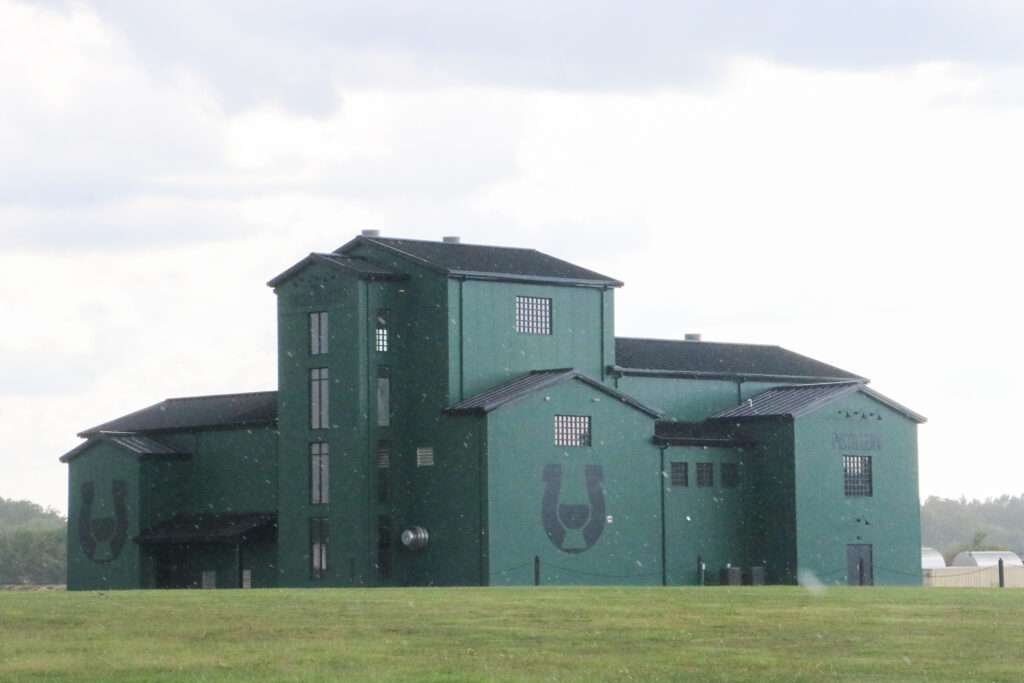
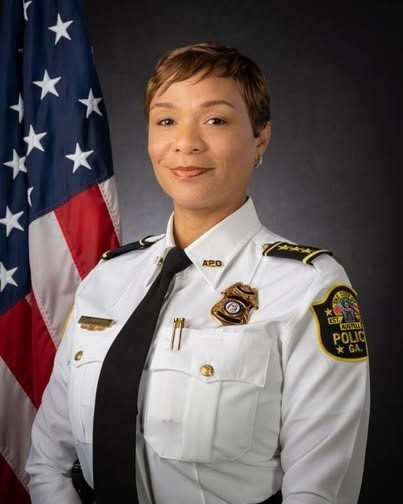
Court filings show payroll now stabilized under Genesis Global as Receiver Phillip G. Young Jr. manages costs, consultants, and $2.5 million in immediate receivership expenses at Uncle Nearest.
By Milton Kirby | Shelbyville, TN | October 5, 2025
Uncle Nearest can be reorganized as a going concern and does not need a fire-sale liquidation, according to the first quarterly report from court-appointed receiver Phillip G. Young Jr.
The receiver says the whiskey company has “significant value” and a realistic path to refinance debt, sell select assets, or be sold as a going concern in an orderly process.
Why This Matters
The report is the first public, court-filed snapshot since the receivership began on August 22. It outlines what was stabilized, what remains at risk, and what comes next for a high-visibility brand now under tight cash controls and lender oversight.
The receiver laid out a short timeline. He aims to sell non-income-producing assets in the next quarter and finish the overall process by the end of the first quarter of 2026 through either a debt refinancing, a new investment, or a going-concern sale.
Key asset moves include:
Cognac Project Assets (France): A château, vineyards, and intellectual property related to a planned cognac line. The receiver estimates a $15–$25 million investment would be needed to launch the line. The estate lacks that capacity now, so he intends to sell these assets. One offer is in hand, with additional interest reported.
Other Properties: Non-income real estate in Martha’s Vineyard, Massachusetts, and several parcels in Bedford County, Tennessee, are under review for potential sale to reduce debt.
Payroll and the Role of Genesis Global
One of Young’s first priorities was payroll. When he arrived, the company’s employee pay system faced a shortfall. Payroll has since been stabilized under Genesis Global, a Professional Employer Organization (PEO) that handles payroll, benefits, tax filings, and HR services for the company.
A PEO works as a partner — sharing employer responsibilities so that small and midsize firms can focus on operations while the PEO manages human resources and compliance. Genesis Global had already been engaged before the receivership and continued under the Receiver’s supervision, ensuring consistent payroll operations. Its support allowed Uncle Nearest to meet payroll deadlines and rebuild employee confidence after weeks of uncertainty.
Cash, Controls, and a 13-Week Budget
The receiver and his advisors built a rolling 13-week budget and reached a forbearance deal with Farm Credit Mid America, the senior lender, to fund immediate needs. The plan included about $2.5 million in one-time cash: roughly $1.0 million to clear urgent payables and $1.5 million for professional fees. Excluding those extraordinary items, the budget was balanced.
Collections and Spending in the Period
Category
Amount (USD)
% of Total
Collections
Operating Receipts
$1,451,747
46 %
Farm Credit Support
$1,700,000
54 %
Total Collections
$3,151,747
100 %
Expenditures
Operating Disbursements
$2,081,796
84 %
Professional Services
$405,370
16 %
Total Expenditures
$2,487,166
100 %
Budget for Period
$3,206,546
—
Variance (Under Budget)
$719,380
—
All bank balances were moved into receiver-controlled accounts. Weekly reconciliations and pre-approval for major disbursements were instituted to preserve liquidity.
Breakdown of Professional Fees
Vendor / Service Category
Amount (USD)
% of Total Fees
Legal Counsel (Bass, Berry & Sims PLC)**
$210,000
52 %
Financial Consultants (Crowe LLP)**
$105,000
26 %
Operational Advisory and HR Support (Genesis Global)**
$55,000
14 %
Receiver Administrative and Compliance Costs
$35,370
8 %
Total Professional Fees
$405,370
100 %
Figures based on allocations detailed in the Receiver’s First Quarterly Report and estimated vendor summaries.
Operations: Trims, Product Flow, and Distributors
To cut costs, the receiver reduced headcount by 12 positions (13%), with further efficiency reviews underway. The team also reset expectations with distributors and vendors. Tennessee Distilling Group partially lifted a credit hold, allowing some product to ship while talks continue toward full release. New product releases are anticipated next quarter.
Photo by Milton Kirby Uncle Nearest
Records, Cap Table, and Internal Reviews
The report flags gaps in historical records and internal controls:
Lost Data: Many pre-2024 financial records were allegedly erased by a former employee. Recovery efforts are underway.
Financials: Some statements are incomplete; the team is recreating reliable reports from source data.
Capitalization Table: The shareholder list is “incomplete and inaccurate,” with unrecorded secondary sales noted. Shares linked to Fawn Weaver were reportedly transferred by a former employee, possibly without authority. The receiver is contacting shareholders to reconcile the cap table.
Misconduct Checks: No evidence of misappropriation by the founder, current management, or employees. Allegations against a former employee remain under investigation.
Taxes and Compliance
Payroll has stabilized under Genesis Global after the initial shortfall. The receiver is assessing income, excise, sales, and property-tax exposures, with Tennessee and New Jersey flagged for possible issues. Future motions may seek court approval to prioritize tax and warehouseman’s-lien payments where needed.
International Steps
French counsel is translating and domesticating the U.S. receivership order to assert control over a French bank account and clear the path to sell the Cognac-region assets.
Timeline
The receiver aims to close the process by late Q1 2026 through refinancing, new equity, or a going-concern sale.
By Milton Kirby | Washington, D.C. | October 2, 2025
Fifty-eight years ago today, the marble halls of the U.S. Supreme Court bore witness to a moment that reshaped American history. On October 2, 1967, Thurgood Marshall raised his right hand and swore the oath of office, becoming the first African American justice to serve on the nation’s highest court.
For many watching, the image was more than ceremonial. It was the realization of a dream born from centuries of struggle — a Black man ascending to the bench of an institution that had once sanctioned slavery, segregation, and the denial of equal rights.
President Lyndon B. Johnson, who nominated Marshall just months earlier, called it “the right man, at the right time, in the right place.” In Marshall, America had found a justice who carried the Constitution not only in his mind but etched deeply into his lived experience.
From Baltimore Streets to Legal Scholar
Born in Baltimore on July 2, 1908, Marshall’s journey to the Supreme Court began in a household that valued both discipline and education. His father, William, a railroad porter, often debated court cases at the dinner table. His mother, Norma, an elementary school teacher, nurtured a love of learning.
As a mischievous schoolboy, Marshall was once punished by being forced to memorize the entire U.S. Constitution. The lesson stuck. Decades later, he joked he could still recite it word for word — but it also planted the seed of his life’s mission: to hold America accountable to its own promises.
Marshall attended Lincoln University in Pennsylvania, graduating in 1930. He then enrolled at Howard University School of Law, where he studied under Charles Hamilton Houston, a brilliant strategist who believed lawyers must serve as “social engineers.” Houston instilled in Marshall a conviction that the courtroom could be a battlefield against injustice.
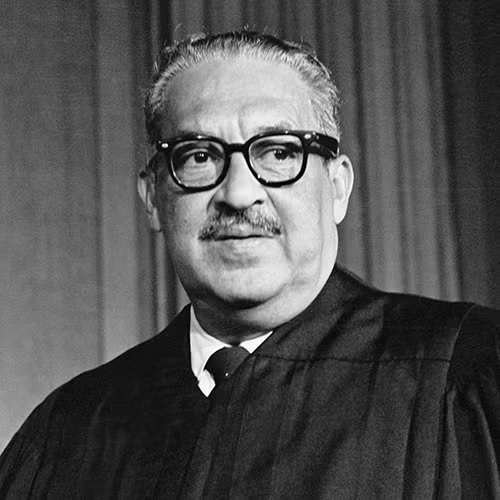
Thurgood Marshall – Courtesy Britannica
“Mr. Civil Rights”
By the mid-1930s, Marshall had joined the NAACP and quickly rose to become its chief counsel. His legal work became the backbone of the civil rights movement. Over the course of his career, Marshall argued 32 cases before the Supreme Court — and won 29 of them.
His most famous victory came in Brown v. Board of Education (1954), where he persuaded the Court to strike down segregation in public schools. The unanimous decision overturned the Plessy v. Ferguson “separate but equal” doctrine and became a cornerstone of the modern civil rights era.
But Brown was just one milestone. In Smith v. Allwright (1944), Marshall dismantled the “white primary” system that excluded Black voters. In Sweatt v. Painter (1950), he challenged unequal law school facilities, a precursor to broader desegregation. Earlier, in Chambers v. Florida (1940), he defended Black men coerced into confessing murder.
Through relentless litigation, Marshall became known as “Mr. Civil Rights” — a lawyer who used the Constitution as both shield and sword against Jim Crow.
“In recognizing the humanity of our fellow beings,” Marshall once said, “we pay ourselves the highest tribute.”
A Judge and Solicitor General
Marshall’s impact extended beyond the NAACP. In 1961, President John F. Kennedy appointed him to the U.S. Court of Appeals for the Second Circuit. Four years later, President Johnson tapped him as the nation’s first Black Solicitor General — the government’s top lawyer before the Supreme Court.
In that role, Marshall argued 19 cases and won 14. His victories ranged from labor rights to antitrust law, further cementing his reputation as one of the era’s most formidable legal minds.
Johnson saw Marshall’s elevation to the Supreme Court as a natural progression. “I believe he has earned that appointment. I believe he deserves it,” the president declared when he announced the nomination in June 1967.
A Historic Confirmation
Marshall’s confirmation hearings before the Senate Judiciary Committee were contentious. Some senators pressed him aggressively on criminal justice issues, while Southern opponents masked their discomfort with questions about his qualifications.
But Marshall’s calm, thorough answers won the day. On August 30, 1967, the Senate confirmed him by a vote of 69 to 11. Two months later, he was sworn in — breaking a barrier that had stood since the Court’s founding in 1789.
For millions of Black Americans, Marshall’s appointment symbolized progress that once seemed unthinkable. Here was a man who had fought segregation in classrooms now seated in the chamber that set the law of the land.
“A child born to a Black mother in a state like Mississippi,” Marshall reflected, “has exactly the same rights as a white baby born to the wealthiest person in the United States. That is the principle I fought for.”
On the Bench: A Voice for the Marginalized
During his 24 years on the Court, Marshall consistently championed the rights of individuals, the poor, and the marginalized. He opposed the death penalty, arguing it was applied disproportionately against minorities and the poor.
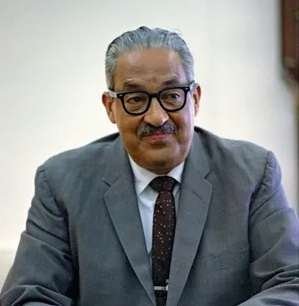
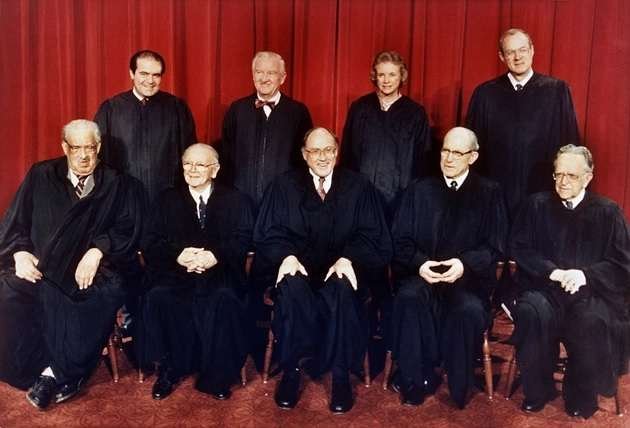
US Supreme Court – April 1988 – AP Photo
In Furman v. Georgia (1972), Marshall sided with the majority in striking down existing death penalty statutes. In later dissents, he argued that the death penalty itself was cruel and unusual punishment.
Marshall was also a strong defender of affirmative action. In Regents of the University of California v. Bakke (1978), he argued that remedies for centuries of discrimination were both constitutional and morally necessary.
His guiding principle was simple yet profound: “Equal means getting the same thing, at the same time, and in the same place.”
Even as the Court grew more conservative in the 1970s and 1980s, Marshall’s voice remained steady. Often in dissent, he nevertheless articulated a vision of justice rooted in fairness and equality.
Retirement and Passing the Torch
Marshall retired in 1991, citing declining health. His departure marked the end of an era. President George H.W. Bush appointed Clarence Thomas, a conservative jurist, as his successor — a decision that underscored the sharp ideological shift of the Court.
Marshall passed away on January 24, 1993, at age 84. He was laid to rest in Arlington National Cemetery, honored as both a civil rights giant and a Supreme Court justice.
Legacy and Relevance Today
Marshall’s legacy reverberates through every corner of American law. Schools, courthouses, and even Baltimore/Washington International Airport bear his name. His career stands as proof that the law, when wielded with courage, can dismantle walls of oppression.
But Marshall himself was clear-eyed about the limits of the legal system. “The legal system can force open doors and sometimes even knock down walls,” he once said, “but it cannot build bridges. That job belongs to you and me.”
Today, as debates rage over voting rights, affirmative action, and racial equity, Marshall’s words carry renewed urgency. His belief in the Constitution as a “living document” — one meant to expand justice rather than freeze it in time — is echoed in current struggles to define equality in America.
Closing Reflection
October 2, 1967, was not just the day a man took an oath. It was the day a nation took a step toward becoming what its founding documents had always promised.
Thurgood Marshall’s life was proof that the Constitution, in the hands of those brave enough to demand its full measure, could be both weapon and witness for justice.
More than half a century later, his shadow stretches across courtrooms, classrooms, and communities. The boy who memorized the Constitution as punishment grew into the justice who forced the country to live up to it.
And in doing so, he gave America not only its first Black justice but also its enduring conscience.
Please consider supporting open, independent journalism – no contribution is too small!
Uncle Nearest faces receivership and $108M debt, but CEO Fawn Weaver rallies support with faith, leadership, and booming sales in Illinois, Florida, Georgia, Maryland, and Alaska.
By Milton Kirby | Shelbyville, TN | September 21, 2025
Uncle Nearest Premium Whiskey, a thriving brand valued at $1.1 billion in 2024 by Forbes and other sources and recognized as the fastest-growing Black-owned spirits brand in the nation, is now embroiled in a federal court battle. A receivership order, linked to a staggering $108 million debt, has handed over the reins of the company’s finances and operations to external parties. This pivotal moment could potentially reshape one of the most celebrated American whiskey stories in recent history.
How the Case Started
On July 28, 2025, Farm Credit Mid-America filed suit, alleging that Uncle Nearest, Nearest Green Distillery, and founders Fawn and Keith Weaver defaulted on over $100 million in loans. The lender accused the company of:
Overstating the value of whiskey barrels used as collateral by $21–24 million.
Failing to keep a $1.5 million cash balance required under loan agreements.
Falling behind on payments and breaching covenants on net worth and net income.
Selling or discounting future revenues without proper notice.
Photo by Milton Kirby
Farm Credit also claimed “insufficient internal financial controls” and said defaults date back to 2023. Still, the lender extended additional credit at the time, “in reliance upon Uncle Nearest’s representations as to its success and strategic growth.”
Uncle Nearest Pushes Back
The Weavers argue the picture is more complicated. In sworn filings, Fawn Weaver declared that former CFO Mike Senzaki “was the sole point of contact responsible for inventory reporting and for signing off on all funding requests tied to those barrels.” She maintains that discrepancies surfaced in early 2024, months before Farm Credit sued.
On the Martha’s Vineyard home purchased through UN House MV LLC, Uncle Nearest submitted internal emails showing that Farm Credit executives “were not only aware of the property but also attended an inaugural Gospel Brunch event at the home.” The filing added, “These were not covert maneuvers.”
Weaver has also spoken directly to supporters. In a widely shared Instagram video, she declared:
“Don’t believe the fake news. Some reports claim I no longer own Uncle Nearest and that I’m not running it. Let me be clear. I built this company. I run this company. And my leadership team, who have all been with me for 6 to 8 years, are right here building alongside me. Our team remains unshaken and unmoved.”
Growth & Market Momentum
On August 16, 2025—two days after the court appointed a receiver—Fawn Weaver took to Instagram to rally customers and partners. She emphasized that, despite legal pressures, Uncle Nearest continues to expand in key markets “in a year where spirits are down.” This continued growth and market momentum is a testament to the company’s resilience and a reason for optimism about Uncle Nearest’s future
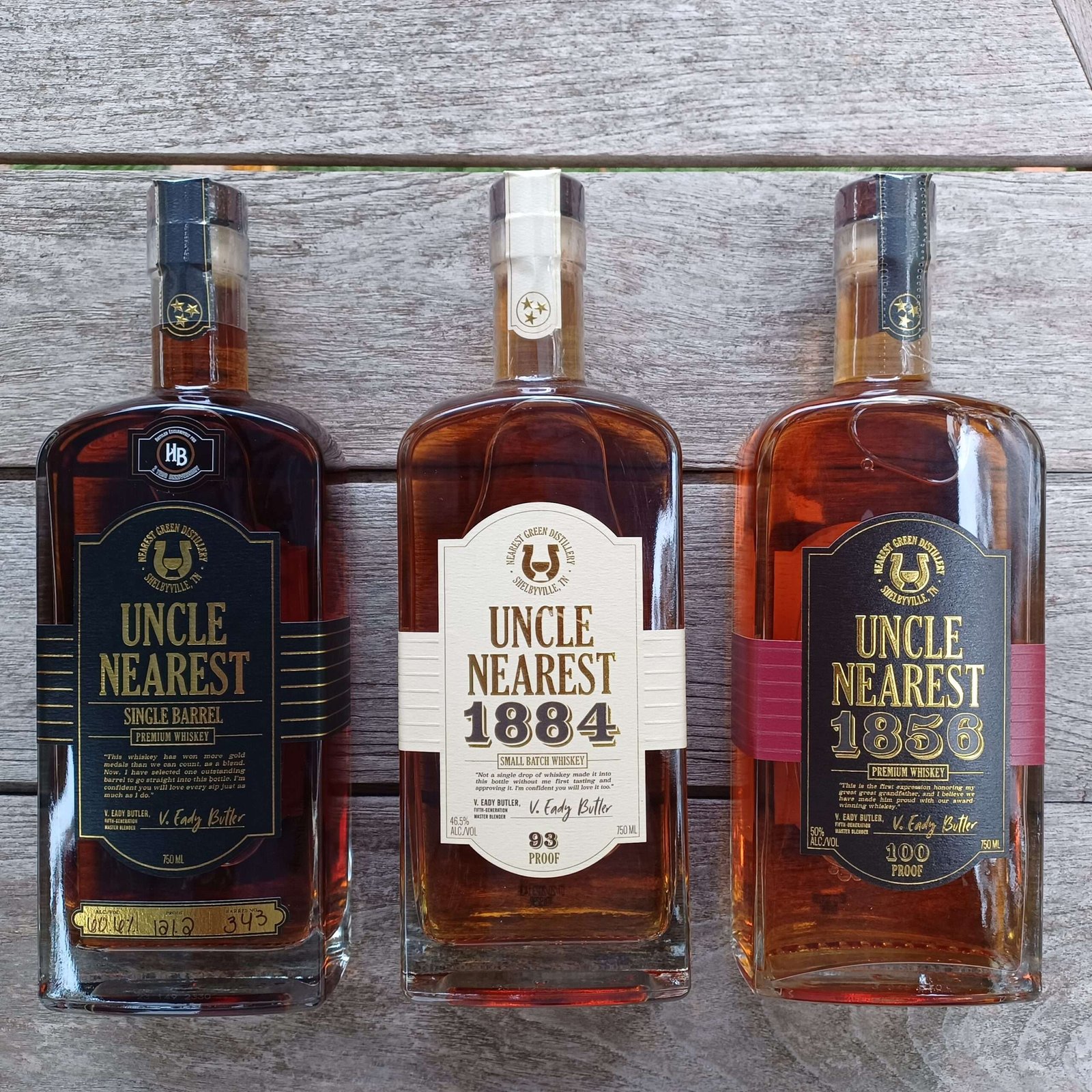
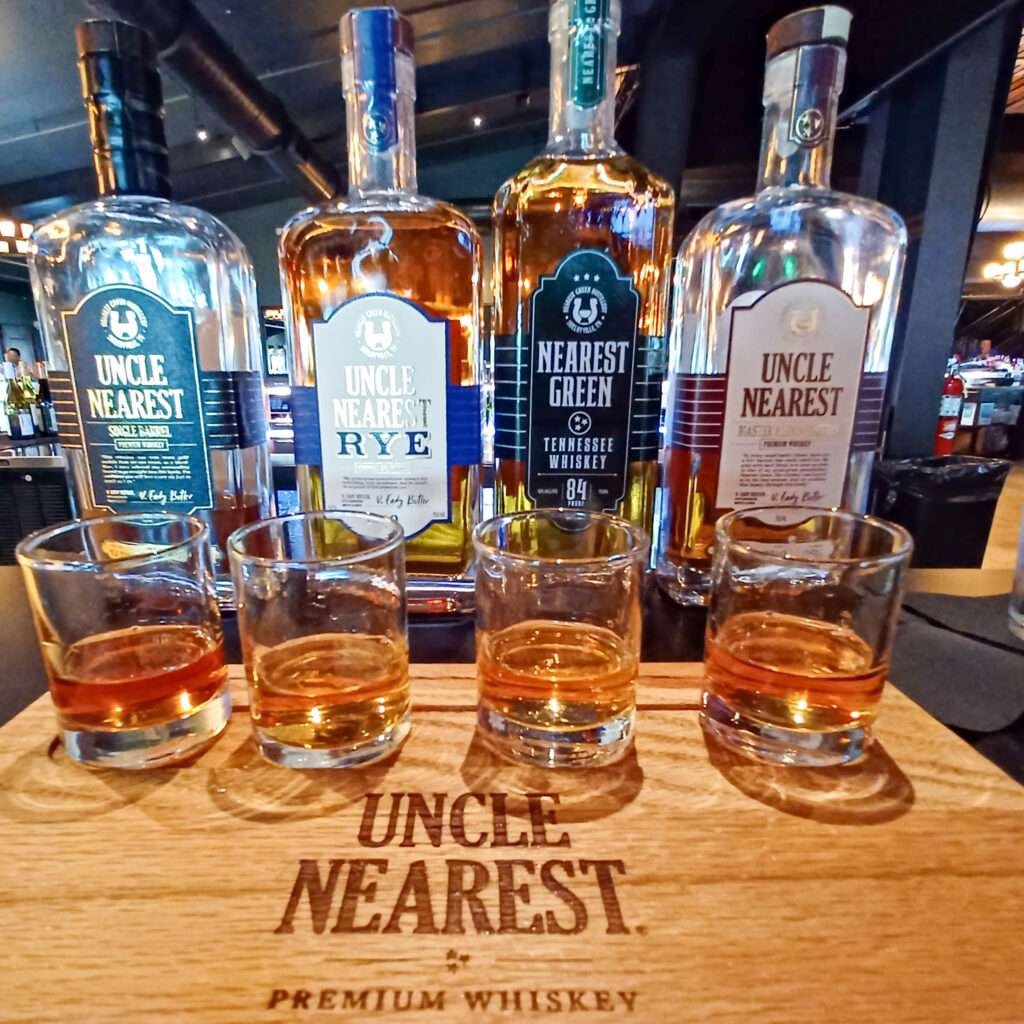
Photo by Milton Kirby – Uncle Nearest Flight
She pointed to sales surges across the country, noting:
Illinois: +216% this month, +21% year-to-date.
Florida: +92% this month, +24% year-to-date.
Georgia: +31% this month, +53% year-to-date..
Maryland: +30% this month, +49% year-to-date.
Alaska: +423% this month, +44% year-to-date.
South Carolina: +48% this month, +53% year-to-date.
Texas: +44% this month, +34% year-to-date.
New Mexico: +32% this month, +22% year-to-date.
Her message was pointed:
“Don’t forget, keep clearing them out, leave no doubt, send a loud message that you are behind this brand and the team that built it.”
The Court’s Decision
On August 14, 2025, U.S. District Judge Charles E. Atchley Jr. appointed Phillip G. Young Jr. as receiver, finding that receivership was “necessary under the circumstances” due to questions of solvency, inadequate collateral, and ongoing defaults.
The order effectively shifts day-to-day financial and operational control to the receiver, while leaving branding and public-facing work partially in the hands of Uncle Nearest leadership.
Money In and Money Out
Records show that Uncle Nearest made large payments before the lawsuit: $9 million in 2024 and $7.5 million earlier this year. Yet Farm Credit says those payments did not cure defaults or fix repeated covenant breaches.
The dispute over barrel values is especially critical. Farm Credit claims the inventory overstatement inflated its lending exposure. Uncle Nearest insists the problems trace back to one former executive.
Assets in Question
The receivership may extend beyond the distillery and barrels. The receiver has asked the court to clarify whether other Weaver-connected entities should be pulled in, including:
Uncle Nearest Real Estate Holdings LLC
Shelbyville Barrel House BBQ LLC
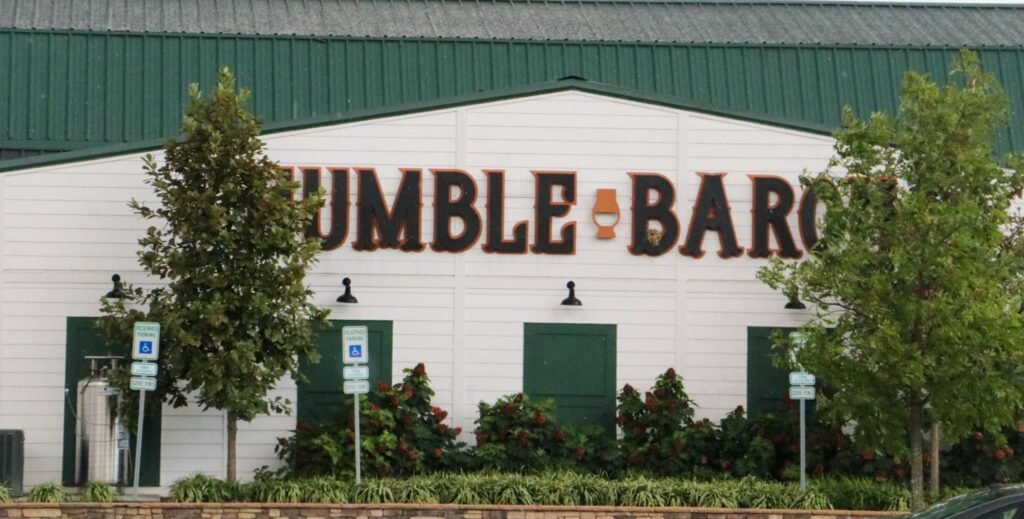
Humble Baron Inc.
Grant Sidney Inc.
Uncle Nearest Spurs VI
Quill and Cask Owner
Additional law firms are also reviewing potential assets in Massachusetts and France.
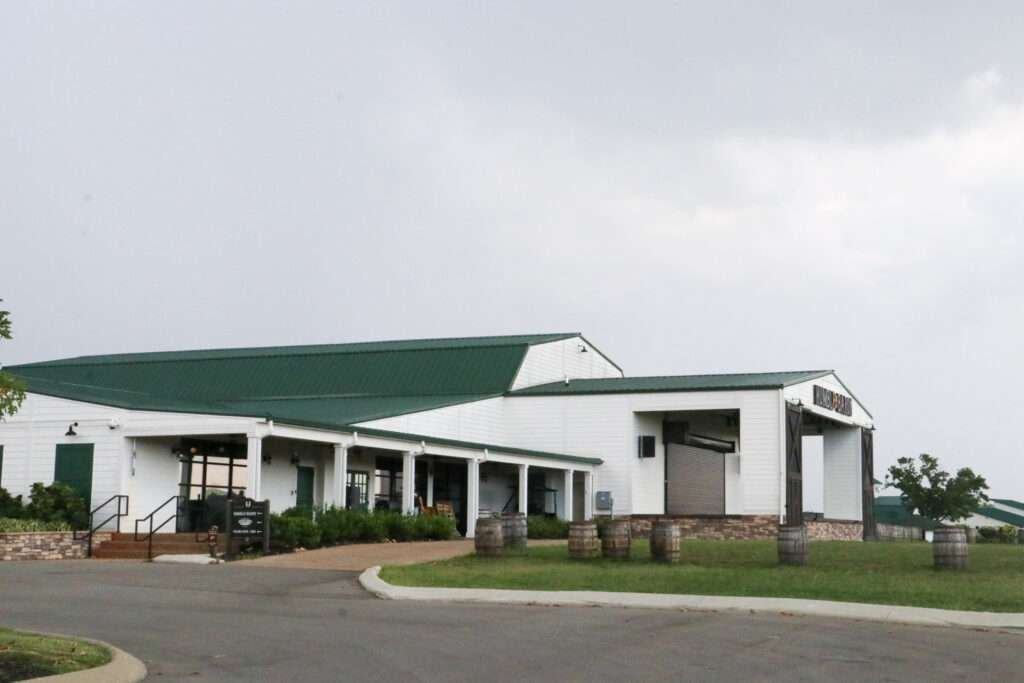
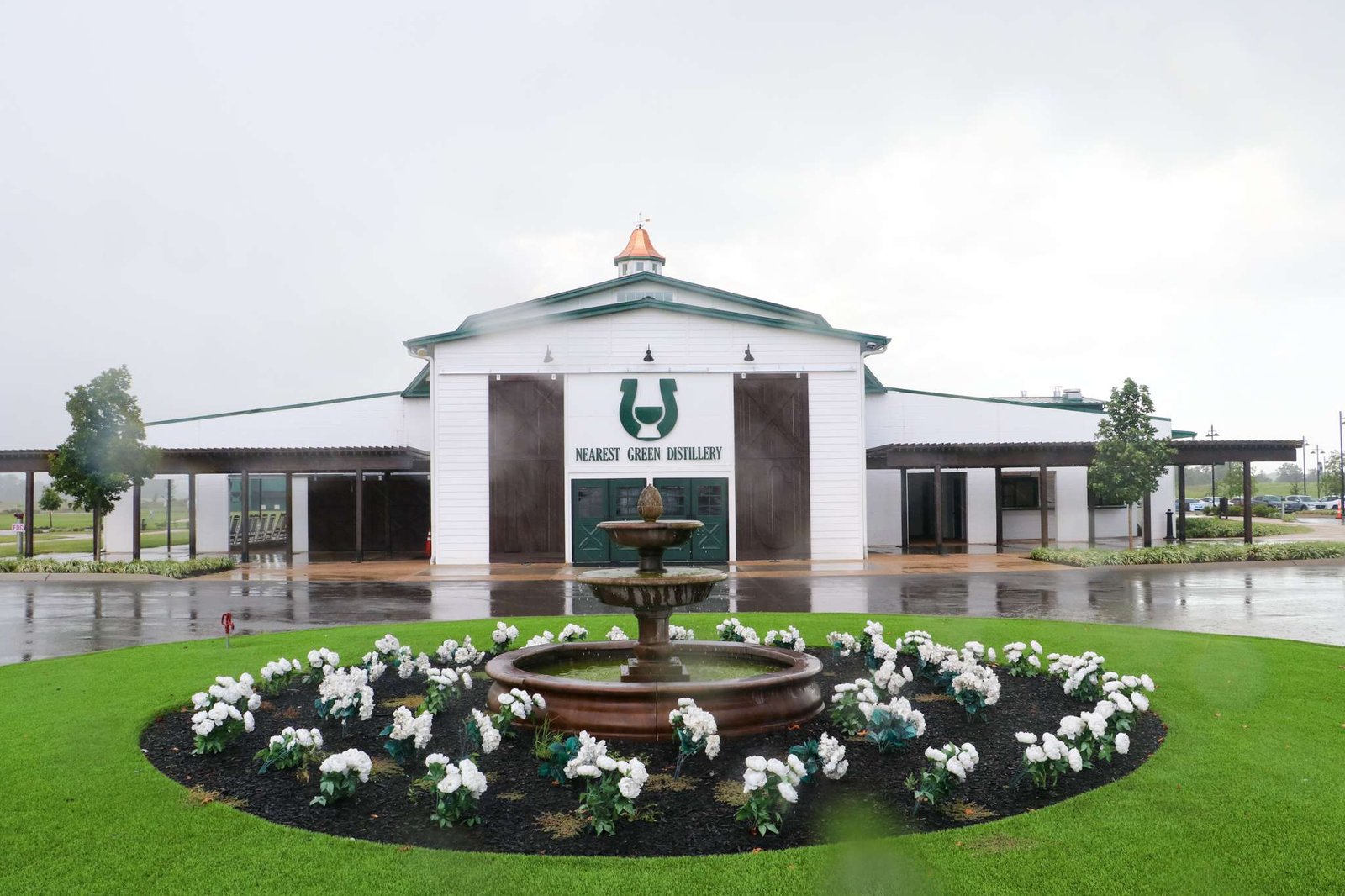
Photo by Milton Kirby – Uncle Nearest Horse Barn
Costs of Receivership
The Financial Impact of Receivership oversight comes at a cost. Young has already hired multiple consulting and legal teams to stabilize operations. These include financial consultants, operational managers, and attorneys specializing in alcohol law.
While the exact fees have not been disclosed in public filings, industry observers note that receivership and professional services can be expensive. For a company already under heavy debt, these additional expenses could create new pressure on cash flow and raise the risk of bankruptcy if revenue cannot keep pace.
Local Impact
The distillery in Shelbyville has become a destination in its own right. Reports show that the site attracted 5,000 to 8,000 visitors every weekend in 2023. The company claims it ranked as the seventh-most visited distillery in the world among its peers. This local economic impact is a testament to Uncle Nearest’s importance to its community and the connections it fosters.
Tourism tied to whiskey is a growing sector in Tennessee, part of the Tennessee Whiskey Trail that draws travelers from across the U.S. and abroad. For Shelbyville, the ripple effects include job opportunities, tourism, and spending at local hotels and restaurants.
How the receivership affects visitor traffic and local suppliers remains unclear, but the stakes are high.
A “People’s CEO” Message
Weaver has leaned into her identity as what she calls the “People’s CEO.” She told followers:
“Keep clearing the shelves. Every bottle you move tells our distributors and partners the same thing. We’ve built one of the strongest and most resilient brands in American history.”
“From the start, I’ve shared the ups and downs of building Uncle Nearest, that transparency is a part of my calling. That is what built one of the strongest brand communities in American history.
That’s why they call me the People’s CEO — because I don’t just show the gloss, I show the grind, the grit, and the gunk.”
She also reminded entrepreneurs of the long road:
“Entrepreneurialism will give you a hundred reasons a day to quit, but strong leadership doesn’t panic. It keeps a steady hand and moves forward.”
What to Watch
The receiver’s first quarterly report, due October 1, 2025, which should reveal cash flow, solvency, and collateral status.
Whether additional Weaver-linked LLCs will be pulled into the receivership.
Possible legal action against the former CFO, or counterclaims from Uncle Nearest.
The impact of consultant and legal fees on the company’s ability to restructure debt.
Continued sales growth in markets like Illinois, Florida, Georgia, Maryland, and Alaska.
A Story Still Unfolding
“What the enemy meant for evil? God meant for good,” Weaver told her audience. That note of faith and defiance now hangs over the courtroom battles and boardroom decisions.
Uncle Nearest’s future is tied to the courts, consultants, and creditors as much as to its whiskey barrels and brand story. The next reports, hearings, and filings will determine whether this is a path toward restructuring or toward deeper financial trouble.
For Shelbyville, for whiskey fans, and for those invested in the legacy of Nearest Green, this is a story to keep watching.
North Carolina A&T sets a record with 15,275 students, reinforcing its role as America’s largest HBCU and a cultural, economic, and alumni powerhouse worldwide.
By Milton Kirby | Greensboro, NC | September 17, 2025
Enrollment Growth
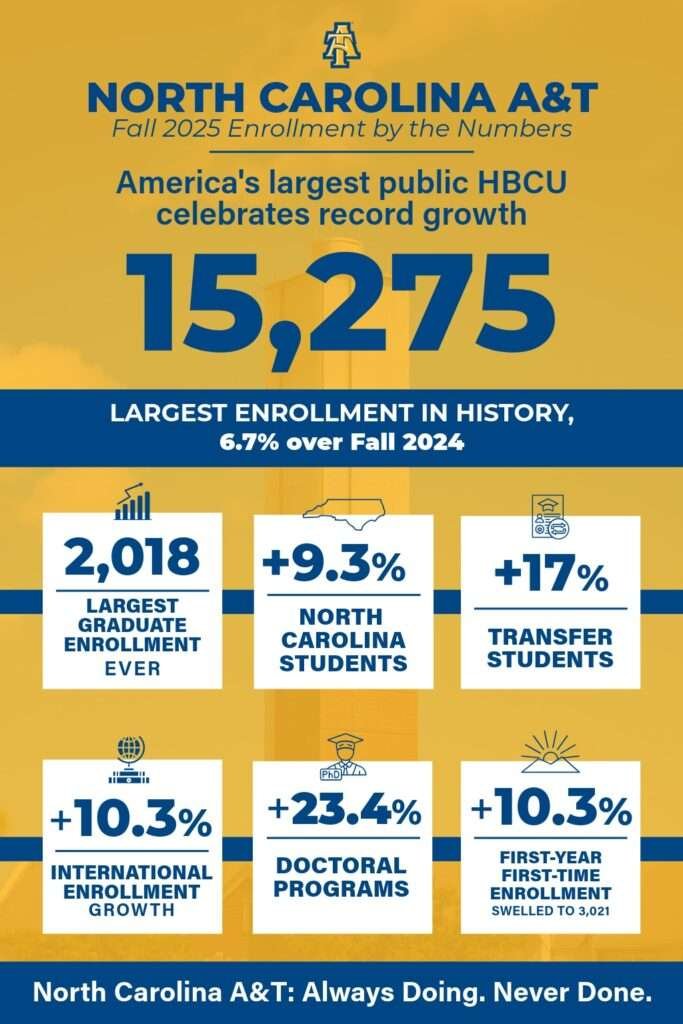
North Carolina Agricultural and Technical State University has once again made history. This fall, the Greensboro-based institution surpassed the 15,000-student mark for the first time, enrolling 15,275 students, a nearly 1,000-student increase over last year. That jump of 6.7% represents the single most significant one-year gain in A&T’s long history.
For the 12th consecutive year, A&T holds the title of the largest public historically Black college or university (HBCU) in the nation. And for the fourth year in a row, it stands as the largest HBCU that America has ever produced.
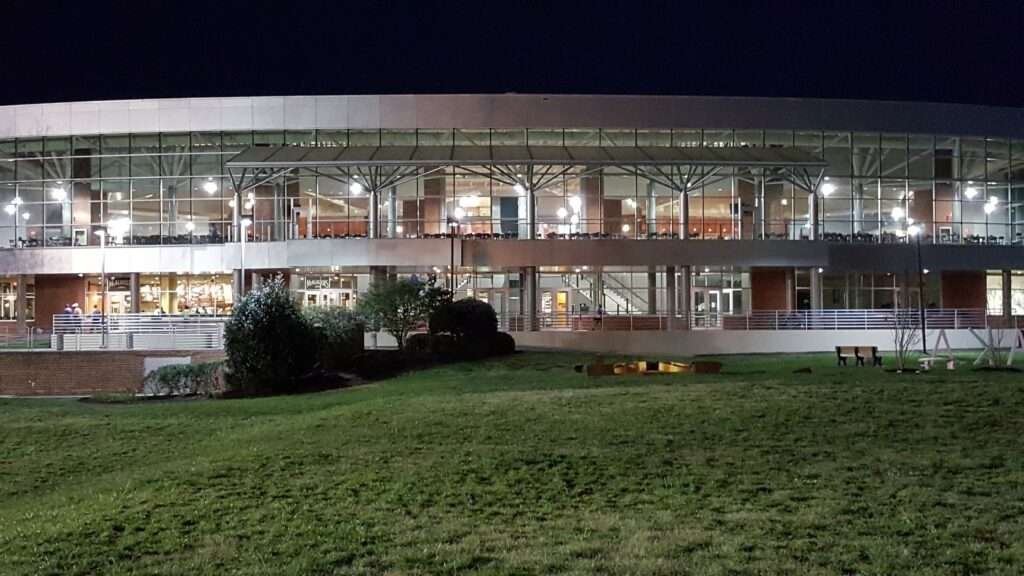
Photo by Milton Kirby NC A&T Williams Cafeteria
“The 2025-26 student body reaffirms our commitment to the people of North Carolina, our national appeal and impact as an exponential, doctoral research HBCU, and the promise that North Carolina A&T holds for students around the world,” said Chancellor James R. Martin II. “We embrace the opportunity to prepare them for a world undergoing seismic knowledge and technology shifts and to guide their development as individuals, ready for lives of achievement and meaning.”
This surge not only reflects national interest in HBCUs but also the powerful draw of A&T’s academic programs, competitive outcomes, and a cultural experience deeply rooted in community and legacy.
Academic Excellence and Student Profile
The university welcomed an entering class of 3,021 first-year students this fall. Their academic credentials tell a story of rising standards and rising demand. The average GPA for the entering class stands at 3.7, while out-of-state freshmen arrived with an impressive 3.93 average GPA. Students came from 36 states plus Washington, D.C., further evidence of A&T’s reach.
NC A&T Enrollment Stats
Once enrolled, students can look forward to opportunities that rival — and often surpass — those of much larger and more established institutions. A&T hosts some of the largest career fairs in America, connecting students with leading employers. Ten years after graduation, an A&T degree pays off. Forbes reports that bachelor’s degree earners from the university enjoy a median salary of $112,000 — second in the University of North Carolina system.
Graduate and Transfer Expansion
This year also marked a watershed moment for graduate education at A&T. For the first time in its history, the Graduate College enrolled more than 2,000 students. The headcount of 2,018 reflects 11.2% growth over last year. Within that, doctoral enrollment surged to 702 students, a 23.4% increase.
The university’s expansion of new master’s and doctoral programs over the past five years is paying clear dividends, both in enrollment and in advancing A&T’s reputation as a research institution.
Transfer students also added to the momentum. 814 new transfers enrolled this fall, a 17% increase. As A&T’s freshman admissions become more competitive, pathways through community colleges and other universities have become vital. These transfers strengthen the student body and underscore A&T’s role as a welcoming, upward-mobility institution.
The university also posted its best-ever freshman-to-sophomore retention rate: 81%. That metric shows more students are not only enrolling but staying and succeeding at A&T.
International and Geographic Reach
Unlike many universities grappling with declining international enrollment, A&T’s global reach is growing. The university enrolled nearly 1,000 international students this fall, a 10.3% increase from last year. Nearly half hail from African nations, underscoring A&T’s global appeal and connections to the African diaspora.
Geographic diversity is also striking. Students come from 97 of North Carolina’s 100 counties, 43 states, and 103 foreign nations. That breadth of representation ensures A&T’s classrooms reflect not just the state’s demographics but also the wider world.
“As interest in A&T continues to grow, our team of enrollment professionals remains dedicated to finding the best and brightest students from North Carolina and beyond for the class of 2030,” said Joseph Montgomery, associate vice provost for Enrollment Management. “We will continue to review all applicants carefully, intentionally, and through a comprehensive, holistic process that aims to identify students who will excel at A&T and become future leaders.”
Economic Impact on Greensboro and North Carolina
The enrollment milestone is not just a number on a spreadsheet; it represents a powerful economic engine for Greensboro, Guilford County, and the state of North Carolina. With over 15,000 students, 2,600 degrees awarded annually, and 65,000 living alumni, A&T stands as one of the region’s most significant contributors to workforce development.
The university’s College of Engineering produces more Black engineers than any other campus in America. Its College of Agricultural and Environmental Sciences leads in producing African American agriculture graduates. Nursing, kinesiology, education, and business programs feed directly into critical industries across the state.
The local impact is also visible during signature cultural moments like Homecoming, famously dubbed “The Greatest Homecoming on Earth” (GHOE). In 2024, GHOE drew over 130,000 attendees, with an estimated $11.3 million economic impact on the Greensboro area. Hotels, restaurants, transportation, and small businesses feel the surge. For many, A&T Homecoming is both a cultural anchor and a financial lifeline.
Daily, students pump dollars into housing, food, and retail. Faculty and staff add stability to Greensboro’s middle class. And A&T’s growing research enterprise — over $78 million annually in academic and scientific research — fuels partnerships with industry and government.
Cultural Significance and the Aggie Spirit
A&T is more than a university. It is a cultural force rooted in history, pride, and resilience. Founded in 1891 as the Agricultural and Mechanical College for the Colored Race, A&T was established under the Morrill Act to provide educational opportunities to people of color who were excluded from other land-grant institutions.
That mission has never faded. From the A&T Four — Ezell Blair (Jibreel Khazan), Joseph McNeil, Franklin McCain, and David Richmond — who ignited the 1960 Greensboro sit-ins, to today’s graduates entering fields in technology, medicine, and public service, Aggies have always stood at the forefront of change.
The phrase “Aggie Pride” is more than a chant at football games. It embodies a community ethos — that success is shared, and that each student carries the hopes of those who came before.
Alumni Legacy and Global Footprint
The university’s alumni footprint stretches far beyond North Carolina. More than 65,000 Aggies are active in business, science, politics, the arts, and community service worldwide.
Among the most notable: Dr. Ronald McNair, the astronaut and physicist who lost his life in the Challenger disaster but left a legacy of courage and scholarship; Rev. Jesse Jackson, civil rights leader and two-time presidential candidate; and Chief Justice Henry Frye, the first African American to serve as chief justice of the North Carolina Supreme Court.
But beyond the famous names, there are countless others: engineers designing next-generation infrastructure, teachers leading classrooms, nurses on the frontlines of care, and entrepreneurs driving small-business growth. The A&T alumni network represents not just success stories, but a living testament to the power of access, opportunity, and determination.
Looking Ahead
As A&T marks this milestone, challenges remain. Housing for a growing student population will need investment. Faculty recruitment and retention must keep pace with enrollment growth. And while graduation rates and retention are improving, the push for even higher student success will continue.
Yet the trajectory is clear. North Carolina A&T is not just growing — it is thriving. In a higher education landscape marked by declining enrollments nationwide, A&T’s expansion underscores the enduring relevance of HBCUs and the unique blend of academic excellence, cultural identity, and community commitment they offer.
“This is our 12th consecutive year of growth, and we continue to be humbled and grateful for the faith that our students place in us to prepare them for lives of meaning and success,” Chancellor Martin said. “North Carolina A&T is setting a national standard as a land-grant HBCU and model for what it means to be a public university in this new millennium.”
As Greensboro celebrates its hometown university’s success, Aggies everywhere — from North Carolina to Nairobi — will see this enrollment milestone not as an end point but as a launching pad. The numbers are historic, yes. But the true measure of A&T’s success lies in the lives its students and alumni continue to shape, and in the pride that echoes, year after year, across generations.
The 2025 Jerry Malloy Negro League Conference in Louisville celebrated Black baseball history with films, panels, and a grave marker dedication, while addressing future challenges of diversity and memory.
By Milton Kirby | Louisville, KY | August 31, 2025
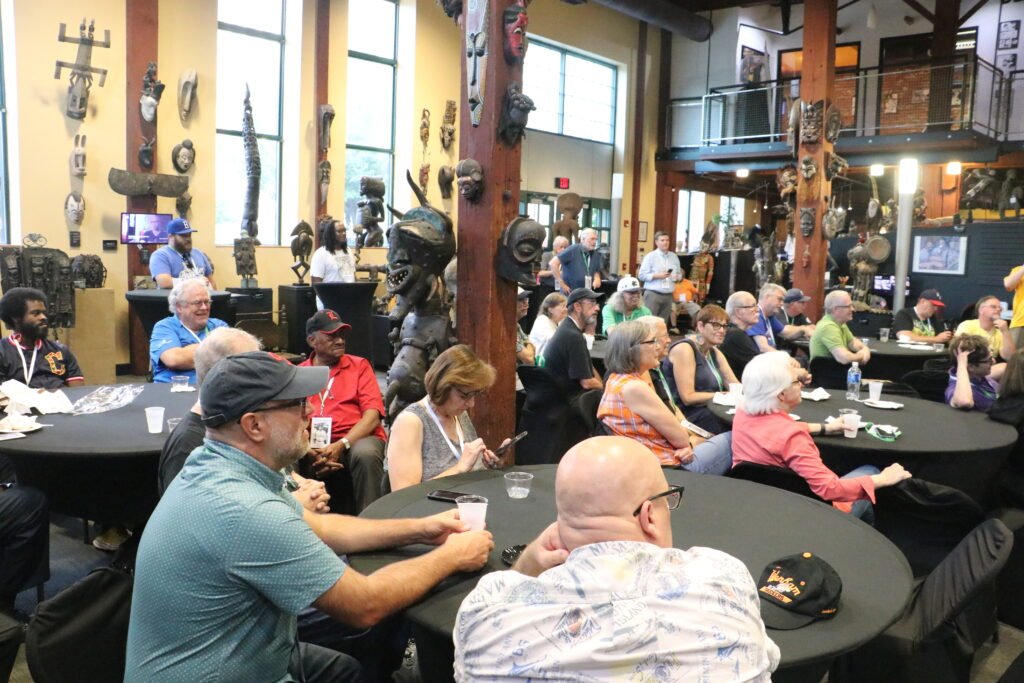
The Society for American Baseball Research (SABR) brought its annual Jerry Malloy Negro League Conference (JMNLC) to Louisville, Kentucky, August 7–9, filling the Galt House Hotel with scholars, historians, fans, and community leaders devoted to preserving the legacy of Black baseball.
This year’s gathering highlighted the cultural and historical depth of the Negro Leagues. Attendees viewed the premiere of I Forgot to Tell You About: The Story of the Cleveland Buckeyes, followed by a panel with former All-Star Kenny Lofton, filmmaker Evelyn Pollard-Gregory, and authors Wayne Pearsall and Vince Guerrieri. The weekend also featured poet Dorian Hairston, a Louisville Baseball History Panel with Harry Rothgerber and Anne Jewell, and a film screening on Black baseball in Nashville.
Historians Gather @ History Museum
Participants enjoyed a tour of the Louisville Slugger Museum & Factory, a reception at the Roots 101 African American Museum, and a Louisville Bats game at Slugger Field. Presenters included longtime researchers such as James Brunson III, Larry McGill, Gary Gillette, Keith Wood, and others who continue to shed light on overlooked chapters of African American baseball.
Honoring Sammy Hughes
The conference closed with a powerful moment on Sunday, August 10, when SABR’s Pee Wee Reese Chapter, working with the Louisville Bats and Louisville Slugger Museum, placed a long-awaited grave marker for Negro Leagues great Sammy Hughes at Louisville Cemetery. Known as “Sammy T,” Hughes was a six-time All-Star second baseman who played with 17 Hall of Fame players (Roy Campanella, Biz Mackey, Mule Suttles, Willie Wells, Josh Gibson, Buck Leonard, Cool Papa Bell, Ray Brown, Ray Dandridge, Turkey Stearnes, Leon Day, Martin Dihigo, Willie Foster, Judy Johnson, Satchel Paige, Hilton Smith, and Jud Wilson), and captured a 1939 Negro National League title with the Baltimore Elite Giants. After his death in 1981, Hughes had lain in an unmarked grave for 44 years.
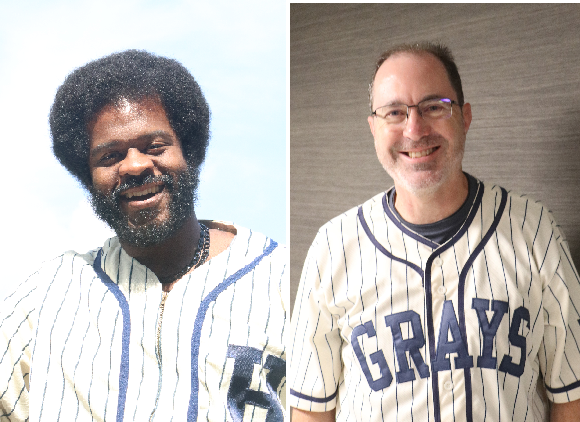
Dorian Hairston (L) – Chris Jensen (R) JMNLC Speakers
History and Mission
Since its founding in 1998, the Jerry Malloy Negro League Conference has been the only national symposium devoted exclusively to Black baseball history. Named for journalist and historian Jerry Malloy (1946–2000), the event reflects the mission of SABR’s Negro Leagues Committee, founded in 1971, to encourage research into the Negro Leagues, pre-Negro League baseball, and the broader African American impact on the game.
Founders such as Ted Knorr, Dick Clark, Larry Lester, Leslie Heaphy, and Malloy himself envisioned a forum where scholarship, storytelling, and community could meet. Their vision still guides today’s gatherings, with annual presentations, trivia contests, youth scholarships, library grants, and the ongoing Negro Leagues Baseball Grave Marker Project, which has provided headstones for more than 30 forgotten players.
The Future: Carrying the Flame
This year’s conference not only honored history but also raised questions about the future. Organizers acknowledged the challenge of drawing more diverse participants and sustaining momentum at a time when diversity initiatives are under political attack.
“The Malloy is the place where connections are made, and ideas are born,” said committee co-chair Todd Peterson. “Good trouble always has, and always will be, made here.”
Fellow co-chair James Brunson added, “The conference bridges past and present. Nothing is foreign, forbidden, or impossible with this group.”
Looking ahead, leaders emphasized Larry Lester’s “Three R’s” — Recognition, Respect, Redemption— as guiding principles for expanding the conference’s reach while ensuring that the painful history of baseball’s color line remains central to public memory.
In the words of one participant, the Malloy is not simply about baseball statistics or forgotten box scores, but about resisting historical amnesia, confronting injustice, and keeping alive the stories of the players who laid the groundwork for integration and equity in sport.
As Peterson concluded: “We are the keepers of the flame. We must be the bulwark against attempts to whitewash the past.”
Please consider supporting open, independent journalism – no contribution is too small!
Chit Chat Atlanta Tours launches Labor Day with immersive Black history, Civil Rights, and cultural experiences, offering visitors a powerful way to discover the soul of Atlanta.
By Milton Kirby | Atlanta, GA | August 27, 2025
This Labor Day, Atlanta visitors and residents will have a new way to experience the city’s legacy of resilience, creativity, and pride. Chit Chat Atlanta Tours, a Black woman-owned cultural tourism company, officially launches September 1 with a lineup of immersive experiences spotlighting the city’s Black history, Civil Rights heritage, and modern cultural excellence.
The company, founded by veteran public relations professional and cultural storyteller Carla Morrison, promises more than sightseeing. Through carefully curated routes, guests will walk the streets where Dr. Martin Luther King Jr. once preached, hear the stories of Atlanta’s trailblazers, and taste the flavors of Black-owned restaurants shaping today’s culture.
“Our mission is to preserve legacy, educate all generations, and spotlight the rich culture of Atlanta’s Black community,” said Morrison. “Whether it’s a family reunion, corporate group, or school trip, our tours are soul-stirring journeys designed to honor the past while celebrating the present.”
A Journey Through Atlanta’s Soul
The tours weave together landmarks and hidden gems across the city. Stops include Ebenezer Baptist Church, the King Center for Nonviolent Social Change, Sweet Auburn Avenue, the APEX Museum, Castleberry Hill, Trap City Café, Patchwerk Studios, the Black Music & Entertainment Walk of Fame, and Tyler Perry Studios.
Each experience blends education with entertainment, giving participants “a little bit of trap, a little bit of truth, and a whole lot of Atlanta pride.”
Signature Experiences
Black History & Civil Rights Tour (2–4 hours): Visits Ebenezer, the MLK Historic Site, Sweet Auburn, SCLC, Big Bethel AME, and historic Black-owned businesses.
Reality ATL Restaurant Tour: A culinary journey highlighting Black-owned restaurants and chefs defining the city’s food scene.
The ATL Remix Tour: Designed for tourists interested in music, film, and fame, mixing history with Atlanta’s cultural flair.
HBCU Campus Tour: Explores Atlanta’s Historically Black Colleges and Universities and their enduring impact.
Peachtree Street Tour: Examines Atlanta’s main artery with its blend of business, culture, and contradictions.
Custom Group Tours: Tailored for schools, churches, DEI retreats, and special events.
Tours start at $75 per person, with private and custom packages available. Year-round bookings are expected to peak during Black History Month, Juneteenth, and the summer reunion season.
A Cultural Legacy Reimagined
By blending storytelling, history, and cultural immersion, Chit Chat Atlanta Tours positions itself as more than a tourism venture—it’s a living classroom and cultural celebration. The company is part of a growing movement in Atlanta to recenter the city’s narrative around the voices that built it.
For bookings or more information, visit www.ChitChatCommunications.biz, follow @ChitChatAtlantaTours on Instagram, or call (404) 319-2130.
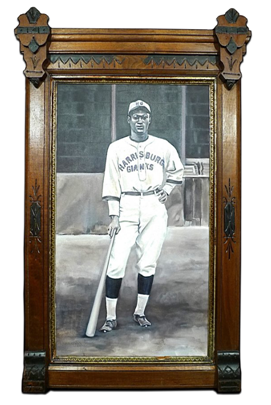
Negro Leagues star Rap Dixon, a five-tool outfielder from Harrisburg, earned Hall of Fame-worthy praise from legends like Oscar Charleston and dominated globally.
By Ted Knorr & Chris Rainey | Harrisburg, PA | Updated August 22, 2025
On December 12, 2018, at the Negro League Baseball Museum in Kansas City, Missouri, Museum President Bob Kendrick, with historian Jay Caldwell, announced the Negro League Centennial Team. The team was a key part of the Museum’s celebration in 2020 of the 100th anniversary of the founding of the Negro Leagues. The team of 30 players, a manager, and an owner was to honor the greatest Negro League players of all-time. Of the 19 position players on the team, only one was not already enshrined in the National Baseball Hall of Fame in Cooperstown, New York — Herbert Alphonso “Rap” Dixon.
Further affirmation of Rap Dixon’s greatness was provided 70 years earlier when in 1949, the greatest of all Negro League outfielders, Oscar Charleston, was asked by a reporter from the Philadelphia Evening Bulletin for his all-time Negro League lineup, Charleston, whose career began before the Negro Leagues were organized, and ended several years after their demise as a major league, offered his team. In the outfield, he placed future Hall of Famers Martin Dihigo in left and Cristobal Torriente in right … between that pair, at his old position of center field, he inserted Rap Dixon. High praise indeed for a lesser-known player among the pantheon of Negro League stars.
A 6-foot-1, 185-pound dynamo who batted and threw right-handed, and played all three outfield positions, Dixon was a classic five-tool player: hitting for both power and average, running, fielding, and throwing. He also had a knack for performing well on the big stage. During his 16-year career, he was a key player on great teams in the Negro Leagues as well as in offseason leagues and a tour of Japan.
Herbert Alphonso Dixon was born on September 15, 1902, in Kingston, Georgia, about 56 miles northwest of Atlanta. He was the first of John and Rosa Goodwin Dixon’s five children. Herbert and his younger brother Paul (also a future Negro League outfielder) developed their rudimentary baseball talents in Georgia’s rural farm country.
Photo courtesy of Phillip Dewey – Rap Dixon
Just before the First World War, Rosa’s brother Oliver P. Goodwin accepted a position in Steelton, Pennsylvania, as pastor of the First Baptist Church. Steelton lies along the Susquehanna River south of the state capital of Harrisburg. Shortly thereafter, additional Dixon and Goodwin families, including John and Rosa Dixon, headed north for greener pastures, joining approximately 1.6 million African Americans opting to leave the South as part of the Great Migration.
The Dixon and Goodwin families settled on Adams Street near Uncle Oliver’s church. Just down the street was the Hygienic School for Colored Children, where Herbert began formal education. He graduated from eighth grade on May 23, 1919, before matriculating at Steelton High School. Herbert’s extracurriculars, in addition to baseball, included boxing, football, and playing the trumpet in the school band. In addition, Herbert worked part-time in the steel mill once he was old enough. According to Chappie Gardner: “[Dixon] got his wonderful strength of arms and shoulder from throwing pig iron billets at the crane operators in the steel mills.”
Herbert Dixon completed only two years of high school. Purportedly, Dixon’s schooling ended, and his “career in baseball started one day when his high school science teacher announced that the class was going to dissect a cat. Dixon, feeling squeamish, exited quickly and went straight to a sporting goods store; with the money he had earned working weekends at the Bethlehem Steel Company, he purchased a glove and bat, took a train to Atlantic City, and joined the Bacharach Giants.” Neither Seamheads.com nor Baseball-Reference.com lists him playing any games with the Giants that year.
By 1919, Dixon became a regular with Steelton’s semipro Keystone Giants. On May 31, the Harrisburg Telegraph announced that “Dixon, the Giants new shortstop, played fast ball and made two healthy swats” in an 8-3 victory over the Middletown White Sox. Dixon usually batted leadoff and was one of the team’s stars, even at age 16.
Perhaps the biggest game for young Herbert with Steelton came on July 16, 1921, at Harrisburg’s Island Park, when they took on the best of the local semipro clubs — Colonel W. Strothers’ Harrisburg Giants. The upstart Steelton club held a 9-4 lead into the bottom of the eighth inning before the more polished Harrisburg team rallied and eventually won the game in the 10th. Dixon played shortstop, batted third, and had two hits in the loss.
Herbert Dixon was briefly with the Keystone Giants in early May 1922 before Colonel Strothers recruited him. Dixon’s debut with Harrisburg occurred on May 20 against the powerful Hilldale Club when he stroked one hit in three at-bats with a run and a ribbie in a 5-3 loss. By mid-June, Dixon was the Harrisburg center fielder. When the veteran fly hawk, Jess Barbour, returned to the lineup, Dixon mainly played right field. Over the summer, he continuously upped his place in the batting order from eighth to fourth. The 1922 season ended on an unhappy note for Harrisburg as they lost their city title in a nine-game series against the fast Motive Power semipro team.
As the 1923 season dawned, Colonel Strothers struggled to find talent for his independent team competing against 14 teams in two leagues. These difficulties were eased when E.B. Lamar of the New York Bacharach Giants joined Harrisburg’s administrative team and brought with him several outstanding players, including outfielder Fats Jenkins, second baseman Dick Jackson, and pitchers Harold Treadwell and Nip Winters. In addition, Strothers brought in William Pettus of the Richmond Giants to anchor the infield at first and to manage the team.
By early 1923, Dixon’s nickname began to appear in print. There are two suggestions as to its origin. One supposes it was derived from the Rappahannock River, which flows through Virginia. How this relates to him is unclear. Sportswriter Chester L. Washington offered a more plausible suggestion: that it grew out of Dixon’s hitting ability while still in high school.
Washington claimed, “Rap hits the old apple with the same degree of force that made William Tell famous.”
The Giants’ primary opponent in 1923 was again the local Motive Power team. John Brackenridge, Motive Power’s manager, threw down the gauntlet in the offseason saying he had “signed the same aggregation of stars that annexed the City championship from Strothers’ Harrisburg Giants.” Unlike 1922, where the Giants got off to a slow start losing 11 of their first 17 contests, the 1923 Harrisburg team captured a dozen victories in their initial 17 games. They faced Ben Taylor’s Washington Potomacs nine times and emerged with six wins.
Dixon started the season slowly at the plate before being sidelined most of July with an undisclosed illness. It was a harbinger of the future for Dixon, who would be haunted by injury and illness during his career. He had powerful arms, but author James Riley called attention to his spindly legs. Riley also suggests that drinking was an issue with Dixon, especially later in his career.
The season culminated, as it had the previous year, with a series against Motive Power. The Giants dropped the opener, 7-4, on the Island Park field. Dixon’s bat led the team to an 8-3 victory in the second game. The remainder of the series was dominated by Giant’s pitcher Nip Winters, who captured three complete-game wins.
During the offseason, the Giants joined the ECL and signed Oscar Charleston to guide the team. Charleston arrived in Harrisburg on March 3, 1924. Immediately, he and Strothers began building a ballclub that Charleston thought could be a dark-horse contender. Retained were outfielders Dixon, Jenkins, and Barbour, and five others. Charleston brought four pitchers with him from the Indianapolis ABCs. Other fresh faces included first baseman Edgar Wesley from the Detroit Stars and pitcher Slim Branham. The new manager gushed about the potential he saw. “We got the stuff, boy, we got the stuff.”
The season began on April 19 with a non-league contest versus the York White Roses, featuring Del Bissonette. The Giants lost a close encounter, 3-1, and Dixon appeared as a defensive replacement for Dick Jackson, the second baseman. Charleston started in right field. Dixon saw little action early in the season as Jackson held down right field. At 21, Rap was the youngest member of the team and may not have won Charleston’s favor yet.
Dixon’s chance to impress came in early June in New York against the Lincoln Giants at the Catholic Protectory Grounds. In a doubleheader victory, he supplied five hits off a quartet of hurlers. By late June, Dixon had cemented his place in right field, joining Jenkins (left) and Charleston (center).
The trio was soon dubbed the “million-dollar outfield” and played together through the 1927 season. Combined, they posted a stellar .351 batting average (898-for-2559) in their time together. The trio is one of only 12 outfield groups that played four or more years together while featuring a future Hall of Famer. Local sportswriter Wellington “Welly” Jones said, “There is no better outfield than Dixon, Charleston, and Jenkins.”
While Dixon maintained his hold on the right-field spot, he hit only .259 in ECL action. His first ECL home run came on July 15 off Brooklyn’s Pud Flournoy. Jenkins batted .336, and Charleston dominated league pitching with 15 home runs and a .405 average. A revolving door at third base and a struggling pitching staff doomed the Giants to a 30-31 mark.
The following season, 1925, was the Harrisburg Giants’ high-water mark. Charleston captured his second consecutive triple crown (.427/20/97 in a 73-game ECL season). Jenkins hit .317 and scored 82 runs, while Dixon made his presence known, hitting .352/8/53. The team finished second (48-24-1, .664) behind Hilldale. The outfield trio was honored with both Charleston and Dixon being named first team All-East, and Jenkins as an honorable mention in left.
That fall, Dixon accepted an invitation from Hilldale’s Biz Mackey and joined the Philadelphia Royal Giants in the California Winter League. The team won the season’s second half with an overall record of 24-15-3. Dixon batted just .271 and usually was in the bottom of the order. He struck four hits as the Royal Giants swept the White King Soapsters in a three-game postseason battle.
The Royal Giants remained in the West after the Winter League season, playing local semipro squads and PCL teams. Dixon hit well in these exhibitions, although the most significant impression his bat made was on the head of Portland catcher Frank Tobin. In a game on March 19, Dixon swung and missed but knocked Tobin unconscious. The team wrapped up their stay in California in early April.
His fine 1925 season made Dixon a star. New York Giants manager John “Muggsy” McGraw told the press that winter that, “If that boy Dixon was not so black, I could make a Cuban out of him and the National League would have another star to talk about. He is, without question, one of the greatest outfielders in the United States.” Despite the glowing praise, Colonel Strothers listened to offers from Rube Foster that might have sent Dixon to Chicago.
In the 1926 season, Dixon again put up nice stats, .323/6/40, while playing 47 of the 49 league games. Charleston’s numbers dipped dramatically, and John Beckwith led the team with a .330 average. Perhaps it was his off-year or maybe the pitching staff’s 5.00 ERA, but, as his biographer Jeremy Beer notes, Charleston “increasingly edged into hotheadedness as the year dragged on.” The manager’s attitude rubbed off on his players. Dixon tried to fight an umpire in Baltimore. Shortstop Rev Cannady went further by slugging an umpire in the jaw. The team finished fourth in the ECL at 27-22.
When the ECL season ended, Dixon again joined Mackey in California. He joined a spectacular lineup featuring holdovers Mackey and Bullet Joe Rogan, plus Turkey Stearnes, Willie Wells, and Andy Cooper. After a decent (9-8) first half, the Royal Giants added Bill Foster. The team caught fire, winning 13 of 14 second-half decisions to capture the playoff qualifying title. In the playoffs, they split four games but failed to capture the official league title when the deciding fifth game with Shell Oil was never played.
Dixon batted .349 — third in the league behind Stearnes (.387) and Shell’s Bob Jones (.361) while leading the league in games and doubles. He finished second on the team (and league) in hits to Stearnes. As in the previous winter, he was the team’s left fielder.
After the season, Philadelphia Royal Giants owner/promoter Lonnie Goodwin desired to take the squad on a tour of Japan, Korea, and the Hawaiian Islands. With the core of his team under contract to Negro League teams such plans were not without controversy. Ownership threatened a five-year suspension on any Negro Leaguers who failed to show for spring training. Of the 14 players on the Winter League team only five risked the potential punishment — Mackey, Cooper, Dixon, Frank Duncan, and Neal Pullen.
On March 9, Goodwin and his team set sail on the La Plata Maru to Yokohama, Japan. The touring Royal Giants were not the same team that had participated in the California Winter League, but they remained a formidable unit. They arrived in Japan on March 29 to begin a 27-game schedule (22 games in Japan; 5 in Korea).
The major-league tour of Japan in 1934, featuring Babe Ruth, was highly influential in the birth of the Nippon Professional Baseball League. Writers also credit the two earlier Negro League tours for creating a love for the game in Japan. In his study of Ruth’s tour, Robert K. Fitts notes that the “Negro Leaguers conducted themselves far better than their white counterparts.” Years of barnstorming had taught them not to embarrass an opponent with antics or running up the score.
The tour opened on April 1 in Tokyo against the Keio University’s Mita Club, which five years earlier had defeated the Herb Hunter All-Stars, 9-3. The Mita Club fell, 2-0, to Cooper, and then Mackey beat them, 10-6, the following day. No box score exists for the opener, but Dixon went three for three with a double, a walk, and a sac fly in the second game. He followed that performance with a five-for-five day (including a triple and double) in cavernous Koshien Stadium.
The Japanese fans were in awe of Dixon’s bat, speed, and throwing arm. Dixon’s eighth consecutive hit was a mere appetizer for his next feat. Koshien Stadium had been built in 1924 with a left-center-field gap that measured 128 meters (420 feet). No native batter had hit or cleared the fence, but on April 6, Dixon smashed a ball that ricocheted off the wall for a triple. Dixon next wowed the fans at Jingu Stadium on April 28 after a 14-0 win. He stood at home plate and threw balls on target to players in the left-field seats.
After Emperor Hirohito commemorated the Japanese tour of Dixon and his mates by presenting them with a trophy, the team headed for Korea. Dixon pitched the May 19 game in present-day Daegu, picking up the victory, 14-2. From there, the team traveled to Honolulu, where they played for two weeks before heading back to the mainland. The threatened lengthy suspension had been reduced to approximately two weeks by ECL President Isaac Nutter.
Dixon finally returned to Harrisburg on July 22. Things were vastly different with the Giants as Oscar Charleston was being dealt to the Hilldale club, and John Beckwith was the manager. Charleston’s departure fell through, and he took the field with Dixon against a Brooklyn Royal Giants team rattled from an auto accident en route to the game.
Brooklyn’s late arrival and a rain shower held the game to just four-and-a-half innings with Harrisburg on top, 8-7. Dixon had a hit and scored a run while batting in the seventh spot and playing his traditional right field. Harrisburg had finished the first half with a 25-20 mark. They were 0-3 in the second half before the victory over Brooklyn. With their million-dollar outfield again intact, the team finished second and posted a 13-8 record after Dixon’s return. Dixon hit .282 in 21 league games.
Dixon returned to the California League that winter, but circumstances were far different than the previous year. A second Black team was entered, called the Cleveland Stars, with a roster that included Dixon’s former Royal Giants teammates Stearnes, Newt Allen, Crush Holloway, and Wells. In addition, Commissioner Landis had imposed restrictions on major leaguers playing in the circuit.
Besides the newly minted Stars, the Royal Giants’ main competition came from Pirrone’s All-Stars. Anchored by Babe Herman and Bob Meusel, Pirrone’s squad beat Dixon’s team early in the campaign, but then Herman and Meusel stopped play to comply with Landis’s edict. After their departure, the All-Stars faded, and the Royal Giants ran away with the title.
After his shortened season with Harrisburg, Dixon exploded in California. His .380 batting average was second in the league behind teammate Jess Hubbard (.442). He exhibited power with a league-leading six doubles and three triples in just 79 at-bats. His five home runs were second to Stearnes’ seven.
Dixon played with the Cleveland Giants in California in 1928-29. His .360 average was only sixth on the team. After a winter in Cuba, Dixon returned to California in 1930-31 with the Royal Giants. In five seasons on the coast, he batted .326 (156-479) and had 21 home runs.
Citing poor attendance, Colonel Strothers disbanded his Harrisburg team in March 1928. Dixon signed with the Baltimore Black Sox and turned in two of the finest seasons ever seen in baseball. In 1928, he posted a line of .398/13/58. They were nearly Triple Crown numbers had teammate Jud Wilson not hit .399 (.0006 points separated them). He also led the circuit with 34 walks. Using modern statistics, he posted an OPS of 1.180 and an OPS+ of 190.
The following year found the team in the American Negro League, where they captured the flag in both halves and posted a league (ANL) best 55-25 mark. In 76 games, Dixon produced even better numbers: .415/16/92. His OPS rose to 1.204 and his OPS+ to 191. Dixon’s marvelous season was jeopardized in July when he was beaned in a game with the Homestead Grays. He fearlessly returned to the lineup the next day and proceeded to rap out 14 consecutive league hits during the week. The streak started against the Grays and culminated on July 28 when he collected eight hits in a doubleheader versus Hilldale. The major-league record for consecutive hits is 12.. Including two walks against the Grays, he had 16 consecutive on-base appearances, which is bested only by Piggy Ward’s 17 in 1893.
Dixon did not go west in the offseason, opting instead to play in Cuba with Almendares. He displayed his power and speed, leading the league in stolen bases (19) and the team with five home runs. (Mule Suttles led the league with seven.)
Dixon entered the 1930 season as a 27-year-old, with his prime years ahead of him. Rather than improving on the two impressive seasons, he tailed off and found himself packing bags to go from team to team. He opened 1930 with the Black Sox and played the first Negro League games at Yankee Stadium in a doubleheader versus the Lincoln Giants on July 5.
Dixon had a reputation for saving his best for big occasions. He opened the scoring in the first game with a home run in the first inning off Bill Holland, but the Giants prevailed easily, 13-4. In the second game, Dixon again homered in the first, then added an inside-the-park blow to deep left-center in the third as Baltimore won, 5-3.
There were 15 Black ballclubs in 1930: nine in the NNL and six Eastern Independent teams. The competition between the two leagues led to players jumping from one circuit to the other. Dixon was one of three big names (with Suttles and Jenkins) to leave the Black Sox as he skipped to the NNL Chicago American Giants. He hit .305 with eight home runs in 49 games for Baltimore and Chicago.
Dixon opened the 1931 season playing left field for the Hilldale club that featured Mackey and Martin Dihigo. He struggled to a .226 average in 44 games before joining the Black Sox late in the season. In 1932, he reunited with manager Oscar Charleston with the Pittsburgh Crawfords. He wowed the fans at Greenlee Field on May 28 with a single and double, two stolen bases, and four runs scored in a 13-4 win over Birmingham. The Crawfords featured 20-year-old catcher Josh Gibson, whose eight home runs took the team title over Dixon’s seven home runs.
Dixon married Rosa (aka Rose) Yarbrough in August 1931 in Richmond, Virginia. The couple was divorced in October 1934, also in Richmond. The decree listed desertion as the cause and noted that Rap had not contested the proceedings. Dixon’s death certificate shows a second wife, Edith Dixon.
Dixon joined the independent Philadelphia Stars in 1933 and came out slugging. He hit a robust .360, finishing second on the team to Jud Wilson (.376). The Stars finished out of contention with a 22-13 mark. Fans rewarded Dixon with a spot on the East roster in the first East-West All-Star game. While the East squad lost 11-7, Dixon had a strong game, going 1-for-3 with a walk, sacrifice fly, and stolen base against Bill Foster.
In November 1933, Dixon joined Josh Gibson and league players on a boat trip to San Juan, Puerto Rico. The players formed a team that the Pittsburgh Courier called the Ramirez Stars. Following the Puerto Rican season, Dixon and Gibson joined the Concordia team from Venezuela. Dr. Leyton Revel and Luis Munoz list Dixon with 21 at-bats with Concordia. It has often been suggested that Dixon injured his back badly during the winter of 1933-34. Concordia played in four series, one of them going nine games, so it appears (from his limited at-bats) that Dixon was injured while with this team. We can further pinpoint the timing by noting that the Philadelphia Tribune reported a trade offer of Cool Papa Bell for Dixon in early February 1934. News of a serious injury had presumably not made its way back to the States by that time.
In the spring of 1934, the Philadelphia Stars released Dixon while he was in the hospital. Was he being treated for the back injury that plagued him the remainder of his life? Dixon’s numbers when he returned to action from 1934-37 indicate a severe downturn. He batted .272 in those seasons, 50 points below his career average.
The Baltimore Black Sox entered the NNL for the second half of the 1934 campaign, and Dixon served as their player/manager. Confident in his recovery, he used himself as a utilityman, even playing third base in a win over the Homestead Grays. That was one of just three wins the team earned. As a manager, he won praise for his work with the young, unknown players, including rookie Leon Day. Dixon’s reputation was rewarded with a spot on the East roster in the All-Star Game. He replaced Vic Harris midgame and went 1-for-2 in the East’s classic win, 1-0.
The following year the Brooklyn Eagles’ Ben Taylor invited Dixon to training camp in Gadsden, Alabama. Soon after his arrival, Dixon was referred to a dentist who discovered four infected molars. Once they were removed, Dixon’s health improved remarkably, and he showed flashes of his athletic talent.
Dixon split the season with Brooklyn and the New York Cubans, batting .301. The Cubans were the second-half champions and faced the Crawfords in the championship. In the spotlight for the final time in his career, Dixon responded by leading all hitters with a .421 average and 1.079 OPS, but was on the losing side.
He joined the Grays in 1936, then finished with a few games with the Crawfords in 1937. He joined the all-star contingent, often labeled the Ciudad Trujillo team, which captured the crown in the Denver Post tournament that August. He played sparingly in the games, quite possibly managing the team. Upon leaving that team, the 35-year-old returned home to Steelton. Dixon took a job with Bethlehem Steel, then in the 1940s, he took a job with the county. Later, he operated a pool hall in Steelton.
While his professional days were over, Rap Dixon still played with Harrisburg area semipros. But mostly he dreamed of bringing the NNL back to Harrisburg. To that end, he became a great advocate for the game in his area, throwing his support and reputation behind numerous efforts to keep the sport alive during the Depression and ensuing war years. This included managing an American Legion team in 1940 and an integrated semipro team.
In 1943 Dixon made an unsuccessful run as a Republican nominee for constable. After the election defeat and a burglary at his pool hall, he left Steelton for greener pastures in Detroit, supposedly for a job coaching a baseball team. A heart attack hospitalized him on July 18, followed by his death on July 20. His body was returned to Harrisburg for funeral services that were attended by his parents, two brothers, a sister, and other family and friends. On June 8, 2007, a citizen’s group dedicated a fitting grave marker in the Midland Cemetery where he had been laid to rest. The Orioles sent Paul Blair and Curt Motton to honor the former Baltimore Black Sox.
Sources
Unless otherwise cited, Rap Dixon’s baseball statistics were compiled by SABR members Gary Ashwill and Kevin Johnson and are available at Seamheads.com. Extensive use of the Harrisburg newspapers provided background. Ancestry.com provided extensive family background information, complemented by 10 years of research and family interviews conducted by Ted Knorr.
Howard University President Ben Vinson III will step down on August 31 after less than two years. Former President Wayne Frederick returns as interim leader during the transition.
By Milton Kirby | Washington, D.C. | August 22, 2025
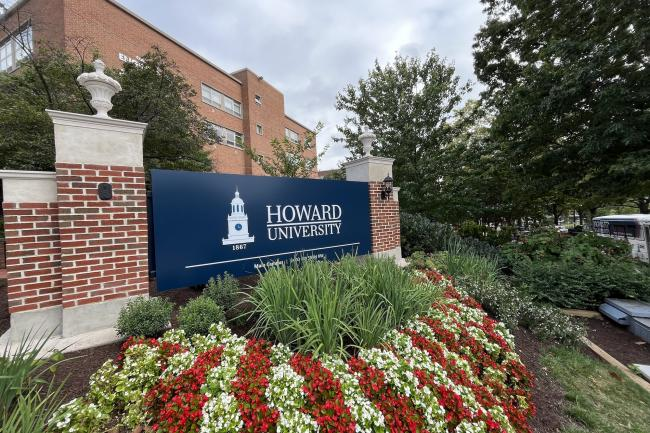
Howard University announced Friday that President Ben Vinson III will step down on August 31, less than two years into his tenure as the school’s 18th president. His departure comes just days into the start of the fall semester at the historically Black university in Washington, D.C.
Vinson, who assumed office in September 2023, said in a statement that he intends to spend more time with his family while continuing his research.
“Over the course of my tenure as president, I have worked with unwavering commitment to advance the strategic vision I believe best serves the future of this institution, including in the areas of AI, data science and analytics, and global and diasporic engagement,” Vinson said. “My foremost priority has always been the well-being and success of this community, and I remain committed to ensuring a smooth and constructive transition.”
The university’s Board of Trustees praised Vinson’s leadership while announcing that Wayne A. I. Frederick, the school’s former president, will come out of retirement to serve as interim president beginning September 1.
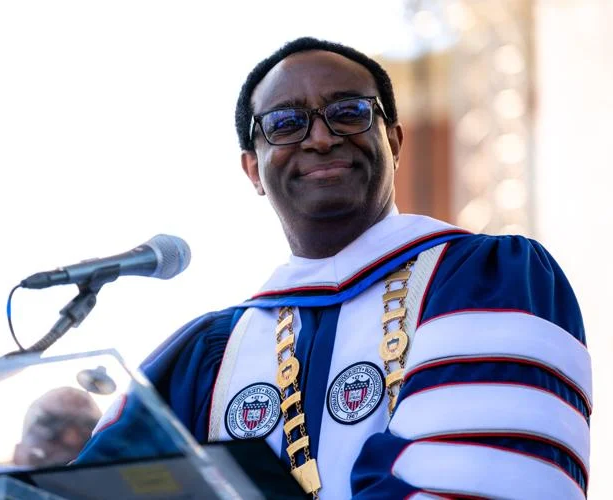
Courtesy Howard University – President Ben Vinson
“On behalf of the Howard University Board of Trustees, we extend our sincere gratitude to Dr. Vinson for his service and leadership,” said board chair Leslie D. Hale. “Given our focus and commitment, the board has selected an interim president who is uniquely equipped to serve the university during this time of transition.”
Frederick previously served as Howard’s 17th president from 2014 to 2023, a period marked by record fundraising, campus modernization, and expansion of student support services. His deep ties to Howard include three degrees from the university. The board said his return would ensure “stability, continuity, and continued progress” as Howard undergoes a nationwide search for its 19th president.
Vinson’s departure is one of the shortest presidencies in the school’s 158-year history. The university did not provide a reason beyond his personal statement, but the change comes as Howard faces several challenges. Recent reporting by the student newspaper, The Hilltop, highlighted frustrations over student account billing errors and limited housing availability. Meanwhile, federal funding battles have placed Howard under financial pressure, with recent attempts to cut the university’s congressional appropriation by tens of millions of dollars. These challenges have put a strain on the university’s leadership and resources.
At the same time, Howard has celebrated historic achievements. In February, the university became the first HBCU to earn Carnegie’s coveted Research One classification, a prestigious designation that reflects its significant growth in research spending and doctoral programs. Enrollment has also surged, topping nearly 15,000 students last fall—up from fewer than 10,000 in 2019.
Despite the sudden leadership transition, Howard officials stressed that the university’s mission remains firm. “Together with our community, we are unwavering in our commitment to build on the university’s positive momentum and accelerate its upward trajectory,” Hale said. This reassurance underscores the continuity of Howard’s values and goals.
Frederick will serve until a permanent successor is selected following a nationwide search.
The Negro National League’s first game on May 2, 1920, marked a historic turning point for Black baseball, led by visionary founder Rube Foster.
By Milton Kirby | Atlanta, GA | Updated August 22, 2025
On May 2, 1920, thousands gathered at Washington Park in Indianapolis, Indiana. They came to witness a moment that would change baseball forever. That day, the Negro National League (NNL) played its first official game. The Indianapolis ABCs beat the Chicago American Giants 4 to 2. Between 6,000 and 8,000 fans filled the stands, making history together.
The man behind it all was Andrew “Rube” Foster. A former star pitcher and manager, Foster dreamed of a league for Black players. At the time, Black athletes were banned from white baseball leagues due to segregation. Foster wanted to give them a stage of their own. His goal was simple but powerful: create a profession for Black players that paid well and made the race proud.
Earlier that year, Foster met with team owners at a YMCA in Kansas City. Together, they formed the Negro National League. Foster boldly declared, “We are the ship, all else the sea.” He became the league’s first president.
The NNL began with eight teams: the Chicago American Giants, Chicago Giants, Indianapolis ABCs, Cuban Stars, Detroit Stars, Dayton Marcos, St. Louis Giants, and the Kansas City Monarchs. While other Negro Leagues had been attempted in the past, none had lasted. Foster made sure this league was different. He worked 15-hour days and even loaned his own money to keep teams going. He shifted players between teams to keep games exciting and fair. He believed in excellence and often reminded players always to be ready, because integration would come one day.
The energy at that first game was electric. Though the American Giants lost, they would later become league champions. And the game itself lit a fire in Black communities across the country. Baseball was the favorite sport of the day. Just like football and basketball are now, Black baseball was the heart of the community. People gathered on weekends to cheer for their local teams in small towns and big cities. The game was easy to play and cheap to set up. All you needed was a bat, a ball, and some open land.
Negro League games were full of energy, speed, and flair. Stars like Satchel Paige wowed crowds with their talent and showmanship. Paige, a tall and confident pitcher, sometimes made his outfield sit down while he struck out batters. “Cool Papa” Bell, one of the fastest men in the sport, could steal two bases on one pitch. Josh Gibson, known as the “Black Babe Ruth,” hit home runs over 575 feet. Oscar Charleston, called the “Black Ty Cobb,” thrilled fans with speed and power.
But life in the Negro Leagues wasn’t easy. Players faced racism daily. They couldn’t eat in most restaurants or stay in white-owned hotels. Some slept on the bus for days. Ted Radcliffe once said, “We didn’t get a chance sometimes to take a bath for 3 or 4 days because they wouldn’t let us.”
Still, the league brought people together. By the 1940s, Black-owned ballparks were places of pride and celebration. Owners gave back to the community, raising money for civil rights causes and Black colleges.
Then came 1947. Jackie Robinson joined the Brooklyn Dodgers and broke the color barrier. Within five years, more than 150 players from the Negro Leagues had joined Major League Baseball. Without its stars and with fewer fans, the Negro Leagues faded away.
But what they built was lasting. The first game on May 2, 1920, wasn’t just a win for the ABCs. It was a win for Black history, sports, and the fight for equality. Rube Foster’s dream came true and paved the way for future generations.
Undefeated WBO welterweight champion Brian Norman Jr., the Decatur-born “Assassin II,” defends his title against Devin Haney in Saudi Arabia after a stunning Tokyo knockout win.
By Milton Kirby | Atlanta, GA | August 13, 2025
Brian Norman, Jr. seems like any other 24-year-old from Decatur, Georgia. He enjoys music, spending time with friends, and—even though he wasn’t asked — he probably enjoys pizza and movie nights. Standing 5’8″ and weighing 147 pounds, he carries himself with quiet confidence, a neatly trimmed beard, and a smile that could brighten a hundred nights.
Photo by Milton Kirby – Brian Norman, Jr.
But unlike most people his age, Norman doesn’t head to an office, warehouse or classroom when he goes to work. He walks into a boxing gym, pulls on his gloves, and steps between the ropes.
There, he’s not just Brian Norman — he’s The Assassin II, a name that signifies his lethal precision and power in the ring, and the reigning World Boxing Organization (WBO) welterweight champion.
Boxing 101 for the Casual Fan
For those new to the sport, professional boxing is organized into weight classes to ensure fair competition. Norman competes in the welterweight division, which includes fighters weighing no more than 147 pounds. The WBO is one of four major sanctioning bodies in professional boxing — alongside the WBA, WBC, and IBF — recognized worldwide for awarding official world titles.
A boxer’s win can come in several ways:
Knockout (KO): When a fighter is knocked down and cannot get back to their feet before the referee counts to ten, or is physically unable to continue.
Technical Knockout (TKO): When the referee stops the fight because one boxer cannot defend themselves safely, even if they are still standing.
Unanimous Decision: After the scheduled rounds are completed, all three judges agree on the winner, awarding points based on clean punches, defense, effective aggression, and ring generalship — a fighter’s ability to control the pace and location of the action.
Split Decision: two of the three judges scored the fight for one boxer, while the third judge scored it for the other boxer. It’s a way to determine the winner when the judges’ opinions are divided.
Norman’s record — 30 fights, 28 wins, and no losses — includes 22 victories by knockout, six by unanimous decision, and two bouts ruled as no contest due to accidental injuries.
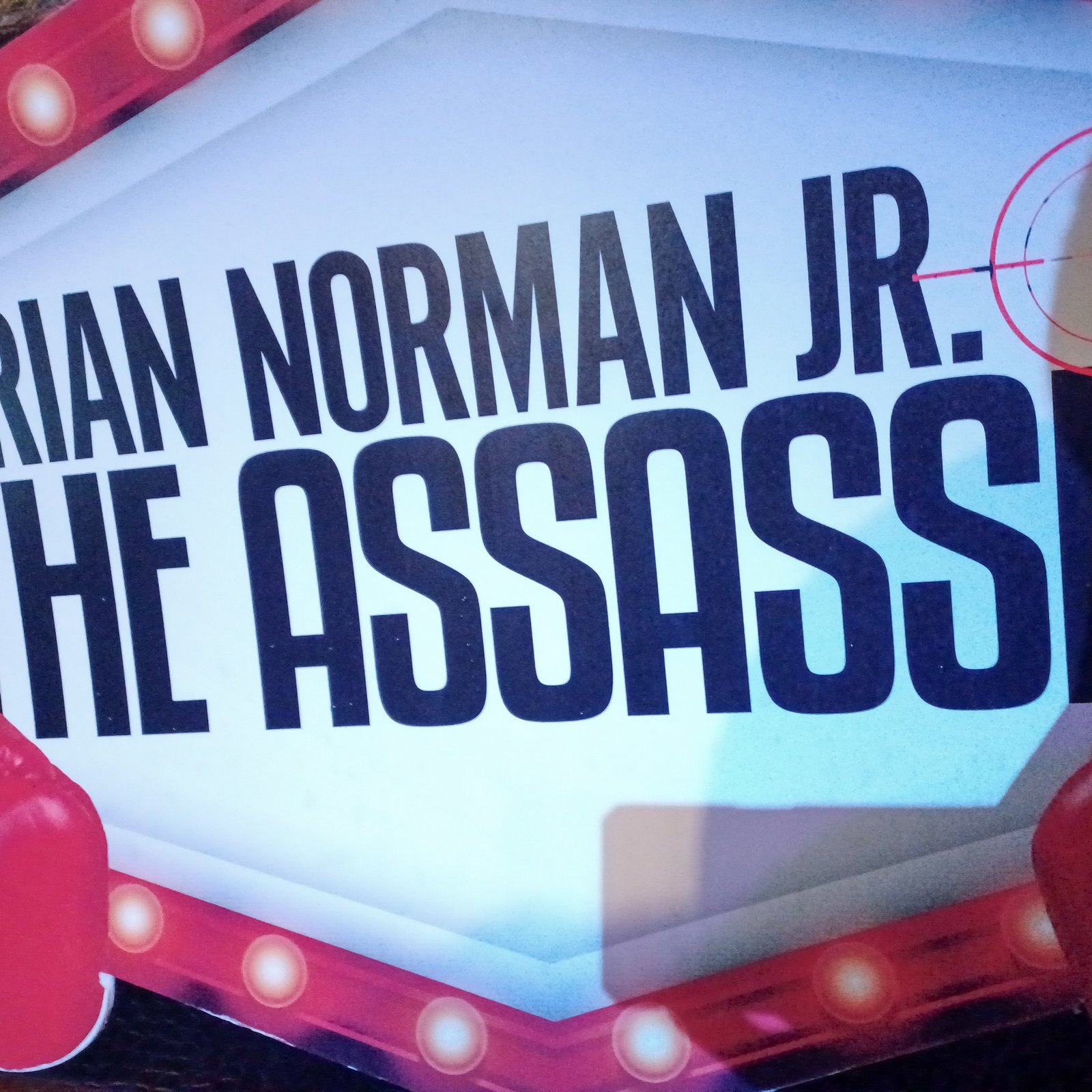
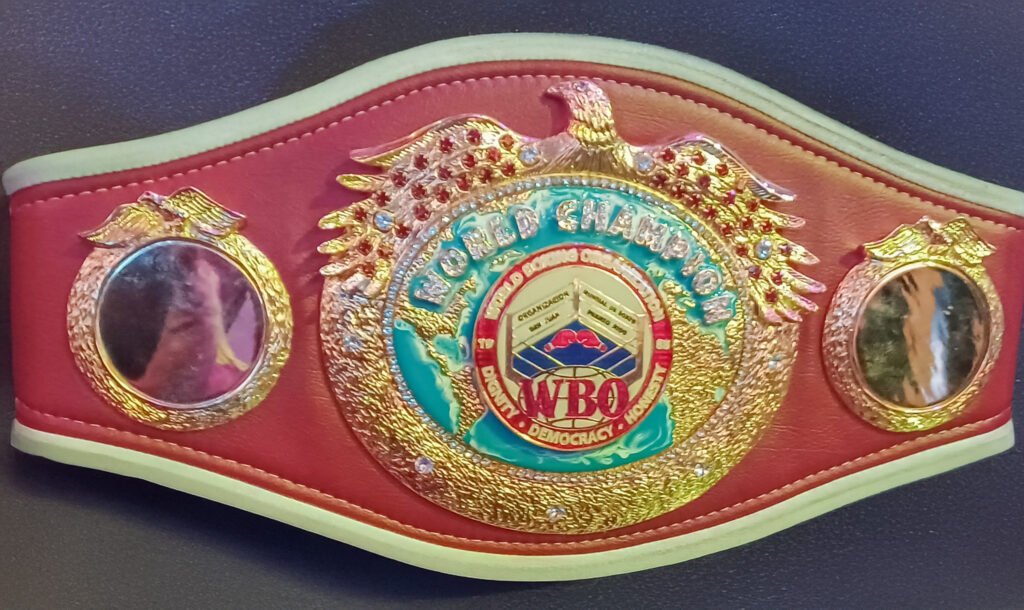
WBO Championship Belt
From Decatur Roots to the Top of the Sport
Born November 23, 2000, Norman grew up in Decatur and attended Lakeside High School. His father, Brian Norman, Sr., was a professional boxer from 2003 to 2011, compiling a record of 18 wins and 11 losses. From childhood, Norman Jr. trained under his father’s guidance, learning both the mental and physical demands of the sport.
In November 2023, Norman won the WBO International welterweight title with a unanimous decision over Quinton Randall in Las Vegas, NV. Brian defended his title in March 2024 against Janelson Figueroa Bocachia in Verona, NY. Both fighters were cut in an accidental clash in the ring. Norman was cut above his right eye in the second round, while Bocachica suffered a cut in the opening round. The bout was stopped at the end of the third round due to the severity of Bocachica’s cut, resulting in a no contest.
His big break came in August 2024, when Terence Crawford — a legend in the sport — vacated the WBO welterweight belt to move up in weight. Norman, already holding the WBO interim title, was promoted to full champion, becoming the youngest male world champion in boxing at the time.
Knockouts, Travel, and Titles
Norman’s most recent defense took him to Tokyo, Japan, on June 19, 2025, where he faced hometown contender Jin Sasaki. In the opening minute, Norman scored his first knockdown with a left hook to the head. By the fifth round, he delivered another left hook so devastating that Sasaki was left on the canvas for several minutes. Many analysts called it a Knockout of the Year candidate.
Norman spoke of the Japanese customs and traditions, and mentioned that since the fight he and Sasaki have exchanged kind and respectful words.
Business in the Ring
Currently signed with Top Rank — the promotional powerhouse behind legends like Muhammad Ali, Oscar De La Hoya, and Manny Pacquiao — Norman has earned an estimated $1 million in career purses. His biggest payday so far was $650,000 in a bout against Cuevas.
The WBO, headquartered in San Juan, Puerto Rico, is a key gatekeeper in boxing, with its champions recognized as among the best in the world. Holding a WBO belt is often a stepping stone to multi-division championships and career-defining fights.
The Risks of the Sport
Brian Norman well understands the risks of his profession. He knows that hundreds of punches to the head can lead to serious long-term effects. As a knowledgeable boxer himself, Norman, Sr. placed an exceptionally high emphasis on Brian, Jr. to become an excellent defensive boxer to protect himself as best as possible.
Coach Natasha (Titi) noted, “It’s amazing to see where Brian has come from versus the skills that he has developed now.”
As for training, Brian says, “he starts counting reps once the workout starts to hurt. Discipline is the key to training and development.” His training regimen includes rigorous workouts, sparring sessions, and a strict diet, all of which contribute to his physical and mental preparedness for each fight.
Next Challenge: Devin Haney in Saudi Arabia
On November 22, 2025, Norman will defend his title against two-division champion Devin Haney in Riyadh, Saudi Arabia. Both men are undefeated — Norman at 28-0 (22 KOs) and Haney at 32-0 (15 KOs) — making this a rare matchup where neither fighter has ever tasted defeat. This highly anticipated bout is expected to be a test of skill, endurance, and determination for both fighters.
For Norman, the fight is another chance to prove that The Assassin II is more than just a nickname. With an undefeated record of 28-0 (22 KOs), he has shown his dominance in the ring. For the sport, it’s an opportunity to showcase one of boxing’s youngest champions to a global audience.
From Decatur’s neighborhood gyms to the bright lights of Las Vegas, Tokyo, and soon Saudi Arabia, Brian Norman, Jr. has shown that even the kid next door can rise to the very top of the boxing world — and do it without a single loss.
Lisa Leslie made history with the WNBA’s first dunk on July 30, 2002—redefining women’s basketball and inspiring generations to reach higher than ever before.
By Milton Kirby | July 30, 2025 | Atlanta, GA
On July 30, 2002, Lisa Leslie soared.
In a split second that lasted forever, the Los Angeles Sparks superstar caught a fast break, glided to the rim, and threw down a one-handed dunk against the Miami Sol. With that slam, she became the first woman to dunk in a WNBA game. Twenty-three years later, on this historic anniversary, her leap still represents a seismic shift in women’s sports.
Leslie didn’t just dunk a basketball that day—she shattered perceptions.
The Dunk That Changed Everything
The play was textbook: a long rebound, a pass to midcourt, a couple of dribbles, and a takeoff from just inside the paint. Fans in the arena rose to their feet in disbelief as the 6-foot-5 center delivered the moment many thought they’d never see in the women’s game.
Leslie, never one to showboat, calmly jogged back on defense.
But history had already been made.
“I didn’t go into the game thinking I’d dunk,” Leslie later told reporters. “It just happened. The opportunity came, and I took it.”
From Compton to the Sky
Lisa Deshaun Leslie was born July 7, 1972, in Gardena, California, and raised in nearby Compton by her hardworking mother, Christine. Tall from an early age, Leslie didn’t pick up basketball seriously until junior high. By then, she was already over six feet tall.
She made an early impact. At Morningside High School, she once scored 101 points—in one half. At 16, she led the U.S. Junior National Team in scoring and rebounding at a world tournament in Spain.
Her dominance followed her to USC, where she earned Naismith Player of the Year honors and left as the Pac-10’s all-time leader in points, rebounds, and blocks.
By the time the WNBA launched in 1997, Lisa Leslie was ready-made for the spotlight.
A Spark From Day One
Drafted by the Los Angeles Sparks in the inaugural WNBA draft, Leslie made an immediate impact. She recorded the first double-double in WNBA history during her debut game against the New York Liberty. Over the next decade, she would redefine what it meant to be a dominant center.
Leslie was a three-time WNBA MVP, two-time champion, and eight-time All-Star. She led the Sparks to back-to-back titles in 2001 and 2002 and capped the latter year with that historic dunk, an exclamation point on one of the most iconic seasons in women’s basketball history.
Later that year, she became the first WNBA player to surpass 3,000 career points.
Dunking Barriers, Not Just Basketballs
The image of Leslie dunking reverberated far beyond the court.
Photo courtesy WNBA Lisa Leslie
For young girls and aspiring athletes, it was a symbol of what was possible.
“She changed the way people talked about women’s basketball,” said Sheryl Swoopes, fellow WNBA legend. “She showed that we weren’t just skilled—we were powerful.”
Leslie wasn’t finished. In 2005, she dunked again, this time at the WNBA All-Star Game. She would eventually become the first player in league history to reach 6,000 points, retire as its all-time leading rebounder, and earn enshrinement in the Naismith Memorial Basketball Hall of Fame in 2015.
Beyond the Hardwood
Leslie’s legacy stretches beyond statistics and slam dunks. She’s also an Olympic icon, winning four gold medals with Team USA between 1996 and 2008. In the 1996 Games, she set a U.S. Olympic record by scoring 35 points in a single game.
Off the court, Leslie built a multi-faceted career. She modeled for high-end fashion houses, earned an MBA, worked in broadcasting, and authored a memoir titled Don’t Let the Lipstick Fool You. She’s appeared in films, television shows, and even video games.
In 2011, Leslie became a part-owner of the Sparks. In 2019, she became head coach of the BIG3 men’s team Triplets—and won a championship in her debut season.
Today, she remains a respected voice in basketball, business, and media, serving as a studio analyst for the Orlando Magic on FanDuel Sports Network Florida.
A Moment That Still Matters
As the WNBA celebrates continued growth in 2025, with record viewership and superstar talent headlined by players like Angel Resse, A’ja Wilson, Caitlin Clark, and Breanna Stewart, the league stands on the foundation built by pioneers like Lisa Leslie.
Her dunk didn’t just make headlines—it made history.
And on this anniversary, it still inspires.
“She dunked for all of us,” said a young Sparks fan attending the team’s commemorative event in Los Angeles. “She made us believe we could fly too.”
Please consider supporting open, independent journalism – no contribution is too small!
Bubba Wallace makes NASCAR history as the first Black driver to win the Brickyard 400 at Indianapolis, earning a playoff spot and inspiring millions.
By Milton Kirby | Indianapolis, IN | July 28, 2025
Bubba Wallace is Black. And now, he’s also a Brickyard 400 champion.
The 31-year-old driver of the No. 23 Toyota Camry for 23XI Racing made history Sunday at Indianapolis Motor Speedway, becoming the first Black driver to win on the famed 2.5-mile oval. With this career-defining victory, Wallace not only snapped a 100-race winless drought but also earned his first crown jewel win — solidifying his place in NASCAR’s history books and punching his ticket to the Cup Series playoffs.
It was a win years in the making.
A Landmark Victory at the Brickyard
After fending off defending champion Kyle Larson through two tense overtime restarts, Wallace powered across the yard of bricks and into the record books. The moment capped a race filled with drama, strategy, and emotion — including an 18-minute rain delay, looming fuel concerns, and a frenzied final-lap showdown.
“Coming off Turn 4, I knew I was going to get there — unless we ran out of gas,” Wallace said after the win. “To overcome so much and to put these people in Victory Lane, that’s what it’s all about.”
In doing so, Wallace became the first Black driver to win a major event at the Indianapolis Motor Speedway since the track opened in 1909. No Black driver has ever won the Indianapolis 500, and Formula 1’s brief run on the road course never saw a Black winner either.
This wasn’t just a win. It was a cultural milestone.
Bubba Wallace during NASCAR Cup Series at Brickyard – Photo AP – Darron Cummings
The Road to the Brickyard
Born William Darrell Wallace Jr. in Mobile, Alabama, and raised in Concord, North Carolina, Bubba Wallace’s path to stardom was anything but conventional. The son of a Black mother, Desiree, a former collegiate track star and social worker, and a white father, Darrell Sr., who runs an industrial cleaning company, Wallace proudly identifies as a Black American.
His parents made it clear to him early on — and to those around them — that his Blackness was not something to be diluted or ignored.
From age nine, Wallace dominated local circuits, winning 35 of 48 Bandolero races in 2005. He rose quickly through NASCAR’s youth development ladder, competing in the K&N Pro Series East, Xfinity, and Truck Series. In 2013, he became the first Black driver in over 50 years to win a national touring series race, joining the legendary Wendell Scott.
By 2018, Wallace had a full-time ride in the NASCAR Cup Series, piloting the famed No. 43 for Richard Petty Motorsports. But it was his partnership with 23XI Racing — co-owned by NBA legend Michael Jordan and Denny Hamlin — that gave Wallace a more robust platform and faster cars. Sunday’s win proved just how far they’ve come.
Trials, Critics, and a Turning Point
Despite his talents, Wallace has never had a smooth ride in the garage. His 2020 season was particularly turbulent. A reported noose in his garage at Talladega sparked a federal investigation and polarized the fanbase. Though the FBI ruled it a pull-down rope with no malicious intent, the backlash that followed was swift and personal.
Wallace’s advocacy for racial justice — from championing Black Lives Matter to pushing NASCAR to ban the Confederate flag — put him in the crosshairs of critics. Former President Donald Trump even demanded an apology. Wallace refused. Instead, he doubled down on his principles and leaned into his platform.
He channeled the pain into performance, winning at Talladega in 2021 and Kansas in 2022. But for the last three seasons, Wallace came close without sealing the deal until Sunday.
Fuel, Faith, and the Finish Line
Wallace had built a 4-second lead late in the race when the skies opened up. A brief rain shower in Turn 1 triggered a red flag with four laps to go. When the race resumed, Wallace had to survive two overtimes, manage tire wear, and pray his fuel would hold out.
“I thought about everything except racing during that red flag,” Wallace admitted. “But once I saw it was Larson behind me, I knew I had to be perfect. He’s the best in the field.”
And he was. Twice, Wallace outpaced Larson on restarts, defending his line and never flinching under pressure. His Chumba Casino-sponsored Camry surged ahead on the final lap, sending fans into a frenzy and his team into tears.
Even Cookie Monster, Sunday’s whimsical grand marshal, could barely contain his excitement.
The Man Behind the Wheel
Beyond the helmet and fire suit, Bubba Wallace is a husband and a new father. He married Amanda Carter — his high school acquaintance turned longtime partner — on New Year’s Eve 2022. The couple welcomed their first child, a son named Becks Hayden Wallace, in September 2024.
“We waited nine months on this little guy,” Wallace wrote on Instagram. “He’s made it all worth it.”
Their love story, rekindled after college and forged through the chaos of national headlines and racetrack travel, reflects Wallace’s blend of resilience and humility.
“I’m a Christian, I believe in pushing for what’s right,” Wallace once told Esquire. “When you see something unjust, you don’t stay silent.”
It’s that same moral compass that led Wallace to found the Live to Be Different Foundation, dedicated to empowering individuals to be themselves and live authentically.
SIDEBAR: Paving the Way — Wendell Scott and NASCAR’s Drive for Diversity
Wendell Scott: The Trailblazer
Wendell Scott was the first Black driver to race full-time in NASCAR’s highest level and the first to win a race in what is now the Cup Series. Born in Danville, Virginia, in 1921, Scott overcame racism, sabotage, and financial obstacles to pursue his passion for racing in the Jim Crow South.
He entered NASCAR in 1953 and made history on December 1, 1963, when he won a race in Jacksonville, Florida. Scott crossed the finish line first, but officials initially awarded the trophy to a white driver. Only hours later, Scott was declared the rightful winner. He never received the trophy during his lifetime.
Scott competed in 495 races over 13 years and earned top-ten finishes in nearly 50 of them — all while funding and fixing his cars. He passed away in 1990, and in 2015, he was posthumously inducted into the NASCAR Hall of Fame.
Bubba Wallace has often credited Wendell Scott’s legacy as a source of inspiration. “He made it possible for someone like me to dream of this,” Wallace has said.
Drive for Diversity: Building a New Generation
Launched in 2004, NASCAR’s Drive for Diversity program aims to recruit and develop minority and female drivers and crew members in a sport that has historically been dominated by white males. The initiative includes:
Rev Racing: A team that competes in the ARCA Menards Series and the Advance Auto Parts Weekly Series, serving as the competition arm of Drive for Diversity.
Driver Development: Talents such as Bubba Wallace, Daniel Suárez, Rajah Caruth, and Hailie Deegan have all passed through the program.
Pit Crew Development: The program also trains aspiring diverse pit crew members for roles on competitive race teams.
NASCAR continues to evolve, but progress hasn’t been easy. Wallace’s win at the Brickyard shows how the seeds planted by Scott — and watered by Drive for Diversity — are beginning to bloom.
“We’re not where we want to be yet,” said Rev Racing’s CEO Max Siegel, “but we’re definitely moving in the right direction.”
What’s Next?
With his Brickyard 400 win, Wallace has secured a coveted playoff spot. He’ll return to the postseason after missing it in 2024. The momentum couldn’t have come at a better time for 23XI Racing, which is currently embroiled in a legal dispute with NASCAR over team charters.
Bubba Wallace during NASCAR Cup Series at Brickyard – Photo AP – Darron Cummings
“Beating the best means being the best,” Wallace said, reflecting on his battle with Larson. “We were the best today.”
The next stop on the Cup Series tour is Iowa, but Wallace’s focus is already on the playoffs. The garage knows he’s more than a symbol now — he’s a threat.
A Legacy in the Making
More than just a win, Sunday’s Brickyard triumph was a culmination of grit, growth, and generational change. Wallace didn’t just win a race. He claimed space in a sport that once made Black drivers feel unwelcome. He honored the legacy of Wendell Scott and paved a path for those yet to come.
“This one’s really cool,” Wallace repeated after the race. “To be here, to win here, to do it the way we did — it means everything.”
It meant everything to his fans, too. As Wallace knelt by the bricks with his wife and baby boy, he etched more than rubber into the track — he cemented a legacy.
Please consider supporting open, independent journalism – no contribution is too small!
Lena Horne broke barriers in Hollywood and civil rights, becoming a trailblazing icon whose courage, music, and legacy continue to inspire generations of Black artists and activists.
By Milton Kirby | Atlanta, GA | June 30, 2025
On what would have been her 108th birthday, the world pauses to honor Lena Horne—a legendary singer, actress, civil rights activist, and one of the most influential Black women in American history. Horne’s career, which spanned over seven decades, was defined not only by her talent and glamour but by her fierce determination to fight against racial injustice and challenge the limits placed on her by society and Hollywood.
Born Lena Mary Calhoun Horne on June 30, 1917, in Brooklyn, New York, she emerged from a lineage of educated and civically engaged African Americans. Her grandmother, an early suffragist and activist, shaped Lena’s worldview. Despite a nomadic and, at times, lonely childhood spent following her mother’s theatrical career across the country, Horne carried the strength of her heritage with her. She left high school at 16 to perform at Harlem’s famed Cotton Club, launching a path that would eventually lead her to become the first Black performer signed to a long-term contract with a major Hollywood studio—Metro-Goldwyn-Mayer (MGM).
While at MGM, Horne appeared in more than 16 films between 1938 and 1978. Yet, due to racism, her roles were often stand-alone musical numbers that could be cut out when films were shown in segregated theaters. She was systematically denied leading roles, and in a cruel twist, even lost the part of Julie LaVerne in the 1951 film “Show Boat” to Ava Gardner, despite previously singing the part in another movie. The role was denied to her because of a ban on interracial relationships onscreen.
Horne never allowed these exclusions to define her. She sued restaurants and theaters for racial discrimination in the late 1940s and joined forces with civil rights leaders like Paul Robeson and Eleanor Roosevelt. Her activism led to blacklisting during the McCarthy era, but Horne never backed down. When the U.S. Army allowed German POWs to sit in front of Black soldiers at a World War II USO performance, she walked off stage and personally financed her own tour to entertain Black troops.
“My identity is very clear to me now. I am a Black woman. I’m free. I don’t have to be a symbol to anybody,” she once said. This powerful statement reflects Lena Horne’s journey of self-definition and pride. Her words continue to inspire others to embrace their own identities with confidence and self-awareness.
Lena Horne
In the 1960s, Horne was a prominent figure in the civil rights movement. She marched in Washington, performed at rallies in the Jim Crow South, and lent her voice and fame to the National Council of Negro Women and the NAACP. Her commitment to the cause was unwavering. When Medgar Evers was assassinated, she had just appeared with him at a rally in Mississippi, a testament to her dedication to the fight for equality.
Her resilience eventually led to triumphs. Horne reinvented herself in the 1980s, dazzling Broadway in the Tony Award-winning one-woman show, Lena Horne: The Lady and Her Music. The show ran for 333 performances and earned her a special Tony Award, as well as two Grammys. It remains the longest-running solo show in Broadway history.
Despite battling multiple sclerosis, a fact she never publicly discussed, Horne lived to be 92. She died in 2010 of heart failure in New York City. Her funeral brought out luminaries like Dionne Warwick, Cicely Tyson, Audra McDonald, and Vanessa Williams—a who’s who of Black excellence shaped in her wake.
Despite the challenges she faced in her career, Horne’s personal life was also marked by resilience and strength. She was a mother and grandmother, and her family was a source of joy and support for her. She had two children, Gail and Edwin, and was later married to white bandleader Lennie Hayton. Their interracial marriage was initially kept secret due to public scrutiny, yet the relationship helped her navigate a treacherous industry with grace and strength.
Lena Horne
Lena Horne’s legacy lives on through her granddaughter Jenny Lumet, a screenwriter who continues to carry on her grandmother’s work. Her name is immortalized in stamps, awards, and most fittingly, the Broadway theater that now bears her name—the Lena Horne Theatre. As the first Black woman to receive this honor, Lena Horne’s enduring impact is a testament to the power of her life and work.
From stormy beginnings to a triumphant, unyielding voice, Lena Horne carved her name into history with elegance and courage. She was not only a fierce activist but also a jazz singer, a movie star, and a patriot. Her performances, both on screen and on stage, were marked by her undeniable talent and grace. Above all, she was a symbol of pride and perseverance, leaving an indelible mark on the arts and civil rights.
Today, on Lena Horne Day, her story continues to inspire artists, activists, and dreamers worldwide. Her legacy, like her music, will never fade.
Please consider supporting open, independent journalism – no contribution is too small!
Wilma Rudolph overcame polio to become a triple Olympic gold medalist and global icon—breaking barriers in sports, civil rights, and women’s history.
By Milton Kirby | Atlanta, GA | June 23, 2025
Born prematurely on June 23, 1940, in a segregated town without electricity or running water, Wilma Glodean Rudolph faced unimaginable odds. As the 20th of 22 children, she battled polio, scarlet fever, and double pneumonia before age six. Doctors said she’d never walk again. Her mother said she would. Wilma believed her mother, and her unwavering faith and resilience continue to inspire us all.
By the age of 11, she had removed her leg brace and was walking unaided. By the age of 16, she was an Olympic medalist. By the age of 20, she was a global icon.
Wilma Rudolph courtesy Wilma Rudolph Foundation
At the 1956 Summer Olympics in Melbourne, Rudolph earned a bronze medal in the 4×100-meter relay, becoming the youngest member of the U.S. track-and-field team. But it was her performance four years later in Rome that immortalized her.
At the 1960 Summer Olympics Rudolph became the first American woman to win three gold medals in a single Games—triumphing in the 100-meter, 200-meter, and 4×100-meter relay events. Her fluid style, blistering speed, and steely determination earned her the nickname “The Black Gazelle.” She was the fastest woman in the world.
Televised worldwide, her achievements catapulted her into the pantheon of sports legends, joining fellow Olympians Muhammad Ali, Oscar Robertson, and Rafer Johnson. But Rudolph’s victories transcended track. When her hometown of Clarksville attempted to honor her with a segregated celebration, she refused to attend. Her stand for equality led to the town’s first integrated parade and banquet, a testament to her enduring impact on civil rights.
Wilma Rudolph courtesy Wilma Rudolph Foundation
Rudolph was a trailblazer for Black and female athletes. She broke gender barriers at events like the Millrose Games and boosted women’s track-and-field visibility across America. She won the 1961 Sullivan Award as the nation’s top amateur athlete, became a two-time Associated Press Female Athlete of the Year, and later served as a goodwill ambassador to French West Africa.
After retiring from track in 1962 at the height of her fame, Rudolph earned her degree from Tennessee State University and turned to coaching and youth advocacy. She founded the Wilma Rudolph Foundation, supporting young athletes nationwide.
Her life-inspired documentaries, a TV movie starring Shirley Jo Finney and Cicely Tyson, and countless children’s books. In 1977, she published her autobiography, Wilma.
Rudolph’s legacy lives on in the U.S. Olympic Hall of Fame, where she was inducted in 1983, and the International Sports Hall of Fame, where she was inducted in 1980. Tennessee State University also honors her, naming its indoor track and dormitory in her honor. We are all appreciative of the lasting impact she has made on the world of sports and civil rights.
In July 1994, following her mother’s death, Rudolph was diagnosed with brain and throat cancer. She died at home in Brentwood, Tennessee, on November 12, 1994, at age 54.
Wilma Rudolph courtesy Wilma Rudolph Foundation
More than an Olympic champion, Wilma Rudolph redefined what it meant to overcome. “My doctor told me I would never walk again. My mother told me I would. I believed my mother,” she once said. And the world has believed in her ever since.
Please consider supporting open, independent journalism – no contribution is too small!
Bishop James A. Healy, America’s first Black Catholic bishop, was ordained 150 years ago. His life shaped U.S. Catholicism through service, education, and advocacy.
By Milton Kirby | Atlanta, GA | June 10, 2025
On June 10, 1854, James Augustine Healy was ordained as a Catholic priest in Paris. Precisely 150 years ago, he became the first known Black Catholic bishop in the United States.
Born into slavery in Jones County, Georgia, on April 6, 1830, Healy was the son of Irish immigrant Michael Healy and Mary Eliza Smith, a mixed-race enslaved woman. Under Georgia law, the Healy children were considered enslaved from birth. Despite their father’s wealth, they were denied the opportunity to receive an education in the South.
Bishop James A. Healy
To change that, Michael Healy sent James and his siblings north. James began his education at a Quaker school on Long Island, then continued his studies in New Jersey.
The family’s lives changed forever when Bishop John Fitzpatrick of Boston helped place the boys at the newly founded College of the Holy Cross in Massachusetts.
At Holy Cross, James thrived. He was named valedictorian of the first graduating class in 1849. He went on to earn a master’s degree and later studied for the priesthood in Montreal and Paris. On June 10, 1854, he was ordained at the Cathedral of Notre Dame.
Healy returned to Boston, where his talents and faith earned him several leadership roles. He served as assistant pastor, chancellor, and rector of the Cathedral of the Holy Cross. He helped start homes for orphans and destitute children and stood up for the Catholic Church in debates over taxes and civil service.
In 1875, Pope Pius IX appointed Healy as Bishop of Portland, Maine. For the next 25 years, he led the diocese, which included all of Maine and New Hampshire. During his time as bishop, Healy oversaw the creation of 60 new churches, 68 missions, 18 convents, and 18 schools. The Catholic population nearly doubled under his leadership.
Healy became known as “the children’s bishop” for his deep concern for orphans, widows, and the poor. He helped found homes for girls and children affected by the Civil War. He even bought part of an island to use as a vacation spot for orphans, where he often visited and played with the youngest ones.
Healy was also a strong voice in national Catholic matters. He attended the Third Plenary Council of Baltimore and helped launch the Catholic University of America. Though he was quietly proud of his Black heritage, he did not promote it publicly. He often faced discrimination, especially in the South, but continued to serve with humility and grace.
Despite illness, Healy celebrated 25 years as bishop in 1900. He died later that year on August 5. He had asked not to be buried in the cathedral crypt. Instead, he was laid to rest in Calvary Cemetery in South Portland under a simple Celtic cross.
Holy Cross, Healy’s alma mater, has honored his legacy with the Bishop Healy Committee, which supports diversity and inclusion. The Archdiocese of Boston also created an award in his name to honor dedicated Black parishioners.
James A. Healy’s life was a story of faith, perseverance, and quiet strength. Though born into slavery, he rose to one of the highest roles in the Catholic Church. He worked tirelessly for the poor, stood firm in his convictions, and left behind a legacy that continues to inspire 150 years later.
Please consider supporting open, independent journalism – no contribution is too small!
Shameta Jones-Harrell becomes the first woman and Black woman to lead a police department in Cobb County, bringing bold vision and community focus to Austell, GA.
By Milton Kirby | Austell, GA | June 6, 2025
In a historic and unanimous decision, the Austell City Council has appointed Shameta Jones-Harrell as the city’s new police chief — making her the first woman, and the first Black woman, to lead any police department in Cobb County’s history.
The vote, which passed 6-0 during a Monday night council meeting, was met with celebration from residents and law enforcement officials alike. As Chief Jones-Harrell stood to take her oath Tuesday evening, the weight of the moment was not lost on the crowd gathered to witness a barrier-breaking chapter in the city’s leadership.
“We are so proud of her and we know that she will do a phenomenal job in this role,” read a statement from the Austell Police Department, shared on social media shortly after the vote.
A Trailblazing Career Built on Service
Jones-Harrell, a Huntsville, Alabama native and Lee High School graduate brings 24 years of law enforcement experience to her new role. Her career began in October 2000 at the College Park Police Department, where she worked as a detective handling sensitive cases such as sex crimes, domestic violence, and crimes against children. She also served on the SWAT team — a rare post for a woman at the time — underscoring her ability to succeed in high-pressure, male-dominated environments.
She later joined the Brookhaven Police Department, where her rise from sergeant to major marked her as a standout leader. There, she led the Support Services Division and developed several community-based initiatives, including the “One Congregation One Precinct” program, which built stronger relationships between officers and local faith communities. She also served as a liaison to the Police Accountability & Legitimacy Committee under the city’s Social Justice, Race, and Equity Commission.
In 2021, she joined the Austell Police Department as deputy chief. Since then, she has been instrumental in overhauling community engagement, leading more than 60 outreach events, and introducing patrol strategies that have been credited with lowering violent crime rates. Her leadership has emphasized proactive policing, transparency, and inclusion.
“One of the reasons why I decided to join law enforcement is so I can make sure I could progress other women through the ranks,”. That mission now takes center stage, as one of her top priorities is increasing the representation of women on the force.
Vision for Austell’s Police Department
Chief Jones-Harrell outlined three key goals for her tenure: securing state accreditation, increasing female representation, and strengthening community connections. “We are almost at the end of that goal,” she said, referring to the department’s progress toward official state certification — a benchmark of professionalism and accountability in policing.
She emphasized that public trust must be earned and maintained through ongoing engagement and transparency. “Community engagement is not an event,” she told reporters. “It’s a lifestyle.”
The department’s mission reflects this ethos: to establish trust through collaboration, transparency, and education while delivering equitable services to all residents.
The department’s Community Liaison Coordinator plays a key role in achieving these goals, facilitating partnerships with homeowner associations, faith organizations, schools, and advocacy groups. These relationships help tailor the department’s response strategies and crime prevention efforts to the specific needs of Austell’s neighborhoods.
A Leader Rooted in Faith, Family, and Forward Motion
Jones-Harrell holds a Bachelor of Science degree in Criminal Justice with a concentration in Forensic Science from Jacksonville State University. She has undergone advanced leadership and crisis management training, including the Law Enforcement Executive Development program and Critical Incident Stress Management courses. She is a member of both the Georgia Association of Chiefs of Police and the International Association of Chiefs of Police.
Though her resume is extensive, Jones-Harrell draws her deepest strength from her faith and family. A photo of her late mother sits near her desk; its inscription reads, “Inside me is a weak heart, but behind me is a strong God.”
“I am a mother of two boys, and I want them to see that leadership is about service, not status,” she said. “I want our department to reflect that too — that we are here to protect and uplift the people we serve.”
Breaking Barriers, Building Bridges
With her appointment, the City of Austell has not only made history, but it has also sent a message of progress and inclusion throughout Cobb County and the state of Georgia. For a city that prides itself on unity and resilience, Jones-Harrell’s elevation symbolizes the future of policing: rooted in service, driven by justice, and led by voices that have long been underrepresented.
She now stands at the helm of a department charged with safeguarding a rapidly growing and diversifying city. But more than that, she stands as a beacon for what’s possible when leadership reflects the community it serves.
Please consider supporting open, independent journalism – no contribution is too small!