President Trump shared a fabricated Denzel Washington endorsement, raising questions about misinformation, celebrity influence, social media credibility, and the responsibility of public officials to verify.
By Milton Kirby | Atlanta, GA | October 13, 2026
President Donald Trump shared a glowing endorsement attributed to Academy Award-winning actor Denzel Washington on social media Monday, October 12.
There was one problem.
Washington never said it.
The fabricated quotation portrayed Washington as a devoted Trump supporter who praised the president’s courage, intelligence, and commitment to America. Trump shared a screenshot of the claim on Truth Social, bringing the false endorsement to a much larger audience.
The incident raises a question that extends beyond celebrity politics: What happens when the president of the United States shares information that has already been identified as false?
A Celebrity Endorsement That Never Happened
The controversy began with a post on X from an account called Red Eagle Updates on Saturday, October 10. The post claimed Washington had described Trump as exceptionally brave, intelligent, and devoted to the country.
The fabricated statement also portrayed Washington as calling Trump a close friend and declaring himself a committed supporter of the president.
The post invited readers to respond to a question: “Do you agree with Denzel? YES or NO?”
Trump shared a screenshot of the message on Truth Social on Monday morning.
However, the fact-checking organization Snopes had already investigated the quotation on October 10 and found no credible evidence that Washington had ever made the statement.
The Washington Post subsequently contacted Washington’s representatives. Alan Nierob, president of PMK Entertainment, confirmed that the statement was fabricated.
“Not real,” Nierob told the newspaper. “No idea where it came from.”
The White House did not respond to The Washington Post’s request for comment.
A Familiar Pattern Involving Washington
This was not the first time Washington’s name had been attached to a fabricated political endorsement.
In 2016, a false story circulated claiming that the actor supported Trump’s presidential campaign. Other misleading statements attributed to Washington appeared in subsequent years.
In 2021, FactCheck.org investigated another social media claim suggesting that Washington had abandoned the Democratic Party to support Trump. Washington’s representative described that story as a fabrication.
The latest false endorsement also contained language previously attributed to actor Matthew McConaughey and Rolling Stones singer Mick Jagger.
The repetition illustrates how fabricated quotations can circulate for years, sometimes with little more than a change in the celebrity’s name.
Celebrity endorsements can carry influence because familiar names attract attention and may lend credibility to political messages. A statement attributed to a respected actor, athlete, or musician can reach audiences who might otherwise pay little attention to political commentary.
That helps explain why fabricated endorsements continue to circulate.
Washington has generally avoided making prominent partisan endorsements. Federal Election Commission records show that he previously contributed to Democratic presidential candidates Barack Obama and Hillary Clinton. Those donations, however, do not establish his current political preferences.
When False Information Reaches the White House
False celebrity endorsements are not new. Social media platforms have long provided opportunities for misleading statements, altered images, and fabricated quotations to spread rapidly.
What makes this incident significant is who shared the information.
A claim no longer needs to be true to gain attention. It can spread when a widely followed account shares it, regardless of whether the underlying information has been verified.
When inaccurate information moves from an ordinary social media account to the president’s platform, it can gain visibility and an appearance of credibility that it otherwise might not receive.
The Denzel Washington incident also was not an isolated example of Trump sharing an invented quotation.
In May 2026, Trump circulated a statement falsely attributed to Republican Sen. John Kennedy of Louisiana. The quotation concerned former President Barack Obama and the Affordable Care Act. Kennedy confirmed that he had not made the statement.
CNN has also documented a 2019 incident in which Trump shared a fabricated quotation attributed to former President Ronald Reagan.
These incidents raise concerns about how information is verified before being distributed by public officials.
There is an important distinction between deliberately creating false information and sharing something without recognizing that it is false.
In the Washington case, the available reporting establishes that Trump shared a fabricated endorsement. It does not establish whether he knew the quotation was false when he posted it.
That distinction matters. So does the responsibility to verify information before passing it along.
The Broader Challenge of Misinformation
The Washington incident comes at a time when Americans are confronting increasingly sophisticated forms of misleading online content.
Fabricated quotations can be created in seconds. Images can be altered to suggest that events occurred when they did not. Artificial intelligence can generate realistic-looking photographs, videos, and audio recordings that make false claims more difficult to identify.
There is no verified evidence that AI was used to create the Washington quotation.
The larger problem is that information can spread widely before its accuracy is established.
Whether misinformation benefits Republicans or Democrats, the consequences extend beyond party politics. Repeated exposure to false claims can undermine confidence in legitimate information sources and make it more difficult for citizens to distinguish verified reporting from political messaging.
For Washington, the latest incident is another example of his name being used to communicate a political position that he did not publicly express.
For the public, it is a reminder that a recognizable name attached to a quotation does not make the quotation authentic.
The Responsibility to Verify
Journalists have a professional obligation to check quotations, identify sources, and correct errors. Those standards are essential to maintaining public trust.
Public officials face a similar expectation when communicating with the people they represent.
The speed of social media does not eliminate the need for accuracy. In fact, the ability to reach millions of people almost instantly makes verification even more important.
Readers also have a role to play.
Before accepting a surprising quotation, particularly one involving politics, they can look for an original interview, video, speech, or statement from the person involved. Established news organizations and independent fact-checkers can provide additional context.
A screenshot is not proof that a statement is authentic. Neither is the number of times it has been shared.
More Than a False Endorsement
The fabricated Denzel Washington endorsement may appear to be a relatively small incident compared with the major policy debates and international challenges facing the country.
But its significance goes beyond whether a Hollywood actor supports a particular president.
It demonstrates how easily an invented statement can move from an online account into a much larger public conversation, even after fact-checkers have questioned its authenticity.
The central issue is not whether Washington supports Trump, another political figure, or no candidate at all. Those are decisions Washington is entitled to make and express for himself.
The issue is whether Americans can rely on information shared by people in positions of public trust.
In this case, the reported evidence establishes that the endorsement was fabricated and that the president shared it.
The larger question is what standards of verification the public should expect from its leaders.
Truth Seekers Journal thrives because of readers like you. Join us in sustaining independent voices.
Sen. Raphael Warnock warns about AI misinformation after fabricated health stories fooled constituents, raising questions about artificial intelligence, social media and election integrity.
By Milton Kirby | Atlanta, GA | September 18, 2026
At first, some of the images were almost funny.
One showed Georgia U.S. Sen. Raphael Warnock with a full head of hair. Another claimed he had become the grandfather of twins.
Neither was true.
“I should be so lucky,” Warnock joked about the hair. “I checked the mirror this morning. Not true.”
But other posts appearing on a Facebook page carried claims that were harder to laugh away.
One falsely claimed Warnock had collapsed on stage. Another said he had undergone surgery and was recovering from cancer.
Those stories were convincing enough that some people apparently believed them.
“Some well-meaning constituents and friends, well-wishers, actually called, saying that they were praying for my speedy recovery,” Warnock said.
Warnock had not suffered the health problems described in the posts.
Instead, the fabricated images and stories became the basis for a warning from the Georgia senator about artificial intelligence, misinformation and what could happen when false content becomes increasingly difficult to distinguish from authentic information.
On Sept. 15, Warnock released a video discussing the posts. His Senate office issued a statement the following day.
“What if hours before an election, someone created a page with AI-generated images, fake stories about the candidates?” Warnock asked. “How will voters know what’s true and what’s not true?”
From the Absurd to the Serious
Warnock said he recently encountered a Facebook page containing numerous AI-generated images and stories about him.
Some were strange enough for him to joke about.
There was the newly grown hair.
There were the nonexistent twin grandchildren.
Then came the health claims.
Warnock said posts suggesting that he was experiencing major health problems and had undergone surgery received “thousands of likes, thousands of views.” His Senate office said other fabricated material claimed he had collapsed on stage and was recovering from cancer.
The Facebook page was later taken down after Warnock’s team notified Facebook, according to The Atlanta Journal-Constitution.
Available public reporting has not identified who operated the page or established why the false material was created.
“As these tools become increasingly powerful, it will get harder and harder to distinguish fact from fiction,” Warnock said.
What Happens Just Before an Election?
Warnock’s warning focused particularly on timing.
False information about a public official can be corrected. An artificial image can be identified. A fabricated story can be debunked.
But Warnock raised the possibility of false AI-generated information appearing only hours before voters go to the polls.
That could leave journalists, campaigns, technology companies and voters with limited time to determine whether rapidly circulating information is authentic.
Warnock called on social media companies to move quickly to label AI-generated material. He also called for congressional action.
“We need guardrails. We need regulations. We need to figure this out,” Warnock said. “The future is already here.”
He did not identify a specific piece of legislation in the video or detail precisely what regulations he wants Congress to adopt.
That leaves a larger policy debate unresolved.
Determining whether an image was generated by artificial intelligence is one question. Determining when and how government should regulate AI-generated political material raises additional questions involving technology, enforcement and free expression.
Warnock’s position is that additional safeguards are needed.
AI Concerns Extend Beyond Social Media
The false Facebook posts are not Warnock’s only recent encounter with questions surrounding artificial intelligence.
Weeks earlier, he visited the proposed site of OpenAI’s 3.2-gigawatt data center in Effingham County. After meeting with residents, Warnock announced his support for a statewide moratorium on new data center construction unless projects meet safeguards involving utility costs, transparency and pollution. His Senate office also referenced the data-center issue when announcing his response to the false AI posts.
The issues are different.
One concerns the physical infrastructure needed to support artificial intelligence and large-scale computing.
The other concerns information produced with AI and how that information reaches the public.
Warnock acknowledged that artificial intelligence is already part of everyday life and said policymakers must also address questions involving jobs and safety.
But the false reports about his health gave him another issue to raise: what happens when something created by artificial intelligence is accepted as real.
When the False Story Looks Real
There is still much that is unknown about the Facebook page.
Publicly available reporting has not established who created it, whether the operator had a political or financial motive, or whether the material was produced simply to attract online traffic.
Those distinctions matter.
Without that information, there is no basis to conclude that the posts were created specifically to influence an election or damage Warnock politically.
What is known is more straightforward.
The page contained fabricated images and stories about a sitting United States senator.
Sens. Raphael Warnock and Ron Wyden opened an inquiry into reports that Trump administration officials may be influencing IRS enforcement against left-leaning nonprofit organizations.
By Milton Kirby | Washington, D.C. | September 5, 2026
More than a decade after the Internal Revenue Service came under fire for subjecting conservative organizations to improper scrutiny, two Democratic senators are asking whether political officials in the Trump administration are attempting to influence IRS enforcement against organizations on the political left.
U.S. Sens. Raphael Warnock of Georgia and Ron Wyden of Oregon have opened an inquiry into reports that senior Treasury officials are considering increased scrutiny of left-leaning tax-exempt organizations and potentially revoking their tax-exempt status.
Warnock is the ranking member of the Senate Finance Subcommittee on Trade, Customs, and Global Competitiveness. Wyden is the ranking member of the Senate Finance Committee.
Their inquiry does not establish that the IRS has improperly targeted any organization. Instead, the senators are seeking documents and answers to determine whether political considerations have influenced or are being used to influence federal tax enforcement.
At the center of the inquiry is a question that reaches beyond the organizations or political party involved: Can Americans trust the IRS to enforce the nation’s tax laws without regard to political ideology?
“Americans of every political persuasion must be able to trust that the IRS applies the tax code objectively under one set of rules,” Warnock and Wyden wrote to Treasury Secretary Scott Bessent and Frank Bisignano, acting head of the IRS.
A Reported ‘Blueprint’
The inquiry follows an Aug. 27 report by the New York Post that Treasury officials were reviewing the tax-exempt status of several organizations, including the Open Society Foundations, Southern Poverty Law Center and Council on American-Islamic Relations, as well as other left-leaning and labor-aligned organizations.
According to the report cited by the senators, members of Bessent’s “inner circle” were developing a “blueprint” that could lead to revocation of some organizations’ tax-exempt status. The newspaper also reported that administration officials wanted to complete “a good chunk of the crackdown” before the November midterm elections.
“If accurate, the New York Post report raises serious questions about whether political officials are influencing IRS decisions concerning particular taxpayers in ways prohibited by federal law,” Warnock and Wyden wrote.
“If accurate” is an important qualification.
The senators’ letter raises questions about what administration officials may be considering or doing. It does not establish that the IRS has been ordered to audit the organizations named in the report or that the agency has decided to revoke their tax-exempt status.
Tax-exempt organizations are not beyond federal enforcement. Organizations operating under Section 501(c)(3) must comply with federal requirements governing their tax-exempt status. Among those restrictions is a prohibition against participating or intervening in political campaigns for or against candidates for public office.
At the same time, IRS guidance allows 501(c)(3) organizations to take positions on public-policy issues, including issues that divide political candidates, as long as their communications do not favor or oppose a candidate.
The issue raised by the Senate inquiry, therefore, is not whether nonprofit organizations can be investigated. It is whether organizations are being selected for scrutiny based on evidence of violations or because of their ideological positions.
Federal Law Restricts Political Intervention
Warnock and Wyden point specifically to Section 7217 of the Internal Revenue Code.
The law makes it unlawful for certain executive branch officials to directly or indirectly request that an IRS employee conduct or terminate an audit or other investigation of a particular taxpayer.
IRS employees who receive prohibited requests are required to report them to the Treasury Inspector General for Tax Administration. A willful violation can result in a fine, imprisonment of up to five years, or both.
The law also contains limited exceptions, including certain requests by the Treasury secretary resulting from implementation of a change in tax policy.
The senators want to know whether Bessent, Treasury political appointees, White House employees or other covered officials communicated with IRS personnel about audits or investigations involving particular taxpayers.
If such communications occurred, they also want to know whether IRS employees reported them to the inspector general and whether Treasury contends any communication was permitted under the tax-policy exception.
Warnock and Wyden additionally raise questions under Section 6103 of the Internal Revenue Code, which generally protects the confidentiality of taxpayer returns and return information.
They ask whether President Donald Trump or White House personnel requested or received taxpayer information concerning tax-exempt organizations connected with the reported initiative and, if so, whether federal requirements governing access to that information were followed.
The letter does not establish that either law has been violated.
National Security Directives Enter the Inquiry
The senators place the reported nonprofit review within a broader series of administration directives.
Their letter points to National Security Presidential Memorandum 7, issued in September 2025, and an executive order directing federal agencies to target financial networks connected to Antifa and domestic terrorism.
Warnock and Wyden contend that those directives extend beyond violent conduct by incorporating ideological viewpoints.
“Rather than targeting actual violence, these directives explicitly conflate terrorism with subjective political viewpoints such as ‘anti-capitalism,’ ‘anti-Christianity,’ and views on race, migration, and gender,” they wrote.
The senators also cite a December 2025 memorandum from then-Attorney General Pam Bondi directing law enforcement to examine financial support for “Antifa-aligned extremists” and pursue applicable tax crimes.
Whether those national-security efforts resulted in improper IRS enforcement against tax-exempt organizations is among the questions the inquiry is seeking to answer.
Ten Questions for the Administration
Warnock and Wyden’s inquiry seeks considerably more than confirmation or denial of the reported “blueprint.”
The senators want the blueprint itself, along with policies, directives, guidance and criteria concerning the selection of tax-exempt organizations for examination or possible revocation.
They want to identify Treasury, IRS, White House and other executive branch officials who developed those policies or recommended particular organizations for review.
They ask whether Treasury, the White House or another executive branch office identified specific organizations for IRS examination, investigation, compliance review or possible revocation.
One question goes directly to the approaching election.
The senators ask whether any executive branch official requested that IRS personnel “accelerate, prioritize, complete, or take enforcement action” concerning particular tax-exempt organizations before the November 2026 elections.
Another asks whether political affiliation, ideological viewpoint, electoral timing or classifications such as “Antifa-aligned” have been used to identify organizations for IRS scrutiny.
The senators also want the administration to explain the legal and evidentiary standards used to determine when a tax-exempt organization has directly or indirectly financed political violence or domestic terrorism and what safeguards prevent officials outside the IRS from directing examinations over the objections of career IRS personnel.
One of their final questions concerns Bessent himself.
Because of Bessent’s previous senior roles at Soros Fund Management and its relationship with the Open Society Foundations, the senators are requesting information about any ethics review, recusal determination, waiver or other safeguards governing his participation in matters involving the foundation.
Warnock and Wyden also instructed Treasury and the IRS to preserve potentially responsive records, including emails, text and encrypted messages, memoranda, notes, calendar entries, meeting materials and draft documents.
They requested answers and documents by Sept. 15.
Echoes of 2013
The inquiry carries particular significance because Washington has confronted questions about political influence over IRS administration before.
In 2013, the Treasury Inspector General for Tax Administration found that the IRS had used inappropriate criteria to identify applications from Tea Party and other organizations for additional scrutiny.
The controversy led the Senate Finance Committee to conduct a bipartisan investigation lasting more than two years.
Republicans and Democrats did not agree on every conclusion. Republicans argued that conservative organizations had been unfairly targeted and that political bias contributed to their treatment. Democrats emphasized serious management failures and noted that the investigation did not establish criminal wrongdoing. The investigation also examined improper treatment and lengthy delays involving some progressive organizations.
But the episode established a broader principle: federal tax administration should not depend upon an organization’s political viewpoint.
Warnock and Wyden invoke that history directly.
“Republican leaders repeatedly argued that tax administration must never be influenced by political bias or viewpoint,” they wrote. “That principle should apply equally regardless of the political views of the organizations involved.”
The comparison provides a standard that does not depend on which political party controls the White House.
If conservative organizations should not face improper IRS scrutiny because of their political views, organizations on the left should receive the same protection.
Enforcement or Political Retaliation?
None of this means nonprofit organizations are immune from government scrutiny.
Organizations granted tax-exempt status must comply with the laws governing that status. Evidence that an organization violated federal tax law can legitimately trigger examination and enforcement.
Warnock and Wyden acknowledge that distinction.
“Organizations that violate section 501(c)(3) should face appropriate enforcement regardless of their politics,” they wrote, “and organizations should never face IRS scrutiny because political officials disapprove of their views.”
That distinction is at the center of the inquiry.
At this stage, publicly available information does not establish that political officials directed the IRS to investigate particular organizations. The inquiry is intended, in part, to determine whether such direction occurred.
It also gives Treasury and the IRS an opportunity to dispute the senators’ premise, explain the purpose of any review of tax-exempt organizations and describe safeguards intended to keep political considerations from influencing IRS enforcement.
The senators have requested answers by Sept. 15.
Those responses could provide the first opportunity to compare the allegations that prompted the inquiry with the administration’s account of what Treasury and the IRS are actually doing.
Until then, the central question remains unanswered: Are organizations being examined because there is evidence they violated federal law, or because political officials disagree with their views?
The answer could determine whether this remains a dispute over tax policy and political rhetoric or becomes a larger examination of the independence of the Internal Revenue Service.
Truth Seekers Journal thrives because of readers like you. Join us in sustaining independent voices.
Shawn Harris’s grassroots campaign tests whether a Black Democrat can compete in deep red rural Georgia, leveraging biography, small dollar fundraising and growing support across northwest communities.
“This story was originally published by Barn Raiser, your independent source for rural and small town news.”
Gap narrows in a district once held by Marjorie Taylor Greene
Lori and Scott Jordan were leaving the Kroger in Dallas, Georgia, on a rainy Tuesday afternoon. They were among the rare people willing to stop and talk politics while others hurried to their cars.
“I got plenty to say,” says Lori. They’ve seen the price of everything go up recently. “The sign right there tells a lot of it. $4.09,” says Scott, pointing to a nearby gas sign. “[The president’s] on TV saying it’s less than $2 per gallon.”
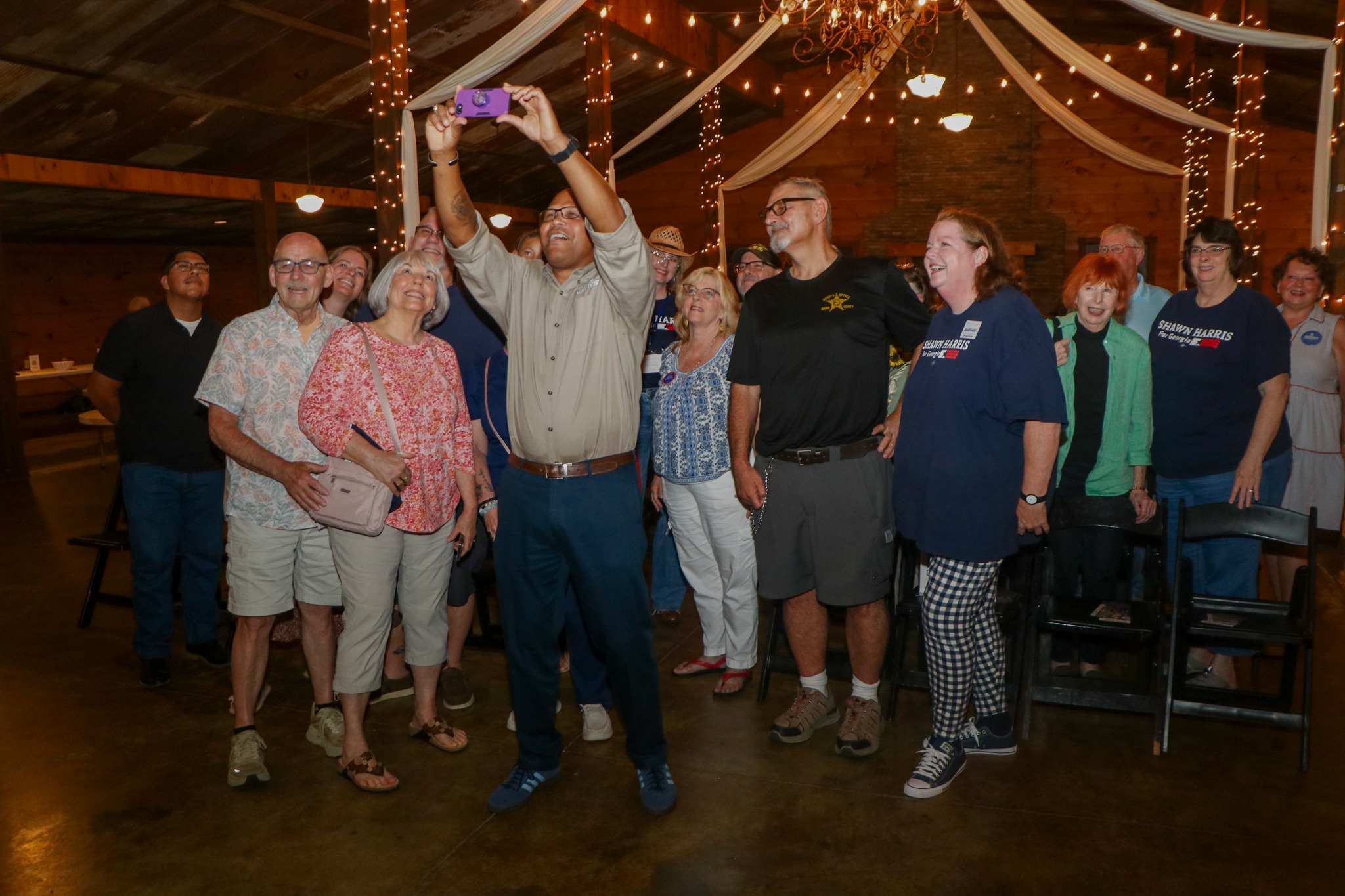
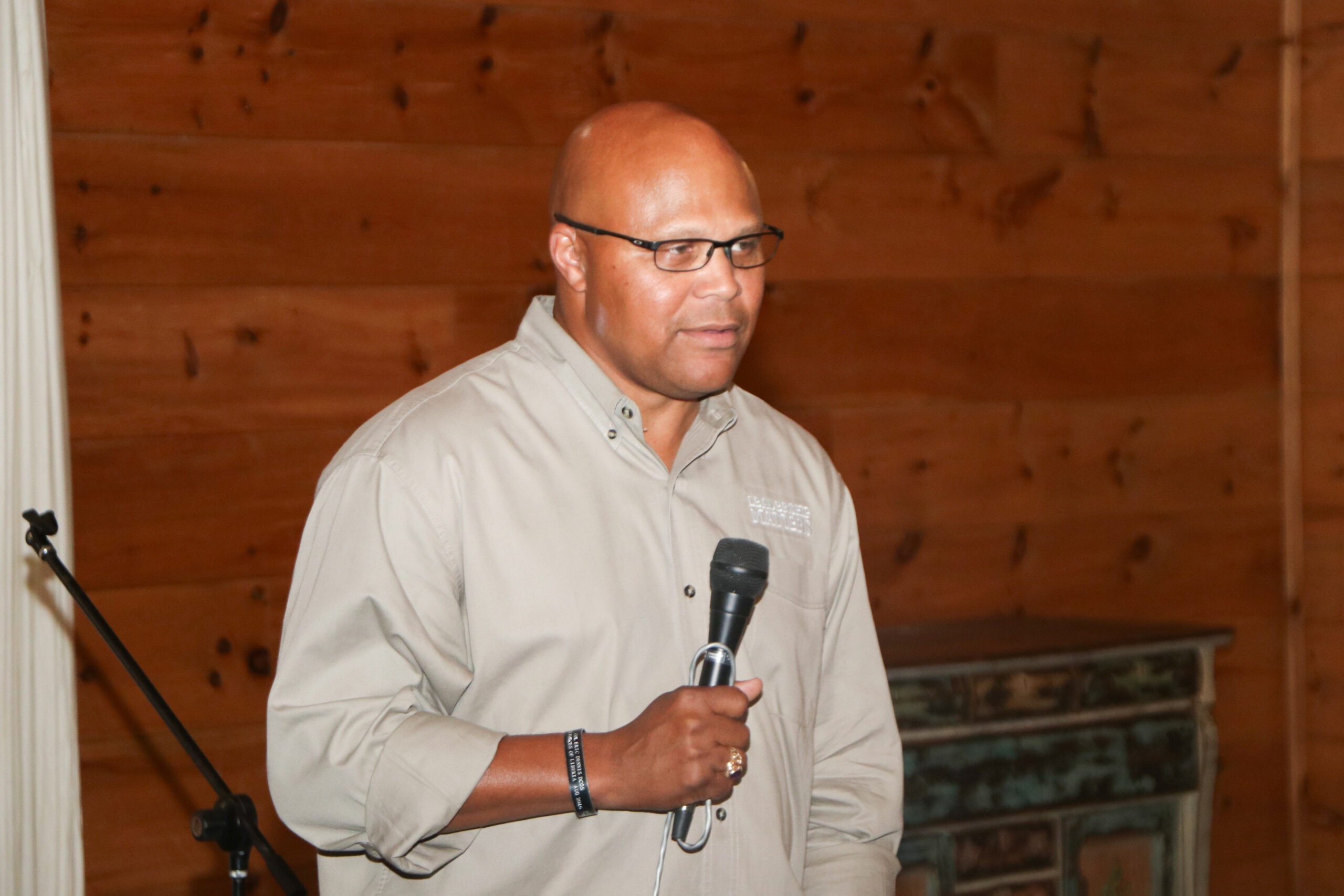
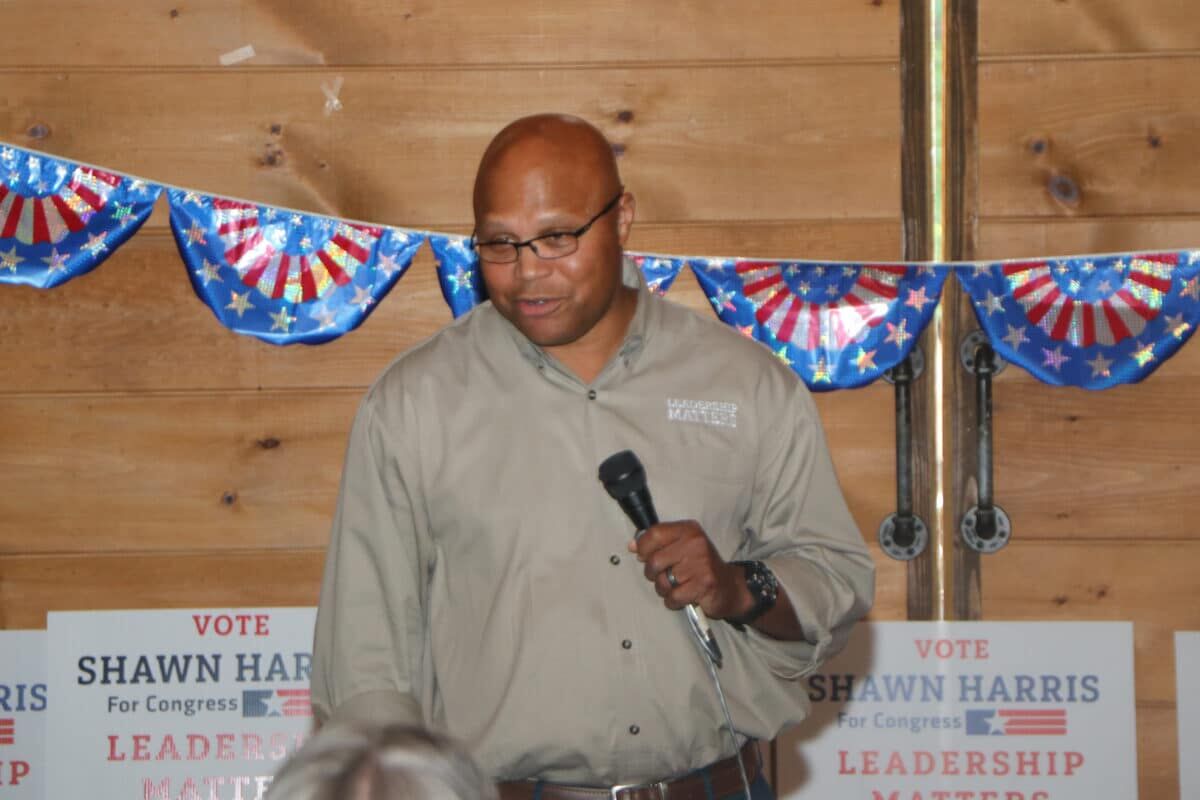
Democrat Shawn Harris speaks to supporters during townhall in Chatsworth, GA July 21, 2026 (Milton Kirby)
The Jordans, a white, middle-aged couple, say they are voting for Shawn Harris, a Black retired brigadier general running as a Democrat for Congress in Georgia’s sprawling 14th Congressional District. The couple frequently finished each other’s sentences while explaining that in the last two years, Scott, 63, who uses a pacemaker, lost his federal health coverage. After the One Big Beautiful Bill rolled back tax credits and imposed new requirements to the Affordable Care Act in 2025, their adult children no longer have access to health insurance, including their daughter, a recent cancer survivor.
“She doesn’t have insurance now,” Lori says quietly.
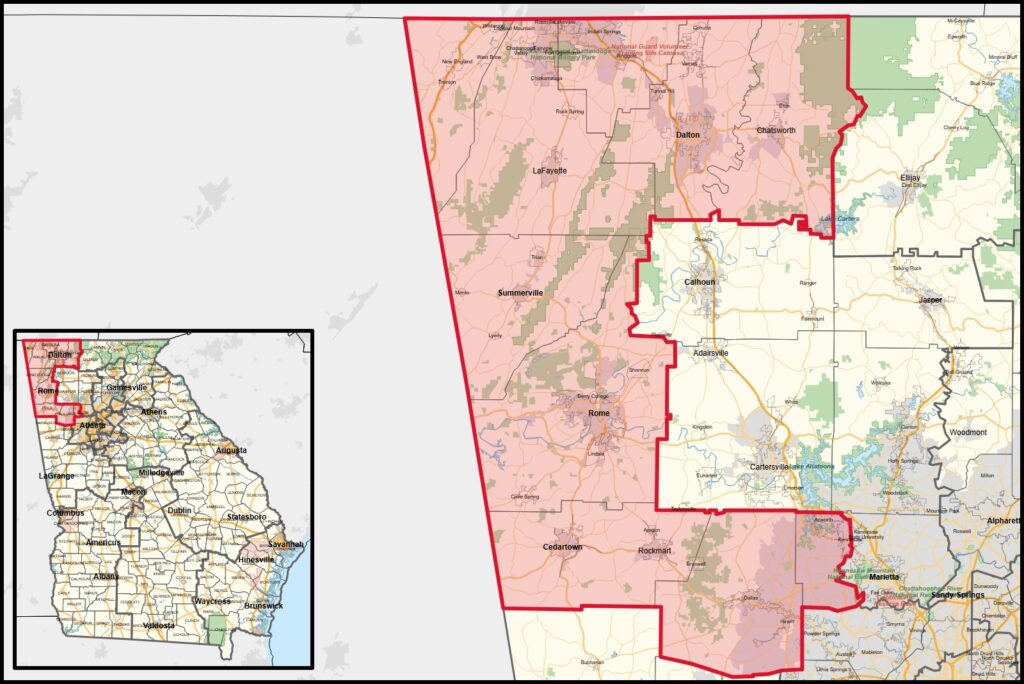
Dallas, a town of 15,000 more than 30 miles northwest of Atlanta, is the county seat of Paulding County, one of the most competitive parts of a congressional district that spans roughly 3,000 square miles along the northwest corner of Georgia’s state line. In previous years, the district held national attention because of its firebrand Republican representative Marjorie Taylor Greene.
Greene rose to power in 2020, riding a wave of extreme right-wing reaction during the pandemic, during which she compared vaccine requirements to the yellow stars that Nazis forced Jews to wear during the Holocaust. Her unabashed promotion of Donald Trump’s false claims of a rigged 2020 election, QAnon conspiracy theories and Christian Nationalist views enabled her rapid ascent as a central figure of the MAGA movement.
Yet Greene’s subsequent fall from grace in the Republican party has marked one of the more astonishing political reversals in recent memory. By 2025, tensions that emerged between Trump and Greene had turned into a full-blown rift as Greene criticized Trump for his opposition to the Epstein Files Transparency Act and ignoring an “America first” agenda with military interventions in Venezuela and Iran. In November 2025, Greene announced her decision to resign from Congress, leaving power up for grabs in her Georgia seat.
14th US Congressional District
In a March special election to complete Greene’s unexpired term, Democrat Shawn Harris finished first in a crowded field of 17 candidates, 12 of them Republicans, receiving 37% of the vote. Republican Clay Fuller finished second with 35%.
In the April runoff, Fuller, who is white, defeated Harris, with 56% of the vote to Harris’s 44%, a difference of just over 15,000 votes. In Paulding County, population 191,000, Harris lost by just 273 votes, garnering 49.9% of the vote, a dramatic 9-point improvement over his previous run.
Both men subsequently secured their parties’ nominations for the November election (Fuller also received Trump’s endorsement), setting up another Harris-Fuller contest, this time for a full two-year term.
The result could carry implications beyond northwest Georgia. In 2024, Harris challenged Greene and lost decisively, receiving just 36% of the vote. Harris’s 44% in the April runoff could either represent evidence of an electorate becoming more receptive to him or the ceiling for a well-funded Democrat in one of Georgia’s most Republican congressional districts.
At a time when Democrats nationally are searching for ways to compete outside major cities and suburbs, Harris is testing whether biography, small-dollar fundraising, local organizing and a deliberate appeal to independents and Republicans can overcome a district’s deeply established partisan identity.
Soldier, farmer and candidate
For Harris, a retired brigadier general and cattle farmer, places like Paulding may determine whether his latest campaign for Congress ends differently from the ones before it.
He is attempting something Democrats have been unable to accomplish in this deeply Republican corner of Georgia: win a seat in Congress. And he’s attempting it as a Black man in an 88% white district without an ounce of support from the Democratic Congressional Campaign Committee (DCCC).
This time, however, his numbers show his effort is about more than making a statement.
Harris’s appeal to northwest Georgia voters begins with his biography.
He grew up on his family’s farm in southwest Georgia. After high school, he enlisted in the U.S. Marine Corps. He later earned a degree in agribusiness from Tuskegee University, where he met his wife, Karla. He transitioned to the U.S. Army, serving as a combat infantry commander in Afghanistan and rising to the rank of brigadier general before retiring. Today, Harris and his wife operate a first-generation grass-fed cattle farm near Rockmart, 50 miles northwest of Atlanta.
Speaking before voters in rural Chatsworth in July, Harris presented himself as a politician focused on constituent service.
“When I get to D.C., my focus is one hundred percent you, your kids and your grandkids,” Harris told the audience. “I don’t need to be seen on TV. I’m not looking to be some celebrity.”
Shawn Harris speaks to voters at a campaign event in Chatsworth, Georgia, on July 21. (Milton Kirby)
For at least one voter in Chatsworth, that message strikes a chord. Peggy Hobgood voted for Trump 3 times.
“Just seems like this time, I hate to say this, that man’s all about putting his name on a building or a boat or a dollar bill,” Hobgood says. “We don’t need a president like that and we don’t need another one falling in behind him either. I just hate to see people, older people who worked their whole lives and they’ve got nothing.” But Hobgood says she has no plans to vote again because “it’s crooked everywhere.”
Harris calls himself a moderate, “common sense” Democrat and argues that his path to Congress requires a coalition of Democrats, independents and Republicans. He is running on bread-and-butter issues such as better roads, more mental health services, more health clinics, lower grocery prices, expanded broadband and a fully-funded farm bill. Fuller, his opponent, is an attorney who also serves in the Air National Guard. Fuller grew up in north Georgia and was the district attorney for a four-county circuit in northwest Georgia, according to his campaign website. Appointed by Trump as a White House Fellow during the president’s first term, he identifies himself as a Christian conservative who defends the unborn. He espouses America First policies including tougher immigration enforcement and mass deportation.
Donald Trump carried the 14th District by roughly 37 percentage points in 2024. But the president’s polling numbers have sunk to new lows. Democratic candidates across the country are tapping into the economic hardship voters are facing from arbitrary on-and-off tariffs and an unprovoked war on Iran driving up prices while Republicans respond with cries of communism.
Harris sees his campaign’s role in a larger Georgia political landscape where many key races are in play.
Democrat Keisha Lance Bottoms, the former mayor of Atlanta, is in a statistical tie with billionaire newcomer Rick Jackson for the open governor’s seat, according to Georgia-based pollster InsiderAdvantage, WABE public radio reports. Jackson announced last week that he has allocated $87 million in advertising against Lance Bottoms, who has less than $1 million on hand. The same poll also showed Sen. Jon Ossoff, the Democratic incumbent, 7 points ahead of his challenger Mike Collins. Both candidates are multimillionaires, according to the Atlanta Journal Constitution.
“If Jon Ossoff is still our senator, and Keisha Lance Bottoms is our governor, she just made history,” Harris tells Barn Raiser. “And then everybody else below me gets elected, all the way down to the lowest level you can come up with, and I lose, that is still a win.”
Measuring rural support
Harris Campaign Communications Representative Lauren Boone tells Barn Raiser that support is already developing across rural Northwest Georgia.
Boone points to local volunteers, donors, people placing yard signs and residents attending events. The campaign says its volunteer operation extends throughout the district and includes people from rural and agricultural communities.
Boone also claims that campaign canvassing from the special and runoff elections indicated Harris received support from 65% of independents and 20% of Republicans.
Georgia does not register voters by political party, making crossover voting difficult to determine from election returns alone, so the campaign’s numbers do not prove Harris won 20% of Republican voters. But they reveal what Harris’s campaign believes its own voter contacts are telling it, and they help explain the campaign’s strategy.
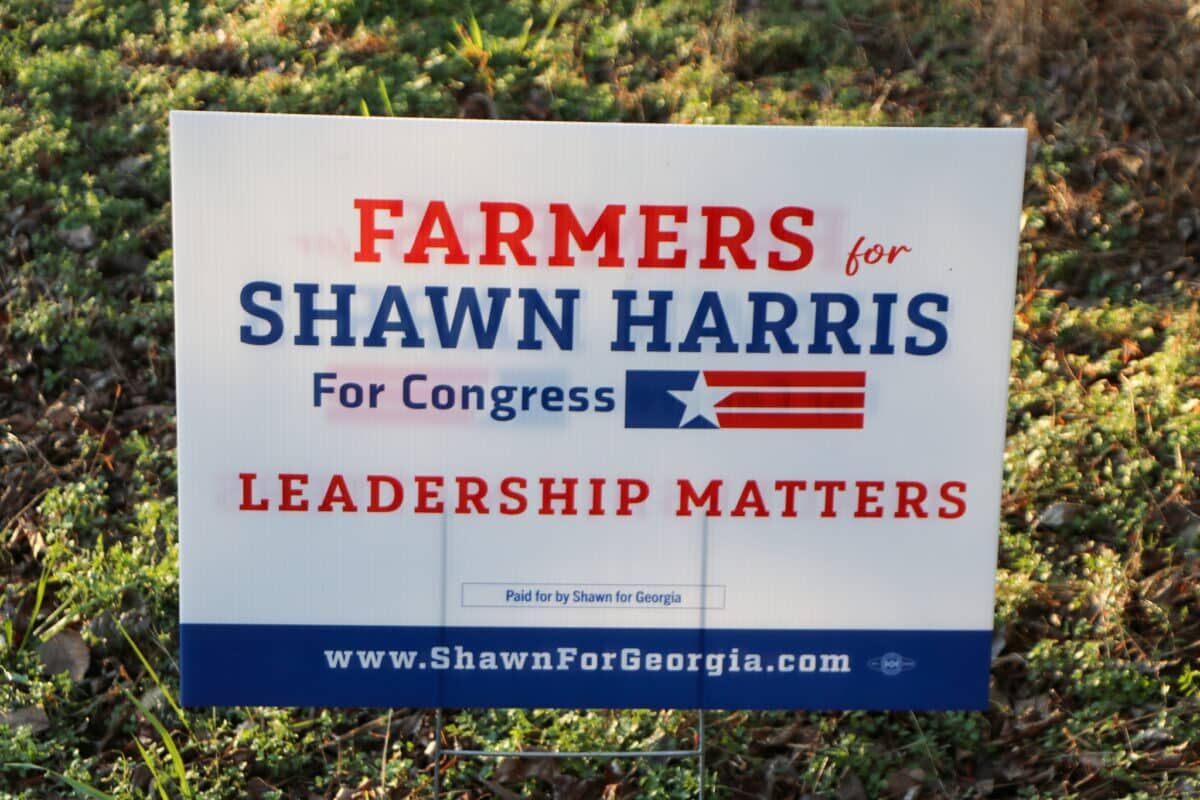
A yard sign supporting Shawn Harris in Georgia’s 14th Congressional District. (Milton Kirby)
An analysis of the election results offers some insights, though. In more Democratic-leaning parts of the district, Harris was able to hold his own, garnering between 43% and 58% of the vote.
But the numbers change considerably farther into the district’s Republican strongholds. In those areas, support for Harris ran between 24% and 36%, far behind Fuller.
Perhaps most strikingly, Harris received only 31% of the vote in Polk County, where he lives and farms.
Those results show both the opportunity and the problem facing his campaign. Harris has demonstrated significant competitiveness in portions of the district, while a substantial Republican wall remains elsewhere.
Can Harris really win over Republicans?
The narrow margin in a Republican stronghold like Paulding does not mean that Paulding has suddenly become Democratic, nor does it establish that large numbers of Republicans crossed over to Harris.
It does demonstrate something more limited, but important: in at least one populous part of this overwhelmingly rural and Republican district, Harris was able to make the race essentially even.
For Democrats looking nationally at whether deeply Republican territory can still be contested, Harris does not necessarily have to turn every red county blue. Neither does he have to persuade most Republicans to vote Democratic. He just needs enough of them, combined with Democrats and independents, to change the arithmetic in counties where Republican margins have traditionally been overwhelming.
Rural Georgians feeling the economic pain of the Trump administration’s policies combined with inaction by a Republican-led Congress might just tip the scale.
Paulding County offers a glimpse of what that would look like.
An $8 million question
Harris has demonstrated an extraordinary ability to raise money without party support.
Federal Election Commission (FEC) records show his campaign raised approximately $8.1 million from April 2025 through June 30, 2026, four times more than his opponent.
Nearly all came from individual contributions. About $6.22 million of Harris’s individual contributions were reported as unitemized.
Communications Representative Boone says the average contribution is $22.02, although that figure cannot be independently verified by FEC reports. Fewer than 50 contributors have donated more than $3,000. Harris reported no candidate loans and no contributions from party committees.
Campaign records show that Harris hired a Massachusetts campaign consultant called Campaign Industries, founded by a veteran election campaign organizer Mac D’Alessandro and a veteran union organizer John Hennelly. It offers candidates complete campaign services from creating strategy to hiring, firing and managing field staff.
The Harris campaign has dedicated more than $3.2 million to digital fundraising and social media, which explains, in part, the high number of small donors.
Boone says the campaign maintains a small staff, with four regular staffers and several part-time consultants and support staff, allowing it to devote resources to direct voter contact.
“We are very focused on our field program, door knocking, phone calling, town halls, etc. throughout the district,” she says. “Our amazing volunteer corps has played a big part in allowing this model to work so successfully.”
Less than $1 million was spent on campaign staff during the 12-month period, according to Boone. The remainder went toward fundraising, voter contact and persuasion through field operations, social media and paid media.
Boone says that in addition to nearly 200 active volunteers inside the district, the campaign has more than 500 nationwide. Some of those volunteers, she says, are expected to travel to northwest Georgia during the closing days of the campaign. For a congressional candidate receiving no DCCC support, the nationwide volunteer network presents an unusual contrast.
Through June 30, Fuller reported approximately $1.85 million in receipts and $1.78 million in spending. About $1.08 million came from individuals, with his top donors contributing tens of thousands each and another $305,481 from other political committees. Fuller also loaned his campaign $450,000.
The Republican PAC Conservatives for American Excellence has spent nearly $500,000 opposing Harris. Additionally, more than $2.7 million in dark money is backing Fuller.
Fuller’s donor list includes the American Israel Public Affairs Committee (AIPAC), the Koch Foundation, MAGA, Inc., Lockheed Martin and WinRed. His PAC donor list is more than 100 organizations long and totals an estimated $305,000. (By comparison, four PACs have donated just under $14,000 to Harris.)
Fuller has also spent the majority of his funds on media buys and digital strategy. His campaign consultant is Wiregrass Strategies, a firm run by Brandon Phillips, manager of Donald Trump’s 2016 Georgia presidential campaign. There is little indication of major expenditures on field staff in his FEC report. His campaign did not respond to requests for interviews.
The contrast shows Harris is attempting to finance a competitive campaign largely through individual contributions and an enormous small-dollar fundraising operation.
Fuller, on the other hand, is benefiting from a different financial ecosystem, including candidate financing, PAC contributions, major donors and outside spending.
A test bigger than GA-14
Harris frequently tells audiences that “leadership matters.” For him, the phrase extends beyond winning an election.
“Leadership means you know when to get the hell out of the way, so somebody else can get in the seats,” Harris told an audience in July.
He has also framed leadership as something extending beyond himself, talking about helping elect other candidates and building political participation throughout the ticket.
His campaign expenditures show he means it. Not only is the Harris campaign not receiving funds from the Democratic Party, he is donating to them. Federal filings show the Harris campaign donating more than $27,000 to Georgia’s state Democratic party and multiple county Democratic parties in the district for event sponsorships and more.
Georgia’s 14th District is becoming a test of something larger: Can a Black Democrat compete in deep-red rural and white America without waiting for the national party to decide the race is winnable?
Harris is betting millions of dollars, hundreds of volunteers and yet another campaign that the answer is yes.
Keisha Lance Bottoms brought confidence and candor to NABJ 2026, but Rick Jackson’s $87 million advertising campaign presents a formidable challenge.
By Milton Kirby | Atlanta, GA | August 18, 2026
Keisha Lance Bottoms walked onto the stage at the 2026 National Association of Black Journalists Convention Friday looking and sounding like a candidate comfortable with who she is.
The Democratic nominee for governor of Georgia spoke about politics, race, election security and the challenge of campaigning across a state where voters may share concerns even when they do not share political labels.
But some of the most revealing moments came when Bottoms stopped talking about the campaign and talked about herself.
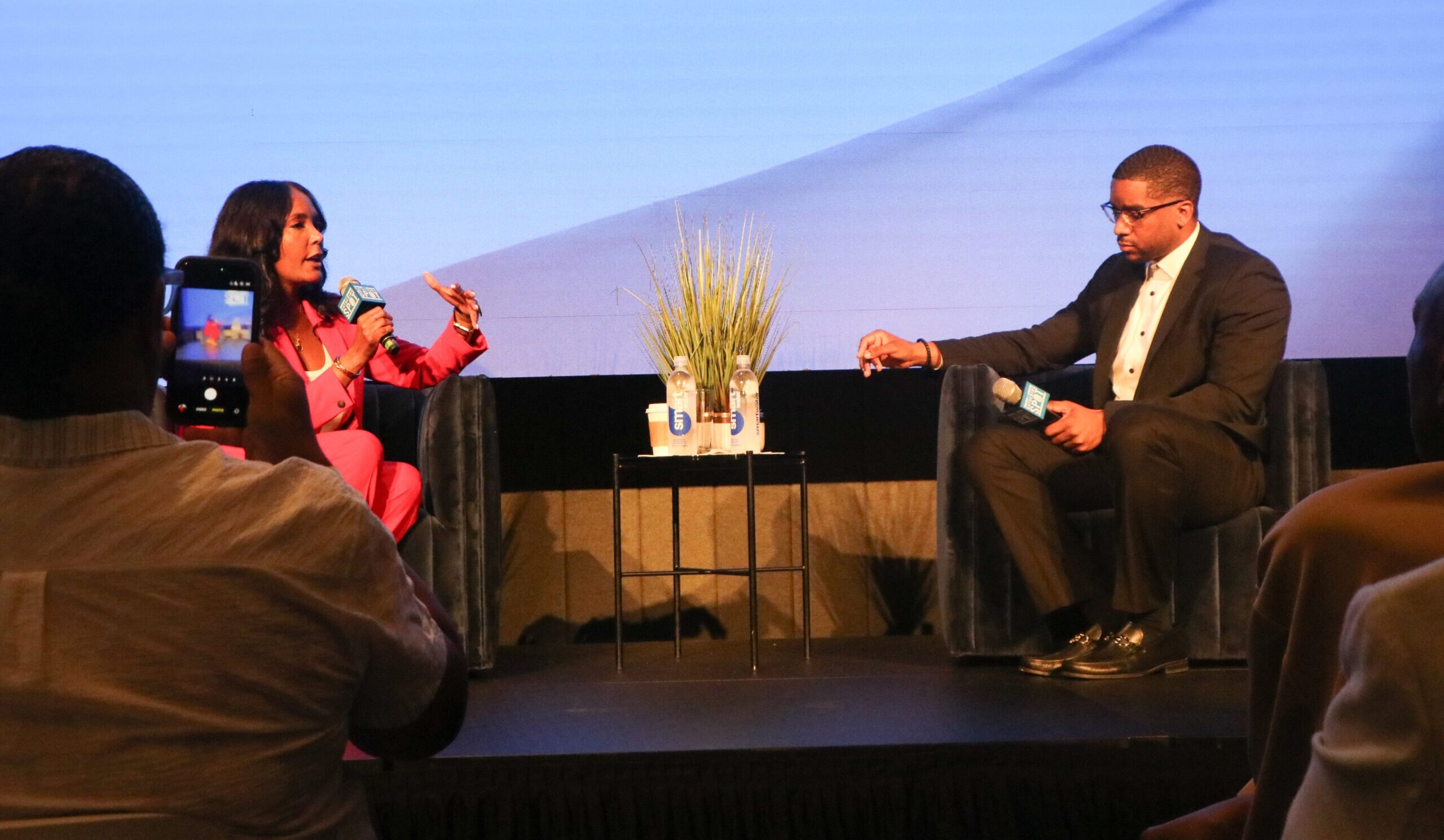
During a fireside chat with Dateline NBC correspondent Blayne Alexander, Bottoms discussed painful chapters of her life that she revealed in her recently published memoir, The Rough Side of the Mountain: A Memoir.
She spoke about her father’s incarceration. Infertility. An eating disorder. Being molested as a child. Therapy.
“I’ve laid it all out,” Bottoms told the audience.
It was a strikingly personal conversation for a candidate less than three months from Election Day.
Yet Bottoms appeared confident and at ease as she moved between the personal and political, making the case that the experiences that shaped her life also shaped the public servant she has become.
From the Back Door to the Front Door
Before Bottoms talked about becoming governor, she talked about her grandfather.
She recalled how he and relatives started a business and came into what the family called “uptown,” now downtown Atlanta, to haul paper and trash from buildings and recycle it.
Eventually, she said, her grandfather bought a truck and traveled along Peachtree Street.
For Bottoms, walking into a downtown Atlanta hotel carries a meaning that goes beyond attending another political event.
She said she thinks about how her grandfather once came downtown to work and how she now has the opportunity to “walk in the front door.”
That history, she said, is always present with her.
Generations later, his granddaughter was sitting onstage at a national gathering of Black journalists as the Democratic nominee for governor of Georgia.
Bottoms did not dwell on the historic nature of her candidacy.
Instead, she pointed to the sacrifices that made it possible.
“My Message Doesn’t Change”
Alexander pressed Bottoms on one of the central questions facing any Democrat seeking statewide office in Georgia: How does a former Atlanta mayor connect with voters far beyond metro Atlanta?
Bottoms rejected the idea that she becomes a different candidate depending on where she campaigns.
“My message doesn’t change,” she said. “The landscape, the geography may be different.”
Whether she is speaking in Macon, Albany, Jesup or Atlanta, Bottoms said voters want many of the same things: strong communities, good schools, access to health care and opportunities for economic prosperity.
The starting points may be different, she said, but the needs often are not.
Bottoms also challenged the notion that she is known only in Atlanta, saying her campaign has been doing the work statewide.
Campaigning outside metro Atlanta can actually make it easier to break through, she argued. In smaller media markets, a gubernatorial candidate’s visit may become one of the biggest local stories of the day.
“You can’t run for a statewide office with fear, or apprehension,” Bottoms said.
She said face-to-face encounters also can break down assumptions. When people sit together one-on-one, they begin to see one another as human beings and sometimes discover that their concerns and beliefs overlap.
For Bottoms, the strategy comes back to authenticity.
“It’s about being who I am, wherever I am, speaking the truth, in whatever room I am in.”
The Rough Side of the Mountain
That theme of authenticity became even more pronounced when Alexander asked what voters might not know about Bottoms.
Her answer was essentially: read the book.
The Rough Side of the Mountain: A Memoir was published in April.
Bottoms told the NABJ audience that she wrote the book while outside public life, after leaving the mayor’s office and the White House, when she had no intention of running for office again.
That mattered.
She suggested she may have been more forthcoming because she was not writing while viewing every revelation through the lens of a future campaign.
Bottoms said she wrote about her father’s incarceration, her infertility, her eating disorder, being molested as a child and her therapy sessions.
The memoir, she explained, was not initially supposed to become the book that ultimately reached stores.
She envisioned something closer to a collection of essays and a love letter to her family, particularly the people and experiences she sometimes felt she had to tuck away as she climbed professionally.
Writing it became cathartic.
The response from readers also surprised her.
Bottoms said people have approached her and shared experiences they had rarely, if ever, discussed publicly. Her willingness to talk about subjects such as incarceration, infertility and childhood sexual abuse opened a door for others to talk about their own lives.
For a gubernatorial candidate, those disclosures carry political risk.
On Friday, Bottoms did not appear burdened by them.
She appeared to have incorporated them into the story she now tells about herself.
Martha’s Vineyard and an Attack From Jackson
The conversation eventually moved directly into the general-election campaign.
Alexander gave Bottoms an opportunity to respond to an attack from Republican nominee Rick Jackson criticizing her travel to Martha’s Vineyard.
Bottoms did not retreat.
She noted Martha’s Vineyard’s long history as a destination for Black families and described it as a place of refuge, community and renewal.
She also connected her ownership of property there to her family’s history and economic progress.
“I find it as a badge of honor that I own land in Martha’s Vineyard and in Georgia,” Bottoms said.
The exchange offered a preview of what Georgians are likely to see much more of before November: Jackson attempting to define Bottoms, and Bottoms trying to prevent him from doing so.
And Jackson has extraordinary resources with which to make that attempt.
The $87 Million Challenge
One subject received surprisingly little examination during the fireside chat: money.
Jackson has committed $87 million to television and digital advertising in the general election after spending more than $100 million of his own money pursuing the Republican nomination.
That financial advantage presents Bottoms with a challenge unlike anything she faced in her campaigns for Atlanta mayor.
It raises a fundamental question:
How does Bottoms prevent Jackson from defining her when he can spend tens of millions of dollars delivering his version of her record to Georgia voters?
Alexander covered considerable territory during the limited conversation, including Bottoms’ personal life, campaigning outside metro Atlanta, Martha’s Vineyard, election security and the state of American democracy.
But the financial disparity between the candidates received little examination.
The issue is particularly significant because the race remains competitive.
A recent Quantus Insights survey of 815 likely Georgia voters, sponsored by the Natural Gas Association of Georgia, put Bottoms at 46.4% and Jackson at 44.9%, with 7.7% undecided.
The poll should be viewed for what it is: one snapshot of the electorate, commissioned by an organization with its own policy interests.
Still, its narrow margin illustrates what is at stake.
If the race remains close, the ability to reach undecided and persuadable voters repeatedly could become decisive.
Jackson can buy an extraordinary amount of that communication.
Bottoms will have to find other ways to compete.
Concerns About Georgia’s Elections
Bottoms also used the NABJ stage to express concern about Georgia’s election system.
Asked whether she believes Georgia’s elections are safe and secure, Bottoms said they are as safe and secure as elections can be in America right now, but she remains concerned about interference and restrictions on voting access.
Her answer quickly moved from concern to strategy.
“We’ve got to show up in the millions,” she said.
Bottoms called for making Election Day a state holiday and expanding early voting opportunities and hours.
Her message was that voters should not wait until Election Day.
Vote early. Vote in large numbers. Create margins large enough that the outcome cannot easily be questioned.
Alexander also asked Bottoms about the possibility of federal intervention surrounding Georgia’s election.
Bottoms said candidates and voters have to be prepared for the unexpected.
She then invoked Atlanta’s civil rights history and argued that Georgia has an opportunity to lead.
Who Does the Governor Work For?
Near the conclusion, Bottoms brought the conversation back to the distinction she wants voters to see between herself and Jackson.
She pointed to her experience as a judge, Atlanta City Council member, mayor and senior White House adviser.
Then she described the people she wants to represent.
The single mother working in the city.
The father trying to pay his rent.
The person struggling to pay for a parent’s medical treatment.
People who need someone in government to speak for them.
Jackson, Bottoms argued, can focus on distractions.
She wants to focus on people’s lives.
It was the campaign message she carried throughout the conversation: biography, hardship and public service presented not as separate chapters, but as parts of the same story.
Confidence Is Not the Question
Bottoms did not look like a candidate searching for her identity Friday.
She appeared confident.
She was willing to discuss the painful parts of her childhood, her family and deeply personal experiences. She defended her success rather than apologizing for it. And she insisted that she can walk into communities across Georgia without changing who she is or what she believes.
The question confronting her campaign is whether that confidence can translate into enough votes to win statewide.
Jackson has the money to make his case again and again.
Bottoms has a different proposition.
She is asking Georgians to look at the whole of her life, including the rough side of the mountain, and decide whether the journey qualifies her to lead the state.
Between now and November, she will have to make sure enough of them hear that story.
With 99 days until Election Day, Democratic gubernatorial nominee Keisha Lance Bottoms urged Georgia voters, especially Black men, to deliver record turnout during a town hall at Atlanta’s Gathering Spot.
At Atlanta’s “Mandate” town hall, the Democratic nominee made a direct appeal to Georgia voters, particularly Black men, arguing that grassroots organizing, not campaign spending, will determine who becomes the state’s next governor.
By Milton Kirby | Atlanta, GA | July 28, 2026
With just 99 days remaining before Georgians choose their next governor, Democratic nominee Keisha Lance Bottoms walked onto the stage at The Gathering Spot Monday evening carrying a message that has become the foundation of her general election campaign.
She isn’t asking voters to be impressed by campaign spending.
She isn’t asking them to be persuaded by carefully choreographed social media moments.
Instead, she is asking them to participate.
Speaking before a packed audience at “The Mandate,” a town hall organized by The Gathering Spot and moderated by co-founder Ryan Wilson, Bottoms repeatedly returned to one central theme: Georgia’s next governor will not be chosen by the candidate with the biggest advertising budget or the most viral campaign photographs. The election, she argued, will ultimately be decided by ordinary Georgians willing to organize their communities, encourage their neighbors and show up to vote in record numbers.
“Turnout is key. Turnout is key. Turnout is key,” Bottoms told the audience, emphasizing that participation—not complacency—will determine whether Democrats can reclaim Georgia’s highest office for the first time in more than a quarter century.
The message came at a pivotal moment in one of the nation’s most closely watched gubernatorial races.
Earlier Monday, Republican nominee Rick Jackson’s campaign announced an $87 million statewide advertising buy, underscoring the enormous financial resources fueling his campaign. Jackson, a billionaire healthcare executive who has already poured more than $100 million into the race, has paired that media strategy with a series of highly publicized visits to Black-owned businesses, churches and community gathering places throughout metro Atlanta.
Bottoms acknowledged the financial disparity but dismissed the notion that money alone will determine the outcome.
“We’re going to do what we need to do with what we have,” she told reporters after the event. “Whatever that amount is, we are still going to take our case directly to the people of this state.”
A Race That Could Reshape Georgia Politics
The stakes extend well beyond the two candidates.
No Democrat has won Georgia’s governor’s race since Roy Barnes was elected in 1998. Yet the state’s political landscape has shifted dramatically over the past decade. Georgia has twice elected Democratic U.S. senators, and razor-thin statewide contests have transformed the state into one of America’s premier political battlegrounds.
Those changes have elevated turnout from a campaign tactic to a governing strategy.
Political analysts from both parties agree that victory in November will depend less on persuading large numbers of undecided voters than on motivating reliable supporters to cast ballots. That reality has placed Black voters and particularly Black men at the center of both campaigns, although the candidates are pursuing markedly different approaches.
Monday night’s town hall reflected Bottoms’ strategy.
Rather than delivering a traditional stump speech, she spent nearly two hours answering questions about affordability, education, healthcare, economic opportunity and voting rights while repeatedly encouraging attendees to become ambassadors for civic participation within their own families and neighborhoods.
Answering a Personal Call to Serve
Bottoms told the audience that seeking the governor’s office was never part of a carefully crafted political roadmap.
After completing her four-year term as mayor of Atlanta, she said life had become comfortable. Returning to elected office was not part of her immediate plans.
That changed after the 2024 presidential election.
“The day after the presidential election, I cursed and then I prayed,” she recalled, explaining that she spent considerable time reflecting on whether she was being called back into public service. The decision, she said, required conversations with her husband and children because campaigns demand sacrifices from entire families, not just the candidates themselves.
“It was really about what am I called to do?” Bottoms said. “What can I offer? And is it worth me getting out of my comfort zone? Because life was comfortable. And the answer was yes.”
That sense of purpose shaped much of the evening’s discussion.
Rather than focusing primarily on partisan attacks, Bottoms framed her candidacy as an effort to build on opportunities created by previous generations while creating new ones for the next.
“I want to be able to look at my kids in their faces and say in this moment I did everything that I could do on behalf of us,” she said.
The Issues She Says Georgians Raise Everywhere
As Bottoms has campaigned from metropolitan Atlanta to rural South Georgia, she said the conversations have remained remarkably consistent.
Whether speaking in barbershops, churches, community centers or small-town gathering places, Georgians repeatedly raise the same concerns.
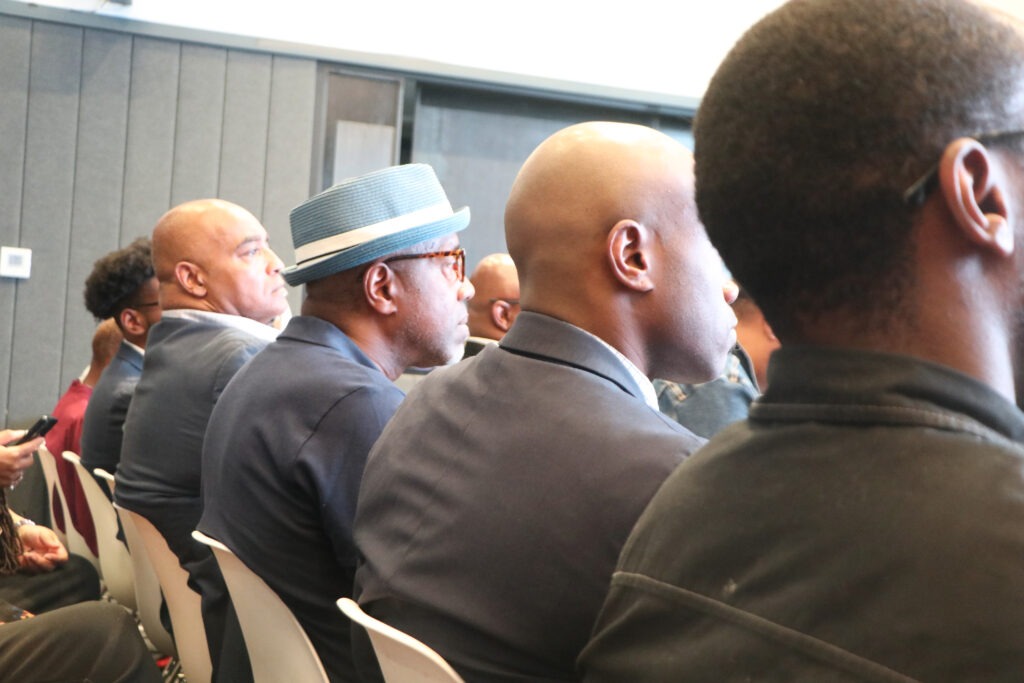
Unidentified Black men listen with intensity – Photo Milton Kirby
The rising cost of groceries.
Housing affordability.
Gas prices.
Healthcare expenses.
Mental health services.
Support for small businesses.
Educational opportunity.
“These are some of the issues that have been generations long,” Bottoms said. “And they are coming up everywhere I go.”
Healthcare emerged as one of the evening’s most frequently discussed topics.
Bottoms argued that many Georgians are facing increasing insurance costs while others have lost coverage altogether. She connected those concerns to broader questions about affordability, describing healthcare as inseparable from the financial pressures confronting working families across the state.
Education also occupied a prominent place in the discussion.
Bottoms criticized Georgia’s long-running struggles to fully fund public education, she stated that the last time the state consistently met its funding commitments she was still a member of the marching band at Frederick Douglass High School.
Her point drew laughter.
It also underscored her broader argument that many of Georgia’s biggest challenges did not emerge overnight but have persisted across generations.
A Direct Conversation With Black Men
Although “The Mandate” welcomed a broad audience, organizers intentionally focused much of the evening on Black men, a voting bloc both political parties increasingly recognize as critical to statewide success.
Wilson challenged the narrative that Black men have become disengaged from politics, noting that conversations inside barbershops and neighborhoods often center on the same economic and quality-of-life concerns shared by other Georgians.
Bottoms agreed.
Drawing from conversations with her own sons and young men she has met while traveling the state, she said Black men are asking practical questions about employment, housing, public safety and whether higher education still guarantees economic opportunity.
“They’re concerned there won’t be jobs,” she said. “They’re concerned whether they’ll be able to afford a home. They’re concerned about interactions with public safety. They’re concerned with mental health.”
At the same time, she rejected suggestions that Black men alone bear responsibility for civic participation.
“I think it’s an unfair burden for Black men to have to carry,” Bottoms said. “This democracy is about all of us.”
Instead of singling out one demographic, she encouraged every eligible voter to recognize that participation extends beyond casting a ballot. It also includes helping neighbors verify voter registration, reminding family members about Election Day and serving as trusted voices within their communities.
That appeal to transform supporters into organizers became the thread connecting nearly every answer she gave throughout the evening.
Policy Versus Political Theater
One of the evening’s sharpest exchanges centered not on taxes, healthcare or education, but on a series of campaign photographs that have fueled debate across social media in recent days.
Republican nominee Rick Jackson has made highly publicized visits to several minority-owned businesses throughout metro Atlanta, including Toast on Lenox, Big Daddy’s Dish on Old National Highway and a Mexican-owned restaurant in Doraville. The visits generated widespread online discussion, with some business owners finding themselves unexpectedly drawn into Georgia’s increasingly heated gubernatorial campaign.
Bottoms said she takes no issue with candidates supporting local businesses. What she questioned was whether highly publicized campaign stops accurately reflect a candidate’s policies.
“I support small businesses. It’s what I do,” she said in a video posted before Monday’s town hall. “What I take exception with is when we let ‘a thing become the thing.’ The theatrics are nice, but what is the real worth? What are you actually doing?”
For Bottoms, the issue is also personal.
She traced her family’s entrepreneurial roots back more than a century, recalling that her great-grandmother operated a business on Atlanta’s west side during the 1920s. Her grandfather and aunt later owned businesses in Vine City and English Avenue, while her mother spent more than three decades operating a beauty salon that served neighborhoods across southwest Atlanta.
Those experiences, she said, shaped her understanding of what neighborhood businesses mean to families and communities.
“I live in southwest Atlanta, and I am surrounded by Black businesses,” Bottoms said during the town hall. “I don’t have to have a camera crew with me every time I walk into one.”
She also questioned what she described as contradictions between Jackson’s outreach and his policy positions, pointing to his criticism of diversity, equity and inclusion initiatives and his support for stricter immigration policies while simultaneously visiting minority-owned businesses.
Her closing line in the Instagram video became one of the week’s most widely shared political remarks.
“Don’t allow people to piss on us and then tell us that it’s raining.”
Defending Her Record as Mayor
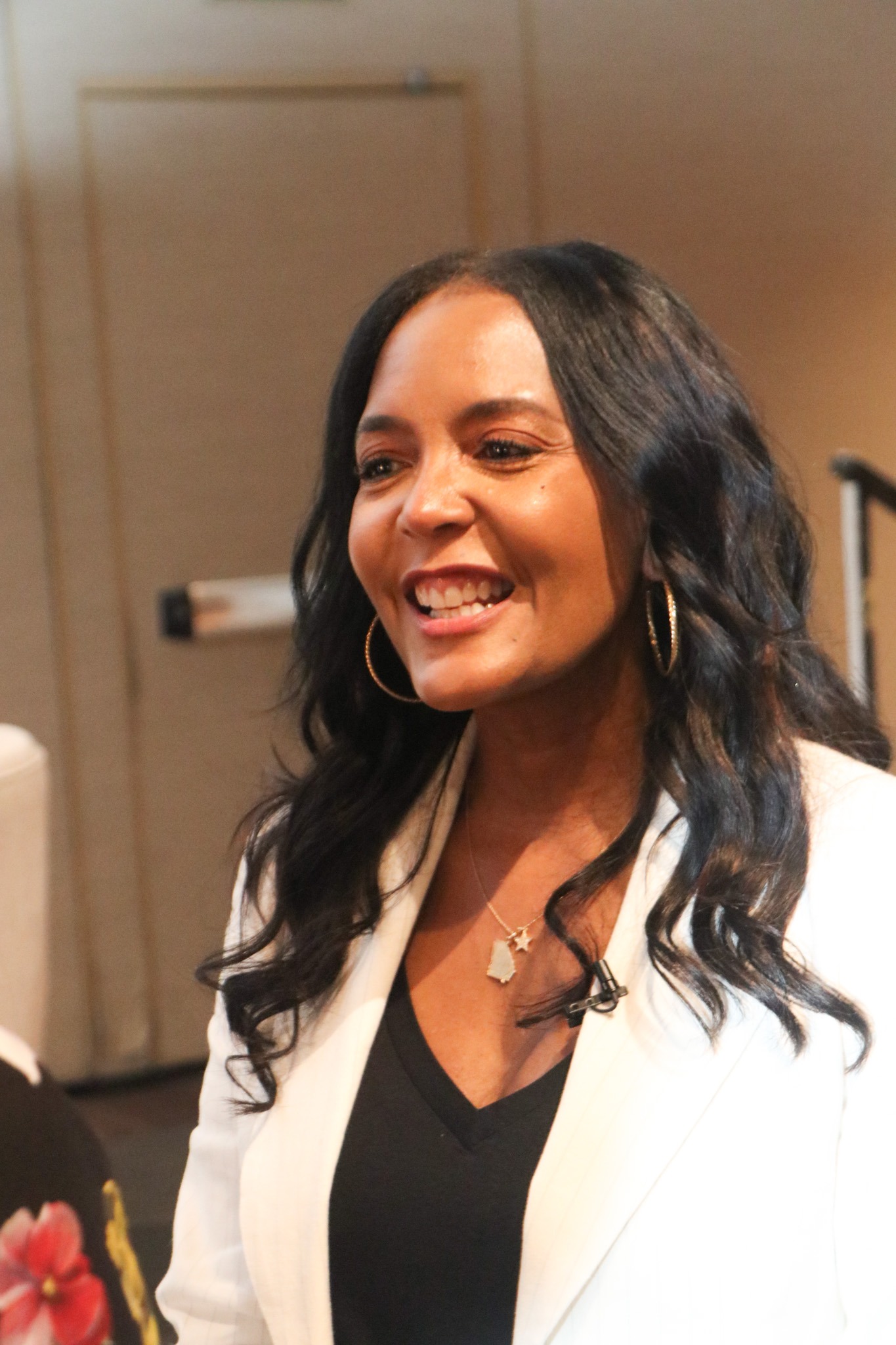
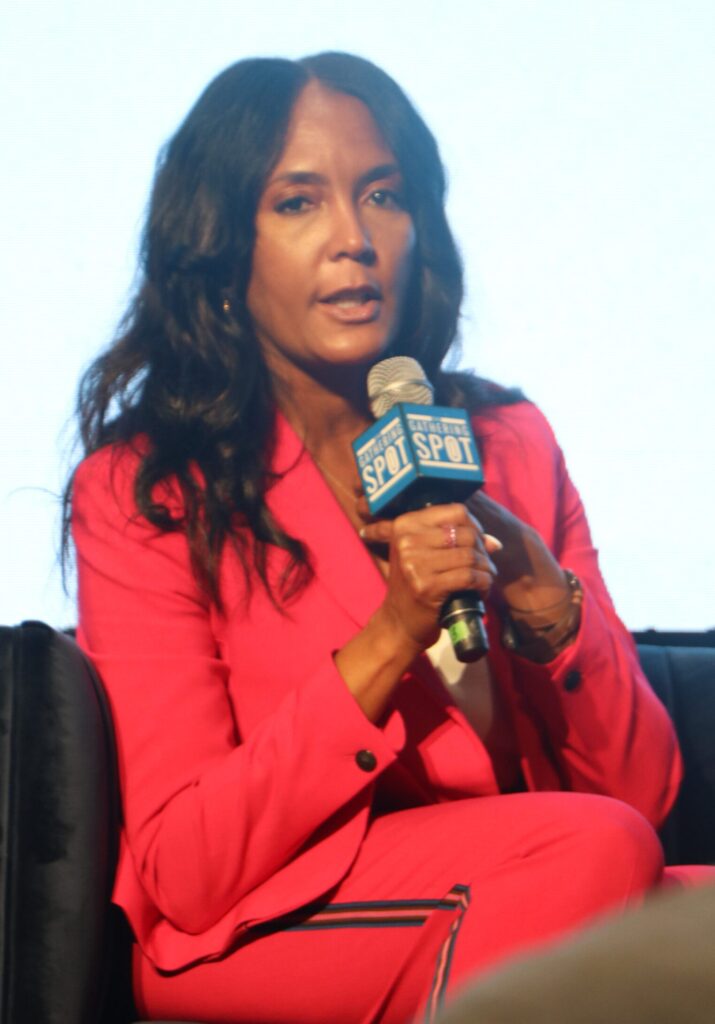
Keisha Lance Bottoms – Photo by Milton Kirby
Jackson has frequently criticized Bottoms’ four-year tenure leading Atlanta, particularly on crime and public safety.
Monday night, she answered those criticisms directly.
Bottoms reminded the audience that she served the full four-year term voters elected her to complete despite receiving multiple invitations to join the Biden administration before leaving office.
“I served every single day,” she said. “I was asked three times to join the Biden-Harris Administration, and I said no because I wanted to complete my time.”
She then walked through what she considers some of her administration’s defining accomplishments.
During the COVID-19 pandemic, Atlanta maintained balanced budgets without laying off employees or furloughing city workers. The city increased financial support for police officers and other frontline employees while continuing major economic development initiatives, including the redevelopment of the Gulch and expanding opportunities for minority-owned businesses to compete for city contracts.
Rather than arguing she governed during easy circumstances, Bottoms suggested her administration demonstrated stability during one of the most difficult periods in the city’s history.
“If you want to say something about me, fine,” she said. “But don’t lie on my name.”
Competing Against a Billionaire
Bottoms acknowledged that this campaign presents challenges unlike any she has previously faced.
Jackson, a wealthy healthcare executive making his first bid for elected office, has already invested more than $100 million of his own money into the race. His campaign’s announcement Monday of an additional $87 million statewide advertising buy underscored the financial gulf separating the two candidates.
Bottoms said she is less concerned about Jackson’s wealth than about how it is being used.
“I’m not mad about him being a billionaire,” she told the audience. “What I am mad about is the way that he is manipulating the narrative with money.”
She added that one friend’s advice continues to resonate throughout the campaign.
“If you can be bought,” she said, “you can be sold.”
Her response reflected a broader strategy that has become increasingly central to her campaign—meeting voters directly rather than attempting to match Jackson’s advertising dollar for dollar.
Looking Beyond Metro Atlanta
Although much of the discussion focused on metropolitan Atlanta, Bottoms repeatedly returned to the importance of rural Georgia.
She described communities where factories have disappeared, broadband access remains limited and young people often leave after graduating from high school because economic opportunities are scarce.
“Some communities look like time has forgotten them,” she said.
Bottoms noted that while residents across Georgia want many of the same things, good schools, quality healthcare, stable jobs and safe neighborhoods. The path toward achieving those goals differs dramatically between urban and rural communities.
Bottoms also addressed the rapid expansion of artificial intelligence data centers across Georgia, calling for a deliberate review of their long-term impact on utility costs, environmental resources and economic development before embracing additional growth.
Rather than opposing the projects outright, she said state leaders should ensure communities receive tangible benefits while avoiding unintended burdens on residents.
Building a Campaign One Conversation at a Time
Perhaps the evening’s most consistent message had little to do with campaign advertising or partisan politics.
Bottoms repeatedly encouraged supporters to become what she called “trusted voices.”
She acknowledged that some people may have time only to cast a ballot on Election Day.
Others, she said, can do more.
Call ten friends.
Help a neighbor verify voter registration.
Knock on doors.
Volunteer.
Encourage family members to vote.
“Put your oxygen mask on first,” she said. “For some people, the most you can do is show up and vote. For others, it’s calling ten people in your phone. Whatever you can do—do it.”
She also warned that misinformation and confusion surrounding elections have become significant obstacles to civic participation, particularly among younger voters trying to distinguish fact from political rhetoric.
Her challenge to supporters was simple: become reliable sources of information inside their own communities.
The Road to November
As the formal program concluded, the campaign did not end.
Bottoms remained inside The Gathering Spot well after the town hall was over, moving deliberately through the room as supporters waited for photographs and reporters gathered for follow-up interviews. She answered questions from members of the media one by one before turning her attention to attendees, posing for photographs and greeting everyone who wanted a moment with her.
There was no rush toward the exit.
No effort to shorten conversations.
The evening closed much the way it had begun; with Bottoms engaging voters one person at a time.
Only after every reporter’s questions had been answered and every attendee seeking a photograph had the opportunity to take one did she leave the venue.
The scene reflected the strategy she had described throughout the evening.
Rather than measuring success by advertising dollars or viral campaign moments, Bottoms repeatedly argued that elections are won through personal relationships, neighborhood organizing and direct conversations with voters.
Before stepping away from the stage earlier that evening, she had summarized her confidence in a single sentence.
“I don’t have to introduce myself to people,” she said. “I just have to earn their vote.”
Whether that strategy can overcome a billionaire opponent’s unprecedented advertising campaign will be answered in November.
The outcome will determine more than who occupies the Governor’s Mansion. It will also test two competing theories of modern campaigning.
One relies on extraordinary financial resources, saturation advertising and carefully orchestrated public appearances. The other is built on conversations, community relationships and the belief that ordinary Georgians, especially if they turn out in record numbers, still possess the greatest power to shape the state’s political future
Support open, independent journalism. Your contribution helps us tell the stories that matter most.
By Milton Kirby | Washington, D.C. | July 24, 2026
A bipartisan effort to make insulin more affordable for millions of Americans moved one step closer to becoming law this week as legislation led by U.S. Senator Reverend Raphael Warnock of Georgia cleared the Senate Health, Education, Labor and Pensions (HELP) Committee.
The Improving Needed Safeguards for Users of Lifesaving Insulin Now (INSULIN) Act of 2026 would cap out-of-pocket insulin costs at $35 per month for Americans with private health insurance while helping uninsured patients obtain insulin for $35 or less..
The committee approved the measure with bipartisan support, sending it to the full Senate for consideration.
For Georgia, where more than 12 percent of residents have diabetes and thousands more remain undiagnosed, the legislation could provide significant financial relief for families struggling with the rising cost of one of the nation’s most essential medications.
Expanding Affordable Insulin Beyond Medicare
The legislation builds on a major healthcare victory achieved in 2022, when Congress capped monthly insulin costs at $35 for Medicare beneficiaries through the Inflation Reduction Act.
Warnock has since worked to extend those protections to every American who depends on insulin, regardless of age or insurance status.
“After years of effort, my bill to cap insulin at $35 a month for everyone is one step closer to becoming law,” Warnock said after the committee vote.
“No one should be forced to put their health or life in danger because they can’t afford insulin or don’t know where to get it.”
If enacted, the INSULIN Act would apply the same $35 monthly out-of-pocket limit to Americans covered by private insurance, closing one of the largest remaining gaps in insulin affordability.
New Resources for Uninsured Patients
The legislation also addresses the needs of Americans without health insurance.
A provision negotiated by Warnock would establish a 10-state pilot grant program that provides funding to community health centers to supply affordable insulin while connecting uninsured patients with ongoing medical care.
The bill would also create a nationalinsulin resource center and hotline to help uninsured individuals locate affordable insulin programs, financial assistance, and healthcare providers.
Supporters say the additional resources recognize that affordability alone is not enough. Many patients also need help finding available programs and navigating the healthcare system.
Rising Costs Continue to Burden Families
The legislation comes as insulin prices remain a significant financial challenge for many Americans.
According to the Health Care Cost Institute, the average price of a 30-day insulin supply nearly doubled between 2012 and 2021, increasing from $271 to $499.
The American Diabetes Association estimates that diabetes-related medical expenses and lost productivity total$412.9 billion each year, with diabetes accounting for one out of every four healthcare dollars spent in the United States.
For patients with Type 1 diabetes and many living with Type 2 diabetes, insulin is not optional. Without consistent access, missed doses can quickly lead to serious and potentially life-threatening complications.
Years of Legislative Effort
Making insulin more affordable has been one of Warnock’s signature healthcare priorities since joining the Senate.
In 2023, Warnock partnered with Republican Senator John Kennedy of Louisiana to introduce legislation extending the $35 monthly cap to all Americans. The two senators also released a report identifying what they called “Insulin Deserts,” counties where high diabetes rates overlap with large uninsured populations, making affordable insulin especially difficult to obtain.
The current legislation represents the latest step in that continuing effort.
Bipartisan Support Gives Bill Momentum
The INSULIN Act is co-led by Senators Jeanne Shaheen of New Hampshire, John Kennedy of Louisiana, and Susan Collins of Maine and has attracted support from more than two dozen Democratic, Republican, and Independent senators.
At a time when healthcare legislation often divides Congress, supporters say the broad bipartisan coalition reflects growing agreement that access to lifesaving insulin should not depend on a family’s financial circumstances.
What Comes Next
The INSULIN Act now advances to the full Senate, where lawmakers will decide whether to send the measure to the House of Representatives.
If ultimately approved by Congress and signed into law, the legislation would represent the most significant expansion of federal insulin affordability protections since the Medicare cap took effect in 2022.
For millions of Americans living with diabetes, supporters say the bill is about more than lowering prescription costs.
It is about ensuring that no one is forced to choose between paying their bills and obtaining the medication they need to stay alive.
Sen. Raphael Warnock celebrates the Trump administration’s decision to abandon planned ICE detention centers in Social Circle and Oakwood after months of local opposition.
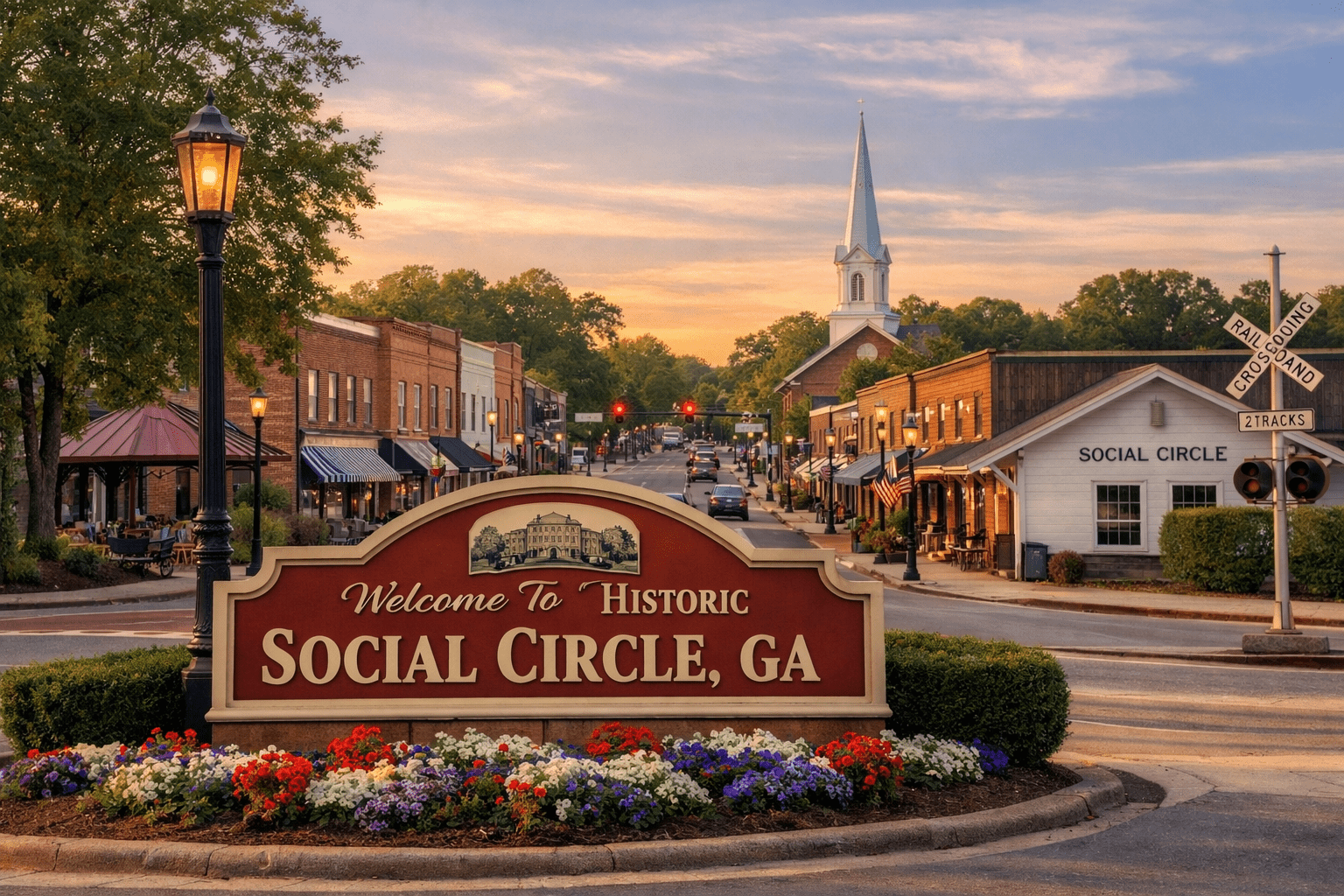
By Milton Kirby | Social Circle, GA | June 20, 2026
For months, residents of Social Circle feared their small town would become home to one of the largest immigration detention facilities in the nation.
Now, after a sustained campaign by local officials, community members, and U.S. Senator Reverend Raphael Warnock, those plans appear to be dead.
The Department of Homeland Security has reportedly abandoned plans to convert warehouses in Social Circle and Oakwood into massive immigration detention centers and instead plans to sell or give away the properties. The decision marks the end of a months-long battle that pitted two small Georgia communities against a federal proposal they believed would overwhelm local infrastructure, strain public services, and fundamentally change the character of their towns.
For Social Circle, a city of roughly 5,000 residents, the stakes could hardly have been higher. Federal officials had planned to convert a one million square foot warehouse on East Hightower Trail into a detention center capable of housing as many as 10,000 detainees, effectively creating a population larger than the town itself.
“Today is a victory for the people of Georgia,” Warnock said following reports that DHS had reversed course. “When we stand up and speak out, the power of the people is more powerful than the people in power.”
The victory did not come easily.
A Plan Discovered After the Fact
One of the most controversial aspects of the proposal was how local leaders learned about it.
According to Warnock, even Social Circle’s mayor first learned of the project through a newspaper article rather than direct communication from federal officials.
“They tried to do this quietly,” Warnock said during a Friday press conference. “Imagine being the mayor of a city of 5,000 and learning the federal government is about to double the size of your town without telling you.”
The proposal immediately raised concerns among residents and local officials who questioned how a small community could absorb a detention center of such magnitude.
Those concerns intensified when ICE purchased the warehouse and surrounding 235 acres for $128 million.
Warnock said the federal government paid approximately twice the property’s market value.
“The Trump-Vance administration likes to talk about waste, fraud and abuse,” Warnock said. “Well, they paid twice the market rate for this facility. They wasted $128 million of taxpayers’ dollars. And now they have an empty building. This is what I call waste, fraud and abuse.”
Infrastructure Concerns Spark Resistance
As details of the project emerged, city officials began sounding alarms about Social Circle’s limited infrastructure capacity.
In March, Warnock traveled to Social Circle to meet with Mayor David Keener, City Manager Eric Taylor, school officials, and concerned residents. During the visit, local leaders outlined the challenges the city would face if the detention center became operational.
According to city officials, Social Circle is permitted to use one million gallons of water per day. During the hottest months of the year, residents already consume between 80 and 90 percent of that capacity.
The city’s wastewater system also operates near its limits, processing about 660,000 gallons per day. Officials estimated that the proposed detention center could require an additional one million gallons daily.
Local leaders warned that the project could lead to boil-water advisories, sewer overflows, and costly infrastructure upgrades that the city was not prepared to fund.
The location of the proposed facility also raised concerns among parents because the warehouse sits near Social Circle Elementary School.
“Folks in Social Circle voted for this president overwhelmingly,” Warnock said during his March visit. “But they didn’t vote for a 10,000-person detention center that will triple the size of their town. They didn’t vote for potential boil-water advisories or sewer overflows because this administration has overstrained their city’s resources.”
Local Voices Reach Washington
As opposition grew, Warnock brought the concerns of Social Circle and Oakwood to Washington.
In February, he filed an amendment that would have prohibited federal funds from being used to acquire, construct, renovate, or expand detention facilities in the two communities. He also sent letters to DHS officials, publicly challenged the proposal, and met with local leaders to highlight their concerns.
At Friday’s press conference, Warnock said he would continue pushing for safeguards to prevent similar situations in the future.
“I offered an amendment during the continuing resolution that would have halted this kind of construction,” he said. “And I’ll continue to make that case.”
The senator repeatedly emphasized that his opposition was driven by the concerns of local residents rather than partisan politics.
“The people of Georgia want secure borders; they do not want massive immigration detention centers in their backyards,” Warnock said earlier this year.
“The Trump-Vance administration likes to talk about waste, fraud and abuse,” Warnock said. “Well, they paid twice the market rate for this facility. They wasted $128 million of taxpayers’ dollars. And now they have an empty building. This is what I call waste, fraud and abuse.”
Relief for Social Circle and Oakwood
The reported DHS decision to dispose of the warehouses effectively ends plans for both detention centers.
For Social Circle, the reversal also preserves future economic opportunities. Local officials had worried that dedicating the property to a detention center would remove valuable commercial land from future development and reduce potential tax revenue for the city.
“This would have taken a whole lot of opportunity off of a potential tax revenue for that very small town,” Warnock said.
Questions remain about what DHS will ultimately do with the properties, but local leaders have expressed hope that the sites can now return to productive commercial use.
For many residents, however, the larger significance lies in the outcome itself.
The battle over the detention center became a test of whether a small community could influence decisions being made hundreds of miles away in Washington.
In the end, Social Circle’s residents proved that they could.
“The people of Social Circle and Oakwood didn’t vote for me,” Warnock said. “But I still fought for them because I was elected to serve all Georgians.”
As the controversy comes to a close, the outcome stands as a reminder that local voices can still shape national decisions, even when those decisions originate at the highest levels of government.
As Warnock put it, “When the people raised their voices, the administration backed down.”
Truth Seekers Journal thrives because of readers like you. Join us in sustaining independent voices.
Georgia voters set the stage for November as Keisha Lance Bottoms, Mike Collins and Mo Ivory secured pivotal victories in races with statewide implications.
By Milton Kirby | Atlanta, GA | June 17, 2026
Georgia voters delivered a series of political surprises Tuesday night, reshaping the state’s political landscape and setting up high-profile contests that will dominate the November ballot.
Billionaire healthcare executive Rick Jackson defeated Lt. Gov. Burt Jones in the Republican gubernatorial runoff, while Congressman Mike Collins secured the Republican nomination for U.S. Senate. In Fulton County, former Commissioner Mo Ivory unseated longtime Chairman Robb Pitts in a result that could significantly alter the direction of government in Georgia’s largest county.
The outcomes signal a changing political environment, with outsiders and challengers scoring major victories against better-known opponents and incumbents.
Rick Jackson Scores Stunning Upset
Rick Jackson – Courtesy photo
The night’s biggest statewide surprise came in the Republican race for governor, where Jackson defeated Jones despite entering the race as a political newcomer.
Jackson reportedly spent more than $100 million of his own money during the campaign, helping fuel one of the most expensive gubernatorial primary contests in Georgia history. His victory came against a candidate who entered the runoff with endorsements from both President Donald Trump and Gov. Brian Kemp.
Jackson built his campaign around his personal story, describing himself as a businessman who rose from poverty to build a successful healthcare staffing company. His message resonated with Republican voters seeking a candidate from outside traditional political circles.
The victory sets up a November showdown with former Atlanta Mayor Keisha Lance Bottoms, who secured the Democratic nomination earlier this year.
Bottoms is seeking to become Georgia’s first woman governor and the first African American woman elected governor in the state’s history.
The two candidates are expected to offer sharply different visions on healthcare, education, economic development, public safety, and the future direction of state government.
Major Leadership Change Coming to Fulton County
While the governor’s race drew statewide attention, one of the most consequential local results occurred in Fulton County.
Former Commissioner Mo Ivory defeated incumbent Chairman Robb Pitts in the Democratic runoff for Fulton County Commission Chair, ending the tenure of one of metro Atlanta’s most recognizable local political leaders.
The result marks a significant shift for Georgia’s largest county and signals what many observers view as a generational change in leadership.
Ivory and Pitts were once political allies. Pitts supported Ivory during her successful 2024 campaign for the Fulton County Commission. However, the relationship deteriorated as the two clashed over property tax increases, budget priorities, program funding, and broader policy issues throughout 2025.
Earlier this year, Ivory resigned from her District 4 commission seat to pursue the chairmanship.
Her victory is expected to have implications beyond the chairman’s office. Several commissioners either lost reelection bids, sought higher office, or left their positions during this election cycle. As a result, the Fulton County Board of Commissioners is expected to include at least four new members next year.
“Based upon what they have said, significant changes may be in store,” Pitts said following the election.
Ivory now advances to face Republican Eric Tatum in November. Given Fulton County’s Democratic voting history, she enters the general election as the favorite.
Senate Race Draws National Attention
Mike Collins – Courtesy photo
In the Republican runoff for U.S. Senate, Congressman Mike Collins defeated former football coach Derek Dooley by a margin of approximately 55.5 percent to 44.5 percent.
The contest became a closely watched battle within the Republican Party. Trump endorsed Collins during the final days of the campaign, while Kemp supported Dooley.
Collins’ victory is being viewed by many political observers as a win for the party’s populist wing and sets the stage for a high-profile general election contest against Democratic incumbent Jon Ossoff.
National political strategists have identified Georgia as one of the key battleground states in the fight for control of the U.S. Senate.
Ossoff quickly turned his attention to the general election, criticizing Collins in a statement released after the results became clear. Republicans, meanwhile, are expected to focus their campaign on border security, inflation, economic issues, and support for President Trump’s agenda.
The Senate race is expected to attract millions of dollars in campaign spending and substantial national media attention over the coming months.
Looking Ahead
With the primary season largely complete, Georgia voters now have a clearer picture of the choices they will face in November.
At the top of the ballot, Bottoms and Jackson will compete to succeed term-limited Gov. Brian Kemp. In the Senate race, Ossoff will seek another term while facing a challenge from Collins.
Closer to home, Fulton County voters will decide whether Ivory’s victory in the Democratic runoff will translate into a new era of county leadership.
Taken together, Tuesday night’s results demonstrated that Georgia voters remain willing to challenge political expectations. The campaigns that emerge over the next several months will help determine not only the future of Georgia, but potentially the balance of political power nationwide.
Sen. Raphael Warnock is challenging Americans to consider what $70 billion could fund in education, housing, health care, and food assistance.
By Milton Kirby | Washington, D.C. | June 4, 2026
How much is $70 billion?
For most Americans, the number is so large that it is difficult to comprehend. U.S. Senator Raphael Warnock is attempting to make that figure more tangible as Congress debates a Republican-backed proposal to provide an additional $70 billion in funding for Immigration and Customs Enforcement (ICE) and U.S. Customs and Border Protection (CBP).
Rather than focusing solely on the immigration debate itself, Warnock is asking Americans to consider an alternative question: What else could that money accomplish?
“The $70 billion that Senate Republicans will force through this week could fund universal pre-K for all 3-and 4-year-olds in this country for two years,” Warnock said in a statement released Thursday. “It represents the annual cost of groceries for nearly 11 million American households. Our government doesn’t suffer from a lack of resources. We suffer from a lack of imagination.”
The Georgia Democrat has emerged as one of the Senate’s most vocal critics of expanding ICE and CBP funding under the Trump administration. According to Warnock’s office, Congress approved approximately $75 billion for the agencies in July 2025. If the additional funding package passes, total funding would reach roughly $145 billion.
To illustrate the scale of the proposed spending, Warnock’s office released a series of comparisons spanning education, food security, health care, and housing.
Education and Child Care
According to the senator’s analysis, $70 billion could fund universal pre-kindergarten programs for all 3- and 4-year-old children in the United States for two years.
The same amount could provide free childcare for approximately 1.3 million children through September 2028 or cover two years of community college tuition for roughly 2.2 million students through September 2029.
Warnock’s office also estimates the funding could be used to double Pell Grants for undergraduate students, potentially expanding college affordability for millions of families.
Food Security
The comparisons extend beyond education.
The senator’s office estimates that $70 billion could cover the annual cost of groceries for approximately 10.7 million American households.
The funding could also provide free school lunches to an additional 22.7 million children through fiscal year 2029 or fund one year of Supplemental Nutrition Assistance Program (SNAP) benefits for approximately 31 million Americans.
For rural communities, the office notes the same amount could provide more than two years of direct payments to American farm producers.
Health Care Implications
Health care is another area highlighted in Warnock’s proposal.
According to the analysis, $70 billion could extend Medicaid coverage to approximately 2.2 million additional Americans through September 2029. The funding could also support an extension of Affordable Care Act premium tax credits for at least one year.
Perhaps most striking, the senator’s office estimates that the same amount would cover all annual insulin expenditures in the United States three times over.
The analysis further suggests $70 billion could address nearly one-third of Americans’ outstanding medical debt.
Housing and Homelessness
Housing affordability remains a growing concern across much of the nation, including Georgia.
Warnock’s office estimates that $70 billion could cover one year of rent for approximately 4.25 million Americans.
The same funding could provide $40,000 in down-payment assistance to every first-time homebuyer this year or support housing assistance for 2.4 million additional Americans through the Section 8 program through September 2029.
Perhaps the most ambitious comparison offered by the senator’s office is that the funding could support efforts sufficient to end homelessness nationwide for nearly eight years.
A Debate Over Priorities
The release comes as Congress continues debating immigration enforcement, border security, and federal spending priorities.
Supporters of increased ICE and CBP funding argue that additional resources are necessary to strengthen border security, enforce immigration laws, and support federal law enforcement operations.
Critics, including Warnock, contend that the proposed spending reflects misplaced priorities at a time when many Americans continue to struggle with rising housing costs, health care expenses, childcare costs, and food insecurity.
While lawmakers remain divided on the policy question, Warnock’s comparisons underscore a broader debate unfolding in Washington: not simply how much government should spend, but where those resources should be directed.
For voters trying to understand the implications of trillion-dollar budgets and billion-dollar appropriations, the senator’s challenge may be the most relevant question of all.
If $70 billion is available, what should America buy?
Support open, independent journalism. Your contribution helps us tell the stories that matter most.
DeKalb County leaders outlined major public safety, housing, infrastructure, and redevelopment initiatives during a wide-ranging quarterly town hall led by CEO Lorraine Cochran-Johnson.
By Milton Kirby | Decatur, GA | May 28, 2026
DeKalb County CEO Lorraine Cochran-Johnson and members of her executive leadership team presented an expansive vision and report on progress for modernization, redevelopment, public safety, infrastructure repair, and housing investment during the county’s first-quarter town hall Wednesday evening at the Porter Sanford III Performing Arts & Community Center.
The nearly two-hour meeting combined department updates, resident questions, and long-term planning discussions as county officials outlined efforts aimed at addressing aging infrastructure, blight, housing affordability, crime reduction, and economic development across DeKalb County.
“This evening, you will hear a report directly from all of the individuals that we have here on this stage,” Cochran-Johnson told attendees. “With 34 different divisions, there are a lot of people who are responsible for the work that you experience each and every day.”
Throughout the evening, county leaders repeatedly emphasized what Cochran-Johnson described as a broader effort to “move with purpose” while modernizing county government systems that, in some cases, officials said had been neglected for years.
Public Safety and Crime Reduction
Public safety emerged as one of the town hall’s central themes.
County officials highlighted increased police recruitment, improved retention, investments in technology, and the continued rollout of DeKalb’s Real Time Crime Center.
According to Tony Hughes, Assistant Chief, DeKalb County Police Department, police recruitment has increased by more than 300 percent since Cochran-Johnson took office, while retention rates now stand at approximately 98 percent.
“When I came into office, for over a four-year period, we lost 385 police officers,” Cochran-Johnson said. “We were at a critical level.”
Assistant Chief Tony Hughes said property crimes are down approximately 25 percent while crimes against persons have also declined.
Officials credited part of that reduction to increased officer presence, new compensation packages, surveillance technology, and the county’s growing use of real-time policing tools.
The county formally opened its Real Time Crime Center in December 2025. Officials said the system integrates traffic cameras, Flock safety cameras, business surveillance systems, and drone technology to improve emergency response and investigations.
“We have been intentional in strategically placing drones and technology,” Cochran-Johnson said. “I would like us to get to the point where we’re never more than three minutes away.”
County leaders also discussed the ongoing crackdown on illegal street racing and intersection takeovers.
Officials said the county’s street takeover initiative has resulted in more than 200 citations, 41 arrests, and the impoundment of multiple vehicles connected to illegal racing activity.
“We cannot continue to allow people to be lawless in our communities,” Cochran-Johnson said. “Crime will show up at your front door.”
The county also highlighted upgrades to its E-911 system, including investments in artificial intelligence tools designed to improve call management during high-volume emergencies.
Infrastructure, Roads, and Aging Systems
Road resurfacing, storm water infrastructure, and aging county systems generated some of the evening’s most detailed discussions.
Public Works Deputy Director Peggy Allen explained that DeKalb now uses a pavement condition index system to evaluate more than 7,200 road segments annually. Roads are graded using a “worst first” philosophy to prioritize resurfacing projects.
County officials said DeKalb resurfaced approximately 120 miles of roadway annually through the Special Purpose Local Option Sales Tax program, commonly known as SPLOST.
However, officials acknowledged that rising costs continue to create challenges.
According to Allen, resurfacing costs that averaged approximately $450,000 per mile in 2018 have now increased to as much as $900,000 to $1 million per mile in some cases.
“We can do no more than we have expendable income to do,” Cochran-Johnson said.
Officials also discussed DeKalb’s aging storm water infrastructure, including failing culverts, damaged drainage systems, and deteriorating pipes.
Allen said the county maintains more than 500 miles of storm water pipe, 22,000 catch basins, nearly 1,000 detention ponds, and more than 200 bridges.
“Our inventory is huge, and our inventory is aging,” Allen said.
Recent heavy rainfall has intensified concerns about flooding and infrastructure failures in several areas of the county.
County officials said storm water upgrades and sewer rehabilitation efforts remain ongoing under federally mandated infrastructure improvement programs.
Housing, Redevelopment, and Economic Growth
DeKalb CEO Lorraine Cochran-Johnson & Chief Housing Officer Dr. Alan Ferguson greet unidentified residents.
Housing affordability and redevelopment were also major priorities discussed during the town hall.
Chief Housing Officer Dr. Alan Ferguson outlined several new county initiatives aimed at increasing homeownership opportunities and preserving existing housing stock.
Among the initiatives announced:
a new down payment assistance program offering up to $20,000 for eligible homebuyers,
employee homeownership incentives for DeKalb workers,
and home preservation grants providing up to $30,000 in repair assistance for qualifying homeowners.
“We want them to live and enjoy the fruits and benefits within DeKalb County,” Ferguson said regarding county employees.
County officials also announced faith-based housing partnership initiatives designed to help churches and religious institutions develop underutilized property for housing projects.
South DeKalb redevelopment efforts generated strong audience interest throughout the evening.
Chief Development Officer Jacob Vallo confirmed that discussions continue regarding the future redevelopment of South DeKalb Mall, which officials described as a key catalyst project for the area.
“Simply put, it’s mixed use,” Vallo said of the redevelopment vision. “Think restaurants, retail, housing, and green space.”
Officials also discussed ongoing transit-oriented development planning near MARTA stations, including Kensington and Indian Creek, along with major trail and greenway projects connected to the South River corridor.
Cochran-Johnson urged residents to remain open to strategic redevelopment and increased density in some areas if they want to attract additional retail investment and higher-income residential growth.
“Do not always say no,” she said. “Learn when to say yes and be specific on what you want.”
Residents Weigh In on Community Engagement
For some residents attending the town hall, the evening represented more than a government update. It reflected what they described as a more visible and accessible style of leadership.
Beverly Dabney, a retired JP Morgan Chase employee and longtime DeKalb resident, said she was encouraged by the administration’s focus on historically underserved areas of South DeKalb.
“Those are the really hard areas to develop,” Dabney said. “You have to get people on your staff that truly understand and are willing to work in those low-income areas.”
Dabney said she believes Cochran-Johnson’s administration has distinguished itself through communication and direct engagement with residents.
“Communication is key,” Dabney said. “The CEO makes her executive staff available so citizens can get immediate answers right away.”
She also praised the administration for holding regular public meetings that bring residents from multiple districts together in one location.
“This is an opportunity,” Dabney said. “A lot of times people think they have to call the CEO all the time, but she makes her leadership team present so people can address concerns directly.”
Dabney described Cochran-Johnson as “a people CEO,” adding that she believes the administration has shown a strong understanding of both county operations and neighborhood-level concerns.
When asked about the CEO’s command of the facts, Dabney said. “She studies the market, she studies the communities, and she understands what needs to happen in these areas.”
Her comments reflected one of the broader themes that surfaced repeatedly throughout the evening: residents want visible progress, but they also want consistent communication and accountability from county leadership.
Sanitation, Sustainability, and Illegal Dumping
One of the evening’s more animated presentations came from sanitation leadership, which outlined plans to modernize operations and expand sustainability efforts.
Director of Sanitation, Eugene McKinnie announced that the department is preparing a rebranding initiative intended to reflect broader environmental and resource recovery goals.
“Trash is cash,” Cochran-Johnson said while discussing sustainability initiatives.
Officials highlighted efforts to improve recycling education, composting programs, route efficiency, and waste diversion strategies.
The county also detailed its aggressive efforts to combat illegal tire dumping, which continues to affect portions of South DeKalb.
According to officials, DeKalb removed more than 37,000 illegally dumped tires during recent cleanup initiatives.
“These people have become so brazen that they will dump tires in front of a fully operational business in the middle of the night,” Cochran-Johnson said.
County officials said new drone surveillance, camera systems, and enforcement partnerships have helped identify repeat offenders.
The county is also exploring private-sector partnerships aimed at improving tire recycling and reducing long-term cleanup costs.
Residents Raise Concerns
While officials highlighted progress across multiple departments, residents also voiced ongoing frustrations involving potholes, blighted properties, flooding, illegal dumping, sidewalks, crime, and neglected developments.
Several questions focused on long-abandoned apartment and condominium complexes, including Brandon Hills, Walden Pond, and Whitehall Forest.
Cochran-Johnson acknowledged the severity of those issues and said legal action and code enforcement efforts remain ongoing.
“Brandon Hills, Walden Pond, and Whitehall Forest will not exist when I leave,” she said.
Residents also pressed officials on South DeKalb redevelopment, Memorial Drive revitalization, and concerns regarding abandoned commercial properties.
County leaders repeatedly emphasized that revitalization efforts require cooperation between government, residents, and private investment partners.
“We are doing fine in DeKalb County,” Cochran-Johnson told attendees near the conclusion of the meeting. “But we are going to have to work together.”
The town hall closed with county leaders encouraging residents to stay engaged through newsletters, community meetings, and county websites as DeKalb continues implementing long-term infrastructure, housing, and redevelopment initiatives.
Officials said additional public meetings and project updates are expected throughout the year as major initiatives continue moving forward.
The Congressional Black Caucus urges corporate America to oppose Republican redistricting that threatens Black representation, calling it a defining test of democracy and corporate integrity.
By Matt Brown | Washington, DC | May 26, 2026
Rep. Yvette Clarke, chair of the Black Caucus, described the letter as “putting corporate America on notice.”
The Congressional Black Caucus on Tuesday called on major corporations across the U.S., including those that previously expressed support for voting rights and racial justice, to oppose redistricting efforts by Republican-led states that seek to eliminate majority-Black U.S. House districts.
In a letter sent to more than 250 companies, members of the Black Caucus urge them to condemn the redistricting efforts, which the lawmakers describe as “coordinated efforts to silence Black voices at the ballot box.” Some of the companies had co-signed their own message to Congress five years ago urging lawmakers to pass the John Lewis Voting Rights Act, a Democratic proposal to restore and update the Voting Rights Act.
That 2021 coalition, Business for Voting Rights, was backed by many of the country’s most valuable and influential companies, including Apple, Amazon, Google, Meta, Microsoft, Tesla, Salesforce, Target, PayPal, Intel and Starbucks.
Tuesday’s letter is the latest effort by the Congressional Black Caucus and its allies to gather support for preventing more Republican-led states from redrawing their legislative maps in ways that would dilute Black political representation. Several states have moved to eliminate congressional districts represented by Black Democratic lawmakers after a U.S. Supreme Court ruling last month that severely weakened a key provision of the Voting Rights Act.
“Corporations that have profited from Black consumers, relied on Black workers, and amassed wealth in part from Black communities cannot look away while Black political power is dismantled in plain sight,” Rep. Yvette Clarke, chair of the Black Caucus, said in an interview.
Clarke described the letter as “putting corporate America on notice,” but she said the caucus was not seeking an adversarial relationship with corporations. Among those receiving Tuesday’s letter were companies based overseas that have a significant presence in the U.S.
The caucus last week called for Black athletes to boycott public universities in states that are gerrymandering their congressional maps to eliminate districts held by Black lawmakers. The 59-member Congressional Black Caucus consists entirely of Democrats, including more than a third from Southern states.
Some lawmakers have said mass protests and federal legislation might be necessary to undo the efforts underway in Republican-led states. Any new federal voting rights law would almost certainly require Democrats to secure majorities in both chambers of Congress and win the presidency.
It is unclear how companies will respond to the demands. The Associated Press was making efforts to contact them.
“Many companies that previously issued statements after the murder of George Floyd, pledged billions toward racial equity initiatives, and spoke forcefully in defense of democracy following January 6 now face a defining test of whether those commitments were rooted in principle or convenience,” the caucus’ letter states.
It also represents the latest instance of the caucus expressing frustrations with corporate America. A 2024 Black Caucus report noted that lawmakers were “troubled that some corporations that made pledges in 2020 have taken several steps in the opposite direction,” such as rolling back or failing to follow through on pledges to diversify their workforces.
“We understand who the occupant in the White House is and the reality of Republicans being in charge,” Democratic Rep. Steven Horsford of Nevada said of the caucus’ message. “But what corporate America also understands is that there will be a shift at some point.”
The letter calls on companies to publicly condemn the redistricting plans, meet with Black Caucus members to discuss corporate America’s role in protecting voting rights and disclose their political donations to Republican politicians in states that are redistricting their congressional maps.
President Donald Trump last year kicked off the unusual mid-decade round of congressional redistricting when he pushed Texas lawmakers to redraw their maps in a way that would add Republican seats. Democratic-led California responded, but it has been mostly Republican states redrawing their lines since as the party tries to maintain its majority in the U.S. House during this year’s midterm elections.
The effort was supercharged by the Supreme Court decision, which allowed even more Republican states to redraw congressional maps that previously had protected minority communities.
Horsford, who chaired the Black Caucus during President Joe Biden’s Democratic administration, said the caucus is demanding that companies “stand on the side of democracy, fairness and equal representation.”
“This is about power, who holds it and what it’s used for,” he said. “And when you’re diluting Black economic and political power, we need to know where these companies stand in this moment, and what side of history they’re on.”
Truth Seekers Journal thrives because of readers like you. Join us in sustaining independent voices.
Keisha Lance Bottoms won Georgia’s Democratic gubernatorial primary outright, avoiding a runoff and positioning herself for a high-stakes November general election battle.
By Milton Kirby | Atlanta, GA | May 20, 2026
Keisha Lance Bottoms captured the Democratic nomination for governor of Georgia Tuesday night without a runoff, delivering a decisive victory in a crowded seven-candidate field and positioning herself as Democrats’ standard-bearer in one of the nation’s most closely watched governor’s races.
With the race called by the Associated Press, Bottoms secured 598,173 votes, or 56.2 percent, easily surpassing the 50 percent threshold needed to avoid a runoff. Jason Esteves finished second with 198,186 votes, or 18.6 percent, while Michael Thurmond received 137,857 votes, or 13.0 percent.
The outright victory represents a significant political achievement for Bottoms, the former Atlanta mayor and former senior advisor to President Joe Biden, as Democrats now look toward a contentious general election battle against the Republican Party closely aligned with Donald Trump.
Speaking before supporters after the race was called, Bottoms framed the election as both personal and historic, repeatedly returning to themes of faith, resilience, civil rights, and economic fairness.
“Georgia sent a clear message tonight that they want a fighter,” Bottoms said during her victory speech. “Someone who will stand up to Donald Trump and all of the chaos that’s raising costs, hurting our economy, and threatening rights generations before us fought and died for.”
Bottoms entered the race with statewide name recognition, national fundraising connections, and deep ties to Georgia Democratic politics. But despite those advantages, avoiding a runoff was viewed by many political observers as far from guaranteed in a field that included multiple established Democratic figures.
Instead, Bottoms consolidated support early and built momentum through strong turnout operations and broad support among Black voters, urban Democrats, and many suburban communities.
In a pre-election interview with the Roland Martin Unfiltered team, Bottoms pointed to record Democratic early voting participation as an encouraging sign.
“It’s been very encouraging to see that we’ve already passed early voting record numbers for turnout,” Bottoms said before Election Day. “What I feel on the ground is that people are realizing the power of their votes.”
She also emphasized that avoiding a runoff was critical to Democratic unity heading into November.
“The earlier we consolidate, the better for all of us on the Democratic side,” she said.
Throughout both her campaign and election-night speech, Bottoms presented herself as a candidate focused on affordability, healthcare access, education, voting rights, and economic opportunity.
Her policy priorities included expanding Medicaid, increasing access to affordable housing, cracking down on corporate landlords, strengthening voting protections, and raising teacher pay.
“It means we must expand Medicaid in this state, making sure everybody has access to healthcare,” Bottoms told supporters. “It means we’ve got to fight to lower costs and ensure families can afford to buy a home or rent a home.”
Bottoms also repeatedly connected her candidacy to Georgia’s civil rights history and her own family legacy.
During her remarks, she referenced her aunt, Ruby Doris Smith Robinson, a prominent student activist in the Student Nonviolent Coordinating Committee, as well as Georgia leaders including Martin Luther King Jr., Jimmy Carter, Raphael Warnock, and Jon Ossoff.
“I am the composition of their dreams and the ones they pushed me to dream for myself,” Bottoms said.
One of the most emotional moments of the speech came as Bottoms reflected on her family’s history in Georgia, tracing her ancestry to enslaved relatives connected to a plantation in Crawfordville once associated with former Confederate Vice President Alexander H. Stephens.
“And here I stand before you,” Bottoms said, “as the Democratic nominee to be the 84th governor of this state.”
The speech also underscored Bottoms’ intention to nationalize the general election around opposition to Trump-aligned Republican policies and what she described as rising economic pressures facing Georgia families.
Without naming a preference in the Republican runoff, Bottoms sharply criticized Republican contenders Bert Jones and Rick Jackson.
“The only people Bert Jones and Rick Jackson have fought for are themselves,” Bottoms said. “Their campaigns are not about Georgians.”
Bottoms’ campaign also leaned heavily into voting rights protections throughout the primary season.
In her Roland Martin interview, she discussed a proposed voting rights agenda named after late Congressman John Lewis that included support for same-day voter registration and opposition to maps she said dilute minority voting power.
She also delivered one of the interview’s most memorable lines while discussing Republicans who have recently attempted to align themselves with Democrats nationally.
“We say that we are the big tent party,” Bottoms said. “But it doesn’t mean that you now need to come up and lead us.”
Then, with a smile, she added: “Welcome to the cookout, but I don’t need you to man the grill right now.”
Bottoms now heads into the general election as Democrats hope to maintain the momentum that has transformed Georgia into one of the nation’s most competitive battleground states over the past decade.
Her victory Tuesday night signals not only strong consolidation inside the Democratic Party, but also the growing influence of a coalition powered by Black voters, suburban organizing, and turnout-focused grassroots operations that have reshaped Georgia politics in recent election cycles.
As supporters celebrated Tuesday night, Bottoms made clear she views the primary as only the beginning.
“So tonight, let’s celebrate,” she told the crowd. “And tomorrow, let’s get back to work.”
Charlotte Mayor Vi Lyles announces a June 30 resignation months after reelection, citing family priorities and closing a historic five‑term tenure as the city’s first Black female mayor.
By Milton Kirby | Charlotte, NC | May 11, 2026
Vi Lyles, the first Black woman ever elected mayor of Charlotte, will resign from office effective June 30, ending a historic political career that helped reshape leadership in one of America’s fastest‑growing cities.
The announcement comes only months after Lyles won reelection in 2025 by a wide margin a victory she celebrated as a mandate to continue expanding affordable housing, improving public safety, and investing in infrastructure. In July 2025, she told supporters, “Charlotte is a city of opportunity… there is still work to do and I’m ready to keep doing it.”
But on May 7, 2026, Lyles said her priorities had shifted.
“Serving as Charlotte’s mayor has been the honor of my life,” she said. “Now, it is time for the next phase of my life, to spend more time with my grandchildren and for someone new to lead us forward.”
Her resignation closes a remarkable public service career spanning more than three decades — one that began long before she stepped into the mayor’s office.
A Historic Rise: The 2017 Breakthrough
For many Charlotte residents, Lyles’ defining moment came on Election Day 2017.
That year, she defeated Republican City Council member Kenny Smith to become Charlotte’s first African American female mayor a milestone that carried deep symbolic weight in a Southern city still grappling with issues of race, growth, and representation.
Her victory came just one year after the 2016 police shooting of Keith Lamont Scott, an event that sparked days of protest and placed Charlotte under national scrutiny. Against that backdrop, Lyles’ election represented both continuity and change a veteran administrator promising stability while breaking one of the city’s highest political barriers.
In her 2017 victory speech, she told supporters:
“You’ve proven that we are a city of opportunity and inclusiveness. You’ve proven a woman whose father didn’t graduate from high school can become this city’s first female African American mayor.”
It was a moment that signaled a new era in Charlotte politics.
A Tenure Defined by Growth, Equity, and Infrastructure
During her five terms, Charlotte experienced rapid population growth, major corporate relocations, and significant public investment. Lyles championed:
Affordable housing initiatives
Public transit expansion, including a voter‑approved sales tax for infrastructure
Racial equity programs
Violence prevention and public safety reforms
Fiscal stability and long‑term planning
She frequently described Charlotte as “a city of opportunity,” a theme that shaped her policy agenda and her public messaging.
“I am very proud of my record as mayor,” she said, “but I also firmly believe that true leadership includes knowing when it is time to let the next generation of leaders take over.”
A Sudden Transition and a City at a Crossroads
Under North Carolina law, the Charlotte City Council will appoint an interim mayor to serve the remainder of Lyles’ term. The appointee must be a Democrat and reside within Charlotte city limits, but does not have to be a current council member.
The process could trigger a broader reshuffling of city leadership. If a sitting council member is appointed mayor, the council must also fill that vacant seat.
Political speculation has already intensified:
Former Mayor Jennifer Roberts has publicly stated she feels “called” to serve as interim mayor and pledged not to run in 2027.
Councilmember Dante Anderson has urged the council to consider an outsider familiar with city government rather than selecting one of its own members.
At least five current council members are rumored to be considering mayoral campaigns in 2027.
Anderson, who grew up in Charlotte public housing, said she is not seeking the interim appointment but believes the city should choose someone who can “keep the seat warm” without influencing the 2027 race.
“There has already been some politics in play during this term,” she said.
Lyles, for her part, said she does not plan to endorse a successor immediately.
“As in all things politics, I am sure there will be speculation as to why I am making this decision now,” she said. “Simply put, I am going to spend time with my grandchildren.”
A Legacy That Will Shape Charlotte for Decades
At 73, Vi Lyles leaves office as one of the most consequential figures in modern Charlotte politics – a leader whose rise reflected the city’s changing demographics and whose tenure helped define its trajectory during a period of extraordinary growth.
Her imprint is visible across the city: in new housing developments, expanded transit plans, strengthened fiscal policy, and a renewed focus on equity.
And her 2017 breakthrough remains a defining moment in Charlotte’s civic identity – a reminder of what representation can mean in a city still evolving.
As Charlotte prepares for a new chapter, Lyles’ legacy endures: a symbol of opportunity, a steward of growth, and a leader who believed deeply in the city she served.
Truth Seekers Journal thrives because of readers like you. Join us in sustaining independent voices.
DeKalb CEO Lorraine Cochran-Johnson outlines $4.7B infrastructure plan, housing initiatives, WRAP assistance program, and crime reductions as county addresses growth and affordability challenges.
By Milton Kirby | Doraville, GA | May 8, 2026
More than 800 business leaders, elected officials, and residents gathered at Assembly Studios on Thursday as Lorraine Cochran-Johnson delivered her annual State of the County address an event that underscored both the scale of DeKalb’s ambitions and the complexity of its challenges.
Hosted by the Council for Quality Growth in partnership with DeKalb County Government and the DeKalb Chamber of Commerce, the annual address serves as a key forum connecting the county’s business community with public leadership and regional stakeholders.
Before taking the stage, Cochran-Johnson was introduced through a short, high-energy video inspired by the film Mission: Impossible, featuring the CEO and members of her cabinet as part of a team navigating challenges and “completing the mission” for DeKalb County. The presentation reinforced the administration’s message that progress is intentional, coordinated, and action-driven.
“You cannot build a thriving county on a failing system,”
Former DeKalb CEO Liane Levetan & Former Atlanta Mayor Shirley Franklin – Photo by Milton Kirby
Cochran-Johnson also paused to recognize the legacy of those who previously led the county, acknowledging former CEOs including Manuel Maloof, Liane Levetan, Vernon Jones, Burrell Ellis, Lee May, and Michael Thurmond—a moment that underscored continuity as the county charts its next phase.
In her remarks, Cochran-Johnson outlined an aggressive agenda centered on public safety, infrastructure, housing, and government reform while acknowledging the work ahead.
“We are not just reimagining what’s possible – we are delivering,” she said.
Crime Down as Public Safety Investments Expand
Comcast & CERM Teams – Photo by Milton Kirby
Public safety remains a cornerstone of the administration’s strategy.
DeKalb County has invested more than $30 million into crime prevention through its “Digital Shield Initiative,” which includes a Real-Time Crime Center, drone first responder program, and expanded camera integration.
According to the county:
Police staffing has increased more than 300 percent since Cochran-Johnson took office
Violent crime is down 11 percent
Overall crime has dropped 25 percent
The county has also focused resources on high-crime areas, often working in partnership with local businesses to deploy surveillance technology and targeted enforcement.
“Public safety affects economic development, property values, and quality of life,” Cochran-Johnson said.
Historic $4.7 Billion Infrastructure Investment
The CEO announced a $4.7 billion water infrastructure plan—the largest in county history—aimed at addressing years of underinvestment.
Imani Barnes GA House District 86 – Photo by Milton Kirby
Cochran-Johnson acknowledged that raising water rates to fund improvements was a difficult but necessary decision.
“You cannot build a thriving county on a failing system,” she said.
To support residents, the county launched the Water Rate Assistance Program (WRAP) in partnership with the Urban League of Greater Atlanta, providing relief to households struggling with rising water costs. The county also conducted outreach to more than 250,000 residents.
Officials say the investment will stabilize the system while supporting long-term growth.
Housing Crisis Drives New Policy Direction
Housing affordability has emerged as one of the most urgent challenges facing the county.
A study cited during the address found that a minimum-wage worker in metro Atlanta would need to work 140 hours per week to afford a two-bedroom apartment.
In response, DeKalb County has elevated housing as a central policy priority under Dr. Alan Ferguson Sr., the county’s first Chief Housing Officer.
Key initiatives include:
Expansion and preservation of affordable housing
Activation of underutilized land
Programs to prevent displacement and homelessness
Through a partnership with Neighborhood Assistance Corporation of America, the county has processed more than 7,000 applications and helped create over 900 new homeowners.
Additional actions include:
A 400-bed emergency shelter
A 60-unit rapid housing initiative
In July 2025, the DeKalb County Board of Commissioners approved an $8 million investment to secure 60 units at the Park 500 apartment complex, expanding the county’s capacity to provide stable housing.
“Housing will not be an afterthought in DeKalb County,” Cochran-Johnson said.
Economic Development Focused on Equity
County leaders say economic development must reach every part of DeKalb not just high-performing areas.
Former DeKalb CEO Michael Thurmond & Dr Alieka Anderson-Henry, Chairwoman Clayton County Board of Commissioners – Photo by Milton Kirby
Recent actions include:
Strategic purchase of county property at 4380 Memorial Drive in Decatur, now serving as a central government and tax operations hub
Investment in key redevelopment corridors
Support for mixed-use projects like Kensington Crossing
The acquisition of the Memorial Drive site marks a shift toward long-term asset ownership after decades of leasing, positioning the county to shape future development along a key corridor.
Cochran-Johnson emphasized that DeKalb’s assets including a strong workforce, proximity to Hartsfield-Jackson Atlanta International Airport, and the presence of DeKalb-Peachtree Airport one of the nation’s busiest general aviation airports along with nine colleges and universities, position the county for continued growth.
Blight Removal and Quality of Life Improvements
Efforts to improve neighborhood conditions are accelerating.
The county reports:
More than 30,000 illegally dumped tires removed
Over 240 blighted properties demolished
Expanded code enforcement operations, now averaging more than 200 cases per month
Road resurfacing, park investments, and extended library hours are also part of broader quality-of-life improvements.
Modernizing Government Operations
Cochran-Johnson said internal reform is critical to sustaining progress.
The county has:
Conducted a comprehensive operational assessment
Implemented performance dashboards across departments
Invested in upgraded 911 systems and enterprise technology
Officials also rebuilt the county’s website, eliminating more than 14,000 outdated pages to improve accessibility and transparency.
“You cannot deliver exceptional results without strong systems,” she said.
What Stakeholders Want Next
DeKalb Chamber Board Member Glenn Wallace – Photo by Milton Kirby
While many attendees expressed support for the county’s direction, conversations at the event revealed areas where residents and stakeholders want more clarity.
Glenn Wallace, a business stakeholder, said small business growth and homelessness remain top concerns.
“I would like to hear more about how we’re going to help small businesses,” Wallace said.
Other attendees pointed to emerging issues such as data center development and infrastructure.
Herb McCoy, a DeKalb resident and former library board member, said he wants a clearer understanding of those developments.
“I’d like to get a better sense of where the county stands,” McCoy said.
At the same time, McCoy expressed confidence in the CEO’s leadership.
“She showed up to practically every board meeting,” he said. “I think we’re in good hands right now.”
Residents Express Cautious Optimism
Among residents, the tone was largely supportive but measured.
Dorothy Anderson, a longtime DeKalb County resident, said she has seen progress but understands the timeline required for change.
“I believe in what she’s done and what she says she’s going to do,” Anderson said. “I know it can’t all be done in one day, but I see her making steps forward.”
She also pointed to the importance of community engagement moving forward.
“People have got to get out there,” she said.
A County in Transition
The address made clear that DeKalb County is actively reshaping its future through investment, policy shifts, and structural reform.
But it also highlighted a central reality: progress is uneven, and the success of these initiatives will ultimately be measured by how broadly they are felt.
“We are not waiting for what’s possible,” Cochran-Johnson said. “We are building it.”
Louisiana Republicans eliminate an elected clerk position days before Calvin Duncan takes office, raising concerns over voter disenfranchisement and judicial restructuring
By Sara Cline and Jack Brook | Baton Rouge, LA & New Orleans, LA | May 3, 2026
Louisiana Republicans eliminated an elected position days before an exonerated man who overwhelmingly won the New Orleans-based clerk seat was set to take office.
Republican Gov. Jeff Landry on Thursday quietly signed into law legislation abolishing the long-standing Orleans Parish clerk of criminal court position, according to Louisiana Secretary of State spokesperson Trey Williams.
Republicans say wiping away the office is a consolidation effort meant to make the local judicial system more efficient and cut costs. But Democrats condemn the change as government overreach, arguing that it infringes on a predominantly Black parish’s decision at the polls.
Calvin Duncan, who spent nearly 30 years behind bars for a crime he did not commit, easily won election to the criminal court clerk position in November, beating the incumbent and earning more than two-thirds of the vote. He had been set to take office Monday and has asked a federal judge to allow him to take office as scheduled.
“It’s a sad thing to see the state government repeating what happened to Black public officials during Reconstruction,” Duncan said. “They will do what they do, and I will do whatever I have to do to vindicate the voters of New Orleans and make sure that what happened to me never happens to anybody else.”
Landry did not immediately respond to requests for comment.
Duncan, a Democrat whose murder conviction was vacated in 2021 after evidence emerged that police officers lied in court, has vowed to help fix the system that once failed him.
Duncan, 63, and his supporters say he is being targeted by the most powerful Republicans in the state, including those who have denied his innocence, even though Duncan’s name is listed on the National Registry of Exonerations.
“We’re doing something because powerful people don’t like him,” Rep. Mandie Landry, a New Orleans Democrat, told lawmakers during a legislative committee hearing in April. Landry, who is not related to the governor, described the Republican efforts as “atrocious” and worries what they could mean for other elected positions in the state.
Law consolidates two court clerk positions
Republicans say the legislation consolidates the civil and criminal court clerks’ offices in Orleans Parish, putting it in line with all other parishes in the state, which have a single clerk’s office. The civil clerk position would remain and absorb the criminal clerk’s role.
Eliminating the clerk position saves the state about $27,000 and the city $233,000, according to the office of the legislative auditor, which added that the long-term costs of consolidation are “unknown.” The legislation also shifts about $1.17 million in state expenditures to the parish. The civil and criminal court clerks have separate physical offices and different case management systems.
The governor told the Associated Press that eliminating Duncan’s elected office was about improving government efficiency and “cleaning up a system in Orleans Parish that has been plagued by dysfunction and corruption for years.”
The consolidation is part of a broader GOP effort during the ongoing legislative session to overhaul the judiciary in New Orleans — including bills that propose abolishing several other elected judicial positions in the parish. However, those jobs would be eliminated further down the line, allowing officials to serve out their terms.
The bill’s Republican author, Sen. Jay Morris, who represents a district several hours from New Orleans, said the goal was to implement the clerk consolidation before Duncan takes office, preventing him from starting a four-year term. Morris acknowledged that he expects lawsuits to be filed because of this law but believes the change to be constitutional.
“It’s unfortunate for Mr. Duncan, I concede that,” Morris told lawmakers in April. “He seems very nice, but we don’t make policy around here for just one person.”
Key takeaways
Election Overturned: Republican Gov. Jeff Landry signed a law eliminating the Orleans Parish criminal court clerk position just days before Calvin Duncan, an exonerated Democrat, was set to assume office.
Consolidation & Cost: The law merges civil and criminal clerk offices, aiming to cut costs ($27,000 state, $233,000 city) and improve efficiency, though long-term savings are uncertain.
Voter Concerns: Critics argue the move disenfranchises voters, undermining the will of a predominantly Black electorate that elected Duncan with 68% of the vote.
Concerns of disenfranchisement
Although conversations have revolved around Duncan, many also raise concerns about how the change potentially could disenfranchise voters — a heightened worry in a deeply red state that has been central to efforts to weaken the Voting Rights Act, including the case at issue in a landmark Supreme Court ruling last week. Orleans Parish is a Democratic hub with a predominantly Black electorate.
“Mr. Duncan was elected by 68% of the vote in a city that’s majority African American. This is the will of the people, and what your bill attempts to do is usurp the will of the people,” Rep. Edmond Jordan, a Democrat, told Morris.
Well before the legislation reached the governor’s desk, Duncan said he could see the writing on the wall. Ahead of the outcome, Duncan’s advocates held a ceremonial swearing-in for him. Hundreds of people gathered on the steps of the Orleans Parish criminal courthouse to support him.
Duncan told lawmakers that along the campaign trail last year, he spoke with many people who told him they typically abstain from voting in elections. “Now, this bill tells people exactly what they had believed — that their vote doesn’t count,” he said.
Cline and Brook write for the Associated Press and reported from Baton Rouge, La., and New Orleans, respectively.
This story originally appeared in Los Angeles Times.