

By Milton Kirby | Chamblee, GA | November 19, 2025
When the DeKalb County Board of Commissioners voted 6–1 on Tuesday, November 18, to authorize Sky Harbour’s proposal for new hangar development at DeKalb–Peachtree Airport (PDK), the decision marked a major turning point in a years-long debate about the airport’s growth, economic footprint, and impact on surrounding neighborhoods.
The vote does not approve construction itself. Instead, it allows the Sky Harbour proposal to move forward under the county’s procurement process, clearing the way for a finalized ground lease and future site development. But inside the chambers—and in the neighborhoods ringing PDK—the decision landed with mixed emotions.
District 2 Commissioner Michelle Long Spears cast the lone “no” vote, arguing that DeKalb County should wait for the results of an ongoing air-quality and noise study before greenlighting any expansion of aviation operations.
“The District 2 office has heard from over 700 people in the area surrounding PDK Airport,” Long Spears wrote in a message to her constituents after the vote. “The vast majority of people have expressed opposition to expansion of airport operations. There has been much concern about the health effects of the noise and jet fuel emissions into the environment. We pledge to work for the health and safety of residents impacted by this decision.”
Supporters of the project, including CEO Lorraine Cochran-Johnson and Airport Director Hunter Hines, noted that the proposal falls squarely within long-established development limits and does not permit larger aircraft than those already authorized at PDK today.
What “Operations” Mean at PDK
Much of the community discussion revolves around “airport operations,” a term that can sound technical but has a straightforward meaning.
An operation is either a takeoff or a landing.
One takeoff = one operation
One landing = one operation
Touch-and-go training flights count as two operations each time the wheels contact the runway and lift off again.
Why this matters:
- PDK averages between 150,000 and 200,000 operations per year.
- Many are training flights or flight-school activity.
- Business jets represent a smaller—though more visible and louder—portion of total operations.
Sky Harbour’s project focuses specifically on based aircraft, not transient traffic, meaning it would not directly increase flight-school training or unrelated jet activity.
But residents fear that added hangars could indirectly increase operations by attracting more business aviation activity to the airport.


Runway Incursions at PDK
DeKalb–Peachtree Airport also carries another distinction that shapes community concern: its record on runway incursions. Between 2021 and 2024, PDK ranked at or near the top in the United States for the number of incursions reported to the FAA, including one study that placed it first with 103 incidents. Most of these events were classified as lower-risk, meaning they did not involve an imminent collision, but the frequency underscores the challenges of a busy general aviation airport with heavy training traffic. Residents often point to these numbers when raising questions about safety, oversight, and whether adding new development on the airfield could place additional pressure on the system. Airport officials have noted that high operations volume—especially from flight schools and private pilots—contributes to this ranking, but the raw numbers remain a major point in ongoing community debates.
FAA Runway Safety Upgrades
In March 2025, the Federal Aviation Administration announced a nationwide rollout of new runway-safety technology to reduce these incidents. The Runway Incursion Device (RID), set for installation at 74 air traffic control towers, alerts controllers in real time when a runway is occupied, closed, or at risk. RID can monitor up to eight runways at once and replaces older, inconsistent systems now used across the country. Industry estimates place installation costs between $5 million and $15 million per airport, depending on integration with radar-based systems like ASDE-X or existing runway-status lights. The deployment is part of the FAA’s “Safety Call to Action,” aimed at reducing runway conflicts after a rise in national incidents. The FAA has confirmed the number of airports (74), but no published list identifying those airports could be located, and officials did not respond to requests for comment.
Environmental Impact of Newer Aircraft
Another part of the airport conversation focuses on the environmental footprint of the planes that fly in and out of PDK. Newer business aircraft generate less noise and burn less fuel than earlier generations. Manufacturers have pushed quieter engine designs, cleaner combustion technology, and more aerodynamic airframes, reducing fuel burn and carbon emissions by roughly 15 to 20 percent with each generation. Sustainable Aviation Fuels (SAF) can further cut lifecycle carbon emissions by up to 80 percent, and both Gulfstream and other jet makers now certify their newer aircraft to run on blends of SAF. While aviation remains difficult to fully decarbonize, modern engines produce fewer particulates, lower nitrogen oxide emissions, and noticeably smaller noise footprints around airports compared to the aircraft they replace. Supporters of PDK modernization say these improvements soften the environmental impact of future operations.
Understanding Repositioning Flights
One of the most misunderstood parts of business aviation is the concept of “repositioning.” A repositioning flight occurs when a jet flies without passengers or cargo so it can be in the correct location for its next trip. These non-revenue flights include “empty legs,” where an aircraft drops passengers at one airport and then must fly empty to another to collect its next set of travelers. At PDK, repositioning also happens when aircraft are based at other airports but use PDK for pickup or drop-off because of convenience or availability. Each repositioning flight counts as an “operation,” adding to both noise and emissions even though no passengers are on board. For communities around PDK, this has become a major concern because empty-leg flights increase total operations without offering any local economic benefit.
The RFP: Why a Gulfstream G650 Sets the Limit
The DeKalb County Board of Commissioners issued RFP No. 22-500625 in August 2022 for the Eastside Aviation Development project—15 to 20 acres of unimproved airfield property. One requirement in that RFP has become central to the debate: any hangar development must be designed to house aircraft no larger than a Gulfstream G650, with a wingspan of 99.7 feet and a height of 25.8 feet.
This restriction means:
- PDK is not authorizing larger aircraft than those already operating there.
- Runway and taxiway limitations prevent heavier or larger jets.
- The Sky Harbour project cannot exceed current aircraft-size limits.
PDK’s Runways: What the Airport Can—and Cannot—Handle
DeKalb–Peachtree Airport spans 745 acres and has three runways. The primary runway, 3R/21L, measures 6,001 feet in length with a weight-bearing capacity of 75,000 pounds for dual-wheel aircraft. This capacity is below the maximum takeoff and landing weights of the G650, meaning aircraft of that class must operate with weight restrictions when using PDK. The remaining runways are shorter and primarily serve smaller general aviation aircraft.
Is There Room to Lengthen the Runway?
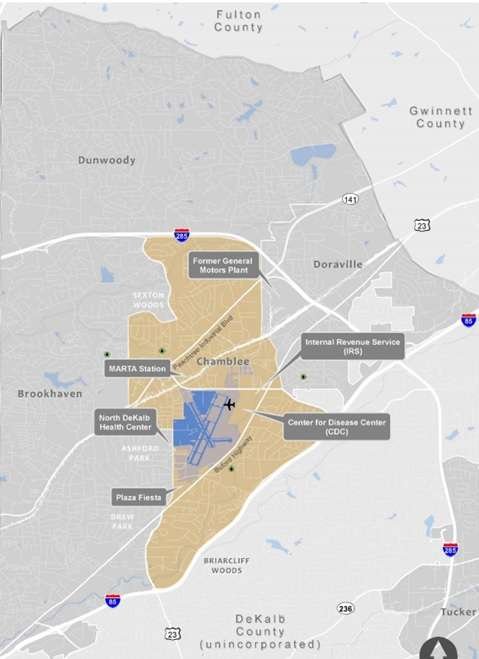
A recurring question among residents is whether PDK could one day extend its primary runway. The answer is effectively no. The airport is surrounded by residential, commercial, and county-owned property, with major roadways and airspace constraints preventing any practical expansion.

Planning Document Confirmation
Long-term expansion fears are often linked to runway length, but PDK’s own planning documents make clear that the airfield cannot grow beyond its current footprint. In the airport’s 2018 Master Plan Update, the county states plainly: “There are no plans to lengthen any runways at PDK.” This appears in Chapter 4, the Facility Requirements section, page 4-24. The document cites physical constraints, nearby roadways, and residential development as reasons why expansion is not feasible.
What the Sky Harbour Project Actually Proposes
Sky Harbour, a publicly traded aviation infrastructure company, plans to develop a Home Base Operator (HBO) campus on roughly 13 acres of PDK’s eastside property. Their development includes modern hangars built for G650-class aircraft, dedicated office and operational space, new ramp and taxiway access, additional vehicle parking, and potential fuel facilities authorized under the RFP.
Sky Harbour markets its campuses as offering:
- “The shortest time to wheels-up in business aviation”
- Dedicated line service for based tenants
- A premium environment for corporate and private aviation users
With national locations from Miami to San Jose and Denver to Nashville, PDK represents their 20th site. CEO Tal Keinan has praised the county’s decision, calling it a “triple win” for DeKalb residents, business aviation users, and the company.
Reducing Repositioning Flights
One of the stated goals in the county’s approval of the Sky Harbour proposal is to cut repositioning flights by nearly half. Sky Harbour’s model centers on creating premium home-base hangars on the airfield, allowing aircraft that frequently use PDK to remain on-site instead of flying in from other airports. When an aircraft is based where its flights originate, there is no need for empty positioning legs to bring the jet into place. Supporters argue that this reduction in unnecessary flights would lower noise, emissions, and congestion. Critics counter that total operations may still rise if more planes choose to base at PDK, but the county’s conditions attempt to balance these effects.
Economic Impact and Jobs
The Sky Harbour project is also expected to generate substantial long-term economic benefits for DeKalb County. Structured as a 50-year ground lease, the development requires no county-funded construction or financial contribution; instead, DeKalb collects steady lease payments and related tax revenue over the life of the agreement. County officials estimate the project could generate roughly $500 million in combined revenue and taxes during the lease term, benefiting DeKalb County government, local schools, and the City of Chamblee. The development is also projected to create approximately 600 jobs, including construction roles, aviation line-service positions, maintenance work, and administrative jobs tied to aircraft operations. Supporters say the economic impact positions PDK as an even stronger hub for corporate and private aviation in metro Atlanta, with growth tied directly to based aircraft rather than transient training flights.
The Airport Authority’s Role
The DeKalb Airport Authority advises the CEO and Board of Commissioners on long-term management and planning for PDK. Its statutory purpose includes maintaining a coordinated airport system, ensuring responsible growth, maximizing public benefit, and aligning local operations with national aviation standards.
A Century of History at PDK
From Camp Gordon in World War I to Naval Air Station Atlanta in World War II, and its transition to civilian use in the late 1950s, PDK has played a major role in Georgia’s military and aviation history. Brief commercial service operated between 2017 and 2020 before being suspended due to the pandemic. Today, it is one of the busiest general aviation airports in the Southeast.
What Comes Next
Sky Harbour’s proposal moves into the negotiation and execution phase for a long-term ground lease. Construction will require FAA review, environmental assessments, and continued community engagement. With public opinion divided, the future of PDK development remains a closely watched issue in DeKalb County.
Related articles
DeKalb Leaders Weigh Sky Harbour Expansion as Residents Demand Answers
DeKalb County Approves $78 Million Contract to Improve Ambulance Response
Related video
Larry Foster – Opposes PDK development
Jonathan Sweatman – Supports PDK development
Please consider supporting open, independent journalism – no contribution is too small!