Keisha Lance Bottoms brought confidence and candor to NABJ 2026, but Rick Jackson’s $87 million advertising campaign presents a formidable challenge.
By Milton Kirby | Atlanta, GA | August 18, 2026
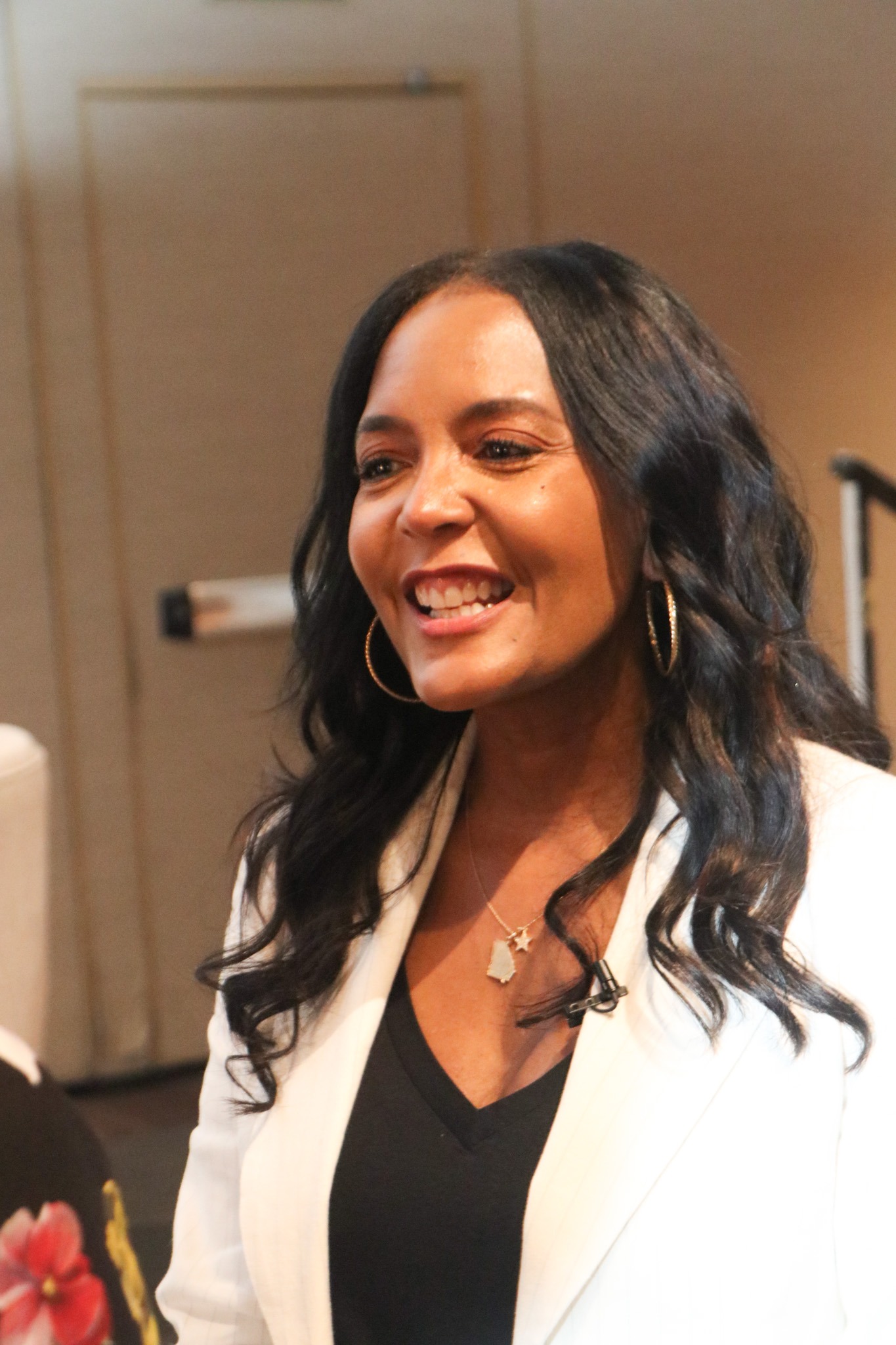
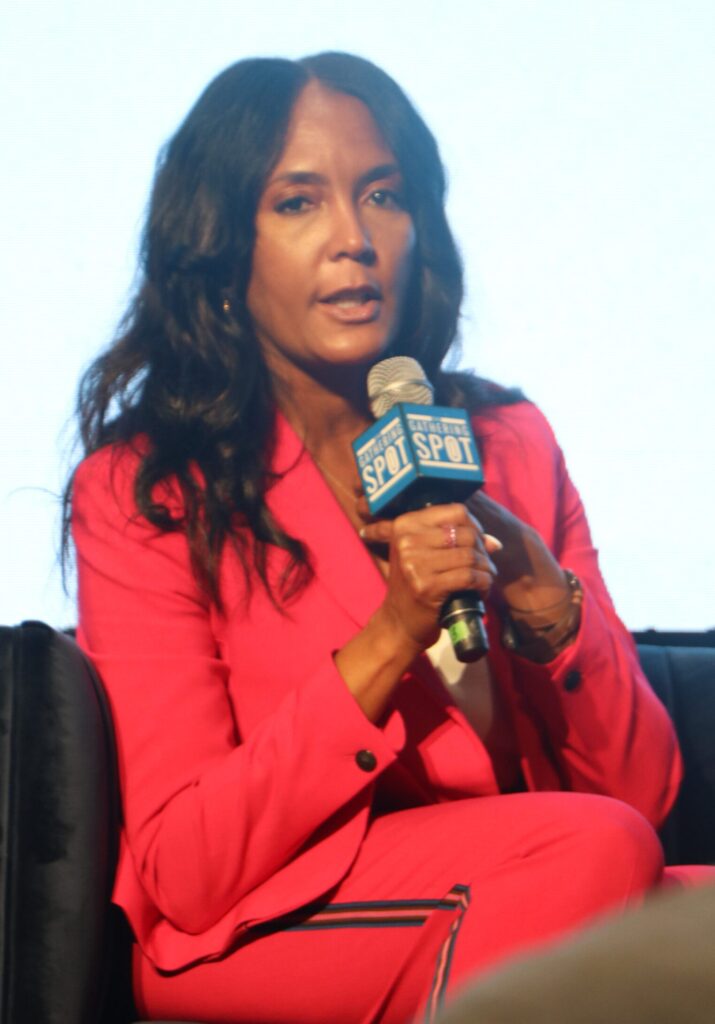
Keisha Lance Bottoms walked onto the stage at the 2026 National Association of Black Journalists Convention Friday looking and sounding like a candidate comfortable with who she is.
The Democratic nominee for governor of Georgia spoke about politics, race, election security and the challenge of campaigning across a state where voters may share concerns even when they do not share political labels.
But some of the most revealing moments came when Bottoms stopped talking about the campaign and talked about herself.
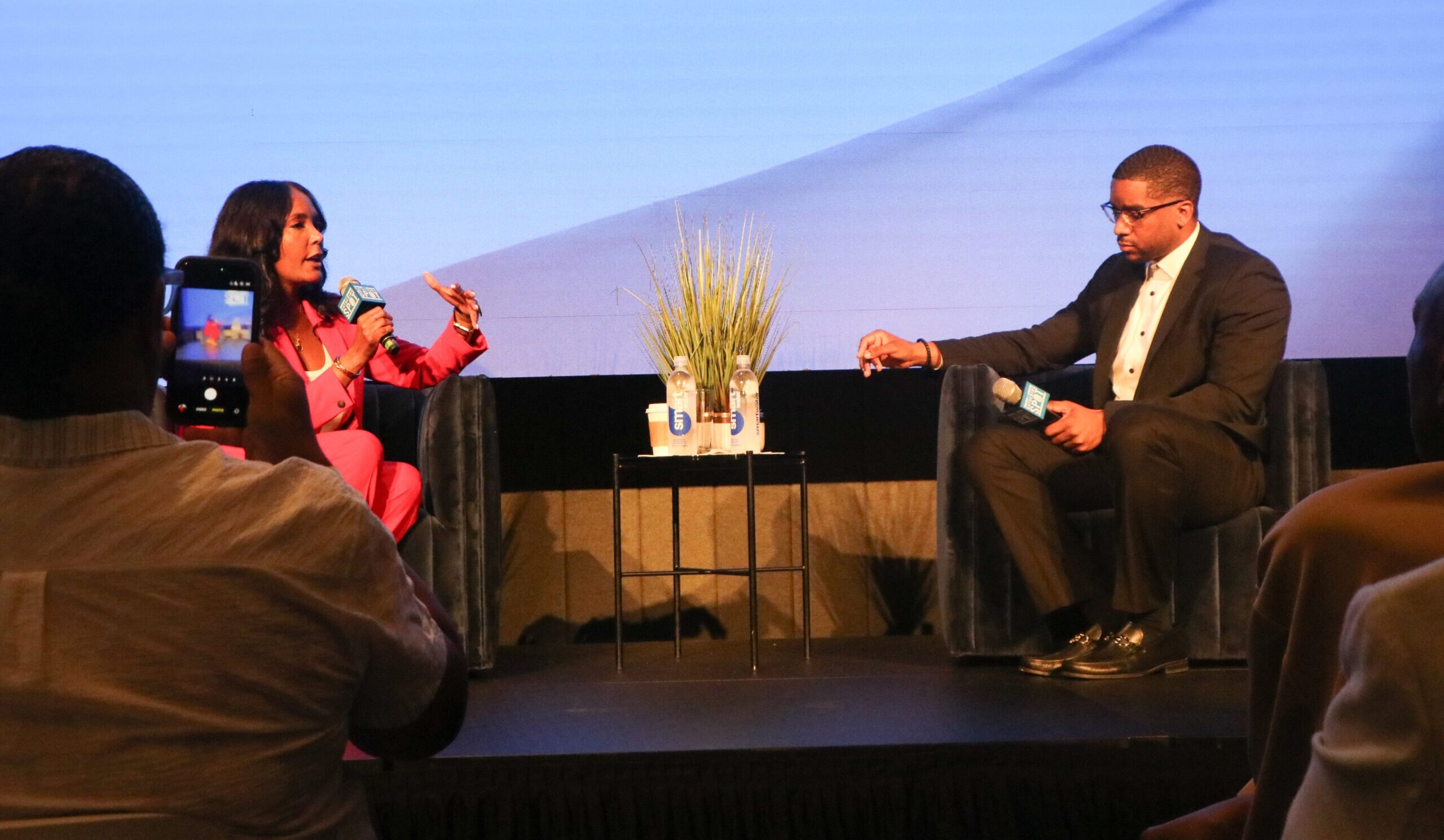
During a fireside chat with Dateline NBC correspondent Blayne Alexander, Bottoms discussed painful chapters of her life that she revealed in her recently published memoir, The Rough Side of the Mountain: A Memoir.
She spoke about her father’s incarceration. Infertility. An eating disorder. Being molested as a child. Therapy.
“I’ve laid it all out,” Bottoms told the audience.
It was a strikingly personal conversation for a candidate less than three months from Election Day.
Yet Bottoms appeared confident and at ease as she moved between the personal and political, making the case that the experiences that shaped her life also shaped the public servant she has become.
From the Back Door to the Front Door
Before Bottoms talked about becoming governor, she talked about her grandfather.
She recalled how he and relatives started a business and came into what the family called “uptown,” now downtown Atlanta, to haul paper and trash from buildings and recycle it.
Eventually, she said, her grandfather bought a truck and traveled along Peachtree Street.
For Bottoms, walking into a downtown Atlanta hotel carries a meaning that goes beyond attending another political event.
She said she thinks about how her grandfather once came downtown to work and how she now has the opportunity to “walk in the front door.”
That history, she said, is always present with her.
Generations later, his granddaughter was sitting onstage at a national gathering of Black journalists as the Democratic nominee for governor of Georgia.
Bottoms did not dwell on the historic nature of her candidacy.
Instead, she pointed to the sacrifices that made it possible.
“My Message Doesn’t Change”
Alexander pressed Bottoms on one of the central questions facing any Democrat seeking statewide office in Georgia: How does a former Atlanta mayor connect with voters far beyond metro Atlanta?
Bottoms rejected the idea that she becomes a different candidate depending on where she campaigns.
“My message doesn’t change,” she said. “The landscape, the geography may be different.”
Whether she is speaking in Macon, Albany, Jesup or Atlanta, Bottoms said voters want many of the same things: strong communities, good schools, access to health care and opportunities for economic prosperity.
The starting points may be different, she said, but the needs often are not.
Bottoms also challenged the notion that she is known only in Atlanta, saying her campaign has been doing the work statewide.
Campaigning outside metro Atlanta can actually make it easier to break through, she argued. In smaller media markets, a gubernatorial candidate’s visit may become one of the biggest local stories of the day.
“You can’t run for a statewide office with fear, or apprehension,” Bottoms said.
She said face-to-face encounters also can break down assumptions. When people sit together one-on-one, they begin to see one another as human beings and sometimes discover that their concerns and beliefs overlap.
For Bottoms, the strategy comes back to authenticity.
“It’s about being who I am, wherever I am, speaking the truth, in whatever room I am in.”
The Rough Side of the Mountain
That theme of authenticity became even more pronounced when Alexander asked what voters might not know about Bottoms.
Her answer was essentially: read the book.
The Rough Side of the Mountain: A Memoir was published in April.
Bottoms told the NABJ audience that she wrote the book while outside public life, after leaving the mayor’s office and the White House, when she had no intention of running for office again.
That mattered.
She suggested she may have been more forthcoming because she was not writing while viewing every revelation through the lens of a future campaign.
Bottoms said she wrote about her father’s incarceration, her infertility, her eating disorder, being molested as a child and her therapy sessions.
The memoir, she explained, was not initially supposed to become the book that ultimately reached stores.
She envisioned something closer to a collection of essays and a love letter to her family, particularly the people and experiences she sometimes felt she had to tuck away as she climbed professionally.
Writing it became cathartic.
The response from readers also surprised her.
Bottoms said people have approached her and shared experiences they had rarely, if ever, discussed publicly. Her willingness to talk about subjects such as incarceration, infertility and childhood sexual abuse opened a door for others to talk about their own lives.
For a gubernatorial candidate, those disclosures carry political risk.
On Friday, Bottoms did not appear burdened by them.
She appeared to have incorporated them into the story she now tells about herself.
Martha’s Vineyard and an Attack From Jackson
The conversation eventually moved directly into the general-election campaign.
Alexander gave Bottoms an opportunity to respond to an attack from Republican nominee Rick Jackson criticizing her travel to Martha’s Vineyard.
Bottoms did not retreat.
She noted Martha’s Vineyard’s long history as a destination for Black families and described it as a place of refuge, community and renewal.
She also connected her ownership of property there to her family’s history and economic progress.
“I find it as a badge of honor that I own land in Martha’s Vineyard and in Georgia,” Bottoms said.
The exchange offered a preview of what Georgians are likely to see much more of before November: Jackson attempting to define Bottoms, and Bottoms trying to prevent him from doing so.
And Jackson has extraordinary resources with which to make that attempt.
The $87 Million Challenge
One subject received surprisingly little examination during the fireside chat: money.
Jackson has committed $87 million to television and digital advertising in the general election after spending more than $100 million of his own money pursuing the Republican nomination.
That financial advantage presents Bottoms with a challenge unlike anything she faced in her campaigns for Atlanta mayor.
It raises a fundamental question:
How does Bottoms prevent Jackson from defining her when he can spend tens of millions of dollars delivering his version of her record to Georgia voters?
Alexander covered considerable territory during the limited conversation, including Bottoms’ personal life, campaigning outside metro Atlanta, Martha’s Vineyard, election security and the state of American democracy.
But the financial disparity between the candidates received little examination.
The issue is particularly significant because the race remains competitive.
A recent Quantus Insights survey of 815 likely Georgia voters, sponsored by the Natural Gas Association of Georgia, put Bottoms at 46.4% and Jackson at 44.9%, with 7.7% undecided.
The poll should be viewed for what it is: one snapshot of the electorate, commissioned by an organization with its own policy interests.
Still, its narrow margin illustrates what is at stake.
If the race remains close, the ability to reach undecided and persuadable voters repeatedly could become decisive.
Jackson can buy an extraordinary amount of that communication.
Bottoms will have to find other ways to compete.
Concerns About Georgia’s Elections
Bottoms also used the NABJ stage to express concern about Georgia’s election system.
Asked whether she believes Georgia’s elections are safe and secure, Bottoms said they are as safe and secure as elections can be in America right now, but she remains concerned about interference and restrictions on voting access.
Her answer quickly moved from concern to strategy.
“We’ve got to show up in the millions,” she said.
Bottoms called for making Election Day a state holiday and expanding early voting opportunities and hours.
Her message was that voters should not wait until Election Day.
Vote early. Vote in large numbers. Create margins large enough that the outcome cannot easily be questioned.
Alexander also asked Bottoms about the possibility of federal intervention surrounding Georgia’s election.
Bottoms said candidates and voters have to be prepared for the unexpected.
She then invoked Atlanta’s civil rights history and argued that Georgia has an opportunity to lead.
Who Does the Governor Work For?
Near the conclusion, Bottoms brought the conversation back to the distinction she wants voters to see between herself and Jackson.
She pointed to her experience as a judge, Atlanta City Council member, mayor and senior White House adviser.
Then she described the people she wants to represent.
The single mother working in the city.
The father trying to pay his rent.
The person struggling to pay for a parent’s medical treatment.
People who need someone in government to speak for them.
Jackson, Bottoms argued, can focus on distractions.
She wants to focus on people’s lives.
It was the campaign message she carried throughout the conversation: biography, hardship and public service presented not as separate chapters, but as parts of the same story.
Confidence Is Not the Question
Bottoms did not look like a candidate searching for her identity Friday.
She appeared confident.
She was willing to discuss the painful parts of her childhood, her family and deeply personal experiences. She defended her success rather than apologizing for it. And she insisted that she can walk into communities across Georgia without changing who she is or what she believes.
The question confronting her campaign is whether that confidence can translate into enough votes to win statewide.
Jackson has the money to make his case again and again.
Bottoms has a different proposition.
She is asking Georgians to look at the whole of her life, including the rough side of the mountain, and decide whether the journey qualifies her to lead the state.
Between now and November, she will have to make sure enough of them hear that story.
MARTA names Jonathan Hunt permanent CEO after a national search, placing safety, transparency, accountability and his promise of “routine excellence” at center stage.
By Milton Kirby | Atlanta, GA | August 14, 2026
Jonathan Hunt did not initially want the job.
When Hunt stepped into the role of interim general manager and CEO of MARTA in August 2025, following the departure of Collie Greenwood, he said he was not interested in becoming the permanent leader of one of the nation’s largest public transit systems.
A year later, Hunt had changed his mind.
After a national search that reached across the transportation industry and identified and contacted more than 250 candidates, the MARTA Board of Directors narrowed the field to three finalists. On Thursday, Aug. 13, it selected the man who had spent the previous year doing the job.
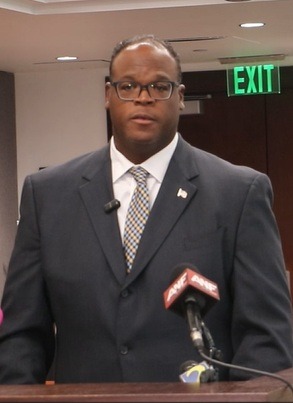
Jonathan Hunt – General Manager & CEO – Photo by Milton Kirby
Hunt is now MARTA’s permanent general manager and chief executive officer.
“To be named general manager and CEO of MARTA is an incredible, incredible honor,” Hunt said following the decision.
But neither Hunt nor MARTA Board Chair Jennifer N. Ide used the occasion simply to celebrate.
Both acknowledged that MARTA still has work to do.
“I think that we are in a much better place than we were a year, 18 months ago,” Hunt said. “But we still have, you know, a ways to go.”
Ide was even more direct.
“How MARTA is operating today is good,” Ide said. “What we expect with Jonathan as the permanent CEO is we expect great. We expect exceptional.”
Then she raised the bar higher.
“Where we are today isn’t good enough for the city of Atlanta.”
For Hunt, the year-long audition is over. The challenge now is turning the accomplishments of his interim tenure into the everyday service riders expect from MARTA.
A National Search Ends at Home
Hunt’s selection followed what MARTA described as an extensive national search.
The Board retained Diversified Search Group following a competitive selection process. According to Ide, the firm and MARTA’s search committee cast a wide net across public transit, airports and airlines, freight and passenger rail, port authorities and logistics.
More than 250 potential candidates were identified and contacted.
Board members representing MARTA’s major jurisdictions participated in the process, developing the position description, screening and vetting candidates and conducting structured interviews.
Three finalists emerged.
Hunt was joined by Cleveland Ferguson III of the Jacksonville Transportation Authority and Leroy Jones of Washington’s Metro system.
The candidates brought different experiences to the competition.
Jones came from one of the nation’s largest transit systems, with extensive bus and rail operations in the Washington metropolitan area.
Ferguson came from Jacksonville, a smaller transit operation without a heavy-rail system comparable to MARTA.
Hunt brought something neither outside candidate could offer: more than a decade inside MARTA and nearly a year already sitting in the chief executive’s chair.
Ide emphasized that the selection was not an indictment of the other finalists.
“The process gave us three exceptional finalists, and I didn’t say that lightly,” she told the Board. “Cleveland Ferguson, Leroy Jones, and Jonathan Hunt each brought something real to the table, and any one of them could have led MARTA well.”
But after final interviews and deliberations, the Board chose Hunt.
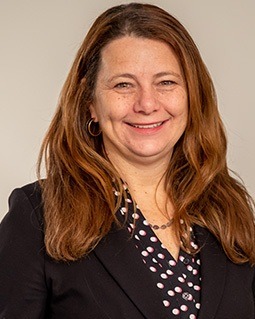
Jennifer Ide – MARTA Board Chair – Courtesy Photo
Ide explained why.
“What ultimately made Jonathan the most qualified candidate was not a single credential,” she said.
Instead, she pointed to Hunt’s leadership and the Board’s belief that MARTA is moving in the right direction under him.
Over the past year, Ide said, Hunt strengthened relationships with MARTA’s jurisdictional partners, business community, employees, stakeholders and riders.
His knowledge of the agency also mattered.
“He understands our operations, our finances, our capital program, and the complicated web of government and community interests that we answer to,” Ide said.
The Candidate Who Initially Didn’t Want the Job
Hunt’s path to the permanent position was unusual because he initially indicated he wasn’t seeking it.
But something changed during his year at the top.
Hunt has described the interim assignment as the most rewarding and purposeful experience of his professional career. He also said people within and around MARTA encouraged him after watching his leadership.
Eventually, the reluctant interim leader became a candidate for the permanent position.
The Board’s decision suggests his year in the job became something few outside candidates could duplicate: a real-world audition.
Hunt took over MARTA during a period of significant change.
During his interim tenure, the agency launched a redesigned bus network, replaced its Breeze fare-payment system and implemented Atlanta’s first bus rapid transit line.
He also oversaw MARTA’s operations, safety and customer experience during the FIFA World Cup, when the region’s transit system faced extraordinary demand.
Ide pointed specifically to the World Cup as evidence of Hunt’s leadership.
“For those few months, all eyes were on MARTA and on Jonathan, and he met the moment and delivered,” she said.
But Hunt’s permanent tenure will not be judged solely by how MARTA performed during a global sporting event.
The more difficult test may be what happens on an ordinary Monday morning.
From World Cup Success to “Routine Excellence”
Hunt has repeatedly used a phrase to describe what he wants MARTA to become: “routine excellence.”
His goal, he says, is a transit system that is safe, clean and reliable every day.
That distinction matters.
Moving huge crowds successfully during the World Cup demonstrated what MARTA can do when the system, its employees and the region are focused on a major event.
The challenge now is delivering that level of reliability when there are no international television cameras and no global event underway.
Ide made clear that the Board shares that expectation.
“We have a unique opportunity to carry the momentum of the World Cup into our everyday routine excellence of service,” she said.
Then she added an important promise.
The Board, she said, will hold Hunt to that standard.
That standard comes as MARTA continues to manage major projects and challenges.
The agency is rolling out a redesigned bus system, transitioning riders to a new Breeze fare system, implementing bus rapid transit and preparing new rail cars for passenger service.
At the same time, riders judge MARTA by more immediate concerns: whether the bus arrives, whether the train is on time, whether stations and vehicles are clean and whether they feel safe while using the system.
Those everyday experiences may ultimately determine whether Hunt’s “routine excellence” becomes more than a phrase.
Safety and Trust Remain Challenges
Safety remains particularly important.
During coverage of the CEO search, riders repeatedly raised security as one of their concerns for MARTA’s next leader.
That concern exists alongside MARTA statistics showing improvements in overall crime.
The distinction between statistics and perception is important.
An agency can report declining crime while riders still feel unsafe. A new CEO must address both.
Hunt appears to recognize that rebuilding confidence will require more than operational improvements.
In his remarks following his selection, he repeatedly returned to three ideas: transparency, accountability and trust.
He pledged greater collaboration across MARTA’s jurisdictions, with businesses and with community leaders.
He also called for “additional transparency as much as we possibly can in order to build back trust.”
“We started doing that in a major way this year,” Hunt said, “but we still have a long way to go.”
He described accountability as good for MARTA and good for rebuilding regional trust.
That acknowledgment may prove important.
Hunt is not taking over an agency that he describes as having completed its transformation. He is taking permanent responsibility for an agency whose shortcomings he openly acknowledges.
From Lawyer to Transit CEO
Hunt’s route to MARTA’s top job differs from the traditional image of a transit executive who spent an entire career running buses and trains.
He joined MARTA in 2014 and spent more than a decade in its legal department, serving as Chief of Corporate Law and Real Estate, Deputy Chief Counsel and ultimately Chief Legal Counsel.
But his professional background extends beyond law.
Earlier in his career, Hunt served as a Senior Assistant City Attorney for the City of Atlanta, handling aviation matters involving Hartsfield-Jackson Atlanta International Airport. He practiced law at Dentons and BakerHostetler and previously worked as a project engineer with Gilbane Building Company.
He also serves on the national board of the American Public Transportation Association and chairs its Legal Affairs Committee.
Hunt holds a bachelor’s degree from Hampton University and a Juris Doctor from Case Western Reserve University School of Law.
Ide emphasized that Hunt’s years inside MARTA have given him an understanding that extends well beyond the legal department.
“He understands our operations, our finances, our capital program, and the complicated web of government and community interests that we answer to,” Ide said.
“He has been in the ring for all of it.”
A Leadership Transition MARTA Did Not Expect
Hunt’s rise began with an unexpected leadership transition.
Greenwood, originally from Canada, joined MARTA in 2019 and became CEO in 2022. He left the agency in 2025 in what MARTA described as an early retirement connected to immigration and personal matters.
MARTA said at the time that the immigration process had affected Greenwood’s personal and professional progress. Greenwood said he and his wife had decided it was a good opportunity to retire early and spend more time with family and friends.
His departure created the opening that eventually placed Hunt in the interim role.
There is also a historical similarity.
Greenwood served as interim CEO before receiving the permanent job. Hunt has now traveled a similar path.
But MARTA’s Board stressed that Hunt did not simply inherit the permanent position.
He had to compete for it.
The national search ultimately brought MARTA back to the executive already inside the building.
The Patron Experience
Perhaps the clearest indication of where Hunt intends to place his attention came near the end of his Board remarks.
He promised to work with MARTA’s leadership team to improve the agency and, “most importantly,” improve the experience MARTA provides its patrons.
That is where the Board’s decision will eventually be judged.
Not in the executive suite.
Not in a press release.
Not simply by the successful handling of one major international event.
But on buses, trains and station platforms across the region.
Can MARTA improve reliability?
Can it increase ridership?
Can riders feel safer?
Can major projects be delivered successfully?
Can the agency become more transparent and accountable?
And can the system provide the safe, clean and reliable service Hunt says riders deserve every day?
Ide has already made clear that “good” will not be enough.
Hunt appears to agree.
“I truly believe we do have the best transit agency in the nation,” he said, “and we need to live up to that mantra.”
For the past year, Jonathan Hunt had the opportunity to show MARTA’s Board what he could do as an interim leader.
The Board liked what it saw enough to give him the job permanently.
Now comes the harder part.
Delivering what Hunt calls “routine excellence,” not for a few extraordinary weeks, but every day.
Support open, independent journalism. Your contribution helps us tell the stories that matter most.
For 16 years, the BronzeLens Film Festival has served as a cultural cornerstone for filmmakers of color, bringing together artists, auFor more than a decade, the BronzeLens Film Festival has served as a cultural cornerstone for filmmakers of color, bringing together artists, audiences and industry professionals in Atlanta to celebrate stories that are often overlooked by mainstream Hollywood. This year, the Oscar-qualifying festival enters a new chapter—one marked by growth, transition and an expanded vision for the future.
Kathleen Bertrand – Courtesy Photo
At the center of that continued growth is Executive Producer Kathleen Bertrand, one of the driving forces behind the festival’s mission to celebrate stories created by and about people of color. Based in Atlanta, BronzeLens was founded to share and applaud the many stories of people of color told through digital moving images. Since its founding, the organization has screened films from creators across the African diaspora and beyond, building a reputation as both a cultural institution and an advocate for diverse storytelling. Bertrand has emphasized BronzeLens’ commitment to educating, enlightening and entertaining audiences while providing a platform for filmmakers whose voices deserve greater visibility.
For the first time in its history, BronzeLens will unfold across two weekends, providing festivalgoers with additional opportunities to experience screenings, professional development workshops, networking events and special programs. The expanded format reflects the festival’s continued evolution and growing impact within Atlanta’s thriving film community.
The festival also enters a period of transition. The 2026 event marks the first since the retirement of Founding Artistic Director Deidre McDonald, whose curatorial vision helped shape BronzeLens into one of the nation’s premier showcases for diverse storytelling. Under McDonald’s leadership, the festival became known for presenting films that explored culture, identity, social justice and the shared experiences of communities around the world.
As BronzeLens moves forward, Jason Gregoryassumes the role of Interim Director of Programming, helping guide the festival through its next phase while maintaining the organization’s commitment to elevating underrepresented voices.
A Fashion Icon Takes Center Stage
The festival opens with the world premiere of Love, Patrick: Nothing is Impossible directed byThe Horne Brothers. The documentary chronicles the extraordinary life of fashion designer Patrick Kelly, the first American admitted to the prestigious Chambre Syndicale du Prêt-à-Porter in Paris.
The film explores Kelly’s groundbreaking impact on the fashion industry while examining themes of race, identity and perseverance. In tribute to the celebrated designer, festival organizers are encouraging attendees to arrive “Runway Ready” for opening night, creating a fitting celebration of a man whose bold creative vision reshaped the fashion world.
Spotlighting Emerging Voices
While marquee premieres help attract attention, BronzeLens has long built its reputation on supporting independent filmmakers and emerging talent.
Among this year’s notable selections is “The Text,” a short film written and directed by Kareemah, founder of Rare Maven Media. The film follows Tanya, an aspiring DJ who returns home for her best friend’s engagement party and finds herself facing a life-altering decision: remain in a troubled relationship or pursue the future she truly desires.
Produced by Rare Maven Media, “The Text” stars Zora Imani as Tanya and Cameron Bhola as Taj. The film is scheduled to screen Aug. 23 at the Tara Theatre, where audiences will have an opportunity to experience one of the independent projects representing the next generation of storytellers.
Projects such as “The Text” exemplify the role BronzeLens continues to play as a launchpad for creatives seeking visibility, industry access and meaningful audience engagement.
Building Careers Behind the Camera
BronzeLens has long distinguished itself by investing not only in completed films but also in the professional development of the people who make them. That commitment is reflected in this year’s Craft Day programming, designed to equip creatives with practical tools and industry knowledge.
Among the highlights is an Acting Master Class and Workshop led by acclaimed actress, director and producer Jasmine Guy.
Additional sessions include:
Get Funded: Producing, Financing and Crowdfunding
Blindsides, a blind table read presented by Black Script
Below the Line: Careers That Build Black Cinema
The ATL Effect: Capital, Culture and Craft
From Page to Screen: The Writers and the Crew Who Build Black Cinema
Together, the programs emphasize the collaborative nature of filmmaking while exploring everything from financing and production to writing, acting and crew development.
Looking Ahead
As BronzeLens embraces its first two-weekend format and navigates a significant leadership transition, its core mission remains unchanged. Under the continued leadership of Executive Producer Kathleen Bertrand, and with new programming leadership in place, the festival remains dedicated to creating opportunities for filmmakers of color to tell stories that inspire, challenge and connect audiences.
In a city that has emerged as a major center for film and television production, BronzeLens continues to offer something unique: a space where culture, creativity and community intersect. With expanded programming, industry-focused workshops, major premieres and emerging voices all sharing the spotlight, the festival appears poised to begin its next chapter while remaining true to the vision that has sustained it for years.
Truth Seekers Journal thrives because of readers like you. Join us in sustaining independent voices.
Ninety years after Jesse Owens won four gold medals in Berlin, his triumphs and treatment at home reveal a powerful American contradiction.
On August 9, 1936, Jesse Owens completed one of the greatest performances in Olympic history. What happened before Berlin made him a champion. What happened afterward tells a larger American story.
Ninety years ago, on August 9, 1936, Jesse Owens stepped onto the track inside Berlin’s Olympic Stadium for one final race.
He had already won three gold medals.
The 100 meters.
The long jump.
The 200 meters.
Now came the 4×100-meter relay.
Owens joined Ralph Metcalfe, Foy Draper and Frank Wykoff on the American team. They crossed the finish line in 39.8 seconds, setting a world record and giving Owens his fourth gold medal of the 1936 Olympic Games.
Four events.
Four gold medals.
All accomplished by a 22-year-old Black American competing in Nazi Germany.
Owens became the most successful athlete of the Berlin Games and the first American track and field athlete to win four gold medals at a single Olympics. His feat would not be matched in the same four events until Carl Lewis accomplished it at the 1984 Los Angeles Olympics.
But 90 years later, Jesse Owens deserves to be remembered for more than what happened during those seven remarkable days in Berlin.
His story began in a sharecropping family in Alabama. It carried him through segregation, poverty and discrimination. It took him to Ohio State University, where he became one of the greatest college athletes in history while being denied some of the basic privileges available to his white teammates.
Then it took him to Berlin, where his performance offered a powerful answer to Adolf Hitler’s theories of racial superiority.
And finally, it brought him home to an America that celebrated his victories while still denying him equality.
That part of the story deserves remembering, too.
Jesse Owens – Photo courtesy of Britannica
From Alabama to Cleveland
James Cleveland Owens was born September 12, 1913, in Oakville, Alabama. He was the youngest of 10 children and the grandson of an enslaved person.
His father was a sharecropper.
When Owens was nine years old, his family moved to Cleveland, Ohio, as part of the Great Migration, the movement of millions of Black Americans out of the rural South in search of greater opportunity elsewhere.
He arrived in Cleveland known as “J.C.”
According to the familiar story, when a teacher asked his name, Owens answered “J.C.” His Southern accent led her to believe he had said “Jesse.”
The name stayed with him for the rest of his life.
So did something else that was becoming increasingly clear.
Jesse Owens could run.
Coach Charles Riley recognized the youngster’s talent and helped develop it. Because Owens worked after school, Riley allowed him to practice before school.
By high school, Owens was becoming a national sensation.
At the 1933 National High School Championships, he tied the world record in the 100-yard dash at 9.4 seconds and established a national high school record in the 220-yard dash.
Colleges noticed.
Owens eventually chose Ohio State University.
The Buckeye Bullet
At Ohio State, Owens became known as the “Buckeye Bullet.”
His performances were extraordinary.
He won eight individual NCAA championships, four in 1935 and four in 1936. During his 1936 season, Owens reportedly won all 42 events he entered.
But athletic greatness did not erase race.
Owens received no athletic scholarship. He worked several jobs to support himself and his family while attending school and training.
He operated an elevator at night. He waited tables. He worked in library stacks. He pumped gas. He also served as a page at the Ohio Statehouse.
And although he competed for Ohio State, Owens could not live on campus with white athletes.
When the team traveled, segregation followed him. He sometimes had to order food rather than eat with his teammates and stay in hotels that accepted Black guests.
The contradiction was already taking shape.
Ohio State could put Jesse Owens in its uniform.
It could depend upon his speed to win championships.
But the racial customs of the time still determined where he could sleep and eat.
Then came May 25, 1935.
Perhaps the Greatest 45 Minutes in Sports
Owens arrived at the Big Ten Championships in Ann Arbor, Michigan, with an injured back after falling down a flight of stairs.
He was not certain he could compete.
Owens reportedly persuaded his coach to let him try the 100-yard dash as a test.
He ran it in 9.4 seconds, tying the world record.
He kept going.
Over roughly the next 45 minutes, Owens set records in event after event.
He broke the world record in the long jump with a leap of 26 feet, 8 1/4 inches. He set records in the 220-yard dash and the 220-yard low hurdles.
His performances in the longer races also bettered the corresponding metric records.
His long jump world record would stand for 25 years.
What Owens accomplished that afternoon has often been described as one of the greatest single-day performances in sports history.
He had proven himself ready for the Olympic Games.
The setting awaiting him would make those Olympics unlike almost any before or since.
Berlin
The 1936 Summer Olympics opened in Berlin under the rule of Adolf Hitler and Nazi Germany.
The Nazi government intended the Games to showcase a powerful Germany before an international audience.
Race was impossible to separate from that presentation.
Nazi ideology promoted the supposed racial superiority of Aryan people while persecuting Jews and other groups the regime considered inferior.
Into that environment walked Jesse Owens.
On August 3, he won the 100 meters in 10.3 seconds.
On August 4, Owens won the long jump with a leap of 26 feet, 5 inches.
On August 5, he captured the 200 meters in 20.7 seconds.
Then, on August 9, Owens and his teammates won the 4×100-meter relay in a world-record 39.8 seconds.
Owens had entered four events.
He won four gold medals.
The symbolism was impossible to ignore.
A Black American had become the dominant athlete at an Olympic Games hosted by a regime preaching racial hierarchy.
Yet one part of the story commonly told about Berlin deserves a closer examination.
What Really Happened With Hitler?
Generations of Americans learned that Hitler personally refused to shake Jesse Owens’ hand after the Black athlete defeated Germany’s competitors.
The historical record is more complicated.
Early in the Olympics, Hitler congratulated selected winners. Olympic officials then told him he would have to greet every medalist or none of them.
Hitler chose not to greet medalists.
Owens himself later disputed the simple version of the story that Hitler had personally singled him out for a snub. He recalled Hitler waving toward him and said he waved back.
None of that changes the racial ideology of Nazi Germany or the significance of Owens’ victories.
But it does change where Owens himself placed responsibility when discussing how he had been treated.
His most pointed complaint was not about Hitler.
It was about his own president.
“It Was Our President Who Snubbed Me”
President Franklin D. Roosevelt never received Jesse Owens at the White House following his four Olympic victories.
He did not send Owens a congratulatory telegram.
And Owens remembered.
Later that year, while speaking at a Republican political event, he said:
“Hitler didn’t snub me. It was our president who snubbed me.”
Owens added that the president had not even sent him a telegram.
The statement becomes even more significant when viewed against records preserved by the National Archives.
While Owens was still competing in Berlin, Americans were already writing to Roosevelt about how the returning Olympians should be treated.
The Rev. Ernest Hall of Cleveland specifically urged Roosevelt to officially receive the successful Olympic competitors upon their return without regard to their race or color.
The White House did not do so.
Owens was not the only Black American representing the country in Berlin. Eighteen Black athletes competed for the United States during the 1936 Olympics.
None received the kind of presidential reception that might seem routine for American Olympic heroes today.
Why Roosevelt made that decision has been debated for decades.
It came during an election year. Roosevelt’s political coalition included growing numbers of Black voters in Northern cities while also relying heavily on powerful white Southern Democrats. Many of those Southern politicians defended segregation and opposed federal action on civil rights.
Those political realities are part of the historical record.
So is another fact.
The president of the United States had an opportunity to publicly receive Jesse Owens and the other Black Olympians.
People asked him to do it.
He did not.
Readers can decide for themselves what that meant.
Celebrated on Broadway, Segregated at the Hotel
America did celebrate Owens when he returned.
New York City welcomed him with a ticker-tape parade through Manhattan’s Canyon of Heroes.
Crowds cheered.
The young man from Oakville, Alabama, had returned home as one of the most famous athletes in the world.
Then came a reminder of the America to which he had returned.
A reception was held in Owens’ honor at the Waldorf-Astoria hotel.
Yet the guest of honor was reportedly not permitted to enter through the hotel’s main entrance.
Owens had to use a freight elevator to reach the reception honoring him.
The scene almost requires no commentary.
A Black man could represent the United States before the world.
He could win four Olympic gold medals.
He could stand beneath the American flag while the national anthem played.
He could receive a parade down Broadway.
But he still could not necessarily walk through the front door.
Four Gold Medals Could Not Feed a Family
Olympic fame did not make Owens wealthy.
The modern world of multimillion-dollar shoe contracts, television advertising and corporate sponsorships did not exist for athletes in 1936.
For Black athletes, opportunities were more limited still.
Owens’ competitive career also ended quickly after Berlin. After leaving a demanding European exhibition tour, he lost his amateur eligibility.
He had a wife and children to support.
So Jesse Owens worked.
Over the years, he held jobs, promoted sporting events and operated businesses. At times he participated in exhibition races against motorcycles, automobiles and even horses.
People later questioned why one of history’s greatest runners would race a horse for money.
Owens had an answer.
He had four gold medals.
But, as he explained, you could not eat them.
The remark captured another side of American sports history.
The nation could cheer a Black champion without necessarily creating a path for that champion to turn accomplishment into economic security.
More Than an Athlete
But reducing Jesse Owens’ post-Olympic life to struggle would also be incomplete.
He built another life.
Owens became a businessman, public speaker, corporate representative and advocate for young people.
His work as a playground director in Cleveland helped begin a lifelong commitment to youth. After moving to Chicago, he continued working with organizations serving young people, including the Chicago Boys’ Club.
In 1955, President Dwight D. Eisenhower enlisted Owens as a goodwill ambassador. He traveled overseas promoting sports and representing the United States.
Owens eventually became a highly sought-after speaker, addressing schools, churches, civic groups, business organizations and young people.
The man once denied equal treatment while representing America increasingly became one of America’s representatives to the world.
Official recognition eventually followed.
The White House, Four Decades Later
On August 5, 1976, President Gerald Ford presented Jesse Owens with the Presidential Medal of Freedom.
Forty years had passed since Berlin.
In 1979, Owens returned to the White House again, where President Jimmy Carter honored him as a Living Legend.
The recognition arrived late in Owens’ life.
He died from lung cancer on March 31, 1980, in Tucson, Arizona.
He was 66.
After his death, Carter remembered Owens as far more than a runner. He described him as a symbol of the struggle against tyranny, poverty and racial bigotry.
Ten years later, Owens was posthumously awarded the Congressional Gold Medal.
His name now appears on schools, roads, parks and athletic facilities.
USA Track & Field’s annual award honoring leading athletes bears the Jesse Owens name.
And the Jesse Owens Foundation continues the family’s work of helping young people develop their talents, broaden their horizons and reach their potential.
Four Gold Medals, Two Americas
It would be easy to end Jesse Owens’ story in Berlin.
Four races.
Four gold medals.
A Black athlete standing victorious in Adolf Hitler’s Germany.
That story is inspiring.
It is also incomplete.
Jesse Owens’ life asks us to remember what happened before Berlin and what happened when he returned home.
He grew up in a sharecropping family.
He became one of America’s greatest college athletes without receiving an athletic scholarship.
He represented a university whose racial customs prevented him from living with his teammates.
He represented the United States in Germany and became the greatest athlete of the Olympic Games.
He returned to a ticker-tape parade but still encountered segregation.
And despite four gold medals, the president of the country he represented never invited him to the White House.
Those are facts.
Why America could celebrate Jesse Owens abroad while denying him equality at home is a larger question.
Ninety years later, perhaps we do not need to answer it for our readers.
Perhaps Jesse Owens’ life provides enough evidence for them to answer it themselves.
On August 9, 1936, Owens crossed his final Olympic finish line and secured his fourth gold medal.
Ninety years later, we remember the speed.
We remember the records.
We remember the medals.
But we should also remember the man.
Jesse Owens did more than run against a stopwatch.
He ran through barriers that his country had placed before him.
And history is still catching up.
Support open, independent journalism. Your contribution helps us tell the stories that matter most.
This column exists for one reason: to answer your questions about Negro League baseball history. To fulfill that mission, we need your help.
If you read and enjoy this column, want it to continue, and haven’t already mastered every corner of Negro League history, we invite you to send us your questions. Your questions are the lifeblood of Shadow Ball—they determine where we go next—from players and teams to memorable games, historic events, and everything in between.
By submitting a question, you help shape the future direction of this column. Your participation is both important and greatly appreciated. In many ways, the continued existence of Shadow Ball depends on readers like you.
This week’s query is submitted by reader George Schuyler, Topeka, KS, which “Major” Negro League lasted the longest?
Let me begin with, thank you George … I very much appreciate this question, I don’t think – even I – can get this one wrong. Here are the seven leagues (and spans) designated as “major” by Major League Baseball on December 16, 2020:
LEAGUE SPAN YEARS
Negro National League 1 1920-1931 12
Eastern Colored League 1923-1928 6
American Negro League 1929 1
Negro Southern League 1932 1
East-West League 1932 1
Negro National League 2 1933-1948 16
Negro American League 1937-1948 12
The list answers the question – the 2nd Negro National League, founded by Gus Greenlee, January 1933, lasted longer than any other Major Negro League and stands behind only the National and American League (now in its 151st season) and the American League (in its 126th season) among all thirteen leagues designated as Major.
Shadow Ball Significa Questions for the past two issues
July 21 Significa “What former Memphis Red Sox player worked at the Peabody Hotel in Memphis after his retirement from baseball?” was incorrectly reported last issue as not having been answered by anyone … turns out that Kevin Johnson, Broken Arrow, OK, submitted the correct answer, Nat Rogers, just minutes after the issue dropped. Sorry about that KJOK.
July 28 Significa “What pitcher won the last Negro League World Series game?” also provided some controversy. A reader offered Wilmer Fields, as the winner, which is confirmed as such at Retrosheet Negro League game files. However, there is no box score but there as a line score showing that R.T. Walker pitched 9 innings before being relieved in the bottom of the 10thwith his team – after a four spot in the top of the 10th– up by four. Further, in Irv Goldfarb’s SABR biography of R.T. Walker he states that Walker “was awarded the victory.” My current reading of MLB rule 10.19 a, b indicates to me that Walker is the winner having pitched 9 innings and being relieved with the lead. In addition, I asked a local Minor League official scorer and he told me that he would credit the win to Walker. Finally, it turns out that the 10.19 rule that is currently in effect was not in effect in 1948 Major League Baseball let alone the Negro National or American Leagues. Prior to 1950 victories were awarded by the official scorer and usually in accordance with today’s current rules.
Ted Knorr
This Week’s Shadow Ball Significa Question of the Week
Who was Jackie Robinson’s Manager on April 15, 1947?Send your answer, along with your comments/questions about the Negro Leagues, to shadowball@truthseekersjournal.com
or mail them to:
Shadow Ball 3904 N. Druid Hills Road
Suite 179 Decatur, GA 30033
Ted Knorr is a Negro League baseball historian, longtime member of the Society for American Baseball Research’s Negro League Committee, and founder of the Jerry Malloy Negro League Conference and several local Negro League Commemorative Nights in central Pennsylvania.
Support open, independent journalism. Your contribution helps us tell the stories that matter most.
Artificial intelligence already shapes everyday life, influencing smartphones, banking, healthcare, employment and online choices while raising important questions about privacy, fairness and human judgment.
By Florita Bell Griffin | Houston, TX | August 11, 2026
Artificial intelligence is often presented as a technology that belongs to the future. News reports show humanoid robots, self-driving vehicles, powerful computers, and machines capable of producing art or carrying on remarkably human-sounding conversations. These images make AI appear distant from ordinary life, as though it exists mainly inside research laboratories, major technology companies, and science-fiction stories. In reality, artificial intelligence has already entered many of the most routine parts of daily life. It may help determine what appears on a person’s telephone screen, which route a driver takes, whether a banking transaction is approved, which job applicant receives further consideration, and which news story reaches a particular reader.
Most people interact with AI without consciously deciding to do so. It operates within smartphones, websites, vehicles, medical systems, stores, workplaces, schools, banks, and entertainment services. It can recommend a movie, identify a face in a photograph, filter unwanted email, translate a message, answer a customer-service question, or alert a credit-card company to suspicious activity. These functions are often convenient, and many have become so familiar that they no longer feel remarkable. Yet each one involves a computer system analyzing information, identifying patterns, and producing a recommendation, prediction, classification, or response.
This quiet integration of artificial intelligence into everyday life deserves attention. Technology is most powerful when it becomes ordinary enough that people stop noticing it. Once a system feels routine, users may no longer ask what information it is collecting, how it reached a conclusion, whether its recommendation is fair, or what happens when it makes a mistake. Understanding everyday AI does not require technical training. It begins with recognizing when a machine is influencing a choice and remembering that automated decisions are still human creations with human purposes, limitations, and consequences.
The Invisible Intelligence Inside Ordinary Devices
A smartphone is one of the clearest examples of artificial intelligence becoming an ordinary companion. When a person unlocks a telephone using facial recognition, the device compares the user’s features with stored information. When the camera automatically improves lighting, reduces blur, sharpens details, or identifies faces, AI-assisted systems are working behind the scenes. A photograph application may allow someone to search thousands of images using words such as “birthday,” “dog,” “beach,” or “car,” even though no one manually labeled each picture. The software has learned to recognize visual patterns and associate them with familiar objects and settings.
The keyboard on a telephone also uses forms of artificial intelligence. Predictive text attempts to anticipate the next word. Autocorrect compares what was typed with common language patterns. Voice-recognition tools turn spoken language into written text, while translation programs convert messages from one language into another. Accessibility features may read text aloud, describe images, create captions, or help people operate devices through speech. These functions can be especially valuable for older adults, people with disabilities, travelers, students, and workers who must communicate quickly.
The usefulness of these systems can make their presence easy to accept without question. Every convenience, however, may require information. A navigation application needs location data. A voice assistant may process spoken commands. A photo service may analyze faces and places. A personalized application may study what the user searches for, watches, purchases, or ignores. The question is not whether all collection of information is harmful. The more important question is whether people understand what is being collected, why it is needed, how long it is retained, and whether it may be used for purposes beyond the service they originally requested.
Artificial intelligence also shapes what people see online. Social-media platforms do not simply present information in the order it was posted. Their systems continually decide which videos, photographs, advertisements, opinions, and news stories are most likely to hold a person’s attention. Every pause, click, search, reaction, share, and repeated viewing may become part of the platform’s understanding of that user. Over time, the system learns which subjects attract interest and which emotions are most likely to produce engagement.
This explains why two people can open the same application and encounter completely different versions of the world. One may see cooking demonstrations, local events, family photographs, and gardening advice. Another may see political conflict, frightening health claims, celebrity rumors, or stories designed to provoke anger. Each person may begin to believe that the information appearing repeatedly on the screen represents what everyone is discussing. In fact, the content has been selected partly because an automated system believes that particular person is likely to respond to it.
A personalized feed can be enjoyable and useful, but it is not a neutral picture of reality. It is a constructed environment shaped by technology, advertising, business priorities, and the user’s own behavior. When a person repeatedly watches angry or fearful content, the system may provide more of it because emotional material often keeps people engaged. The platform does not necessarily ask whether the information is healthy, balanced, or true. Its immediate concern may be whether the user continues watching.
How AI Influences Choices, Opportunities, and Access
Artificial intelligence does more than recommend entertainment. It increasingly participates in decisions that affect money, employment, healthcare, transportation, education, and access to services. Online retailers use AI to recommend products, predict demand, adjust advertisements, and estimate what a customer may be willing to purchase. A product displayed prominently may appear to be the best choice, even when its position results from advertising agreements, sales patterns, or the retailer’s desire to increase profit.
Consumers should therefore distinguish between a recommendation and independent advice. When an online store says, “You may also like,” the system is attempting to predict what the customer may buy. It is not necessarily deciding what the customer needs, what provides the best value, or what fits the person’s budget. AI can make shopping faster, but it cannot replace comparison, financial judgment, or the discipline to avoid unnecessary purchases.
Banks and credit-card companies use AI to detect unusual transactions and possible fraud. If a card is suddenly used in another country or for a purchase far outside the customer’s normal spending pattern, an automated system may temporarily block the transaction or request confirmation. This can prevent theft and allow financial institutions to examine far more activity than human employees could review manually.
The same ability to identify patterns can also influence loan decisions, credit evaluations, insurance rates, and account reviews. These decisions may appear objective because they are produced by a computer, but computers do not create fairness automatically. AI systems are designed by people and trained on information produced by human societies. If past data reflects unequal treatment, inaccurate records, or long-standing discrimination, an automated system may repeat those patterns. A machine can process information consistently and still produce an unfair result.
Employment systems present similar concerns. Companies may use AI to screen résumés, identify promising candidates, schedule interviews, measure productivity, summarize meetings, or evaluate employee performance. A résumé system may reject an applicant because certain words, employment gaps, or educational experiences do not match patterns found among previously successful employees. Yet the pattern may fail to recognize talent that appears in a different form.
When an automated system influences employment, lending, insurance, education, or healthcare, people should be able to ask how the decision was made and how to challenge an error. “The computer decided” is not an acceptable end to the conversation. Organizations choose the systems they use, decide which information enters them, and determine how heavily to rely on their conclusions. Human responsibility does not disappear merely because a decision has been automated.
Healthcare is another area in which AI may provide both meaningful benefits and serious concerns. Medical systems can help analyze scans, organize records, identify possible drug interactions, predict which patients may require additional monitoring, and reduce administrative work. Consumer devices can track heart rate, sleep, activity, and other health-related information. These tools may help patients notice patterns and prepare more informed questions for medical professionals.
However, a health application does not know a person in the same way a qualified clinician does. It may lack the full medical history, family circumstances, environmental conditions, medication details, and personal observations needed to understand a symptom. AI may assist healthcare, but it should not create the illusion that a quick automated answer is equal to a careful professional evaluation. The greater the possible harm from an incorrect answer, the more important human review becomes.
Convenience Without Surrendering Judgment
The most serious long-term concern may not be that artificial intelligence suddenly takes control of everyday life. It may be that people gradually give away small acts of judgment because automated assistance feels easier. Navigation systems can weaken a person’s awareness of direction. Recommendation systems can reduce independent discovery. Writing tools can encourage people to submit language they have not carefully considered. Summaries can replace reading. Search results can become substitutes for investigation, and personalized feeds can become substitutes for understanding the wider world.
Using a tool does not automatically weaken human ability. A calculator can support mathematics, and a map can support travel. The problem begins when assistance becomes dependence and convenience becomes unquestioned authority. A navigation application may recommend the fastest route, but the driver must still notice weather, safety, construction, and local conditions. A writing system may produce a polished message, but the sender remains responsible for its meaning. A medical tool may suggest a possibility, but a patient should still seek qualified care when the situation requires it.
The same principle applies to generative AI systems that write, summarize, create images, answer questions, or hold conversations. Their fluent language can make them appear more knowledgeable than they are. A system may provide a useful explanation one moment and an inaccurate statement the next. It may generate a confident answer without reliable evidence. Users should therefore treat AI as a powerful assistant rather than an unquestionable authority.
Everyday readers can protect themselves by developing a few simple habits. When an automated system makes an important recommendation, consider who operates it, what information it may be using, what outcome it is designed to produce, and who benefits from that outcome. When the decision affects employment, healthcare, money, education, or legal rights, seek an explanation and verify the information through reliable human or official sources. Review privacy settings, limit unnecessary permissions, and remember that accepting convenience does not require abandoning caution.
Artificial intelligence is neither a magical solution nor an independent force that appeared without human direction. It is created, funded, trained, purchased, and deployed by people and institutions. Some applications improve safety, accessibility, communication, and efficiency. Others may increase surveillance, manipulation, inequality, misinformation, or dependence. The same technology can produce benefit or harm depending on who controls it and how it is used.
Becoming an informed AI user does not mean learning to program or understanding every technical process. It means recognizing when a machine is influencing what you see, what you are offered, and how you are evaluated. It means understanding that a recommendation is not a command, a prediction is not a certainty, and an automated answer is not necessarily the truth.
Artificial intelligence is already in the pocket, home, workplace, vehicle, and institutions of the average person. It is helping to organize daily life in ways that are often useful and sometimes invisible. The task before ordinary citizens is not to fear every use of AI or accept every use without question. It is to remain aware, ask who is responsible, protect personal information, and preserve human judgment in a world increasingly shaped by intelligent machines.
Kween Jacqueline Merrill wins the Soul Country Music Star Atlanta Regional, advancing to Los Angeles after four Black country artists compete at the Georgia International Horse Park.
Four distinct voices competed at the Georgia International Horse Park as Soul Country Music Star brought its search for emerging Black country artists at the BPIR rodeo
By Milton Kirby | Conyers, GA | August 9, 2026
Four artists entered the Soul Country Music Star Atlanta Regional carrying different sounds, stories and interpretations of what Soul country music can be.
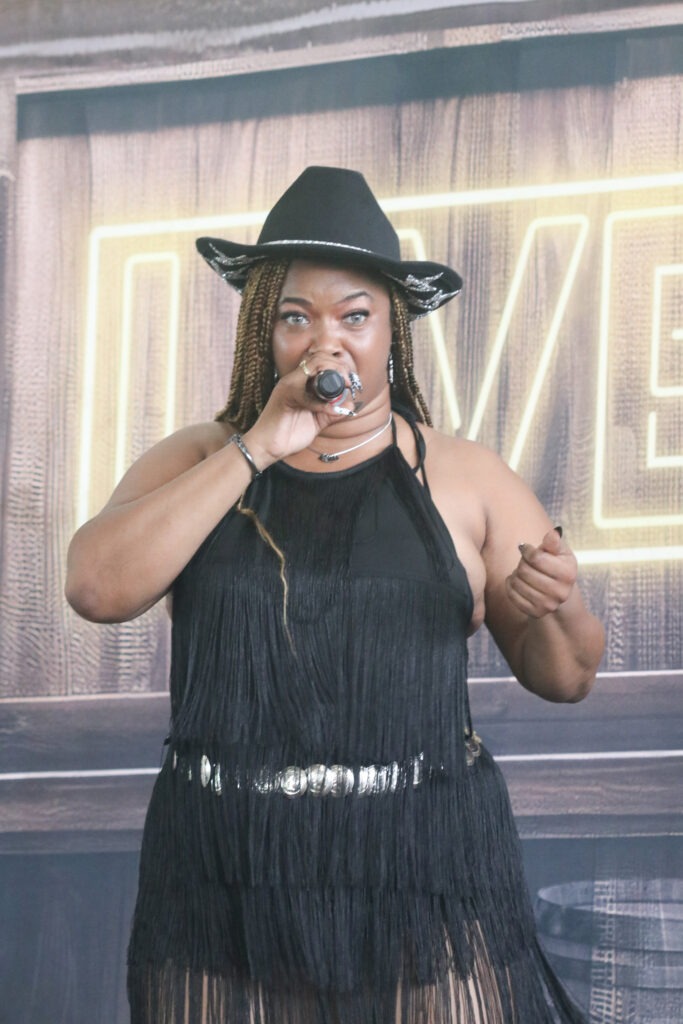
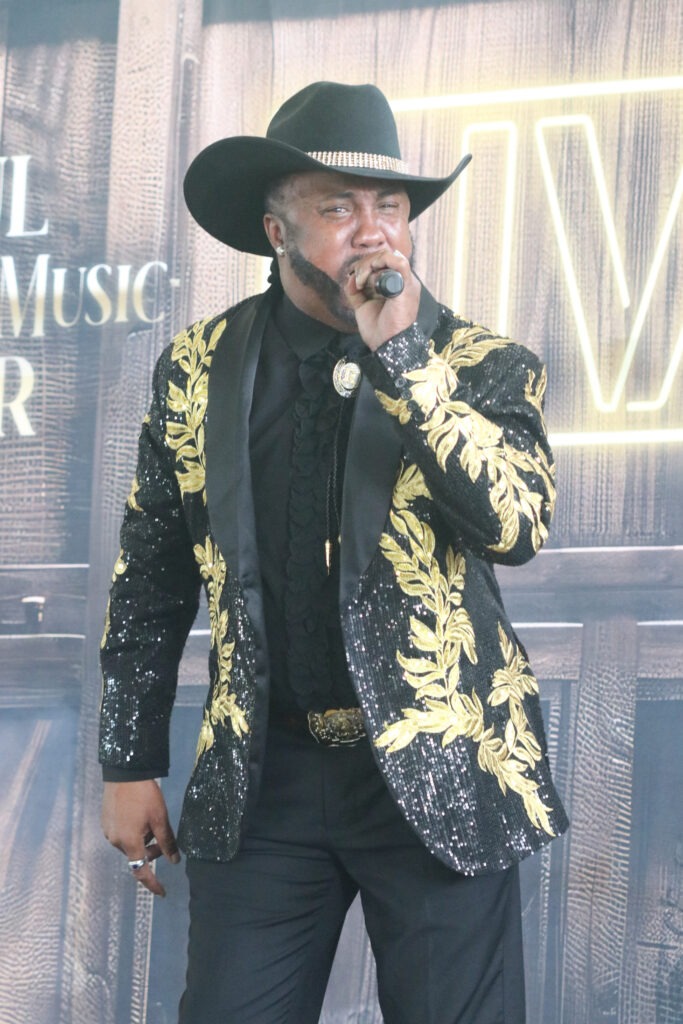
By the end of the opening round, Reggie Stacy and Kween Jacqueline Merrill remained. Each returned to the stage at the Georgia International Horse Park on August 1 to perform one final song before the judges made their decision.
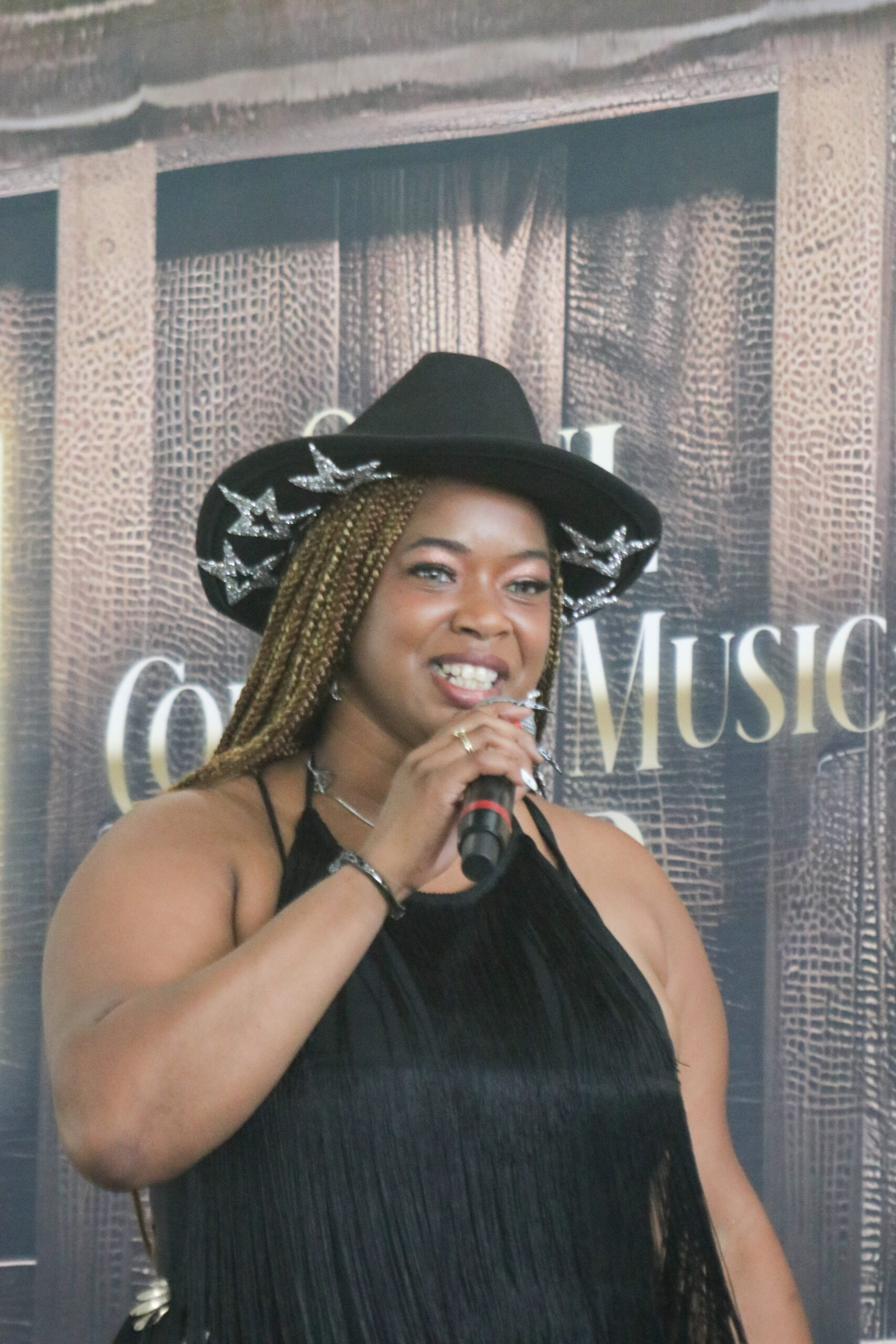
Jacqueline Merrill – Photo by Milton Kirby
Merrill was named the 2026 Atlanta Regional champion, earning a place in the national finals in Los Angeles and moving one step closer to the competition’s $10,000 grand prize.
For an artist who had spoken with The Truth Seekers Journal days earlier about faith, motherhood, personal loss, health struggles and perseverance, the victory marked another chapter in a journey that began in church when she was a child.
“It feels like I listened to God and it all worked out,” Merrill said after winning.
Now, the Road from Atlanta to Hollywood belongs to her.
Four Artists, Four Different Sounds
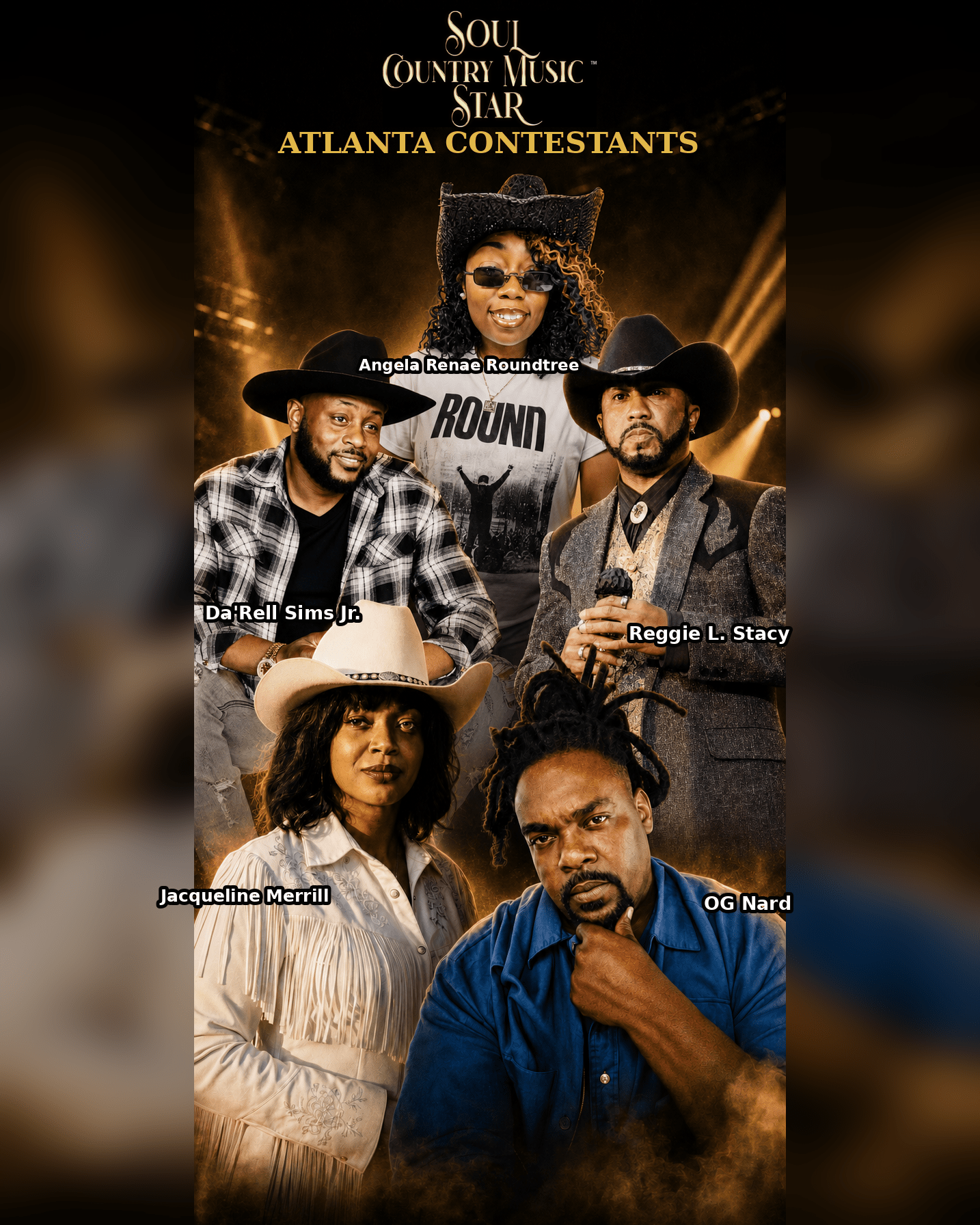
Presented as part of the Bill Pickett Invitational Rodeo’s Soul Country Rodeo Experience, the Atlanta SCMS Regional featured Angela Roundtree, Bernard “OG Nard” Stephens, Stacy and Jacqueline Merrill.
Roundtree brought gospel-rooted expression and a belief in performing with authenticity, emotion and meaning. OG Nard introduced what he calls “Trapp Kountry,” blending country storytelling, Southern Soul and contemporary urban influences. Stacy arrived with years of performance experience and an appreciation for country music shaped by artists including Charley Pride and Chris Stapleton.
Merrill brought perhaps the most difficult sound to categorize. She is a singer, songwriter, rapper, country artist and gospel performer, but she has never viewed those descriptions as competing identities. To her, they are all parts of the same artist.
Her relationship with music began in church. At five years old, she led her first song in the Church of God in Christ, and music remained part of her life through motherhood, hardship, health challenges and loss. Rather than separating those experiences from her artistry, she incorporated them into it.
In Atlanta, Merrill also performed an original song written specifically for the Bill Pickett Invitational Rodeo. Before the competition, she told TSJ what she wanted audiences to take away from her music.
“If I made you feel something,” Merrill said, “then I’ve done my job.”
On August 1, she also convinced the judges.
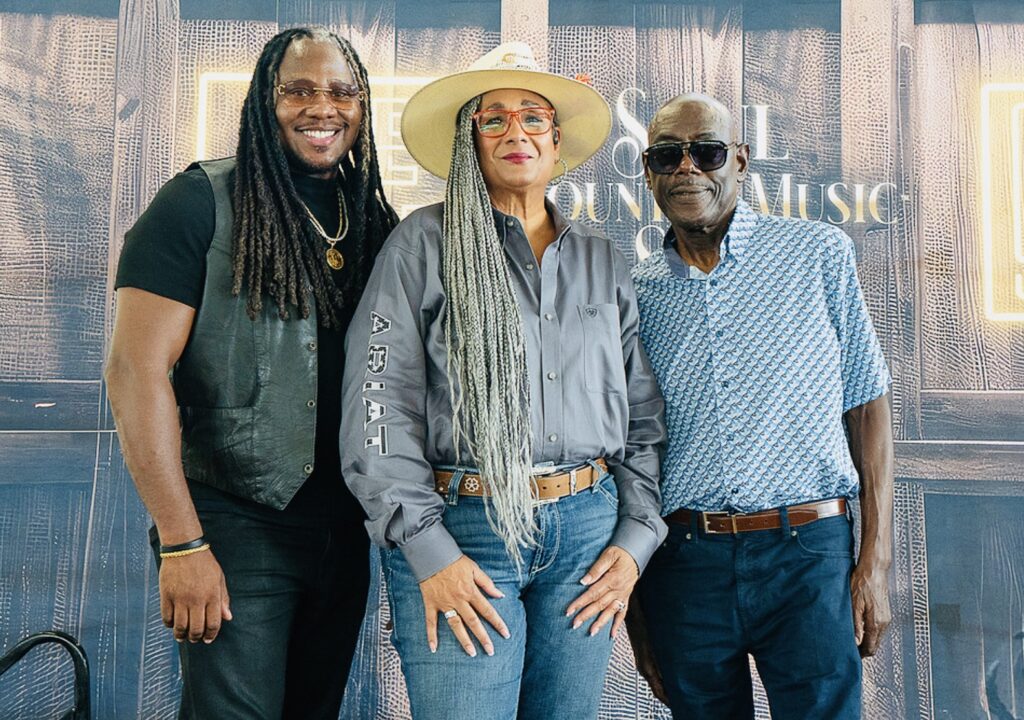
SCMS Atlanta Judges L to R Debonair DJ PNUT, Dr, Acynthia Villery & Rickey Davis Scott – Photo by Richard DuCree
Down to the Final Two
After the opening round, Stacy and Merrill performed again before three judges; Dr. Acynthia Villery, the BPIR rodeo announcer and influencer, Music Producer and Talent Scout Rickey Davis Scott and V-103FM Debonair DJ Pnut.
Their comments throughout the competition revealed that strong vocals alone were not enough. Stage presence, song selection and artistic identity also mattered, as did understanding the distinction between Southern Soul and the Soul Country sound the competition was seeking.
OG Nard, for example, was praised for his energy and ability to command attention. The judges also noted that some of his song choices leaned more toward Southern Soul and encouraged him to build a stronger connection to Soul Country.
Reggie Stacey – Photo by Milton Kirby
The critique highlighted a challenge for artists working in a musical space that is still defining itself. Soul Country does not require performers to abandon gospel, blues, Southern Soul, hip-hop or the other influences that shaped them. Instead, artists are challenged to show how those influences can live within country music while preserving the storytelling at the heart of the genre. That’s the goal.
In that context, song selection becomes more than a showcase for a performer’s voice. It becomes a statement about who the artist is.
Bringing Soul Country into the Rodeo
The Atlanta event marked a new approach for Soul Country Music Star and the Bill Pickett Invitational Rodeo. Margo Wade LaDrew, founder and creator of Soul Country Music Star, told the audience that the competition had traditionally been presented as a separate Friday night event. In Atlanta, organizers brought it directly into the rodeo experience.
When Wade LaDrew asked whether the audience enjoyed seeing Soul Country Music Star incorporated into the rodeo, the response came in cheers.
“This was something we wanted to try and do here at the rodeo,” she told the crowd, explaining that organizers could consider incorporating the competition into future rodeo programming.
The pairing is a natural one. For more than four decades, the Bill Pickett Invitational Rodeo has celebrated the often-overlooked history of Black cowboys and cowgirls while providing a national platform for Black Western culture. Soul Country Music Star extends that mission into music.
Black musicians have been part of country music since its earliest development, even when their contributions were overlooked or separated from the genre’s mainstream story. Although Black country artists are receiving greater visibility today, Wade LaDrew reminded the Atlanta audience that the work is not finished.
“As you know, the genre is just starting to open up, but we still have a long way to go,” she said.
Her request was straightforward: support the artists, follow them, share their music and help build the audiences their careers need to grow.
Wade LaDrew also recognized Valeria Howard Cunningham, president and CEO of the Bill Pickett Invitational Rodeo, for supporting opportunities for Black country artists. She thanked Soul Country Music Star producer Michelle Johnson, the judges, SCMS show host Kirk Jay, DJ Tiffany Guess and others who helped bring the competition into the Atlanta rodeo.
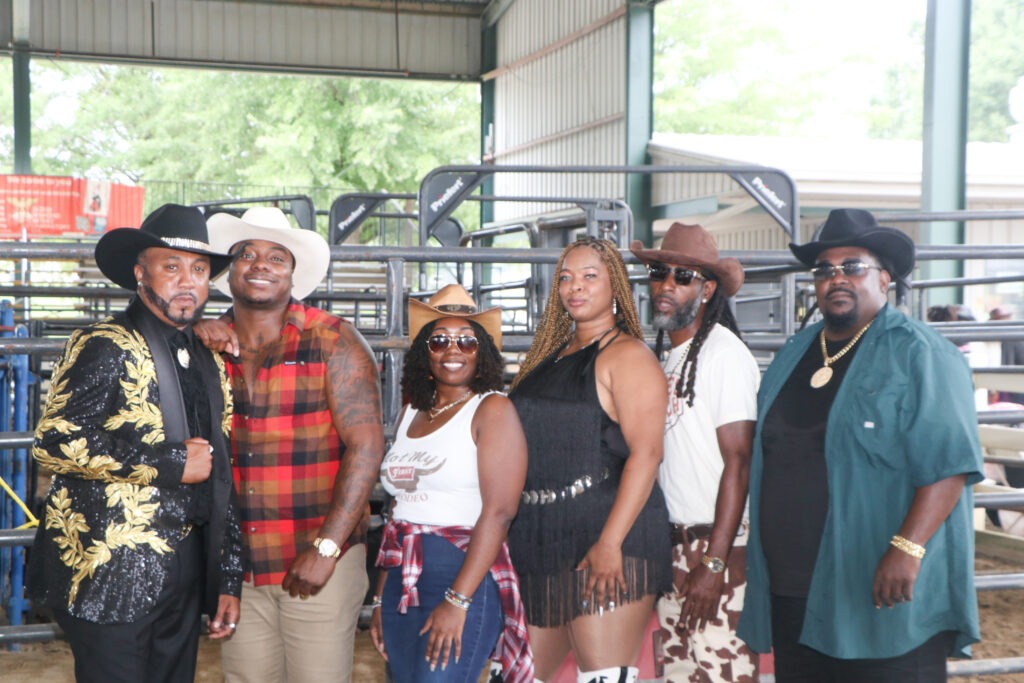
L – R – Reggie Stacey, Kirk Jay, season 1 winner, Angela Roundtree, Jacqueline Merrill, Nathaniel “Mr. Bowleggs” Dansby, season 2 winner & Bernard “OG Nard” Stephens – Photo by Milton Kirby
The Road to Hollywood
Merrill’s victory placed her alongside Brenda Guy, Dallas-Fort Worth Regional winner; Silas Reed IV, Memphis Regional winner; and Glenn Stanton, Los Angeles Regional winner.
One regional competition remains before the national finals. The Washington, D.C./Maryland Regional is scheduled for September 18 at The Show Place Arena in Upper Marlboro, Maryland.
The regional champions will then travel to Los Angeles for the Soul Country Music Festival and National Finals on October 31 and November 1, where they will compete for the $10,000 grand prize and the Soul Country Music Star national title.
Only one artist could become Atlanta’s regional champion, but something larger also happened at the Georgia International Horse Park. Four Black artists were given a stage to present four different visions of where country music can go, and another audience heard performers who might not have received the same opportunity a generation ago.
For Merrill, Atlanta was not the finish line. It was another door.
Black farmers across the South confront climate change, shifting growing seasons, drought, flooding and rising costs while fighting to protect land and livelihoods.
By Milton Kirby | Atlanta, GA | August 8, 2026
This reporting was made possible thanks to a grant from Grist.
For generations, farming required knowing the land and learning the seasons.
Farmers knew when the ground was usually ready. They knew when to plant, when rain normally came, when temperatures should begin to fall and how much grass cattle could expect from a pasture.
Weather was never completely predictable. Farming has always required risk.
But Black farmers interviewed across Alabama, Mississippi, Louisiana, Georgia, North Carolina and Virginia describe something different happening now.
The old assumptions are becoming less dependable.
They describe warmer temperatures, shifting planting dates, drought, intense rainfall, flooding, unexpected freezes and changing growing conditions. Some have altered what they plant. Others have changed when they plant. Cattle producers are watching pastures and hay supplies more carefully. Crop farmers are investing in irrigation, drainage, high tunnels and soil conservation.
And sometimes, after making all those adjustments, they still lose the crop.
Taken together, their experiences reveal something larger than a collection of bad weather events.
The U.S. Department of Agriculture’s Southeast Climate Hub describes agriculture in the region as operating under “increasing weather variability.” The Hub identifies drought, heat stress, excessive moisture and changing pest pressures among the risks confronting Southeastern producers.
The U.S. Environmental Protection Agency similarly identifies changing temperature and precipitation patterns, changes in extreme weather and shifts in growing seasons among the evidence of a changing climate.
For the farmers visited, those scientific descriptions have practical meanings.
Climate change is a decision about whether to put seed in the ground.
It is a field planted twice.
It is a pasture without enough grass.
It is hay that has to be purchased.
It is soil washed away by heavy rain.
It is produce that never reaches market.
And for Black farmers, those pressures are landing on top of a much older struggle over land, capital and survival in American agriculture.
The Calendar Is Moving
Bobby Wilson has spent decades working in Georgia agriculture.
Long before Metro Atlanta Urban Farm took root in College Park, Wilson spent years in agricultural extension, learning how to help farmers succeed. Today, he and his wife, Margarett, are reshaping five acres into an urban agricultural campus, producing food, training families, and cultivating a new generation of growers.
The farm grows more than two dozen crops across warm and cool seasons and is Certified Naturally Grown.
Wilson has watched something fundamental change over the course of his agricultural career.
The planting calendar.
Dates farmers once regarded as relatively safe are no longer necessarily the dates they use today. Warmer conditions can tempt a farmer to plant earlier, creating the possibility of getting produce to market ahead of competitors.
But warmth in early spring does not guarantee that winter is finished.
A late cold snap can turn that advantage into a loss.
USDA says growing seasons are changing as temperatures rise. Earlier spring conditions and later first frosts can lengthen growing periods, but earlier plant development can also leave crops vulnerable when damaging cold arrives after growth has begun.
That is the contradiction farmers are learning to manage.
Dennis Dahmer Sr. has confronted it in Mississippi.
An unexpected freeze damaged sugarcane on his farm, forcing him to reconsider when he should plant.
But changing a planting date after one bad season does not eliminate the risk.
Next year may be different.
That uncertainty is becoming part of farming itself.
In New Orleans, Ashley Webb and her husband, Andres Barcelo-Sanchez, have learned a similar lesson.
They operate Barcelo Gardens in the Ninth Ward, where what began as a community garden grew into an urban farm, farmers market and fresh-produce operation serving an area with limited access to fresh food.
Webb teaches gardening according to growing zones and seasons, but New Orleans presents another complication: the city’s heat-island effect can create conditions different from surrounding areas.
The couple also learned quickly that crops they had grown in Los Angeles did not necessarily perform the same way in Louisiana. Corn and carrots struggled. They adjusted, turning toward crops including okra, long beans, cucumbers and hot peppers.
Adaptation began with paying attention.
Crate of vegetable from the Barcelo Gardens – Photo by Milton Kirby
Too Little Water. Then Too Much.
Water may be the clearest example of the contradictions farmers described.
Harry McCoy raises cattle at McCoy Ranch in Pell City, Alabama.
When rainfall declines, pasture suffers.
Cattle still have to eat.
When the pasture no longer supplies enough grass, it must be replaced with purchased feed or hay, turning a weather problem into an economic one.
Anson County, North Carolina, cattle farmer Keith Crawford understands that equation.
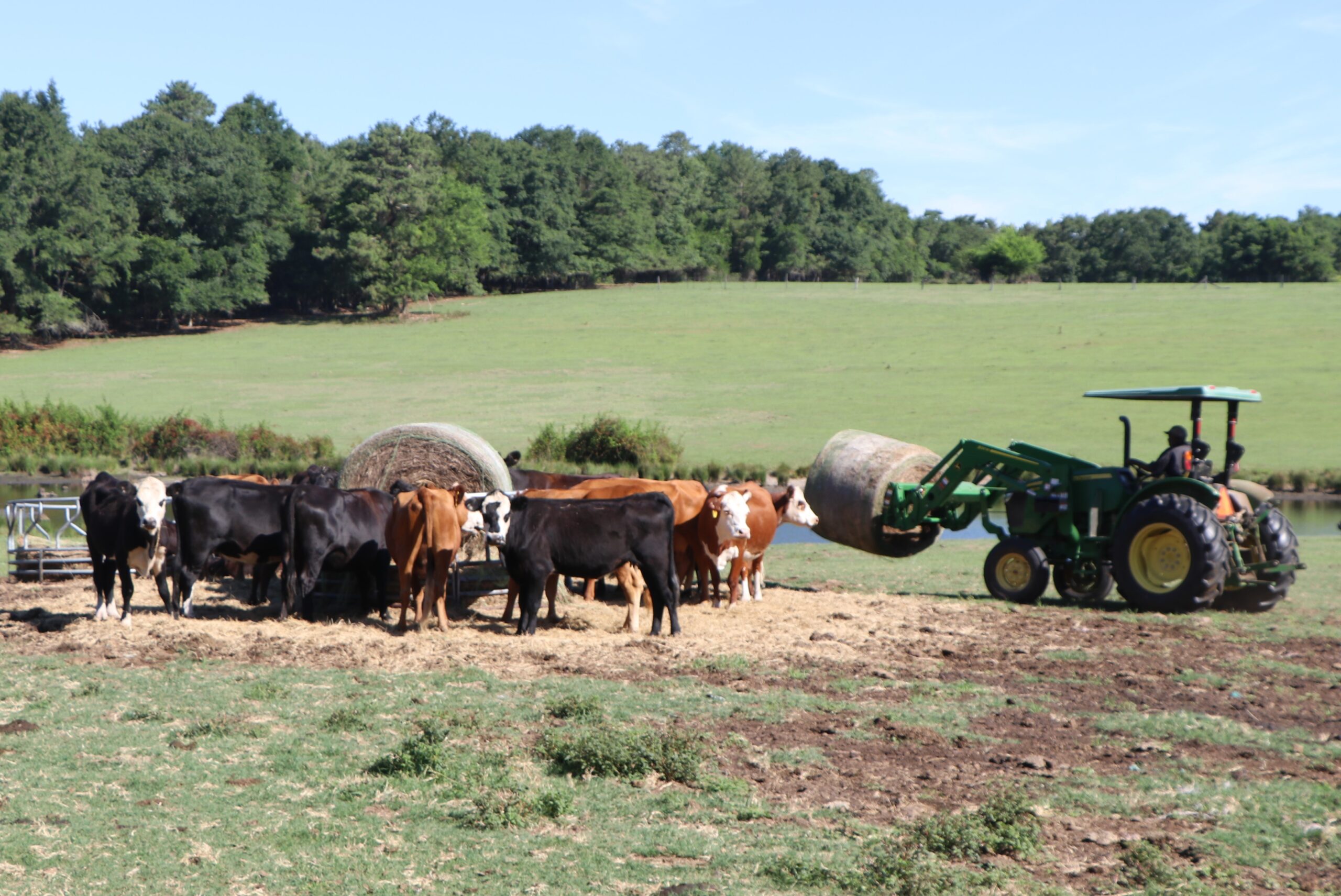
Crawford raises Black Angus and Hereford-cross cattle. He has watched the availability and cost of hay become a critical issue for livestock producers.
Crawford cuts hay and watches weather forecasts closely because producing feed requires its own set of weather calculations. Hay needs the right window for cutting, drying and baling. Rain arriving at the wrong time can damage what a farmer has already spent time and money producing.
Crawford described neighboring cattle producers selling animals when hay became difficult or too expensive to obtain.
For a cattle farmer, drought doesn’t just strike once. It can strike two or even three times. It begins with shrinking ponds and water sources, leaving livestock without reliable drinking water. Then it hits again when pastures wither, forcing farmers to buy hay or feed at inflated prices and driving up the cost of keeping cattle alive. By the time the third blow lands, through reduced weight and lower market value, the damage is already deep.
USDA’s Southeast Climate Hub notes that climate conditions can weaken both pasture and feed resources, pushing feed costs higher. Heat stress can also reduce livestock productivity.
Shawn Harris, a cattle farmer in Rockmart, Georgia, has built a sophisticated underground maze of pipes to keep water flowing to his herd when the pond runs low, a climate adaptation strategy born from necessity.
But several hundred miles away, other farmers are confronting the opposite problem.
Too much water.
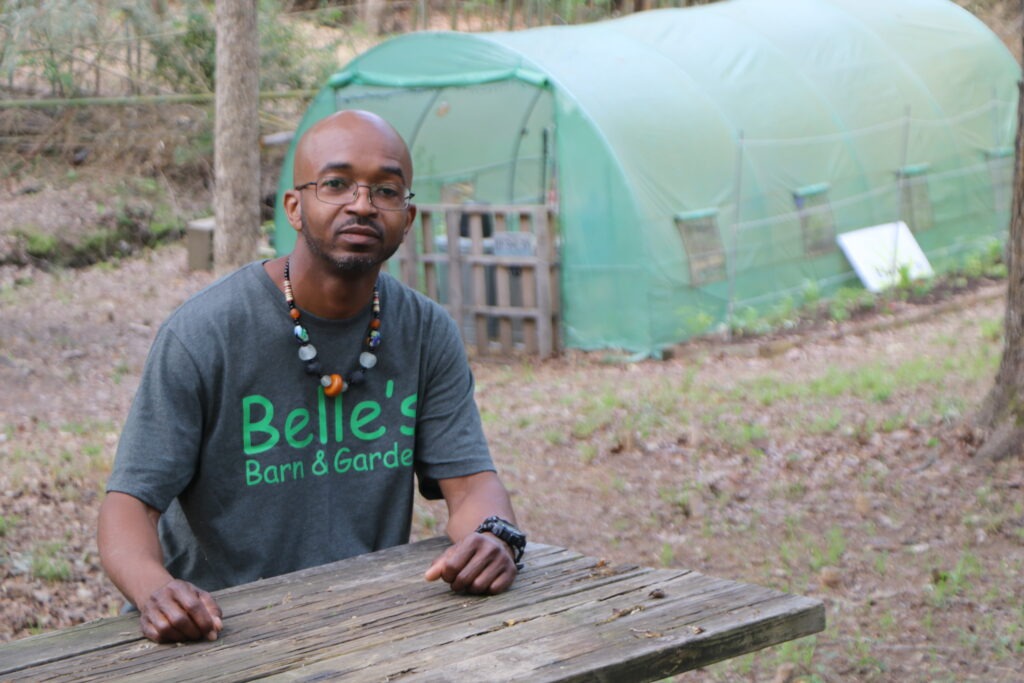
At Belle’s Barn & Garden in Mississippi, the Rev. D’Andre Miles described periods of dry conditions followed by intense rainfall.
When large amounts of rain fall quickly, the water does not always soak gently into the soil.
It moves.
And when it moves, soil can move with it.
Miles’ approach is to work with the landscape. Vegetation around vulnerable areas can slow water and help hold soil in place rather than leaving the ground exposed.
That philosophy reflects Belle’s broader approach to agriculture: working with natural systems instead of constantly trying to overpower them.
Jesse Buie of Ole Brook Organics in Brookhaven, Mississippi, has also had to think carefully about water.
Buie has more than three decades of farming experience and grows certified organic vegetables, melons, ginger, turmeric, wheatgrass and microgreens.
Heavy rain can saturate growing areas and threaten crops.
His response has included changing how growing areas are configured so water can move more effectively through the farm.
USDA’s research helps explain how both stories can be true at once.
The Southeast can experience substantial rainfall and still suffer drought. Rainfall variability, heat and increased water loss through evaporation and plants can produce dry conditions, while rainfall concentrated into fewer, heavier events can create flooding and runoff.
For farmers, the question is not simply how much rain falls.
It is when it falls, where it falls and how quickly it arrives.
Foot Print Farm vegetables – Photo by Milton Kirby
When One Planting Becomes Two
Few interviews illustrate the economics of climate risk more clearly than Kara Boyd’s.
Boyd Farms operates about 1,500 acres across three farms in Virginia, giving this investigation a view of climate pressures on a substantially larger Black farming operation.
Boyd described having to replant roughly 200 to 300 acres after conditions contributed to poor germination.
Consider what that means economically.
The farmer pays for seed.
The farmer pays for fuel.
The farmer pays for equipment.
The farmer pays for labor.
The crop goes into the ground.
Then enough of it fails to emerge.
The farmer starts again.
But the second planting does not merely repeat the first expense. It also begins later, potentially shortening the crop’s growing window and affecting eventual yield.
Crop insurance can soften the loss.
It does not necessarily erase it.
USDA’s Southeast Climate Hub says changes in the timing and amount of precipitation can contribute to short-term crop failures and longer-term declines in production. Higher temperatures can also reduce yields, while climate variability can expose crops to damaging temperature fluctuations.
Boyd’s experience turns those scientific findings into a balance-sheet problem.
A failed planting has a price.
Metro Atlanta Urban Farm – Photo by Milton Kirby
The Same Storm Does Not Mean the Same Loss
Boyd’s operation also exposes one of the central questions in this investigation.
Climate does not distinguish between a Black farmer and a white farmer.
But farmers do not encounter climate risk with equal resources.
A large operation may have more acreage over which to spread costs, greater access to equipment, stronger cash flow and more ability to absorb a failed field.
For a small farmer, one failed crop can represent a much larger percentage of annual production.
Boyd described that difference vividly, saying an event that feels like a relatively small storm to a large operation can feel like a hurricane and an earthquake to a smaller Black farmer.
That is where a climate story becomes an economic story.
And where an economic story becomes a story about history.
A Crisis Built on an Older Loss
Black farmers did not enter today’s climate challenges on equal footing.
In 1920, USDA recorded more than 925,000 Black farm operators, representing roughly 14 percent of the nation’s farmers.
What followed was one of the most dramatic agricultural declines in American history.
Over subsequent generations, Black farmers lost millions of acres of farmland while the number of Black farmers fell sharply.
A USDA historical review, Black Farmers in America, 1865-2000, documents the racial discrimination and social and institutional barriers that restricted Black farmers’ ability to acquire land, operate independently and retain farms.
Discriminatory lending was part of that history.
So were foreclosures, unequal access to agricultural institutions and land passed between generations without clear title.
The consequences of that history remain part of today’s agricultural landscape. In a 2026 policy resolution, the National Black Caucus of State Legislators noted that Black farmers held more than 16 million acres of farmland in 1910, but just 4.7 million acres by 2017, a loss of more than 70 percent of Black-owned agricultural land.
The resolution identifies discriminatory lending, unequal access to credit and crop insurance, exclusion from grant opportunities and inequities in agricultural subsidies and assistance as continuing barriers facing Black farmers. NBCSL called on Congress, state legislatures and USDA to expand access to grants and loans, strengthen civil rights enforcement, provide legal assistance to protect inherited farmland and invest in food infrastructure and markets that can help Black producers remain economically viable.
Heirs’ property remains part of the discussion today.
When land passes to multiple descendants without a will or clear title, ownership can become fragmented. That can make property vulnerable and complicate efforts to borrow against the land or participate in programs requiring proof of control.
But Boyd cautions against making heirs’ property the entire story.
From her perspective, access to capital, participation in federal crop insurance and the ability to navigate agricultural programs can be equally important, if not more important, to the survival of Black farms.
Her argument adds an important complication.
The problem is not simply whether Black families own land.
It is whether they possess the financial tools needed to keep farming it.
Foot Print Farms – Photo by Milton Kirby
Who Can Afford to Adapt?
Dennis Dahmer knows irrigation could help protect crops during dry periods.
But knowing what would help and being able to justify the investment are different things.
For a farmer working a relatively small number of acres, a major irrigation system may never generate enough additional farm income to recover its cost.
For a producer farming hundreds or thousands of acres, the same investment can produce an entirely different calculation.
That exposes one of the most important climate-justice questions raised by this reporting.
Adaptation costs money.
Irrigation costs money.
Wells cost money.
High tunnels cost money.
Drainage costs money.
Replacing seed costs money.
Buying hay costs money.
Even participation in crop insurance requires farmers to understand the system, maintain records, meet reporting requirements and pay premiums.
Boyd said those requirements can become barriers for smaller producers unfamiliar with federal crop insurance or reluctant to enter a system they may not trust.
That distrust did not emerge from nowhere.
It exists against the historical record of discrimination Black farmers experienced within American agricultural institutions.
Learning to Work the System
Dr. Cindy Ayers-Elliott has taken a different approach.
At Foot Print Farms in Jackson, Mississippi, Ayers-Elliott operates a 68-acre farm producing specialty crops, vegetables and livestock while using agriculture as a tool for community and economic development.
Her farm trains young people and adults.
It also works with USDA and the Natural Resources Conservation Service.
Ayers-Elliott believes farmers must learn how the system works.
That means obtaining a USDA farm number, understanding conservation programs, keeping records and identifying resources that can help pay for infrastructure or improve production.
Her farm uses adaptation and conservation tools that include irrigation and protected growing. But her larger contribution may be education.
A federal program is of little value to a farmer who does not know it exists, does not understand the paperwork or cannot determine whether the farm qualifies.
That gap between the existence of assistance and the ability to access it remains one of the central policy questions raised by this investigation.
One proposal before Congress attempts to address some of those structural barriers.
The Black Farmers and Socially Disadvantaged Farmers Increased Market Share Act, introduced in the U.S. House by the late Georgia Rep. David Scott and other lawmakers, would create a USDA grant program supporting food hubs designed to increase market access for socially disadvantaged farmers and ranchers. The legislation would authorize $100 million for the program in fiscal year 2026, with grants available for infrastructure, processing, storage, transportation, equipment and marketing. Recipients would not be required to provide federal matching funds.
The bill would also direct USDA to prioritize purchases from socially disadvantaged producers for domestic food assistance programs and strengthen accountability for discrimination and other civil rights violations within the department.
The legislation does not solve the climate problem confronting farmers. But it speaks directly to another question raised repeatedly during this reporting: whether farmers already absorbing greater weather risk will have the capital, markets, infrastructure and institutional support necessary to adapt.
Rev. D’Andre Miles – Bells Barn & Garden – Photo by Milton Kirby
Building Resilience From the Ground Up
The farmers interviewed are not waiting passively for someone to rescue them.
They are experimenting.
They are adapting.
And in many cases, the techniques they are using mirror practices recommended by USDA.
At Metro Atlanta Urban Farm, Wilson emphasizes the soil itself.
Cover crops, compost and organic matter help restore nutrients and improve the ground rather than simply extracting from it season after season.
At Belle’s Barn & Garden, Miles emphasizes natural systems and protecting the landscape.
At Ole Brook Organics, Buie adapts drainage and production methods to conditions on his particular farm.
At Foot Print Farms, Ayers-Elliott combines infrastructure, conservation and education.
Ricky Davis, founder of Sowing Seeds Farms in Bessemer, Alabama, incorporates water conservation, controlled growing systems and agricultural education into the operation.
The operation was established not simply to grow food but to create a community gathering place for farmers and entrepreneurs, promote economic development and teach healthier and more sustainable ways of living.
USDA identifies many of the same approaches, including cover crops, conservation tillage, efficient irrigation, improved soil-water retention, erosion control and water-management infrastructure.
The important lesson is that adaptation is not one machine, one crop or one federal program.
It is local.
What works on one farm may not work five miles away.
Boyd sees that even across her own acreage. Rain can fall on one section of a farm while missing another.
A county line cannot tell a farmer whether enough rain fell on a particular field.
The land itself decides.
When Farming Is the Paycheck
At Fountain Heights Farms in the Birmingham area, climate risk carries another dimension.
Farming is not supplemental income.
It is the livelihood.
That distinction matters.
Many small farmers maintain outside employment because the farm alone cannot consistently support the household. Fountain Heights does not have that secondary income cushion.
A lost crop is therefore not merely a disappointing harvest.
It is lost household income.
The operation also exists within a larger community food system, making affordability and access part of the farm’s mission.
That means climate pressure can travel beyond the property line.
When a community farm produces less food, the people depending on that farm can feel the loss too.
Climate Change Does Not Stop at the Farm Gate
Barcelo Gardens demonstrates that connection particularly clearly.
Webb and Barcelo-Sanchez began growing food after realizing their Ninth Ward neighborhood lacked convenient access to fresh produce.
Their garden eventually grew into a market that also obtains food from other producers.
Among them is Jubilee Justice, a Black-led agricultural organization based near Alexandria, Louisiana, that works on sustainable farming practices.
Ricky Davis – Sowing Seeds Farm – Photo by Milton Kirby
That creates a chain.
A farmer loses a crop.
A market has less produce.
A neighborhood already lacking grocery options has fewer sources of fresh food.
The climate event may happen in a field miles away.
Its consequences arrive in the city.
The same principle applies elsewhere in this investigation.
Metro Atlanta Urban Farm teaches families how to produce food.
Foot Print Farms trains future farmers and entrepreneurs.
Sowing Seeds combines food production with community education.
Fountain Heights works to keep food available and affordable.
These operations are more than businesses occupying acreage.
They are pieces of community infrastructure.
Protecting the farm can therefore mean protecting more than the farmer.
Science Catches Up With What Farmers See
The experiences documented across these farms are consistent with risks identified by the USDA Southeast Climate Hub.
When I described the farmers’ observations to Dr. Mac Callaham Jr., director of the Hub, including warmer conditions, changing growing seasons, flooding and precipitation problems, his initial response was direct.
“Yeah, absolutely.”
Callaham pointed specifically to shifting growing seasons, variability in precipitation and increasing temperatures among the issues agricultural producers are confronting.
His program’s public materials go further.
The Southeast Climate Hub says farmers and land managers are dealing with drought, heat stress, excessive moisture, changing pest pressures and increasing weather variability.
Its crop research warns that changes in temperature and the timing and amount of precipitation can affect yields and contribute to crop failure.
Its livestock research identifies heat stress and changes in pasture and feed resources as risks to producers.
Its growing-season research describes earlier spring conditions, later frosts and the possibility that earlier plant development can leave crops exposed to damaging cold.
The science does not mean every failed crop, flooded field or expensive roll of hay can individually be blamed on climate change.
Weather still varies naturally.
But taken across regions and over time, the conditions farmers described fit a larger pattern agricultural scientists are already studying.
Callaham also acknowledged that the language surrounding the federal government’s work has changed.
He said his program previously focused more explicitly on climate literacy and climate education, but priorities shift between presidential administrations.
The current emphasis, he said, remains on helping farmers, forest landowners and grazing-land managers improve productivity and resilience to risk.
The terminology may change.
The farmer still has to plant.
Mother Nature Has the Final Say
Kara Boyd summed up the limits of adaptation in a few words.
“We’re trying to adapt to Mother Nature,” she said. “But she has the final say.”
That may be the central truth running through every farm visited.
Farmers can move planting dates.
They can build high tunnels.
They can improve drainage.
They can install irrigation.
They can rebuild soil.
They can capture rainwater.
They can buy crop insurance.
They can change crops.
They can study forecasts.
They can learn government programs.
But none of those decisions gives them control over the weather.
For Black farmers, the question is not whether they know how to adapt.
They have been adapting for generations.
The harder question is how many additional costs, failed plantings, droughts, floods, freezes and changing seasons a farmer can absorb before adaptation is no longer enough.
Across the South, the farmers interviewed are still planting.
Still raising cattle.
Still rebuilding soil.
Still feeding communities.
Still teaching the next generation.
But they are doing so while some of the seasonal assumptions inherited from previous generations become less dependable.
Climate change is altering the conditions under which they farm.
History has shaped the resources they have available to respond.
The future of Black farming may depend on whether the institutions surrounding these farmers can adapt as quickly as the farmers themselves already have.
Support open, independent journalism. Your contribution helps us tell the stories that matter most.
With 99 days until Election Day, Democratic gubernatorial nominee Keisha Lance Bottoms urged Georgia voters, especially Black men, to deliver record turnout during a town hall at Atlanta’s Gathering Spot.
At Atlanta’s “Mandate” town hall, the Democratic nominee made a direct appeal to Georgia voters, particularly Black men, arguing that grassroots organizing, not campaign spending, will determine who becomes the state’s next governor.
By Milton Kirby | Atlanta, GA | July 28, 2026
With just 99 days remaining before Georgians choose their next governor, Democratic nominee Keisha Lance Bottoms walked onto the stage at The Gathering Spot Monday evening carrying a message that has become the foundation of her general election campaign.
She isn’t asking voters to be impressed by campaign spending.
She isn’t asking them to be persuaded by carefully choreographed social media moments.
Instead, she is asking them to participate.
Speaking before a packed audience at “The Mandate,” a town hall organized by The Gathering Spot and moderated by co-founder Ryan Wilson, Bottoms repeatedly returned to one central theme: Georgia’s next governor will not be chosen by the candidate with the biggest advertising budget or the most viral campaign photographs. The election, she argued, will ultimately be decided by ordinary Georgians willing to organize their communities, encourage their neighbors and show up to vote in record numbers.
“Turnout is key. Turnout is key. Turnout is key,” Bottoms told the audience, emphasizing that participation—not complacency—will determine whether Democrats can reclaim Georgia’s highest office for the first time in more than a quarter century.
The message came at a pivotal moment in one of the nation’s most closely watched gubernatorial races.
Earlier Monday, Republican nominee Rick Jackson’s campaign announced an $87 million statewide advertising buy, underscoring the enormous financial resources fueling his campaign. Jackson, a billionaire healthcare executive who has already poured more than $100 million into the race, has paired that media strategy with a series of highly publicized visits to Black-owned businesses, churches and community gathering places throughout metro Atlanta.
Bottoms acknowledged the financial disparity but dismissed the notion that money alone will determine the outcome.
“We’re going to do what we need to do with what we have,” she told reporters after the event. “Whatever that amount is, we are still going to take our case directly to the people of this state.”
A Race That Could Reshape Georgia Politics
The stakes extend well beyond the two candidates.
No Democrat has won Georgia’s governor’s race since Roy Barnes was elected in 1998. Yet the state’s political landscape has shifted dramatically over the past decade. Georgia has twice elected Democratic U.S. senators, and razor-thin statewide contests have transformed the state into one of America’s premier political battlegrounds.
Those changes have elevated turnout from a campaign tactic to a governing strategy.
Political analysts from both parties agree that victory in November will depend less on persuading large numbers of undecided voters than on motivating reliable supporters to cast ballots. That reality has placed Black voters and particularly Black men at the center of both campaigns, although the candidates are pursuing markedly different approaches.
Monday night’s town hall reflected Bottoms’ strategy.
Rather than delivering a traditional stump speech, she spent nearly two hours answering questions about affordability, education, healthcare, economic opportunity and voting rights while repeatedly encouraging attendees to become ambassadors for civic participation within their own families and neighborhoods.
Answering a Personal Call to Serve
Bottoms told the audience that seeking the governor’s office was never part of a carefully crafted political roadmap.
After completing her four-year term as mayor of Atlanta, she said life had become comfortable. Returning to elected office was not part of her immediate plans.
That changed after the 2024 presidential election.
“The day after the presidential election, I cursed and then I prayed,” she recalled, explaining that she spent considerable time reflecting on whether she was being called back into public service. The decision, she said, required conversations with her husband and children because campaigns demand sacrifices from entire families, not just the candidates themselves.
“It was really about what am I called to do?” Bottoms said. “What can I offer? And is it worth me getting out of my comfort zone? Because life was comfortable. And the answer was yes.”
That sense of purpose shaped much of the evening’s discussion.
Rather than focusing primarily on partisan attacks, Bottoms framed her candidacy as an effort to build on opportunities created by previous generations while creating new ones for the next.
“I want to be able to look at my kids in their faces and say in this moment I did everything that I could do on behalf of us,” she said.
The Issues She Says Georgians Raise Everywhere
As Bottoms has campaigned from metropolitan Atlanta to rural South Georgia, she said the conversations have remained remarkably consistent.
Whether speaking in barbershops, churches, community centers or small-town gathering places, Georgians repeatedly raise the same concerns.
Unidentified Black men listen with intensity – Photo Milton Kirby
The rising cost of groceries.
Housing affordability.
Gas prices.
Healthcare expenses.
Mental health services.
Support for small businesses.
Educational opportunity.
“These are some of the issues that have been generations long,” Bottoms said. “And they are coming up everywhere I go.”
Healthcare emerged as one of the evening’s most frequently discussed topics.
Bottoms argued that many Georgians are facing increasing insurance costs while others have lost coverage altogether. She connected those concerns to broader questions about affordability, describing healthcare as inseparable from the financial pressures confronting working families across the state.
Education also occupied a prominent place in the discussion.
Bottoms criticized Georgia’s long-running struggles to fully fund public education, she stated that the last time the state consistently met its funding commitments she was still a member of the marching band at Frederick Douglass High School.
Her point drew laughter.
It also underscored her broader argument that many of Georgia’s biggest challenges did not emerge overnight but have persisted across generations.
A Direct Conversation With Black Men
Although “The Mandate” welcomed a broad audience, organizers intentionally focused much of the evening on Black men, a voting bloc both political parties increasingly recognize as critical to statewide success.
Wilson challenged the narrative that Black men have become disengaged from politics, noting that conversations inside barbershops and neighborhoods often center on the same economic and quality-of-life concerns shared by other Georgians.
Bottoms agreed.
Drawing from conversations with her own sons and young men she has met while traveling the state, she said Black men are asking practical questions about employment, housing, public safety and whether higher education still guarantees economic opportunity.
“They’re concerned there won’t be jobs,” she said. “They’re concerned whether they’ll be able to afford a home. They’re concerned about interactions with public safety. They’re concerned with mental health.”
At the same time, she rejected suggestions that Black men alone bear responsibility for civic participation.
“I think it’s an unfair burden for Black men to have to carry,” Bottoms said. “This democracy is about all of us.”
Instead of singling out one demographic, she encouraged every eligible voter to recognize that participation extends beyond casting a ballot. It also includes helping neighbors verify voter registration, reminding family members about Election Day and serving as trusted voices within their communities.
That appeal to transform supporters into organizers became the thread connecting nearly every answer she gave throughout the evening.
Policy Versus Political Theater
One of the evening’s sharpest exchanges centered not on taxes, healthcare or education, but on a series of campaign photographs that have fueled debate across social media in recent days.
Republican nominee Rick Jackson has made highly publicized visits to several minority-owned businesses throughout metro Atlanta, including Toast on Lenox, Big Daddy’s Dish on Old National Highway and a Mexican-owned restaurant in Doraville. The visits generated widespread online discussion, with some business owners finding themselves unexpectedly drawn into Georgia’s increasingly heated gubernatorial campaign.
Bottoms said she takes no issue with candidates supporting local businesses. What she questioned was whether highly publicized campaign stops accurately reflect a candidate’s policies.
“I support small businesses. It’s what I do,” she said in a video posted before Monday’s town hall. “What I take exception with is when we let ‘a thing become the thing.’ The theatrics are nice, but what is the real worth? What are you actually doing?”
For Bottoms, the issue is also personal.
She traced her family’s entrepreneurial roots back more than a century, recalling that her great-grandmother operated a business on Atlanta’s west side during the 1920s. Her grandfather and aunt later owned businesses in Vine City and English Avenue, while her mother spent more than three decades operating a beauty salon that served neighborhoods across southwest Atlanta.
Those experiences, she said, shaped her understanding of what neighborhood businesses mean to families and communities.
“I live in southwest Atlanta, and I am surrounded by Black businesses,” Bottoms said during the town hall. “I don’t have to have a camera crew with me every time I walk into one.”
She also questioned what she described as contradictions between Jackson’s outreach and his policy positions, pointing to his criticism of diversity, equity and inclusion initiatives and his support for stricter immigration policies while simultaneously visiting minority-owned businesses.
Her closing line in the Instagram video became one of the week’s most widely shared political remarks.
“Don’t allow people to piss on us and then tell us that it’s raining.”
Defending Her Record as Mayor
Keisha Lance Bottoms – Photo by Milton Kirby
Jackson has frequently criticized Bottoms’ four-year tenure leading Atlanta, particularly on crime and public safety.
Monday night, she answered those criticisms directly.
Bottoms reminded the audience that she served the full four-year term voters elected her to complete despite receiving multiple invitations to join the Biden administration before leaving office.
“I served every single day,” she said. “I was asked three times to join the Biden-Harris Administration, and I said no because I wanted to complete my time.”
She then walked through what she considers some of her administration’s defining accomplishments.
During the COVID-19 pandemic, Atlanta maintained balanced budgets without laying off employees or furloughing city workers. The city increased financial support for police officers and other frontline employees while continuing major economic development initiatives, including the redevelopment of the Gulch and expanding opportunities for minority-owned businesses to compete for city contracts.
Rather than arguing she governed during easy circumstances, Bottoms suggested her administration demonstrated stability during one of the most difficult periods in the city’s history.
“If you want to say something about me, fine,” she said. “But don’t lie on my name.”
Competing Against a Billionaire
Bottoms acknowledged that this campaign presents challenges unlike any she has previously faced.
Jackson, a wealthy healthcare executive making his first bid for elected office, has already invested more than $100 million of his own money into the race. His campaign’s announcement Monday of an additional $87 million statewide advertising buy underscored the financial gulf separating the two candidates.
Bottoms said she is less concerned about Jackson’s wealth than about how it is being used.
“I’m not mad about him being a billionaire,” she told the audience. “What I am mad about is the way that he is manipulating the narrative with money.”
She added that one friend’s advice continues to resonate throughout the campaign.
“If you can be bought,” she said, “you can be sold.”
Her response reflected a broader strategy that has become increasingly central to her campaign—meeting voters directly rather than attempting to match Jackson’s advertising dollar for dollar.
Looking Beyond Metro Atlanta
Although much of the discussion focused on metropolitan Atlanta, Bottoms repeatedly returned to the importance of rural Georgia.
She described communities where factories have disappeared, broadband access remains limited and young people often leave after graduating from high school because economic opportunities are scarce.
“Some communities look like time has forgotten them,” she said.
Bottoms noted that while residents across Georgia want many of the same things, good schools, quality healthcare, stable jobs and safe neighborhoods. The path toward achieving those goals differs dramatically between urban and rural communities.
Bottoms also addressed the rapid expansion of artificial intelligence data centers across Georgia, calling for a deliberate review of their long-term impact on utility costs, environmental resources and economic development before embracing additional growth.
Rather than opposing the projects outright, she said state leaders should ensure communities receive tangible benefits while avoiding unintended burdens on residents.
Building a Campaign One Conversation at a Time
Perhaps the evening’s most consistent message had little to do with campaign advertising or partisan politics.
Bottoms repeatedly encouraged supporters to become what she called “trusted voices.”
She acknowledged that some people may have time only to cast a ballot on Election Day.
Others, she said, can do more.
Call ten friends.
Help a neighbor verify voter registration.
Knock on doors.
Volunteer.
Encourage family members to vote.
“Put your oxygen mask on first,” she said. “For some people, the most you can do is show up and vote. For others, it’s calling ten people in your phone. Whatever you can do—do it.”
She also warned that misinformation and confusion surrounding elections have become significant obstacles to civic participation, particularly among younger voters trying to distinguish fact from political rhetoric.
Her challenge to supporters was simple: become reliable sources of information inside their own communities.
The Road to November
As the formal program concluded, the campaign did not end.
Bottoms remained inside The Gathering Spot well after the town hall was over, moving deliberately through the room as supporters waited for photographs and reporters gathered for follow-up interviews. She answered questions from members of the media one by one before turning her attention to attendees, posing for photographs and greeting everyone who wanted a moment with her.
There was no rush toward the exit.
No effort to shorten conversations.
The evening closed much the way it had begun; with Bottoms engaging voters one person at a time.
Only after every reporter’s questions had been answered and every attendee seeking a photograph had the opportunity to take one did she leave the venue.
The scene reflected the strategy she had described throughout the evening.
Rather than measuring success by advertising dollars or viral campaign moments, Bottoms repeatedly argued that elections are won through personal relationships, neighborhood organizing and direct conversations with voters.
Before stepping away from the stage earlier that evening, she had summarized her confidence in a single sentence.
“I don’t have to introduce myself to people,” she said. “I just have to earn their vote.”
Whether that strategy can overcome a billionaire opponent’s unprecedented advertising campaign will be answered in November.
The outcome will determine more than who occupies the Governor’s Mansion. It will also test two competing theories of modern campaigning.
One relies on extraordinary financial resources, saturation advertising and carefully orchestrated public appearances. The other is built on conversations, community relationships and the belief that ordinary Georgians, especially if they turn out in record numbers, still possess the greatest power to shape the state’s political future
Support open, independent journalism. Your contribution helps us tell the stories that matter most.
By Florita Bell Griffin | Houston, TX | July 28, 2026
Artificial intelligence is often discussed as a technical breakthrough, a business race, or a symbol of the future. Those descriptions are part of the picture, but they are too small to explain what is now unfolding. AI has become a public matter because it is entering the ordinary structures of life at scale. It is shaping how people find information, receive recommendations, apply for jobs, interact with institutions, complete schoolwork, manage finances, and move through digital systems that increasingly organize modern existence. For that reason, the most important question is no longer whether AI is impressive. The question is what this technology means for human beings living inside the environments it is beginning to shape.
That is where the human stakes come into view. AI matters because it affects the conditions under which people think, decide, trust, work, learn, and relate to one another. It changes how reality is filtered and presented. It influences what gets attention and what gets buried. It alters the pace of work, the structure of communication, and the meaning of judgment in settings where people once expected human discretion to remain central. These are deep social changes, even when they arrive quietly through ordinary tools and familiar platforms.
Public attention is needed because AI is moving from assistance into influence. In its earlier public image, digital technology was often described as a tool people used when they wanted something. Search for an answer. Send a message. Buy a product. Look up directions. The user acted, and the system responded. AI changes that relationship. Increasingly, systems now anticipate, rank, summarize, recommend, classify, and predict. They do more than wait for human instruction. They help shape what appears to matter before the user even begins deciding.
That shift has major consequences. A recommendation can influence a purchase. A ranking can influence a belief. A generated summary can influence understanding. A predictive score can influence whether someone receives attention, scrutiny, or opportunity. In each case, the machine may appear to be only assisting. In reality, it may already be helping structure the field inside which human judgment occurs. That is why the public should pay attention. The influence of AI often begins long before a final decision is visible.
One of the deepest human stakes involves trust. People live by trust every day. They trust institutions to handle information responsibly, systems to function fairly, professionals to exercise judgment, and public-facing platforms to give usable access to what they need. As AI becomes more integrated into the systems people depend on, that trust is increasingly being placed in tools that are more dynamic, more opaque, and more interpretive than earlier digital systems. A machine does simply retrieve information. It may frame it. It may prioritize one path over another. It may decide what is relevant, what is normal, and what deserves attention.
That changes the texture of daily life. Much of what people now experience as convenience is also a form of invisible mediation. The system helps sort the world before the individual sees it. In some cases that is helpful. It reduces overload and makes complex environments easier to navigate. But it also means that human beings are relying more heavily on systems whose internal assumptions they do understand. Public attention is necessary because trust becomes fragile when influence grows faster than understanding.
The workplace offers one of the clearest examples of these human stakes. AI can improve productivity, support communication, automate routine tasks, and help people move through information faster. Many workers are already benefiting from those capabilities. At the same time, the introduction of AI into work changes expectations. It can accelerate pace, intensify monitoring, shift evaluation standards, and redefine what counts as acceptable output. Workers may gain assistance while also entering environments where the pressure to produce more, faster, becomes harder to resist. That is a human stake, not just a technical one, because it affects dignity, autonomy, and the lived experience of labor.
Education raises similar concerns. AI tools can explain material, support students, and widen access to help. Those are important advantages. Yet education is also about forming habits of thought, concentration, authorship, and independent reasoning. When AI enters the learning process too casually, it can blur the line between support and substitution. Students may gain immediate answers while losing some of the struggle through which understanding deepens. Teachers and families must now think carefully about how to preserve intellectual formation in an environment where generated assistance is increasingly easy to access. That is why AI deserves public attention from parents, educators, and communities, not only from technical experts.
The human stakes also extend into emotional and social life. AI is entering communication systems, recommendation engines, entertainment platforms, and digital spaces where people form impressions, sustain relationships, and interpret the world around them. As systems become better at tailoring content, predicting preferences, and shaping what individuals encounter, they begin to influence mood, attention, and perception. That influence may feel subtle because it is woven into ordinary routines. Yet what people repeatedly see, hear, and respond to affects how they feel, what they believe, and how they understand others. A society should pay close attention whenever technologies begin shaping emotional environments at scale.
Another major stake is the preservation of meaningful choice. Many people assume choice exists as long as options appear on the screen. But meaningful choice depends on the conditions under which those options are presented. If recommendations are highly personalized, rankings are behaviorally tuned, prices are dynamically adjusted, and some pathways are elevated while others are quietly hidden, then choice begins to operate inside an engineered environment. People still choose, but the setting in which they choose is being actively structured. Public attention is necessary because freedom can narrow gradually while still appearing intact on the surface.
This is especially serious when AI enters high-impact settings such as healthcare, finance, employment, insurance, public services, and legal or administrative systems. In those environments, machine-guided processes can influence who gets approved, delayed, escalated, reviewed, or denied. Even where humans remain involved, AI may shape what those humans see first, what risks appear significant, or what cases deserve priority. The human stake is obvious: when systems influence access to opportunity, care, safety, and recognition, the public has every reason to ask how those systems work and where accountability remains.
Public attention is also needed because AI can create the appearance of authority very easily. A fluent answer, a calm tone, a polished explanation, and an efficient interface can all make a system seem more trustworthy than it actually is. Human beings are naturally responsive to confidence and coherence. Yet an output can sound persuasive while being incomplete, biased, or contextually wrong. The danger grows when people begin to rely on style as a substitute for reliability. A technology with that level of persuasive power should be a matter of broad public concern.
None of this means AI is only a threat. That framing would be too simple and too careless. AI can support medicine, research, education, accessibility, logistics, communication, and public administration in important ways. It can reduce burdens, widen assistance, and help institutions function more effectively where overload is real. The point is that usefulness does remove seriousness. A technology can be beneficial and still require strong public scrutiny. In fact, the more deeply a system is woven into everyday life, the more necessary that scrutiny becomes.
What public attention should produce is a better quality of civic response. Citizens do need to master the mathematics of machine learning in order to understand what is at stake. They do need clear language, institutional transparency, and the confidence to ask strong questions. Where is AI being used? What role does it play in shaping outcomes? What forms of review and appeal exist? What assumptions are built into the system? Whose interests are being optimized? How is trust being earned? These are public questions because the consequences of AI are public consequences.
The human stakes of AI are therefore larger than the technology itself. They concern what kind of society people want to build around systems that can predict, classify, recommend, and influence behavior at enormous scale. They concern whether convenience will quietly outrun autonomy, whether speed will outrun judgment, and whether fluency will outrun truth. They concern whether human beings will remain meaningfully present in the decisions and environments that shape their lives.
That is why this technology deserves public attention. AI is helping organize modern life in ways that touch work, learning, trust, family, institutions, and individual choice. Its influence is growing through systems people use every day, often without fully seeing how much mediation is already taking place. Public attention is not a sign of fear. It is a sign of seriousness. Whenever a technology begins to shape the terms on which human beings understand, decide, and live, the public has every reason to look closely.
This column exists for only one purpose: that is to answer your questions on Negro League baseball history. To that end, we need your help … if you are reading this column, enjoy it, want it to continue, and do not already know everything about Negro League history … then please submit a question on any aspect of Negro League history. Your questions are the lifeblood of Shadow Ball—they shape where we go next … players, teams, events, and more – and, in so doing, you will direct where this column goes moving forward. Your participation is important and appreciated. The very existence of this column depends on you. Submit your questions to shadowball@truthseekersjournal.com.
Given the level of talent in the Negro Leagues and so few slots opened in the major leagues, why and when did the Negro League collapse? Elston Hoskins, Saint Charles, Missouri
Before getting to the “why and when” I want to recognize the astute preamble to your query which correctly notes that the available, unfettered by recognized contracts, talent of Negro League represented the greatest source of talent in the history of the game. Simultaneously, with 15 franchises in opposition to the thought of integration in this moment of time due to racism, ignorance, poor judgement or whatever rationale one wants to invent the process of bringing talent of color to the Majors was painfully slow despite a demonstrated high reward as the below illustration shows:
One would think such slow movement from the Negro Leagues would postpone, as Mr. Hoskins’ question implies, the inevitable collapse, sic, of the Negro Leagues. The reality was that Negro League baseball fans for several reasons – racial pride, quality of play, media attention (and lack thereof) – almost immediately began an exodus from a viable entertainment source and major African American business to the American and National Leagues
I think the “Why” has been covered. For me, the “When” is simultaneous with Jackie Robinson’s final exit from the Kansas City Monarch locker room in August 1945. However, with no players of color on Major League rosters in 1946 I count that year as the last where the Negro Leagues should be considered major.’. Major League itself is a little more forgiving in its definition, by edict on December 16, 2020, of Major Leagues includes the Negro National and Negro American League through 1948. The Society for American Baseball Research extends its Major league imprimatur through the 1950 season. All three of us (MLB, SABR and myself) recognize that the Negro Leagues specifically the Negro American League sputter on, descending in quality and quantity until 1960 or ’61.
Last Week’s Shadow Ball Significa Question of the Week
Which former Memphis Red Sox player worked in various roles at the Peabody Hotel after his baseball career ended? Nat Rogers, himself a veteran of over twenty years at the highest level of baseball permitted, hit .305 with an OPS+ of 111 and better than average fielding percentage and range factor in all three outfield positions, who must be considered a solid Major League outfielder. After his playing days were over, he worked in various capacities at the Peabody Hotel in Memphis and was as much a favorite with that clientele as with baseball fans. No reader submitted a guess so this week’s question, hopefully, will be a bit more inviting.
This Week’s Shadow Ball Significa Question of the Week
Ted Knorr
Which pitcher won the last “Major League” Negro League World Series game? Send your answer, along with your comments/questions about the Negro Leagues, to
The stage in Atlanta will introduce only one new regional champion, but the story of Soul Country Music Star stretches far beyond a single performance or a single city.
Across the country, artists are stepping onto stages with different voices, different life experiences, and different reasons for making music. Some are seasoned performers. Others are chasing opportunities they have spent years praying for. All share a belief that country music has room for stories that have too often gone unheard.
Three artists have already secured their places in the Soul Country Music Star Finals, scheduled for October 31 in Los Angeles. Brenda Guy earned her victory in the Fort Worth-Dallas Regional. Silas Reed captured the Memphis Regional title. Glenn Stanton advanced by winning the Los Angeles Regional. Their journeys through the competition are complete, at least for now, as they wait for the remaining regional champions to join them on the national stage.
The spotlight now turns to Atlanta.
On August 1, at the Georgia International Horse Park in Conyers, five artists will compete for the chance to become the next regional champion and earn a coveted spot in the Los Angeles finals and Festival. The competition is part of the Bill Pickett Invitational Rodeo’s Soul Country Rodeo Experience.
OG NARD, Angela Roundtree, Da’Rell Sims Jr., Reggie Stacy, and Jacqueline Merrill each bring distinct musical styles, backgrounds, and aspirations. Yet, after speaking with each of them, one thing became remarkably clear.
This competition is about far more than selecting the next winner.
It is about discovering artists who are redefining what Soul country music can be.
Some draw from gospel traditions that first shaped their voices in church pews. Others blend country with Southern soul, hip-hop, Americana, or contemporary storytelling. Some speak openly about grief, redemption, and perseverance. Others see music as a bridge connecting generations, cultures, and communities.
Together, they represent a movement that is steadily expanding both the sound and the story of country music.
As the road to Los Angeles continues, The Truth Seekers Journal spoke with three regional winners from Memphis, Dallas–Fort Worth, and Los Angeles who have already secured their places in the finals, as well as the five Atlanta regional contestants preparing for their opportunity. Their conversations reveal not only why they sing, but also what they hope their music will leave behind long after the final note fades.
More than a competition, Soul Country Music Star has become a window into the next generation of Black Soul Country artists, each carrying a unique story to the stage.
More Than a Singing Competition
For more than four decades, the Bill Pickett Invitational Rodeo (BPIR) has celebrated the often overlooked history and legacy of Black cowboys and cowgirls, preserving a chapter of the American West that many people never learned in school. Alongside the excitement of rodeo competition, the organization has steadily expanded its cultural programming to showcase the music, traditions, and creative voices that have long been part of that heritage.
One of its newest and fastest growing programs is Soul Country Music Star.
Far more than a traditional talent competition, Soul Country Music Star provides emerging performers with a national platform to showcase their artistry before live audiences while introducing new voices to one of America’s oldest musical traditions. Regional competitions are held across the country, with each winner advancing to the national finals and festival, where one artist will ultimately earn the title of Soul Country Music Star, a $10,000 cash prize and a chance to tour with the BPIR in 2027.
This year’s journey has already produced regional winners in Memphis, Dallas–Fort Worth, and Los Angeles. Atlanta will select its finalist on August 1, followed by the final regional competition on September 19 at The Show Place Arena in Upper Marlboro, Maryland. The four out of state regional winners will then travel to Los Angeles for the Soul Country Music Festival & National Finals, taking place October 31 and November 1 at the Autry Museum of the American West in Griffith Park.
The competition is also helping reshape public perceptions of country music.
For generations, Black artists have played a foundational role in the evolution of country music, from its earliest influences rooted in gospel, blues, and folk traditions to today’s expanding blend of Southern Soul, Americana, and contemporary country. Yet many of those contributions have remained underrecognized.
The artists participating in Soul Country Music Star are helping change that narrative.
Some arrive with decades of performing experience. Others are taking their first major step onto a national stage. Their musical styles differ widely, but each brings an authentic perspective shaped by family, faith, hardship, perseverance, and community.
After speaking individually with the three regional winners, and the five Atlanta Regional contestants, one theme surfaced again and again.
None of them spoke first about winning.
Instead, they spoke about purpose.
For some, music became a way to preserve family traditions. For others, it offered healing after personal loss, redemption after difficult seasons, or the freedom to express themselves without being confined by expectations. Nearly every conversation returned to faith, perseverance, and the belief that music could touch lives beyond the stage.
That may be the competition’s greatest achievement.
Before judges score a single performance, audiences are introduced to artists whose stories are every bit as compelling as the songs they perform.
The Road Already Traveled
Long before the Atlanta Regional contestants step onto the stage, three artists have already secured their places in the Soul Country Music Star Finals. Their victories came hundreds of miles apart, in different cities and before different audiences, yet their stories reveal that there is no single path to success.
Brenda Guy earned top honors in the Fort Worth-Dallas Regional by doing what she has always believed music should do: bring people together.
Her performances are rooted in connection. Whether singing before longtime country music fans or audiences experiencing Soul Country for the first time, Guy believes every performance should create a relationship between the artist and the listener. That ability to connect has become one of her greatest strengths and helped carry her to a regional championship.
In Memphis, Silas Reed took a different road.
A musician, educator, and student of Black musical history, Reed views every performance as an opportunity to preserve a legacy that stretches across generations. His appreciation for country music is grounded in research, faith, and a deep understanding of the Black artists whose influence helped shape the genre long before many of them received recognition. Rather than simply entertaining audiences, Reed hopes every performance encourages listeners to better understand the music’s history while inspiring the next generation of artists to carry that tradition forward.
Thousands of miles away in Los Angeles, Glenn Stanton emerged from a very talented pool of Soul Country artists at the California Regional with yet another perspective.
An actor, Americana artist, and storyteller, Stanton speaks openly about music as a source of healing. His songs often reflect life’s difficult seasons, reconciliation, and hope. Rather than separating country music from personal experience, Stanton embraces both, believing that authentic storytelling has the power to comfort people who may be carrying struggles of their own.
Although their musical styles differ, Guy, Reed, and Stanton share something larger than a regional title.
“Promotional Artwork Courtesy of Soul Country Music Star”
Each views music as a calling rather than simply a career.
Each spoke about faith, purpose, and service before discussing trophies or recognition.
And each now waits for October 31, when regional champions from across the country will gather in California to compete for the Soul Country Music Star national title.
Their journeys have reached the next chapter.
Atlanta’s is just beginning.
A New Stage. Five New Dreams.
When the Soul Country Music Star competition arrives in Atlanta on August 1, five artists will step onto the stage carrying very different stories, but sharing one common goal: to become the next regional champion and earn a place alongside Brenda Guy, Silas Reed, Glenn Stanton, and the other regional winners awaiting the national finals in California.
For some, the competition represents the culmination of decades spent performing before live audiences. For others, it is an opportunity to introduce audiences to a new sound or to share deeply personal stories through music. Together, they represent a cross-section of today’s Black country music landscape, where gospel harmonies, Southern Soul, Americana, traditional country, and contemporary influences exist side by side.
Their names are Bernard Stephens aka OG NARD, Angela Roundtree, Da’Rell Sims Jr., Reggie Stacy, and Jacqueline Merrill.
Over the course of several conversations with The Truth Seekers Journal, each answered the same basic questions about music, inspiration, and purpose.
None gave the same answers.
And that may be what makes this year’s Atlanta Regional one of the most compelling stops on the Road to Los Angeles.
Five Artists. Five Different Dreams.
By the time the Soul Country Music Star competition reaches Atlanta on August 1, the judges will already know what a regional champion looks like.
What they will not know is whose story will emerge next.
The five artists preparing to compete in Atlanta come from different backgrounds, different musical traditions, and different walks of life. Some have spent years performing before live audiences. Others have built loyal followings while waiting for an opportunity to introduce themselves to a larger stage.
What unites them is not a common sound.
It is a common belief that country music still has room for voices that reflect their own experiences.
OG Nard (Bernard Stephens): A Story of Redemption
For OG Nard (Bernard Stephens), music represents something larger than entertainment.
It represents another chance.
The Atlanta artist openly acknowledges that life has included difficult chapters, but he refuses to allow those experiences to define his future. Instead, they have become the foundation of his music and his desire to encourage others facing similar struggles.
OG describes his music as “Trapp Kountry,” a style that blends country storytelling with the sounds and experiences of contemporary urban life. Rather than trying to fit into someone else’s definition of country music, he has created a style that reflects where he comes from, what he has lived through, and people he hopes to reach.
His music carries a message of perseverance.
During our conversation, OG spoke repeatedly about giving back to young people, helping others avoid mistakes he has already made, and using music to demonstrate that redemption remains possible regardless of a person’s past.
For him, the Atlanta Regional is more than another performance.
It is another opportunity to prove that second chances can become new beginnings.
Angela Roundtree: Singing from the Heart
If OG’s music speaks through redemption, Angela Roundtree’s begins with authenticity.
Raised in a family where gospel music was part of everyday life, Roundtree says she has been singing for as long as she can remember. Yet despite her remarkable voice and growing audience, she remains remarkably humble, often describing herself as someone who simply wants listeners to feel what she feels.
Her songwriting rarely begins with commercial trends or radio formats.
Instead, it begins with life.
Sometimes the inspiration arrives while driving alone.
Sometimes it grows from personal experiences that eventually become songs capable of touching complete strangers.
Roundtree admits she has battled self-doubt and even describes herself as someone who occasionally gets in her own way. That honesty may be one of her greatest strengths. Rather than presenting herself as a polished celebrity, she allows audiences to see both her confidence and her vulnerability.
When she steps onto the stage in Atlanta, she is not trying to become someone else.
She is simply trying to be herself.
And for many artists, that may be the hardest performance of all.
Da’Rell Sims Jr.: Building an Atlanta Sound
While some artists spend years trying to fit comfortably inside an established genre, Da’Rell Sims Jr. is focused on creating space for something new.
He calls it Atlanta Country.
Growing up in Atlanta with family roots that stretch into rural Georgia, Sims believes country music should reflect the places and experiences that shaped him. Rather than choosing between country, hip-hop, Southern Soul, or gospel influences, he embraces all of them, creating a sound that reflects the city he calls home.
“I’m the bridge,” he said during our conversation, explaining that his music connects traditions that many people mistakenly view as separate.
For Sims, authenticity matters more than stereotypes.
He has little interest in performing a version of country music that doesn’t feel genuine. His songs are built on real experiences, real people, and real emotions. Whether writing about relationships, everyday life, or personal growth, he believes audiences recognize honesty long before they recognize polish.
That same philosophy extends beyond the stage.
An entrepreneur as well as a musician, Sims thinks about music as part of a larger vision that includes education, branding, film, television, and community impact. He has even developed music designed to help children learn reading, mathematics, history, and life skills, demonstrating that entertainment and education can exist together.
His long-term vision reaches well beyond recording songs.
He wants to build something lasting.
If Atlanta Country becomes part of the national conversation, Sims hopes it will not simply introduce audiences to another musical style. He hopes it will encourage listeners to recognize that country music continues to grow because artists are willing to bring their own communities, cultures, and experiences into the genre.
For Da’Rell Sims Jr., the Atlanta Regional represents more than a competition.
It is an opportunity to introduce audiences to a new way of thinking about country music.
Reggie Stacy: Prepared for the Moment
If Da’Rell Sims Jr. is introducing something new, Reggie Stacy is building upon a foundation that has taken decades to establish.
Long before arriving at the Soul Country Music Star competition, Stacy had already built a reputation as a polished performer. He has appeared in singing competitions across the country, performed the National Anthem at sporting events, entertained audiences in restaurants and live music venues, and earned recognition as both Country Vocalist of the Year and Country Entertainer of the Year at a major competition in Pigeon Forge, Tennessee.
Yet despite those accomplishments, he speaks less about success than preparation.
Every performance begins with prayer.
Every rehearsal is approached with purpose.
Every appearance is treated as an opportunity to represent himself, his band, and his faith with professionalism.
“It’s not on my timing,” he explained while discussing his career. “It’s on God’s time.”
That quiet confidence runs throughout his story.
Rather than measuring progress by trophies alone, Star believes every performance is another step toward the larger stage he has envisioned since childhood. He speaks openly about trusting the process, remaining patient, and continuing to improve while waiting for the next opportunity.
His musical influences reflect that same respect for tradition.
Inspired by artists including Charlie Pride and Chris Stapleton, Stacy embraces the soulful storytelling that has long defined country music while adding his own warmth and vocal style. His original song, Livin Life, celebrates the balance between hard work and enjoying the moments that make life meaningful.
As he prepares for the Atlanta Regional, Stacy is not trying to reinvent country music.
He simply wants to honor it through excellence.
For him, the greatest performance is not measured by applause alone.
It is measured by leaving the stage knowing he gave audiences everything he had.
Jacqueline Merrill: Music Without Boundaries
If there is one artist in the Atlanta Regional who refuses to be confined by labels, it is Jacqueline Merrill.
Singer.
Songwriter.
Rapper.
Performer.
Those titles describe what she does.
They do not fully explain who she is.
Merrill describes herself as an artist who refuses to be placed in a box. During our conversation, she spoke passionately about studying vocal techniques, listening carefully to the phrasing and breathing of legendary performers, and challenging herself to master different musical styles. That curiosity has made her one of the competition’s most versatile performers, comfortable moving between gospel, soul, country, and contemporary music without losing her own identity.
Her introduction to music began in church.
At just five years old, she led her first song in the Church of God in Christ, discovering both her voice and her confidence before a congregation that recognized her gift almost immediately. That early foundation continues to shape every performance today.
Faith remains at the center of everything she does.
Throughout our conversation, Merrill repeatedly described moments in her life that she believes were guided by God, from opportunities that appeared unexpectedly to doors that opened at precisely the right time. She views the Soul Country Music Star competition not as coincidence, but as confirmation that she is walking the path prepared for her.
For Merrill, Soul Country represents freedom.
Freedom to sing.
Freedom to rap.
Freedom to tell stories.
Freedom to express herself without allowing traditional genre boundaries to define her artistry.
She believes audiences should leave every performance feeling something.
Sometimes that feeling is joy.
Sometimes it is laughter.
Sometimes it is reflection.
The emotion matters less than the connection.
“If I made you feel something,” she said, “then I’ve done my job.”
That perspective has been shaped by life’s deepest challenges.
Merrill spoke openly about personal loss, health struggles, and the responsibilities of motherhood. Rather than allowing those experiences to silence her, she has transformed them into purpose. Her children remain her greatest motivation, inspiring her to keep moving forward and demonstrating through her own life that perseverance can outlast disappointment.
As she prepares for the Atlanta Regional, Merrill carries more than songs to the stage.
She carries a testimony.
One built on faith, resilience, and the belief that music has the power to change lives.
More Than Eight Voices
After conversations with three regional winners and five Atlanta Regional contestants, one conclusion became impossible to ignore.
No two artists described country music in exactly the same way.
Brenda Guy spoke about creating connections.
Silas Reed viewed every performance as an opportunity to preserve history.
Glenn Stanton found healing through storytelling.
OG embraced redemption through what he proudly calls Trapp Kountry.
Angela Roundtree sang with disarming honesty and vulnerability.
Da’Rell Sims Jr. envisioned a future shaped by Atlanta Country.
Reggie Stacy built his career on preparation, professionalism, and faith.
Jacqueline Merrill celebrated artistic freedom without boundaries.
Their musical styles differ.
Their life experiences differ.
Even their reasons for standing on stage differ.
Yet every conversation returned to the same foundation.
Family.
Faith.
Perseverance.
Purpose.
None of the artists spoke first about trophies, prize money, or recognition.
Instead, they spoke about making meaningful music, encouraging others, honoring those who came before them, and leaving audiences better than they found them.
Perhaps that is what makes Soul Country Music Star different.
The competition may crown one regional winner in Atlanta.
But before the judges make their decision, audiences will have the opportunity to hear five artists who represent five distinct visions of where Soul country music is headed.
And beyond Atlanta, three regional champions already await them in California, each carrying a different story but sharing the same dream of becoming the next Soul Country Music Star.
The Road Continues
When the lights come up in Atlanta on August 1, one performer will move one step closer to the national title.
But regardless of who advances, the competition is accomplishing something that reaches far beyond a single evening of music.
It is introducing audiences to artists whose stories challenge long-held assumptions about country music while celebrating the Black traditions that helped shape the genre from its earliest beginnings.
The Road to Los Angeles is about more than selecting a champion.
It is about discovering voices that deserve to be heard.
On October 31, another chapter in that journey will be written when regional winners from across the country gather in California for the Soul Country Music Star Finals.
By then, Atlanta will have added another name to that growing list.
Until then, the music continues.
The Road to Los Angeles
Regional Winners
Already qualified for the Soul Country Music Star Finals
Fort Worth-Dallas Regional Brenda Guy
Memphis Regional Silas Reed
Los Angeles Glenn Stanton
Upcoming Regional Competitions
Atlanta, Georgia August 1, 2026
Washington, DC/Maryland September 19, 2026 The Show Place Arena Upper Marlboro, Maryland
Soul Country Music Festival & National Finals
Saturday, October 31, 2026 Los Angeles, California
Sunday, November 1, 2026 12:00 p.m. to 6:00 p.m.
Autry Museum of the American West Griffith Park
National Finals & Soul Country Music Festival October 31-Novemebr 1 California
Eight Conversations. One Discovery.
After speaking individually with each artist, one thing became increasingly clear. Although every conversation began with music, none remained there for long. Discussions quickly turned toward faith, family, perseverance, loss, healing, service, and purpose. The artists differed in style, personality, and performance, but they shared a common belief that music should leave people better than it found them.
That may ultimately become the lasting impression of this year’s Soul Country Music Star competition. While audiences will remember the performances, they may remember the stories behind those performances even more.
The Road to Los Angeles Continues
On August 1, one more artist will earn the right to continue the Road to Los Angeles. But regardless of who advances, every performer who steps onto the Atlanta stage will bring something that cannot be measured by judges’ scores alone: a story shaped by faith, family, perseverance, and a belief that music still has the power to connect people. In the end, that may be Soul Country Music Star’s greatest accomplishment.
Support open, independent journalism. Your contribution helps us tell the stories that matter most.
The Obama Presidential Center’s new “Ask the Archivist” program gives visitors direct access to National Archives experts, expanding public engagement with the Obama Administration’s digital presidential records.
By Milton Kirby | Chicago, IL | July 26, 2026
For many visitors, a trip to the Obama Presidential Center is an opportunity to experience the story of the nation’s first Black president through exhibits, artifacts, and interactive displays. Beginning this summer, it also offers something far less common: the chance to sit down face-to-face with the people responsible for preserving that history.
The Obama Foundation and the National Archives and Records Administration (NARA) have launched “Ask the Archivist,” a new public program that gives visitors direct access to professional presidential archivists inside the Obama Presidential Center.
The initiative reflects the continuing partnership between the Obama Foundation and NARA to make the records of the Obama Administration more accessible to researchers, students, historians, and the general public.
Bringing History Within Reach
Under the new program, a NARA archivist will be available every Thursday from July 23 through October 8, 2026, from 10 a.m. to 6 p.m. Central Time, at the Obama Presidential Center Branch of the Chicago Public Library.
Visitors can ask questions about presidential records, learn how to conduct research using the Barack Obama Presidential Library’s digital collections, and better understand how presidential archives are preserved and made available to the public.
Rather than simply viewing history behind glass, guests will have an opportunity to learn directly from the professionals who manage one of the nation’s largest presidential archives.
A Different Kind of Presidential Library
Unlike earlier presidential libraries built primarily around paper documents, the Obama Presidential Library represents a new chapter in presidential recordkeeping.
Approximately **95 percent of the Obama Administration’s records were created digitally**, making it one of the first presidential libraries designed around a predominantly digital archive.
That distinction has required an unprecedented effort to preserve millions of electronic records while also digitizing the remaining physical documents.
The Obama Foundation has committed more than $4.5 million to support NARA’s work digitizing those remaining materials, allowing more of the collection to become accessible online.
The result is a library model that extends far beyond a single building, enabling researchers across the country to explore presidential records through digital collections while still preserving original historical materials.
Continuing a Historic Partnership
Foundation leaders say the new program builds naturally on an already successful collaboration between the two organizations.
“The National Archives have been a tremendous partner to us as we work to illuminate the work of the Obama Administration at the Obama Presidential Center, particularly in the artifact lending program and digitization of records,” said Valerie Jarrett, Chief Executive Officer of the Obama Foundation.
Jarrett said “Ask the Archivist” represents another step toward making President Barack Obama’s administration accessible and transparent for the public.
Dr. Kenvi Phillips, Director of the Barack Obama Presidential Library, said the partnership gives visitors a richer understanding of the presidential collection.
“We are excited to partner with the Obama Foundation to provide another avenue for public awareness and access to the records of the Obama Administration,” Phillips said.
He noted that visitors can now experience both museum artifacts and personal conversations with archivists who can explain how the Library’s digital holdings are organized and accessed.
Beyond Museum Exhibits
The new program expands the educational mission of the Obama Presidential Center beyond traditional museum experiences.
Numerous artifacts and historical records owned by NARA are already on loan and displayed throughout the Center’s museum, allowing visitors to encounter original presidential materials while learning about the policies, decisions, and events that shaped the Obama presidency.
The addition of on-site archivists transforms that experience into an interactive one, helping visitors understand not only what they are seeing but also how presidential history is documented, preserved, and researched.
For students beginning research projects, educators seeking classroom resources, genealogists, journalists, and historians, the opportunity to speak directly with a presidential archivist offers practical guidance that is rarely available outside the National Archives.
Preserving a Digital Presidency
As government increasingly conducts its work electronically, preserving digital records has become one of the greatest challenges facing modern archivists.
Emails, digital photographs, electronic memoranda, social media content, and other born-digital records require preservation methods very different from traditional paper archives.
The Obama Presidential Library has become one of the nation’s leading examples of how those records can be organized, protected, and eventually made available to the public while meeting legal requirements governing presidential records.
Programs such as “Ask the Archivist” help explain that work to visitors while encouraging greater public engagement with one of the country’s most significant historical collections.
A Living Institution
The program also reflects the broader vision behind the Obama Presidential Center itself.
Rather than functioning solely as a traditional presidential museum, the Center was designed to be an active civic institution that encourages public participation, lifelong learning, and community engagement.
Adding direct access to presidential archivists reinforces that mission by inviting visitors not only to reflect on history but also to explore it firsthand.
For anyone curious about how presidential history is preserved, or how to begin researching one of the most consequential administrations of the 21st century, the answer may now be as simple as asking the archivist.
Support open, independent journalism. Your contribution helps us tell the stories that matter most.
By Milton Kirby | Washington, D.C. | July 24, 2026
A bipartisan effort to make insulin more affordable for millions of Americans moved one step closer to becoming law this week as legislation led by U.S. Senator Reverend Raphael Warnock of Georgia cleared the Senate Health, Education, Labor and Pensions (HELP) Committee.
The Improving Needed Safeguards for Users of Lifesaving Insulin Now (INSULIN) Act of 2026 would cap out-of-pocket insulin costs at $35 per month for Americans with private health insurance while helping uninsured patients obtain insulin for $35 or less..
The committee approved the measure with bipartisan support, sending it to the full Senate for consideration.
For Georgia, where more than 12 percent of residents have diabetes and thousands more remain undiagnosed, the legislation could provide significant financial relief for families struggling with the rising cost of one of the nation’s most essential medications.
Expanding Affordable Insulin Beyond Medicare
The legislation builds on a major healthcare victory achieved in 2022, when Congress capped monthly insulin costs at $35 for Medicare beneficiaries through the Inflation Reduction Act.
Warnock has since worked to extend those protections to every American who depends on insulin, regardless of age or insurance status.
“After years of effort, my bill to cap insulin at $35 a month for everyone is one step closer to becoming law,” Warnock said after the committee vote.
“No one should be forced to put their health or life in danger because they can’t afford insulin or don’t know where to get it.”
If enacted, the INSULIN Act would apply the same $35 monthly out-of-pocket limit to Americans covered by private insurance, closing one of the largest remaining gaps in insulin affordability.
New Resources for Uninsured Patients
The legislation also addresses the needs of Americans without health insurance.
A provision negotiated by Warnock would establish a 10-state pilot grant program that provides funding to community health centers to supply affordable insulin while connecting uninsured patients with ongoing medical care.
The bill would also create a nationalinsulin resource center and hotline to help uninsured individuals locate affordable insulin programs, financial assistance, and healthcare providers.
Supporters say the additional resources recognize that affordability alone is not enough. Many patients also need help finding available programs and navigating the healthcare system.
Rising Costs Continue to Burden Families
The legislation comes as insulin prices remain a significant financial challenge for many Americans.
According to the Health Care Cost Institute, the average price of a 30-day insulin supply nearly doubled between 2012 and 2021, increasing from $271 to $499.
The American Diabetes Association estimates that diabetes-related medical expenses and lost productivity total$412.9 billion each year, with diabetes accounting for one out of every four healthcare dollars spent in the United States.
For patients with Type 1 diabetes and many living with Type 2 diabetes, insulin is not optional. Without consistent access, missed doses can quickly lead to serious and potentially life-threatening complications.
Years of Legislative Effort
Making insulin more affordable has been one of Warnock’s signature healthcare priorities since joining the Senate.
In 2023, Warnock partnered with Republican Senator John Kennedy of Louisiana to introduce legislation extending the $35 monthly cap to all Americans. The two senators also released a report identifying what they called “Insulin Deserts,” counties where high diabetes rates overlap with large uninsured populations, making affordable insulin especially difficult to obtain.
The current legislation represents the latest step in that continuing effort.
Bipartisan Support Gives Bill Momentum
The INSULIN Act is co-led by Senators Jeanne Shaheen of New Hampshire, John Kennedy of Louisiana, and Susan Collins of Maine and has attracted support from more than two dozen Democratic, Republican, and Independent senators.
At a time when healthcare legislation often divides Congress, supporters say the broad bipartisan coalition reflects growing agreement that access to lifesaving insulin should not depend on a family’s financial circumstances.
What Comes Next
The INSULIN Act now advances to the full Senate, where lawmakers will decide whether to send the measure to the House of Representatives.
If ultimately approved by Congress and signed into law, the legislation would represent the most significant expansion of federal insulin affordability protections since the Medicare cap took effect in 2022.
For millions of Americans living with diabetes, supporters say the bill is about more than lowering prescription costs.
It is about ensuring that no one is forced to choose between paying their bills and obtaining the medication they need to stay alive.
Black Writers Weekend concludes its national tour in Atlanta with three days of storytelling, film, publishing, networking, and opportunities that extend far beyond books.
By Milton Kirby | Atlanta, GA | July 23, 2026
Every generation has places where movements take shape.
Some begin in churches. Others start in classrooms, neighborhood barbershops, or around kitchen tables where stories are shared long before they are ever written down.
For thousands of Black writers, readers, filmmakers, publishers, and creative entrepreneurs across the country, one of those places has become Black Writers Weekend.
What started nearly two decades ago as a gathering for Black authors has grown into a national movement that celebrates storytelling while helping creatives build careers, expand their audiences, and take greater ownership of their work. After stops this year in Dallas, Newark, Los Angeles, Chicago, and Washington, D.C., the 2026 tour concludes in Atlanta from July 31 through August 2 with three days of conversations, workshops, film screenings, networking, and celebration.
For anyone still wondering whether the event is worth attending, organizers believe the answer lies in understanding that Black Writers Weekend is no longer simply about books.
It is about building the future of Black storytelling.
More Than a Festival
The publishing industry has changed dramatically over the past decade.
Writers today are no longer limited to traditional publishing houses. Independent publishing, digital platforms, podcasts, streaming services, audiobooks, newsletters, and social media have opened new pathways for creative voices to reach audiences directly.
Those opportunities, however, come with new challenges.
Authors must learn marketing, branding, distribution, intellectual property, audience development, and business strategy in addition to mastering the craft of writing.
Black Writers Weekend was designed to help bridge those gaps.
Produced by AAMBC Inc., the nonprofit organization behind the festival, the event has spent 18 seasons creating opportunities for Black creatives to learn from experienced professionals while building relationships that often continue long after the weekend ends.
“BWW is about making sure Black storytelling isn’t treated as a moment, it’s a movement,” said Delphine of Legacy Media.
“After 18 seasons and over 30,000 readers and creatives touched, I see BWW as infrastructure. We’re building the pipeline. The future of Black storytelling depends on us controlling more of our own distribution, our own narratives, and our own platforms.”
Her words capture what many attendees say separates Black Writers Weekend from a traditional literary festival.
It is not simply a place to showcase completed work.
It is a place where careers begin.
Where Stories Meet Opportunity
This year’s Atlanta finale reflects how much the festival has evolved.
The weekend opens Friday at the historic Auburn Avenue Research Library with the Black Writers Weekend Film Festival, featuring more than 20 independent films created by Black filmmakers. The evening concludes with a screening of Dear Black Writers, a documentary exploring the artists and storytellers fueling today’s Black literary movement. Later that evening, poets and spoken-word artists will gather for Open Mic in the Garden at The Darwin Hotel, one of the festival’s most anticipated community traditions.
The focus shifts Saturday and Sunday to the Loudermilk Conference Center, where more than 80 speakers will lead discussions ranging from publishing and digital marketing to filmmaking, branding, entertainment, and entrepreneurship.
Among the featured sessions are the BookFunnel Workshop, designed to help authors expand their readership through digital distribution, the “I Am Creative” conversation with bestselling author Zane and filmmaker Trey Haley, and the Access to Hollywood panel featuring Jonathan Curtiss, Lamont Pete, Imani Nia Robinson, and Lynette Blackwell. Other sessions will explore how attorneys, publicists, talent managers, and financial advisors help creatives protect and grow their brands.
For aspiring writers and filmmakers, the weekend offers something that cannot be downloaded from the internet.
Access.
Beyond Amazon
Delphine believes one of the biggest mistakes new authors make is assuming success begins and ends with publishing a book online.
“The biggest mistake I see debut authors make is thinking distribution is just about getting a listing on Amazon and calling it a day,” she said.
Instead, she encourages writers to build relationships with bookstores, festivals, community organizations, and media outlets that already serve Black readers.
“Distribution isn’t just logistics,” she said. “It’s visibility. You have to be seen and remembered before someone picks up your book in a market where nobody knows your name yet.”
That philosophy explains why Black Writers Weekend has expanded into multiple cities across the country.
Each stop introduces writers to new readers, new collaborators, and new opportunities.
“My advice to new authors is don’t treat a festival stop like a one-off event,” Delphine said. “Treat it like the first domino.”
The Power of Honest Stories
While publishing strategies and marketing workshops are important, organizers never lose sight of why people write in the first place.
Stories change lives.
Asked about memoirs rooted in trauma and resilience, such as Little Miracles of Katrina by M. V. Despenza, Delphine said authenticity remains a writer’s greatest strength.
“Your story doesn’t need to be polished to be powerful,” she said.
She believes readers recognize honesty immediately, especially when writers refuse to sanitize painful experiences.
“Don’t rush the healing to finish the book,” she said. “Let the book carry the healing as it happens.”
For many aspiring writers attending Black Writers Weekend, those words may prove just as valuable as any publishing contract.
Why Community Media Matters
Another recurring theme throughout Black Writers Weekend is the importance of community-centered journalism.
While major media organizations often determine which stories receive national attention, Delphine believes local and independent outlets frequently discover important voices long before they become household names.
“They’re everything,” she said of community media.
“Community-centered outlets don’t wait for permission. They cover us because we matter to them, not because we’re trending.”
That relationship between independent journalism and emerging writers has become an important part of the festival’s identity, helping connect authors with readers who may never encounter their work through traditional publishing channels.
Atlanta’s Growing Literary Legacy
Anyone who attended Black Writers Weekend in Atlanta last year already understands why so many people return.
The 2025 festival brought together bestselling authors, filmmakers, podcasters, publishing professionals, and emerging writers for conversations on everything from world-building and memoir writing to Hollywood opportunities, banned books, and the future of Black storytelling. Those sessions sparked collaborations, mentorships, and professional relationships that extended well beyond the closing ceremony.
This year’s finale aims to build on that momentum.
Saturday evening’s Book Swap Party at Buckhead Art & Gallery will once again invite attendees to exchange books while meeting fellow readers in a relaxed, art-filled setting. Throughout the weekend, informal conversations in hallways, networking events, and community gatherings may prove just as meaningful as the scheduled programming.
Often, the most important story begins after the panel discussion ends.
More Than a Weekend
Black Writers Weekend is not asking people to attend another conference.
It is inviting them into a community built on stories.
Some attendees will leave with signed books.
Others will leave with publishing contacts, business partnerships, or the confidence to finally finish the manuscript sitting on their computer.
Some may discover a new favorite author.
Others may discover their own voice.
That is why Black Writers Weekend has grown from a literary gathering into one of the nation’s most important celebrations of Black creativity.
And for one weekend this summer, that movement comes home to Atlanta.
Support open, independent journalism, your contribution helps us tell the stories that matter most.
By Florita Bell Griffin, Ph.D | Houston, TX | July 21, 2026
Speed is often treated as a universal good. Faster systems are praised as smarter. Quicker decisions are framed as better decisions. Acceleration becomes synonymous with progress, efficiency, and relevance. In many technological environments, speed is positioned as the primary signal of advancement.
Yet for people who have lived long enough to observe patterns repeat, speed begins to register differently. It does not simply feel fast. It feels loud.
This sensation is not about age in a biological sense. It is about exposure. People who have moved through multiple eras of change have learned that speed amplifies whatever already exists inside a system. When structure is sound, speed can feel exhilarating. When structure is thin, speed becomes destabilizing. Experience sharpens the ability to sense the difference.
Earlier in life, speed often feels forgiving. Consequences are lighter. Recovery is easier. Decisions can be reversed with minimal cost. The environment absorbs error. Over time, people experience situations where rapid movement produces lasting effects. They witness reorganizations that move too quickly to integrate learning. They see technologies deployed at scale before their implications are understood. Speed stops feeling neutral and starts feeling consequential.
Consider an organization that prioritizes rapid iteration above all else. Decisions are made quickly. Features ship continuously. Feedback loops shorten. On the surface, the system appears agile. Yet employees who have lived through previous cycles of acceleration notice familiar signals. Documentation lags behind implementation. Context disappears between iterations. Rationales change without record. The organization moves faster, but understanding struggles to keep pace. Speed becomes noise.
The same pattern appears in communication systems. Messages arrive instantly. Channels multiply. Expectations compress. Response time becomes a proxy for competence. Those with experience recognize how this alters judgment. Faster communication encourages premature conclusions. It rewards reaction over reflection. It fills available attention without increasing clarity. Over time, people begin to experience speed not as efficiency, but as constant interruption.
Speed also changes how systems handle error. Rapid environments often assume mistakes can be corrected quickly. What this overlooks is how errors propagate when systems are tightly coupled. A fast decision made without sufficient context can ripple outward before it is detected. Those who have lived through system failures understand that speed without buffers magnifies impact. What feels agile in the moment can become fragile over time.
This sensitivity grows after people have witnessed consequences unfold slowly. A policy change whose effects appear years later. A technology adoption that reshapes incentives long after rollout. A restructuring that improves metrics while hollowing culture. Memory teaches that not all outcomes reveal themselves at the pace of implementation. Speed feels loud because it drowns out signals that only emerge over time.
Consider a public institution that adopts an automated decision system to increase efficiency. Processing time drops dramatically. Backlogs clear. The improvement is immediate and measurable. Yet experienced observers notice what the system does not capture. Edge cases disappear into averages. Appeals become harder to navigate. Accountability blurs as decisions move faster than explanation. The institution appears more efficient, while trust quietly erodes. Speed has outpaced understanding.
Human lives do not operate at constant velocity. Learning unfolds unevenly. Insight often arrives after delay. Judgment benefits from pause. People with experience recognize that certain forms of knowledge require time to surface. When systems eliminate pause entirely, they eliminate the conditions under which deeper understanding forms.
This does not mean speed is inherently harmful. It means speed requires structure. Without continuity, acceleration becomes overwhelming. Signals blur together. Prior lessons are bypassed. People lose the ability to locate themselves within the system’s movement. The result is not resistance, but withdrawal. Individuals continue to function while disengaging from meaning.
Speed also alters how authority is perceived. In fast systems, authority tends to reside with those who respond quickest rather than those who understand most deeply. Decision-making shifts toward immediacy. Reflection is reframed as delay. Over time, this devalues experience not because it lacks relevance, but because it operates on a different timescale.
People who have lived long enough to feel this shift are not rejecting speed. They are responding to its volume. Speed feels loud when it leaves no room for context to settle. It overwhelms the internal processes that integrate new information with prior understanding. What once felt energizing begins to feel abrasive.
Continuity offers a way to recalibrate. Systems designed with continuity acknowledge that not all intelligence arrives instantly. They create space for sequence, explanation, and integration. They allow speed where it strengthens coherence and slow where it preserves understanding. They recognize that pace is not a single setting, but a variable that must align with consequence.
Consider a system that introduces deliberate checkpoints during rapid change. Decisions move quickly, but rationales are recorded. Transitions are documented. Feedback is contextualized rather than immediately acted upon. In such systems, speed remains present, but it is no longer overwhelming. People stay oriented because the system remembers itself as it moves.
Over time, this distinction becomes critical. Systems that prioritize speed alone tend to burn through trust. Systems that balance speed with continuity gain durability. They move quickly without becoming disorienting. They remain responsive without becoming chaotic.
Why speed feels loud after a certain age is not a mystery. It is a signal. It reflects accumulated awareness of consequence, propagation, and delayed impact. It indicates that the observer has learned how systems behave beyond the moment of action.
As technology continues to accelerate, this perspective becomes increasingly valuable. Systems that dismiss it will continue to optimize for immediacy while destabilizing those inside them. Systems that listen to it gain access to a deeper form of intelligence, one that understands how movement unfolds across time.
Speed will always matter. The question is whether it is governed by structure or allowed to dominate it. The answer determines whether progress remains inhabitable, or whether it becomes something people endure rather than inhabit.