
By Florita Bell Griffin | Houston, TX | May 12, 2026
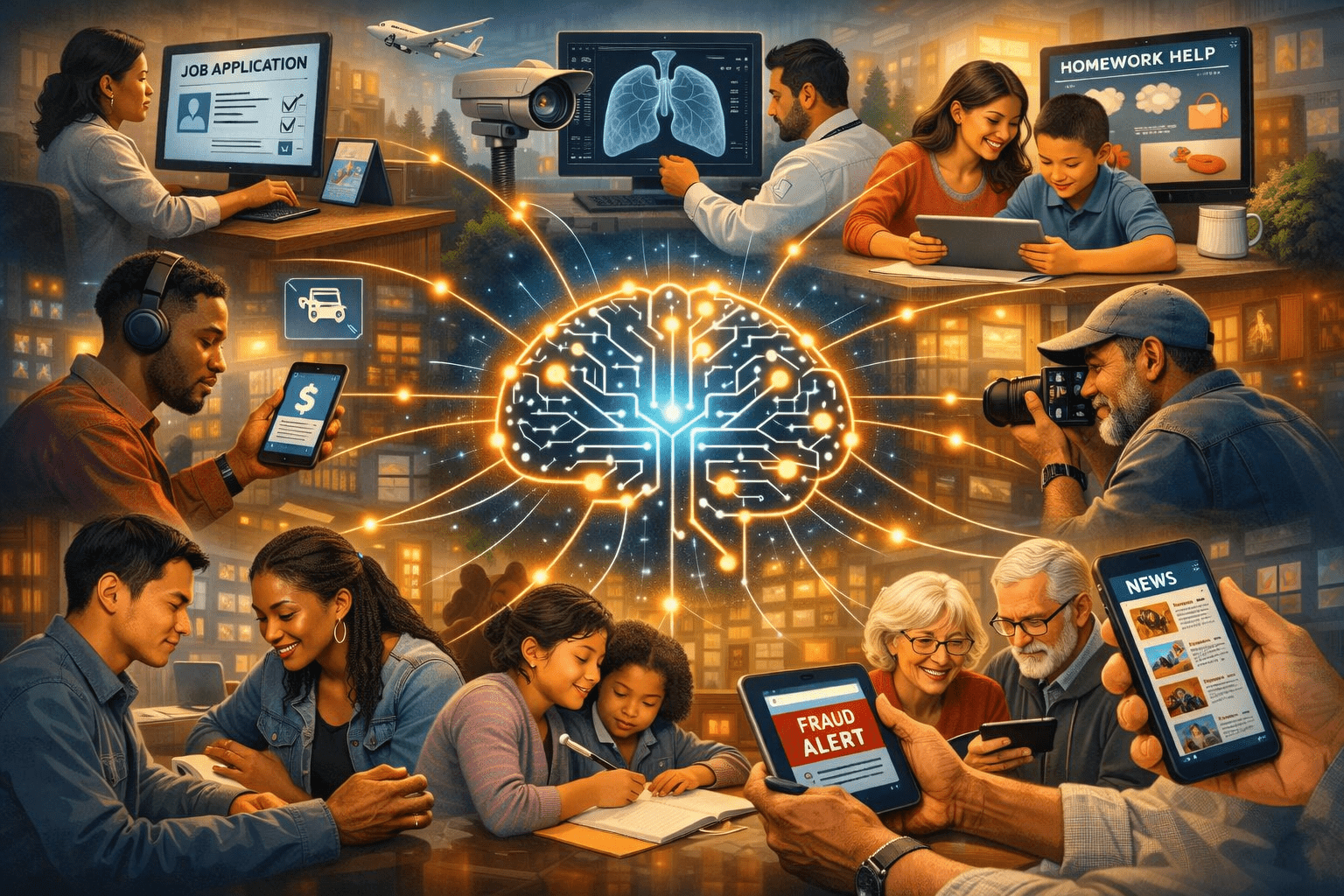
Artificial intelligence is often described in ways that make ordinary people feel as though the subject belongs to somebody else. The language can sound technical, distant, and crowded with terms that seem built for specialists rather than citizens, families, workers, or community members. Yet the truth is much simpler than the surrounding noise suggests. AI affects everyone because it has already moved into the systems that shape everyday life. It is present when people search for information, apply for jobs, use maps, interact with customer service, receive banking alerts, shop online, scroll through news feeds, help children with schoolwork, or rely on institutions to process important decisions. In that sense, AI is no longer a narrow technology topic. It has become part of the public environment.
To understand why AI affects everyone, it helps to begin with plain language rather than spectacle. At its core, AI is a type of digital system that can recognize patterns, generate responses, and perform tasks that once required more direct human effort. It can sort information, summarize documents, answer questions, draft language, recommend choices, identify likely patterns, and help automate decisions. Sometimes it does these things well. Sometimes it does them poorly. Sometimes it does them with a tone of confidence that sounds stronger than the truth beneath the answer. That is one of the most important facts ordinary people should understand. AI can be fast, helpful, persuasive, and wrong at the same time.
This matters because modern life already depends on digital systems. Most people do not wake up thinking about databases, software layers, platform architecture, or automated workflows. They wake up thinking about work, bills, appointments, transportation, school, health, family concerns, communication, and the responsibilities of the day. Yet many of those activities now pass through systems that AI influences. A search engine may decide what information appears first. A hiring platform may help sort applicants. A bank may use AI to detect unusual behavior. A school may use software that helps students or teachers generate material quickly. A hospital or insurer may use systems that help process large volumes of records and requests. The reason AI affects everyone is simple. Everyday life now moves through environments where AI is increasingly embedded.
One of the clearest effects can be seen in how people find and receive information. For years, digital search mainly involved typing a question and reviewing links. People had to choose where to click, what to read, and which sources seemed credible. AI changes that experience by offering direct summaries, generated responses, and neatly packaged answers that appear ready for immediate use. That can save time, and in many situations it does. Yet the deeper change lies in what happens to judgment when people stop tracing where information came from. A smooth answer can create the feeling of understanding before real understanding has been tested. In plain language, AI affects everyone because it changes how people come to believe they know something.
Work is another major part of the story. Many employees now use or encounter AI even when they do not think of themselves as working with advanced technology. They may see tools that draft messages, summarize notes, organize data, suggest replies, analyze documents, or support customer interactions. For some workers, this makes parts of the day easier. It can reduce repetition and save time. For others, it creates a new source of pressure. When software can produce something quickly, expectations can shift just as quickly. Employers may want more done in less time. Workers may be expected to supervise, refine, or improve machine-generated content while still carrying full responsibility for quality. In ordinary life, that means AI is changing jobs even before it fully changes job titles.
Families feel the change in a different way. Parents now raise children in a world where machines can answer questions, generate essays, solve equations, summarize reading, and imitate polished expression in seconds. That creates both opportunity and tension. AI can help explain a concept, support practice, and make some tasks more accessible. It can also make it easier for a child to move around the effort that real learning requires. Human growth still depends on patience, concentration, memory, correction, and the slow building of judgment. A polished answer is not the same thing as a developed mind. AI affects everyone because it enters the home, the classroom, and the habits children form long before adulthood.
Communication has changed as well. AI can help people write faster, sound more polished, and organize thoughts more quickly than before. That can feel useful, especially in a world where people are often tired, rushed, and carrying more than one person’s worth of daily responsibility. Yet the ease of generated language also changes what communication feels like. Words can become easier to produce than to mean. Tone can sound thoughtful without much thought behind it. Confidence can appear where knowledge is weak. Ordinary people encounter this every day now, whether they realize it or not, through emails, posts, articles, summaries, scripts, and automated responses that sound human enough to shape perception. AI affects everyone because language itself is one of the main ways people judge trust, seriousness, and intention.
Trust may be the most important part of all. People live in a time when text, images, audio, and video can all be generated or reshaped with growing ease. A realistic voice clip can spread quickly. A convincing image can circulate before anyone checks its source. A smooth explanation can be shared widely because it sounds authoritative on first contact. This changes what ordinary people must do to remain grounded. They need to ask stronger questions. Where did this come from. Who is behind it. Has it been confirmed elsewhere. Does it sound certain because it is true, or because it was designed to sound certain. AI affects everyone because it makes discernment more necessary in everyday life, not less.
Consumer life also helps explain why this technology reaches so broadly. AI influences what people are encouraged to watch, buy, read, notice, or believe matters most. Recommendation systems help shape entertainment. Shopping systems shape purchasing patterns. News feeds shape attention. Navigation tools shape movement. These systems often feel helpful because they reduce effort. Yet they also guide behavior quietly. They create the path of least resistance. Over time, repeated small influences become part of how a person’s daily life is structured. In plain language, AI affects everyone because it helps arrange the options people see and the choices that feel easiest to make.
The same is true in healthcare, finance, insurance, and public services. AI can help identify patterns, flag unusual behavior, process requests, and support administrative flow. These uses may improve speed and efficiency, and in many cases that matters. Still, real people live inside the outcomes of these systems. A patient wants to know whether a case received meaningful attention. A worker wants to know whether a decision can be challenged if a system gets it wrong. A family wants clarity if an insurer or institution relies on automated processing in ways that shape important outcomes. AI affects everyone because people do not experience technology in the abstract. They experience it through consequences.
The most important point is that people do not need technical expertise to understand what is at stake. They do not need to build AI systems in order to ask serious questions about how those systems affect ordinary life. They can ask who designed a tool, what data shaped it, what it rewards, what it overlooks, where human review enters, and how errors are corrected. They can teach children that speed is not wisdom. They can remind schools, businesses, and institutions that convenience carries responsibility. They can preserve the habit of pausing long enough to think before accepting the first polished answer that arrives.
AI in plain language is this: a powerful set of digital tools and systems that now shape how people search, work, communicate, learn, shop, trust, and move through the world. That is why this technology affects everyone. Its importance does not come from futuristic fantasy. Its importance comes from ordinary life. The more clearly people understand that, the better prepared they will be to live with AI wisely, question it responsibly, and keep human judgment at the center of the age now unfolding.
© 2026 Truth Seekers Journal. Published with permission from the author. All rights reserved.
Support open, independent journalism—your contribution helps us tell the stories that matter most.

