
By Florita Bell Griffin, Ph.D | Houston, TX | April 21, 2026
Most people who have lived long enough can sense when something is changing in the wrong way, even when it appears to be working. Systems improve. Outputs sharpen. Efficiency increases. Yet something essential thins. The sensation arrives quietly, often before language forms around it, registering instead as unease, fatigue, or distance. It can feel like walking into a familiar place after a renovation and realizing the layout makes sense on paper while the experience feels strangely disorienting.
This response comes from pattern recognition. Over time, people learn to distinguish movement that carries meaning from movement that merely accelerates. Earlier decades reward speed. Later years sharpen sensitivity to coherence. Progress that arrives without sequence feels unstable. Improvement that sheds its own history feels incomplete. What people recognize in these moments is discernment: an internal measurement of whether a system still holds together across time.
Many people over forty already know how to learn new tools. They have learned repeatedly across careers, technologies, institutions, and roles. What unsettles them now is rarely the demand to learn. The deeper issue is orientation. Too often, new systems arrive as if nothing existed before them. They provide instruction without context, features without lineage, and efficiency without explanation. The burden of coherence shifts onto the individual, who is left to reconcile what was with what is, without meaningful support from the structure itself.
Consider a system that updates regularly. Interfaces refresh. Terminology shifts. Workflows reorganize. Each change functions as intended. Performance metrics rise. Support demands fall. Yet longtime users feel disoriented rather than strengthened. The system has changed correctly, yet it has changed without coherence. No bridge connects the earlier state to the present one. No visible lineage explains how one version became the next. The result rarely presents as failure. The result presents as gradual erosion of trust, because the user can feel the system moving while the system declines to show its own continuity.
This dynamic extends far beyond software. Consider a healthcare organization that introduces a new operational model to improve throughput and reduce costs. Appointments become shorter. Scheduling becomes optimized. Data flows more cleanly between departments. Yet patients feel increasingly unseen, and practitioners struggle to reconcile new protocols with established judgment. Outcomes may improve on paper, while continuity of care thins. What has been gained in efficiency has been traded for intelligibility. The system works, yet fewer people feel grounded within it, because the link between prior practice and current policy remains unclear.
A life accumulates context whether a platform acknowledges it or overlooks it. Decisions leave residue. Experiences layer. Judgment forms through consequence rather than instruction. People carry forward lessons from work, family, loss, responsibility, and recovery. When tools enter that terrain without regard for what already exists, they feel intrusive rather than supportive. This becomes especially visible after forty, because the reader holds enough lived sequence to detect when a system treats human reality as interchangeable.
The difference shows up in subtle places. A tool can offer new power while draining confidence. A process can become smoother while leaving users less certain of their footing. A platform can create speed while requiring people to re-translate their own history into new labels. Over time, this creates a specific kind of fatigue: the fatigue of carrying coherence alone. People remain capable and engaged, yet they spend energy reconstructing context that a well-designed system could have carried forward on their behalf.
This is why certain innovations feel misaligned despite technical success. Systems may perform flawlessly while quietly dissolving coherence. They optimize outcomes while thinning meaning. People who have navigated enough transitions recognize this dynamic instinctively. They have seen institutions evolve, organizations restructure, technologies arrive, and narratives reset. They understand that sequence matters, because sequence is how accountability stays visible. Sequence is how judgment retains legitimacy. Sequence is how a person remains themselves across change.
Over time, the absence of continuity produces predictable consequences. Confidence erodes, rarely because people lack ability, and more often because they lack orientation. Decision-making becomes reactive rather than grounded. Authority shifts from judgment to procedure. Participation narrows to compliance. The shift tends to appear as silence rather than protest. People disengage without dramatic refusal. They adopt the tool while withholding trust. They follow the workflow while reducing investment. A system can interpret that as success because output continues, while the deeper relational layer continues thinning.
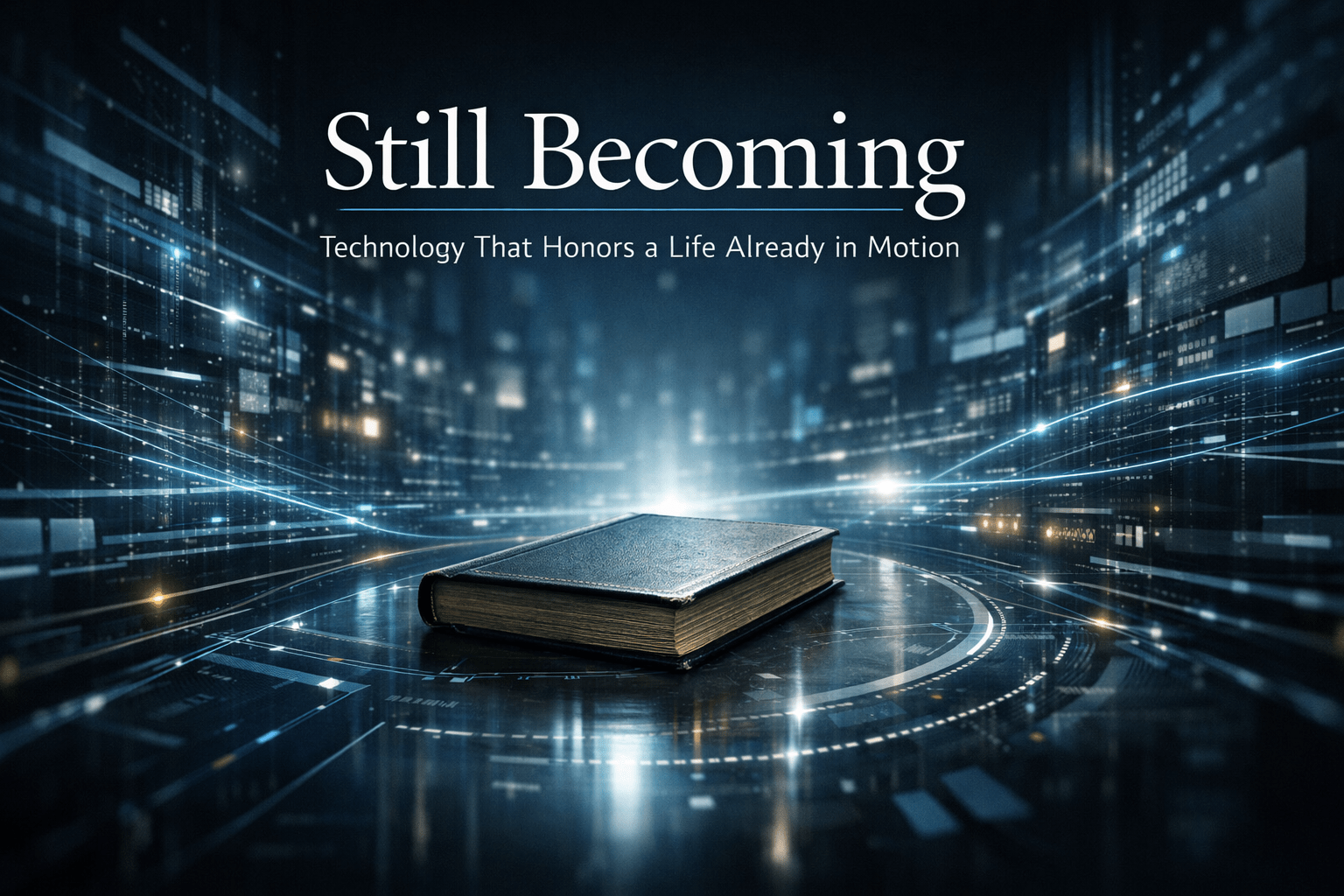
Still becoming describes growth that carries forward rather than breaks apart. It reflects development that aligns with a life already in motion, rather than demanding reinvention at the cost of integrity. In this posture, experience becomes an asset rather than an obstacle. Memory serves as structure rather than sentiment. Judgment operates as signal rather than delay. The person remains intact while the tool becomes more capable.
As intelligent systems increasingly shape how people work, decide, and interpret their own value, this distinction grows more consequential. Performance alone rarely satisfies. Coherence becomes the measure. Systems reveal their true character through how they handle what came before. Systems that honor sequence strengthen trust because they remain intelligible across time. Systems that erase lineage require users to rebuild meaning repeatedly, and that cost accumulates.
Still becoming is a way to describe progress that remains inhabitable. It is the choice to build systems that can move forward without abandoning the lives already inside them. It is the insistence that continuity carries value, because continuity is how people recognize themselves across change.
This distinction is the terrain this inventor now moves through.
© 2026 Truth Seekers Journal. Published with permission from the author. All rights reserved.
Related articles
Living With AI: How It Is Changing Work, Family, and Community
When Systems Forget Who They Were Built For
Why Familiarity Is Not the Same as Understanding
Support open, independent journalism—your contribution helps us tell the stories that matter most.

