
By Florita Bell Griffin, Ph.D | Houston, TX | April 28, 2026
Progress rarely fails where people expect it to. It rarely collapses outright or breaks in visible ways. More often, it succeeds technically while losing its sense of orientation. Systems advance. Capabilities expand. Performance improves. Yet the path that led there becomes increasingly difficult to trace. What remains functions, but it no longer explains itself.
This kind of failure is subtle. It does not announce itself as malfunction or crisis. It appears instead as disconnection between past and present. Progress moves forward, but it leaves no markers behind. It arrives somewhere new without accounting for how it got there. Over time, that absence begins to matter more than any single improvement.
Early innovation moves easily because there is little history to preserve. Decisions are provisional. Dependencies are light. Tradeoffs remain visible. As systems mature, however, they accumulate consequence. Choices embed themselves into structure. Temporary solutions become permanent assumptions. Institutional memory forms through repetition, exception, and response. Progress that ignores this accumulation may remain efficient, but it begins to feel unstable.
People tend to notice this most clearly after they have lived through several cycles of change. They have seen organizations modernize, restructure, consolidate, and rebrand themselves. They have watched technologies promise clarity while introducing new layers of abstraction. They understand that change is unavoidable. What unsettles them is not complexity. It is amnesia.
Consider an organization that adopts a new enterprise platform intended to unify operations across departments. The rollout is efficient. Training is streamlined. Output increases. Reporting becomes cleaner. Leadership views the transition as a success. Yet employees struggle to explain how current workflows relate to previous ones. Longstanding expertise becomes difficult to locate within the new structure. Knowledge that once moved through people now sits awkwardly inside the system. The platform delivers results, but it no longer carries its own story. People comply with the process while quietly withdrawing trust from it.
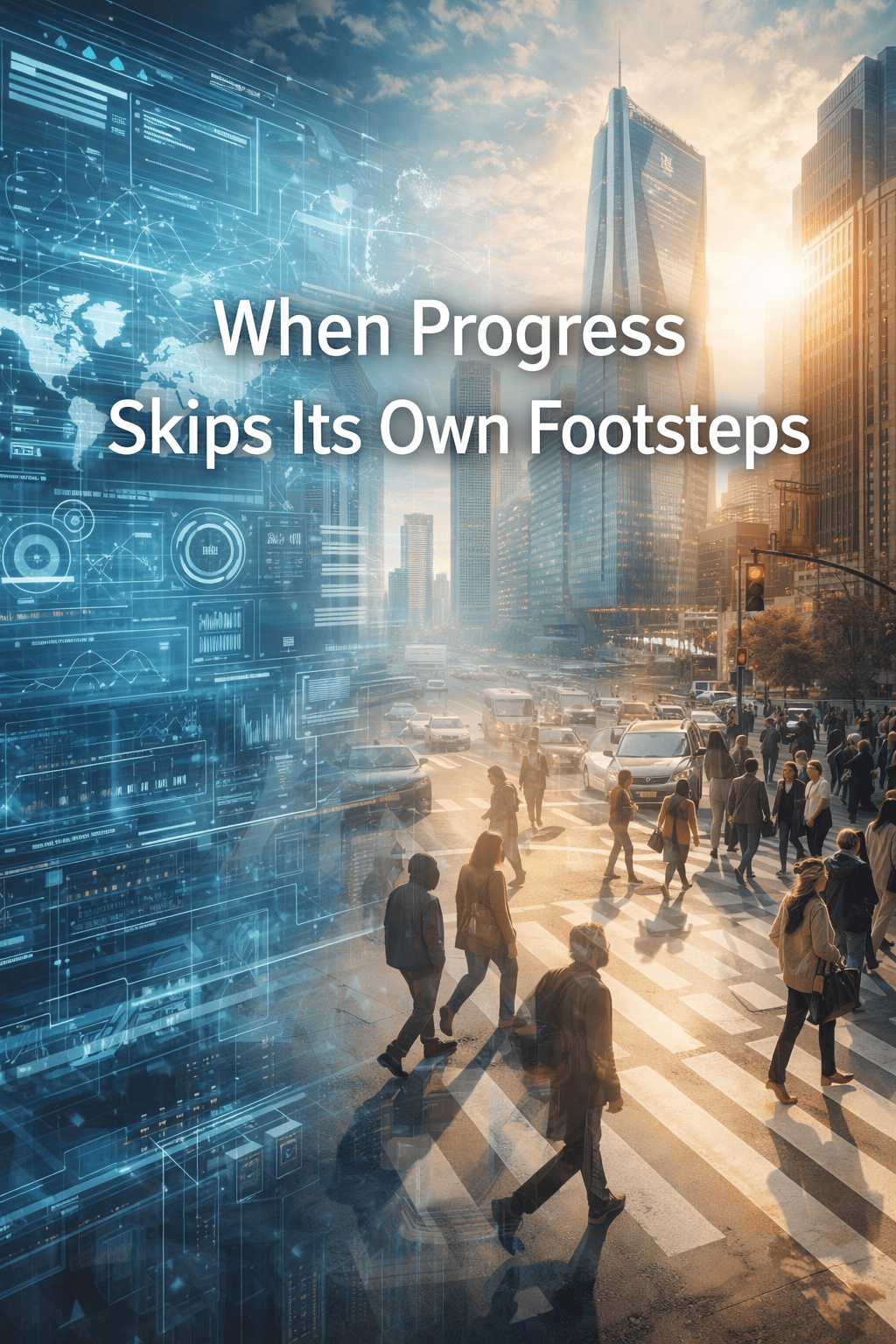
A similar pattern appears in public systems. Consider a city that implements a data-driven infrastructure upgrade to improve traffic flow and energy efficiency. Sensors optimize movement. Algorithms rebalance load. Measurable outcomes improve. Commute times shorten. Resource use becomes more efficient. Yet residents lose a sense of continuity with prior planning decisions. Neighborhoods experience change without understanding how tradeoffs were made or how the new system reflects what existed before. The city works better, but it feels less knowable. Progress arrives, but its footsteps are missing.
In both cases, the system advances without carrying forward its own rationale. Decisions disappear into implementation. Sequence dissolves into outcome. Over time, this changes how people relate to the system itself. They follow instructions, but they stop inhabiting the logic behind them. They perform tasks, but they no longer feel oriented within the larger structure.
When sequence disappears, accountability becomes diffuse. Decisions feel less owned because their origins are unclear. Authority shifts away from judgment and toward procedure. Over time, participation changes shape. People execute rules without understanding intent. They adapt repeatedly without being shown how each state emerged from the last. The system continues to operate, yet fewer people feel responsible for its direction.
Human lives rarely function this way. Experience builds through accumulation. Lessons retain shape because they remain connected to prior outcomes. Growth remains intelligible because it unfolds in sequence. People understand themselves not as isolated moments, but as continuations of what came before. When systems fail to mirror this reality, they place the burden of coherence on the individual rather than the structure.
This burden shows up quietly. A tool can offer new power while draining confidence. A process can become smoother while leaving people less certain of their footing. A platform can increase speed while requiring users to repeatedly translate their own history into new terms. Over time, this creates a specific kind of fatigue: the fatigue of carrying continuity alone.
This is why progress that skips its own footsteps often provokes unease rather than resistance. People are not rejecting advancement. They are responding to disorientation. They sense that the system has moved faster than understanding can follow. They feel required to adapt without being oriented. Over time, that requirement erodes trust.
The long-term consequences are predictable. Decision-making becomes reactive rather than grounded. Expertise becomes harder to transmit because lineage is obscured. Mentorship weakens because the system no longer exposes how judgment was formed. New participants learn what to do, but not why it evolved that way. Progress continues, yet its foundations grow less stable.
Progress that honors continuity behaves differently. It makes its evolution visible. It carries forward its rationale alongside its functionality. Each change explains how it emerged from what preceded it. Sequence becomes part of the system rather than an external memory held by a few individuals. People remain oriented because the structure remembers itself.
This form of progress does not move more slowly. It moves more intelligibly. It allows people to inhabit change without losing their footing. It preserves accountability because decisions remain traceable. It preserves trust because movement makes sense across time.
When progress skips its own footsteps, it accelerates while understanding contracts. When it carries them forward, it gains the capacity to endure. The difference is not technical sophistication. It is whether the system can remain coherent as it moves.
© 2026 Truth Seekers Journal. Published with permission from the author. All rights reserved.
Support open, independent journalism—your contribution helps us tell the stories that matter most.

