Florita Bell Griffin, Ph.D.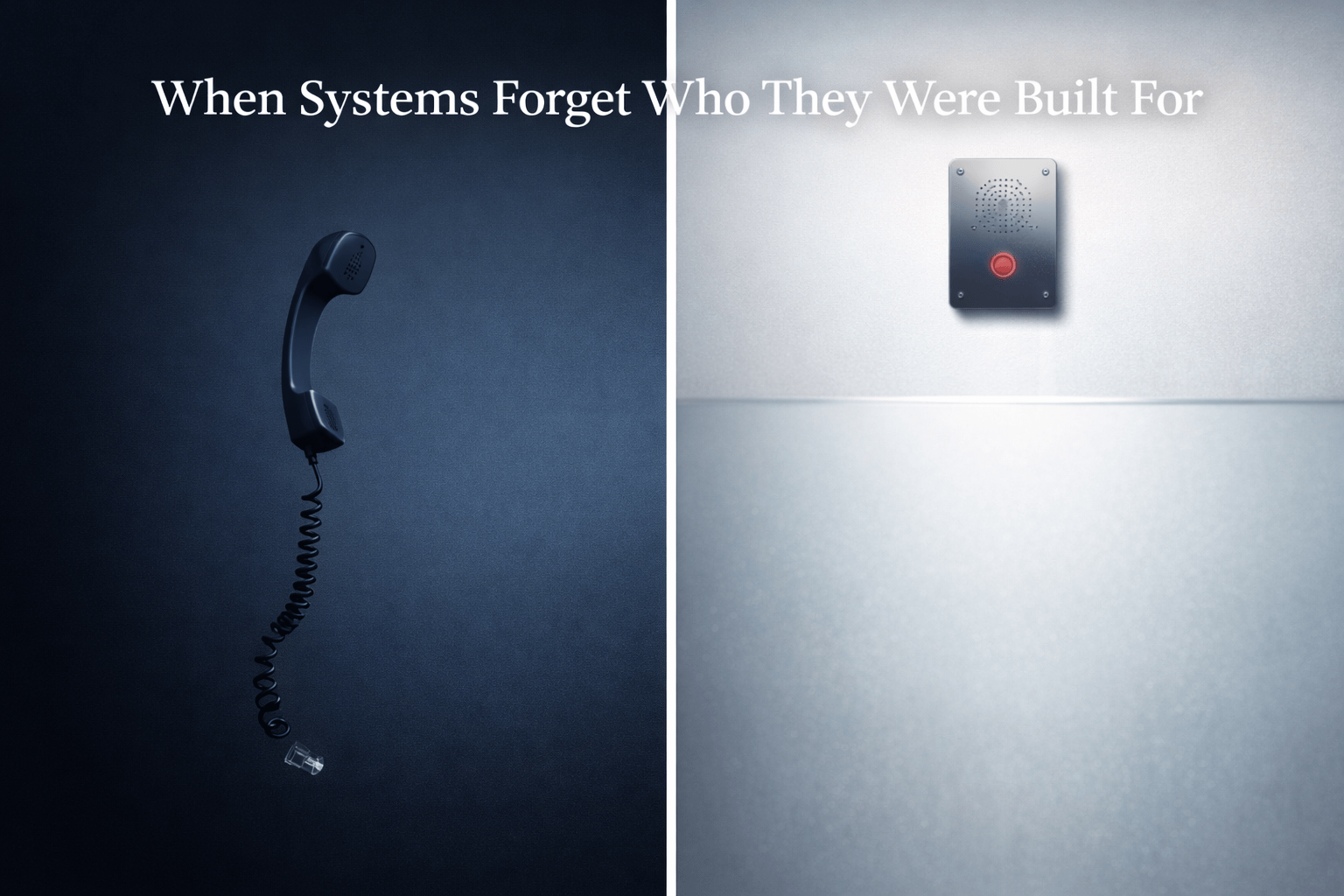
By Florita Bell Griffin, Ph.D. | Houston, TX | April 7, 2026
Most systems begin with people in mind. They are designed to solve a specific problem, remove friction, or make life easier for a defined group. Early versions reflect this clarity. Decisions are grounded in lived experience. Tradeoffs are visible. Purpose is easy to articulate. Over time, something shifts.
As systems scale, optimize, and evolve, they often lose contact with the very people they were created to serve. This does not happen through neglect. It happens through success. Metrics improve. Adoption increases. Complexity grows. And gradually, the system’s center of gravity moves away from human need and toward internal performance. This shift is subtle, but its effects are profound.
When a system forgets who it was built for, it begins to prioritize efficiency over understanding. Speed replaces explanation. Optimization replaces empathy. Decisions are justified through data abstractions that no longer resemble lived experience. The system still functions, but it feels colder, more rigid, less responsive. People notice this before organizations do.
Consider a healthcare platform introduced to streamline patient intake and reduce administrative burden. Initially, patients experience shorter wait times and clearer communication. Over time, additional features are layered in. Forms expand. Automated prompts multiply. Decision trees replace conversation. The platform becomes more capable, yet patients feel less seen. The system remembers the process, but forgets the person.
This pattern appears across domains. Financial tools designed to simplify budgeting grow into complex dashboards optimized for analytics rather than clarity. Educational platforms built to support learning become assessment engines that track performance without context. Workplace systems created to enable collaboration turn into surveillance mechanisms that measure activity rather than contribution. In each case, the system has not failed. It has drifted.
Drift occurs when continuity between original purpose and current behavior is lost. Decisions remain rational within the system’s internal logic, but that logic no longer includes the human experience that once guided it. The system forgets who it was built for because that knowledge is not preserved as a governing constraint.
This forgetting is rarely intentional. It emerges from a series of reasonable decisions made in isolation. Each optimization makes sense on its own. Each efficiency gain appears beneficial. But without continuity, these changes accumulate in a way that reshapes the system’s identity.
People with long memory sense this early. They recognize when interactions feel more transactional than relational. They notice when systems require adaptation rather than offering support. They experience a growing gap between what a system promises and how it behaves in practice.
You can hear this in everyday language. “It’s faster, but it’s harder to deal with.” “It works, but it doesn’t listen.” “You have to know how to work the system.” These are signals of misalignment, not incompetence. They indicate that the system’s evolution has outpaced its original intent.
Consider a public service portal designed to increase accessibility. Online access expands reach. Self-service options reduce cost. Yet for many users, particularly those navigating life transitions or unfamiliar processes, the system becomes more difficult to navigate. Instructions assume prior knowledge. Error handling is minimal. Support is buried. The system performs efficiently while leaving users behind. What has been lost is not capability, but orientation.
Systems that remember who they were built for retain an internal reference point. They evaluate change not only by performance metrics, but by impact on the people at the center. They ask whether new features clarify or complicate. Whether speed enhances or undermines understanding. Whether automation removes burden or simply redistributes it.
This kind of memory must be designed. It does not emerge naturally as systems grow. Without explicit continuity mechanisms, systems default to internal optimization. They become excellent at serving their own processes while growing increasingly opaque to users.
Technology accelerates this dynamic. Automated systems learn from usage patterns, but patterns alone do not capture intent. They reflect behavior constrained by available options. When systems optimize for what is measured rather than what is meant, they amplify existing limitations. The system becomes more precise while becoming less humane.
Consider a customer support system that uses automated routing to reduce resolution time. Common issues are handled quickly. Edge cases are escalated slowly. Over time, users learn to frame problems in ways the system recognizes, rather than describing them accurately. The system appears efficient, but truth is filtered to fit its logic. Both sides adapt, and meaning erodes.
This is what it looks like when a system forgets who it was built for. People change to accommodate the system instead of the system adapting to people.
Reintroducing memory requires more than feedback surveys or user testing. It requires preserving the system’s original purpose as an active constraint on future decisions. It means documenting not just what a system does, but why it exists. It means carrying forward the context of its creation and using that context to govern change.
Systems that maintain this continuity behave differently. They remain explainable even as they grow complex. They offer off-ramps instead of forcing compliance. They treat exceptions as information rather than noise. They evolve without losing their center.
For people navigating an increasingly automated world, this distinction matters. Systems that remember their purpose feel supportive even when they are powerful. Systems that forget feel demanding even when they are efficient. One invites trust. The other requires endurance.
As intelligent systems continue to shape daily life, remembering who they were built for becomes a form of accountability. It ensures that progress does not come at the cost of dignity. It anchors innovation to human reality rather than abstract performance.
When systems forget who they were built for, people do not suddenly reject them. They adapt quietly. They comply outwardly. They disengage inwardly. Over time, this creates distance that no amount of optimization can repair.
Systems that remember remain inhabitable. They change without alienating. They grow without erasing their origins. They retain continuity between intention and impact.
That continuity is not sentimental. It is structural. And in a world of accelerating change, it is one of the few safeguards that keeps technology aligned with the lives it is meant to serve.
© 2026 Truth Seekers Journal. Published with permission from the author. All rights reserved.
Truth Seekers Journal thrives because of readers like you. Join us in sustaining independent voices.