
By Milton Kirby | Atlanta, GA | September 22, 2026
By the time a group of Atlanta-area entrepreneurs gathered at the Russell Innovation Center for Entrepreneurs on July 31, artificial intelligence was no longer simply something to ask questions.
It had become something they were expected to put to work.
For months, participants in the Atlanta Business League’s Digital Mastery program had worked through online visibility, email marketing, social media, automation, data management, cybersecurity, business expenses and artificial intelligence.
Now came the harder question: What were they going to do with it?
The final session was designed to bring the lessons together as participants developed 30-day, 90-day and year-long AI plans for their businesses.
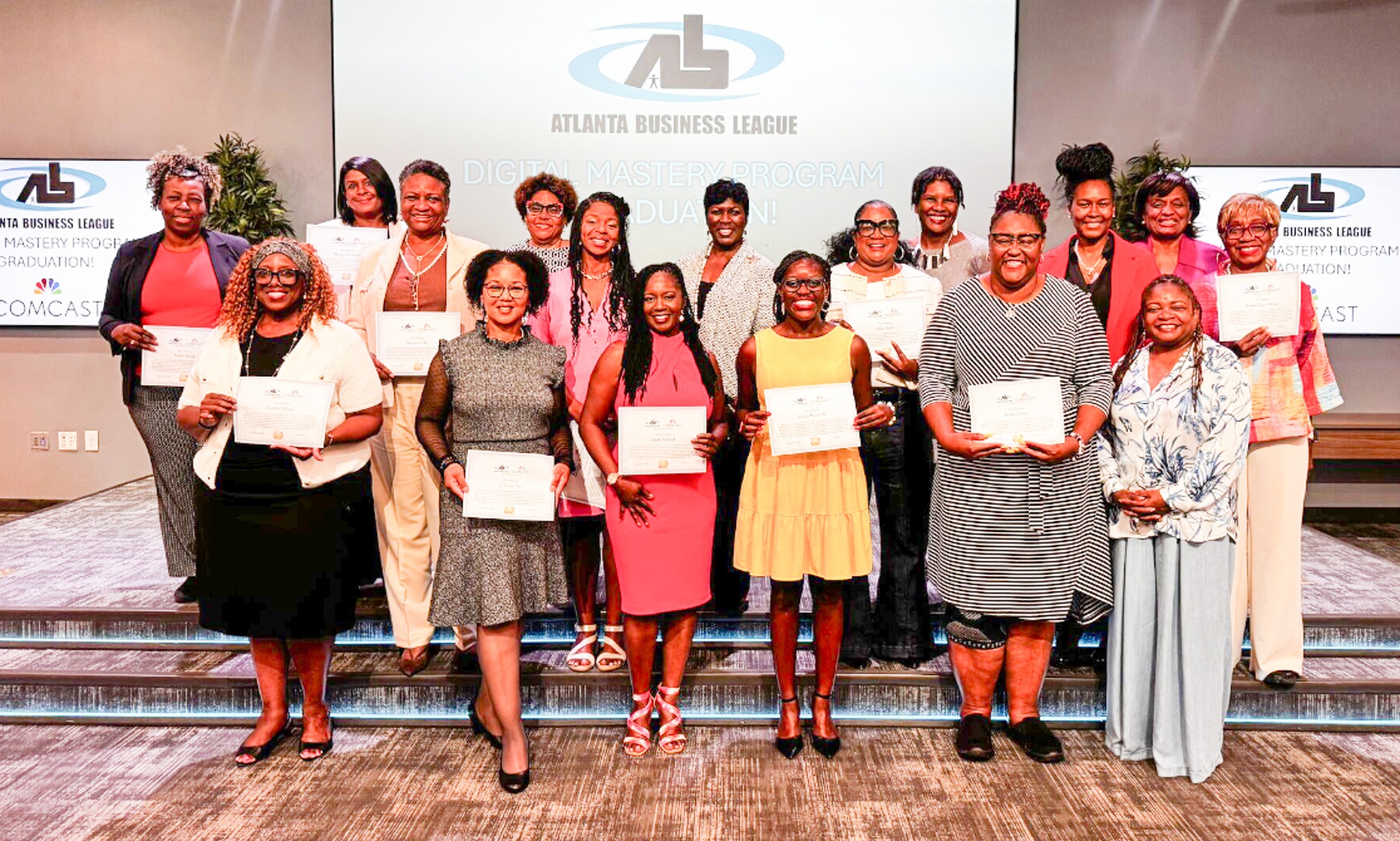
It was the culmination of a 10-session program called “Digital Mastery for Small Business Growth: From Online Presence to AI-Powered Success,” sponsored by Comcast and taught by Dr. Kimberly N. West, founder of Magnum Opus Consulting and an Atlanta Business League board member.
Fifty-three people registered for the 2026 program, following more than 35 business owners and professionals who received certificates of completion in 2025.
Atlanta Business League President CEO Leona Barr Davenport, who attended most of the sessions, said the commitment required from the entrepreneurs was itself significant.
“These are entrepreneurs who, despite being busy, took the time to learn,” Davenport said.
She credited Comcast, West and the participants with making the experience “both valuable and enjoyable.”
The course promised practical instruction aimed at helping entrepreneurs strengthen their online presence, streamline operations and use digital tools and AI to improve visibility, automate workflows and increase revenue. Each session was structured around instruction, hands-on implementation, questions and real-world application.
But learning artificial intelligence turned out to involve considerably more than learning how to write a good prompt.
For some participants, it meant reconsidering how customers find their businesses. For others, it meant discovering where important company information was stored, who had access to it or how much money was disappearing each month into software subscriptions.
And for at least one participant, it began with a more basic question:
What does any of this have to do with running a newspaper?
Learning From Inside the Classroom
Disclosure is important here.
I was not an outside observer of Digital Mastery. I was a participant.
Comcast asked me to document the cohort’s journey in a feature for The Truth Seekers Journal. When I invited classmates to share their experiences, I told them the story would not be written “from the outside looking in,” but from “right here in the trenches” with them.
That gave me an unusual position from which to report the story.

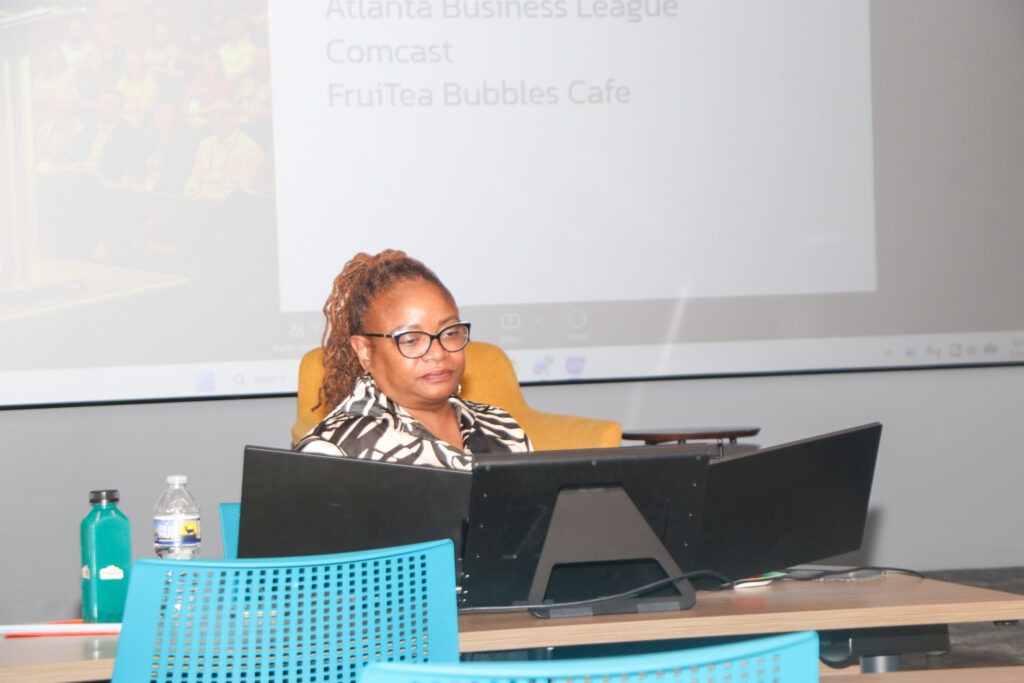
I was simultaneously learning the material and evaluating whether it had practical value for the newspaper I publish.
Halfway through the course, I wasn’t convinced.
During a May conversation with fellow participant Delphyne Lomax Taylor, we talked about having to go back and watch the Zoom sessions again to fully absorb the material.
“My intentions was to apply the class to the newspaper,” I told her, according to a recording of the conversation. “And so far not much has been covered that actually applies to the newspaper.”
I had asked West for at least “one nugget” each week that could specifically apply to a newspaper because I saw publishing as different from many of the other businesses represented in the class.
Taylor was wrestling with the material in her own way.
She was already using ChatGPT for practical business tasks. She described writing proposals and emails herself and then putting them into AI to have the language tightened. At one point, she said she began paying for ChatGPT after reaching a usage limit while trying to complete her work.
The conversation captured something that could easily be lost in all the excitement surrounding AI.
Using it is one thing.
Understanding how it fits into an actual business is another.
More Than ChatGPT
That distinction was central to West’s approach.
Her course did not treat AI as a stand-alone technology that business owners needed to bolt onto their companies.
In one session, West urged participants to think about technology they were already using. AI capabilities were increasingly appearing inside existing business software, she explained.


“The question is not which shiny tool you should chase,” West said. Instead, businesses should ask whether they are using the AI capabilities already available inside their existing tools.
“Because that’s really where the work is actually happening.”
That approach matters at a time when entrepreneurs can be bombarded with new AI applications promising to write, design, automate, analyze or otherwise transform their businesses.
West’s advice was to begin with the business problem.
When one participant asked how many AI tools a business should use, West said there was no universal answer.
“What you need to do is you have to look at your business and look at what the business needs are and then find the tool or tools that are going to satisfy the needs of your business,” she said.
It was a less glamorous lesson than simply demonstrating the newest AI product.
But it may have been one of the course’s most useful.
Getting the House in Order
That became particularly apparent during the May 14 session.
West called it “Get Your House in Order.”
The subjects were money, data and security.
“This is not the sexiest module that we have,” West told the class. “It’s a little boring sometimes. But it is probably one of the most important modules that we will have.”
One exercise was what West called the “seven day disappearance test.”
Suppose the owner became completely unavailable for seven days.
What would break?
What would stall?
What would become confusing?
Participants were told to think about passwords, backups, systems, vendors, approvals, money, data, security and operations. Some said payroll or operational decisions could suffer. Others said their businesses could continue. Taylor said her business partner could step in, but if both were unavailable, most or all of the business could be affected.
Then West turned to data.
“Data is the asset that most business owners do not realize that they own,” she said.
Customer records. Contracts. Vendor records. Receipts. Reports. Standard operating procedures. Content libraries. Training materials.
“Data is business memory.”
For a newspaper publisher wondering how this course applied to journalism, that was one of those nuggets I had been asking for.
A newspaper’s memory is its reporting.
Recordings. Transcripts. Photographs. Source documents. Research. Contacts. Drafts. Published articles.
Lose control of those assets and AI is the least of the problem.
The session also pushed participants to examine recurring technology expenses and security practices. West encouraged them to know what they were paying for, whether tools were actually being used and whether critical accounts had backups, multifactor authentication and recovery plans.
Suzanne Forte, senior director of public relations for Comcast’s Big South Region, said business owners are confronting economic uncertainty, rising costs and a technology environment moving faster than many can track.
At the same time, they are increasingly expected to understand cybersecurity, digital operations and customer experience while still operating their businesses.
The cohort was intended to help entrepreneurs apply technology to customer engagement, operations and business decisions.
“Technology and digital skills help people connect, learn, work, and thrive,” Forte said in written responses to questions from The Truth Seekers Journal.
She said Comcast’s support was intended to help entrepreneurs “access tools and knowledge they can use to adapt, grow, and participate more fully in the digital economy.”
But Forte’s definition of success did not stop at completing a class or receiving a certificate.
“When participants apply what they learn, share those skills, and strengthen their businesses and networks, that demonstrates meaningful progress,” she said.
By that measure, the question becomes not what was taught during the 10 sessions, but what participants did afterward.
From Understanding to Execution
Dr. Patricia Kelly Marsh came to Digital Mastery with a considerable head start.
Marsh is a physician and CEO of Ask Me Your MD, Inc., or AMY MD. Her company was already using AI to support what she described as a scalable telechat care model.
She joined the program because she wanted a better understanding of available AI and digital tools and how they could be strategically applied to healthcare delivery, technology development and company growth.
For Marsh, one of the most significant changes involved digital visibility.
Before the course, she said, digital visibility seemed important but broad. The program helped her become more deliberate about brand awareness, online engagement and the company’s digital footprint.
Marsh reported that after applying lessons from the program, AMY MD experienced more than a 400% increase in engagement across its social media platforms. She also said website events per session increased and the site’s key-event rate nearly tripled.
Those results were reported by Marsh and were not independently verified by The Truth Seekers Journal.
She described the experience as taking her “from basic understanding to bold execution.”
The program, she said, gave her the tools and confidence to use AI and digital strategy to help grow and scale the company.
When the Person Outranks the Business
Yvonne Bryant Johnson found a different lesson.
Johnson said an AI and strategic branding exercise revealed that her own name had greater online visibility and recognition than her company, Bryant & Associates..
“That realization was both humbling and transformational,” Johnson wrote.
It made her reconsider the relationship between her personal brand, the company’s identity and her long-term business strategy.
Johnson said assignments that initially felt like homework became opportunities to sharpen her thinking about branding, search-engine optimization, visibility and trust.
She also praised West’s ability to turn complicated concepts into “practical tools and actionable frameworks.”
Johnson’s perspective comes with relevant context: she has longstanding ties to the Atlanta Business League. She described herself as a founding faculty member of ABL’s Take Your Business 2 the Next Level program and a past ABL board member.
Still, her experience illustrates one of the course’s broader lessons.
AI does not necessarily have to invent something new for a business.
Sometimes its value comes from revealing something about the business that was already there.
Owning the Audience
West also repeatedly pushed participants to distinguish between digital platforms they use and digital assets they own.
After a session devoted to email systems, she reminded participants that social media companies can come and go and algorithms can change.
An email list, however, belongs to the business.
“If you walked away understanding that one thing, Session 2 did its job,” West wrote afterward.
Another session dealt with finding where an audience actually lives online and using AI to create content that sounds like the business rather than like everyone else using the same technology.
For small businesses, those lessons can be easy to overlook amid fascination with generative AI.
The technology may be new.
The underlying business questions are not.
Who are your customers?
How do they find you?
What information do you own?
What are you paying for?
Who has access to your systems?
What happens if you disappear tomorrow?
And what problem are you actually trying to solve?
Consumers or Creators?
By the final session, the conversation had moved beyond simply learning to operate AI tools.
West challenged participants to think about their relationship to the technology itself.
“We are consumers, right?” she said, according to a recording of the session. “We need to be creators or producers.”
She continued: “We need to be decision makers about the data and where it’s used and how it’s used.”
The recording is imperfect, but the larger point is clear: learning to use AI should eventually mean understanding enough to make informed choices about how it fits into a business.
That is a considerably higher standard than learning how to ask ChatGPT a question.
And it helps explain why the final assignment mattered.
Months of individual exercises were supposed to become an operating plan.
Thirty days.
Ninety days.
A year.
The participant now had to decide what deserved to be implemented.
The Work Begins After the Certificate
There is no single way to measure what 53 registrants took away from Digital Mastery.
The written participant responses available to The Truth Seekers Journal do not support claiming that every member of the cohort experienced the same transformation.
They clearly did not enter the program at the same place.
Marsh was already incorporating AI into a healthcare company.
Johnson discovered a branding issue.
Taylor was using AI to tighten proposals and emails while acknowledging that she needed to revisit some of the classes to fully absorb the material.
And I spent part of the program asking how lessons designed for conventional businesses applied to an independent newspaper.
That diversity may be one of the most useful things about looking at the program from inside the classroom.
“AI mastery” does not necessarily mean mastering the same tool.
It can mean understanding which technology a business needs, and which it does not.
It can mean discovering that information scattered across computers is an asset that needs to be organized.
It can mean realizing that another monthly subscription is not automatically an investment.
It can mean securing an account, owning an email list, understanding an audience or recognizing that the business cannot function for seven days without its owner.
And sometimes it can mean recognizing that the best use of artificial intelligence is not allowing it to make a decision, but becoming better prepared to make the decision yourself.
Davenport said the sessions challenged participants to reconsider how they operate their businesses and where new opportunities might exist.
“They challenged our thinking, broadened our perspectives, and opened our eyes to new opportunities for growth and innovation,” she said. “The experience encouraged us to think differently, embrace change, and explore new ways to stay current, strengthen, and grow our businesses.”
For Davenport, that willingness to change may ultimately matter more than mastering any particular technology.
“The future belongs to entrepreneurs who are willing to pivot, learn, adapt, and grow,” she said.
Comcast’s Forte said she hopes participants leave with the confidence to use technology more strategically to reach customers, streamline operations and identify new paths for growth.
The certificates can show that the participants completed the program.
They cannot show whether Digital Mastery worked.
That test began when the laptops closed, the participants left the Russell Innovation Center and returned to their businesses.
What they do differently next will provide the answer.
Truth Seekers Journal thrives because of readers like you. Join us in sustaining independent voices.