
By Ted Knorr | Harrisburg, PA | May 26, 2026
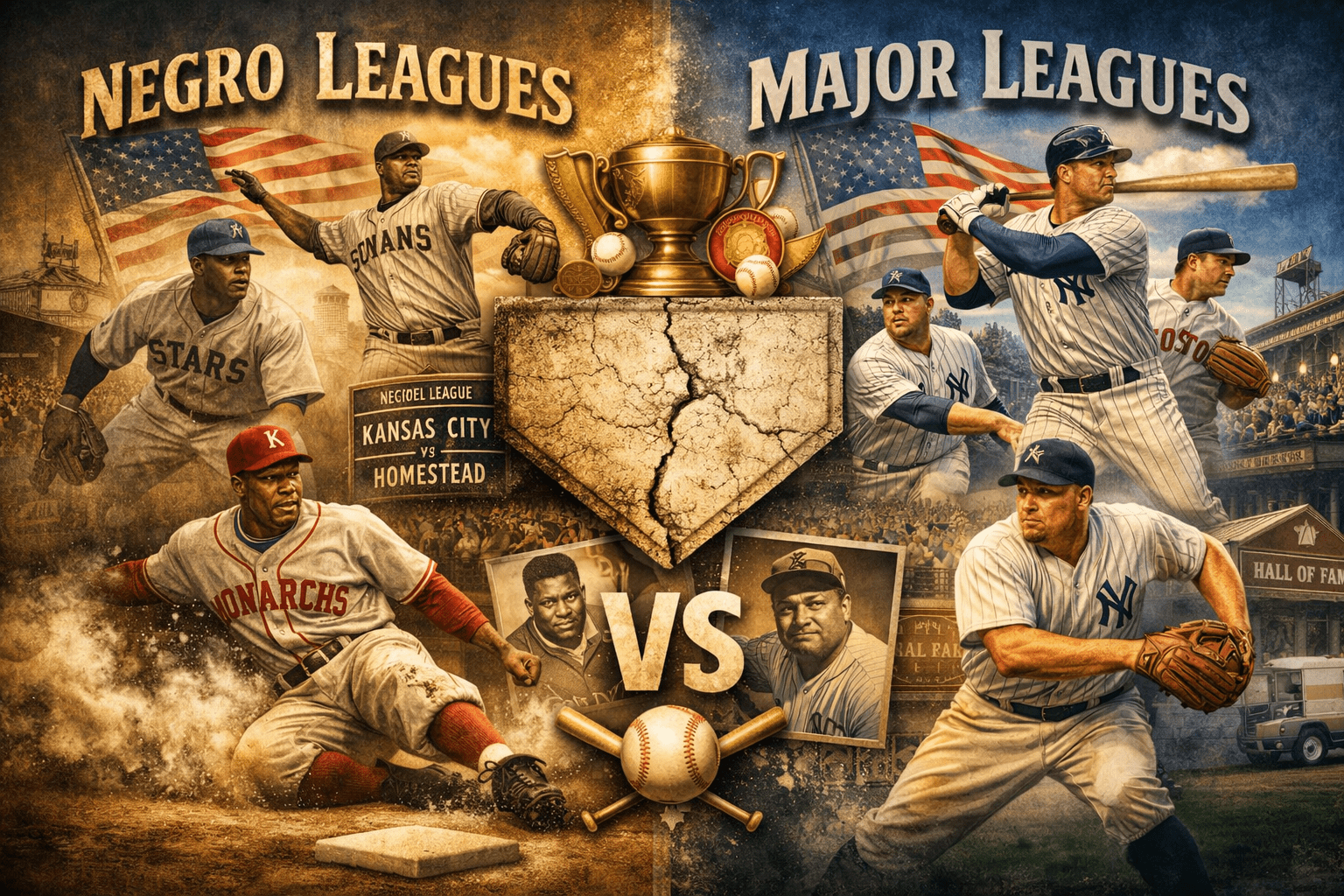
“In small cities and small towns across the country, there were other teams and other stars that may have been the greatest of the century, but whose deeds would live only in the memory of those who saw them play. Over the years, Black baseball stars played against White Major League stars at least 438 times in off-season exhibition games. The Whites won 129 of those postseason games. The Blacks won 309 (70.5%).” – Baseball, 5th Inning, Shadow Ball, Ken Burns, 1994
Appendix II of “The Negro Leagues were Major Leagues,” edited by Todd Peterson, pp. 214-226, lists 503 games, dates, and opponents, depicting games between Negro League teams and Major League teams. Negro League teams won 268 (54.6%), while losing 222, with 13 ties.
In addition to Burns and Peterson, I have seen compilations by historians William McNeil (69.8% in the California Winter League) and John Holway (57.1%), and researchers Scott Simkus (52.7%) and bench5 (54.5%). Every one of them finds the “so-called” Negro League teams holding their own (winning as often as losing) against “so-called” Major League teams. Comparable results are reported from both my interpretation of Seamheads Negro League Database (where 67 Negro League pitchers won 54.1% of their decisions against teams made up of Major League players) and Retrosheet’s Database (58.0%), with both showing an edge to the Negro League teams.
I have never seen a compilation showing the Negro League teams losing more than they win. While each of these compilations have their own circumstances (such as, the California Winter League usually featuring one Black team and three or four White teams meaning the White talent was diluted; and Ken Burns compilation is admittedly culled from oral history with few if any box scores.), my claim is unquestionably supported by these compilations and that is the record shows “so called” Negro League teams held their own against “so called” Major League teams.
Further factual evidence supporting my claim is provided with the following data:
Major League and Negro League Regular Season Slash Lines 1920-1948
AVG OBP SLG OPS
Major League .275 .340 .388 .728
Negro League .270 .331 .372 .703
The 29-season slash lines on both sides of the color line are virtually identical.
Source: “The Negro Leagues were Major Leagues,” p. 19, edited by Todd Peterson, McFarland & Company, 2020. Major League data is from baseball-reference.com. Negro League data is from Seamheads.com, NL/RAG, and the Center for Negro League Baseball Research.
In concert with the compilations of games between Negro League and Major League and the regular season data over 29 years being identical, the argument – accepted by Major League Baseball on December 16, 2020 – that the Negro Leagues were (indeed) Major Leagues has now been accepted by those who matter and by a growing number of informed baseball writers, researchers, and fans.

This editorial celebrates that December 2020 decision and advocates for a positive, logical, and similar decision by the National Baseball Hall of Fame and Museum, a 501 (c) (3) educational institution with the responsibility of educating the populace on the history of the National Pastime. In the next issue of Shadow Ball, I hope to be more specific in my “advice” for the National Baseball Hall of Fame and Museum. Here are some points for your pondering over the next couple of weeks:
- The National Baseball Hall of Fame & Museum has done spectacular work in telling the history (and quality) of the Negro Leagues in a compelling fashion (as noticed, in my view, by most everyone but themselves).
— In 2021, they reinstalled a procedure, flawed but at least it is an improvement, once again providing the possibility by which Negro League players, executives, managers, and umpires could be elected and, in 2022, for the first time since 2006, successfully inducted two “executives,” Buck O’Neill and Bud Fowler
— In 2022, the Museum launched a Black Baseball Initiative, which involved partnering with Major League Baseball, Major League Baseball Players Association, Negro League Baseball Museum, Jackie Robinson Foundation, and others. This new initiative bore fruit in 2024 with
— in 2024, the Hall erected a new Hank Aaron statue entitled “Keep Swinging”, the new exhibit “The Souls of the Game: Voices of Black Baseball”, the integration of Black baseball accomplishments into existing exhibits throughout the museum was instituted, established an interactive youth activity “We Play” involving K-4 students in baseball history, celebrated the Negro Leagues East-West Classic, in collaboration with Dr. Gerald Early the Hall jointly published a book on, and inviting the Society for American Baseball Research’s Negro League Committee to convene its annual research conference in the Hall.
— This litany tells us that the Hall’s heart is in the right place.
- In the right place in every corner of the museum except for its “namesake” Hall of Fame plaque gallery which honored 29 Negro League players twenty years ago and now includes only 28 – Frank Grant’s role having been inexplicably reassigned from player to executive … with no new Negro League players even eligible until the December 2027 election … only 17% of all Hall of Fame players debuting under segregation in that gallery are Negro Leaguers … this contrasts starkly with the parallel fact that just over 45% are players of color (i.e. Negro Leaguers) among players debuting since April 15, 1947. It is time for the Hall of Fame to match achievements with the rest of the museum.
- My recommendation to the National Baseball Hall of Fame & Museum is to induct additional Negro League players to the Hall of Fame. I recommend that we once again be focused on the 20 remaining Negro League players, executives, and managers on the 2006 ballot, plus Vic Harris. There is no need to wait until December 2027 … an election should be held in December 2026 with a qualified expert panel – as was done in 2006, a segregated Negro Leaguers only ballot (as in 1971-1977, 1995-2001 and in 2006), with a 75% affirmative vote requirement, but like in 2006 with an up/down vote on all 21 personages and no limit on the number of affirmative votes case by each voter.
If enacted, I can guarantee a great step will have been taken by the Hall and its mission will have been furthered immensely in keeping with the Black Baseball initiative begun in 2022.
Dear Readers, if you agree with my recommendation, please let the Hall of Fame know. It has been long demonstrated that they will not advance without a gentle nudge every now and then. Let them know 28 Negro League players is not enough. They can be reached at:
National Baseball Hall of Fame & Museum * 25 Main Street * Cooperstown, New York 13326
Truth Seekers Journal thrives because of readers like you. Join us in sustaining independent voices.
Thanks for continuing to fight the good fight to get deserving stars of the Negro Leagues the recognition they deserve. Your knowledge of the history and the feats of the Negro Leagues stars is impressive and convincing. I hope the Hall of Fame voters listen to you.
Margie,
Thank you for your kind words and for finding my editorial in The Truth Seekers Journal to be convincing… there are many qualified, deserving Negro League baseball Hall of Fame candidates … yet somehow the Hall seems to go through a period of high achievement in this regard in the 70s, 90s and in 2006 and then, with the job unfinished take a break … their current break has reached twenty years since they inducted a Negro League player. I hope you (and other readers) take note of the address:
National Baseball Hall of Fame & Museum
25 Main Street
Cooperstown, NY 13326
A brief note from you, the daughter of Robert Peterson (author of Only the Ball was White which itself was one of the foundational pieces that pushed the Hall to do the right thing five decades ago) should serve to assist the Hall in seizing this opportunity to finish the job.)