
Milton Kirby | Atlanta, GA | April 5, 2026
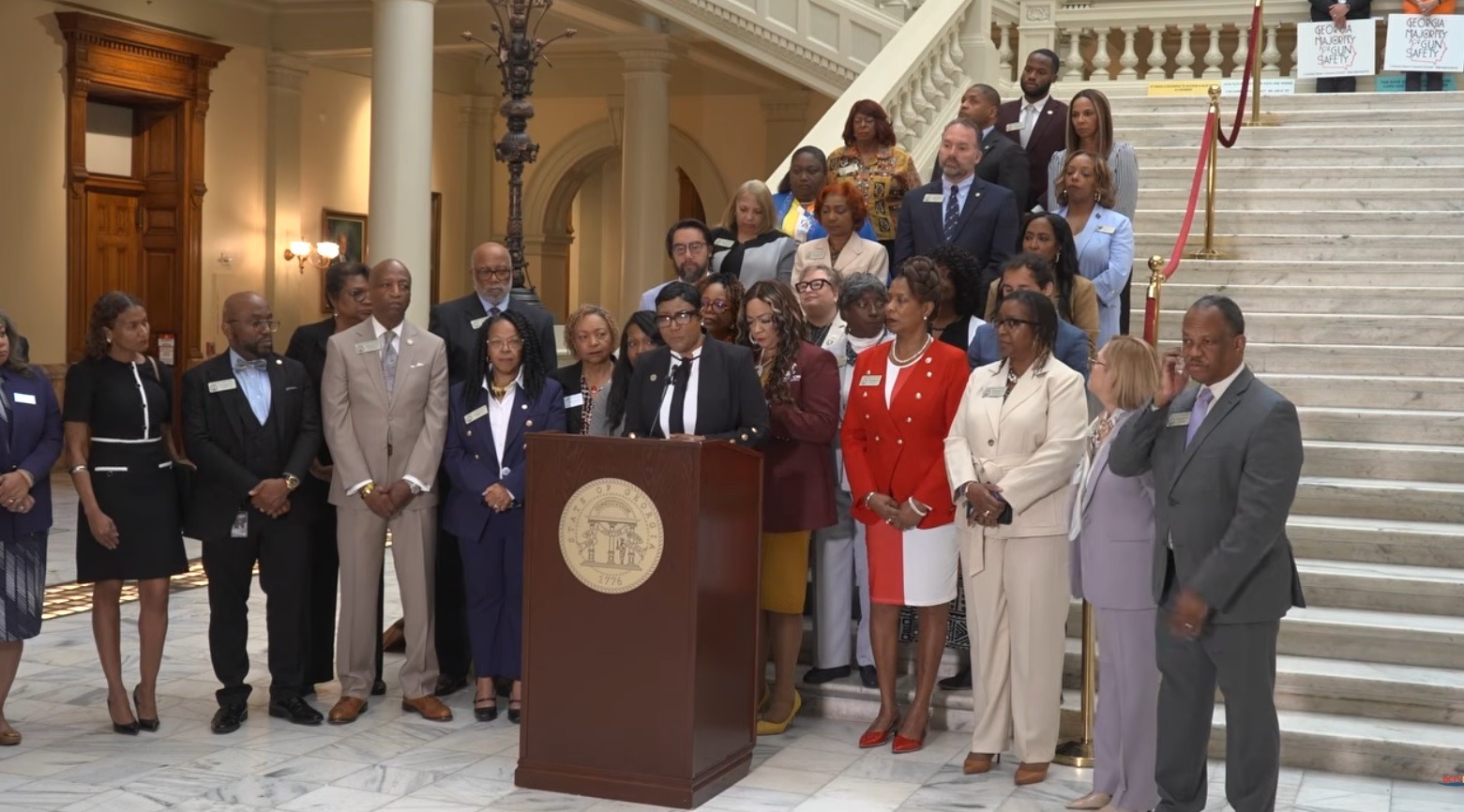
A coalition of metro Atlanta leaders gathered at the Georgia State Capitol on March 31 to deliver a unified message: veto House Bill 369.
Led by DeKalb County CEO Lorraine Cochran-Johnson, officials from DeKalb, Fulton, Cobb, Gwinnett, and Clayton counties stood alongside members of the Georgia House Democratic Caucus to oppose the Senate substitute version of the legislation. Their appeal was directed squarely at Governor Brian Kemp.
At issue is a provision that would make local elections nonpartisan—but only in five of Georgia’s 159 counties.
A Bill Reshaped Late in the Process
State Representative Carla Drenner opened the press conference by raising concerns about how the bill evolved. She noted that HB 369 “began as something entirely different” before being significantly altered through a Senate amendment that did not receive full debate in the House.
“That matters,” Drenner said, emphasizing that legislative process ensures transparency and public trust.
Leaders argued that such a late-stage transformation raises questions about fairness, particularly given the bill’s targeted scope.
What HB 369 Would Do
Under the proposed substitute, elections for key local offices—including commissioners, district attorneys, and tax officials—would become nonpartisan in Clayton, Cobb, DeKalb, Fulton, and Gwinnett counties.
Those counties represent nearly four million residents and a significant share of Georgia’s economic activity.
Cochran-Johnson and other leaders emphasized that these same counties are largely led by Democratic and African American officials—an overlap they say cannot be ignored.
“If fairness and election integrity are truly the goals,” Cochran-Johnson asked, “why does this bill apply to only five counties out of 159?”
Concerns Over Voter Impact
Speakers repeatedly stressed that removing party affiliation from ballots could make it harder for voters to make informed decisions.
“It matters who represents you,” Cochran-Johnson said. “Party affiliation is often a precursor to values and ideology.”
Clayton County Chairwoman Dr. Alieka Anderson Henry echoed that concern, warning the bill would create “two different election systems” within the same state—one for most counties and another for just five.
“That is not fairness,” she said. “That is discrimination.”
A Broader Question of Local Control
Beyond voter clarity, leaders framed the issue as one of local governance.
Henry County Chairwoman Carlotta Harrell, whose county would not be directly affected, said the bill sets a troubling precedent.
“If the state can redefine election structures in one set of counties today,” she said, “it opens the door for similar interventions across the state in the future.”
That sentiment was echoed across the podium: decisions about local elections, they argued, should originate within local communities not be imposed by the state.
A United Regional Front
The event brought together an unusually broad coalition of elected officials across metro Atlanta, signaling the regional weight behind the opposition.
Gwinnett County Representative Dr. Jasmine Clark described the bill as a “targeted” effort to reshape political power, while Cobb County Chairwoman Lisa Cupid called for collaboration rather than division.
Even counties not directly impacted stood in solidarity, underscoring concerns that the legislation could reshape governance statewide.
The Call to Action
Cochran-Johnson closed her remarks with a direct appeal to the governor.
“If our counties, our state, and our nation are to remain beacons of democracy,” she said, “we must reject laws like HB 369 that target, divide, and discriminate under the guise of good policy.”
She added a final warning: “Today, both the people and the world are watching Georgia. Let us not fall on the wrong side of history. Democracy has a price.”
As of this writing, Governor Kemp has not publicly indicated whether he will sign or veto the bill.
Metro leaders say they will continue to monitor its progress—and remain prepared to push back.
Truth Seekers Journal thrives because of readers like you. Join us in sustaining independent voices.