
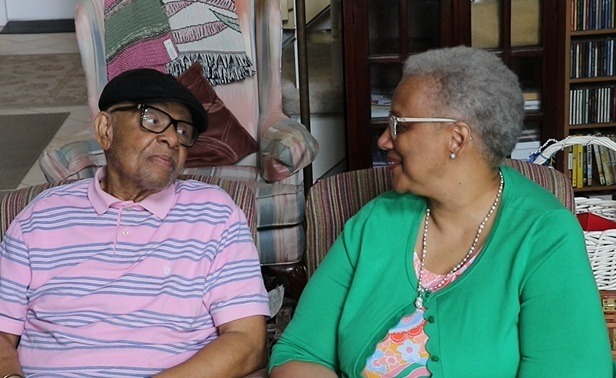
By Milton Kirby | Old Hickory, TN | August 25, 2026
Jacqui and Donel King were attending a lung cancer summit in New Orleans when, near the end of the event, Jacqui stopped at an information table.
One card remained on the table.
It looked ordinary, about the size of a business card, folded like a small tent. There was nothing about its appearance to suggest that the information inside would soon become worth its weight in gold to the Kings.
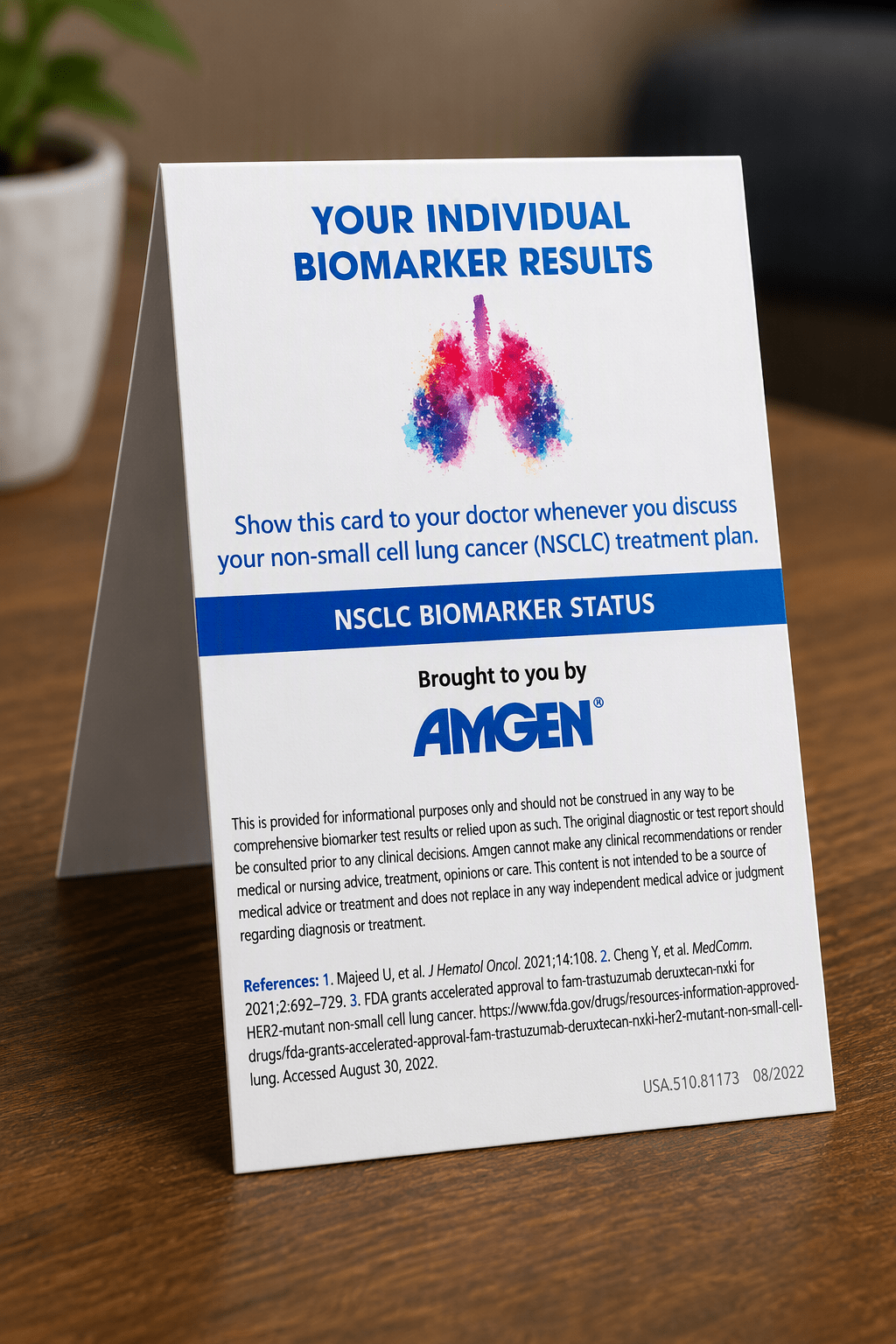
Inside was information about biomarkers associated with lung cancer and questions patients could take to their doctors to get answers.
Jacqui picked up the last card brought it home and then took it to her husband’s next appointment with his oncologist.
What happened next helped change the conversation surrounding Donel King’s Stage 4 lung cancer diagnosis.
The Kings walked into the appointment prepared to ask whether biomarker testing had been performed.
It had.
They just didn’t know it.
The testing had identified a KRAS G12C mutation in Donel’s cancer, a molecular characteristic for which a targeted treatment was available.
For Jacqui, the moment demonstrated something she now believes every patient and caregiver needs to know and understand.
“You don’t know how to advocate for yourself if you don’t know what it is that you’re looking for,” she said.
Before Cancer Took Center Stage
Cancer is now part of the Kings’ daily lives.
But that’s not where their story began.
Donel and Jacqui met in Houston more than three decades ago. Both were single parents, and their marriage brought together a blended family.
Jacqui’s life became increasingly centered on ministry and leadership in the United Methodist Church. Donel describes his role throughout much of their marriage as supporting that calling while pursuing his own entrepreneurial interests.
Their life together took them through Texas, Tennessee and Illinois.
They also endured major events long before lung cancer entered their lives.
While serving in Port Arthur, Texas, the Kings experienced the devastating 2005 hurricane season. Their church and community dealt with families displaced by Hurricane Katrina and then faced hurricanes that affected their own area.
Jacqui remembers the period as one of ministry, survival, rebuilding and prayer.
Donel brought another life experience to the marriage.
He is an Air Force veteran who served in air traffic control.
Donel would learn much later in life that he was dyslexic, finally putting a name to difficulties he had experienced years earlier. Decades later, cancer would confront him with another lesson about the power of knowing exactly what you are dealing with.
He also spent years as an entrepreneur and describes himself as someone who enjoys technology, business, gardening and community service.
He calls himself a “Renaissance man.”
And cancer was not completely new to him.
Donel was diagnosed with prostate cancer in 2009 and underwent removal of his prostate.
They were unaware that years later, another cancer was growing inside him.
A Fall Changes Everything
By 2025, Donel had experienced pain in his shoulder and hip. A simple X-ray had not revealed the cause.
He underwent regular physical examinations and was frustrated that nothing had identified the cancer earlier.
Then, in October 2025, while the Kings were living in Springfield, Illinois, Donel’s leg gave way while walking down a flight of stairs.
He fell. The fall fractured his femur and badly damaged his hip.
Further medical evaluation revealed something far more serious.
Stage 4 lung cancer.
The cancer had spread beyond his lung, metastasizing to his hip and shoulder. Donel could no longer walk.
Their lives changed almost immediately.
Physicians in Illinois told the couple Donel needed specialized orthopedic oncology care that was not available locally. They worked to get him back to the Nashville area, where he could receive care through the VA and other specialists.
After returning home, Donel entered rehabilitation while doctors simultaneously confronted the cancer and the severe damage to his hip.
The first biopsy in Illinois failed to provide enough tissue for all of the testing doctors needed, Jacqui said.
Then came major surgery.
Rebuilding a Hip While Fighting Cancer
On February 18, 2026, Donel underwent an operation to reconstruct his hip and pelvis.
He remembers an eight-hour surgery that would begin rebuilding the structure of an extensively damaged hip that might allow him to walk again.
Doctors also obtained additional tissue. That tissue would later become important to Donel’s cancer story
Meanwhile, Donel begin cancer treatment that consisted of radiation, chemotherapy and infusion therapy. Donel remembers what chemotherapy did to him physically.
His hair disappeared.
So did the black beard he loved.
Jacqui looked at him during the interview and offered a reminder of what mattered more.
“But he’s still here.”
Donel responded:
“I’m still here.”
But the treatments were difficult the cancer was not responding as they had hoped.
Jacqui was began her search for treatment options, something she knows how to do.
Jacqui Starts Looking for Answers
Jacqui had previously researched lung cancer resources after the wife of a colleague was diagnosed with lung cancer.
When Donel was diagnosed, she returned to that research.
This time, she searched specifically for organizations working with African Americans and lung cancer.
She found the HEAL Collaborative.
HEAL focuses on health education and advocacy, including efforts to provide patients and caregivers with information they can use to navigate cancer care. Its lung cancer resources include information about screening, treatment, clinical trials, biomarker testing and self-advocacy.
Jacqui contacted the organization and learned about HEAL’s annual Lung Cancer Patient & Caregiver Summit.
The Kings registered and began planning their trip to attend HEAL’s 2026 3rd Annual Summit in New Orleans.
The 2026 gathering was designed specifically to address the needs of Black communities affected by lung cancer. HEAL brought patients and caregivers together with healthcare professionals, researchers, advocates and community leaders for discussions about early detection, personalized treatment, clinical trials and patient advocacy.
For Donel and Jacqui, those subjects were not theoretical.
They were living them.
Getting to New Orleans was not automatic.
Donel had recently undergone major surgery and needed medical clearance to travel.
They got it.
And they went.
That trip would introduce the Kings to a word that would become central to their cancer journey:
Biomarker testing.
What Is a Biomarker?
Cancer is not necessarily the same disease in every person who receives the same broad diagnosis.
A biomarker is a biological characteristic that can provide doctors with information about a cancer. In some cancers, testing can identify specific molecular changes that may help physicians determine whether a targeted treatment is appropriate.
For a patient, the distinction can be simplified.

A cancer diagnosis identifies the disease.
Biomarker testing tells doctors more about the particular characteristics of that patient’s cancer.
And targeted therapy acts against a particular target or characteristic.
The Kings did not understand that distinction before New Orleans.
The Last Card on the Table
At the Summit, the Kings attended a breakout session about biomarker testing.
The message they carried away was direct: patients with lung cancer should ask for a biomarker test that will provide information about the specific characteristics of their cancer, so their doctor can consider more personalized treatment options.
That was what sent Jacqui to the Amgen table, one of the pharmaceutical companies supporting the Summit.
There she found the wallet-sized card containing information about biomarkers associated with non-small cell lung cancer. Jacqui took the last one on the table.
She decided that when they returned home, the card was going with them to Donel’s next oncology appointment.
They were going to ask questions.
But the story took an unexpected turn.
The Kings did not return home, request biomarker testing and then wait for a laboratory to perform it.
The testing had apparently already been done.
They simply did not know it.
“An Awakening on Both Sides”
Additional tissue obtained during Donel’s hip surgery had been sent for laboratory analysis.
By the time the Kings walked into the oncology appointment with their card, biomarker testing had identified KRAS G12C in Donel’s cancer.
Jacqui remembers putting the card into the conversation and learning that the result was already there.
She called the moment “an awakening on both sides.”

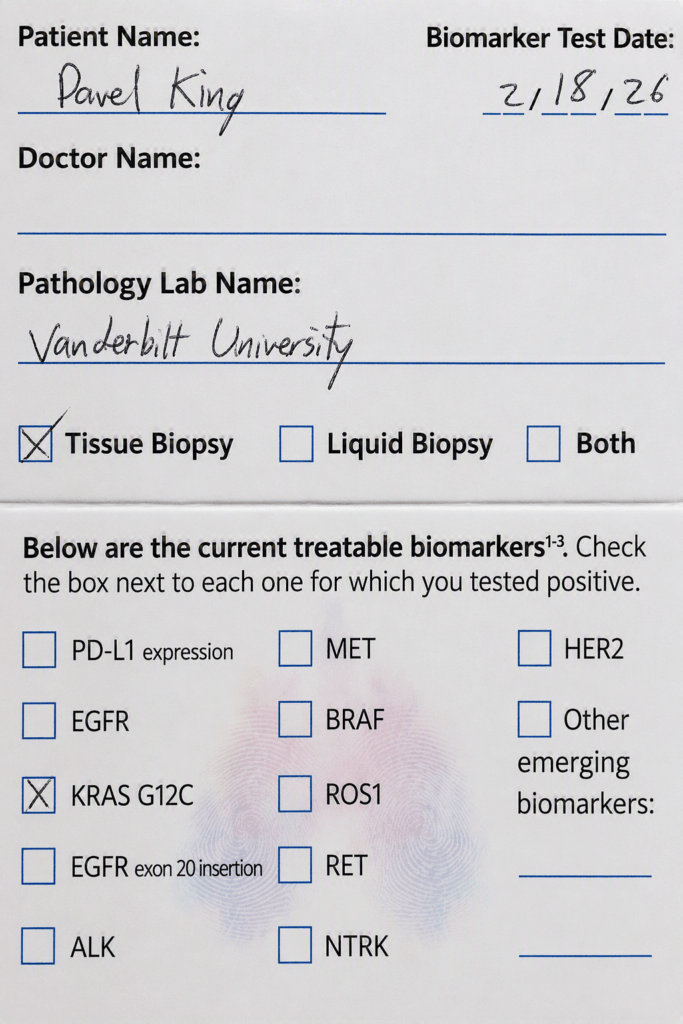
The Kings had arrived intending to ask whether the test should be performed.
Instead, the conversation became about what the completed test had found and what could be done with that information.
The KRAS gene helps regulate cell growth. Some cancers carry a particular alteration known as KRAS G12C.
That distinction mattered because medicines have been developed to target KRAS G12C.
One of those targeted treatments is Lumakras, or sotorasib, manufactured by Amgen.
The U.S. Food and Drug Administration approved Lumakras in 2021 for certain adults with KRAS G12C-mutated locally advanced or metastatic non-small cell lung cancer who have received at least one prior systemic therapy. The FDA labeling calls for patients to be selected based on the presence of the KRAS G12C mutation determined by an FDA-approved test.
That is the type of targeted treatment Donel’s biomarker result made possible for his physicians to consider.
The medication is not a cure.
Donel understands that.
But to him, it represented another option.
The “Silver Bullet”
Donel has his own name for the treatment.
He calls it his “silver bullet.”
He is quick to explain what he means.
He does not believe the pill simply makes Stage 4 cancer disappear.
His hope is that the therapy can stop the cancer from progressing or cause tumors to shrink.
Donel says he feels much better since moving away from chemotherapy and beginning the targeted treatment.
He is also being monitored.
Blood work is part of his routine. CT scans will help his physicians determine whether the tumors are shrinking, remaining stable or progressing.
Asked what he wants those scans to show, Donel did not give a complicated answer.
“My hope is that it’s not moving,” he said. “That’s my goal.”
Caregiving Wasn’t in the Retirement Plan
The story is not Donel’s alone.
Cancer changed Jacqui’s life too.
Her retirement was supposed to begin a different season.
Instead, she became caregiver, researcher, medical navigator, household manager and advocate while simultaneously dealing with grief and a major move.
Her mother had been ill and died during the same larger period of upheaval.
The Kings were also moving back from Illinois to Tennessee.
Donel was in hospitals and rehabilitation facilities.
Jacqui dealt with packing, moving, selling a house, setting up their Tennessee home, arranging medical equipment and keeping track of appointments.
“Caregiving wasn’t on my retirement,” she said.
At another point she summed up the experience even more simply:
“There’s no script for this.”
Yet sitting with the Kings revealed something that a list of caregiving responsibilities could not.
After more than 30 years of marriage and 33 years as a couple, Donel and Jacqui still displayed the easy affection of people discovering each other. They finished each other’s sentences and sometimes started the same thought at the same time. They gazed at one another as the other spoke. More than once, Jacqui looked at Donel, smiled and seemed, for a moment, almost giddy.
It was an unexpected sight in an interview about Stage 4 lung cancer.
Their story was about biomarker testing, targeted therapy and caregiving. But sitting across from the Kings, another story was unfolding in plain sight.
This was also a love story.
The couple learned to accept help.
Friends and colleagues organized meals.
Neighbors helped with equipment.
The VA helped with transportation to medical appointments.
Their church and broader community prayed.
And Jacqui learned something caregivers sometimes resist.
“You can’t do it by yourself,” she said.
Information Is Only Half the Job
The Kings credit HEAL Collaborative with putting information in front of them that they did not previously understand and how to be your own advocate.
But Jacqui believes attending a conference is not enough.
“If you get the information, that’s half of the game because then you’ve got to follow through,” she said.
In the Kings’ case, the chain is unusually clear.
HEAL created the setting where they learned why biomarker testing mattered.
At an Amgen table, Jacqui picked up the last card explaining what they should ask about.
Back home, that question led them into a conversation about a KRAS G12C result already in Donel’s medical record.
And that result helped identify a targeted treatment option.
But none of those steps happened in isolation.
Information had to reach the patient.
The patient and caregiver had to understand why it mattered.
They had to take that information back to the people providing Donel’s medical care.
And physicians had to determine the appropriate treatment.
That may be the central lesson of the Kings’ experience.
The laboratory had information about Donel’s cancer.
His medical team had access to that information.
The Kings had attended appointments.
What changed after New Orleans was their ability to participate in the conversation differently.
They knew the word biomarker.
They had a card.
They had questions.
And they knew they were supposed to ask them.
There is an important nuance.
The Kings’ account does not establish that Donel’s physicians had overlooked the biomarker result or would not have discussed targeted therapy without the card. Jacqui said the medical team appeared to be preparing to talk with them about what could come next.
What the Summit and the card clearly changed was the Kings’ understanding of the conversation.
They arrived knowing what to ask.
Tennessee Expands Biomarker Coverage
The Kings’ experience comes as Tennessee is changing its insurance rules surrounding biomarker testing.
Tennessee enacted legislation in 2026 requiring specified health plans to provide biomarker-testing coverage beginning with plans issued, amended or renewed on or after January 1, 2027. The law includes TennCare coverage when biomarker testing is medically necessary.
The law does not mandate biomarker testing to screen people without symptoms. Its coverage provisions address testing used for diagnosis, treatment, disease management or monitoring when applicable requirements are met.
The distinction is important.
Lung cancer screening and biomarker testing are not the same thing.
Screening is intended to identify lung cancer in people who meet established eligibility criteria before symptoms develop.
Biomarker testing can help physicians make treatment decisions after cancer is identified.
For the Kings, understanding those differences has become part of learning to navigate cancer.
The Losses Cancer Creates
Stage 4 cancer has taken more from Donel than hair.
It took mobility.
For months he could not walk.
It interrupted his businesses.
It pulled him away from volunteer work, gardening and the other activities of a man who describes himself as hands-on.
Donel calls those losses a form of grief.
He had been an active man.
Suddenly, much of his life required other people to do things for him.
“For the moment, I just said, well, I just got to step back and take my hands off of them and just kind of go with the flow,” he said.
Still, optimism comes easily to him.
He calls himself a “perpetual optimist.”
“When I see manure, I’m looking for the pony,” he said.
That optimism now has specific goals.
One is walking again.
Donel continues physical therapy and believes he is getting closer.
Another is traveling.
During one appointment, someone asked him a question he was not expecting:
What are you going to do with the time you have?
It stopped him.
Now he has answers.
He wants to take a train across the country.
He wants to travel.
He talks about Egypt.
Cancer has forced him to think about time differently.
Faith, Medicine and the Road Ahead
Faith runs through nearly every chapter of the Kings’ story.
Jacqui is a minister.
Donel speaks openly about God.
They describe prayer surrounding his surgery, treatment and recovery.
But their faith has not meant waiting passively.
Jacqui searched.
They traveled.
They listened.
They carried information home.
They asked questions.
Donel continued treatment.
Jacqui continued caregiving.
And both continued learning.
They see no contradiction between prayer and medicine.
For Jacqui, vulnerability also became part of the lesson.
When people ask how things are going, caregivers do not always have to say everything is fine.
Sometimes, she said, the answer needs to be:
Not great today.
I need help today.
Healing, she believes, sometimes requires letting other people into the struggle.
For Donel, the future remains uncertain.
Stage 4 lung cancer is still Stage 4 lung cancer.
The next CT scan matters.
So does the next physical therapy session.
So does the possibility of taking another step without assistance.
But he is no longer talking only about treatment.
He is talking about where he wants to go.
What he wants to see.
What he wants to do with the days in front of him.
Cancer has forced Donel King to surrender control over much of his life.
It has not taken his sense of possibility.
“I’m alive,” he said. “God has spared me another day. And I’m just going to get up and do the best I can with that day.”
And for now, he is waiting for the next scan with one straightforward hope:
“My hope is that it’s not moving.”
The HEAL Collaborative is based in Atlanta, GA. To learn more, please visit: www.healcollaborative.org.
Related articles
Six Blocks That Changed the Conversation About Lung Health
A Celebration of Hope Inspires Birmingham’s Community Conversation on Lung Cancer
Part I – “Anyone With Lungs”: Understanding the Hidden Realities of Lung Cancer
Part II – “Your Lungs Are Talking”: How the Respiratory System Works – and What It Tells Us
Part III – “From Awareness to Action”: Communities Confront Lung Cancer Together
Support open, independent journalism. Your contribution helps us tell the stories that matter most.