

By Milton Kirby | New Orleans, LA | November 14, 2025
A Little Girl at the Center of History
On November 14, 1960, a six-year-old girl in a starched dress and white shoes climbed the steps of William Frantz Elementary School in New Orleans. Four federal marshals flanked her — two in front, two behind — as a screaming mob hurled slurs, objects, and threats.
Her name was Ruby Nell Bridges.
That short walk into first grade changed the course of American history.
Born on September 8, 1954, in Tylertown, Mississippi, Ruby came into the world just months after the U.S. Supreme Court issued its landmark Brown v. Board of Education decision, declaring segregated public schools unconstitutional. Her early life, however, bore no resemblance to a legal victory. She grew up on a sharecropping farm, the eldest of five children born to Abon and Lucille Bridges, in a system designed to keep Black families poor and trapped on the land.
When Ruby was four, her parents left that world behind, moving to New Orleans in search of better work and a better future. Her father found a job as a gas station attendant. Her mother took night work to help support their growing family. Ruby helped watch her younger brothers and sister and walked a long way each day to an all-Black kindergarten, even though an all-white school sat just five blocks from her home.
That distance — five blocks that might as well have been a different country — became the line she was asked to cross.
A Test Meant to Exclude, and a Mother Who Said Yes
By 1960, under pressure from federal courts to comply with Brown v. Board, the Orleans Parish School Board tried a different tactic: administering an entrance exam for Black children. The test was designed to be difficult, with the hope that few, if any, would pass. If the children failed, white officials hoped, they could claim integration just wasn’t “practical” and delay it even longer.
Ruby’s father wanted no part of it. He feared exactly what would come — trouble, backlash, danger. Her mother, Lucille, saw something else: a chance for her daughter to get a stronger education and, just as important, to open a door “for all African-American children,” not just her own.
They argued. They prayed. And in the end, Lucille convinced Abon to say yes.
Out of all the Black children who took the test in New Orleans, only six passed. Three were assigned to McDonogh No. 19 Elementary. Ruby Bridges would be the only Black child sent to William Frantz — and the first Black child to integrate an all-white elementary school in the Deep South.
The court orders stated that the schools would open in September. Louisiana politicians responded with delay, stalling integration with every legal trick they could find. It took until November 14, 1960, for the judge’s order to finally break through.
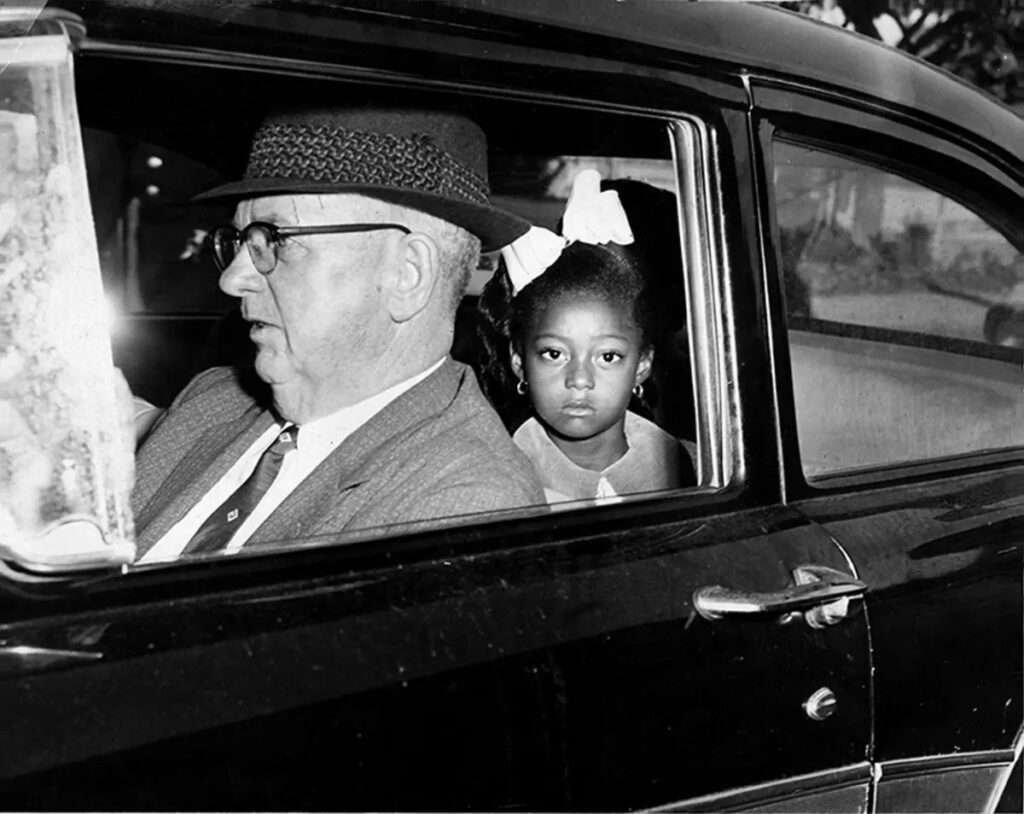
That Monday morning, federal marshals drove Ruby and her mother the five blocks to William Frantz. In the car, the marshals calmly explained how they would walk around her to shield her from danger. Ruby, who had grown up watching parades and Mardi Gras crowds, thought the screaming crowd outside the school might be some celebration.
It was not.
Inside the School, Alone in a Classroom
White parents rushed to pull their children from the building as soon as Ruby walked in. Every teacher but one refused to teach while a Black child was enrolled. That first day, Ruby and her mother never made it to a classroom at all; they spent the day in the principal’s office while chaos raged outside.
On the second day, a young white teacher from Boston, Barbara Henry, came to meet her.
“Good morning, Ruby,” she said with a smile. “I’m your new teacher.”
Henry was the only educator willing to teach Ruby that year. Every other child assigned to her class was withdrawn or transferred, leaving Ruby as the single student in a first-grade room built for many. For the rest of that school year, Mrs. Henry taught her one-on-one — phonics, numbers, reading, writing — often sitting side by side at tiny desks rather than standing at the front of the room.
Outside the classroom, hate tried to make its presence felt daily. A white woman waved a Black baby doll in a coffin. Another threatened to poison Ruby, prompting the marshals to insist she only eat food brought from home. She could not go to the cafeteria. She couldn’t play outside during recess. Even to use the restroom, she had to be escorted down the hallway by federal marshals.
And yet, every day, she walked through that mob “like a little soldier,” Charles Burks, one of the marshals who escorted Bridges, later recalled. She did not cry. She did not turn back. Her resilience in the face of such adversity is a testament to the strength of the human spirit.
The Cost — and Quiet Courage — of One Family’s Decision
The Bridges family paid a steep price for that walk to school. Their sacrifices, both personal and financial, are a stark reminder of the toll that the fight for equality can take on individuals and families.
Ruby’s father lost his job at the gas station. The family’s regular grocery store refused to serve them. In Mississippi, her grandparents were turned off the land they had sharecropped for 25 years because of “the trouble” their granddaughter was causing in New Orleans. Under that kind of pressure, her parents’ marriage strained and eventually broke apart.
But the story was not only about hostility. Some white families chose to keep their children at William Frantz. A Methodist minister, Lloyd Anderson Foreman, walked his five-year-old Pam daughter through the mob, telling reporters, “I simply want the privilege of taking my child to school.” A neighbor gave Ruby’s father a new job painting houses. Others babysat, watched the family’s home to deter threats, and even walked behind the marshal’s car as Ruby traveled to school. These acts of solidarity show that change is possible, even in the face of deep-seated prejudice.
Child psychiatrist Dr. Robert Coles, disturbed by what he saw on the news, volunteered to counsel Ruby during that year. He met with her regularly at home, trying to understand how a child could carry such a burden. Years later, he would write The Story of Ruby Bridges for children and support the Ruby Bridges Foundation with his royalties.
Through it all, Ruby’s mother urged her to lean on faith. “If you’re afraid, pray,” she told her daughter. Ruby began praying on the way to school and, in time, even prayed for the people screaming at her. Years later, she recalled one morning when her teacher saw her lips moving as she walked through the crowd.
“Were you talking to them?” Mrs. Henry asked.
“No,” Ruby said. “I was praying for them.”
Life After the Mob, and the Work That Continues
By the time Ruby reached second grade, the mobs had thinned, the marshals were gone, and other Black children had quietly entered the school. Mrs. Henry, who had stood with her in that first, lonely year, was not invited back. The city, and much of the country, seemed eager to forget that ugly chapter.
Ruby finished elementary school at William Frantz, graduated from an integrated high school, and built a life in New Orleans. She studied travel and tourism, worked for years as a travel agent, married Malcolm Hall, and raised four sons. For a long time, she rarely spoke about what had happened when she was six.
That changed in the 1990s, when reporters, scholars, and schoolchildren began to ask: What happened to the little girl in Norman Rockwell’s famous painting, The Problem We All Live With? The painting, based on her walk into William Frantz, shows a small Black girl in a white dress, escorted by marshals past a wall splashed with a racial slur and a smashed tomato.
By then, Ruby had returned in a quiet way to William Frantz, volunteering as a parent liaison and helping families navigate the school system. She also reunited with Mrs. Henry after more than three decades. The two women, one Black and one white, one from New Orleans and one from Boston, picked up an old connection that had never really faded.
In 1999, Ruby founded the Ruby Bridges Foundation, dedicated to “the values of tolerance, respect, and appreciation of all differences.” As she often says, “Racism is a grown-up disease, and we must stop using our children to spread it.”
She has spent the years since speaking at schools, churches, museums, and universities, telling a new generation what it means to be the child at the center of a nation’s battle over who belongs in its classrooms.
The Other Three Who Walked That Morning
Ruby Bridges was not the only child who climbed into a federal marshal’s car on November 14, 1960. That same morning, just a few blocks away in the Lower Ninth Ward, three other six-year-old girls — Leona Tate, Gail Etienne, and Tessie Prevost — stepped into history as well.
Together with Ruby, they are known as the “New Orleans Four,” although for decades their story was eclipsed by the spotlight that was placed almost solely on Bridges.
These three children integrated McDonogh No. 19 Elementary School, a traditionally all-white school that had resisted the Supreme Court’s Brown v. Board ruling for six long years. Like Ruby, they passed the same deliberately difficult entrance exam meant to keep Black children out of white classrooms.
That morning, federal marshals arrived at each girl’s home to escort them to their first day of first grade. As the car approached McDonogh 19, the girls heard a roaring crowd and — being New Orleans children — assumed it was Mardi Gras.

But what awaited them was no parade.
In front of the school, white protesters beat garbage-can lids, waved signs, and screamed hatred so loud and vicious that it startled even the federal escorts. “If they could get to me, they’d kill me,” Etienne later said. “At six years old, I’m wondering what I could have done to make people react this way.”
Within minutes of their arrival, every white student was pulled out of the building. The McDonogh Three sat outside the principal’s office as children streamed out around them. By day’s end, they were the only three students left in the school.
For their safety, the windows were covered with paper. The girls were unable to use the lunchroom. Their teacher, Mrs. Meyers, a young white woman from New Orleans, created a refuge for them — teaching lessons, offering comfort, and letting them jump rope and play hopscotch in the hallways instead of going outside.
Their courage came at immense cost, just as Ruby’s did. Their presence helped force open New Orleans’ schoolhouse doors and contributed to the moral and political momentum that later fueled the 1964 Civil Rights Act.
Today, their legacy is newly recognized:
• Leona Tate now owns the McDonogh 19 building, converting it into a civil rights museum through the Leona Tate Foundation for Change.
• Tessie Prevost, who later spent decades working quietly at the LSU School of Dentistry, passed away July 6, 2024, her contribution finally receiving the attention it long deserved.
• Gail Etienne continues to speak publicly about that day she mistook the mob for a Mardi Gras crowd — childhood innocence shattered in seconds.
Their bravery — alongside Ruby Bridges’ — reminds the country that school desegregation was never the work of one child alone. It was carried by four 6-year-old girls who faced mobs, terror, and abandonment to open the doors of American education.
From Desegregation to the DEI Backlash
Ruby Bridges’ walk into William Frantz Elementary helped open the doors of American public education. My own mother later rode buses into newly integrated schools in Southern California, part of that first generation of students who tried, in good faith, to build classrooms that truly reflected the country around them.
Within a single lifetime, many of those gains are under new attack.
School districts are banning books that deal honestly with race. Diversity, equity, and inclusion programs are being dismantled or defunded. Legal and political campaigns promise a return to a colorblind “meritocracy” that looks suspiciously like the old order in new clothes.
The mobs outside Ruby’s school carried signs and shouted slurs. Today’s fights often come wrapped in legal language and policy briefs. But at the heart of the struggle is the same question: Who gets to belong, and on what terms?
Ruby’s, Leona’s, Gail’s, and Tessie’s Mandate for Our Moment
Ruby Bridges was not an activist when she first climbed those steps. She was a child who loved jump rope, softball, and her younger siblings. The same was true for Leona, Gail, and Tessie — little girls thrust into a national confrontation over who deserved an equal education.
Their bravery was theirs.
The consequences were theirs.
And the mandate they carried is now ours
Today, as elders of the civil rights generation, Ruby, Leona, Gail, and the late Tessie Prevost leave behind a truth America must confront: schools can still be places that either bring children together or tear them apart.They opened the doors. They set the example. They showed the cost.
The question, now as then, is whether the country is willing to honor that sacrifice — in our school boards, in our policies, in our public memory, and in the stories we teach our children.
Their walk was not just a moment.
It was a mandate.
Their walk into William Frantz and McDonogh 19 did not end segregation everywhere. It didn’t erase racism. But it drew a clear line between the world we inherited and the world we’re still trying to build.
The question now and then is whether the country has the will to honor it — in our policy fights, in our school districts, and in the stories we choose to tell our children about what happened on those steps in New Orleans, and why it still matters.
Related articles
U.S. Marshals Escort Casket of Tessie Prevost-Williams
Please consider supporting open, independent journalism – no contribution is too small!