
By Ted Knorr | Harrisburg, PA | September 8, 2026
… this column exists for only one purpose and that is to answer your questions on Negro League baseball history. To that end, I need your help … if you are reading this column and enjoy it and want it to continue and you don’t already know everything about Negro League history … then please submit a question on any aspect of Negro League history. Your questions are the lifeblood of Shadow Ball—they shape where we go next.
How Fast Was Cool Papa Bell?
- Faster than the speed of light
- Faster than Jimmie Lyons, prime v prime
- He could cover 100 yards in about 10 seconds
- He was, and remains, the fastest baseball player ever
Phil Durnitz of Albuquerque, New Mexico, submitted the question, and I will do my best to answer it. Only one of the multiple‑choice options can be definitively shown to be correct — but each deserves examination.
A. Faster than the speed of light
Satchel Paige was fond of telling this story about his longtime roommate, Cool Papa Bell. In John Holway’s Voices from the Great Black Baseball Leagues (1975), Paige is quoted as saying:
“That man was so fast he could turn out the light and jump in bed before the room got dark.”
Taken literally, Paige is suggesting Bell outran light itself. We’ll file that away for now — in the category of tall tales, but glorious ones.
B. Faster than Jimmie Lyons
In the same Holway interview, Bell recounts one of the stories that helped build his reputation:
“(In 1922 or ’23) Jimmie Lyons was supposed to be the fastest man in the (Negro) League(s)… Rube Foster wanted us to race… So we went out and raced, and I beat Jimmie Lyons… I just ran off from Jimmie Lyons. That’s when I got my reputation.”
Lyons was extremely fast, and beating him was no small feat. But context matters: in 1922–23 Bell was 19 or 20 years old, while Lyons was 32 or 33. It shows Bell was faster than an older Lyons — not necessarily faster than Lyons in his prime.
Bell’s interview continues with stories of scoring from first on bunts, scoring from second on fly balls, and even being “faster than Jesse Owens,” based on the oft‑repeated claim that Bell circled the bases (120 yards) in 12 seconds flat. Holway adds the famous but misleading line that Bell “scored from second on a ground ball to win the 1934 All‑Star Game, 1–0.” The ball, in fact, was hit past the infield and into the outfield for a single. Bell’s recollections are wonderful, but they are unabashed braggadocio.
C. He could run 100 yards in about 10 seconds
We can estimate Bell’s straight‑line speed using his recorded “round‑the‑bases” times. Four such times appear in the historical record:

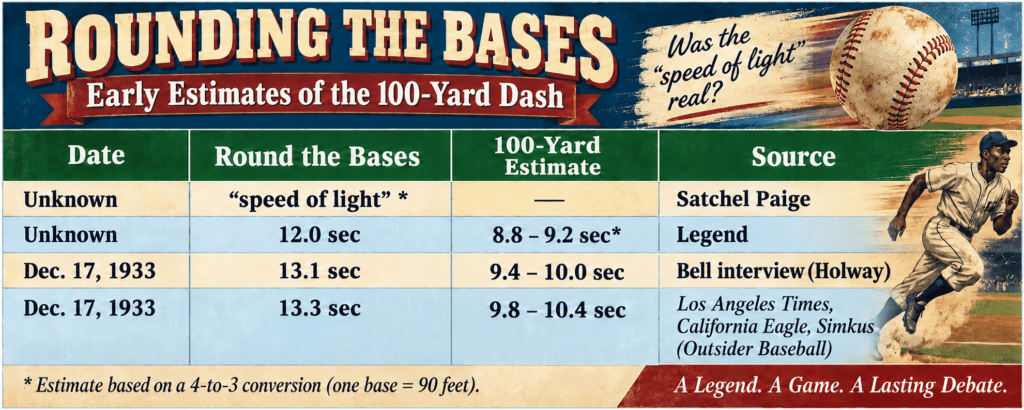
Even allowing for exaggeration, all four numbers are spectacularly fast. Paige’s story is entertaining; the 12‑second legend would still be a world record in 2026. But even the slowest verified number — 13.6 seconds, on a wet track, in December 1933, at age 30 — is extraordinary.
For comparison, the fastest Statcast‑measured modern time is Byron Buxton’s 13.85 seconds. A hand‑timed 13.6 and a fully automated 13.85 are essentially identical.
Thus, the record shows Bell was capable of roughly a 10‑second 100‑yard dash at a time when the world record stood at 9.5.
D. He was, and remains, the fastest baseball player ever
Here we enter the realm of opinion — but informed opinion. Using rate statistics from Seamheads (runs scored minus home runs, triples, and stolen bases, prorated per plate appearance), I rank the greatest Negro League speedsters as follows:
- Oscar Charleston
- Willard Brown
- Cool Papa Bell
- Bullet Rogan
- Jimmie Lyons
- Rap Dixon
- Hurley McNair
- George Shively
- Turkey Stearnes
- Cristóbal Torriente
Henry Milton, Sam Jethroe, and Doc Dudley would appear here as well but lack sufficient plate appearances to qualify.
Charleston and Bell stand out for combining elite speed with long careers. Bell finishing in the top three of this methodology confirms he was one of the fastest runners in Negro League history. Whether he was the fastest is debatable — Milton, Jethroe, Lyons, Shively, and several Hall of Famers could all stake a claim.
Conclusion
The correct answer is C.
Cool Papa Bell would have been a consistent 10‑flat or better 100‑yard runner at a time when the fastest sprinters in the world were posting 9.6, 9.5, and 9.4. Bell was exactly as fast as legend suggests — and unquestionably one of the fastest players ever to play the game.
Thanks to authors John Holway and Scott Simkus for their excellent work, to Satch and Cool for their stories, and to Mr. Durnitz for his question.
Last Week’s Shadow Ball Significa Question of the Week
Q: What was Atlanta’s most prolific Negro League franchise (in terms of years in the league)? A: The Atlanta Black Crackers — provided by Will Clark of Hackensack, NJ.
This Week’s Shadow Ball Significa Questions of the Week
In 1937, Monte Irvin joined the Newark Eagles under an assumed name — what was it? In 1942, Larry Doby joined the Newark Eagles under an assumed name — what was it?


Ted Knorr is a respected Negro League baseball historian, a longtime member of the Society for American Baseball Research’s Negro League Committee, and the founder of the Jerry Malloy Negro League Conference as well as several Negro League Commemorative Nights in central Pennsylvania.
Beyond his research and organizing work, Ted is frequently invited to speak at sporting events, community programs, family gatherings, and educational forums, where he brings Negro League history to life. His deep knowledge of the players, teams, and cultural impact of Black baseball has made him a trusted voice for audiences who want to understand the legacy and significance of the Negro Leagues.
Send questions or Significa answers to shadowball@truthseekersjournal.com or Shadow Ball, 3904 N Druid Hills Rd, Ste 179, Decatur, GA 30033.
Truth Seekers Journal thrives because of readers like you. Join us in sustaining independent voices.
It was a pleasure to meet you in Memphis at my first Jerry Malloy conference. I hope that my panel participation added some historical significance to the event. Thanks for keeping this history alive.
Carlis,
I very much enjoyed meeting you also at this year’s Malloy Conference … and, truly, I thought your panel was wonderful and I learned a lot about all five players discussed. Your father’s story was different from the others because of his proximity to the biggest story in the game … and his career record with the Homestead Grays, Great Lakes Naval Training Center, in the Winter Leagues and even in ’46 at Trois-Rivieres demonstrate that he had the right stuff.
I look forward to seeing you again next year at the Malloy. In the meantime, keep up the great work on behalf of your Pop!
Ted