
By Florita Bell Griffin | Houston, TX | August 11, 2026
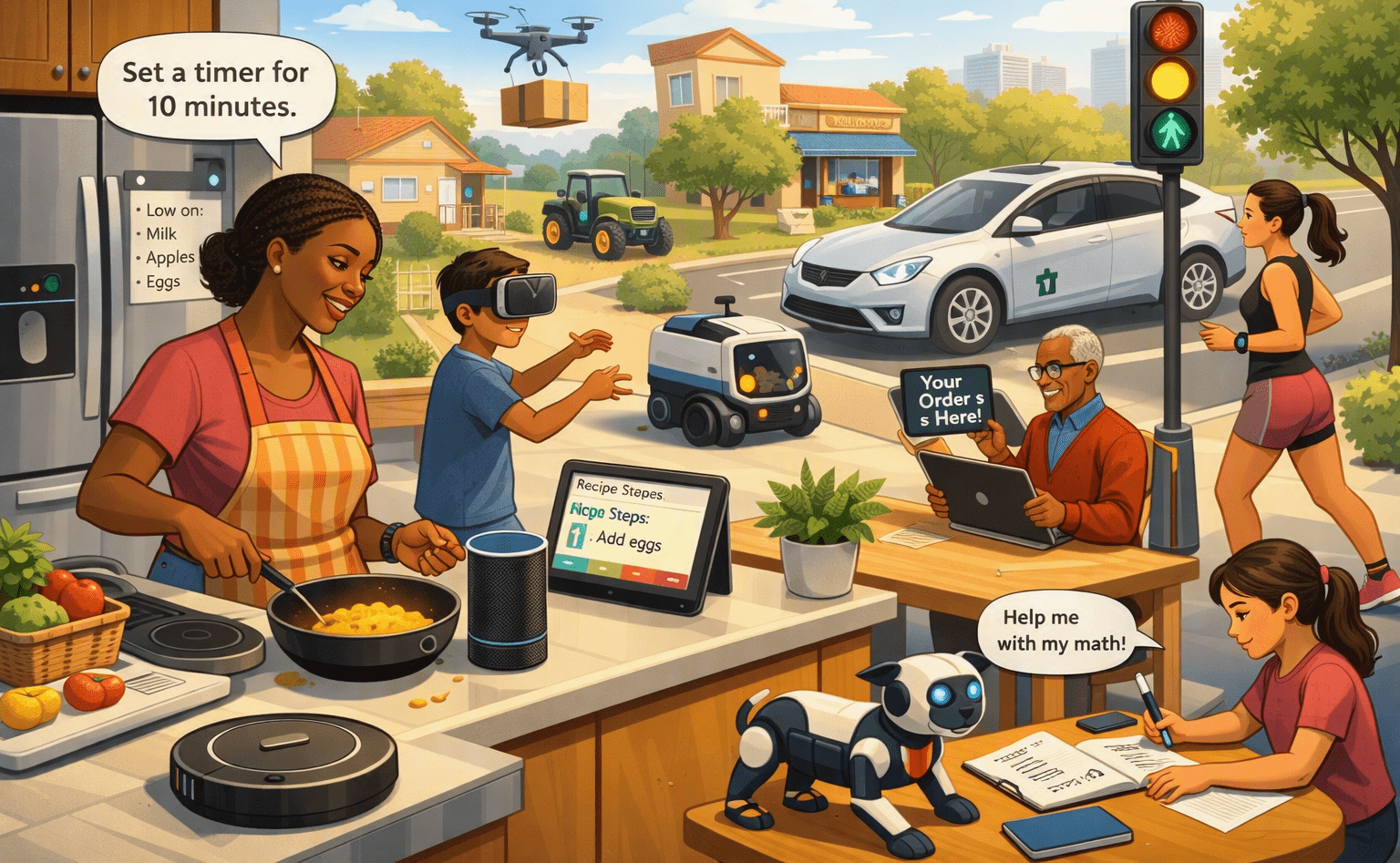
Artificial intelligence is often presented as a technology that belongs to the future. News reports show humanoid robots, self-driving vehicles, powerful computers, and machines capable of producing art or carrying on remarkably human-sounding conversations. These images make AI appear distant from ordinary life, as though it exists mainly inside research laboratories, major technology companies, and science-fiction stories. In reality, artificial intelligence has already entered many of the most routine parts of daily life. It may help determine what appears on a person’s telephone screen, which route a driver takes, whether a banking transaction is approved, which job applicant receives further consideration, and which news story reaches a particular reader.
Most people interact with AI without consciously deciding to do so. It operates within smartphones, websites, vehicles, medical systems, stores, workplaces, schools, banks, and entertainment services. It can recommend a movie, identify a face in a photograph, filter unwanted email, translate a message, answer a customer-service question, or alert a credit-card company to suspicious activity. These functions are often convenient, and many have become so familiar that they no longer feel remarkable. Yet each one involves a computer system analyzing information, identifying patterns, and producing a recommendation, prediction, classification, or response.
This quiet integration of artificial intelligence into everyday life deserves attention. Technology is most powerful when it becomes ordinary enough that people stop noticing it. Once a system feels routine, users may no longer ask what information it is collecting, how it reached a conclusion, whether its recommendation is fair, or what happens when it makes a mistake. Understanding everyday AI does not require technical training. It begins with recognizing when a machine is influencing a choice and remembering that automated decisions are still human creations with human purposes, limitations, and consequences.
The Invisible Intelligence Inside Ordinary Devices
A smartphone is one of the clearest examples of artificial intelligence becoming an ordinary companion. When a person unlocks a telephone using facial recognition, the device compares the user’s features with stored information. When the camera automatically improves lighting, reduces blur, sharpens details, or identifies faces, AI-assisted systems are working behind the scenes. A photograph application may allow someone to search thousands of images using words such as “birthday,” “dog,” “beach,” or “car,” even though no one manually labeled each picture. The software has learned to recognize visual patterns and associate them with familiar objects and settings.
The keyboard on a telephone also uses forms of artificial intelligence. Predictive text attempts to anticipate the next word. Autocorrect compares what was typed with common language patterns. Voice-recognition tools turn spoken language into written text, while translation programs convert messages from one language into another. Accessibility features may read text aloud, describe images, create captions, or help people operate devices through speech. These functions can be especially valuable for older adults, people with disabilities, travelers, students, and workers who must communicate quickly.
The usefulness of these systems can make their presence easy to accept without question. Every convenience, however, may require information. A navigation application needs location data. A voice assistant may process spoken commands. A photo service may analyze faces and places. A personalized application may study what the user searches for, watches, purchases, or ignores. The question is not whether all collection of information is harmful. The more important question is whether people understand what is being collected, why it is needed, how long it is retained, and whether it may be used for purposes beyond the service they originally requested.
Artificial intelligence also shapes what people see online. Social-media platforms do not simply present information in the order it was posted. Their systems continually decide which videos, photographs, advertisements, opinions, and news stories are most likely to hold a person’s attention. Every pause, click, search, reaction, share, and repeated viewing may become part of the platform’s understanding of that user. Over time, the system learns which subjects attract interest and which emotions are most likely to produce engagement.
This explains why two people can open the same application and encounter completely different versions of the world. One may see cooking demonstrations, local events, family photographs, and gardening advice. Another may see political conflict, frightening health claims, celebrity rumors, or stories designed to provoke anger. Each person may begin to believe that the information appearing repeatedly on the screen represents what everyone is discussing. In fact, the content has been selected partly because an automated system believes that particular person is likely to respond to it.
A personalized feed can be enjoyable and useful, but it is not a neutral picture of reality. It is a constructed environment shaped by technology, advertising, business priorities, and the user’s own behavior. When a person repeatedly watches angry or fearful content, the system may provide more of it because emotional material often keeps people engaged. The platform does not necessarily ask whether the information is healthy, balanced, or true. Its immediate concern may be whether the user continues watching.
How AI Influences Choices, Opportunities, and Access
Artificial intelligence does more than recommend entertainment. It increasingly participates in decisions that affect money, employment, healthcare, transportation, education, and access to services. Online retailers use AI to recommend products, predict demand, adjust advertisements, and estimate what a customer may be willing to purchase. A product displayed prominently may appear to be the best choice, even when its position results from advertising agreements, sales patterns, or the retailer’s desire to increase profit.
Consumers should therefore distinguish between a recommendation and independent advice. When an online store says, “You may also like,” the system is attempting to predict what the customer may buy. It is not necessarily deciding what the customer needs, what provides the best value, or what fits the person’s budget. AI can make shopping faster, but it cannot replace comparison, financial judgment, or the discipline to avoid unnecessary purchases.
Banks and credit-card companies use AI to detect unusual transactions and possible fraud. If a card is suddenly used in another country or for a purchase far outside the customer’s normal spending pattern, an automated system may temporarily block the transaction or request confirmation. This can prevent theft and allow financial institutions to examine far more activity than human employees could review manually.
The same ability to identify patterns can also influence loan decisions, credit evaluations, insurance rates, and account reviews. These decisions may appear objective because they are produced by a computer, but computers do not create fairness automatically. AI systems are designed by people and trained on information produced by human societies. If past data reflects unequal treatment, inaccurate records, or long-standing discrimination, an automated system may repeat those patterns. A machine can process information consistently and still produce an unfair result.
Employment systems present similar concerns. Companies may use AI to screen résumés, identify promising candidates, schedule interviews, measure productivity, summarize meetings, or evaluate employee performance. A résumé system may reject an applicant because certain words, employment gaps, or educational experiences do not match patterns found among previously successful employees. Yet the pattern may fail to recognize talent that appears in a different form.
When an automated system influences employment, lending, insurance, education, or healthcare, people should be able to ask how the decision was made and how to challenge an error. “The computer decided” is not an acceptable end to the conversation. Organizations choose the systems they use, decide which information enters them, and determine how heavily to rely on their conclusions. Human responsibility does not disappear merely because a decision has been automated.
Healthcare is another area in which AI may provide both meaningful benefits and serious concerns. Medical systems can help analyze scans, organize records, identify possible drug interactions, predict which patients may require additional monitoring, and reduce administrative work. Consumer devices can track heart rate, sleep, activity, and other health-related information. These tools may help patients notice patterns and prepare more informed questions for medical professionals.
However, a health application does not know a person in the same way a qualified clinician does. It may lack the full medical history, family circumstances, environmental conditions, medication details, and personal observations needed to understand a symptom. AI may assist healthcare, but it should not create the illusion that a quick automated answer is equal to a careful professional evaluation. The greater the possible harm from an incorrect answer, the more important human review becomes.
Convenience Without Surrendering Judgment
The most serious long-term concern may not be that artificial intelligence suddenly takes control of everyday life. It may be that people gradually give away small acts of judgment because automated assistance feels easier. Navigation systems can weaken a person’s awareness of direction. Recommendation systems can reduce independent discovery. Writing tools can encourage people to submit language they have not carefully considered. Summaries can replace reading. Search results can become substitutes for investigation, and personalized feeds can become substitutes for understanding the wider world.
Using a tool does not automatically weaken human ability. A calculator can support mathematics, and a map can support travel. The problem begins when assistance becomes dependence and convenience becomes unquestioned authority. A navigation application may recommend the fastest route, but the driver must still notice weather, safety, construction, and local conditions. A writing system may produce a polished message, but the sender remains responsible for its meaning. A medical tool may suggest a possibility, but a patient should still seek qualified care when the situation requires it.
The same principle applies to generative AI systems that write, summarize, create images, answer questions, or hold conversations. Their fluent language can make them appear more knowledgeable than they are. A system may provide a useful explanation one moment and an inaccurate statement the next. It may generate a confident answer without reliable evidence. Users should therefore treat AI as a powerful assistant rather than an unquestionable authority.
Everyday readers can protect themselves by developing a few simple habits. When an automated system makes an important recommendation, consider who operates it, what information it may be using, what outcome it is designed to produce, and who benefits from that outcome. When the decision affects employment, healthcare, money, education, or legal rights, seek an explanation and verify the information through reliable human or official sources. Review privacy settings, limit unnecessary permissions, and remember that accepting convenience does not require abandoning caution.
Artificial intelligence is neither a magical solution nor an independent force that appeared without human direction. It is created, funded, trained, purchased, and deployed by people and institutions. Some applications improve safety, accessibility, communication, and efficiency. Others may increase surveillance, manipulation, inequality, misinformation, or dependence. The same technology can produce benefit or harm depending on who controls it and how it is used.
Becoming an informed AI user does not mean learning to program or understanding every technical process. It means recognizing when a machine is influencing what you see, what you are offered, and how you are evaluated. It means understanding that a recommendation is not a command, a prediction is not a certainty, and an automated answer is not necessarily the truth.
Artificial intelligence is already in the pocket, home, workplace, vehicle, and institutions of the average person. It is helping to organize daily life in ways that are often useful and sometimes invisible. The task before ordinary citizens is not to fear every use of AI or accept every use without question. It is to remain aware, ask who is responsible, protect personal information, and preserve human judgment in a world increasingly shaped by intelligent machines.
© 2026 Truth Seekers Journal. Published with permission from the author. All rights reserved.
Support open, independent journalism, your contribution helps us tell the stories that matter most.

