
By Milton Kirby | Atlanta, GA | October 13, 2026
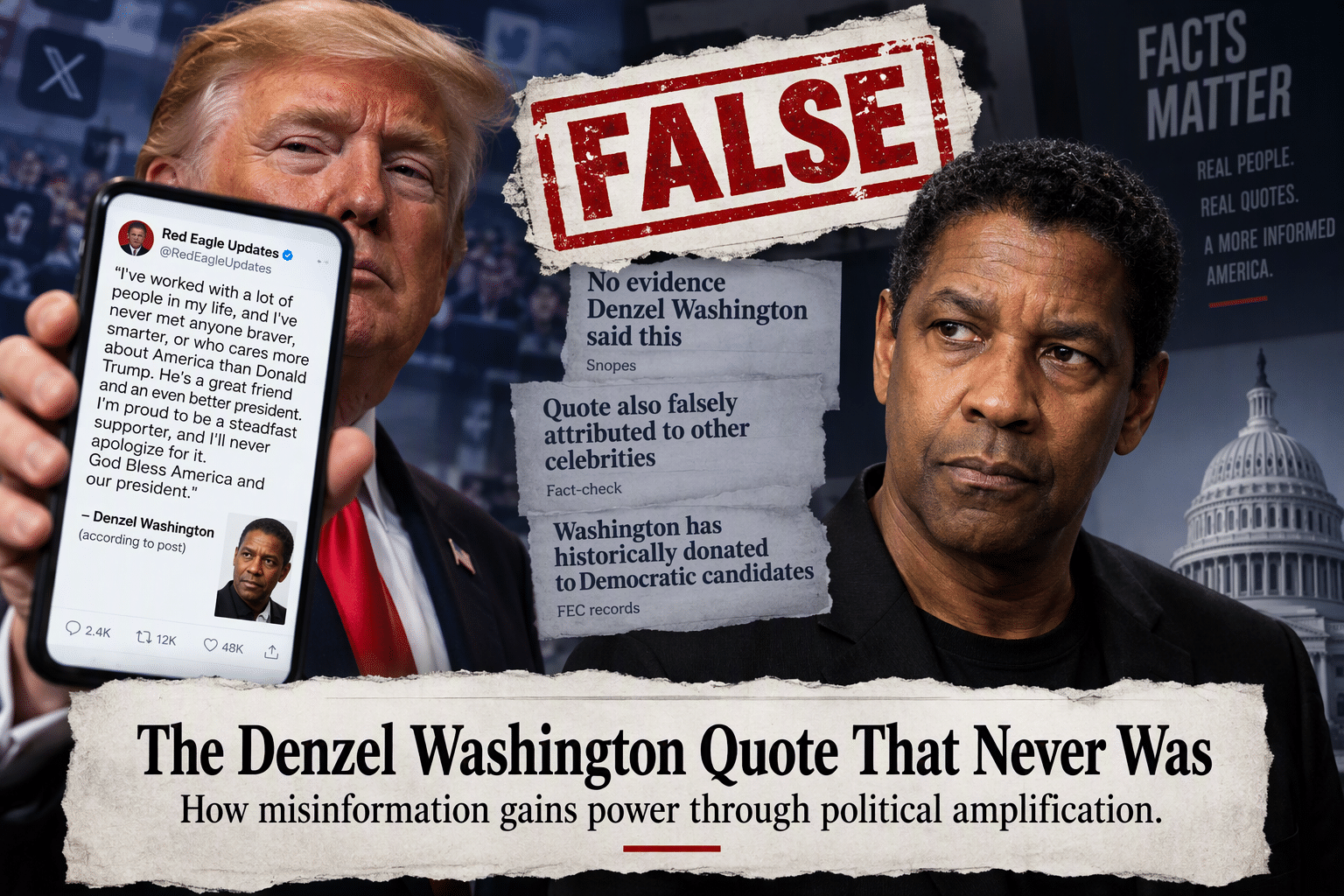
President Donald Trump shared a glowing endorsement attributed to Academy Award-winning actor Denzel Washington on social media Monday, October 12.
There was one problem.
Washington never said it.
The fabricated quotation portrayed Washington as a devoted Trump supporter who praised the president’s courage, intelligence, and commitment to America. Trump shared a screenshot of the claim on Truth Social, bringing the false endorsement to a much larger audience.
The incident raises a question that extends beyond celebrity politics: What happens when the president of the United States shares information that has already been identified as false?
A Celebrity Endorsement That Never Happened
The controversy began with a post on X from an account called Red Eagle Updates on Saturday, October 10. The post claimed Washington had described Trump as exceptionally brave, intelligent, and devoted to the country.
The fabricated statement also portrayed Washington as calling Trump a close friend and declaring himself a committed supporter of the president.
The post invited readers to respond to a question: “Do you agree with Denzel? YES or NO?”
Trump shared a screenshot of the message on Truth Social on Monday morning.
However, the fact-checking organization Snopes had already investigated the quotation on October 10 and found no credible evidence that Washington had ever made the statement.
The Washington Post subsequently contacted Washington’s representatives. Alan Nierob, president of PMK Entertainment, confirmed that the statement was fabricated.
“Not real,” Nierob told the newspaper. “No idea where it came from.”
The White House did not respond to The Washington Post’s request for comment.
A Familiar Pattern Involving Washington
This was not the first time Washington’s name had been attached to a fabricated political endorsement.
In 2016, a false story circulated claiming that the actor supported Trump’s presidential campaign. Other misleading statements attributed to Washington appeared in subsequent years.
In 2021, FactCheck.org investigated another social media claim suggesting that Washington had abandoned the Democratic Party to support Trump. Washington’s representative described that story as a fabrication.
The latest false endorsement also contained language previously attributed to actor Matthew McConaughey and Rolling Stones singer Mick Jagger.
The repetition illustrates how fabricated quotations can circulate for years, sometimes with little more than a change in the celebrity’s name.
Celebrity endorsements can carry influence because familiar names attract attention and may lend credibility to political messages. A statement attributed to a respected actor, athlete, or musician can reach audiences who might otherwise pay little attention to political commentary.
That helps explain why fabricated endorsements continue to circulate.
Washington has generally avoided making prominent partisan endorsements. Federal Election Commission records show that he previously contributed to Democratic presidential candidates Barack Obama and Hillary Clinton. Those donations, however, do not establish his current political preferences.
When False Information Reaches the White House
False celebrity endorsements are not new. Social media platforms have long provided opportunities for misleading statements, altered images, and fabricated quotations to spread rapidly.
What makes this incident significant is who shared the information.
A claim no longer needs to be true to gain attention. It can spread when a widely followed account shares it, regardless of whether the underlying information has been verified.
When inaccurate information moves from an ordinary social media account to the president’s platform, it can gain visibility and an appearance of credibility that it otherwise might not receive.
The Denzel Washington incident also was not an isolated example of Trump sharing an invented quotation.
In May 2026, Trump circulated a statement falsely attributed to Republican Sen. John Kennedy of Louisiana. The quotation concerned former President Barack Obama and the Affordable Care Act. Kennedy confirmed that he had not made the statement.
CNN has also documented a 2019 incident in which Trump shared a fabricated quotation attributed to former President Ronald Reagan.
These incidents raise concerns about how information is verified before being distributed by public officials.
There is an important distinction between deliberately creating false information and sharing something without recognizing that it is false.
In the Washington case, the available reporting establishes that Trump shared a fabricated endorsement. It does not establish whether he knew the quotation was false when he posted it.
That distinction matters. So does the responsibility to verify information before passing it along.
The Broader Challenge of Misinformation
The Washington incident comes at a time when Americans are confronting increasingly sophisticated forms of misleading online content.
Fabricated quotations can be created in seconds. Images can be altered to suggest that events occurred when they did not. Artificial intelligence can generate realistic-looking photographs, videos, and audio recordings that make false claims more difficult to identify.
There is no verified evidence that AI was used to create the Washington quotation.
The larger problem is that information can spread widely before its accuracy is established.
Whether misinformation benefits Republicans or Democrats, the consequences extend beyond party politics. Repeated exposure to false claims can undermine confidence in legitimate information sources and make it more difficult for citizens to distinguish verified reporting from political messaging.
For Washington, the latest incident is another example of his name being used to communicate a political position that he did not publicly express.
For the public, it is a reminder that a recognizable name attached to a quotation does not make the quotation authentic.
The Responsibility to Verify
Journalists have a professional obligation to check quotations, identify sources, and correct errors. Those standards are essential to maintaining public trust.
Public officials face a similar expectation when communicating with the people they represent.
The speed of social media does not eliminate the need for accuracy. In fact, the ability to reach millions of people almost instantly makes verification even more important.
Readers also have a role to play.
Before accepting a surprising quotation, particularly one involving politics, they can look for an original interview, video, speech, or statement from the person involved. Established news organizations and independent fact-checkers can provide additional context.
A screenshot is not proof that a statement is authentic. Neither is the number of times it has been shared.
More Than a False Endorsement
The fabricated Denzel Washington endorsement may appear to be a relatively small incident compared with the major policy debates and international challenges facing the country.
But its significance goes beyond whether a Hollywood actor supports a particular president.
It demonstrates how easily an invented statement can move from an online account into a much larger public conversation, even after fact-checkers have questioned its authenticity.
The central issue is not whether Washington supports Trump, another political figure, or no candidate at all. Those are decisions Washington is entitled to make and express for himself.
The issue is whether Americans can rely on information shared by people in positions of public trust.
In this case, the reported evidence establishes that the endorsement was fabricated and that the president shared it.
The larger question is what standards of verification the public should expect from its leaders.
Truth Seekers Journal thrives because of readers like you. Join us in sustaining independent voices.