
By Florita Bell Griffin, Ph.D. | Houston, TX | August 18, 2026
Artificial intelligence has a remarkable ability to sound confident. Ask an AI system a question about history, medicine, money, technology, travel, politics, or even your favorite television show, and it may respond in polished sentences with dates, names, explanations, and conclusions that seem completely authoritative. The grammar may be excellent, the reasoning may appear organized, and the answer may include details you did not know enough to ask about. Yet there is something every everyday AI user should understand: confidence in the wording of an AI response is not the same thing as certainty about the facts. That distinction may be one of the most important forms of AI literacy we can learn.
Artificial intelligence does not necessarily become visibly cautious when it is unsure. It may not announce, “I am guessing,” before giving an uncertain answer. In fact, a weak answer can sometimes be delivered in exactly the same polished tone as a strong one. This means that people cannot judge the reliability of an AI response merely by how intelligent, detailed, or convincing it sounds. Fortunately, you do not have to become a computer scientist to recognize when more verification is needed. You simply have to develop the habit of asking better questions about the information AI gives you.
Modern generative AI systems are extraordinarily sophisticated language systems. They can analyze information, explain complicated subjects, compare ideas, help write documents, summarize material, reason through problems, and interact conversationally. However, generating a convincing response and establishing that every statement in that response is factually correct are two different things. An AI system may encounter incomplete information, misunderstand exactly what you are asking, combine details about two similar people or events, rely on information that has changed, or make an inference that seems reasonable without having enough evidence to support it.
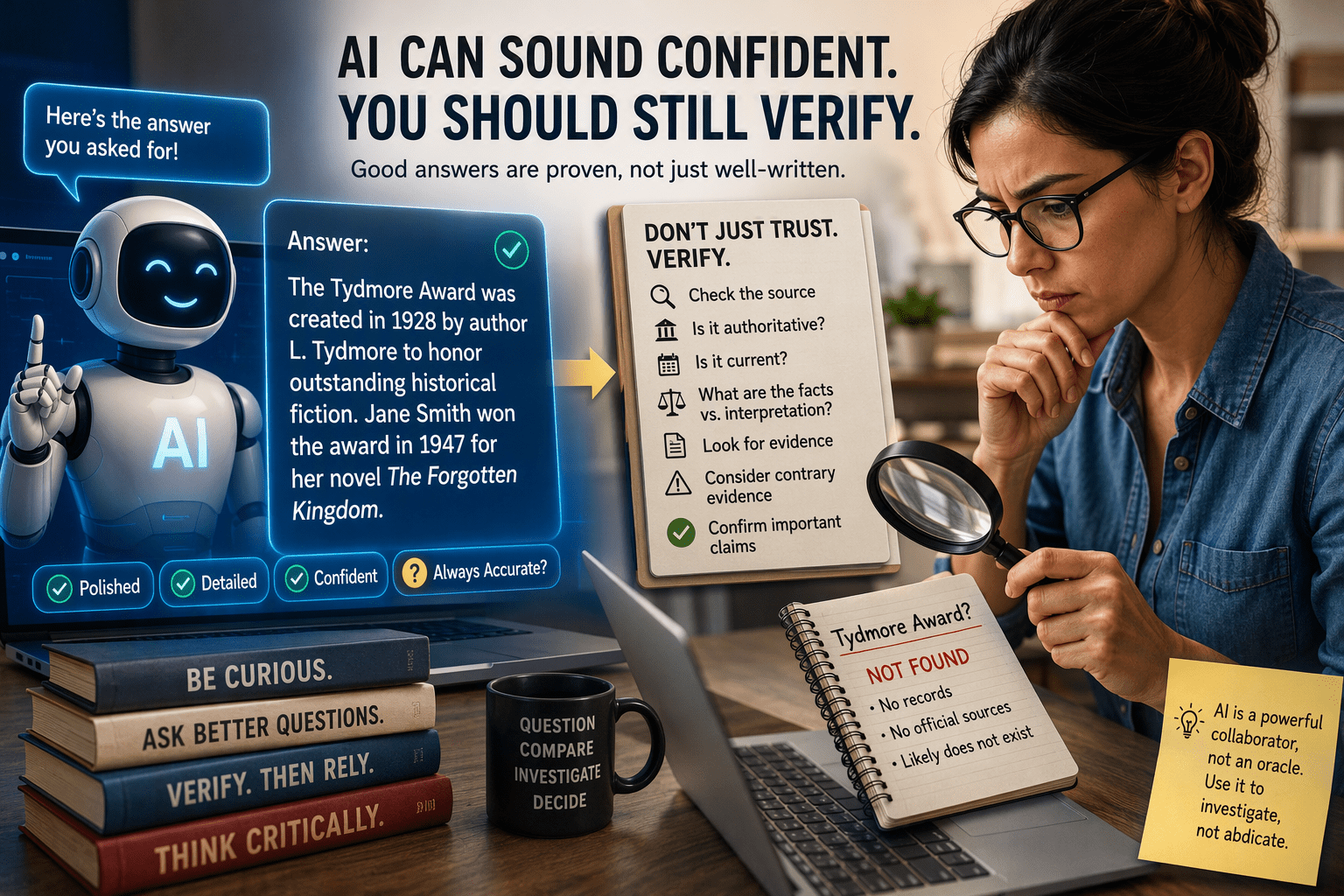
This problem is often described as an AI “hallucination,” but for everyday users, there may be an easier way to understand it: sometimes AI fills in a gap. The difficulty is that the filled-in gap may sound exactly like a fact. Imagine asking AI about a little-known author. The system correctly identifies the author’s first book, writing style, and general period of publication, then provides the name of an award the author supposedly received. Because everything surrounding that statement is accurate, you naturally assume that the award is accurate too. It may not be. One incorrect detail can hide comfortably inside ten correct ones, which is why responsible AI use requires more than simply deciding whether an answer sounds right.
Some questions are much safer to ask casually than others. If you ask AI to explain the difference between a metaphor and a simile, help organize your grocery list, suggest questions for a family interview, rewrite a paragraph, brainstorm birthday party themes, or explain a difficult concept in simpler language, a small factual error may have little consequence. Other questions deserve far greater scrutiny. Questions about medications, legal obligations, retirement money, government benefits, taxes, medical symptoms, or statements attributed to political leaders can carry real consequences if the information is wrong.
A useful rule is that the greater the consequence of being wrong, the greater the need for verification. Timeliness matters as well. An AI answer about a long-established historical fact may remain useful for years, while an answer about current mortgage rates, an election, a recently changed law, a company executive, an airline policy, a product recall, or breaking news can become outdated very quickly. Whenever your question depends heavily on words such as “current,” “latest,” “today,” “recently,” “still,” or “now,” it is wise to make sure the information has been checked against current sources.
One of the easiest ways to use AI more intelligently is to stop asking only for answers and begin asking about the quality of those answers. After receiving an important response, you can ask which parts are established facts and which parts are interpretation. You can ask what information the AI is least certain about, what should be independently verified before you rely on it, or which sources would be most authoritative for confirming the answer. Those questions transform AI from something that simply delivers conclusions into something that can help you investigate them.
Source quality is particularly important. If you are asking about taxes, an official tax agency is generally more authoritative than a random financial blog. If the question concerns a medication, regulatory agencies, respected medical institutions, and peer-reviewed research may deserve more weight than social media commentary. If you are investigating a law, court decision, corporate announcement, or government policy, the original source often matters more than dozens of websites repeating someone else’s description of it. Ten websites repeating the same inaccurate claim do not make the claim true.
You can also ask AI to look for credible evidence that contradicts its first answer. This can be especially useful when dealing with controversial subjects, historical claims, scientific debates, political assertions, consumer products, or popular stories that have been repeated so often that people assume they must be true. AI can be particularly valuable when you ask it to help you investigate an issue rather than simply telling you what to believe.
Another important habit is learning to recognize suspicious specificity. False information can become more convincing when it contains precise details. A statement saying that “a study found this” may make you somewhat skeptical. A statement claiming that “a 2019 study involving 2,417 participants found a 37.8 percent improvement” suddenly feels much more authoritative. Yet specificity itself is not evidence. Names, percentages, dates, quotations, court cases, scientific papers, statistics, titles, organizations, laws, and historical events should be verified precisely because they are specific.
If AI gives you the title of a study, ask it to locate the study. If it provides a quotation, ask for the original source. If it describes a law, examine the actual statute or information from the responsible government agency. If it claims that a company made an announcement, look for the company’s own announcement. If it attributes a statement to a public figure, look for the speech, interview, transcript, video, or other primary record. When a claim is important, the question should move from “Does this sound believable?” to “Can this be confirmed?”
It is also useful to notice what happens when you challenge an answer. If you ask the same factual question from a slightly different angle and names, dates, numbers, or explanations begin changing significantly, the subject deserves closer examination. AI correcting itself is not necessarily a problem. Correction is a useful part of inquiry. However, repeated factual instability can indicate that the system does not have a firm basis for the answer it initially supplied.
Truth seeking also becomes easier when we learn to separate facts from interpretation. Consider the statement that a company eliminated 5,000 jobs. That is a factual claim that can potentially be verified. Now consider the statement that the layoffs prove the company is failing. That is an interpretation. The company may be failing, but it could also be restructuring, automating certain functions, eliminating duplicate positions after an acquisition, responding to investor pressure, or changing its business strategy. The fact and the explanation are not the same thing.
AI can move smoothly between facts and interpretation because human conversation does the same thing. The transition can be so natural that we barely notice it. One useful approach is to ask AI to present verifiable facts first and its interpretation separately. Doing this can make the conversation much clearer because it prevents an AI-generated interpretation from quietly taking on the appearance of an established fact.
Perhaps the most important change we can make in our relationship with artificial intelligence is to stop treating it like an electronic oracle that possesses an invisible vault containing every correct answer. AI is far more useful when approached as a powerful collaborator in inquiry. It can help us ask better questions, identify possibilities we have not considered, explain terminology that makes difficult sources easier to understand, compare competing claims, locate inconsistencies, summarize complicated documents, distinguish evidence from speculation, and identify what additional information would be needed before reaching a conclusion.
That kind of collaboration is very different from surrendering our judgment to a machine. Human beings have always had to evaluate information. Long before artificial intelligence, newspapers, television programs, books, websites, experts, teachers, politicians, corporations, advertisers, neighbors, friends, relatives, and strangers all told us things they believed were true. Some were correct, some were mistaken, some were biased, some were poorly informed, and some intentionally misled others. Artificial intelligence did not invent the problem of unreliable information. It introduced a new kind of messenger capable of communicating with unusual speed, fluency, patience, and apparent authority.
One of the most powerful questions we can bring into any important AI conversation is also one of the oldest: How do we know? What is the evidence? Where did the information originate? Is the source authoritative? Is the information current? Can the claim be independently confirmed? Are we looking at a documented fact, a reasonable inference, a disputed interpretation, an estimate, or a guess? These questions matter far more than whether an answer sounds sophisticated or agrees with what we already believe.
The people who benefit most from artificial intelligence may not ultimately be those who learn the most complicated prompts. They may be the people who learn when an answer is sufficient, when it deserves another question, when it requires outside verification, and when they need to examine the evidence for themselves. AI can make information easier to reach, easier to understand, and easier to analyze, but the human ability to question, compare, investigate, and judge remains essential.
In an age when machines can generate convincing language almost instantly, knowing how to distinguish a good answer from a merely good-sounding answer may become one of the most important everyday skills of all. That does not make artificial intelligence less useful. It makes the person using it more capable of using its extraordinary power wisely.
© 2026 Truth Seekers Journal. Published with permission from the author. All rights reserved.
Related articles
Living With AI: How It Is Changing Work, Family, and Community
When Systems Forget Who They Were Built For
Why Familiarity Is Not the Same as Understanding
Support open, independent journalism. Your contribution helps us tell the stories that matter most.

