Florita Bell Griffin, Ph.D.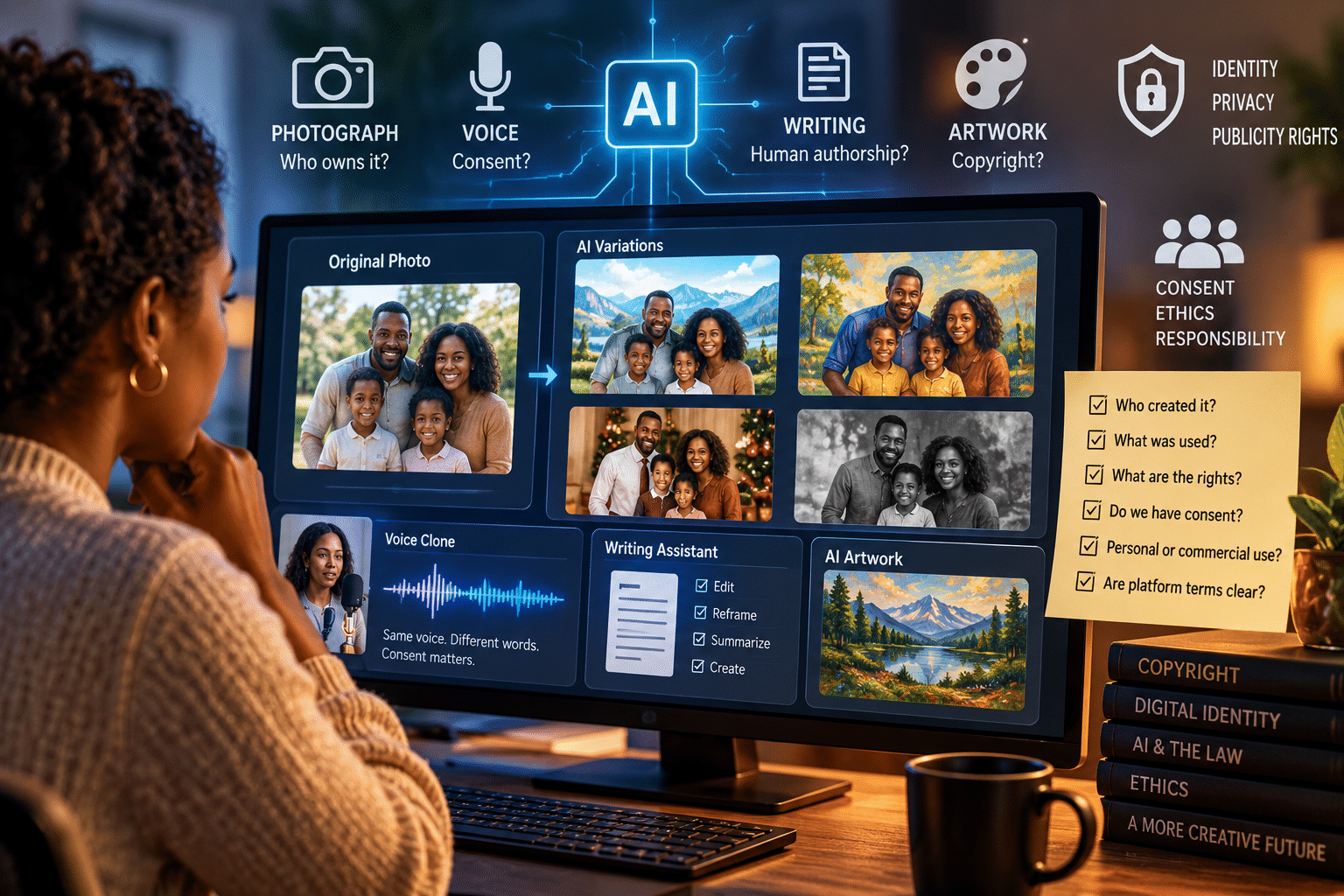
By Florita Bell Griffin, Ph.D. | Houston, TX | September 29, 2026
For most of modern creative history, people had a reasonably intuitive understanding of authorship. A writer wrote a book, a photographer took a photograph, a musician composed a song, and an artist painted a picture. Questions of ownership could still become complicated, particularly when employers, publishers, contracts, or collaborations were involved, but the connection between human creator and creative work was usually easy to see.
Generative artificial intelligence has made that connection far more complicated. A person can now type a few sentences and receive an original-looking image, song, essay, voice recording, video, logo, or design. The result may never have existed before, yet the person who requested it may not have physically drawn, photographed, performed, or written most of what appears. This raises a simple-sounding question with a surprisingly complicated answer: Who owns it?
In the United States, copyright protection has traditionally been based on human authorship. The U.S. Copyright Office stated in its 2025 report on AI and copyrightability that material produced by generative AI can receive copyright protection when sufficient human-authored expression is involved, but purely AI-generated material is not protected merely because a person supplied prompts. The Office also explained that using AI as a tool does not automatically prevent a larger human-created work from qualifying for copyright.
For everyday users, the easiest way to understand this is to think about creative control. If someone asks an AI system to “create a beautiful sunset over the ocean” and simply accepts the first image, the human contribution may be limited. If a person creates original material, repeatedly modifies elements, combines AI-generated portions with substantial human work, edits the composition, and makes creative choices about the final result, the analysis becomes different.
The exact legal outcome can depend on the particular work and circumstances, so people creating valuable commercial material should seek appropriate legal advice. The broader principle, however, is useful for everyone: asking a machine to make something and personally authoring the creative expression are not necessarily the same thing.
The issue becomes even more interesting with photography. Suppose someone uploads a family photograph to an AI system and asks it to change the background, improve the lighting, alter clothing, or create a painting based on the image. The original photograph may already have a human photographer whose copyright exists independently of the AI-generated version.
People often assume that because they appear in a photograph, they automatically own the photograph. Copyright generally belongs initially to the photographer unless some other legal arrangement changes that result. This is one reason professional photography agreements often specify what the customer may reproduce, publish, or distribute.
Voice raises another set of questions because a voice is not simply a piece of creative content. It is part of a person’s identity. AI voice-cloning technology can reproduce the sound of someone speaking words that person never said. This creates issues involving consent, impersonation, privacy, publicity rights, fraud, contracts, and other laws that go beyond ordinary copyright.
The U.S. Copyright Office devoted the first part of its AI report to digital replicas and recommended federal legislation addressing unauthorized replicas of a person’s voice or appearance. That demonstrates how quickly the idea of digital identity is becoming a serious legal and social issue.
Everyday people should begin thinking of their voices as digital assets. A recording posted publicly can potentially become material from which technology learns vocal characteristics. The same is true of video. People who once thought nothing of posting long recordings of themselves online may increasingly want to consider how those recordings could be reused.
This is especially relevant to performers, speakers, teachers, musicians, influencers, actors, executives, and anyone whose voice or appearance has professional value. A contract allowing a company to use a recorded performance may need to address whether the material can also be used to generate future synthetic performances.
Writing creates another interesting boundary. Many people now use AI to improve emails, articles, reports, books, advertising copy, and social-media posts. If the person begins with original ideas and writing and uses AI mainly for editing, restructuring, or assistance, the human creative contribution remains clear. If the machine generates nearly everything and the user merely accepts it, the situation becomes less straightforward.
The safest practice for creators who want to maintain a strong record of human authorship is to preserve their own contribution. Keep drafts, notes, outlines, revisions, source materials, photographs, sketches, or other evidence showing how the work developed. These records can demonstrate that AI functioned as a tool within a broader human creative process rather than serving as the only source of expression.
Ownership also depends on the terms of the AI service being used. A platform may allow users broad rights to use outputs while imposing other conditions through its terms of service. Those terms can change, and commercial users should understand them rather than assuming every AI service operates under the same rules.
Businesses face additional concerns when employees create material with AI. A worker may use a generative system to create a company logo, advertisement, training manual, presentation, or design. The company should understand what tool was used, what source material was entered, and what rights exist in the resulting work.
There is also the question of what was used to train generative AI systems in the first place. Writers, artists, publishers, photographers, and other creators have raised significant questions about whether copyrighted works can be used for AI training and under what circumstances. The Copyright Office has separately examined those issues, which remain part of an evolving legal and policy landscape.
For ordinary users, the important point is that “AI made it” does not answer every ownership question. One must still ask what human material went in, who contributed creative expression, what platform terms apply, whether another person’s image or voice was used, and whether the final work will be used privately or commercially.
Consent may become as important as ownership. A person might legally possess a photograph of a friend but still create serious ethical problems by using that photograph to generate embarrassing or deceptive material. The ability to create something does not automatically create the right to use another person’s identity however we choose.
Families will face these questions too. Parents may use AI to create imaginative pictures of children. Relatives may animate old family photographs or recreate the voice of someone who has died. These uses can be meaningful and emotionally powerful, but they also introduce questions about dignity, consent, memory, and the line between preserving history and manufacturing events that never happened.
Technology has made creation easier than ever before, but easier creation requires more thoughtful decisions about authorship and responsibility. We are entering a period in which people may possess thousands of digital objects that were partly created by humans and partly created by machines. The most useful question may therefore be larger than “Who owns this?” We may also need to ask who authored it, who consented to it, what source material contributed to it, what rights were granted, and how honestly the final work is being presented.
Artificial intelligence has opened extraordinary creative possibilities to people who may never have considered themselves artists, writers, musicians, or designers. That expansion of creativity can be exciting. It also means that ordinary people now encounter questions once reserved for publishers, lawyers, studios, and professional creators.
In the AI era, creativity is becoming easier to produce while authorship is becoming harder to define. Understanding that difference will be increasingly important for anyone who wants to create, publish, sell, share, or protect digital work.
© 2026 Truth Seekers Journal. Published with permission from the author. All rights reserved.
Related articles:
AI Can Save You Time, but Can It Make You Smarter?
Living With AI: How It Is Changing Work, Family, and Community
When Systems Forget Who They Were Built For
Why Familiarity Is Not the Same as Understanding
Truth Seekers Journal thrives because of readers like you. Join us in sustaining independent voices.

 Milton Kirby