
By Florita Bell Griffin, Ph.D | Houston, TX | February 24, 2026
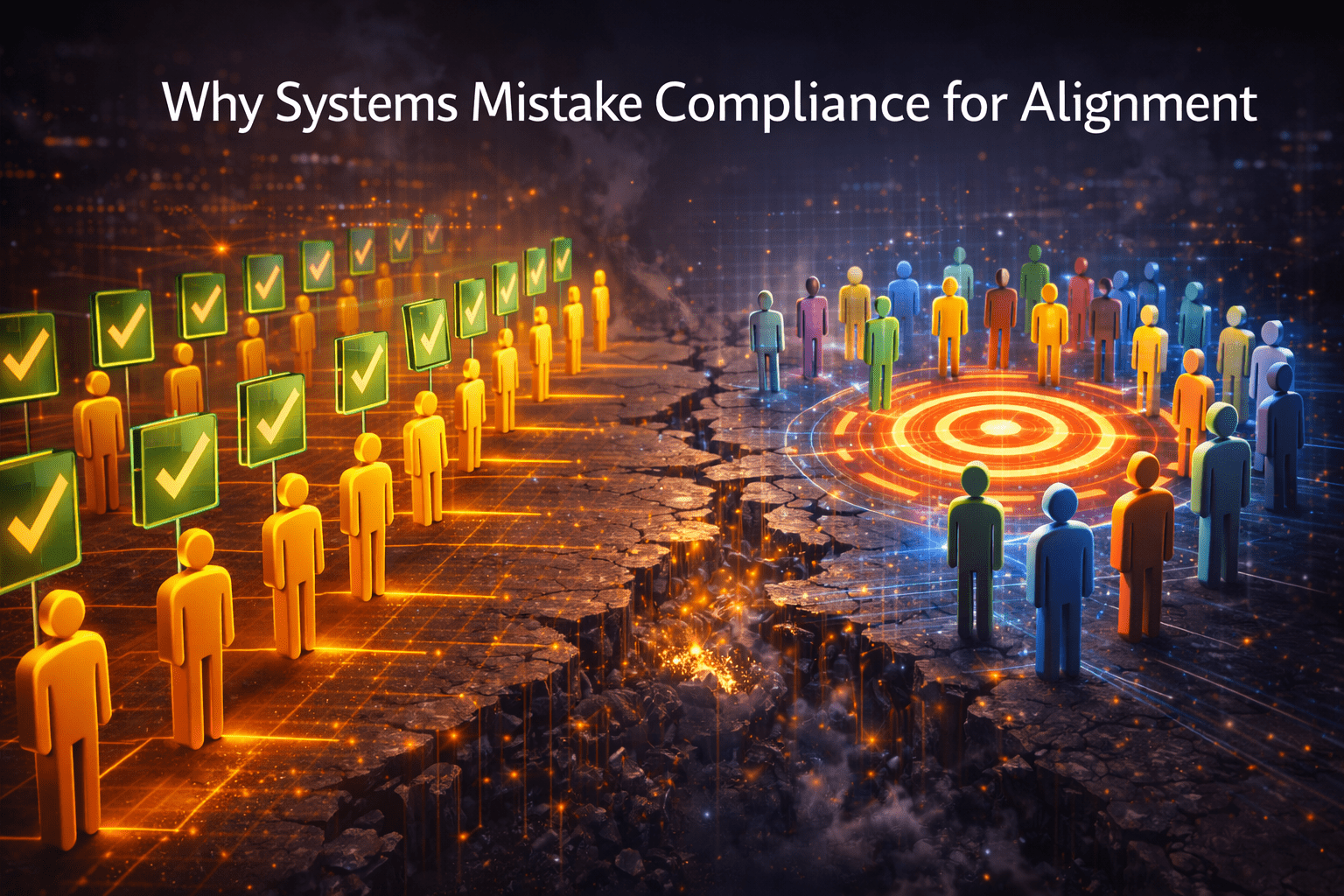
Compliance is easy to measure. Rules are followed. Procedures are executed. Outputs meet specification. From a system’s perspective, compliance looks like success. It produces order. It reduces friction. It creates predictability. Alignment is harder to see.
Alignment exists when people understand not only what is required, but why it matters. It reflects shared purpose, not enforced behavior. Aligned systems do not rely on constant monitoring or correction. They hold together because participants recognize themselves in the system’s intent.
As systems grow more complex, the distinction between compliance and alignment becomes increasingly important. Many systems optimize for compliance because it is visible and enforceable. Alignment, by contrast, operates quietly. It reveals itself through judgment, discretion, and initiative rather than adherence alone.
Early in a system’s life, alignment often emerges naturally. The problem being solved is clear. The stakes are understood. Participants share context. Rules are few because intent is widely held. People adjust their behavior not because they are required to, but because they see the point.
Over time, this shared understanding becomes harder to maintain. Systems scale. Distance increases between decision-makers and participants. Context fragments. To compensate, rules multiply. Policies formalize what was once implicit. Compliance becomes the primary signal of order. This shift is subtle. It rarely feels like a loss at first. In fact, it often feels like progress.
Consider an organization that introduces detailed procedures to ensure consistency. Roles are clarified. Expectations are documented. Performance becomes easier to track. From a management perspective, the system improves. Yet employees begin to focus on satisfying requirements rather than exercising judgment. Questions narrow. Initiative declines. The organization becomes orderly, but less responsive. Compliance has replaced alignment.
The same pattern appears in digital systems. Platforms enforce standardized workflows to ensure reliability. Deviations are restricted. Automation handles edge cases by redirecting them into predefined channels. Users learn how to succeed by conforming to the system’s logic rather than engaging with its purpose. The system functions smoothly, but meaning thins.
Compliance creates a specific kind of quiet. People stop challenging assumptions. They stop offering context. They adapt behavior to avoid friction rather than improve outcomes. The system appears stable, yet it is no longer learning.
This is especially visible to those with experience. They recognize when systems reward surface correctness over deeper understanding. They notice when doing the right thing becomes secondary to doing the acceptable thing. Their discomfort is often misread as resistance, when it is actually a signal of misalignment.
Alignment requires continuity of intent. It depends on systems carrying forward their original purpose as they evolve. When intent is preserved, rules serve understanding. When intent fades, rules become substitutes for meaning.
Systems that mistake compliance for alignment often struggle during change. When conditions shift, compliant behavior offers little guidance. People wait for instructions rather than responding intelligently. Adaptation slows because judgment has been sidelined. The system becomes brittle, even though it appears well-controlled.
Consider a regulatory framework designed to ensure fairness. Requirements are explicit. Enforcement is consistent. Yet participants begin to optimize behavior to satisfy the letter of the rule rather than its spirit. Outcomes technically comply, while underlying goals are undermined. The system enforces correctness without achieving alignment.
Alignment cannot be mandated. It must be cultivated. It emerges when systems explain themselves, preserve context, and invite understanding. It requires trust that participants can act wisely when given clarity rather than constraint.
This does not mean abandoning structure. It means recognizing what structure is for. Rules should reinforce shared intent, not replace it. Procedures should support judgment, not suppress it. Enforcement should protect purpose, not obscure it.
As systems become more automated, the temptation to equate compliance with success grows stronger. Automated systems excel at enforcement. They can detect deviation instantly. What they cannot do on their own is ensure alignment. Without deliberate design, automation amplifies compliance while eroding shared understanding.
People sense this erosion even when they cannot name it. They feel constrained rather than supported. They comply without committing. Over time, engagement becomes transactional. The system functions, but loyalty dissolves.
Systems that remain aligned behave differently. They tolerate variation when it reflects intent. They invite explanation rather than punishment. They treat questions as signals rather than disruptions. They remain coherent because participants understand not just what to do, but why it matters.
Mistaking compliance for alignment is a common failure mode of mature systems. It produces order without meaning and stability without resilience. Correcting it requires more than better rules. It requires restoring continuity between purpose and practice.
Alignment is not visible in reports. It shows up in how systems respond when rules are insufficient. When that response is thoughtful rather than rigid, alignment is present. When it is silent or defensive, compliance has taken its place.
Understanding this distinction is essential for building systems that endure. Compliance keeps systems running. Alignment keeps them alive.
© 2026 Truth Seekers Journal. Published with permission from the author. All rights reserved.
Truth Seekers Journal thrives because of readers like you. Join us in sustaining independent voices.

