
 Florita Bell Griffin, Ph.D.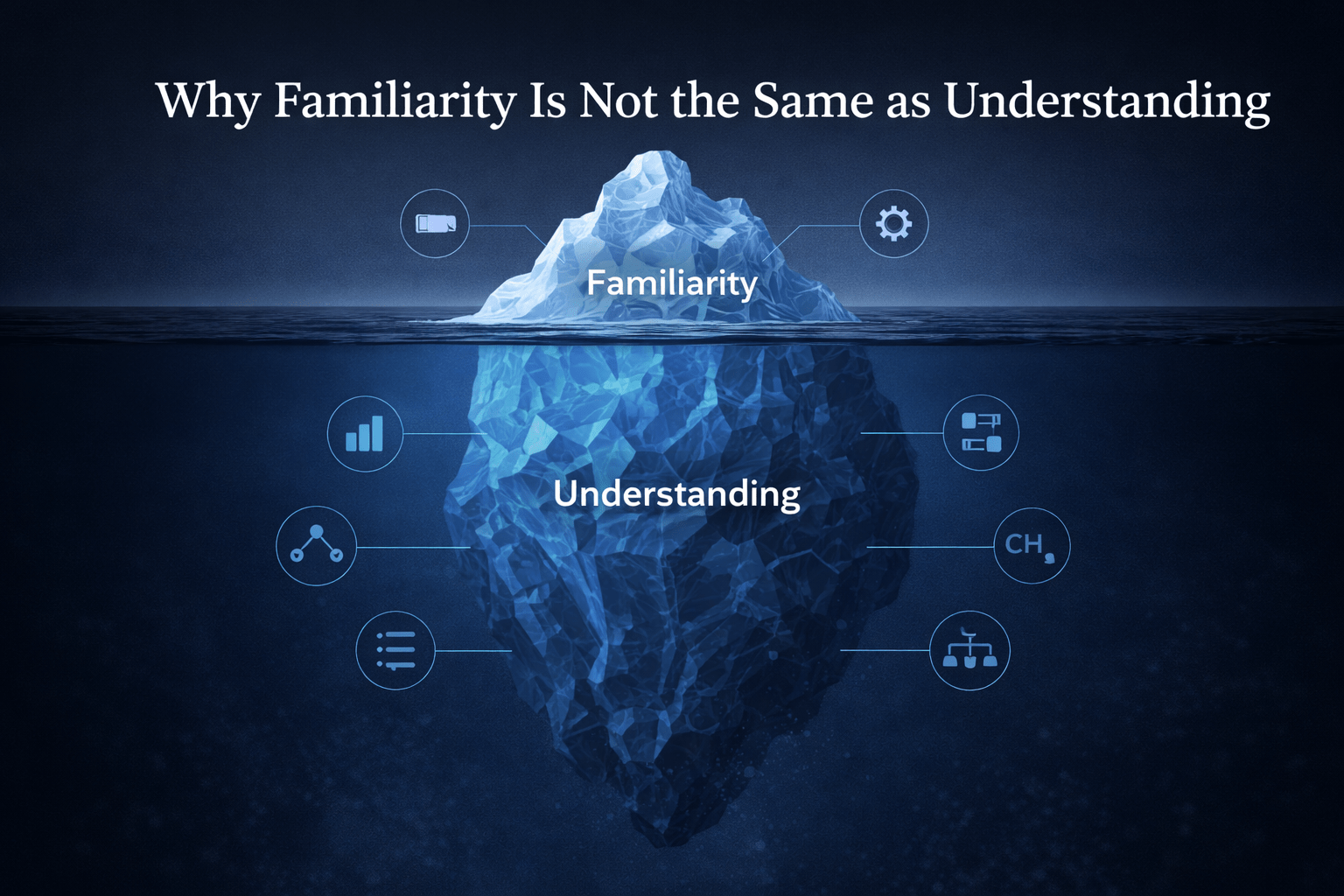
By Florita Bell Griffin, Ph.D. | Houston, TX | March 31, 2026
Familiarity is often mistaken for mastery. When people encounter a system repeatedly, learn its surface behaviors, and navigate it without friction, it can appear that understanding has been achieved. Buttons are known. Sequences are memorized. Outcomes are predictable. The system feels usable.
Understanding is something else entirely. Understanding involves knowing why a system behaves the way it does, how its parts relate, and what changes will produce which consequences. It includes awareness of limits, tradeoffs, and failure modes. Familiarity allows a person to operate within a system. Understanding allows a person to reason about it.
Modern systems encourage familiarity while quietly discouraging understanding. Interfaces are designed to be intuitive. Complexity is hidden. Automation absorbs decision-making. Users are guided toward correct outcomes without being exposed to the logic beneath them. The experience feels smooth, but the structure remains opaque.
This approach is not accidental. It reduces friction. It lowers barriers to entry. It enables scale. Yet over time, it creates a specific imbalance. People become proficient at using systems they do not truly understand. They know how to get results without knowing how those results are produced.
Consider a workplace tool that automates reporting and analysis. Users learn which inputs generate the desired outputs. Dashboards provide clarity at a glance. Decisions are made quickly. Yet few users can explain how metrics are calculated, which assumptions are embedded, or how changes upstream affect conclusions downstream. Familiarity enables action. Lack of understanding limits judgment.
The same pattern appears in consumer technology. Navigation systems provide turn-by-turn guidance. Users arrive efficiently. Over time, people lose their sense of spatial orientation. They know how to follow directions, but not how places relate. Familiarity with the tool replaces understanding of the environment. When the system fails, users feel lost in ways they did not before.
Understanding requires exposure to structure. It involves seeing connections, dependencies, and constraints. It grows through explanation, not repetition. Systems optimized for ease often remove these opportunities. They function as black boxes, delivering results while withholding rationale. This matters because familiarity breaks down under change.
When systems evolve, familiar patterns shift. Buttons move. Defaults change. Automation behaves differently. Users who rely on familiarity feel disoriented. They struggle not because they are incapable, but because they lack a mental model that explains what has changed. Understanding provides resilience. Familiarity does not.
People with long experience recognize this distinction intuitively. They have watched systems change around them. They know that knowing where to click is less important than knowing what a system is trying to do. They ask questions that go beyond usage: What does this replace? What assumptions does it carry? What happens when conditions change?
Systems that equate usability with understanding miss this signal. They interpret requests for explanation as unnecessary friction. Over time, they design away transparency in favor of smoothness. The result is a population of competent users who are increasingly dependent on stability.
This dependency becomes visible during disruption. When a system produces unexpected outcomes, users struggle to intervene meaningfully. They lack the context needed to diagnose issues or propose alternatives. Responsibility concentrates with system designers, while users are left to accept or exit.
Understanding distributes agency. It allows people to participate in shaping outcomes rather than merely consuming them. It supports informed disagreement. It enables adaptation when conditions shift. Familiarity, by contrast, encourages compliance. It works well until it doesn’t.
Consider an automated decision system used in public services. Applicants learn which inputs lead to approval. Over time, they adapt behavior to fit the system’s expectations. Yet few understand how decisions are weighted or why certain cases fail. When outcomes appear unfair, explanations are difficult to obtain. Familiarity with the process does not equate to understanding of the criteria.
The gap between familiarity and understanding widens as systems become more complex. Machine learning models, layered architectures, and interconnected platforms produce outcomes that are difficult to explain even to their creators. When systems prioritize ease of use over interpretability, this gap becomes structural.
Continuity offers a way to address this imbalance. Systems designed with continuity preserve explanatory pathways as they evolve. They expose lineage. They document rationale. They allow users to see how present behavior emerged from past decisions. Understanding becomes cumulative rather than episodic.
This does not require burdening users with unnecessary detail. It requires designing for intelligibility rather than mere convenience. It means recognizing that some users want to understand, not just operate. It means valuing explanation as a feature rather than a cost.
Familiarity creates comfort. Understanding creates confidence. Comfort allows systems to be used. Confidence allows systems to be trusted. The two are often conflated, but they serve different purposes.
As technology continues to shape decision-making across domains, this distinction becomes increasingly important. Systems that optimize solely for familiarity will continue to function smoothly while leaving users unprepared for change. Systems that support understanding build capacity over time.
Understanding does not slow progress. It stabilizes it. It allows people to move with systems rather than being carried by them. It transforms users into participants.
The future of intelligent systems will depend less on how easy they are to use and more on how well they can be understood. Familiarity may get people through the interface. Understanding is what keeps them oriented when the system inevitably changes.
© 2026 Truth Seekers Journal. Published with permission from the author. All rights reserved.
Truth Seekers Journal thrives because of readers like you. Join us in sustaining independent voices.








Believing that knowledge is what we know, but wisdom is how we use it makes this wonderfully explained article such a worthy read. Your insight is uncanny. Thank you for the work that you do.