Milton Kirby
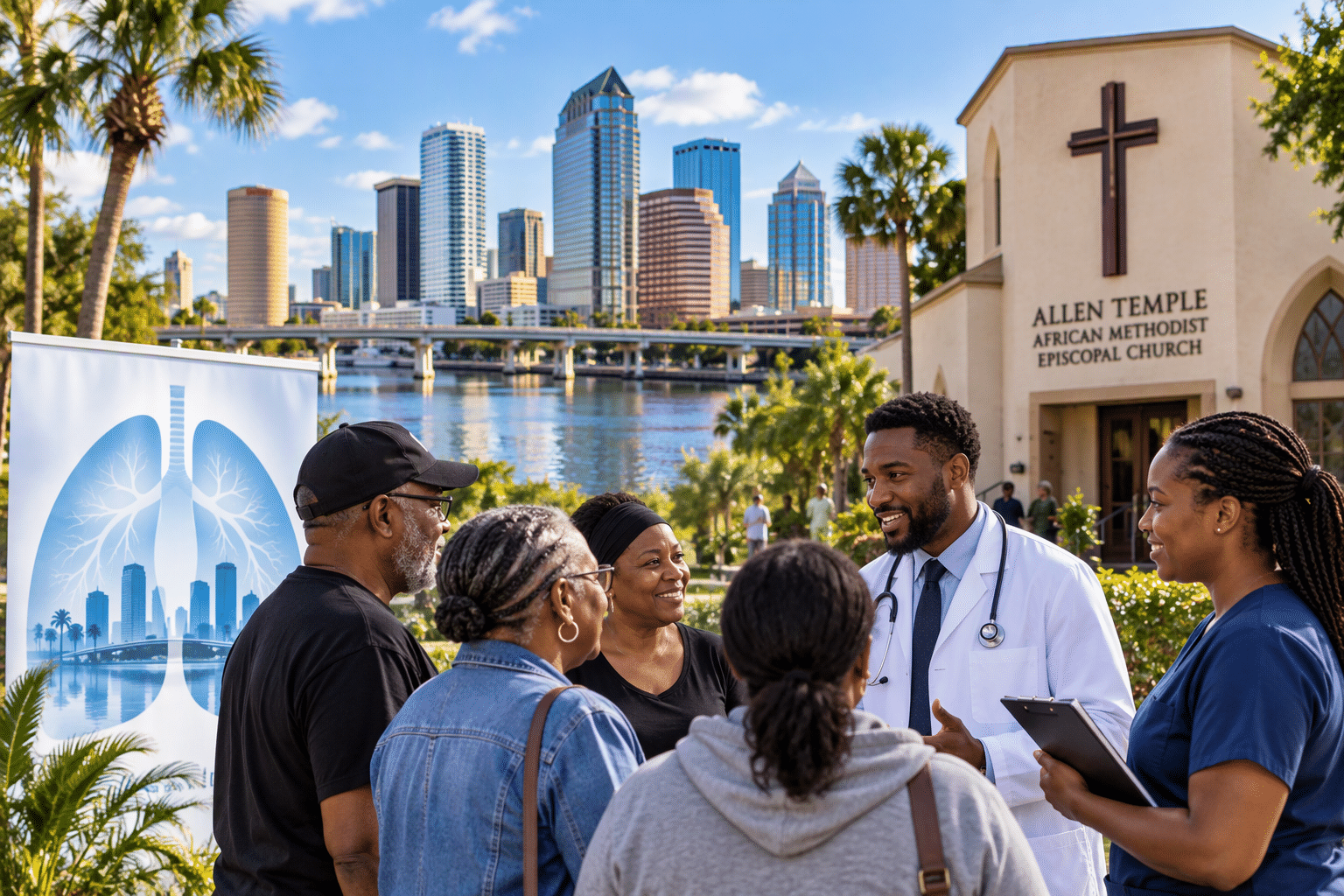
HEAL Collaborative brings doctors, community leaders, and patient advocates together in East Tampa to talk about early testing, treatment access, insurance coverage, and health gaps.
By Milton Kirby | Tampa, FL | November 27, 2026
Breathing is something most people rarely think about until it gets hard.
A cough that will not go away. Shortness of breath. Wheezing. Chest tightness. Feeling so tired that everyday tasks are harder than they used to be.
Many people brush off these signs as allergies, aging, asthma, smoking, or simply being out of shape. Waiting too long to check them out can delay finding serious illnesses like chronic obstructive pulmonary disease (COPD) and lung cancer.
On Saturday, December 12th, the Atlanta-based group HEAL Collaborative will host its “Lung Health Unified” Community Health & Advocacy Event. Doctors, patient advocates, faith leaders, and local groups will gather at Allen Temple African Methodist Episcopal Church in East Tampa.
The event will cover how COPD and lung cancer affect Tampa neighborhoods. Speakers will focus on finding these diseases early, reaching specialists, navigating care, and getting help with insurance and medical costs.
HEAL Collaborative works to close health gaps in Black and Brown communities. They do this by bringing trusted medical experts, education, and health resources straight into local gathering spaces.
With support from AstraZeneca, Allen Temple AME Church, and Caregiver’s Helping Hand, Inc., the program blends medical facts with talks about health policy and the roadblocks that keep patients from getting care.
For Tampa residents, this conversation is urgent.
Two Diseases, Shared Challenges
According to the Centers for Disease Control and Prevention (CDC), nearly 16 million U.S. adults have COPD. Millions more may have it and not even know it.
COPD is a long-term lung disease that blocks airflow and makes breathing harder over time. Its two most common forms are emphysema and chronic bronchitis.
Because symptoms often build up slowly, people tend to adjust to breathing limits without realizing how much lung power they have lost. There is no cure for COPD right now. However, the right medicines, lung rehab programs, and daily habit changes can help patients manage symptoms and live well.
Lung cancer is different—it happens when abnormal cells grow out of control in the lungs. When caught early, some lung cancers can be treated before they spread to other parts of the body.
Even though they are different diseases, they share key links. Smoking is a top risk factor for both, and breathing in harmful fumes or dust at home or work can also play a role. Studies also show that having
COPD raises a person’s risk for lung cancer, even among people with the same smoking history.
Still, neither illness affects only people who smoke. A lingering cough, wheezing, trouble breathing, or repeat lung infections should always be checked by a doctor—not written off as just getting older.
Learning how these two diseases compare will be a main focus on December 12th. Dr. Rachel Mooney, a lung specialist with Tampa Lung Specialists, will explain how doctors test for and treat COPD. Dr. Lary Robinson, who leads lung cancer screening at Moffitt Cancer Center, will share why early lung cancer checks save lives.
Early Detection: What Tampa’s Numbers Reveal
State health data shows how heavily lung cancer affects the Tampa area. According to the Florida Department of Health, Hillsborough County had 1,013 new lung cancer cases in 2023. That equals a rate of 55.1 cases per 100,000 residents, which is higher than Florida’s statewide rate of 51.1. In 2024, 460 county residents died from the disease.
Data from the National Cancer Institute (2018–2022) shows that 61.3% of lung cancers in Hillsborough County were found after the cancer had already spread beyond the lungs.
Those numbers matter because survival rates drop sharply when cancer is found late. Nationwide, about 65.5% of patients live at least five years when lung cancer is caught early, before it spreads. That number falls to 10.5% once the cancer spreads to distant organs. (These figures show broad averages, not what will happen to any single patient.)
Even though early screening saves lives, many people who qualify never get tested. Today, the U.S. Preventive Services Task Force advises a yearly low-dose CT scan for adults ages 50 to 80 who have a heavy smoking history (at least a pack a day for 20 years, or the equivalent) and who either still smoke or quit within the past 15 years.
Some people do not know this scan exists. Others run into roadblocks like lack of rides, insurance worries, hard-to-book appointments, or doctors who never bring up screening.
Finding COPD early brings a different challenge. Doctors confirm COPD using a simple breathing test called spirometry, which measures how much air you can blow out and how fast. Routine testing is not advised for adults who feel fine. However, anyone with a lasting cough, wheezing, or trouble breathing should ask their doctor about getting tested.
For both COPD and lung cancer, knowing the warning signs, understanding your risks, and seeing a doctor early are vital first steps. Still, awareness alone is not enough—patients also need a clear path to care.
A Diagnosis Does Not Guarantee Access to Treatment
Finding a lung disease is only the start of a patient’s journey.
Data from the American Lung Association highlights clear gaps in care across Florida. About 22.2% of Black lung cancer patients in the state were diagnosed at an early stage, compared with 26.6% of White patients. In addition, about 32.6% of Black patients received no treatment after their diagnosis, compared with 26.3% of White patients.
While these numbers do not explain why each person went untreated, they point to serious barriers—such as trouble reaching specialists, insurance gaps, and lack of transportation.
People with COPD face similar hurdles. High costs for daily inhalers, few nearby lung specialists, and limited access to lung rehab programs can all stand in the way of steady care.
Some lung cancer patients can also benefit from biomarker testing. This lab test checks a tumor’s specific traits to help doctors match patients with targeted cancer drugs. Because test results can shape a patient’s entire treatment plan, making sure insurance covers these tests is a key part of the discussion.
When Healthcare Meets Advocacy
Medical facts alone cannot fix every problem in the healthcare system. That is why HEAL Collaborative’s Tampa event will also tackle health policy and insurance coverage.
Sarah Hoffman, director of the COPD Action Alliance, will lead a session called “COPD Advocacy in Action.” Panelists will also discuss why insurance plans need to cover lung cancer scans, COPD breathing tests, and biomarker testing without heavy out-of-pocket costs.
Two leaders from AstraZeneca—Brooke Bernal, who leads U.S. oncology health equity and inclusion, and Josh Spagnola, director of regulatory and government affairs—are also slated to speak.
For patients and families, knowing what insurance covers, how to appeal a denied claim, and where to find financial aid can be just as vital as understanding a diagnosis. Better health outcomes require fixing the systems that decide whether care is affordable and within reach.
Care Navigation and Community Support
Richedean Yvette Hills-Ackbar, founder and executive director of Tampa-based Caregiver’s Helping Hand, Inc., knows firsthand how easy it is to overlook breathing changes.
Having lived with asthma and allergies her whole life, Hills-Ackbar recalled feeling sudden chest tightness and shortness of breath while walking to get ready for an overseas trip. While asthma, COPD, and lung cancer are separate conditions, her story shows why paying attention to new breathing symptoms matters.
“I’m hoping that they learn a better way of coping and dealing with their symptoms,” Hills-Ackbar told The Truth Seekers Journal about the upcoming event.
She also stressed that a serious illness affects the whole family—especially loved ones who step in as caregivers. Family caregivers often juggle doctor visits, medicines, rides, meals, and emotional support on top of their own daily lives.
“Caregivers have to make sure they take care of themselves,” she said.
Earlier this year, Hills-Ackbar attended a HEAL Collaborative lung health event in New Orleans. There, she met lung cancer survivors, learned from doctors, and noticed something special: the event offered real support for caregivers, too.
“They took care of the caregivers,” she recalled.
Helping patients and families find local resources, understand care plans, and navigate a confusing medical system is essential to saving lives.
Bringing Healthcare Into Trusted Community Spaces
For Tampa City Councilwoman Naya Young, who represents District 5, closing health gaps means looking beyond the clinic walls. She pointed out that affordable care, reliable transit, safe housing, healthy food, and strong neighborhoods all shape a person’s health.
“These issues are all connected and we have to look at the whole picture,” Young said in written responses to The Truth Seekers Journal.
She also stressed that leaders must listen first.
“We can’t address challenges in our community without first listening to the people who are experiencing them,” she said.
Young believes health education works best when it meets people where they already gather—in churches, schools, neighborhood centers, and local events.
“Our faith-based organizations have trust and relationships within the neighborhoods while our healthcare professionals bring the expertise and knowledge to the community,” she said. “Simply put, we all need each other if we are going to create solutions that will have a lasting impact.”
That teamwork sits at the heart of HEAL Collaborative’s mission. By uniting doctors, advocates, faith leaders, and neighbors, the event aims to close the gap between medical care and the people who need it most.
Sometimes, better health begins simply by gathering, breathing, and connecting.
Community Event Information
“Lung Health Unified” Community Health & Advocacy Event
Gather, Breath & Connect: A Community Conversation on Lung Health
Let’s Talk About COPD, Lung Cancer and How They Connect

Date: Saturday, December 12, 2026
Check-in and Registration: 9:00 a.m.
Program: 10:00 a.m.–12:00 p.m.
Location: Allen Temple AME Church
2101 Lowe Street
Tampa, FL 33605
Discussion Topics:
- The impact of COPD and lung cancer on Tampa communities.
- Early detection, screening and diagnostic testing.
- Access to specialists and treatments.
- Care navigation and support.
- Insurance coverage and financial assistance.
A holiday brunch will be served at the conclusion of the program.
The first 100 people to register will receive a $20 Visa gift card, according to the event flyer.
Registration: Contact Gabrielle at 404-803-9580 or scan the QR code on the event flyer.
Event Host: HEAL Collaborative
Proud Supporters: AstraZeneca, Allen Temple AME Church and Caregiver’s Helping Hand, Inc.
Editor’s Note: The Truth Seekers Journal works with HEAL Collaborative to support community health education and outreach initiatives.
Support open, independent journalism—your contribution helps us tell the stories that matter most.