Milton Kirby
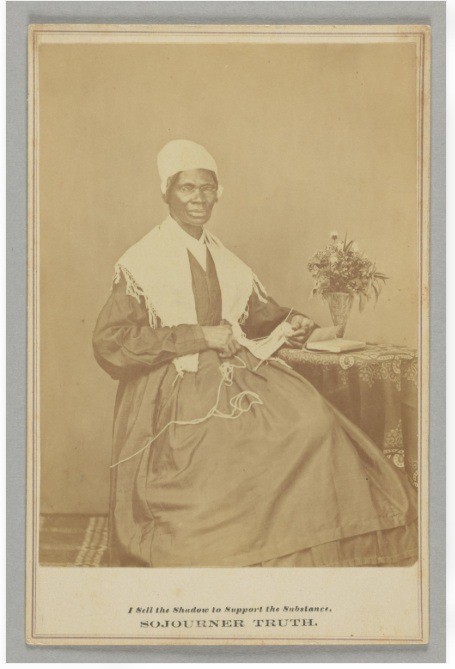
143 years after her passing, the pioneering abolitionist and women’s rights advocate remains an enduring symbol of courage, faith, justice and equality.
By Milton Kirby | Atlanta, GA November 24, 2026
On November 26, 1883, Sojourner Truth died at her home in Battle Creek, Michigan, bringing to a close an extraordinary life that helped reshape America’s conversation about freedom, human dignity and equality.
Her contributions were so significant that in 2005, the Michigan Legislature officially designated November 26 of each year as Sojourner Truth Day, recognizing her role in the abolition of slavery, the advancement of women’s rights and the pursuit of social justice.
Born into slavery as Isabella Baumfree, she entered a world that denied her the most fundamental human rights. She never received a formal education, never learned to read or write, and endured the brutality of slavery. Yet she emerged as one of the nineteenth century’s most influential advocates for human rights.
Her journey took her from the farms of New York to courtrooms, national speaking platforms and eventually the White House.
Today, 143 years after her passing, The Truth Seekers Journal honors the life and legacy of a woman who refused to accept the limitations society placed upon her and challenged America to live up to its founding ideals.
From Enslavement to Freedom
Sojourner Truth was born around 1797 in Dutch-speaking Ulster County, New York, to enslaved parents, James and Elizabeth Baumfree. Her exact date of birth remains unknown.
Dutch was her first language. Although denied a formal education, she developed a deep knowledge of Scripture through oral instruction, laying the foundation for the spiritual convictions that would guide her throughout her life.
At approximately nine years old, Isabella was separated from her parents and sold along with a flock of sheep for $100. She was subsequently sold to other enslavers, enduring physical abuse, exhausting labor and the anguish of family separation.
The trauma continued into adulthood. Around 1815, she fell in love with Robert, an enslaved man from a neighboring farm, but their relationship was violently ended by his enslaver.
Isabella was later forced into a union with an enslaved man named Thomas. Motherhood brought additional hardships as slavery deprived her of the ability to determine the futures of her children.
Her experiences serve as a reminder that slavery was not exclusively a Southern institution.
In 1799, New York passed its Gradual Emancipation Act. Rather than immediately abolishing slavery, the legislation required children born to enslaved mothers after July 4, 1799, to remain in compulsory service until age 25 for females and 28 for males.
Subsequent legislation established July 4, 1827, as the date for the emancipation of those still enslaved under the old system.
John Dumont, Isabella’s enslaver, promised her early freedom but later reneged.
Unwilling to wait any longer, Isabella left in 1826 with her infant daughter, Sophia, leaving behind children whose freedom she could not yet secure.
She found refuge with Isaac and Maria Van Wagenen, who helped secure her freedom.
For Isabella, however, personal freedom was only the beginning.
A Mother’s Fight for Justice
Shortly after gaining her freedom, Isabella discovered that her young son, Peter, had been illegally sold and taken to Alabama.
Having experienced the pain of being separated from her own parents, she was determined that her son would not disappear into the institution of slavery.
With assistance from the Van Wagenens, Isabella pursued legal action to secure his return.
Consider the magnitude of that undertaking. A formerly enslaved Black woman, unable to read or write, challenged White men through a legal system operating within a nation where slavery remained widespread.
In 1828, she prevailed and regained custody of her son.
It was a remarkable legal victory and an early demonstration of a characteristic that would define the remainder of her life: an unwillingness to remain silent when confronted with injustice.
Sadly, her reunion with Peter would not last forever.
In 1839, Peter joined the crew of a whaling ship. Although his mother received correspondence during his travels, he did not return with the ship in 1842. She never heard from him again.
A Spiritual Awakening and a New Identity
In 1829, Isabella moved to New York City, where she worked as a domestic employee and became increasingly involved in religious communities.
During this period, she faced another significant personal challenge. Following a scandal involving a religious community with which she had been associated, Isabella was falsely accused of wrongdoing.
Once again, she turned to the courts, successfully defending her reputation through a libel lawsuit.
Her spiritual journey eventually led to a profound transformation.
In 1843, believing that God had called her to travel and preach, Isabella adopted the name Sojourner Truth.
Her new name reflected her mission. She would journey across the country, proclaiming truth, challenging injustice and advocating for freedom and equality.
She eventually joined the Northampton Association of Education and Industry in Massachusetts, a progressive community committed to abolition, racial equality, women’s rights and religious tolerance.
There, she developed relationships with prominent abolitionists, including Frederick Douglass, William Lloyd Garrison and David Ruggles.
Encouraged by fellow reformers, Truth developed into a nationally recognized public speaker whose personal experiences gave extraordinary moral authority to her message.
An Author, Homeowner and Independent Woman
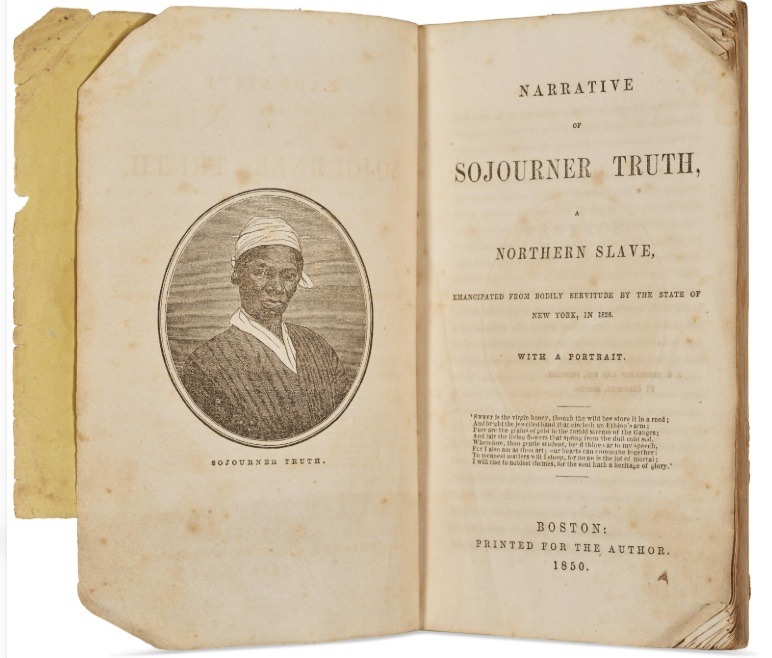
In 1850, with assistance from Olive Gilbert, Truth published her autobiography, The Narrative of Sojourner Truth.
For a formerly enslaved woman who could neither read nor write, the publication of her life story was an extraordinary achievement.
Her autobiography provided readers with a firsthand account of slavery while helping finance her public speaking and advocacy.
That same year, Truth purchased property on Park Street in Florence, Massachusetts, for $300.
The significance of homeownership for a woman who had once been legally considered someone else’s property cannot be overstated.
She also marketed photographic portraits of herself to support her work, using the memorable caption:
“I sell the shadow to support the substance.”
Through her autobiography, speaking engagements and photographic portraits, Truth demonstrated a remarkable degree of resourcefulness and economic independence.
She had transformed experiences intended to silence and diminish her into powerful instruments for social change.
“Ain’t I a Woman?”
On May 29, 1851, Truth addressed the Ohio Women’s Rights Convention in Akron, delivering what would become one of the most celebrated speeches in American history.
At a time when the women’s rights movement was gaining momentum, Black women often found themselves excluded from prevailing conversations about equality.
Truth challenged that exclusion.
Drawing upon her experiences performing demanding physical labor and enduring the hardships of slavery, she confronted prevailing assumptions about women’s capabilities and their place in society.
Her message was both simple and revolutionary: freedom and equality could not be reserved for some women while being denied to others.
The address became widely known as “Ain’t I a Woman?”
There is, however, an important historical distinction concerning the speech.
The version most Americans recognize today was published in 1863 by Frances Dana Barker Gage, nearly 12 years after Truth delivered her remarks. Gage portrayed Truth as speaking in a Southern dialect, despite her upbringing in Dutch-speaking New York.
An earlier account, published by Marius Robinson in the Anti-Slavery Bugle on June 21, 1851, does not contain the famous recurring phrase.
Although the precise wording remains a subject of historical discussion, the central message is unmistakable.
Truth challenged both racial discrimination and gender inequality, recognizing that Black women experienced forms of oppression that could not adequately be addressed by considering race or gender independently.
More than a century before the term intersectionality entered public discourse, Truth was confronting the realities that the concept would later describe.
Civil War Service and Presidential Recognition
In 1857, Truth relocated to the Harmonia community near Battle Creek, Michigan, which would become her home base for the remainder of her life.
When the Civil War began in 1861, she supported the Union cause, encouraged Black men to enlist and organized provisions for Black soldiers.
Among those who served was her grandson, James Caldwell, a member of the famed 54th Massachusetts Infantry Regiment.
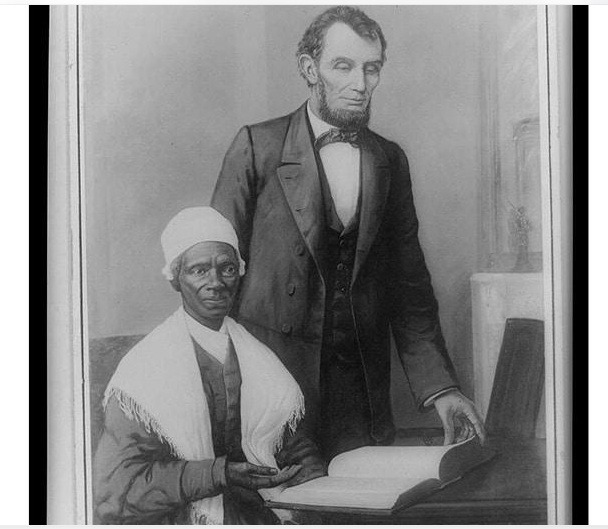
Her advocacy eventually took her to Washington, D.C., where, in October 1864, she met President Abraham Lincoln at the White House.
During their meeting, Lincoln showed her a Bible presented to him by Black residents of Baltimore.
For a woman born into slavery, separated from her family and denied access to education, meeting the president of the United States represented a remarkable chapter in an already extraordinary life.
Truth also assisted formerly enslaved people as they struggled to establish independent lives.
When confronted with discriminatory treatment on Washington’s streetcars, she successfully pursued legal action against a conductor who had attempted to prevent her from riding.
Her resistance to segregated public transportation occurred decades before similar acts of courage became defining moments of the modern civil rights movement.
Freedom Beyond Emancipation
Truth understood that the abolition of slavery alone would not guarantee meaningful freedom.
Formerly enslaved Americans faced enormous obstacles, including poverty, limited access to education, racial violence and exclusion from economic opportunities.
She became a vocal advocate for providing formerly enslaved families with land, recognizing that property ownership could offer a foundation for economic independence.
Although Congress never granted the land she sought through her petition campaign, her advocacy raised questions about economic justice that would continue to resonate throughout American history.
Truth also remained committed to women’s suffrage, insisting that Black women should not be excluded from the expansion of voting rights.
In 1872, nearly seven years after the ratification of the Thirteenth Amendment, she attempted to vote in the presidential election but was turned away.
Despite advancing age and declining health, she continued advocating for racial equality, women’s rights and other social reforms, including prison reform and opposition to capital punishment.
Her commitment to justice remained unwavering.
An Enduring National Legacy
Sojourner Truth died on November 26, 1883, at approximately 86 years of age. She was laid to rest in Oak Hill Cemetery in Battle Creek, Michigan.
Her death marked the end of a remarkable life, but not the end of her influence.
Educational institutions, community organizations, monuments and public spaces across the United States now bear her name.
In 1970, the State University of New York at New Paltz named its campus library in her honor.
In 1997, NASA’s Mars Pathfinder mission featured a robotic rover named Sojourner, extending recognition of her name beyond Earth.
In 2005, Michigan established Sojourner Truth Day.
In 2009, a bronze bust of Truth, created by sculptor Artis Lane, was unveiled in Emancipation Hall at the U.S. Capitol Visitor Center, making her the first Black woman honored with a bust in the United States Capitol.
On May 29, 2024, exactly 173 years after her historic address, Akron, Ohio, officially opened the Sojourner Truth Legacy Plaza. The plaza features a life-size bronze sculpture created by Akron artist Woodrow Nash.
These honors recognize a woman whose influence extended far beyond her lifetime.
A Legacy Worth Remembering
As we commemorate the anniversary of Sojourner Truth’s passing, we remember far more than the date of her death.
We remember a woman who transformed personal suffering into public purpose and who devoted her life to expanding freedom for others.
Perhaps the most meaningful tribute to Sojourner Truth is not found in bronze sculptures, memorials or buildings bearing her name, but in the continued pursuit of the principles for which she stood.
She understood that freedom must extend beyond the removal of physical restraints, that equality must include those whose voices are often overlooked, and that justice requires the courage to challenge wrongdoing.
She possessed no elected office, academic degree or inherited wealth. What she possessed was conviction, determination, faith and an extraordinary willingness to speak truth to power.
One hundred forty-three years after her passing, her life remains a testament to the power of an individual to challenge injustice and influence the course of history.
Sojourner Truth’s legacy belongs not only to Black Americans or to women. It belongs to America.
And it deserves to be remembered.
This article is the inaugural installment of The Truth Seekers Journal’s “Honoring the Life and Legacy of” series, dedicated to recognizing individuals whose courage, achievements and contributions helped shape our history. Through this recurring feature, TSJ seeks to celebrate Black history throughout the year, recognizing that Black history is American history.
| Source | Historical relevance |
| National Park Service | Biography, family history and advocacy |
| Library of Congress | Autobiography and historical records |
| Sojourner Truth Memorial Committee | Legal victories, Florence residence and homeownership |
| Michigan Legislature | Official designation of Sojourner Truth Day |
| U.S. Capitol Visitor Center | Legal accomplishments and civil rights advocacy |
| Historic Northampton | Homeownership and economic independence |
| National Trust for Historic Preservation | Sojourner Truth Legacy Plaza |


 Ted Knorr