From Texas to DC: A 2300 Mile Barefoot Walk for Peace

Buddhist monks drew thousands in Decatur as they walked through metro Atlanta on a 2,300-mile pilgrimage promoting peace, mindfulness, compassion, and community connection.

By Milton Kirby | Decatur, GA | January 1, 2026

DeKalb County became a place of quiet reflection and shared purpose on Tuesday, Dec. 30, as a group of Buddhist monks passed through metro Atlanta during their 2,300-mile Walk for Peace from Texas to Washington, D.C.

Thousands gathered across the Decatur area to welcome the monks, who were on day 66 of a 120-day pilgrimage dedicated to promoting peace, loving kindness, and compassion. Clad in flowing saffron and ocher robes, the monks moved deliberately and barefoot through neighborhoods, city centers, and public spaces, drawing residents outdoors and turning ordinary streets into places of connection.

The journey began Oct. 26, 2025, in Fort Worth, Texas, and will conclude Feb. 13, 2026, at the U.S. Capitol. Along the way, the monks have crossed the Deep South, walking an average of 25 to 30 miles each day and sleeping outdoors in tents whenever possible.

A peaceful pause in Decatur

The monks entered DeKalb County after walking from Clayton County and made a major daytime stop at the Porter Sanford Performing Arts Center in Greater Decatur. There, they shared a simple lunch and greeted a steady stream of visitors seeking blessings, conversation, or a moment of stillness.

Leading the pilgrimage is Venerable Bhikkhu Pannakara, who invited the crowd to take part in a brief mindfulness exercise.

“After you get a piece of paper and a pen, write this down: ‘Today is going to be my peaceful day,’” Pannakara told the audience. “Read it over and over, then read it out loud. Tell the universe that today is my peaceful day. No one can mess it up.”

Following his remarks, attendees lined up to receive white blessing cords from the monks. The cords, tied gently around the wrist, serve as reminders of mindfulness, compassion, and the responsibility to carry peace into daily life.

Onlookers also lined West Trinity Place and other downtown streets, quietly waving as the monks passed. Many said the walk felt especially meaningful at a time when social media and daily news reflect widespread anxiety and division.

Local leaders welcome the pilgrims

As evening fell, a second gathering took place at the Beacon Municipal Complex in Decatur. Though blessing cords were not offered at this stop, the monks led a group blessing and were welcomed by civic and faith leaders from across Georgia.

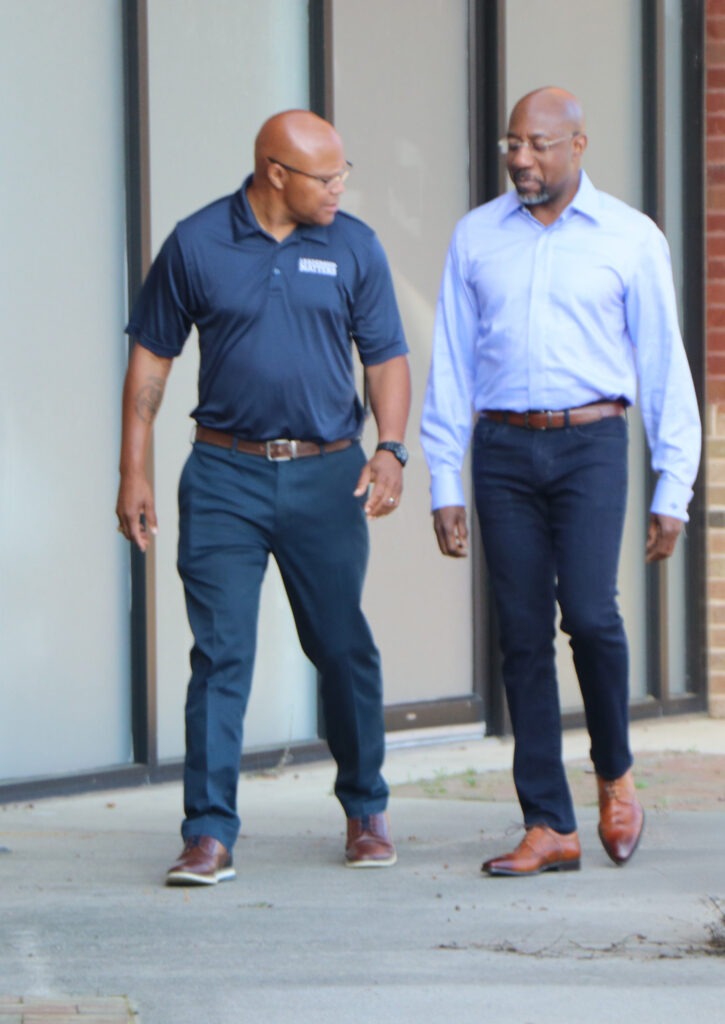
Those addressing the crowd included Senator Raphael Warnock, Congressman Hank Johnson, Georgia House Representative Ruwa Romman, DeKalb County CEO Lorraine Cochran-Johnson, and Mayor of Decatur, GA Patti Garrett.

“It truly warms my heart to see all of you here,” Garrett said. “It is an honor for Decatur to be part of this peace event.”

Warnock, who also serves as senior pastor of Ebenezer Baptist Church, reflected on scripture as it related to the monks’ journey.

“He has shown you, O mortal, what is good,” Warnock said. “And what does the Lord require of you? To do justice, to love kindness, and to walk humbly with your God.”

He added that the monks’ physical pilgrimage gave those words fresh meaning. “We could use more justice,” Warnock said. “We can certainly use more kindness. And they’ve taught us how to walk humbly — literally.”

Why they walk

Pannakara said the idea for the walk came after years of witnessing suffering while operating a global relief nonprofit and traveling across conflict-affected regions.

“I’ve seen a lot of suffering in many different ways,” he said. “That led me to think about doing something for this country and this world, hoping it will heal some people.”

He spoke candidly about the chaos he sees in modern life. “If there is no loving kindness, there is no peace. If there is no compassion, there is no peace,” he said. “If we don’t have peace within ourselves, we cannot expect anyone else to bring us peace.”

The monks come from Theravada Buddhist monasteries around the world. Many had never met before the pilgrimage began, yet their shared discipline and daily walking practice have created a bond that resonates with those they encounter.

The journey continues — with resilience

After leaving downtown Decatur, the monks walked several more miles and spent the night at Tobie Grant Recreation Center in Scottdale. Residents along McLendon Drive watched quietly as the group passed through early the next morning. On Dec. 31, day 67 of the journey, the monks continued on to Snellville.

Their walk has not been without hardship. On Nov. 19, 2025, along U.S. Highway 90 near Dayton, Texas, a distracted truck driver struck the group’s escort vehicle, which was pushed into two monks walking along the roadside. One monk, Bhante Dam Phommasan, suffered catastrophic injuries that resulted in the amputation of part of his leg. He later returned home to Snellville to recover and has remained in close contact with the group.

Despite the danger and physical toll — including bandaged feet from stepping on glass, nails, and rocks — the monks say mindfulness sustains them.

“What’s made it beautiful is how people have welcomed and hosted us despite not knowing who we are or what we believe,” Pannakara said.

Aloka, the peace dog

Often walking just ahead of the monks is Aloka, a rescue dog whose name means “divine light” in Sanskrit. Aloka first joined Pannakara during a 112-day walk across India in 2022, following the monks from Kolkata nearly to the Nepal border. Once critically ill, the dog was carried and nursed back to health by Pannakara.

Now a beloved companion on the U.S. pilgrimage, Aloka has become a symbol of perseverance and gentleness, inspiring millions of followers online.

“I named him light because I want him to find the light of wisdom,” Pannakara said.

A practice, not a destination

The monks have asked supporters not to walk alongside them for extended distances, but to visit during designated stops and reflect on the message in their own way.

In a statement, the group said they hope the pilgrimage reminds Americans that “peace is not a destination — it is a practice.”

“As the nation faces division, mental health crises, and conflict at home and abroad, this walk offers a simple truth,” the statement read. “Peace begins within the heart of each person and extends outward to families, communities, and society.”

As the monks continue north through Georgia and into the Carolinas, their quiet presence leaves behind something lasting — a reminder that even in uncertain times, peace can still be practiced, one step at a time.

Related video

The Monks Walking Through Georgia

Truth Seekers Journal thrives because of readers like you. Join us in sustaining independent voices.

DeKalb County Tax Commissioner Irvin J. Johnson to Retire After 26 Years of Public Service

DeKalb County Tax Commissioner Irvin J. Johnson will retire Dec. 31 after 26 years of service, with Chief Deputy Nicole M. Golden set to succeed him.

By Milton Kirby | Decatur, GA | December 26, 2025

After nearly 26 years of service to DeKalb County—10 of them as tax commissioner—Irvin J. Johnson will retire effective Dec. 31, 2025, closing a long chapter in county government marked by stability, modernization, and consistent revenue performance.

Johnson announced his retirement while highlighting the work of the office he led through a decade of change. He credited staff for maintaining operations during the pandemic, expanding digital services, strengthening security protocols, and increasing community outreach.

“I am grateful for the opportunity to lead one of DeKalb’s key governmental functions,” Johnson said in a statement. “We achieved the approval of 10 consecutive and timely tax digest submissions, which supported county and school operations. Those results came from a committed and excellent team.”

Leadership Transition Already in Place

Photo Courtesy Tax Commissioner Nicole Golden

Under Georgia law, the office will transition to Nicole M. Golden, the current chief deputy tax commissioner. Golden will assume leadership to ensure operational continuity. The tax commissioner is an elected position; Johnson was reelected in 2024, with a term that runs through 2029.

Golden brings more than 20 years of legal experience and nine years as chief deputy. Johnson said she is well prepared to lead the office and maintain service levels across all divisions.

A Career Built From the Inside Out

Johnson began his career in the tax commissioner’s office in July 2000 as a network coordinator. He advanced through multiple roles, including supervisor, manager, and chief deputy. In 2016, he succeeded former Tax Commissioner Claudia Lawson and was later elected.

Before joining the county, Johnson held leadership roles in the private and nonprofit sectors. His experience included quality systems management at Square D Company, training supervision at Michelin Tire Corporation, manufacturing supervision at Westinghouse Electric Corporation, and job development work with the Shenango Valley Urban League.

Community and Professional Leadership

Beyond his county role, Johnson has been active across DeKalb and the state. He is a past president of the South DeKalb Rotary Club and a former chair of the Georgia Tax Commissioners’ Technology Development Council. He has also served on the board of the DeKalb Regional Land Bank Authority and on the board of directors at Mount Moriah Baptist Church in Tucker.

In 2024, Johnson was named Tax Commissioner of the Year by the Georgia Association of Black County Officials, in recognition of his leadership and service.

An Office With Broad Responsibilities

The DeKalb County Tax Commissioner’s Office collects and disburses personal and real property taxes, administers homestead exemptions, processes vehicle registrations and renewals, and collects motor vehicle taxes. Johnson said modernizing these services was a priority throughout his tenure.

As he prepares to step away, Johnson expressed confidence in the office’s future. With Golden set to lead and an experienced team in place, county officials say residents can expect continuity in one of DeKalb’s most essential operations.

Related articles

New Challenges, New Approaches: DeKalb County Strengthens Regional Ties and Invests in Community Growth

Truth Seekers Journal thrives because of readers like you. Join us in sustaining independent voices.

Senate Democrats Push $15 Billion Plan to Reconnect Communities Divided by Highways

Senate Democrats introduce the $15B REPAIR Infrastructure Act to reconnect communities divided by highways, prevent displacement, and expand funding for equitable transportation projects nationwide.

By Milton Kirby | Washington, D.C. | December 22, 2025

A bipartisan-backed effort to repair the long-term damage caused by urban highways moved forward this week as U.S. Senate Democrats introduced legislation to reauthorize and expand the federal government’s flagship program aimed at reconnecting communities split apart by legacy infrastructure.

The Restoring Essential Public Access and Improving Resilient Infrastructure Act, known as the REPAIR Infrastructure Act, would invest $15 billion over five years to help cities and towns redesign or remove divisive roadways, restore neighborhood connections, and prevent displacement tied to major transportation projects.

The bill was introduced by Sen. Raphael Warnock, Sen. Lisa Blunt Rochester, and Sen. Jeff Merkley, building on the Reconnecting Communities Pilot Program created under the 2021 Infrastructure Investment and Jobs Act.

From Pilot Program to Permanent Policy

Since its launch, the U.S. Department of Transportation has funded 257 projects in 47 states, supporting initiatives that redesign streets, remove outdated highway structures, improve transit access, and spur local economic development. Supporters of the REPAIR Act say those early successes justify turning the pilot into a permanent, fully funded program.

Under the legislation, Congress would authorize $3 billion annually from fiscal years 2027 through 2031, funded through the Highway Trust Fund. Of that total, $750 million each year would be dedicated to planning grants, while $2.25 billion would support capital construction projects.

“These projects are about more than concrete and asphalt,” supporters argue. “They are about restoring access to jobs, schools, healthcare, and opportunity.”

Guardrails Against Displacement

A central feature of the bill is its focus on equity and community protection. The REPAIR Act would formally require projects to promote economic development while preventing displacement of existing residents, a frequent criticism of past infrastructure investments.

Projects would be evaluated on whether they include robust community participation plans, partnerships with local organizations, and strategies to preserve affordability. Eligible efforts could include renter and homeowner assistance, affordable housing preservation, mixed-income development, and protections for small businesses.

The legislation also bars grant funds from being used to increase the number of travel lanes on existing highways, signaling a shift away from highway expansion and toward neighborhood-scale reconnection.

Broader Eligibility Across Federal Programs

Beyond direct grants, the REPAIR Act expands eligibility for reconnection projects across multiple federal transportation programs, including:

  • National Highway Performance Program
  • Surface Transportation Block Grants
  • Highway Safety Improvement Program
  • Congestion Mitigation and Air Quality Program
  • National Highway Freight Program
  • Rural Surface Transportation Grants
  • Carbon Reduction Program

The bill also formally defines “divisive roadway infrastructure,” including limited-access highways and viaducts that act as barriers to mobility and economic activity.

Georgia Examples Loom Large

The legislation carries particular significance for Georgia, where highway construction in the mid-20th century reshaped cities and displaced historically Black neighborhoods. In Atlanta, the Downtown Connector severed once-thriving communities. In Savannah, the I-16 flyover cut through Black business districts near the city’s core.

Backers of the bill say REPAIR funding could help address those lingering impacts while guiding future projects toward community-led solutions.

Broad Coalition Support

The REPAIR Infrastructure Act is endorsed by a wide coalition of planning, environmental, and local government organizations, including Smart Growth America, the National League of Cities, the American Society of Landscape Architects, America Walks, the Congress for the New Urbanism, the Natural Resources Defense Council, and the Rails to Trails Conservancy, along with more than 70 additional national groups.

Supporters argue the bill reflects a growing consensus that transportation policy must balance mobility with health, climate resilience, and neighborhood stability.

What Comes Next

The bill has been referred to committee, where lawmakers will debate funding levels and implementation details. If passed, it would mark one of the most significant federal commitments to undoing the social and economic harms caused by 20th-century highway construction. For cities still living with the consequences of those decisions, proponents say the message is clear: reconnecting communities is no longer an experiment — it is national policy.

Shadow Ball: Learning More About Negro League History

December 23, 2025

Dear Shadow Ball: What pitcher holds the Negro League record for most inning pitched?

Mick Kolb, York, PA.

Dear Mick:  My go to source for such questions is Seamheads Negro League Database. The leader in innings pitched in that database is Cannonball Dick Redding (2,334 innings over 26 years). This total includes games in the Negro Leagues plus Cuba, the Florida Winter Hotel League, and games versus minor and major league teams. Limiting the view, as your question does, to Negro League games only sent me to a different source – mlb.com. Since May 2024, Negro League statistics are now included on that site. To interpret and compile innings pitched, I turned to Tom Thress, President, Retrosheet, who informed me that Willie Foster (with 1,521 innings) leads all pitchers in total innings pitched in major Negro League games.

Last week’s Shadow Ball Significa question – Who was the first African American signed to a contract by the Boston Red Sox organization? For the 2nd week in a row, Will Clark, Hackensack, NJ, smacks one of my hanging curves over the fence … dodging my reach for a Pumpsie Green – who, in 1959, was the first African-American to play for the Boston Red Sox –   answer he kept his focus on 1950 and offered Piper Davis which is correct. Unfortunately, Piper never got the call to come to Fenway.

The Shadow Ball Significa Question of the Week: Who was the last surviving Atlanta Black Crackers player? Here is a clue for you to keep from going down a rabbit hole – this player was born and died in Atlanta.

Ted Knorr

Ted Knorr is a Negro League baseball historian, longtime member of the Society for American Baseball Research’s Negro League Committee, and founder of the Jerry Malloy Negro League Conference and several local Negro League Commemorative Nights in central Pennsylvania. You can send questions for Knorr on Negro League topics as well as your answers to the week’s Significa question to  shadowball@truthseekersjournal.com or Shadowball, 3904 N Druid Hills Rd, Ste 179, Decatur, GA 30033

Support open, independent journalism—your contribution helps us tell the stories that matter most.


The Powerball Jackpot Reaches $1.660 Billion

The Powerball jackpot climbs to $1.660 billion as no winner emerges, fueling nationwide ticket sales and boosting Georgia Lottery education funding ahead of Monday’s drawing.

By Milton Kirby | Decatur, GA | December 22, 2025

The Powerball jackpot has surged to $1.660 billion, placing it among the four largest lottery prizes in U.S. history and igniting another nationwide wave of ticket buying driven by hope, habit, and long odds.

The winning numbers from Saturday, December 20, 2025, were 4, 5, 28, 52, and 69, with the Powerball 20. No ticket matched all six numbers, pushing the jackpot higher ahead of Monday night’s drawing.

As lines stretch across convenience stores and gas stations, the spectacle once again raises a quieter, persistent question: who is actually funding these billion-dollar jackpots—and who benefits most from the system behind them?


A Jackpot Built on Millions of Small Bets

When Powerball jackpots climb into the billion-dollar range, economists estimate tens of thousands of tickets are sold every minute nationwide, with sales accelerating sharply in the final hours before each drawing.

In Georgia, those sales flow through the Georgia Lottery, which operates through roughly 8,500 retail locations statewide. Proceeds support education programs such as the HOPE Scholarship, HOPE Grant, and Georgia Pre-K.

Since its creation in 1993, the Georgia Lottery has generated more than $25 billion for education, a figure frequently cited by lottery officials as evidence of public benefit. Research shows, however, that the source of those funds is far from evenly distributed.


What the Atlanta ZIP Code Maps Show

Visual mapping of Atlanta-area ZIP codes tells a consistent story seen in academic studies nationwide.

Lower-income ZIP codes in South DeKalb, Southwest Atlanta, and parts of South Fulton show higher concentrations of lottery retailers and higher per-capita ticket purchases. By contrast, wealthier areas in North Fulton, North DeKalb, and suburban communities show lower per-capita participation, even when absolute income levels are higher.

Metro Atlanta lottery retailers – per capita l participation (darker area represented higher participation)

Researchers affiliated with Georgia State University and other institutions have found that lottery spending increases as median household income declines. Retail density, advertising visibility, and consumer participation all rise in economically stressed neighborhoods.

Economists describe this pattern as a regressive funding structure, in which lower-income households spend a greater share of their income than wealthier households.


A National Pattern, Not a Georgia Exception

This dynamic extends far beyond metro Atlanta.

Studies cited by the Urban Institute and the Brookings Institution conclude that households earning under $30,000 annually spend three to ten times more of their income on lottery tickets than households earning over $75,000.

Lottery participation is highest where economic mobility is lowest, and where sudden wealth appears most transformative. As jackpots rise, those disparities become more pronounced.


Who Benefits From Lottery Funding

While lottery revenue is raised disproportionately from lower-income communities, the largest education benefits often flow elsewhere.

HOPE scholarships and grants are most frequently claimed by students who complete high school, meet GPA thresholds, and attend college. Those outcomes are more common among middle- and upper-middle-income households, which tend to have stronger academic preparation and access to resources.

The result, economists argue, is an indirect upward transfer of wealth, even when lottery funds are directed toward public education.


Billion-Dollar Winners and Long Odds

The scale of modern jackpots is a relatively recent development. Earlier versions of Powerball included jackpot caps and better odds. Structural changes extended the odds dramatically, allowing jackpots to roll over longer and grow larger.

Powerball Ticket 12-22-25

That evolution culminated in 2022, when a $2.04 billion Powerball ticket sold in California became the largest lottery prize ever claimed. The sole winner, Edwin Castro, opted for a lump-sum payout of $997.6 million, according to the California Lottery.

Those rare wins dominate headlines, while millions of losing tickets quietly sustain the system.


The Lottery’s Counterpoint

Lottery officials and defenders argue that participation is voluntary entertainment rather than taxation, that proceeds fund voter-approved education programs, and that scholarships and Pre-K deliver measurable public benefits across the state.

They also note that without lottery funding, education programs would likely require alternative taxes or face reductions. Critics respond that voluntary participation does not eliminate inequity when spending patterns align so closely with income and geography.


Hope, Math, and Public Policy

For many players, the lottery represents possibility more than probability. Behavioral economists point to optimism bias and financial stress as powerful motivators, especially during billion-dollar jackpot runs.

The math, however, remains unforgiving. The odds of winning the Powerball jackpot are roughly one in 292 million.

As Georgians line up for the next drawing, the growing jackpot reflects a national reality: billion-dollar dreams are built from millions of small wagers, many placed in communities that can least afford to lose them.

Support open, independent journalism—your contribution helps us tell the stories that matter most.

DeKalb County Launches Real Time Crime Center, Marking Major Shift Toward Technology-Driven Public Safety

DeKalb County launches a $2M Real Time Crime Center, combining drones, cameras, and analytics to improve response times, officer safety, and coordinated public safety efforts.

By Milton Kirby | Decatur, GA | December 19, 2025

DeKalb County officials on Thursday marked a major milestone in the County’s public safety strategy with the official launch of its new Real Time Crime Center (RTCC), a $2 million, high-tech operations hub designed to deliver faster response times, improved coordination, and enhanced officer safety.

The ribbon cutting and press conference were held at the DeKalb County Police Department Headquarters, located at 1960 W. Exchange Place in Tucker, where the RTCC now serves as the County’s centralized hub for live data, analytics, and coordinated response. County leaders described the center as a cornerstone of the Digital Shield Initiative, a comprehensive public safety strategy led by DeKalb County Chief Executive Officer Lorraine Cochran-Johnson.

“These investments represent a bold, forward-thinking approach to public safety,” Cochran-Johnson said. “By leveraging technology, we are strengthening officer safety, improving response times, and reimagining how we protect every DeKalb resident.”

DeKalb Real Time Crime Center Ribbon Cutting

A Central Hub for Real-Time Intelligence

Housed within police headquarters, the RTCC functions as a command center where civilian analysts and sworn officers monitor hundreds of live video feeds and data streams simultaneously. The system is designed to provide officers with real-time intelligence during active calls, giving them critical situational awareness before arriving on scene.

“This center strengthens our ability to prevent crime, support victims, and deliver the level of service that our residents expect and deserve,” said DeKalb County Police Chief Gregory Padrick, a longtime DeKalb professional recently promoted from within the department.

Following the ribbon-cutting, attendees toured the facility and observed live demonstrations of the RTCC’s capabilities, including a Drone as a First Responder deployment that showed how drones can be rapidly launched to provide aerial views during emergencies, active pursuits, or missing-person cases.

The Digital Shield Initiative: A Countywide Investment

The Real Time Crime Center is one component of the County’s broader Digital Shield Initiative, a multi-year, $18.9 million investment in public safety technology. The initiative integrates multiple tools into a single operational platform, enabling faster, more coordinated responses across agencies.

Key components include license plate recognition cameras deployed throughout the county to help track stolen vehicles and suspects in real time, an integrated data platform that connects video, alerts, and analytics into one interface, and a dedicated drone program focused on law-enforcement-specific use rather than general surveillance. The RTCC also integrates gunshot detection technology capable of pinpointing the location of gunfire, in some cases, before a 911 call is placed.

County officials emphasized that these tools are intended to support officers in the field, improve response times, and reduce risk during volatile situations.

Partnership With Flock Safety and “Safe County” Designation

A major partner in the RTCC is Flock Safety, which announced during the event that DeKalb County has been designated the first “Flock Safe County” in the nation. The designation reflects a full countywide deployment of Flock technology, connecting law enforcement, fire services, traffic, schools, businesses, and neighborhoods on a shared platform.

“This real-time crime center combines what is truly the most innovative stack of technology a county could imagine,” said Greg Langley, CEO of Flock Safety. “From license plate readers to drones, cameras, and audio detection, all of it is unified in a modern AI intelligence suite.”

As part of the designation, DeKalb County residents and businesses are eligible for discounted Flock Safety solutions and free installation, expanding participation beyond government facilities.

Privacy Protections and Voluntary Participation

County leaders stressed that participation by residents and businesses is voluntary and tiered. Through the Connect DeKalb camera registry, property owners may choose to register the location of their cameras or, for higher-traffic businesses, integrate live feeds accessible only to police during emergencies.

Officials emphasized that the RTCC does not use facial recognition technology. Instead, artificial intelligence tools are limited to identifying objects of interest, such as specific vehicle types or weapons, a safeguard designed to balance effectiveness with privacy and public trust.

DeKalb Real Time Crime Center

Regional Perspective and Proven Results

During the ceremony, Lisa Cupid, Chairwoman of the Cobb County Board of Commissioners, shared her experience with Flock Safety technology, which is already in use across Cobb County. Cupid noted that the deployment of Flock’s license plate readers and integrated analytics has contributed to public safety improvements of up to 25 percent, offering a regional example of how real-time intelligence can deliver measurable results.

Her remarks underscored the growing regional trend toward data-driven policing and inter-agency coordination.

Leadership Transitions and Unified Public Safety

The opening of the RTCC follows recent leadership appointments within DeKalb County government. In addition to Chief Padrick’s promotion, former DeKalb Fire Chief Darnell Fullum was elevated to Director of Public Safety, consolidating oversight of police, fire, and emergency services.

County officials also recognized and thanked outgoing leadership for their service during the transition period.

Technology, Youth, and Long-Term Crime Prevention

While technology took center stage, Cochran-Johnson emphasized that digital tools alone cannot address the root causes of crime.

“We understand that investing strictly in technology does not solve the problem of crime,” she said. “Crime is deeply rooted in economics.”

As part of a broader prevention strategy, the CEO outlined a coordinated effort to ensure that by 11th grade, every student in DeKalb County has a designated career pathway. Those pathways align with 18 skilled trades currently offered at no cost through programs supported by the State of Georgia, creating direct pipelines into high-demand careers and long-term economic stability.

The County also highlighted partnerships aimed at youth engagement and prevention, including a recent grant from QuikTrip to the DeKalb County Athletic League to support community-based programming. Additional partnerships with DeKalb County Schools are expected to be announced in January.

What Comes Next

Beginning in January, DeKalb County plans to host public town halls to provide residents with more information about the Real Time Crime Center, privacy safeguards, and opportunities for community participation.

As Cochran-Johnson framed it, the RTCC is more than a facility; it represents a shift in philosophy toward proactive, coordinated, and prevention-focused public safety.

The CEO further noted that the Real Time Crime Center supports the County’s broader Reimagine DeKalb vision — building safer, more connected, and more resilient communities by pairing technology with economic opportunity and community trust.

Related articles

DeKalb Reimagined: CEO Lorraine Cochran-Johnson Charts New Path Forward

Boots on the Ground: CEO Lorraine Cochran-Johnson Sets a Bold Pace in DeKalb County

DeKalb CEO  Cochran-Johnson Calls for Focus and Discipline in Reform Rollout

Truth Seekers Journal thrives because of readers like you. Join us in sustaining independent voices.

Another Ring for Michael Jordan — and a Quiet Bill NASCAR Didn’t Have to Pay

Michael Jordan’s NASCAR settlement delivered evergreen charters—but by settling, NASCAR avoided public scrutiny of how much revenue teams may still be shielded from.

Truth Seekers Journal Opinion | December 18, 2025

Michael Jordan has won championships in packed arenas, in boardrooms, and now—quietly—in a federal courthouse.

The Dec. 11 settlement between NASCAR, 23XI Racing, and Front Row Motorsports didn’t come with confetti or a trophy presentation. But make no mistake: this was another ring. And like many of Jordan’s biggest wins, it came from knowing when to press—and when to take the points and walk away.

The public story is stability. NASCAR’s joint statement leaned hard on words like “growth,” “alignment,” and “the future of the sport.” The headline change was the introduction of evergreen charters, a long-sought concession that turns teams from renters into something much closer to franchise owners.

The quieter story is what didn’t happen.

Because this case settled, NASCAR did not have to answer—under a jury verdict—for how much money it may have kept from teams over the past several years. And that may be the most expensive silence in the garage.

During the trial, sworn testimony put real numbers on what team owners have whispered for years. An economist testified that NASCAR owed the plaintiffs roughly $364.7 million in damages. More striking, he estimated that chartered teams as a whole were underpaid by more than $1 billion from 2021 to 2024 based on comparative revenue models used in other major motorsports and professional leagues.

A verdict doesn’t just award damages. It creates a public record. It creates precedent. And it invites follow-on lawsuits.

By settling, NASCAR capped its legal exposure and sealed off discovery that might have gone even deeper into revenue allocation, internal strategy, and contingency planning. The confidential settlement check—whatever the number—may end up being a bargain compared to what a full verdict could have exposed.

This is where the “Another Ring” framing really matters.

Jordan didn’t need to win by knockout. He needed to change the geometry of the court.

By forcing NASCAR to the table and extracting evergreen charters, Jordan and his partners permanently increased the value of every chartered team. That alone is a long-game victory worth far more than a one-time damages award. Team valuations rise. Financing gets easier. Sponsors gain confidence. And ownership groups now hold an asset NASCAR can’t casually claw back.

But the settlement also allowed NASCAR to keep one advantage: opacity.

No public verdict means no court-ordered accounting of exactly how much revenue teams should have received, how internal distribution decisions were justified, or how much leverage NASCAR exercised behind closed doors. The sport avoided a public spreadsheet moment—one where every team owner, sponsor, and potential investor could point to a judge’s findings and say, this is what the teams were denied.

From NASCAR’s perspective, that matters. Revenue sharing is the third rail of sports governance. Once a court defines it, control shifts fast.

From the teams’ perspective, the question now becomes strategic, not legal: how much money remains shielded by the absence of a verdict?

The new charter structure creates leverage for future negotiations, but it does not automatically rebalance every dollar flowing through the sport. International media rights. Intellectual property. Digital and data revenue. Those streams are growing, and the settlement language suggests progress—but not full transparency.

Jordan’s win, then, is both decisive and incomplete.

He secured permanence where there was uncertainty. He forced governance changes where there was unilateral control. And he reminded NASCAR that “take-it-or-leave-it” only works until someone powerful enough refuses.

But by settling, NASCAR avoided the kind of judicial reckoning that could have reset revenue sharing overnight. The sport lives to negotiate another day—and that means the real financial fight may not be over. It’s just been postponed.

That may be the final lesson of this case.

Championships aren’t always about domination. Sometimes they’re about leverage, timing, and knowing which battles to end before the clock hits zero. Jordan didn’t just win another ring. He changed the rules of the game—and left open the question of how much more value teams are still chasing.

In NASCAR, that’s a quiet kind of victory. And for now, a very expensive kind of peace.

The Billion-Dollar Settlement: How 23XI and Front Row Forced NASCAR’s Hand

NASCAR’s Dec. 11 settlement with 23XI and Front Row delivered evergreen charters, reshaped team power, and raised franchise values after a high-stakes antitrust trial.

By Milton Kirby | Charlotte, NC | December 16, 2025

On Dec. 11, 2025, NASCAR, 23XI Racing, and Front Row Motorsports announced a settlement that ended a federal antitrust trial in Charlotte and changed the sport’s business future in a way team owners have chased for years: a form of “evergreen” charter, meaning charters no longer live under the constant threat of expiration on NASCAR’s timeline.

That one phrase, tucked into the joint statement, explains why so many people in the garage called it a generational moment. For nearly a decade, NASCAR’s charter system has worked like a license: valuable, but still dependent on renewal and still shaped by a single power center. Now, the settlement commits NASCAR to issuing an amendment to existing charter holders that includes a form of evergreen charters “subject to mutual agreement,” while keeping the financial terms confidential.

The agreement closed a fight that started long before a jury ever sat down. It began with years of tense negotiations over revenue, governance, and the basic question of whether NASCAR’s top teams were true partners in the sport’s growth—or simply contractors expected to accept whatever terms came from Daytona. When 23XI and Front Row refused to sign what many described as a last-chance charter offer, the dispute moved from boardrooms to federal court. The trial then forced NASCAR to defend its business model in public, under oath, and with internal documents entering the record.

The end result was a settlement that likely moved hundreds of millions of dollars in risk off NASCAR’s balance sheet, while shifting long-term leverage toward teams that have argued for years they were carrying too much cost and too little certainty.

How much money was really at stake

Even though the settlement check is confidential, the trial record put hard numbers in the air.

In sworn testimony, economist Edward Snyder calculated damages of $364.7 million for 23XI and Front Row combined, with $215.8 million attributed to 23XI and $148.9 million to Front Row. He also testified that chartered teams were underpaid by $1.06 billion from 2021 to 2024 based on his model of what a more competitive revenue structure would have produced.

Those figures matter for two reasons.

First, they created a credible worst-case scenario for NASCAR in front of a jury: not just a one-time verdict, but a verdict that could have been trebled under antitrust law if willful conduct was found, plus legal fees, plus the reputational hit of being labeled a monopoly in a high-profile sports trial. The public reporting around the case consistently treated the potential exposure as massive, even if no one can state a precise final “billion-dollar” number without the verdict itself.

Second, they gave team owners a plain-language measure of what they have argued privately for years: the teams’ slice of the sport’s major revenue streams has not matched the costs teams shoulder to compete at the Cup level.

Snyder’s work also gave the jury a comparison point. His analysis contrasted NASCAR’s revenue share to Formula 1, which he said shares roughly 45% with teams compared to NASCAR’s 25% in his estimate, though NASCAR disputed the comparison.

The settlement did not publicly publish a new percentage split. But it did something that can be just as powerful in business: it changed the legal status of the core asset.

The “evergreen” charter as the real prize

If you strip away the headlines and focus on incentives, the evergreen charter is the settlement’s crown jewel.

Charters are the sport’s version of a franchise slot. They are tied to guaranteed entry (for the chartered field) and a share of certain revenue. Before this deal, the charter system still ran on renewal cycles and the reality that NASCAR, as the sanctioning body, held final power over the contract terms.

Under the settlement, NASCAR committed publicly to issuing an amendment that includes evergreen charters. That changes how owners, sponsors, lenders, and potential investors can value a team.

A team that “owns” a long-term, stable charter is different from a team that “rents” participation under a contract that can be rewritten. Evergreen status moves a NASCAR Cup team closer to a modern franchise model, where the slot itself is a durable asset and where the owner can plan in decades, not contract windows.

That is why even teams that never joined the lawsuit still benefit on paper the morning after the settlement: their charters immediately look more secure.

What the trial exposed

The lawsuit was not simply about money. It was also about control: who controls the schedule, who controls the rulebook, who controls the terms of participation, and what happens to a team that refuses to sign.

During the trial, the public learned more about NASCAR’s contingency planning and negotiation posture than it had seen in years. One of the most talked-about examples was the so-called “Project Gold Codes” deck—described in coverage as a contingency plan for operating the sport if teams boycotted or if NASCAR had to take more of the competition in-house.

From a legal standpoint, the existence of a contingency plan is not shocking. Big businesses plan for crises. What made it explosive in this context was how it fit into the teams’ narrative: that NASCAR was prepared to outlast resistance, pressure holdouts, and keep racing under alternative structures.

That is the kind of evidence that can change settlement posture fast, because it can shape how a jury views intent and leverage.

Why NASCAR settled

In its joint statement, NASCAR framed the settlement as “long-term stability” and “meaningful growth,” and emphasized that fans would continue to enjoy uninterrupted access to racing.

But the business reason is simpler: NASCAR settled because trials are unpredictable, and antitrust risk is the kind of risk corporate leaders try to cap early.

The longer the case stayed in open court, the more internal emails, negotiation notes, and executive testimony could become public. Even if NASCAR believed it had a strong defense, it still faced a jury, still faced a judge managing a slow-moving trial, and still faced the possibility that a single bad day of testimony could shift momentum.

A settlement, by contrast, lets NASCAR do three things at once:

  1. Limit legal exposure without a precedent-setting verdict.
  2. Protect business relationships tied to media rights, sponsors, and manufacturers.
  3. Move the sport into 2026 with a new story: unity and stability.

NASCAR even pointed directly to 2026 in the statement, noting the season begins with the Daytona 500 on Feb. 15, 2026.

How all teams may benefit

Even with confidential financial terms, the settlement creates clear, shared benefits for chartered teams:

More valuable charters

Evergreen status increases the durability of the charter asset. When an asset becomes more durable, it becomes easier to finance, easier to insure, and easier to sell. It can also make it easier for teams to bring in outside investment without giving up control.

More stable sponsor pitches

Sponsors want certainty. “We might not have a charter next cycle” is not a strong pitch. “We are a permanent, chartered franchise” is.

A clearer future for succession

Some NASCAR teams are family businesses. Others are now part of larger ownership groups. In both cases, long-term value matters. A system that looks more like a franchise model helps owners plan beyond one contract.

More leverage for the next negotiation

The settlement shows that NASCAR will compromise when the risk becomes real. Owners will remember that the next time they negotiate over costs, rules, and revenue streams.

Why the biggest teams didn’t sue

One of the most important questions our readers will asked is: why didn’t Hendrick Motorsports, Team Penske, Joe Gibbs Racing, RFK Racing, Richard Childress Racing, and other established powers lead the charge?

There are several grounded reasons—none of which require assuming cowardice or disloyalty.

They had more to lose in the short term

Big teams often have the deepest sponsor networks and the most integrated technical pipelines. A long court fight risks disruption: sponsor uncertainty, manufacturer tension, and internal distraction.

They already had influence inside the system

The largest teams often have stronger informal influence—relationships, history, access—than newer teams. That influence can translate into deals, exceptions, or quiet wins that never make headlines.

They may have preferred private pressure

Not every power fight happens in public. Some teams may have believed the better play was to support charter changes behind closed doors while letting 23XI and Front Row take the legal risk.

Newer ownership groups had a different risk profile

23XI is backed by Michael Jordan’s brand power and business confidence, plus Denny Hamlin’s racing credibility. Front Row, led by Bob Jenkins, has years in the sport and a willingness to fight for an economic model that keeps mid-tier teams alive. In a system where many owners felt forced to sign, these two groups were positioned to push back harder.

What the future looks like

The settlement does not solve every tension. NASCAR still controls the rulebook, the officiating, and the schedule. But it does change the conversation from “take it or leave it” to “we need agreement.”

The sport now enters 2026 with a headline race date already set: the Daytona 500 on Feb. 15, 2026. That matters because NASCAR can sell 2026 as a fresh start: new season, new stability, and a newly reinforced charter structure.

It also means the next fights will likely be quieter and more technical—about how “subject to mutual agreement” is defined in practice, what governance mechanisms exist behind the scenes, and how new revenue streams are shared as NASCAR expands internationally and experiments with new event formats.

One more reality is worth naming: the sport’s center of gravity has shifted. NASCAR may still be the sanctioning body, but the teams now have a stronger claim to being stakeholders with equity that cannot be dismissed as temporary.

That is why this settlement will be remembered less for the confidential dollar amount—and more for the one change that can reshape the garage for decades: evergreen charters.


The Tale of the Tape: The Ask vs. The Get

The Ask (Trial Testimony)

  • $364.7 million in damages for 23XI and Front Row combined (expert testimony).
  • Claim that teams were underpaid $1.06 billion from 2021–2024 (expert testimony).
  •  

The Get (Settlement Announcement)

  • NASCAR will issue a charter amendment including a form of evergreen charters, subject to mutual agreement.
  • Financial terms are confidential.

Related articles

23XI, NASCAR and Front Row Strike Deal to Strengthen Team Equity and Gro

Michael Jordan’s 23XI Racing Scores Major Win in NASCAR Antitrust Fight

History is Made: Bubba Wallace Becomes the First Black NASCAR Driver to Win on the Indianapolis Oval

Support open, independent journalism—your contribution helps us tell the stories that matter most.
From OutKast to Urban Renewal: The Civic Center and Atlanta’s Complicated Progress

The Atlanta Civic Center’s story spans fire, displacement, Broadway, OutKast, and redevelopment — revealing how culture, land, and power shaped one of Atlanta’s most iconic sites.

By Milton Kirby | Atlanta, GA | December 14, 2025

For nearly half a century, the Atlanta Civic Center stood as one of the city’s most important cultural crossroads — a place where Broadway met ballet, punk rock met opera, and civic life met national television. Built in 1967 and officially closed in 2014, the venue played an outsized role in shaping Atlanta’s artistic identity during a period of explosive growth and transformation.

Now, more than a decade after its final curtain call, the Civic Center site is entering a new chapter. As of December 9, 2025, a multi-phase redevelopment led by Atlanta Housing is underway, with plans to honor the site’s legacy while addressing one of Atlanta’s most urgent modern needs: housing.

But the story of the Civic Center did not begin in 1967. Long before the first spotlight was raised, this land carried a deeper history — one marked by destruction, resilience, and displacement.


Before the Spotlight: The Land Beneath the Civic Center

The ground beneath the Atlanta Civic Center has been asked to start over more than once.
In 1917, the Great Atlanta Fire tore through this area, destroying more than 1,900 buildings and displacing over 10,000 residents. From the ashes emerged Buttermilk Bottom — a working-class, majority-Black neighborhood that took root in what is now considered Midtown and the Old Fourth Ward.

Buttermilk Bottom was not vacant land waiting for redevelopment. It was a living community defined by churches, extended families, small businesses, music, and culture. Residents built full lives there despite persistent neglect, as city investment flowed elsewhere.

By the mid-20th century, the neighborhood was labeled a “slum” by city leaders and the local press. In 1963, then-Mayor Ivan Allen Jr. unveiled plans to redevelop Buttermilk Bottom using federal urban renewal bonds. Homes were demolished. Businesses were shuttered. A school was closed. Families were forced to move.

Rather than replacing the neighborhood with new public housing, the city cleared the land for a civic complex — an auditorium and exhibition hall designed to project Atlanta’s modern image to the nation. When the Atlanta Civic Center opened in 1967, Buttermilk Bottom was gone. The area was rechristened Bedford Pine.

Protests against the destruction of the neighborhood coincided with national unrest following the assassination of Dr. Martin Luther King Jr. in 1968, underscoring the racial and economic tensions embedded in Atlanta’s redevelopment choices.The Civic Center rose as a symbol of progress — but one built atop displacement.


A Pattern Beyond One Site

The clearance of Buttermilk Bottom was not an isolated decision. During the same era, Atlanta pursued similar urban renewal projects across the city, particularly in working-class and Black neighborhoods.

Just south of downtown, the Washington-Rawson neighborhood — once a thriving in-town community — was carved apart by expressway construction and demolition. Part of the land was designated for public housing. Another section was set aside for Atlanta–Fulton County Stadium, completed in 1965 as the city sought national recognition and a Major League Baseball franchise.

For many residents, the promise was familiar: progress, opportunity, renewal. The result was often the same — displacement without replacement. Together, these projects revealed a redevelopment philosophy that prioritized national visibility over neighborhood stability.

Against this backdrop, the Civic Center took shape — both a cultural achievement and a reminder of the costs of progress.


A City Builds a Cultural Anchor

When the Atlanta Civic Center opened in 1967, Atlanta was positioning itself as the cultural and commercial capital of the New South. City leaders envisioned a modern performance venue capable of hosting national touring productions, large civic gatherings, and televised events.
With a seating capacity of approximately 4,600, the Civic Center was the largest performance stage in the Southeast at the time. Designed to replace the aging Municipal Auditorium, it quickly became a centerpiece of Atlanta’s arts and entertainment ecosystem.
For audiences, the Civic Center symbolized access — a place where Atlanta could experience world-class performances without leaving home.


Broadway Comes to Atlanta

Throughout the 1970s, 1980s, and 1990s, the Civic Center became synonymous with Broadway in Atlanta. National and regional touring productions regularly filled its stage, bringing marquee shows to audiences who might not otherwise travel to New York.

Productions such as Two Gentlemen of Verona (1974), George M! (1981), and The Wizard of Oz during its 1999 national tour helped cultivate Atlanta’s theatergoing audience and cemented the city’s reputation as a serious stop on the national touring circuit.

For decades, the Civic Center functioned as a cultural bridge — connecting Atlanta’s growing metropolitan population with the broader world of American theater.


A Home for High Culture

In its early decades, the Civic Center also played a critical role in Atlanta’s classical arts scene. Beginning in 1969, the Atlanta Symphony Orchestra, along with opera and ballet companies, used the space for major performances.

Before newer, specialized venues emerged, the Civic Center was where many Atlantans first encountered large-scale orchestral music, opera, and ballet. These performances helped establish Atlanta as a city capable of supporting both popular entertainment and high culture — a dual identity that still defines the region.


Television Lights and National Exposure

From 2011 to 2015, the Civic Center reached millions of living rooms as the filming location for Family Feud during Steve Harvey’s tenure as host.

The show’s presence quietly reinforced Atlanta’s growing role in television production, years before the city’s reputation as “Hollywood of the South” fully took hold. The venue also hosted graduations, political rallies, church services, and mayoral inaugurations, strengthening its role as both a cultural and civic gathering place.


SciTrek and a Generation of Curiosity

One of the Civic Center’s most distinctive chapters began in 1988, when SciTrek, an interactive science museum, moved in. For 16 years, until 2004, SciTrek welcomed thousands of schoolchildren from across Georgia.

For many Atlantans who came of age in the 1990s, SciTrek was their first exposure to science beyond the classroom — another reminder of the Civic Center’s adaptability and reach.


From Symphony to Punk Rock

As Atlanta’s music scene diversified, so did the Civic Center’s bookings. In later years, the venue hosted pop-punk bands like All Time Low, punk icons Dropkick Murphys and Rancid, and local artists including Hoodrich Savo and Ms. Honesty.

From opera to punk, the Civic Center became known for its range — a venue willing to host contrasting worlds under one roof.


Why the Curtain Fell

Despite its cultural importance, the Civic Center struggled to remain viable in the 21st century. Operating costs increasingly outweighed revenue. Built in 1967, the facility lacked the amenities and technology expected by modern touring productions.

A $2 million renovation in 2001 offered only temporary relief. As newer venues such as State Farm Arena and Mercedes-Benz Stadium opened, fewer major acts chose the Civic Center.
By 2014, declining bookings made continued operation difficult to justify. The Civic Center officially closed in October of that year, ending a 47-year run.


A Sale, a Promise, and a New Vision


In 2017, the City of Atlanta sold the 19-acre Civic Center property to the Atlanta Housing Authority for just over $30 million. In December 2025, officials broke ground on a multi-phase redevelopment that will ultimately include approximately 1,500 housing units, 38 percent of which will be affordable.

The first phase is a $60 million project delivering 148 apartments for low-income seniors, scheduled for completion in 2027. Plans for the broader site include retail, office, community, and cultural spaces, a hotel, a grocery store, a public plaza, and the possible creation of an arts-centered high school.

Speaking at the groundbreaking, Mayor Andre Dickens reflected not only as the city’s leader, but as someone personally shaped by the Civic Center. He recalled seeing OutKast perform on its stage and later returning to the same space for his own graduation — moments that captured how the venue functioned as both a cultural launchpad and a civic gathering place.

“This is sacred ground, sacred work,” Dickens said. “We made a promise to the people of Atlanta to make this a city where everyone can live, grow, and retire with dignity — a city of opportunity for all — and we intend to keep it that way.”

Once a site of graduations, concerts, church services, and inaugurations, the Civic Center is now part of what city leaders describe as a return to purpose — a future shaped by memory as much as by momentum.


A Legacy That Still Echoes

The Atlanta Civic Center’s story is not simply one of closure, but of evolution. For nearly five decades, it reflected Atlanta’s ambitions, creativity, and contradictions.

From Broadway classics to punk rock anthems, from symphonies to science exhibits, and from civic ceremonies to game-show lights, the Civic Center captured the full spectrum of Atlanta life — even as it stood on land shaped by loss and resilience.

As cranes rise where spotlights once shone, the Civic Center’s physical form may fade, but its meaning deepens. It becomes part of a larger story — of a city continually remaking itself, learning, and, perhaps this time, remembering who was here before.

Related video

Civic Center Photo Slideshow

Related articles

Mayor Dickens Names New Housing Leadership Team to Drive Atlanta’s Affordable Housing Vision

Dickens, Invest Atlanta Board Advance Affordable Housing Push Amid National Crisis

No contribution is too small. Support us today and help keep truth accessible for all.

DeKalb Targets Illegal Tire Dumping With $250K Initiative

DeKalb County launches a $250,000 initiative to combat illegal tire dumping, removing over 37,000 tires and targeting major dump sites across neighborhoods and commercial corridors.

By Milton Kirby | Decatur, GA | December 12, 2025

DeKalb County officials on Friday announced one of the most aggressive environmental cleanup efforts in the county’s history, unveiling a $250,000 initiative that has already removed more than 37,000 illegally dumped tires from neighborhoods, commercial corridors, and private property across the county.

The announcement came during a press conference led by DeKalb County Chief Executive Officer Lorraine Cochran-Johnson, who framed the effort as both an environmental response and a community restoration campaign.

“This is not just a cleanup. This is a reclaiming of our communities,” Cochran-Johnson said. “To put this into perspective, if the 37,000 tires we have removed were laid end to end, they would stretch 20 to 25 miles — the equivalent of the entire Atlanta BeltLine loop or the distance from Midtown Atlanta to Hartsfield-Jackson Airport. That is what our neighborhoods have been forced to live beside.”

Photo by Milton Kirby -Varkel Lane

The cleanup is being carried out by DeKalb County’s Sanitation Division and Beautification Unit, with Ricky Crockett serving as the county’s lead coordinator. Crews are targeting some of the most hazardous and logistically challenging illegal tire dump sites in DeKalb, many located on steep slopes, in wooded ravines, or near abandoned structures.

Eight Priority Sites Targeted

County officials initially identified nine priority locations for remediation. One site, at 3747 Presidential Parkway, was previously cleaned by the Georgia Environmental Protection Division. The remaining eight sites form the backbone of the current initiative.

Four of those sites have already been fully cleared and are scheduled for final inspection and approval on December 3, 2025. The remaining four locations require more complex retrieval methods due to limited access and safety concerns but are projected to be completed by the week of December 24, weather permitting.

The eight priority cleanup sites include:

  • 5986 Marbut Road, Lithonia (behind a residence)
  • 3041 Northeast Expressway, Atlanta (former State Farm property with steep slope)
  • 4221 Covington Highway, Decatur (former tire store)
  • 3590 Covington Highway, Decatur (burned building)
  • 3486 Covington Highway, Decatur (behind rehabilitation facility)
  • 6941 Brannon Hill Road, Clarkston (residential neighborhood)
  • 1785 Continental Way SE (commercial landscaping area)
  • 1700 Corey Boulevard, Decatur (church property)

Officials estimate the total volume of tires removed from these locations is in the tens of thousands, with several sites requiring specialized equipment and extended timelines.

“Organized Environmental Crime”

Cochran-Johnson did not mince words when describing the scale and intent behind many of the dumping incidents.

“We must confront a difficult truth,” she said. “Much of this dumping is not accidental. It is organized environmental crime. We have documented cases where a business drives into our county at night and dumps 3,000 tires in a single incident, leaving taxpayers and communities to pick up the pieces. That is unacceptable.”

Photo by Milton Kirby – 2285 Randall Rd

Illegal tire dumping poses serious environmental and public safety risks. Stockpiled tires create fire hazards, attract mosquitoes, and often become magnets for additional illegal dumping and criminal activity. County leaders said the cleanup effort is part of a broader strategy that combines enforcement, prevention, and long-term restoration.

Push for Statewide Reform

Beyond local cleanup, DeKalb County is advocating for changes to Georgia’s tire remediation laws to help counties better address widespread dumping.

The county supports amendments to O.C.G.A. § 12-8-40.1 that would allow Solid Waste Trust Fund reimbursements for projected cleanup costs in hard-to-reach areas, permit counties to seek reimbursement on behalf of municipalities when intergovernmental agreements are in place, and provide additional state funding for large counties with populations over 500,000.

County leaders said those reforms are critical to sustaining long-term cleanup efforts and deterring repeat offenders.

Legal Disposal and What Comes Next

Residents are reminded that they can legally dispose of up to 10 tires per trip at the Seminole Road Landfill, located at 4203 Clevemont Road in Ellenwood. Tires are transported from the site to approved recycling facilities. Additional information is available by calling the landfill at (404) 687-4040.

Cochran-Johnson also announced that the county is developing a permanent solution to address tire disposal. In early 2026, DeKalb plans to introduce an option allowing all residents and businesses to legally dispose of tires, a move officials hope will undercut illegal dumping at its source.

The current initiative aligns with the county’s Reimagine DeKalb agenda, focusing on reducing blight, improving safety, and restoring pride in heavily impacted communities.

During a recent drive through Lithonia, The Truth Seekers Journal observed multiple tire dump sites at varying stages, many of which appeared to have begun with just a handful of discarded tires before rapidly expanding. Once visible, the piles often grew rapidly, reinforcing a pattern county officials say underscores the need for swift cleanup and consistent enforcement.

Related articles

Dekalb County GA Fall Paper Shredding Event             

New Challenges, New Approaches: DeKalb County Strengthens Regional Ties and Invests in Community Growth

DeKalb CEO  Cochran-Johnson Calls for Focus and Discipline in Reform Rollout

Truth Seekers Journal thrives because of readers like you. Join us in sustaining independent voices.

Exit mobile version