When we launched The Truth Seekers Journal (TSJ), our mission was simple: to restore trust in local journalism by focusing on verified facts, transparency, and the stories that truly shape our community.
Today, I am proud to share that the “pulse” of this journal is stronger than ever. This past week, we reached a significant turning point in our growth. Our page views have tripled, and most importantly, our Returning Visits have grown by over 1,000%. This tells me that TSJ isn’t just a site you stumble upon. It is becoming a trusted resource you rely on.
National Recognition
I am also honored to announce that The Truth Seekers Journal has been awarded a prestigious rural reporting grant from Grist, following a highly competitive national selection process. Grist is a national leader in environmental and justice journalism.
Furthermore, to ensure we maintain the highest ethical standards, we have been formally accepted as members of the Society of Professional Journalists (SPJ), the Online News Association (ONA), the National Association of Black Journalists (NABJ), and the Atlanta Press Club. These affiliations are our “gold standard” promise to you that our reporting is independent, ethical, and professional.
Expanding Our Expertise
Growth isn’t just about numbers; it’s about the depth of the stories we can tell. I am thrilled to highlight two key pillars of our expanded editorial team:
Dr. Florita Bell Griffin has joined us as a Contributing Writer and Systems Analyst. Dr. Griffin will lead our coverage in the AI, Science, and Technology sectors. Her expertise allows us to move beyond the headlines, providing our readers with deep-dive analysis on how emerging technologies and infrastructure projects impact our local economy and daily lives..
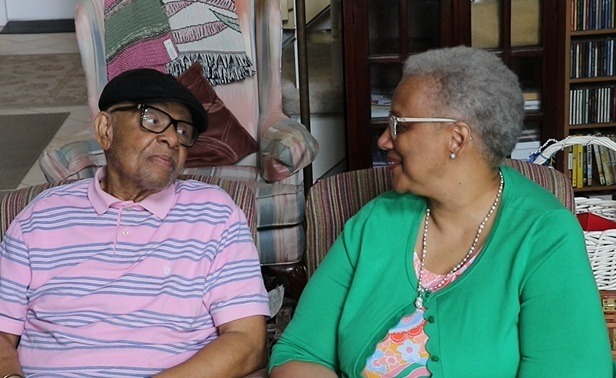
Ted Knorr, our resident historian, continues to bridge the gap between our past and present through his twice-monthly column, “Shadow Ball: Learning More About Negro League History.” Many of you have already engaged with Ted by submitting questions and sharing family stories, making “Shadow Ball” a true cornerstone of our community dialogue.
The Road Ahead
We are no longer just a news site; we are a growing civic institution. Whether we are investigating DeKalb data centers or documenting the rich history of the South, our goal remains the same: to give you the information you need to understand your community and shape your future.
Thank you for being the most important part of this journey. We are just getting started.
By Brigadier General (Retired) Shawn Harris, Candidate for Congress, Georgia’s 14th Congressional District | Rockmart, GA | September 11, 2026
Twenty-five years ago, our nation was attacked on September 11, 2001. Like millions of Americans, I remember the shock, grief, and uncertainty that followed. We watched our fellow citizens murdered at the World Trade Center, the Pentagon, and aboard United Airlines Flight 93. We watched first responders run toward danger. We watched ordinary Americans come together in an extraordinary time of need.
For those of us who wore the uniform in the years that followed, September 11 was not simply a date on a calendar, but a call to service.
I had already spent years serving our country, first as an enlisted Marine and later as an Army National Guard officer. After the attacks of 9/11, I commanded an Embedded Training Team (ETT) in combat in the mountains of Kapisa, Afghanistan as part of our nation’s prosecution of the Global War on Terror. I saw firsthand the commitment of American service members, young men and women from every background and every corner of the nation who carried out difficult missions far from home because they believed in their oath, their fellow soldiers, and the country they served.
A commander in combat makes decisions knowing that the lives of soldiers, families, and innocent civilians may hang in the balance. The most difficult part of military leadership is not the ceremony, the rank, or the recognition. It is caring for the people entrusted to you, and at times, having to tell a family that someone they love will not be coming home.
Georgia understands the values of service and sacrifice, because Georgia is a state that supports the military. Our state is home to service members, veterans, military families, National Guard members, Reservists, and civilian employees who support America’s defense every day. From Fort Benning and Fort Stewart to Hunter Army Airfield, Robins Air Force Base, Moody Air Force Base, Dobbins Air Reserve Base, Naval Submarine Base Kings Bay, Fort Gordon, and Marine Corps Logistics Base Albany, Georgia’s military communities are woven into the life of our state.
That spirit of service is familiar to me because I grew up on a farm in Blakely, Georgia. I learned early that work must be done, promises must be kept, and people must look after one another. Those lessons carried me from the Marine Corps to the Army, from combat in Afghanistan to senior leadership assignments and eventually to my retirement forty years later as an Army Brigadier General. Today, my wife Karla and I operate a grass-fed cattle farm back home in Rockmart, Georgia, where our neighbors understand that service is not a slogan. It is a way of life.
The lesson of September 11 is not only in how America was attacked. It is in how Americans responded.
We responded when firefighters entered buildings from which others were fleeing. They responded when police officers, medical professionals, construction workers, volunteers, and neighbors came to Ground Zero. We responded when Americans donated blood, raised flags, prayed for strangers, and comforted families they had never met. We responded when more than 250,000 young patriotic Americans joined the military in the year after September 11. In the two decades that followed, millions of Americans served in Afghanistan and Iraq. And thousands never returned home.
Their service is part of the story of September 11. So are the families who waited through deployments, the veterans who came home with visible and invisible wounds, and the Gold Star families who continue to live with an absence no words can fill.
On this anniversary, Georgia should remember that our veterans are not distant figures from history. They are part of every community in the 14th Congressional District and throughout our state.
We honor them best not only with ceremonies, flags, and speeches, but by keeping our promises to them. That means ensuring that veterans receive the health care, benefits, job opportunities, education, and support they earn through their service. It means respecting military families and recognizing the burdens that deployments place on spouses, children, and caregivers. It means sending leaders to Washington who understand the consequences of war, the value of peace, and the lifelong responsibility our nation owes to those who served.
Georgia has always produced citizens willing to serve something greater than themselves. That is who we are. It is what our military communities represent. It is the legacy we must preserve for the next generation.
On September 11, we remember. We honor and recommit ourselves to the country and the people for whom so many have sacrificed.
Targeted ads feel invasive because AI analyzes searches, locations, purchases, and app activity—predicting needs without listening. Digital behavior creates detailed profiles that shape advertising.
By Florita Bell Griffin, Ph.D. | Houston, TX | September 8, 2026
Almost everyone has had the experience. You mention a product in conversation, and later that day an advertisement for something similar appears on your phone. You talk about taking a trip, buying new flooring, changing your diet, or getting a pet, and suddenly related ads seem to follow you everywhere. The experience can feel so specific that many people conclude their phone must have been secretly listening.
Sometimes the explanation is simpler and, in some ways, more unsettling. Modern advertising systems do not need to listen to every conversation in order to learn a great deal about a person. They already receive enormous amounts of information from searches, purchases, location history, website visits, app activity, social-media behavior, loyalty programs, device usage, and the behavior of people with similar interests. Artificial intelligence helps connect those pieces and make predictions about what a person may want next.
Suppose someone begins searching for kitchen cabinets, watches several home-renovation videos, visits a furniture website, and spends time reading about new appliances. Advertising systems can recognize the pattern and conclude that the person may be remodeling. The user may then begin seeing advertisements for flooring, lighting, countertops, contractors, and kitchen equipment. If the person happened to discuss remodeling with a friend that same day, the ad can feel like proof that the conversation was overheard, even though the system may have reached the same conclusion from other digital clues.
Location data can add another layer. A phone may know that its owner visited a car dealership, pharmacy, shopping center, airport, or home-improvement store. Apps can also collect information about device type, browsing habits, approximate age, interests, and previous purchases. Data brokers and advertising networks can combine information from different sources, creating detailed consumer profiles that most people never see.
Artificial intelligence makes those profiles more powerful because it can identify patterns that would be difficult for a human being to notice. It can group people according to likely interests, predict which users may be preparing to move, purchase a vehicle, change jobs, or take a vacation, and decide which advertisement has the best chance of receiving a response. The system does not need to know someone personally in the human sense. It only needs enough data to make a useful prediction.
This is why targeted advertising can feel almost psychic. A person may not have searched directly for a baby stroller, for example, but changes in shopping behavior, location, online reading, and related purchases may cause an advertising system to place that person into a category associated with new parents. Similar predictions can be made about homeownership, travel, education, hobbies, finances, and major purchases.
That does not mean microphones are never used. Many apps request microphone access for legitimate reasons, including voice messaging, calls, video recording, or voice assistants. People should still review which applications have permission to access the microphone, camera, location, contacts, and photographs. An app that does not need a particular permission should not automatically receive it simply because the request appears during installation.
The larger lesson is that privacy in the digital age is not only about whether someone is secretly listening. It is also about how much can be learned from ordinary behavior. A collection of small details can reveal far more than any single piece of information. Search history alone may show what a person is curious about. Location data may show where that person spends time. Shopping data may reveal financial priorities. Social-media activity may reveal interests, relationships, and concerns. When those pieces are combined, they can create a surprisingly accurate picture.
Consumers can reduce some of this tracking by reviewing privacy settings, limiting unnecessary app permissions, turning off location access when it is not needed, clearing advertising identifiers, rejecting optional tracking where possible, and using browser settings that reduce cross-site tracking. It is also wise to pay attention to loyalty programs, free apps, quizzes, and other services that collect information in exchange for convenience.
The goal is not to become afraid of every advertisement or assume that every company is watching every move. The goal is to understand how the modern data economy works. Many digital services are free because attention and personal information have value. Advertising systems are designed to know enough about users to predict what may influence them.
So, is your phone listening to you? Sometimes a device may be using a microphone because you gave an app permission to do so. But in many cases, the more accurate explanation is that the digital world already knows enough about your behavior that it does not need to hear the conversation.
That realization may be even more important. Privacy is no longer only about what we say aloud. It is also about the trail we leave behind every time we click, search, travel, shop, watch, and scroll.
… this column exists for only one purpose and that is to answer your questions on Negro League baseball history. To that end, I need your help … if you are reading this column and enjoy it and want it to continue and you don’t already know everything about Negro League history … then please submit a question on any aspect of Negro League history. Your questions are the lifeblood of Shadow Ball—they shape where we go next.
How Fast Was Cool Papa Bell?
Faster than the speed of light
Faster than Jimmie Lyons, prime v prime
He could cover 100 yards in about 10 seconds
He was, and remains, the fastest baseball player ever
Phil Durnitz of Albuquerque, New Mexico, submitted the question, and I will do my best to answer it. Only one of the multiple‑choice options can be definitively shown to be correct — but each deserves examination.
A. Faster than the speed of light
Satchel Paige was fond of telling this story about his longtime roommate, Cool Papa Bell. In John Holway’s Voices from the Great Black Baseball Leagues (1975), Paige is quoted as saying:
“That man was so fast he could turn out the light and jump in bed before the room got dark.”
Taken literally, Paige is suggesting Bell outran light itself. We’ll file that away for now — in the category of tall tales, but glorious ones.
B. Faster than Jimmie Lyons
In the same Holway interview, Bell recounts one of the stories that helped build his reputation:
“(In 1922 or ’23) Jimmie Lyons was supposed to be the fastest man in the (Negro) League(s)… Rube Foster wanted us to race… So we went out and raced, and I beat Jimmie Lyons… I just ran off from Jimmie Lyons. That’s when I got my reputation.”
Lyons was extremely fast, and beating him was no small feat. But context matters: in 1922–23 Bell was 19 or 20 years old, while Lyons was 32 or 33. It shows Bell was faster than an older Lyons — not necessarily faster than Lyons in his prime.
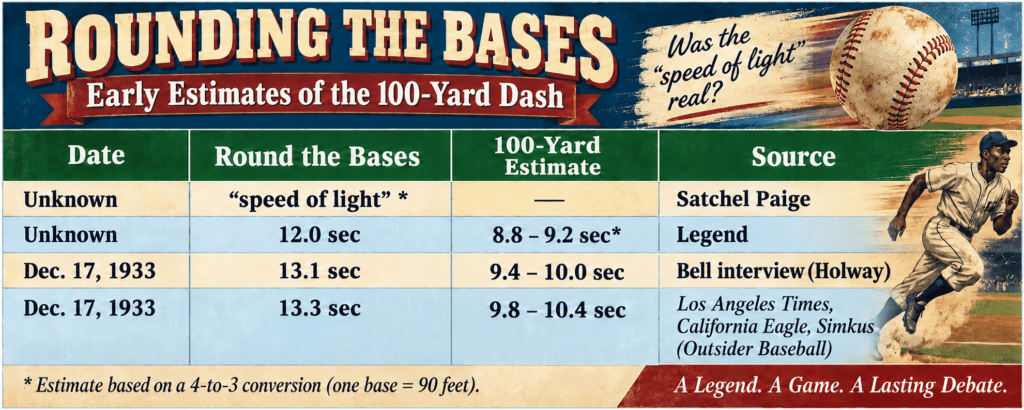
Bell’s interview continues with stories of scoring from first on bunts, scoring from second on fly balls, and even being “faster than Jesse Owens,” based on the oft‑repeated claim that Bell circled the bases (120 yards) in 12 seconds flat. Holway adds the famous but misleading line that Bell “scored from second on a ground ball to win the 1934 All‑Star Game, 1–0.” The ball, in fact, was hit past the infield and into the outfield for a single. Bell’s recollections are wonderful, but they are unabashed braggadocio.
C. He could run 100 yards in about 10 seconds
We can estimate Bell’s straight‑line speed using his recorded “round‑the‑bases” times. Four such times appear in the historical record:
Shadow Ball Player Speed
Even allowing for exaggeration, all four numbers are spectacularly fast. Paige’s story is entertaining; the 12‑second legend would still be a world record in 2026. But even the slowest verified number — 13.6 seconds, on a wet track, in December 1933, at age 30 — is extraordinary.
For comparison, the fastest Statcast‑measured modern time is Byron Buxton’s 13.85 seconds. A hand‑timed 13.6 and a fully automated 13.85 are essentially identical.
Thus, the record shows Bell was capable of roughly a 10‑second 100‑yard dash at a time when the world record stood at 9.5.
D. He was, and remains, the fastest baseball player ever
Here we enter the realm of opinion — but informed opinion. Using rate statistics from Seamheads (runs scored minus home runs, triples, and stolen bases, prorated per plate appearance), I rank the greatest Negro League speedsters as follows:
Oscar Charleston
Willard Brown
Cool Papa Bell
Bullet Rogan
Jimmie Lyons
Rap Dixon
Hurley McNair
George Shively
Turkey Stearnes
Cristóbal Torriente
Henry Milton, Sam Jethroe, and Doc Dudley would appear here as well but lack sufficient plate appearances to qualify.
Charleston and Bell stand out for combining elite speed with long careers. Bell finishing in the top three of this methodology confirms he was one of the fastest runners in Negro League history. Whether he was the fastest is debatable — Milton, Jethroe, Lyons, Shively, and several Hall of Famers could all stake a claim.
Conclusion
The correct answer is C.
Cool Papa Bell would have been a consistent 10‑flat or better 100‑yard runner at a time when the fastest sprinters in the world were posting 9.6, 9.5, and 9.4. Bell was exactly as fast as legend suggests — and unquestionably one of the fastest players ever to play the game.
Thanks to authors John Holway and Scott Simkus for their excellent work, to Satch and Cool for their stories, and to Mr. Durnitz for his question.
Last Week’s Shadow Ball Significa Question of the Week
Q: What was Atlanta’s most prolific Negro League franchise (in terms of years in the league)? A: The Atlanta Black Crackers — provided by Will Clark of Hackensack, NJ.
This Week’s Shadow Ball Significa Questions of the Week
In 1937, Monte Irvin joined the Newark Eagles under an assumed name — what was it? In 1942, Larry Doby joined the Newark Eagles under an assumed name — what was it?
Ted Knorr
Ted Knorr is a respected Negro League baseball historian, a longtime member of the Society for American Baseball Research’s Negro League Committee, and the founder of the Jerry Malloy Negro League Conference as well as several Negro League Commemorative Nights in central Pennsylvania.
Beyond his research and organizing work, Ted is frequently invited to speak at sporting events, community programs, family gatherings, and educational forums, where he brings Negro League history to life. His deep knowledge of the players, teams, and cultural impact of Black baseball has made him a trusted voice for audiences who want to understand the legacy and significance of the Negro Leagues.
Send questions or Significa answers to shadowball@truthseekersjournal.com or Shadow Ball, 3904 N Druid Hills Rd, Ste 179, Decatur, GA 30033.
Truth Seekers Journal thrives because of readers like you. Join us in sustaining independent voices.
Sens. Raphael Warnock and Ron Wyden opened an inquiry into reports that Trump administration officials may be influencing IRS enforcement against left-leaning nonprofit organizations.
By Milton Kirby | Washington, D.C. | September 5, 2026
More than a decade after the Internal Revenue Service came under fire for subjecting conservative organizations to improper scrutiny, two Democratic senators are asking whether political officials in the Trump administration are attempting to influence IRS enforcement against organizations on the political left.
U.S. Sens. Raphael Warnock of Georgia and Ron Wyden of Oregon have opened an inquiry into reports that senior Treasury officials are considering increased scrutiny of left-leaning tax-exempt organizations and potentially revoking their tax-exempt status.
Warnock is the ranking member of the Senate Finance Subcommittee on Trade, Customs, and Global Competitiveness. Wyden is the ranking member of the Senate Finance Committee.
Their inquiry does not establish that the IRS has improperly targeted any organization. Instead, the senators are seeking documents and answers to determine whether political considerations have influenced or are being used to influence federal tax enforcement.
At the center of the inquiry is a question that reaches beyond the organizations or political party involved: Can Americans trust the IRS to enforce the nation’s tax laws without regard to political ideology?
“Americans of every political persuasion must be able to trust that the IRS applies the tax code objectively under one set of rules,” Warnock and Wyden wrote to Treasury Secretary Scott Bessent and Frank Bisignano, acting head of the IRS.
A Reported ‘Blueprint’
The inquiry follows an Aug. 27 report by the New York Post that Treasury officials were reviewing the tax-exempt status of several organizations, including the Open Society Foundations, Southern Poverty Law Center and Council on American-Islamic Relations, as well as other left-leaning and labor-aligned organizations.
According to the report cited by the senators, members of Bessent’s “inner circle” were developing a “blueprint” that could lead to revocation of some organizations’ tax-exempt status. The newspaper also reported that administration officials wanted to complete “a good chunk of the crackdown” before the November midterm elections.
“If accurate, the New York Post report raises serious questions about whether political officials are influencing IRS decisions concerning particular taxpayers in ways prohibited by federal law,” Warnock and Wyden wrote.
“If accurate” is an important qualification.
The senators’ letter raises questions about what administration officials may be considering or doing. It does not establish that the IRS has been ordered to audit the organizations named in the report or that the agency has decided to revoke their tax-exempt status.
Tax-exempt organizations are not beyond federal enforcement. Organizations operating under Section 501(c)(3) must comply with federal requirements governing their tax-exempt status. Among those restrictions is a prohibition against participating or intervening in political campaigns for or against candidates for public office.
At the same time, IRS guidance allows 501(c)(3) organizations to take positions on public-policy issues, including issues that divide political candidates, as long as their communications do not favor or oppose a candidate.
The issue raised by the Senate inquiry, therefore, is not whether nonprofit organizations can be investigated. It is whether organizations are being selected for scrutiny based on evidence of violations or because of their ideological positions.
Federal Law Restricts Political Intervention
Warnock and Wyden point specifically to Section 7217 of the Internal Revenue Code.
The law makes it unlawful for certain executive branch officials to directly or indirectly request that an IRS employee conduct or terminate an audit or other investigation of a particular taxpayer.
IRS employees who receive prohibited requests are required to report them to the Treasury Inspector General for Tax Administration. A willful violation can result in a fine, imprisonment of up to five years, or both.
The law also contains limited exceptions, including certain requests by the Treasury secretary resulting from implementation of a change in tax policy.
The senators want to know whether Bessent, Treasury political appointees, White House employees or other covered officials communicated with IRS personnel about audits or investigations involving particular taxpayers.
If such communications occurred, they also want to know whether IRS employees reported them to the inspector general and whether Treasury contends any communication was permitted under the tax-policy exception.
Warnock and Wyden additionally raise questions under Section 6103 of the Internal Revenue Code, which generally protects the confidentiality of taxpayer returns and return information.
They ask whether President Donald Trump or White House personnel requested or received taxpayer information concerning tax-exempt organizations connected with the reported initiative and, if so, whether federal requirements governing access to that information were followed.
The letter does not establish that either law has been violated.
National Security Directives Enter the Inquiry
The senators place the reported nonprofit review within a broader series of administration directives.
Their letter points to National Security Presidential Memorandum 7, issued in September 2025, and an executive order directing federal agencies to target financial networks connected to Antifa and domestic terrorism.
Warnock and Wyden contend that those directives extend beyond violent conduct by incorporating ideological viewpoints.
“Rather than targeting actual violence, these directives explicitly conflate terrorism with subjective political viewpoints such as ‘anti-capitalism,’ ‘anti-Christianity,’ and views on race, migration, and gender,” they wrote.
The senators also cite a December 2025 memorandum from then-Attorney General Pam Bondi directing law enforcement to examine financial support for “Antifa-aligned extremists” and pursue applicable tax crimes.
Whether those national-security efforts resulted in improper IRS enforcement against tax-exempt organizations is among the questions the inquiry is seeking to answer.
Ten Questions for the Administration
Warnock and Wyden’s inquiry seeks considerably more than confirmation or denial of the reported “blueprint.”
The senators want the blueprint itself, along with policies, directives, guidance and criteria concerning the selection of tax-exempt organizations for examination or possible revocation.
They want to identify Treasury, IRS, White House and other executive branch officials who developed those policies or recommended particular organizations for review.
They ask whether Treasury, the White House or another executive branch office identified specific organizations for IRS examination, investigation, compliance review or possible revocation.
One question goes directly to the approaching election.
The senators ask whether any executive branch official requested that IRS personnel “accelerate, prioritize, complete, or take enforcement action” concerning particular tax-exempt organizations before the November 2026 elections.
Another asks whether political affiliation, ideological viewpoint, electoral timing or classifications such as “Antifa-aligned” have been used to identify organizations for IRS scrutiny.
The senators also want the administration to explain the legal and evidentiary standards used to determine when a tax-exempt organization has directly or indirectly financed political violence or domestic terrorism and what safeguards prevent officials outside the IRS from directing examinations over the objections of career IRS personnel.
One of their final questions concerns Bessent himself.
Because of Bessent’s previous senior roles at Soros Fund Management and its relationship with the Open Society Foundations, the senators are requesting information about any ethics review, recusal determination, waiver or other safeguards governing his participation in matters involving the foundation.
Warnock and Wyden also instructed Treasury and the IRS to preserve potentially responsive records, including emails, text and encrypted messages, memoranda, notes, calendar entries, meeting materials and draft documents.
They requested answers and documents by Sept. 15.
Echoes of 2013
The inquiry carries particular significance because Washington has confronted questions about political influence over IRS administration before.
In 2013, the Treasury Inspector General for Tax Administration found that the IRS had used inappropriate criteria to identify applications from Tea Party and other organizations for additional scrutiny.
The controversy led the Senate Finance Committee to conduct a bipartisan investigation lasting more than two years.
Republicans and Democrats did not agree on every conclusion. Republicans argued that conservative organizations had been unfairly targeted and that political bias contributed to their treatment. Democrats emphasized serious management failures and noted that the investigation did not establish criminal wrongdoing. The investigation also examined improper treatment and lengthy delays involving some progressive organizations.
But the episode established a broader principle: federal tax administration should not depend upon an organization’s political viewpoint.
Warnock and Wyden invoke that history directly.
“Republican leaders repeatedly argued that tax administration must never be influenced by political bias or viewpoint,” they wrote. “That principle should apply equally regardless of the political views of the organizations involved.”
The comparison provides a standard that does not depend on which political party controls the White House.
If conservative organizations should not face improper IRS scrutiny because of their political views, organizations on the left should receive the same protection.
Enforcement or Political Retaliation?
None of this means nonprofit organizations are immune from government scrutiny.
Organizations granted tax-exempt status must comply with the laws governing that status. Evidence that an organization violated federal tax law can legitimately trigger examination and enforcement.
Warnock and Wyden acknowledge that distinction.
“Organizations that violate section 501(c)(3) should face appropriate enforcement regardless of their politics,” they wrote, “and organizations should never face IRS scrutiny because political officials disapprove of their views.”
That distinction is at the center of the inquiry.
At this stage, publicly available information does not establish that political officials directed the IRS to investigate particular organizations. The inquiry is intended, in part, to determine whether such direction occurred.
It also gives Treasury and the IRS an opportunity to dispute the senators’ premise, explain the purpose of any review of tax-exempt organizations and describe safeguards intended to keep political considerations from influencing IRS enforcement.
The senators have requested answers by Sept. 15.
Those responses could provide the first opportunity to compare the allegations that prompted the inquiry with the administration’s account of what Treasury and the IRS are actually doing.
Until then, the central question remains unanswered: Are organizations being examined because there is evidence they violated federal law, or because political officials disagree with their views?
The answer could determine whether this remains a dispute over tax policy and political rhetoric or becomes a larger examination of the independence of the Internal Revenue Service.
Truth Seekers Journal thrives because of readers like you. Join us in sustaining independent voices.
Shawn Harris’s grassroots campaign tests whether a Black Democrat can compete in deep red rural Georgia, leveraging biography, small dollar fundraising and growing support across northwest communities.
“This story was originally published by Barn Raiser, your independent source for rural and small town news.”
Gap narrows in a district once held by Marjorie Taylor Greene
Lori and Scott Jordan were leaving the Kroger in Dallas, Georgia, on a rainy Tuesday afternoon. They were among the rare people willing to stop and talk politics while others hurried to their cars.
“I got plenty to say,” says Lori. They’ve seen the price of everything go up recently. “The sign right there tells a lot of it. $4.09,” says Scott, pointing to a nearby gas sign. “[The president’s] on TV saying it’s less than $2 per gallon.”
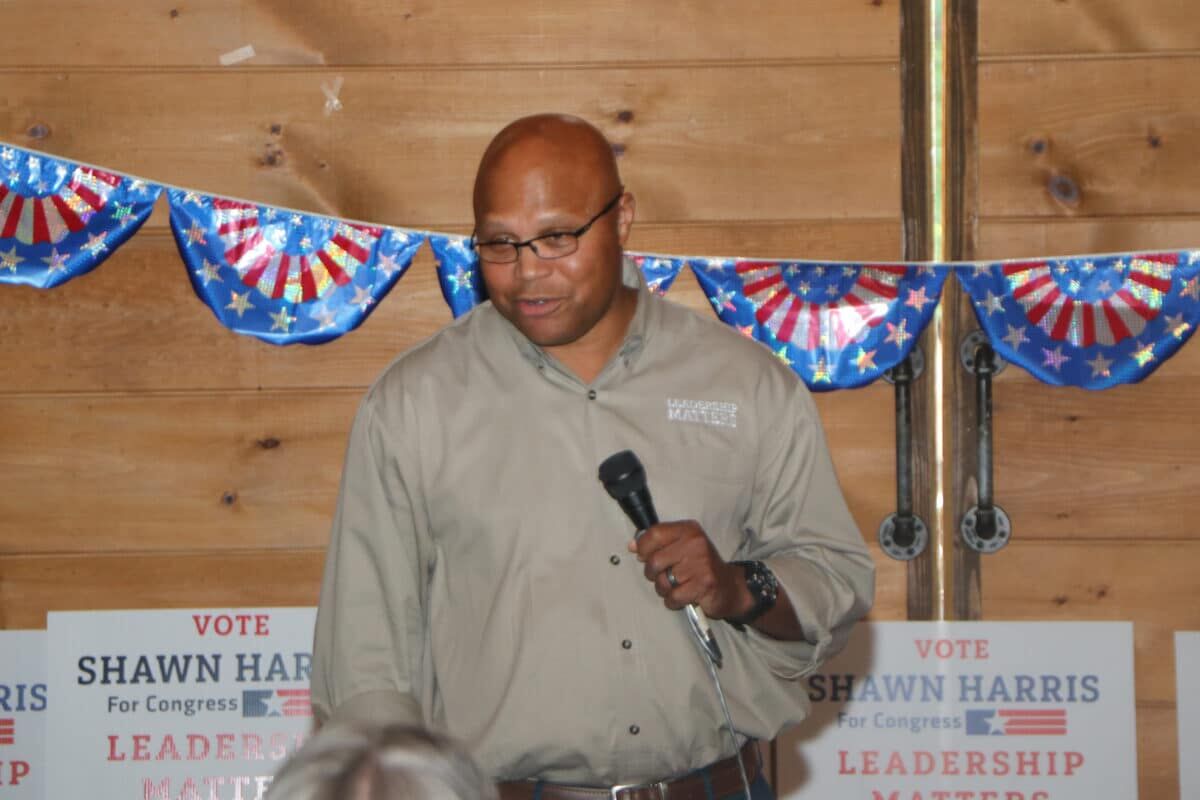
Democrat Shawn Harris speaks to supporters during townhall in Chatsworth, GA July 21, 2026 (Milton Kirby)
The Jordans, a white, middle-aged couple, say they are voting for Shawn Harris, a Black retired brigadier general running as a Democrat for Congress in Georgia’s sprawling 14th Congressional District. The couple frequently finished each other’s sentences while explaining that in the last two years, Scott, 63, who uses a pacemaker, lost his federal health coverage. After the One Big Beautiful Bill rolled back tax credits and imposed new requirements to the Affordable Care Act in 2025, their adult children no longer have access to health insurance, including their daughter, a recent cancer survivor.
“She doesn’t have insurance now,” Lori says quietly.
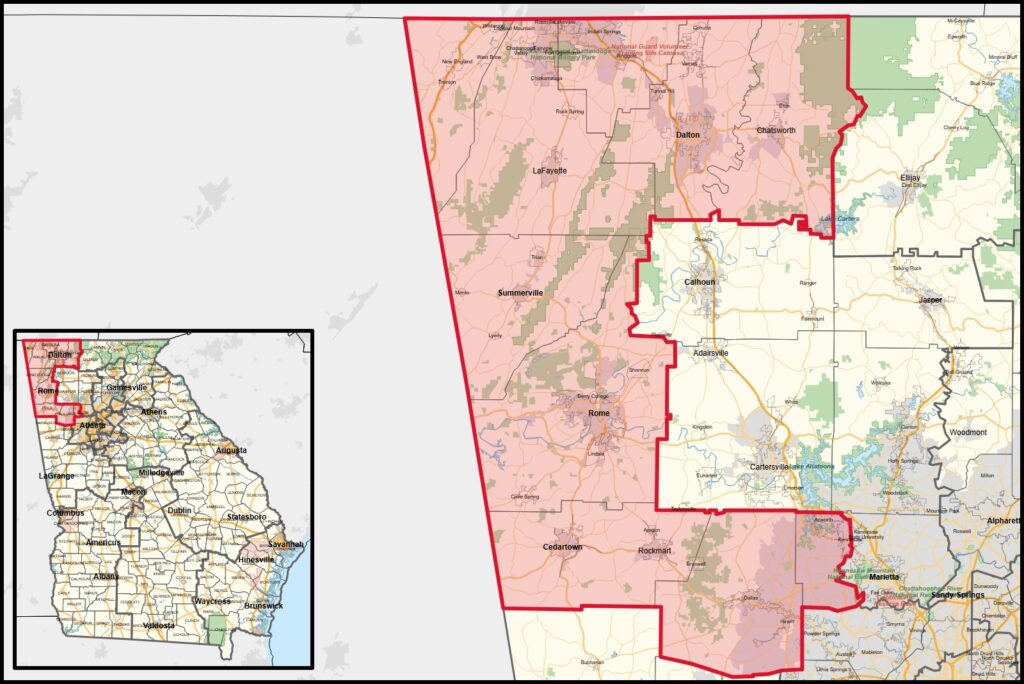
Dallas, a town of 15,000 more than 30 miles northwest of Atlanta, is the county seat of Paulding County, one of the most competitive parts of a congressional district that spans roughly 3,000 square miles along the northwest corner of Georgia’s state line. In previous years, the district held national attention because of its firebrand Republican representative Marjorie Taylor Greene.
Greene rose to power in 2020, riding a wave of extreme right-wing reaction during the pandemic, during which she compared vaccine requirements to the yellow stars that Nazis forced Jews to wear during the Holocaust. Her unabashed promotion of Donald Trump’s false claims of a rigged 2020 election, QAnon conspiracy theories and Christian Nationalist views enabled her rapid ascent as a central figure of the MAGA movement.
Yet Greene’s subsequent fall from grace in the Republican party has marked one of the more astonishing political reversals in recent memory. By 2025, tensions that emerged between Trump and Greene had turned into a full-blown rift as Greene criticized Trump for his opposition to the Epstein Files Transparency Act and ignoring an “America first” agenda with military interventions in Venezuela and Iran. In November 2025, Greene announced her decision to resign from Congress, leaving power up for grabs in her Georgia seat.
14th US Congressional District
In a March special election to complete Greene’s unexpired term, Democrat Shawn Harris finished first in a crowded field of 17 candidates, 12 of them Republicans, receiving 37% of the vote. Republican Clay Fuller finished second with 35%.
In the April runoff, Fuller, who is white, defeated Harris, with 56% of the vote to Harris’s 44%, a difference of just over 15,000 votes. In Paulding County, population 191,000, Harris lost by just 273 votes, garnering 49.9% of the vote, a dramatic 9-point improvement over his previous run.
Both men subsequently secured their parties’ nominations for the November election (Fuller also received Trump’s endorsement), setting up another Harris-Fuller contest, this time for a full two-year term.
The result could carry implications beyond northwest Georgia. In 2024, Harris challenged Greene and lost decisively, receiving just 36% of the vote. Harris’s 44% in the April runoff could either represent evidence of an electorate becoming more receptive to him or the ceiling for a well-funded Democrat in one of Georgia’s most Republican congressional districts.
At a time when Democrats nationally are searching for ways to compete outside major cities and suburbs, Harris is testing whether biography, small-dollar fundraising, local organizing and a deliberate appeal to independents and Republicans can overcome a district’s deeply established partisan identity.
Soldier, farmer and candidate
For Harris, a retired brigadier general and cattle farmer, places like Paulding may determine whether his latest campaign for Congress ends differently from the ones before it.
He is attempting something Democrats have been unable to accomplish in this deeply Republican corner of Georgia: win a seat in Congress. And he’s attempting it as a Black man in an 88% white district without an ounce of support from the Democratic Congressional Campaign Committee (DCCC).
This time, however, his numbers show his effort is about more than making a statement.
Harris’s appeal to northwest Georgia voters begins with his biography.
He grew up on his family’s farm in southwest Georgia. After high school, he enlisted in the U.S. Marine Corps. He later earned a degree in agribusiness from Tuskegee University, where he met his wife, Karla. He transitioned to the U.S. Army, serving as a combat infantry commander in Afghanistan and rising to the rank of brigadier general before retiring. Today, Harris and his wife operate a first-generation grass-fed cattle farm near Rockmart, 50 miles northwest of Atlanta.
Speaking before voters in rural Chatsworth in July, Harris presented himself as a politician focused on constituent service.
“When I get to D.C., my focus is one hundred percent you, your kids and your grandkids,” Harris told the audience. “I don’t need to be seen on TV. I’m not looking to be some celebrity.”
Shawn Harris speaks to voters at a campaign event in Chatsworth, Georgia, on July 21. (Milton Kirby)
For at least one voter in Chatsworth, that message strikes a chord. Peggy Hobgood voted for Trump 3 times.
“Just seems like this time, I hate to say this, that man’s all about putting his name on a building or a boat or a dollar bill,” Hobgood says. “We don’t need a president like that and we don’t need another one falling in behind him either. I just hate to see people, older people who worked their whole lives and they’ve got nothing.” But Hobgood says she has no plans to vote again because “it’s crooked everywhere.”
Harris calls himself a moderate, “common sense” Democrat and argues that his path to Congress requires a coalition of Democrats, independents and Republicans. He is running on bread-and-butter issues such as better roads, more mental health services, more health clinics, lower grocery prices, expanded broadband and a fully-funded farm bill. Fuller, his opponent, is an attorney who also serves in the Air National Guard. Fuller grew up in north Georgia and was the district attorney for a four-county circuit in northwest Georgia, according to his campaign website. Appointed by Trump as a White House Fellow during the president’s first term, he identifies himself as a Christian conservative who defends the unborn. He espouses America First policies including tougher immigration enforcement and mass deportation.
Donald Trump carried the 14th District by roughly 37 percentage points in 2024. But the president’s polling numbers have sunk to new lows. Democratic candidates across the country are tapping into the economic hardship voters are facing from arbitrary on-and-off tariffs and an unprovoked war on Iran driving up prices while Republicans respond with cries of communism.
Harris sees his campaign’s role in a larger Georgia political landscape where many key races are in play.
Democrat Keisha Lance Bottoms, the former mayor of Atlanta, is in a statistical tie with billionaire newcomer Rick Jackson for the open governor’s seat, according to Georgia-based pollster InsiderAdvantage, WABE public radio reports. Jackson announced last week that he has allocated $87 million in advertising against Lance Bottoms, who has less than $1 million on hand. The same poll also showed Sen. Jon Ossoff, the Democratic incumbent, 7 points ahead of his challenger Mike Collins. Both candidates are multimillionaires, according to the Atlanta Journal Constitution.
“If Jon Ossoff is still our senator, and Keisha Lance Bottoms is our governor, she just made history,” Harris tells Barn Raiser. “And then everybody else below me gets elected, all the way down to the lowest level you can come up with, and I lose, that is still a win.”
Measuring rural support
Harris Campaign Communications Representative Lauren Boone tells Barn Raiser that support is already developing across rural Northwest Georgia.
Boone points to local volunteers, donors, people placing yard signs and residents attending events. The campaign says its volunteer operation extends throughout the district and includes people from rural and agricultural communities.
Boone also claims that campaign canvassing from the special and runoff elections indicated Harris received support from 65% of independents and 20% of Republicans.
Georgia does not register voters by political party, making crossover voting difficult to determine from election returns alone, so the campaign’s numbers do not prove Harris won 20% of Republican voters. But they reveal what Harris’s campaign believes its own voter contacts are telling it, and they help explain the campaign’s strategy.
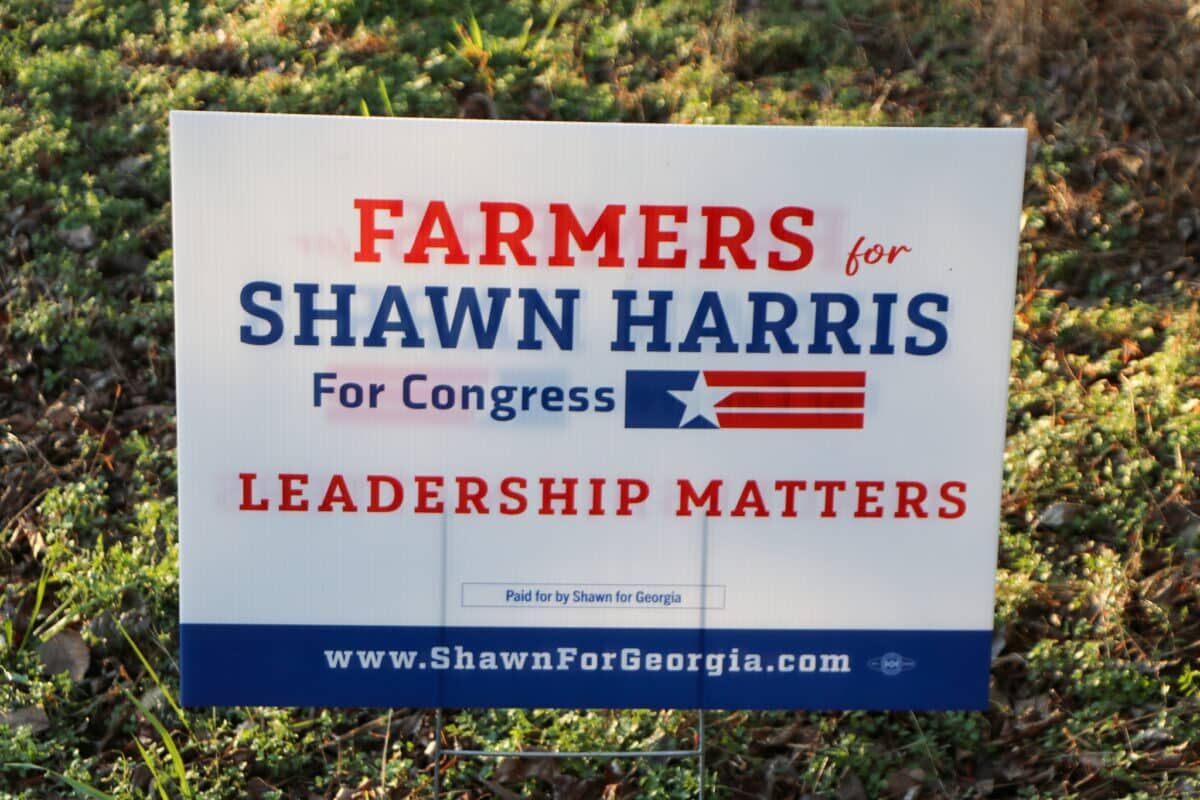
A yard sign supporting Shawn Harris in Georgia’s 14th Congressional District. (Milton Kirby)
An analysis of the election results offers some insights, though. In more Democratic-leaning parts of the district, Harris was able to hold his own, garnering between 43% and 58% of the vote.
But the numbers change considerably farther into the district’s Republican strongholds. In those areas, support for Harris ran between 24% and 36%, far behind Fuller.
Perhaps most strikingly, Harris received only 31% of the vote in Polk County, where he lives and farms.
Those results show both the opportunity and the problem facing his campaign. Harris has demonstrated significant competitiveness in portions of the district, while a substantial Republican wall remains elsewhere.
Can Harris really win over Republicans?
The narrow margin in a Republican stronghold like Paulding does not mean that Paulding has suddenly become Democratic, nor does it establish that large numbers of Republicans crossed over to Harris.
It does demonstrate something more limited, but important: in at least one populous part of this overwhelmingly rural and Republican district, Harris was able to make the race essentially even.
For Democrats looking nationally at whether deeply Republican territory can still be contested, Harris does not necessarily have to turn every red county blue. Neither does he have to persuade most Republicans to vote Democratic. He just needs enough of them, combined with Democrats and independents, to change the arithmetic in counties where Republican margins have traditionally been overwhelming.
Rural Georgians feeling the economic pain of the Trump administration’s policies combined with inaction by a Republican-led Congress might just tip the scale.
Paulding County offers a glimpse of what that would look like.
An $8 million question
Harris has demonstrated an extraordinary ability to raise money without party support.
Federal Election Commission (FEC) records show his campaign raised approximately $8.1 million from April 2025 through June 30, 2026, four times more than his opponent.
Nearly all came from individual contributions. About $6.22 million of Harris’s individual contributions were reported as unitemized.
Communications Representative Boone says the average contribution is $22.02, although that figure cannot be independently verified by FEC reports. Fewer than 50 contributors have donated more than $3,000. Harris reported no candidate loans and no contributions from party committees.
Campaign records show that Harris hired a Massachusetts campaign consultant called Campaign Industries, founded by a veteran election campaign organizer Mac D’Alessandro and a veteran union organizer John Hennelly. It offers candidates complete campaign services from creating strategy to hiring, firing and managing field staff.
The Harris campaign has dedicated more than $3.2 million to digital fundraising and social media, which explains, in part, the high number of small donors.
Boone says the campaign maintains a small staff, with four regular staffers and several part-time consultants and support staff, allowing it to devote resources to direct voter contact.
“We are very focused on our field program, door knocking, phone calling, town halls, etc. throughout the district,” she says. “Our amazing volunteer corps has played a big part in allowing this model to work so successfully.”
Less than $1 million was spent on campaign staff during the 12-month period, according to Boone. The remainder went toward fundraising, voter contact and persuasion through field operations, social media and paid media.
Boone says that in addition to nearly 200 active volunteers inside the district, the campaign has more than 500 nationwide. Some of those volunteers, she says, are expected to travel to northwest Georgia during the closing days of the campaign. For a congressional candidate receiving no DCCC support, the nationwide volunteer network presents an unusual contrast.
Through June 30, Fuller reported approximately $1.85 million in receipts and $1.78 million in spending. About $1.08 million came from individuals, with his top donors contributing tens of thousands each and another $305,481 from other political committees. Fuller also loaned his campaign $450,000.
The Republican PAC Conservatives for American Excellence has spent nearly $500,000 opposing Harris. Additionally, more than $2.7 million in dark money is backing Fuller.
Fuller’s donor list includes the American Israel Public Affairs Committee (AIPAC), the Koch Foundation, MAGA, Inc., Lockheed Martin and WinRed. His PAC donor list is more than 100 organizations long and totals an estimated $305,000. (By comparison, four PACs have donated just under $14,000 to Harris.)
Fuller has also spent the majority of his funds on media buys and digital strategy. His campaign consultant is Wiregrass Strategies, a firm run by Brandon Phillips, manager of Donald Trump’s 2016 Georgia presidential campaign. There is little indication of major expenditures on field staff in his FEC report. His campaign did not respond to requests for interviews.
The contrast shows Harris is attempting to finance a competitive campaign largely through individual contributions and an enormous small-dollar fundraising operation.
Fuller, on the other hand, is benefiting from a different financial ecosystem, including candidate financing, PAC contributions, major donors and outside spending.
A test bigger than GA-14
Harris frequently tells audiences that “leadership matters.” For him, the phrase extends beyond winning an election.
“Leadership means you know when to get the hell out of the way, so somebody else can get in the seats,” Harris told an audience in July.
He has also framed leadership as something extending beyond himself, talking about helping elect other candidates and building political participation throughout the ticket.
His campaign expenditures show he means it. Not only is the Harris campaign not receiving funds from the Democratic Party, he is donating to them. Federal filings show the Harris campaign donating more than $27,000 to Georgia’s state Democratic party and multiple county Democratic parties in the district for event sponsorships and more.
Georgia’s 14th District is becoming a test of something larger: Can a Black Democrat compete in deep-red rural and white America without waiting for the national party to decide the race is winnable?
Harris is betting millions of dollars, hundreds of volunteers and yet another campaign that the answer is yes.
Bronx residents and lung cancer survivor Colette Smith show why community trust, early detection and access matter ahead of a September cancer health conversation.
By Milton Kirby | Bronx, NY | August 31, 2026
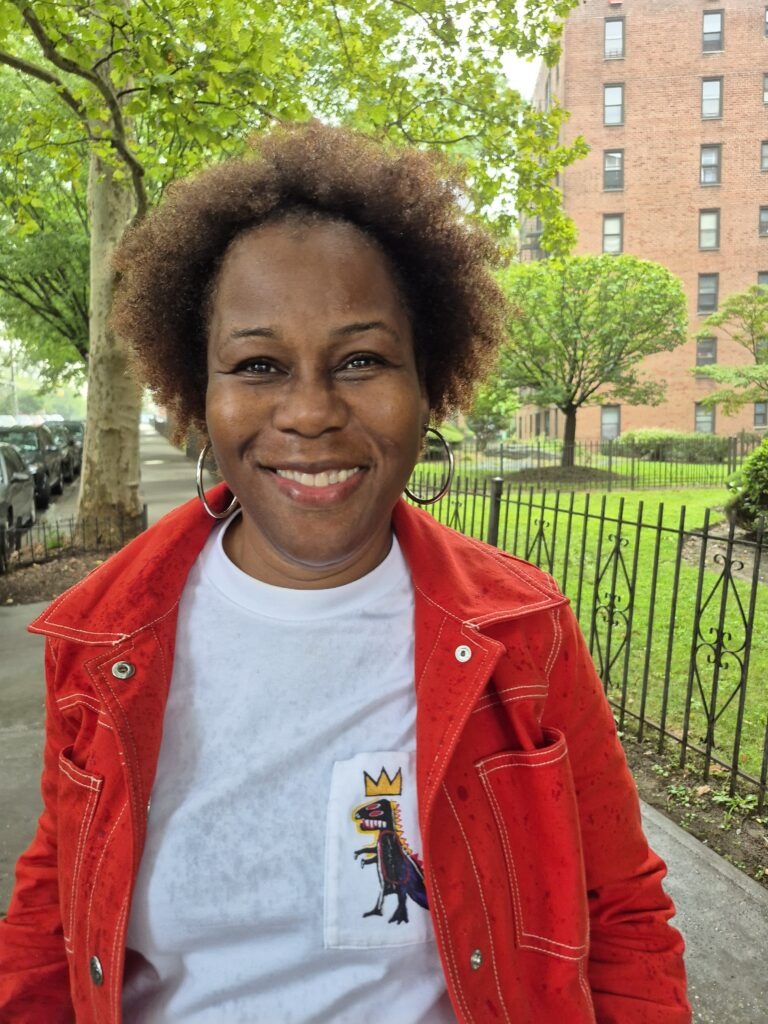
Along a Bronx street lined with apartment buildings, Colette Smith tends flowers growing in beds along the sidewalk.
She is quick to correct anyone who calls it her garden.
“It’s our garden,” Smith said.
The flowers have grown from seeds. Solar lights illuminate the beds after dark. Trees provide shade on hot days, when neighbors sometimes bring out lawn chairs.
For Smith, working in the soil provides something more.
She is a lung cancer survivor.
Colette Smith The Bronx, NY (Milton Kirby)
Cancer, she said, “can live in your head if you let it.” Even years after treatment, an upcoming scan or unexpected reminder can bring the anxiety rushing back.
“When I come out here and I play in the dirt and the soil, it quiets that,” Smith said. Working with something living and beautiful, she said, gives her a feeling of control.
These days, Smith is cultivating more than flowers.
She is trying to grow awareness about lung cancer in a borough where residents face significant health disparities, and where getting potentially lifesaving information to the people who need it can be a challenge.
On Sept. 19, HEAL Collaborative, with support from Amgen, Merck and Commonpoint Bronx, will hold a community conversation at Commonpoint Bronx, 1665 Hoe Ave. The program is scheduled from 9 a.m. to 12:30 p.m..
The gathering will focus on lung cancer screening and treatment while also addressing patient navigation, mental wellness, financial health literacy, medical debt and access to care.
But before residents walk through the doors, another part of the work is already taking place outside them.
It is happening on sidewalks, beneath elevated subway tracks and at bus stops.
Sometimes the conversation begins with a simple question:
Do you know someone who could benefit from this information?
Sometimes the answer is no.
Sometimes there are only minutes to discover that the answer is yes.
A Cancer She Wasn’t Expecting
Smith did not fit the image many people still associate with lung cancer.
She did not smoke.
Her cancer was discovered after an unrelated medical procedure. Smith said an elevated heart rate eventually led her to an emergency room, where doctors performed a CT scan while looking for blood clots.
Instead, they found nodules in her lungs.
Smith recalls being told that because she did not smoke, she should not worry about the nodules and should follow up in six months.
She didn’t wait.
Smith went to her primary-care physician. Another scan was performed about four months later, but questions remained.
Finally, Smith asked her doctor a different kind of question.
“If this were your wife, what would you do?”
She was referred to a cardiothoracic surgeon.
That encounter did not satisfy her either.
Smith eventually sought another surgeon and continued asking questions, including whether a biopsy could be performed before major surgery. The process ultimately confirmed lung cancer at an early stage, and surgery followed.
The Lung Cancer Foundation of America identifies Smith’s diagnosis as Stage 1A adenocarcinoma in 2015 and describes her as a never-smoker.
Her experience now informs one of the messages she carries into her community: lung cancer is not only a smoker’s disease, and patients sometimes have to push for answers.
“But I Don’t Smoke”
That message remains necessary.
During conversations with Bronx residents about the upcoming program, questions about lung cancer sometimes produced an immediate response:
They didn’t smoke.
In one encounter, two women responded that way after hearing about the Sept. 19 program.
The conversation turned to something they had not necessarily considered: people who have never smoked can develop lung cancer.
That does not mean every nonsmoker should receive routine lung cancer screening. Current screening recommendations generally target people at high risk based largely on age and smoking history.
But Smith’s experience illustrates why lung cancer cannot be viewed exclusively as a smoker’s disease.
One of the women described keeping up with other preventive health care, including mammograms and gynecological visits.
Another woman encountered during the outreach said she had been screened and was approaching her 50th birthday.
These encounters were not a scientific survey and cannot establish what Bronx residents generally know about lung cancer.
But they offer a glimpse of the challenge facing organizations trying to increase awareness.
Before someone can decide whether screening or additional information might be relevant, that person first has to understand why it could matter.
Smith has seen what can happen when that connection is made.
She recalled meeting a man during a neighborhood block party where she shared her cancer story.
Later, he returned with news.
“I heard your story and I went and got screened,” Smith recalled him saying.
According to Smith, doctors at Mount Sinai found a lung nodule and began monitoring it. The man smoked, she said, but Smith believes another part of their encounter was important.
He trusted her.
He heard the information from someone in his community and acted on it.
For Smith, that is what impact looks like.
“There are more stories out there like that,” she said. “We just need to find them or they need to find us.”
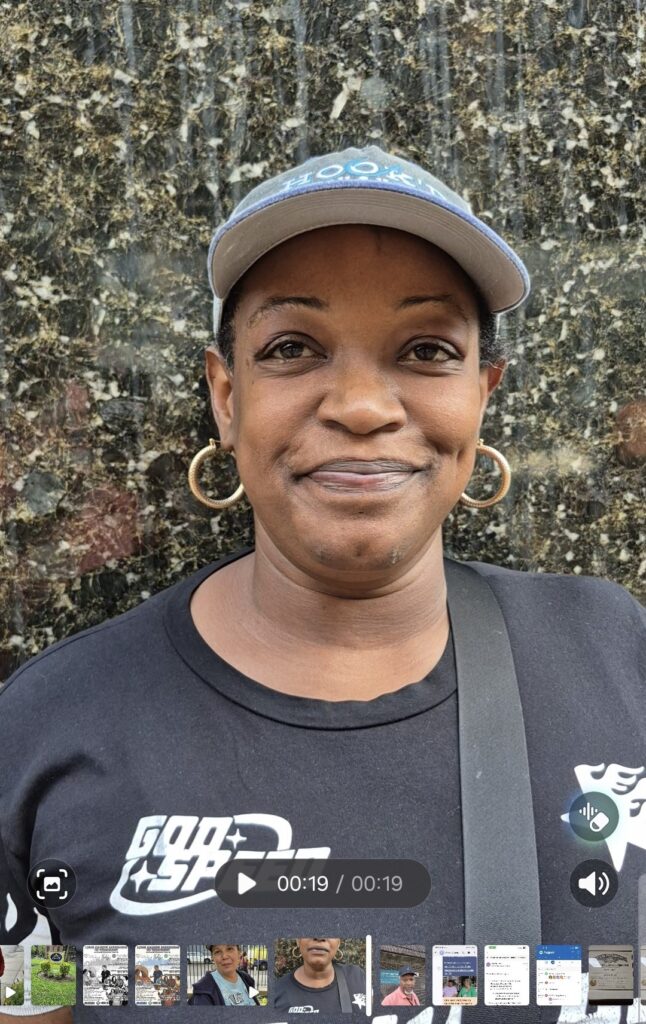
Ishawna Bridges, The Bronx, NY (Milton Kirby)
Ten Minutes at a Bus Stop
Under elevated subway tracks in the Bronx, the roar overhead and noise from the street made conversation difficult.
Ishawna Bridges was waiting for a bus.
There were perhaps 10 minutes before it arrived, only a brief window to tell her about the Sept. 19 community conversation on lung cancer screening and treatment.
Then the conversation changed.
Bridges said her mother has Stage 4 kidney and lung cancer.
“My mom’s has stage four kidney and lung cancer,” Bridges said during a brief recorded statement. “And I think this will be a good result and good information for me and my mom.”
She wanted to attend the Sept. 19 gathering and hoped her mother could attend as well.
Bridges discussed trying to get her mother there and possibly enlisting her brother’s help.
She carries other family responsibilities as well. Bridges said she has a nonverbal son with autism and another son with multiple sclerosis.
“I have a lot going on,” she said.
Then the bus came.
A woman who had been waiting for public transportation was gone.
But in those few noisy minutes beneath the elevated tracks, what began as an effort to tell a stranger about a community health program had connected with a family already confronting advanced cancer.
For Bridges, questions about cancer treatment were not theoretical.
They were already inside her family.
Her encounter illustrated something easily lost when community health is discussed in terms of programs, initiatives and statistics.
People have to be reached in the middle of their lives.
They are catching buses. Going to work. Caring for children and parents. Managing illnesses. Paying bills.
Sometimes there may be only 10 minutes to make the connection.
Lung Cancer and the Bronx
Traveling along the Bruckner Expressway offers another view of the Bronx.
Older brick apartment buildings line portions of the roadway, many with window air-conditioning units jutting from window after window. From the expressway, parts of the borough can appear caught between eras.
The view does not tell the whole story of the Bronx. But it offers a visible reminder that New York’s prosperity and modernization has not reached every neighborhood in the same way.
At the street level, however, another Bronx emerges.
People tend flowers along the sidewalk. They wait beneath elevated subway tracks for buses. They care for children and aging parents. And community advocates such as Colette Smith work to make sure their neighbors have information that could someday save a life.
It is against that backdrop that the Sept. 19 community conversation will take place.
The Bronx had an estimated 1.38 million residents in 2024. About 55% were Hispanic and nearly 30% were non-Hispanic Black, according to the New York State Department of Health. More than one in five Bronx families lived below the poverty line during the 2020-2024 period, and nearly 36% of children were living in poverty.
Lung cancer also cuts across racial and ethnic lines.
From 2020 through 2022, the age-adjusted lung cancer incidence rate in the Bronx was 38.5 cases per 100,000 residents, according to state health data.
The rate was highest among non-Hispanic White residents, at 53.6 per 100,000. It was 43.8 among non-Hispanic Black residents, 34.4 among Asian and Pacific Islander residents and 30.6 among Hispanic residents.
Those numbers are important because they prevent an oversimplification of the story: Black Bronx residents do not have the borough’s highest lung cancer incidence rate.
But incidence is not the only measure of disparity.
Across New York, Black people with lung cancer are less likely than White patients to have their disease diagnosed early, according to the American Lung Association’s State of Lung Cancer report.
The report also identifies disparities in survival and treatment among Black patients. Those findings provide a broader context for Smith’s concerns about the experiences of Black women with lung cancer.
Smith belongs to an affinity group of Black women who have experienced the disease. She said the group once included 32 women and that three have since died. Many, she said, experienced later-stage disease.
“We don’t get believed when we go to doctors’ offices and we describe symptoms,” Smith said. “We are not given diagnostic measures. We just get ignored.”
Smith’s experience cannot establish how frequently that happens throughout the health-care system.
But independent health data show that disparities in lung cancer diagnosis, survival and treatment exist.
The numbers and Smith’s experience arrive at the issue from different directions.
Together, they raise a question central to the Sept. 19 gathering: How do communities make sure people receive useful cancer information, and can act on it, before opportunities for early intervention disappear?
Four Organizations Behind the Conversation
That challenge is bringing together HEAL Collaborative, Amgen, Merck and Commonpoint.
Their support of the Sept. 19 community conversation brings health advocacy, private-sector resources and an established community presence together in one place.
But the larger question is not simply who supports a Saturday health event.
It is what happens afterward.
A community conversation can provide information for several hours.
Improving health outcomes requires people to know what to do with that information after they leave, where to go, whom to call and how to navigate the barriers between learning about screening and actually receiving appropriate care.
Smith believes part of the answer is trust.
She wants health outreach to happen in ways that feel natural to the community, including conversations and activities where residents feel comfortable asking questions. She has discussed bringing screening resources directly into neighborhoods.
She knows what can happen when people feel comfortable enough to listen.
One man heard her story.
Then he got screened.
Cancer Doesn’t End With Treatment
Smith’s advocacy did not end when doctors removed her cancer.
She said other lung nodules have been monitored for roughly 11 years. Some have disappeared or calcified.
Neither did her experience navigating the health-care system end after surgery.
Smith said an insurance company denied coverage for one of her surveillance CT scans about two years ago.
She challenged the decision.
“We got to fight them,” she said.
There was also the financial side of cancer.
Her husband’s earlier experience with prostate cancer prompted Smith to obtain disability and catastrophic-illness insurance and think more seriously about how the family would manage if she became seriously ill.
Two or three years later, she said, she received her own lung cancer diagnosis.
Because those protections were already in place, Smith said she was able to spend months recovering at home without the same fear about what she calls “financial toxicity.”
That experience helps explain why the Sept. 19 conversation extends beyond screening and treatment to mental wellness, financial health literacy and medical debt.
Cancer can begin with an abnormal scan.
Its consequences can spread into employment, household finances, transportation, caregiving and mental health.
Smith knows that.
So does Bridges.
But the two women stand at very different places in the cancer journey.
One is years beyond an early-stage lung cancer diagnosis and now spends part of her life encouraging others to seek information, ask questions and advocate for themselves.
The other is a daughter whose mother is confronting Stage 4 disease and who hopes a Saturday morning community conversation might provide information her family can use.
Between those experiences are Bronx residents whose relationship with cancer may not yet be known.
Some may be caring for someone with cancer.
Some may qualify for lung cancer screening.
Some may need help navigating treatment.
Some may be worried about what medical care will cost.
Some may simply hear something on Sept. 19 that becomes important later.
And others may never walk through the door unless somebody reaches them first.
Finding Each Other
Back on her Bronx block, Smith continues tending the flowers.
The garden gives her somewhere to put some of the anxiety cancer left behind. Her advocacy gives her somewhere to put the experience.
Smith believes there are other people who need to hear what she and other survivors have learned.
“We just need to find them or they need to find us,” Smith said.
A short distance away, beneath the elevated subway tracks, that challenge became literal.
Bridges was waiting for a bus.
The trains and traffic made it difficult to hear. Her mother has Stage 4 cancer. She had other family responsibilities waiting for her.
And there were perhaps 10 minutes to make a connection.
But the work of reaching people will continue after the chairs are put away.
Because somewhere in the Bronx, another person may be waiting for a bus, walking home, sitting beneath a shade tree or simply going about an ordinary day unaware that a conversation they have not yet had could someday matter.
Smith put the challenge more simply.
“We just need to find them or they need to find us.”
In the Bronx, perhaps they need to find each other.
The HEAL Collaborative is based in Atlanta, GA. To learn more, please visit: www.healcollaborative.org.
Valeria Howard Cunningham’s Power 50 honor reflects her leadership in preserving Black Western heritage, expanding the Bill Pickett Invitational Rodeo, and creating generational opportunities through cultural stewardship.
By Milton Kirby | Washington, D.C. | September 4, 2026
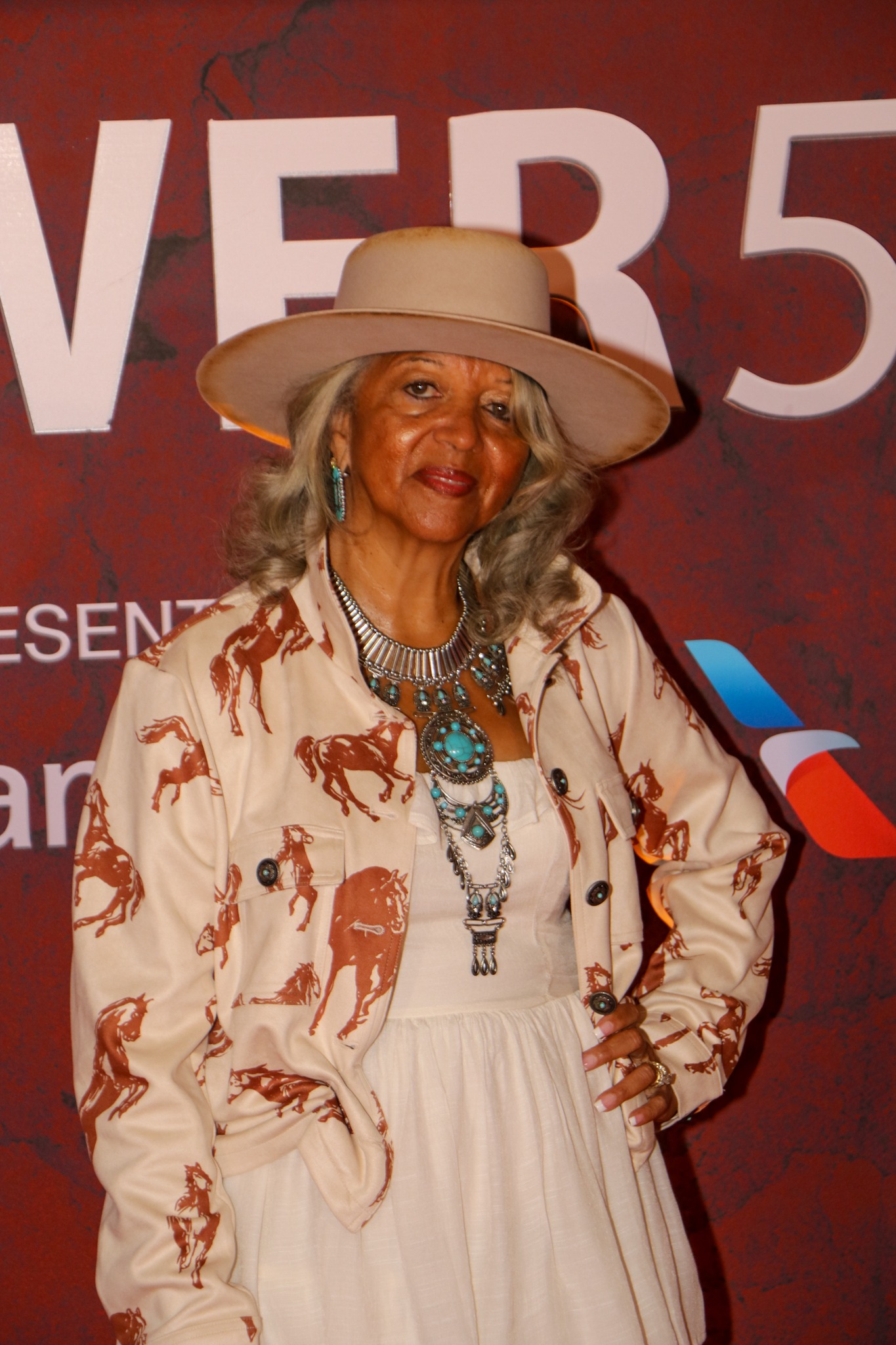
When Valeria Howard Cunningham was recognized as one of the U.S. Black Chambers, Inc. 2026 Power 50 Women of Influence, she was being honored for more than the title she holds.
For Cunningham, president and CEO of the Bill Pickett Invitational Rodeo, the recognition represented something else: responsibility.
“Being named a U.S. Black Chambers Power 50 Woman of Influence is both a tremendous honor and a humbling reminder of the responsibility that comes with leadership,” Cunningham told The Truth Seekers Journal.
That responsibility will soon bring Cunningham back to the Washington, D.C., area.
The return offers a fitting connection between recognition and responsibility: Washington celebrated Cunningham’s influence. In Upper Marlboro, audiences will see the institution she leads in motion.
That responsibility did not begin when she assumed the top leadership role.
Cunningham helped build the Bill Pickett Invitational Rodeo alongside her husband, founder Lu Vason, becoming deeply involved in both its business operations and cultural mission. After Vason’s death in 2015, she stepped into the lead role, assuming full responsibility for protecting the institution while guiding it into a new era.
She inherited the responsibility for an institution she had already helped shape.
What followed was the challenge of preserving its history, expanding its reach and ultimately defining what the organization would become under her leadership.
Taking the Reins
Vason founded the Bill Pickett Invitational Rodeo in 1984 after recognizing how rarely the contributions of Black cowboys and cowgirls were reflected in popular portrayals of the American West.
His answer was to create a rodeo where Black competitors could showcase their skills while audiences learned about a history many had never been taught.
Cunningham was part of building that vision.
She understood the business of the rodeo, its relationships and the cultural purpose behind it. But after Vason’s death, the responsibility changed.
The decisions were now hers.
So was the future.
She faced questions about whether the organization could survive the death of its founder and whether she could carry it forward.
Cunningham did more than keep it alive.
The national tour continued. Corporate and community partnerships were strengthened. Educational and cultural programming expanded. The organization developed initiatives connecting Black Western heritage with music, health, youth development and community engagement.
Today, the Bill Pickett Invitational Rodeo describes itself as the world’s only touring African American rodeo association. In 2026, it is celebrating its 42nd year while continuing to present Black cowboys and cowgirls before audiences around the country.
That transition from helping build the institution to becoming the person responsible for its direction reshaped Cunningham’s understanding of leadership.
“Success isn’t measured by the titles you hold,” Cunningham told TSJ.
Her measure is what happens because someone held the position: the lives affected, opportunities created and doors opened for others.
That philosophy helps explain why the Power 50 recognition carries significance beyond another honor for Cunningham.
Preserving History by Keeping It Alive
The U.S. Black Chambers’ Power 50 Women of Influence recognizes women whose leadership contributes to economic growth, social progress and generational impact.
Cunningham’s work touches all three, but perhaps nowhere is her influence clearer than in cultural preservation.
The American cowboy occupies an almost mythical place in the nation’s history. Yet the image created by generations of movies and television often left Black cowboys outside the frame.
They were never outside the history.
Black men worked as cowboys, ranch hands, horsemen and cattle drivers across the West after the Civil War. Their contributions helped build the cattle industry and Western communities, even as popular culture largely failed to tell their stories.
The Bill Pickett Invitational Rodeo challenges that omission every time it enters an arena.
History there is not presented behind glass.
It rides through the gate.
Young people can see Black cowboys and cowgirls competing in real time while encountering a Western history that includes people who look like them.
For Cunningham, that connection between past and future is essential.
Her work is not only about preserving history but ensuring that Black communities participate in telling it.
That means introducing another generation to the people whose contributions might otherwise disappear from public memory.
Creating Something for the Next Generation
Cunningham’s leadership has also extended well beyond the rodeo arena.
Through the Bill Pickett Invitational Rodeo Foundation, the broader mission includes scholarships, mentorship, educational programming, community engagement and youth development.
Among its programs is Rodeo for Kidz Sake, which introduces young people to Black Western history while giving them an opportunity to experience the rodeo and see Black cowboys and cowgirls in the arena.
The Foundation’s work reflects a basic principle running through Cunningham’s approach to leadership: influence has little value if it ends with the person who possesses it.
That same philosophy can be seen in the organization’s expanding cultural reach.
Under Cunningham’s leadership, BPIR has developed initiatives connecting Black Western heritage with music, including programs that create opportunities for emerging Black country artists and broaden the cultural experience surrounding the rodeo.
Health initiatives, youth programs and community partnerships have further extended the organization beyond competition.
The rodeo remains the centerpiece.
But the institution surrounding it has grown.
That growth changes how Cunningham’s Power 50 recognition can be viewed.
The honor places her among accomplished women from business, media, entertainment, finance, public service and other fields.
But Cunningham’s path is unusual.
Her platform is a rodeo.
Her classroom can be an arena.
And the history she is working to preserve includes people who helped build America but were largely absent from the version of the West generations of Americans encountered in popular culture.
That gives Cunningham’s leadership both a cultural and generational dimension.
The goal is not simply for audiences to remember Bill Pickett or Lu Vason.
It is for young people to understand that there is a history preceding them, and a place for them in the history still being written.
From Stewardship to Leadership
When Cunningham assumed full responsibility for the Bill Pickett Invitational Rodeo after Vason’s death, it would have been easy to describe her role simply as preserving her husband’s legacy.
More than a decade later, that description is incomplete.
Cunningham had already helped build the institution.
What came afterward required leadership of her own.
She had to lead competitors, families, sponsors and audiences through a transition after the death of the organization’s founder. She had to protect the history at the center of the rodeo while positioning BPIR for another generation.
She also had to decide where the organization could go next.
The continued national tour is one measure of that work.
The expansion of corporate and community partnerships is another.
So are the scholarships, mentorship programs, educational initiatives, youth development efforts and cultural programming that have widened BPIR’s influence beyond the arena.
Its ability to introduce new audiences to Black Western culture may be the most visible measure of all.
But Cunningham appears to measure her impact differently.
Not by titles.
Not simply by recognition.
But by what remains after the recognition is over.
That may explain why she described being named a Power 50 Woman of Influence as both an honor and a responsibility.
The award recognizes what she has already accomplished.
The responsibility concerns what she does next.
For Cunningham, that means continuing to tell a history too important to lose, creating opportunities for those coming behind her and ensuring that the institution she helped build is strong enough for another generation to inherit.
That work will continue Sept. 18 and 19 in Upper Marlboro, where the Bill Pickett Invitational Rodeo National Championship Finals will bring Black cowboys and cowgirls from across the country to The Show Place Arena for three performances and competition for more than $200,000 in cash and prizes.
AI chatbots feel private, but the information users share may be stored, analyzed, or retained. Understanding how AI tools handle data is essential for protecting personal and confidential information.
By Florita Bell Griffin, Ph.D. | Houston, TX | September 1, 2026
Millions of people now use artificial-intelligence chatbots for everything from writing emails to planning trips, organizing ideas, understanding medical terms, preparing résumés, and working through personal problems. The conversation often feels private because it appears on a personal screen and responds directly to the user. That feeling can lead people to type information they would never place in a public post. The important question is what happens to that information after it is entered.
AI systems need information in order to respond. When a user types a question, uploads a document, or shares an image, the system processes that material to generate an answer. Different services have different rules about how long information is stored, whether conversations may be used to improve models, who can access the data, and what privacy controls are available. This means users should not assume that every AI service handles information in the same way.
The safest approach is to think before sharing. A chatbot may be useful for drafting a letter about a financial dispute, but entering a full bank account number is usually unnecessary. It may help explain a medical report, but the user should consider whether names, addresses, identification numbers, and other personal details need to remain in the document. The same principle applies to tax records, legal documents, employee information, confidential business plans, and family matters.
People often reveal sensitive information gradually without realizing how much has accumulated. One question may include a first name. Another may mention an employer. A later message may include a city, a financial situation, or a family relationship. Each detail may seem harmless by itself, but together they can create a much clearer picture of the person.
This is especially important when using unfamiliar or free AI tools. A polished website does not automatically mean strong privacy protection. Users should look for information about data practices, account controls, retention policies, and whether conversation history can be deleted. Businesses should be particularly careful about entering confidential company information into consumer AI systems without knowing how that information is handled.
AI tools are also being built into email programs, office software, search engines, phones, and workplace systems. This can make the technology feel like a normal part of the environment, but convenience should not eliminate good judgment. Before pasting sensitive material into any AI system, ask whether the full information is necessary for the task.
Often, it is not. A person seeking help understanding a contract can remove names, addresses, account numbers, and signatures. Someone asking for help with a financial calculation can use rounded figures rather than exact identifying information. A worker seeking help with a difficult email can describe the situation without copying confidential internal messages word for word.
There is another reason to be careful. AI-generated conversations may feel temporary because they resemble spoken dialogue, but digital information can be stored, logged, backed up, or retained according to a service’s policies. Users should therefore treat important information with the same care they would use when sending an email or uploading a document to a website.
This does not mean people should stop using AI for personal or professional tasks. The technology can be extraordinarily useful. It can help organize thoughts, explain difficult concepts, improve writing, compare options, and reduce time spent on routine work. The wiser approach is to separate useful context from unnecessary exposure.
A good rule is to share what the AI needs to help, but not everything you know. Remove details that identify people when those details are not required. Avoid entering passwords, Social Security numbers, banking credentials, private medical identifiers, and confidential business secrets. Review privacy settings and understand whether conversation history can be managed or deleted.
The rise of AI has created a new kind of digital relationship. People are speaking to machines in a way that feels conversational, personal, and sometimes deeply private. That makes privacy awareness more important, not less.
Before typing something into an AI chatbot, ask one simple question: Would I be comfortable placing this information into another digital system if I knew it might be stored? If the answer is no, the information probably deserves another layer of protection.
The U.S. Black Chambers 2026 Power 50 Women of Influence honors Black women whose leadership, entrepreneurship and impact are shaping business and communities nationwide.
By Milton Kirby | Washington, D.C. |August 30, 2026
Inside The Ritz-Carlton in Washington, D.C., accomplished Black women from across the country gathered Monday, July 13th to be recognized for their influence.
They were executives and entrepreneurs, filmmakers and advocates, corporate leaders and community builders. Their professions differed, as did the paths that brought them into the room.
But throughout the U.S. Black Chambers, Inc. 2026 Power 50 Women of Influence luncheon, conversations kept returning to a larger question: What makes someone influential?
Nicole Parker had a straightforward answer.
“How you give, how you serve, how you show up.”
Parker, a member of the inaugural Power 50 class, was describing qualities behind an annual recognition of Black women whose leadership and impact extend across business, government, healthcare, finance, entertainment, technology, nonprofit leadership and other sectors.
Some of the women honored have names recognized far beyond their industries. Others have spent years doing consequential work with considerably less public attention.
That distinction is part of why the Power 50 exists.
Looking Beyond Familiar Names
Tiffany Murphy, who works with the Power 50 program, said its beginnings grew partly from noticing who was, and was not, receiving recognition.
“We realized the same Black female executives were getting recognized, but there were so many that were doing wonderful things,” Murphy said. “And that’s what essentially became the Power 50.”
The response to the program suggests just how many women fit that description.
Murphy said USBC received nearly 1,000 nominations for the 2026 class.
Organizers then faced the difficult task of narrowing that pool to the women who would receive the annual recognition. Despite the Power 50 name, Murphy acknowledged that organizers have found it difficult to limit the final class to exactly 50.
The number of nominations points to something larger than an awards program. There is no shortage of Black women leading companies, building organizations, influencing industries and serving communities. The challenge is making sure more of that work is seen.
Murphy believes the program itself is beginning to reach another stage.
“I think this is the first year it’s really kind of did its own thing,” Murphy said. “We’re five years in. It’s getting buzz. People are learning more about it.”
The 2026 class included women from a broad range of professions and experiences.
Cheryl Boone Isaacs, former president of the Academy of Motion Picture Arts and Sciences, was named Global Trailblazer of the Year. U.S. Rep. Jasmine Crockett was named Woman of the Year.
Isaacs made history in 2013 when she became the first African American to serve as president of the Academy. She now serves as founding director of the Sidney Poitier New American Film School at Arizona State University.
But national name recognition is not what defines a Power 50 honoree.
The class also includes women building businesses, creating nonprofits, opening professional pathways and working in communities where their names may never regularly appear in national headlines.
“How You Give, How You Serve, How You Show Up”
Parker has watched the Power 50 develop from its early years.
A small-business owner and USBC board member, she returned for the 2026 luncheon as a previous honoree supporting a new class of women.
“The Power 50 is just about women leading the movement, from women entrepreneurs to C-suite executives in all industries,” Parker said.
Asked what goes into identifying a Woman of Influence, Parker did not begin with titles, money or celebrity.
“They look at community,” she said. “They look at the impacts that you’ve done in your industry or in the community, how you give, how you serve, how you show up.”
Inside the luncheon, those qualities took different forms.
For one woman, influence meant turning a missing pathway into an opportunity for others.
For another, it meant recognizing the collective economic and creative power of Black women.
And for another, being honored for decades of work became a reminder that there was still more to do.
Creating the Opportunity She Once Needed
Agnes Moss knows what it is like to search for a professional pathway and not find one.
Moss, founder and president of the National Black Movie Association, once dreamed of working in film.
Agness Moss – Photo by Milton Kirby
While attending North Carolina Central University, she could see successful Black filmmakers such as Spike Lee and John Singleton. What she could not see was a clear path from college into a sustainable career in the industry.
“We didn’t have social media, so there was no direct path to get to a viable career in the film industry,” Moss said.
Her professional journey eventually took her into news, education, public relations and other fields. Still, the desire to tell stories through film remained.
Years later, Moss began asking herself what might have changed her own journey.
“How could my trajectory have been different?” she recalled. “What did I need?”
The answer helped shape the National Black Movie Association, a nonprofit that champions Black stories, promotes equity in film education and works to connect aspiring filmmakers, including students at historically Black colleges and universities, with opportunities in the industry.
Moss summarized the evolution of that work in one sentence.
“We used to advocate for opportunities in the film industry, but now we create them.”
Her experience offered one answer to the question of what influence can accomplish.
It can make sure someone coming behind you does not encounter the same closed door.
Kyra Hardwick – Photo by Milton Kirby
“We’re All Impact Makers”
Kyra Rénel Hardwick saw another kind of power in bringing accomplished Black women together.
Hardwick, founder of The Kyra Company, works with small businesses and corporations on operations and business development.
“Black women coming together and being honored for being amazing is top tier,” Hardwick said. “But the fact that we know we’re all impact makers is what makes this amazing.”
For Hardwick, the significance was not simply that individual women were receiving awards. It was what their collective presence represented.
“You get us in the same room and all this good energy, regardless of what our economic status is, regardless of what our economy is saying, we are innovators. We’re creators.”
The room represented women who had accumulated experience, relationships, resources and influence in different corners of American life.
Bringing them together created the possibility that individual influence could become collective impact.
Beth Powell – photo by Milton Kirby
Recognition Without Arrival
Beth Powell offered perhaps the clearest example of why recognition matters even to someone who has already accomplished much.
Powell is a Boeing 737 captain with American Airlines, as well as an author, emerging filmmaker and longtime community advocate.
She described being selected for the Power 50 as “incredible, humbling and, at the same time, inspirational.”
Her reaction also illustrated Parker’s earlier description of the qualities behind the recognition.
Powell said her community work spans more than 26 years. Yet when she looked around the gathering, she did not describe herself as someone who had arrived.
She saw women she admired.
“I see the vision, and that they believe in me, and that I will be like my heroes and sheroes someday,” Powell said.
It was a striking observation from a woman who had already been selected to stand among those she admired.
Recognition can acknowledge a body of work. But it can also tell recipients that others see something in them that they may still be working to see fully in themselves.
For Powell, selection to the Power 50 did not sound like an endpoint.
It sounded like another reason to keep going.
The Work That Remains
The Power 50 luncheon was built around recognition, but the conversations surrounding it repeatedly returned to responsibility.
Murphy talked about women whose work deserved to be seen.
Parker talked about giving, serving and showing up.
Moss talked about creating opportunities.
Hardwick talked about impact.
And Powell talked about work.
Together, their voices offered a definition of influence considerably broader than a job title or a place on an annual list.
Influence meant having enough experience to create a pathway for someone else.
Enough visibility to bring attention to work that matters.
Enough access to open a door.
And enough humility to recognize that receiving an honor does not mean the work is finished.
Powell returned to that idea as she reflected on what the gathering represented.
“We’re celebrating tenacity,” she said. “We’re celebrating the work. We’re celebrating the work within the community I’ve done over 26 years, and there is work that still remains to be done.”
For an event honoring some of the nation’s influential Black women, it was a fitting reminder of what the Power 50 recognition can mean.
Not merely reaching the room. But remembering who still needs a door opened.
Truth Seekers Journal thrives because of readers like you. Join us in sustaining independent voices.
Atlanta and MARTA reached a $52 million settlement ending their More MARTA funding dispute, shifting attention from competing audits to promised transit improvements.
By Milton Kirby | Atlanta, GA | August 28, 2026
The City of Atlanta and MARTA have reached a $52 million settlement ending a years-long dispute over how money collected through the voter-approved More MARTA Atlanta sales tax was allocated for enhanced bus service.
The agreement resolves a disagreement that produced dramatically different conclusions about how much money should have been returned to the More MARTA account.
A city-commissioned audit concluded that MARTA had overcharged the program by approximately $70 million. MARTA disputed that finding, and a later assessment by accounting firm KPMG calculated the amount at approximately $865,630.
The final settlement landed between those figures, but considerably closer to the city’s calculation.
MARTA has already transferred $19.37 million from the MARTA Reserve Account to the More MARTA Atlanta Reserve Account. Under the settlement, MARTA will transfer another $32.63 million in monthly installments, with the full amount transferred no later than Aug. 31, 2028.
The $52 million represents the full and final resolution of the disputed amounts involving More MARTA sales-tax proceeds used for enhanced bus service.
“This agreement puts a long-running dispute behind us and allows us to put our full focus where it belongs, delivering the transit investments Atlantans voted for,” Mayor Andre Dickens said in announcing the agreement.
Dickens credited MARTA General Manager and CEO Jonathan Hunt, MARTA Board Chair Jennifer Ide, Atlanta City Council Transportation Committee Chair Alex Wan and the staffs of both organizations with reaching the settlement.
“We can disagree, work through difficult issues and still find a way forward,” Dickens said. “This resolution protects Atlanta’s investment and gives us a stronger foundation to work together on the transit system our residents and region deserve.”
How Did $70 Million Become $865,630?
At the center of the dispute was not an allegation that MARTA spent More MARTA money on something unrelated to transit.
It was an accounting disagreement over how much of Atlanta’s More MARTA sales-tax revenue should have been charged for operating enhanced bus service and how much should have remained available for capital projects.
Atlanta voters approved an additional half-penny sales tax in 2016 to expand and improve transit within the city. Collections began supporting enhanced service in 2017.
As the program developed, MARTA charged More MARTA for service improvements above an established baseline, including increased frequency on bus routes.
Questions about those calculations eventually led the Atlanta City Council in 2023 to seek an audit of the program.
Accounting firm Mauldin & Jenkins examined More MARTA from its inception through June 30, 2023. Its report concluded that MARTA had charged approximately $70 million more than it should have for enhanced bus service.
MARTA strongly disputed the finding.
The transit agency argued that the methodology used to reach the $70 million figure failed to properly account for changes in transit service, particularly when MARTA reduced service throughout the system during the COVID-19 pandemic.
A subsequent KPMG assessment examined the competing methodology.
KPMG concluded that the original approach to allocating enhanced-service costs worked during the program’s early years, when service was primarily being added in Atlanta. But that methodology became less appropriate after service reductions occurred throughout MARTA’s larger system.
Under the earlier approach, reductions elsewhere in the MARTA system could affect calculations involving Atlanta’s More MARTA operating fund even when those reductions were not caused by changes to Atlanta service.
KPMG recommended a proportional methodology designed to distribute service changes more broadly across the transit system.
Using that approach, the amount calculated as due to the More MARTA capital fund was approximately $865,630.
That left Atlanta and MARTA tens of millions of dollars apart.
City officials continued to stand behind the original audit.
MARTA maintained that the city’s calculation was based on a flawed methodology.
The settlement announced Thursday resolves that argument at $52 million.
No Declaration of a Winner
The numbers make the agreement noteworthy.
The settlement is approximately $18 million below the nearly $70 million identified in Atlanta’s audit.
But it is more than $51 million above the approximately $866,000 calculated under the later KPMG methodology.
The agreement does not say MARTA admitted that Atlanta’s audit was correct.
Nor does the settlement erase the competing conclusions reached during the dispute.
Instead, the city and MARTA describe the $52 million as the full and final resolution of all disputed amounts related to More MARTA sales-tax proceeds allocated for enhanced bus service.
That distinction is important.
The settlement resolves what MARTA will transfer to the More MARTA account. It does not necessarily resolve which accounting methodology should be considered correct.
Disagreement Spilled Into Public View
What began as an accounting dispute eventually contributed to broader tension between Atlanta City Hall and MARTA.
One of the most visible flashpoints involved the planned transformation of Five Points Station, the downtown hub connecting MARTA’s north-south and east-west rail lines.
In June 2024, Dickens asked MARTA to pause work on the approximately $230 million Five Points project while questions surrounding More MARTA and other concerns were being addressed.
Although MARTA and the city later announced plans to move the project forward, disagreement developed over permits needed for construction.
Records later reported by The Atlanta Journal-Constitution showed city officials telling MARTA representatives that resolving the More MARTA audit and moving the permits forward were linked. Dickens publicly denied that his administration was withholding permits because of the audit.
By March 2025, the disagreement had become unusually public.
Dickens appeared before MARTA’s board as city and transit officials offered conflicting accounts about permits, meetings and communications between the organizations.
The new settlement provides an opportunity to change that relationship.
“Resolving this matter provides greater certainty for both MARTA and the City and allows us to continue moving the More MARTA Atlanta program forward,” Hunt said.
Hunt was named MARTA’s permanent general manager and CEO earlier this month after serving approximately a year in the position on an interim basis.
“Our customers are best served when MARTA and the City are working together in a collaborative fashion,” Hunt said. “This agreement gives us an opportunity to turn the page, strengthen that partnership and focus on making meaningful improvements to our system while delivering safe and reliable transit for the people of Atlanta.”
Where Does the $52 Million Go?
Despite the size of the settlement, MARTA is not writing Atlanta a $52 million check for the city’s general budget.
The money is being transferred between MARTA-administered accounts.
MARTA previously moved $19.37 million from the MARTA Reserve Account into the More MARTA Atlanta Reserve Account. The remaining $32.63 million will be transferred through monthly installments by Aug. 31, 2028.
Those funds will then be available for future More MARTA projects and other program priorities.
The distinction matters because the settlement is ultimately about transit money and where within MARTA’s financial structure that money belongs.
It also raises a broader question.
Moving $52 million into More MARTA means those dollars will not be available for other MARTA purposes.
MARTA officials have indicated the agreement is not expected to affect the agency’s operating expenses, but it could reduce money available for systemwide state-of-good-repair projects. The agency could have to defer or reduce some projects, identify savings or consider financing alternatives.
Those decisions have not been finalized.
A Promise Made by Voters
For Atlanta residents, the larger issue extends beyond the accounting disagreement.
In 2016, voters approved the half-penny More MARTA sales tax to make a substantial long-term investment in the city’s transit system.
The program was envisioned as a way to expand transit and improve mobility throughout Atlanta. An initial collection of dozens of possibilities was eventually narrowed to 17 projects approved by MARTA’s board in 2018.
Those plans have changed over time as construction costs increased, priorities shifted and projects were reconsidered.
Progress has also been uneven.
The Summerhill Bus Rapid Transit project and the NextGen Bus Network have been among the most visible More MARTA initiatives moving toward delivery, while several other projects originally envisioned under the program remain years away or have changed significantly from their original concepts.
That history makes Atlanta City Council Transportation Committee Chair Alex Wan’s emphasis on accountability particularly relevant.
“Atlanta voters made a significant investment in the future of transit when they approved More MARTA, and we have a responsibility to make sure those dollars are accounted for and deliver the improvements residents were promised,” Wan said.
“This settlement provides needed resolution and allows all of us to move forward with greater accountability, transparency and focus on delivering projects.”
MARTA Board Chair Jennifer Ide similarly described the settlement as an opportunity to rebuild the working relationship between MARTA and the city.
“This settlement reflects the kind of responsible governance our customers and taxpayers should expect,” Ide said.
“The Board appreciates the work by both parties to reach a resolution that provides clarity, closes this chapter and creates an opportunity for a stronger working relationship between MARTA and the City of Atlanta.”
From Accounting to Accountability
The settlement answers a question that has followed MARTA and Atlanta for more than two years.
The amount is $52 million.
But resolving the accounting dispute creates another test for both organizations.
The settlement announcement does not specify which More MARTA projects will receive the additional money now being committed to the program.
That means the next phase of the story will not be decided by auditors.
It will be measured by what gets built.
Nearly a decade after Atlanta voters approved an additional sales tax to expand and improve transit, MARTA and the city have agreed on how much money will resolve their dispute.
Now they must show Atlantans what that $52 million will deliver.
Support open, independent journalism. Your contribution helps us tell the stories that matter most.
A lung cancer summit taught Jacqui and Donel King about biomarker testing, helping them
By Milton Kirby | Old Hickory, TN | August 25, 2026
Jacqui and Donel King were attending a lung cancer summit in New Orleans when, near the end of the event, Jacqui stopped at an information table.
One card remained on the table.
It looked ordinary, about the size of a business card, folded like a small tent. There was nothing about its appearance to suggest that the information inside would soon become worth its weight in gold to the Kings.
Inside was information about biomarkers associated with lung cancer and questions patients could take to their doctors to get answers.
Jacqui picked up the last card brought it home and then took it to her husband’s next appointment with his oncologist.
What happened next helped change the conversation surrounding Donel King’s Stage 4 lung cancer diagnosis.
The Kings walked into the appointment prepared to ask whether biomarker testing had been performed.
It had.
They just didn’t know it.
The testing had identified a KRAS G12C mutation in Donel’s cancer, a molecular characteristic for which a targeted treatment was available.
For Jacqui, the moment demonstrated something she now believes every patient and caregiver needs to know and understand.
“You don’t know how to advocate for yourself if you don’t know what it is that you’re looking for,” she said.
Before Cancer Took Center Stage
Cancer is now part of the Kings’ daily lives.
But that’s not where their story began.
Donel and Jacqui met in Houston more than three decades ago. Both were single parents, and their marriage brought together a blended family.
Jacqui’s life became increasingly centered on ministry and leadership in the United Methodist Church. Donel describes his role throughout much of their marriage as supporting that calling while pursuing his own entrepreneurial interests.
Their life together took them through Texas, Tennessee and Illinois.
They also endured major events long before lung cancer entered their lives.
While serving in Port Arthur, Texas, the Kings experienced the devastating 2005 hurricane season. Their church and community dealt with families displaced by Hurricane Katrina and then faced hurricanes that affected their own area.
Jacqui remembers the period as one of ministry, survival, rebuilding and prayer.
Donel brought another life experience to the marriage.
He is an Air Force veteran who served in air traffic control.
Donel would learn much later in life that he was dyslexic, finally putting a name to difficulties he had experienced years earlier. Decades later, cancer would confront him with another lesson about the power of knowing exactly what you are dealing with.
He also spent years as an entrepreneur and describes himself as someone who enjoys technology, business, gardening and community service.
He calls himself a “Renaissance man.”
And cancer was not completely new to him.
Donel was diagnosed with prostate cancer in 2009 and underwent removal of his prostate.
They were unaware that years later, another cancer was growing inside him.
A Fall Changes Everything
By 2025, Donel had experienced pain in his shoulder and hip. A simple X-ray had not revealed the cause.
He underwent regular physical examinations and was frustrated that nothing had identified the cancer earlier.
Then, in October 2025, while the Kings were living in Springfield, Illinois, Donel’s leg gave way while walking down a flight of stairs.
He fell. The fall fractured his femur and badly damaged his hip.
Further medical evaluation revealed something far more serious.
Stage 4 lung cancer.
The cancer had spread beyond his lung, metastasizing to his hip and shoulder. Donel could no longer walk.
Their lives changed almost immediately.
Physicians in Illinois told the couple Donel needed specialized orthopedic oncology care that was not available locally. They worked to get him back to the Nashville area, where he could receive care through the VA and other specialists.
After returning home, Donel entered rehabilitation while doctors simultaneously confronted the cancer and the severe damage to his hip.
The first biopsy in Illinois failed to provide enough tissue for all of the testing doctors needed, Jacqui said.
Then came major surgery.
Rebuilding a Hip While Fighting Cancer
On February 18, 2026, Donel underwent an operation to reconstruct his hip and pelvis.
He remembers an eight-hour surgery that would begin rebuilding the structure of an extensively damaged hip that might allow him to walk again.
Doctors also obtained additional tissue. That tissue would later become important to Donel’s cancer story
Meanwhile, Donel begin cancer treatment that consisted of radiation, chemotherapy and infusion therapy. Donel remembers what chemotherapy did to him physically.
His hair disappeared.
So did the black beard he loved.
Jacqui looked at him during the interview and offered a reminder of what mattered more.
“But he’s still here.”
Donel responded:
“I’m still here.”
But the treatments were difficult the cancer was not responding as they had hoped.
Jacqui was began her search for treatment options, something she knows how to do.
Jacqui Starts Looking for Answers
Jacqui had previously researched lung cancer resources after the wife of a colleague was diagnosed with lung cancer.
When Donel was diagnosed, she returned to that research.
This time, she searched specifically for organizations working with African Americans and lung cancer.
HEAL focuses on health education and advocacy, including efforts to provide patients and caregivers with information they can use to navigate cancer care. Its lung cancer resources include information about screening, treatment, clinical trials, biomarker testing and self-advocacy.
Jacqui contacted the organization and learned about HEAL’s annual Lung Cancer Patient & Caregiver Summit.
The Kings registered and began planning their trip to attend HEAL’s 2026 3rd Annual Summit in New Orleans.
The 2026 gathering was designed specifically to address the needs of Black communities affected by lung cancer. HEAL brought patients and caregivers together with healthcare professionals, researchers, advocates and community leaders for discussions about early detection, personalized treatment, clinical trials and patient advocacy.
For Donel and Jacqui, those subjects were not theoretical.
They were living them.
Getting to New Orleans was not automatic.
Donel had recently undergone major surgery and needed medical clearance to travel.
They got it.
And they went.
That trip would introduce the Kings to a word that would become central to their cancer journey:
Biomarker testing.
What Is a Biomarker?
Cancer is not necessarily the same disease in every person who receives the same broad diagnosis.
A biomarker is a biological characteristic that can provide doctors with information about a cancer. In some cancers, testing can identify specific molecular changes that may help physicians determine whether a targeted treatment is appropriate.
For a patient, the distinction can be simplified.
Biomarker Individual Results
A cancer diagnosis identifies the disease.
Biomarker testing tells doctors more about the particular characteristics of that patient’s cancer.
And targeted therapy acts against a particular target or characteristic.
The Kings did not understand that distinction before New Orleans.
The Last Card on the Table
At the Summit, the Kings attended a breakout session about biomarker testing.
The message they carried away was direct: patients with lung cancer should ask for a biomarker test that will provide information about the specific characteristics of their cancer, so their doctor can consider more personalized treatment options.
That was what sent Jacqui to the Amgen table, one of the pharmaceutical companies supporting the Summit.
There she found the wallet-sized card containing information about biomarkers associated with non-small cell lung cancer. Jacqui took the last one on the table.
She decided that when they returned home, the card was going with them to Donel’s next oncology appointment.
They were going to ask questions.
But the story took an unexpected turn.
The Kings did not return home, request biomarker testing and then wait for a laboratory to perform it.
The testing had apparently already been done.
They simply did not know it.
“An Awakening on Both Sides”
Additional tissue obtained during Donel’s hip surgery had been sent for laboratory analysis.
By the time the Kings walked into the oncology appointment with their card, biomarker testing had identified KRAS G12C in Donel’s cancer.
Jacqui remembers putting the card into the conversation and learning that the result was already there.
She called the moment “an awakening on both sides.”
NSCLC – Results
The Kings had arrived intending to ask whether the test should be performed.
Instead, the conversation became about what the completed test had found and what could be done with that information.
The KRAS gene helps regulate cell growth. Some cancers carry a particular alteration known as KRAS G12C.
That distinction mattered because medicines have been developed to target KRAS G12C.
One of those targeted treatments is Lumakras, or sotorasib, manufactured by Amgen.
The U.S. Food and Drug Administration approved Lumakras in 2021 for certain adults with KRAS G12C-mutated locally advanced or metastatic non-small cell lung cancer who have received at least one prior systemic therapy. The FDA labeling calls for patients to be selected based on the presence of the KRAS G12C mutation determined by an FDA-approved test.
That is the type of targeted treatment Donel’s biomarker result made possible for his physicians to consider.
The medication is not a cure.
Donel understands that.
But to him, it represented another option.
The “Silver Bullet”
Donel has his own name for the treatment.
He calls it his “silver bullet.”
He is quick to explain what he means.
He does not believe the pill simply makes Stage 4 cancer disappear.
His hope is that the therapy can stop the cancer from progressing or cause tumors to shrink.
Donel says he feels much better since moving away from chemotherapy and beginning the targeted treatment.
He is also being monitored.
Blood work is part of his routine. CT scans will help his physicians determine whether the tumors are shrinking, remaining stable or progressing.
Asked what he wants those scans to show, Donel did not give a complicated answer.
“My hope is that it’s not moving,” he said. “That’s my goal.”
Caregiving Wasn’t in the Retirement Plan
The story is not Donel’s alone.
Cancer changed Jacqui’s life too.
Her retirement was supposed to begin a different season.
Instead, she became caregiver, researcher, medical navigator, household manager and advocate while simultaneously dealing with grief and a major move.
Her mother had been ill and died during the same larger period of upheaval.
The Kings were also moving back from Illinois to Tennessee.
Donel was in hospitals and rehabilitation facilities.
Jacqui dealt with packing, moving, selling a house, setting up their Tennessee home, arranging medical equipment and keeping track of appointments.
“Caregiving wasn’t on my retirement,” she said.
At another point she summed up the experience even more simply:
“There’s no script for this.”
Yet sitting with the Kings revealed something that a list of caregiving responsibilities could not.
After more than 30 years of marriage and 33 years as a couple, Donel and Jacqui still displayed the easy affection of people discovering each other. They finished each other’s sentences and sometimes started the same thought at the same time. They gazed at one another as the other spoke. More than once, Jacqui looked at Donel, smiled and seemed, for a moment, almost giddy.
It was an unexpected sight in an interview about Stage 4 lung cancer.
Their story was about biomarker testing, targeted therapy and caregiving. But sitting across from the Kings, another story was unfolding in plain sight.
This was also a love story.
The couple learned to accept help.
Friends and colleagues organized meals.
Neighbors helped with equipment.
The VA helped with transportation to medical appointments.
Their church and broader community prayed.
And Jacqui learned something caregivers sometimes resist.
“You can’t do it by yourself,” she said.
Information Is Only Half the Job
The Kings credit HEAL Collaborative with putting information in front of them that they did not previously understand and how to be your own advocate.
But Jacqui believes attending a conference is not enough.
“If you get the information, that’s half of the game because then you’ve got to follow through,” she said.
In the Kings’ case, the chain is unusually clear.
HEAL created the setting where they learned why biomarker testing mattered.
At an Amgen table, Jacqui picked up the last card explaining what they should ask about.
Back home, that question led them into a conversation about a KRAS G12C result already in Donel’s medical record.
And that result helped identify a targeted treatment option.
But none of those steps happened in isolation.
Information had to reach the patient.
The patient and caregiver had to understand why it mattered.
They had to take that information back to the people providing Donel’s medical care.
And physicians had to determine the appropriate treatment.
That may be the central lesson of the Kings’ experience.
The laboratory had information about Donel’s cancer.
His medical team had access to that information.
The Kings had attended appointments.
What changed after New Orleans was their ability to participate in the conversation differently.
They knew the word biomarker.
They had a card.
They had questions.
And they knew they were supposed to ask them.
There is an important nuance.
The Kings’ account does not establish that Donel’s physicians had overlooked the biomarker result or would not have discussed targeted therapy without the card. Jacqui said the medical team appeared to be preparing to talk with them about what could come next.
What the Summit and the card clearly changed was the Kings’ understanding of the conversation.
They arrived knowing what to ask.
Tennessee Expands Biomarker Coverage
The Kings’ experience comes as Tennessee is changing its insurance rules surrounding biomarker testing.
Tennessee enacted legislation in 2026 requiring specified health plans to provide biomarker-testing coverage beginning with plans issued, amended or renewed on or after January 1, 2027. The law includes TennCare coverage when biomarker testing is medically necessary.
The law does not mandate biomarker testing to screen people without symptoms. Its coverage provisions address testing used for diagnosis, treatment, disease management or monitoring when applicable requirements are met.
The distinction is important.
Lung cancer screening and biomarker testing are not the same thing.
Screening is intended to identify lung cancer in people who meet established eligibility criteria before symptoms develop.
Biomarker testing can help physicians make treatment decisions after cancer is identified.
For the Kings, understanding those differences has become part of learning to navigate cancer.
The Losses Cancer Creates
Stage 4 cancer has taken more from Donel than hair.
It took mobility.
For months he could not walk.
It interrupted his businesses.
It pulled him away from volunteer work, gardening and the other activities of a man who describes himself as hands-on.
Donel calls those losses a form of grief.
He had been an active man.
Suddenly, much of his life required other people to do things for him.
“For the moment, I just said, well, I just got to step back and take my hands off of them and just kind of go with the flow,” he said.
Still, optimism comes easily to him.
He calls himself a “perpetual optimist.”
“When I see manure, I’m looking for the pony,” he said.
That optimism now has specific goals.
One is walking again.
Donel continues physical therapy and believes he is getting closer.
Another is traveling.
During one appointment, someone asked him a question he was not expecting:
What are you going to do with the time you have?
It stopped him.
Now he has answers.
He wants to take a train across the country.
He wants to travel.
He talks about Egypt.
Cancer has forced him to think about time differently.
Faith, Medicine and the Road Ahead
Faith runs through nearly every chapter of the Kings’ story.
Jacqui is a minister.
Donel speaks openly about God.
They describe prayer surrounding his surgery, treatment and recovery.
But their faith has not meant waiting passively.
Jacqui searched.
They traveled.
They listened.
They carried information home.
They asked questions.
Donel continued treatment.
Jacqui continued caregiving.
And both continued learning.
They see no contradiction between prayer and medicine.
For Jacqui, vulnerability also became part of the lesson.
When people ask how things are going, caregivers do not always have to say everything is fine.
Sometimes, she said, the answer needs to be:
Not great today.
I need help today.
Healing, she believes, sometimes requires letting other people into the struggle.
For Donel, the future remains uncertain.
Stage 4 lung cancer is still Stage 4 lung cancer.
The next CT scan matters.
So does the next physical therapy session.
So does the possibility of taking another step without assistance.
But he is no longer talking only about treatment.
He is talking about where he wants to go.
What he wants to see.
What he wants to do with the days in front of him.
Cancer has forced Donel King to surrender control over much of his life.
It has not taken his sense of possibility.
“I’m alive,” he said. “God has spared me another day. And I’m just going to get up and do the best I can with that day.”
And for now, he is waiting for the next scan with one straightforward hope:
“My hope is that it’s not moving.”
The HEAL Collaborative is based in Atlanta, GA. To learn more, please visit: www.healcollaborative.org.
This column exists for one reason: to answer your questions about Negro League baseball history. To fulfill that mission, we need your help.
If you read and enjoy this column, want it to continue, and haven’t already mastered every corner of Negro League history, we invite you to send us your questions. Your questions are the lifeblood of Shadow Ball—they determine where we go next—from players and teams to memorable games, historic events, and everything in between.
By submitting a question, you help shape the future direction of this column. Your participation is both important and greatly appreciated. In many ways, the continued existence of Shadow Ball depends on readers like you.
Joe Pomrenke, Harrisburg, PA posted: “I’d like to learn more about the famous 1933 East-West Classic.” Accordingly, today’s Shadowball column will endeavor to satisfy Joe’s curiosity/interest. Much of my knowledge on this subject comes from the research/writings of Lyle Spatz, Larry Lester, and Bob Lemoine. Lastly, I need to thank former APBA Game Company President Fritz Light, current President John Herson, and the late Negro League historian James A. Riley.
Major League Baseball hosted its initial all-star game on July 6, 1933, in Chicago’s Comiskey Park very much in conjunction with the 1933 Chicago World’s Fair. It was that international fair’s desire to incorporate some sort of athletic event into international exposition that sparked the imagination of Chicago Tribune Sports Editor Arch Ward. Due to his flamboyant promotional style Ward was known as ‘the Cecil B. DeMille of Sports”. In addition to the Major League Baseball All-Star game, Mr. Ward was instrumental in the creation of Golden Glove boxing (1928), the annual College All Star Football Game (1934), the initial professional World Basketball Tournament (1939), the All-American Football Conference (1946), as well as lesser events such as speed skating competitions, bowling tournaments and charity horse racing events.
The MLB game attracted a bigger crowd than the Negro League game but that was not always the case as Negro League attendance topped 40,000 on 8 separate occasions and outdrawing the Majors on several instances.
Willie Foster is the only pitcher to hurl a complete game in any all-star game on either side of the color line
Hall of Famers Babe Ruth and Mule Suttles hit the first HR in each of these inaugural events
Finally, 21 Hall of Fame players, two Hall of Fame managers, and two Hall of Fame umpires appeared in the July 6th NL/AL matchup. In contrast, only 12 Hall of Fame players (including East Manager Pop Lloyd appeared in the Negro League game underscoring my recurring theme of all Shadow ball articles – in order to properly represent the history of the National Pastime prior to 1947 the National Baseball Hall of Fame must induct more Negro League players. A good starting point would be the five Negro Leaguers that appeared in the September 10 game that have been on one or more Hall of Fame ballots and appeared in this first game: Rap Dixon, Dick Lundy, Fats Jenkins, Alex Radclif, and Vic Harris.
To finish this topic, utilizing the computer version – Baseball for Windows – of the APBA Major League Baseball Game I simulated several hundred All Star games between Major League Hall of Fame teams circa 1933 versus a team of Negro League Hall of Famers from that same era. The below line score provides some detail of a representative game that, in my imagination, took place in the afterglow of the July 6 and September 10th game. Of the 600 games that I simulated — the traditional Major League team won 301 times (50.2%) but was outscored by 72 runs over the 600-game schedule. In other words, the level of talent was identical on both sides of the color line just as I believe it actually was during baseball’s segregated era (1876-1946).
October 8, 1933
123 456 789 RHE
NeL 300 011 020 713 0 LP –William Bell
MLB 000 322 02 9 12 0 WP –Carl Hubbell
HR Gibson, NeL, Gehrig, Foxx, Klein
Attendance: 32, 634, 734 imagined
The Negro League out hit the traditional Majors 13 to 12 but left 7 baserunners on base whereas the trads left only 3
Rap Dixon threw out the Fordham Flash – Frankie Frisch – at home for the last out in the 8th.
The two squads hit for combined .262 batting average over the 600 simulated games … Babe Ruth out homered Josh Gibson 132 (34 per 154g) to 104 (27 per 154g)
Cool Papa Bell led the way with 28 steals beating out Oscar Charleston, 18, and Rap Dixon, 15.
Satchel Paige won the most games 73 and posted the highest winning percentage 55% while leading the way in shutouts 8 and strike outs 903
Readers can expect to see more use of the APBA/BBW simulator in upcoming articles.
Last Week’s Shadow Ball Significa Question of the Week
Who was Jackie Robinson’s Manager on April 15, 1947? No one offered at this query … it was Burt Shotton who led the Dodgers to pennants in ’47 and ’49.
Ted Knorr
This Week’s Shadow Ball Significa Question of the Week
What was the name of Atlanta’s most prolific franchise (in terms of years in the league) in the Negro Leagues?
Ted Knorr is a Negro League baseball historian, longtime member of the Society for American Baseball Research’s Negro League Committee, and founder of the Jerry Malloy Negro League Conference and several local Negro League Commemorative Nights in central Pennsylvania. You can send questions for Knorr on Negro League topics as well as your answers to the week’s Significa question to shadowball@truthseekersjournal.com or Shadow Ball, 3904 N Druid Hills Rd, Ste 179, Decatur, GA 30033
By Florita Bell Griffin, Ph.D. | Houston, TX | August 25, 2026
One of the biggest promises of artificial intelligence is time. AI can draft a letter in seconds, summarize a long document, explain an unfamiliar subject, create a travel plan, organize notes, compare products, and generate ideas almost instantly. Tasks that once required an hour may take only a few minutes.
That efficiency is real, and for many people it is one of the most valuable benefits of the technology. The more difficult question is what happens when people begin using AI not only to save time, but to avoid thinking.
There is an important difference between assistance and substitution. A calculator can help a person solve a difficult equation, but someone who never learns basic arithmetic becomes dependent on the calculator. GPS can help a driver reach an unfamiliar destination, but constant reliance on navigation may weaken the ability to remember routes. AI can help a person write more clearly, but if it begins producing every message, report, and idea, the user may gradually stop developing a personal voice.
This does not mean AI makes people less intelligent. Used well, it can do the opposite. A student can ask for a simpler explanation of a difficult concept. A reader can request examples that make an unfamiliar idea easier to understand. A business owner can use AI to organize scattered thoughts before making a decision. A traveler can compare several options quickly and spend more time considering which one actually fits.
The difference lies in how the technology is used. Asking AI to explain something is different from asking it to think in your place. A person who reads an AI summary and then examines the original material is using the tool to accelerate learning. A person who reads only the summary may be trading understanding for convenience.
The same issue appears in writing. AI can help someone organize ideas, improve grammar, or find a clearer way to express a thought. That can be especially useful for people who struggle with writing or who have strong ideas but difficulty putting them into words. The danger comes when the final result sounds polished but does not reflect what the person actually knows or believes.
A useful way to think about AI is as a very capable assistant who can work quickly but still needs direction. The user must decide what matters, what is accurate, what fits the situation, and what should be rejected. Those decisions require judgment, and judgment grows through use.
People can make AI more intellectually useful by asking better questions. Instead of saying, “Give me the answer,” try asking, “Explain this in a way I can understand,” “Show me the strongest arguments on both sides,” or “What am I missing?” Instead of asking AI to write an entire opinion, ask it to help organize your own ideas. Instead of accepting the first explanation, ask for examples, evidence, and alternative interpretations.
AI can also help people learn faster because it allows immediate follow-up. A person reading about economics can ask what a term means. Someone learning history can request a timeline. A homeowner can ask for an explanation of a contractor’s estimate. A patient can ask for help understanding unfamiliar medical vocabulary before speaking with a doctor. In each case, the technology can reduce confusion and make information more accessible.
The most important thing is to remain mentally present. Read what the AI produces. Question it. Change it. Compare it with other information. Decide whether it makes sense. The more actively a person engages with the answer, the more likely the technology will support thinking instead of replacing it.
There is also value in occasionally doing things without assistance. Write a paragraph before asking AI to improve it. Try to remember the route before opening navigation. Work through a problem before requesting the solution. Read the article before asking for the summary. These small practices help preserve the skills that technology is designed to support.
Artificial intelligence is likely to become more capable and more deeply integrated into everyday life. It will continue saving time, reducing routine work, and making information easier to access. The people who benefit most may not be those who ask AI to do everything for them. They may be those who learn how to combine the speed of the machine with the judgment of the human mind.
AI can make information faster. It can make tasks easier. It can make complex subjects more understandable. Whether it makes us smarter depends largely on what we choose to do after the answer appears.
The Atlanta Dream is headed back to the WNBA playoffs.
Behind a career-high 31 points and 14 rebounds from Angel Reese, the Dream defeated the Phoenix Mercury 99-89 Saturday at Mortgage Matchup Center to clinch a postseason berth for the fourth consecutive season.
For Reese, it will be her first trip to the WNBA playoffs.
“It feels good to finally get here,” Reese said. “I want more than the playoffs. I want to walk away a champ and that’s why I came to Atlanta.”
The victory was Atlanta’s third straight and improved the Dream to 24-13 with seven games remaining in the regular season.
Atlanta has secured a place in the postseason, but the remaining games could determine whether the Dream opens the playoffs at home.
“You don’t want to peak too early and we are right where we want to be right now,” Reese said.
Reese Sets a Career High
Reese’s 31 points surpassed her previous career high of 27, set against Seattle in 2024.
She added 14 rebounds, four steals and two assists while recording her 25th double-double of the season and her third consecutive double-double.
Atlanta Dream – Angel Reese drills a jump shot – Dream courtesy photo
Reese has also produced at least 20 points, 10 rebounds and three steals in three consecutive games. She became the third player in WNBA history to accomplish that feat, joining A’ja Wilson and Nneka Ogwumike.
“She keeps getting better,” Dream Head Coach Karl Smesko said. “She was scoring in a multitude of ways.”
Reese was not Atlanta’s only scoring threat.
Rhyne Howard finished with 20 points, five assists, three rebounds and two steals. It was Howard’s 15th game this season with at least 20 points.
Allisha Gray scored 17 points and added five rebounds and four assists.
Jordin Canada finished with 12 points, five assists, two steals and a season-high two blocks.
Isobel Borlase contributed a career-high six assists.
Canada, Gray, Howard and Reese all scored in double figures.
Atlanta is now 24-8 with a starting lineup of Canada, Gray, Howard, Naz Hillmon and Reese.
Dream Comes Out Firing
Atlanta established control early.
The Dream built a 29-18 first-quarter lead behind six 3-pointers and eight assists.
Howard was especially aggressive from outside. All seven of her first-quarter field goal attempts came from behind the 3-point line, and she made four.
Atlanta’s defense was just as effective.
The Dream held Phoenix to 26.7% shooting in the opening quarter.
“Today the way we started, and the last two games, the way we came out, we came out with a lot of aggression on the defensive end, which got our offense going, and we were able to maintain that throughout the last two games,” Canada said.
The Dream’s 3-point shooting cooled considerably in the second quarter. Atlanta made only one of eight attempts from beyond the arc.
But the Dream found another way to score.
Atlanta attacked inside and extended its lead to 50-35 by halftime.
The Dream eventually finished with 48 points in the paint and shot 87.5% from the free-throw line.
Phoenix Erases Most of the Lead
A game that Atlanta appeared to have under control changed quickly in the third quarter.
Phoenix shot 59.1% from the field during the period and made five of seven shots from 3-point range.
With 45 seconds remaining in the quarter, the Mercury had cut Atlanta’s lead to one.
Madina Okot made two free throws to give the Dream a 71-68 advantage. Howard then ended the quarter with a bank shot that sent Atlanta into the fourth leading 73-68.
The Dream still had the lead.
Smesko, however, saw a stretch of basketball that could prove much more costly in the postseason.
He said Atlanta cannot afford another five-minute stretch like the one it had to begin the third quarter. The Dream failed to run sets correctly, did not get back on defense and allowed too many layups.
“It’s hard to play great for 40 minutes but that’s the goal,” Smesko said.
Atlanta Responds
The Dream did not allow Phoenix’s third-quarter momentum to carry into the fourth.
Atlanta opened the final period with a 6-2 run to rebuild its advantage to 79-70.
This time, Phoenix did not come back.
Atlanta maintained control through the remainder of the fourth quarter and closed out the 99-89 victory.
“It was good to see us regroup, get the win, and qualify for the playoffs,” Smesko said.
The Dream forced 16 Phoenix turnovers and turned them into 18 points. Atlanta also recorded 12 steals.
Those numbers help explain how Atlanta survived a night when Phoenix nearly erased a 15-point halftime deficit.
But Smesko’s concern about the third quarter also provides a glimpse at what comes next.
The Dream has accomplished one goal.
It has reached the playoffs.
Now Atlanta has seven regular-season games to improve its postseason position and eliminate the stretches that could turn a playoff game in the wrong direction.
The Goal Gets Bigger
For a team that has now qualified for the postseason four consecutive years, simply getting there does not have to be the final measure of success.
The Dream still has an opportunity to earn home-court advantage in the opening round.
Atlanta also enters the final portion of the regular season with Reese producing some of the best numbers of her career and Howard, Gray and Canada providing additional scoring.
The win in Phoenix demonstrated why the Dream can be dangerous.
Atlanta defended, forced turnovers, scored inside and had four starters finish in double figures.
It also demonstrated what still needs work.
A 15-point halftime lead nearly disappeared during one quarter.
Atlanta responded before it cost the Dream the game.
That response allowed the Dream to leave Phoenix with its third consecutive victory and, more importantly, a guaranteed place in the postseason.
The four-game road trip concludes Monday in Los Angeles.
The question facing Atlanta is no longer whether it will reach the playoffs.
It is what the Dream will do once it gets there.
Reese has already made clear what she wants.
“I want more than the playoffs,” Reese said. “I want to walk away a champ.”
BronzeLens opened with Love, Patrick: Nothing is Impossible, introducing a new generation to fashion pioneer Patrick Kelly’s extraordinary journey from Mississippi to Paris.
By Milton Kirby | Atlanta, GA | August 22, 2026
Opening night of the BronzeLens Film Festival belonged to Patrick Kelly.
His phone had been buzzing with messages from people telling him they could not make it.
After helping bring the story of the Mississippi-born fashion designer to the screen, Horne found himself confronting one of a filmmaker’s most basic opening-night fears.
Would anybody show up?
“I don’t even know how to explain it,” Horne said later. “You get nervous about these things, because, like, is anybody going to come?”
He got his answer when he arrived at the Tara Atlanta Theatre.
The house was packed.
“And then when you come, you realize the most important people in your life that needed to support this film on this day are here,” Horne said.
They came for opening night of the 17th annual BronzeLens Film Festival and the world premiere of Love, Patrick: Nothing is Impossible, a documentary about a Black designer from Mississippi whose journey took him from the American South to the highest levels of Paris fashion. BronzeLens listed the film as its 6:45 p.m. opening-night world premiere. (BronzeLens Atlanta Film Festival, Inc)
Before the film began, BronzeLens founder and executive producer Kathleen Bertrand welcomed the audience and introduced Jason Gregory, interim director of programming.
Festival organizers had encouraged opening-night guests to arrive “Runway Ready,” and many accepted the invitation. Before the theater lights dimmed, the Tara lobby had become a fashion showcase of its own, a fitting prelude to a film about a designer who believed clothes should bring joy.
But by the time the film ended and the conversation inside the theater began, opening night had become about something larger than a movie premiere.
It was about remembering Patrick Kelly.
And for some people in the audience, it was about discovering him for the first time.
From Mississippi to Paris
Patrick Kelly grew up in Mississippi surrounded by women who helped shape both his personality and his fashion.
His grandmother, Ethel Rainey, was especially influential.
She gave him old copies of Vogue and Harper’s Bazaar when he was a child. She took him to Black Baptist church, where Kelly noticed the women dressed from head to toe in their Sunday best.
Even one of Kelly’s most recognizable design signatures had roots in his Mississippi childhood.
His grandmother mended his shirts with mismatched buttons.
Kelly moved to Atlanta in 1974, where he volunteered to design window displays for Yves Saint Laurent Rive Gauche. Atlanta became another stop on a journey that eventually took him to New York and then Paris. (Philadelphia Museum of Art)
New York proved difficult.
Paris changed everything.
Kelly moved to France in late 1979. His skinny, body-conscious dresses decorated with colorful buttons eventually attracted the attention of French Elle, which featured his first commercial collection in February 1985. (Philadelphia Museum of Art)
His designs were bold, playful and unmistakably his.
Buttons became a signature.
So did bright colors, bows, body-hugging dresses and humor.
Kelly’s runways featured Black models and women whose bodies did not always conform to the narrow image traditionally associated with high fashion.
He was not merely putting Black models on a runway.
He was putting a broader vision of Black beauty there.
Then came history.
In 1988, Kelly became thefirst American and first Black designer voted into the prestigious Chambre Syndicale du Prêt-à-Porter des Couturiers et des Créateurs de Mode. His admission was sponsored by Pierre Bergé, cofounder of Yves Saint Laurent, and designer Sonia Rykiel. (Philadelphia Museum of Art)
For a Black man from Mississippi, it was an extraordinary ascent.
More than three decades later, his clothes remain in museum collections and have been the subject of major exhibitions. (Philadelphia Museum of Art)
Yet his name is unfamiliar to many Americans.
That contradiction sits near the heart of Love, Patrick.
“I Had No Knowledge of Patrick Kelly”
Stephanie Proctor Johnson, an executive producer of the documentary and operations manager for the Horne Brothers, made a striking admission after the premiere.
“I had no knowledge of Patrick Kelly,” she said.
Johnson said she first learned about him when the film project came to the Horne Brothers.
Even after becoming involved, she said the filmmaking team had to learn the magnitude of what Kelly had accomplished.
“I don’t think as a designer, none of us realized the essence of what he had done,” she said.
That experience was reflected in the audience.
Some people at the Tara knew Kelly’s story.
Yolanda Durbin was one of them.
Durbin attended fashion school after Kelly’s death and remembers professors discussing him.
“I’m glad he is getting the notoriety that he deserves,” she said.
Others were meeting Patrick Kelly for the first time.
That raises an uncomfortable question.
How does an American designer become the first American and first Black designer voted into one of the most important organizations in French fashion, attract international attention and work with some of the world’s most recognizable models, yet become unfamiliar to another generation?
Love, Patrick does not merely celebrate Kelly’s success.
It attempts to put his name back into circulation.
Bringing Patrick Kelly’s Story to the Screen
The Patrick Kelly project had been developing for years.
Johnson said executive producers Ray Cornelius and Jessica Manning met with Ryon Horne in early 2025. By that summer, the larger Horne Brothers team had committed to the production.
The filmmakers traveled to Paris, following Kelly’s path and speaking with people connected to his life and work.
The project also had an important connection to Kelly himself through Bjorn Guil Amelan, Kelly’s former life and business partner. The Philadelphia Museum of Art identifies Amelan and Bill T. Jones as the donors behind a promised gift of approximately 80 Kelly ensembles featured in its Runway of Love retrospective. (Philadelphia Museum of Art)
Making the documentary required the kind of resourcefulness familiar to independent filmmakers.
“We did it on a bootstrap,” Johnson said.
For Latrisha Horne, Ryon’s wife, the project meant watching a familiar transformation at home.
When Ryon becomes immersed in a film, she said, he goes into “work mode.”
“He works in the studio and we may not see him months at a time because he’s so dedicated to the project,” she said.
Latrisha traveled to Paris during production and, for the first time, watched her husband working on location.
“I was like a little kid,” she recalled.
Now that the film has premiered, she wants its reach to grow.
“It needs to get on Netflix or a streaming platform so that more people can be exposed,” she said. “It needs to be seen by so many people.”
The Smile
For all the history contained in the documentary, one characteristic of Patrick Kelly repeatedly commanded attention.
His smile.
It turns out the smile was also part of his design philosophy.
Kelly often expressed a simple goal: he wanted his clothes to make people smile. (Philadelphia Museum of Art)
His life was hardly free from struggle.
Kelly grew up in Mississippi during the 1950s and 1960s. He later navigated race as a Black man in the international fashion industry. His career required leaving the United States before he found his greatest professional success.
And his life ended during the devastation of the AIDS epidemic.
Yet on screen, Kelly repeatedly smiled.
Johnson noticed it.
So did Dr. Courtney A. Hammonds, who participated in the documentary.
Kelly’s personality, Johnson said, seemed “contagious.”
She remembered another sentiment expressed by Kelly in the film:
“I just want to have fun.”
The joy was reflected in his clothes.
Kelly used bright colors, buttons, bows and humor. He brought his Southern roots into Paris fashion and mixed them with influences from Black culture, fashion history and the club scenes of New York and Paris. (Philadelphia Museum of Art)
Hammonds saw something larger in Kelly’s smile.
“The smile can transcend everything,” Hammonds said.
More Than a Documentary
For Hammonds, Love, Patrick is ultimately about storytelling.
Hammonds credited the Horne Brothers, Manning, Cornelius and the larger production team with bringing together people who could contribute different pieces to Kelly’s story.
But Hammonds also challenged the audience to think about what happens after a story has been recovered.
“We can excavate a story, but now it’s up to the next generation to do something with that,” Hammonds said.
That may be one of the central questions Love, Patrick leaves behind.
What do people do once they know?
Hammonds believes Kelly’s story can resonate even with people who had never heard his name.
He was a Southerner.
He came from a small Mississippi city.
And he reached one of the biggest stages imaginable in his profession.
“We have a cousin in Vicksburg,” Hammonds said. “We have a cousin in Alabama. We have a cousin in Atlanta.”
Kelly’s journey, in that sense, becomes more than fashion history.
It becomes a story about possibility.
Hammonds suggested there is still much more for audiences to discover.
“Patrick Kelly is more than a monolith,” Hammonds said. “He’s really an encyclopedia that’s yet to be read.”
Why BronzeLens Matters
That story found an appropriate stage at BronzeLens.
Founded in 2009, the nonprofit festival is dedicated to promoting Atlanta as a film center for people of color, showcasing films created by people of color and providing networking opportunities to develop future filmmakers. BronzeLens is also an Oscar-qualifying festival in the short-film category. (BronzeLens Atlanta Film Festival, Inc)
Atlanta-based filmmaker Adelin Gasana sees the festival as more than a screening opportunity.
Gasana, whose documentary Brannu was also screening during the festival, said this is his third year participating in BronzeLens. He said the experience has helped him learn about film marketing, meet people and see strong independent films.
That kind of infrastructure matters at a time when independent filmmakers increasingly must find creative ways to finance, market and distribute their work.
Gasana particularly welcomed BronzeLens’ expanded emphasis on Georgia filmmakers this year.
For him, local filmmaking does not necessarily mean telling small stories.
His own documentary examines land, agriculture, development pressure and questions about what happens when competing visions of progress collide.
Love, Patrick likewise stretches far beyond Atlanta.
But its connections to the city run deep.
Kelly spent formative years here before Paris. The Horne Brothers are Atlanta filmmakers. And now Atlanta has hosted the documentary’s world premiere.
The result is a story that can travel internationally while remaining rooted in the South.
“Nothing Is Impossible”
The title of the documentary carries its own story.
Patrick Kelly is buried at Père Lachaise Cemetery in Paris.
AI can sound convincing even when wrong. Learn essential AI literacy skills to verify facts, question sources, and distinguish evidence from interpretation.
By Florita Bell Griffin, Ph.D. | Houston, TX | August 18, 2026
Artificial intelligence has a remarkable ability to sound confident. Ask an AI system a question about history, medicine, money, technology, travel, politics, or even your favorite television show, and it may respond in polished sentences with dates, names, explanations, and conclusions that seem completely authoritative. The grammar may be excellent, the reasoning may appear organized, and the answer may include details you did not know enough to ask about. Yet there is something every everyday AI user should understand: confidence in the wording of an AI response is not the same thing as certainty about the facts. That distinction may be one of the most important forms of AI literacy we can learn.
Artificial intelligence does not necessarily become visibly cautious when it is unsure. It may not announce, “I am guessing,” before giving an uncertain answer. In fact, a weak answer can sometimes be delivered in exactly the same polished tone as a strong one. This means that people cannot judge the reliability of an AI response merely by how intelligent, detailed, or convincing it sounds. Fortunately, you do not have to become a computer scientist to recognize when more verification is needed. You simply have to develop the habit of asking better questions about the information AI gives you.
Modern generative AI systems are extraordinarily sophisticated language systems. They can analyze information, explain complicated subjects, compare ideas, help write documents, summarize material, reason through problems, and interact conversationally. However, generating a convincing response and establishing that every statement in that response is factually correct are two different things. An AI system may encounter incomplete information, misunderstand exactly what you are asking, combine details about two similar people or events, rely on information that has changed, or make an inference that seems reasonable without having enough evidence to support it.
This problem is often described as an AI “hallucination,” but for everyday users, there may be an easier way to understand it: sometimes AI fills in a gap. The difficulty is that the filled-in gap may sound exactly like a fact. Imagine asking AI about a little-known author. The system correctly identifies the author’s first book, writing style, and general period of publication, then provides the name of an award the author supposedly received. Because everything surrounding that statement is accurate, you naturally assume that the award is accurate too. It may not be. One incorrect detail can hide comfortably inside ten correct ones, which is why responsible AI use requires more than simply deciding whether an answer sounds right.
Some questions are much safer to ask casually than others. If you ask AI to explain the difference between a metaphor and a simile, help organize your grocery list, suggest questions for a family interview, rewrite a paragraph, brainstorm birthday party themes, or explain a difficult concept in simpler language, a small factual error may have little consequence. Other questions deserve far greater scrutiny. Questions about medications, legal obligations, retirement money, government benefits, taxes, medical symptoms, or statements attributed to political leaders can carry real consequences if the information is wrong.
A useful rule is that the greater the consequence of being wrong, the greater the need for verification. Timeliness matters as well. An AI answer about a long-established historical fact may remain useful for years, while an answer about current mortgage rates, an election, a recently changed law, a company executive, an airline policy, a product recall, or breaking news can become outdated very quickly. Whenever your question depends heavily on words such as “current,” “latest,” “today,” “recently,” “still,” or “now,” it is wise to make sure the information has been checked against current sources.
One of the easiest ways to use AI more intelligently is to stop asking only for answers and begin asking about the quality of those answers. After receiving an important response, you can ask which parts are established facts and which parts are interpretation. You can ask what information the AI is least certain about, what should be independently verified before you rely on it, or which sources would be most authoritative for confirming the answer. Those questions transform AI from something that simply delivers conclusions into something that can help you investigate them.
Source quality is particularly important. If you are asking about taxes, an official tax agency is generally more authoritative than a random financial blog. If the question concerns a medication, regulatory agencies, respected medical institutions, and peer-reviewed research may deserve more weight than social media commentary. If you are investigating a law, court decision, corporate announcement, or government policy, the original source often matters more than dozens of websites repeating someone else’s description of it. Ten websites repeating the same inaccurate claim do not make the claim true.
You can also ask AI to look for credible evidence that contradicts its first answer. This can be especially useful when dealing with controversial subjects, historical claims, scientific debates, political assertions, consumer products, or popular stories that have been repeated so often that people assume they must be true. AI can be particularly valuable when you ask it to help you investigate an issue rather than simply telling you what to believe.
Another important habit is learning to recognize suspicious specificity. False information can become more convincing when it contains precise details. A statement saying that “a study found this” may make you somewhat skeptical. A statement claiming that “a 2019 study involving 2,417 participants found a 37.8 percent improvement” suddenly feels much more authoritative. Yet specificity itself is not evidence. Names, percentages, dates, quotations, court cases, scientific papers, statistics, titles, organizations, laws, and historical events should be verified precisely because they are specific.
If AI gives you the title of a study, ask it to locate the study. If it provides a quotation, ask for the original source. If it describes a law, examine the actual statute or information from the responsible government agency. If it claims that a company made an announcement, look for the company’s own announcement. If it attributes a statement to a public figure, look for the speech, interview, transcript, video, or other primary record. When a claim is important, the question should move from “Does this sound believable?” to “Can this be confirmed?”
It is also useful to notice what happens when you challenge an answer. If you ask the same factual question from a slightly different angle and names, dates, numbers, or explanations begin changing significantly, the subject deserves closer examination. AI correcting itself is not necessarily a problem. Correction is a useful part of inquiry. However, repeated factual instability can indicate that the system does not have a firm basis for the answer it initially supplied.
Truth seeking also becomes easier when we learn to separate facts from interpretation. Consider the statement that a company eliminated 5,000 jobs. That is a factual claim that can potentially be verified. Now consider the statement that the layoffs prove the company is failing. That is an interpretation. The company may be failing, but it could also be restructuring, automating certain functions, eliminating duplicate positions after an acquisition, responding to investor pressure, or changing its business strategy. The fact and the explanation are not the same thing.
AI can move smoothly between facts and interpretation because human conversation does the same thing. The transition can be so natural that we barely notice it. One useful approach is to ask AI to present verifiable facts first and its interpretation separately. Doing this can make the conversation much clearer because it prevents an AI-generated interpretation from quietly taking on the appearance of an established fact.
Perhaps the most important change we can make in our relationship with artificial intelligence is to stop treating it like an electronic oracle that possesses an invisible vault containing every correct answer. AI is far more useful when approached as a powerful collaborator in inquiry. It can help us ask better questions, identify possibilities we have not considered, explain terminology that makes difficult sources easier to understand, compare competing claims, locate inconsistencies, summarize complicated documents, distinguish evidence from speculation, and identify what additional information would be needed before reaching a conclusion.
That kind of collaboration is very different from surrendering our judgment to a machine. Human beings have always had to evaluate information. Long before artificial intelligence, newspapers, television programs, books, websites, experts, teachers, politicians, corporations, advertisers, neighbors, friends, relatives, and strangers all told us things they believed were true. Some were correct, some were mistaken, some were biased, some were poorly informed, and some intentionally misled others. Artificial intelligence did not invent the problem of unreliable information. It introduced a new kind of messenger capable of communicating with unusual speed, fluency, patience, and apparent authority.
One of the most powerful questions we can bring into any important AI conversation is also one of the oldest: How do we know? What is the evidence? Where did the information originate? Is the source authoritative? Is the information current? Can the claim be independently confirmed? Are we looking at a documented fact, a reasonable inference, a disputed interpretation, an estimate, or a guess? These questions matter far more than whether an answer sounds sophisticated or agrees with what we already believe.
The people who benefit most from artificial intelligence may not ultimately be those who learn the most complicated prompts. They may be the people who learn when an answer is sufficient, when it deserves another question, when it requires outside verification, and when they need to examine the evidence for themselves. AI can make information easier to reach, easier to understand, and easier to analyze, but the human ability to question, compare, investigate, and judge remains essential.
In an age when machines can generate convincing language almost instantly, knowing how to distinguish a good answer from a merely good-sounding answer may become one of the most important everyday skills of all. That does not make artificial intelligence less useful. It makes the person using it more capable of using its extraordinary power wisely.