
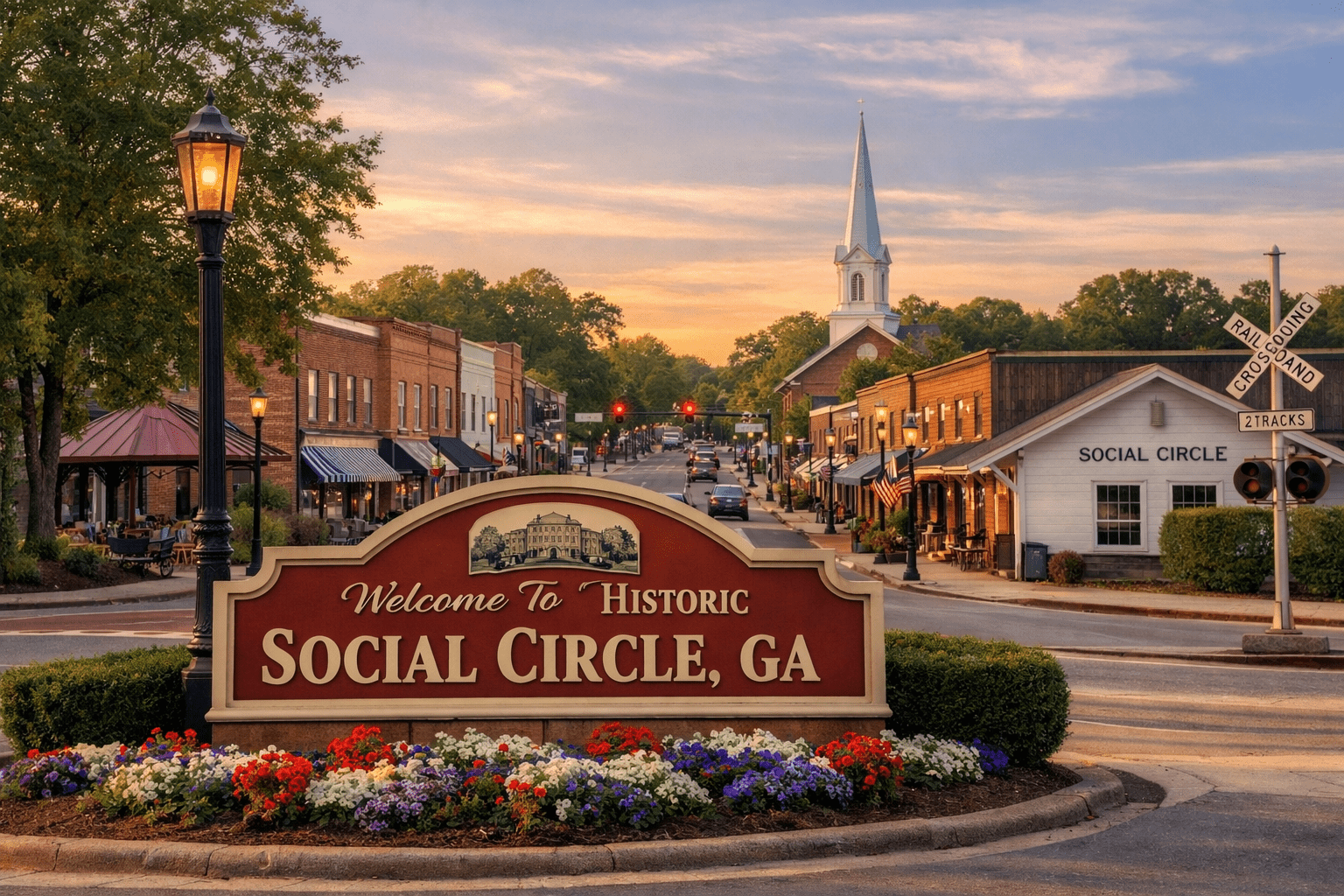
By Milton Kirby | Social Circle, GA | June 20, 2026
For months, residents of Social Circle feared their small town would become home to one of the largest immigration detention facilities in the nation.
Now, after a sustained campaign by local officials, community members, and U.S. Senator Reverend Raphael Warnock, those plans appear to be dead.
The Department of Homeland Security has reportedly abandoned plans to convert warehouses in Social Circle and Oakwood into massive immigration detention centers and instead plans to sell or give away the properties. The decision marks the end of a months-long battle that pitted two small Georgia communities against a federal proposal they believed would overwhelm local infrastructure, strain public services, and fundamentally change the character of their towns.
For Social Circle, a city of roughly 5,000 residents, the stakes could hardly have been higher. Federal officials had planned to convert a one million square foot warehouse on East Hightower Trail into a detention center capable of housing as many as 10,000 detainees, effectively creating a population larger than the town itself.
“Today is a victory for the people of Georgia,” Warnock said following reports that DHS had reversed course. “When we stand up and speak out, the power of the people is more powerful than the people in power.”
The victory did not come easily.
A Plan Discovered After the Fact
One of the most controversial aspects of the proposal was how local leaders learned about it.
According to Warnock, even Social Circle’s mayor first learned of the project through a newspaper article rather than direct communication from federal officials.
“They tried to do this quietly,” Warnock said during a Friday press conference. “Imagine being the mayor of a city of 5,000 and learning the federal government is about to double the size of your town without telling you.”
The proposal immediately raised concerns among residents and local officials who questioned how a small community could absorb a detention center of such magnitude.
Those concerns intensified when ICE purchased the warehouse and surrounding 235 acres for $128 million.
Warnock said the federal government paid approximately twice the property’s market value.
“The Trump-Vance administration likes to talk about waste, fraud and abuse,” Warnock said. “Well, they paid twice the market rate for this facility. They wasted $128 million of taxpayers’ dollars. And now they have an empty building. This is what I call waste, fraud and abuse.”
Infrastructure Concerns Spark Resistance
As details of the project emerged, city officials began sounding alarms about Social Circle’s limited infrastructure capacity.
In March, Warnock traveled to Social Circle to meet with Mayor David Keener, City Manager Eric Taylor, school officials, and concerned residents. During the visit, local leaders outlined the challenges the city would face if the detention center became operational.
According to city officials, Social Circle is permitted to use one million gallons of water per day. During the hottest months of the year, residents already consume between 80 and 90 percent of that capacity.
The city’s wastewater system also operates near its limits, processing about 660,000 gallons per day. Officials estimated that the proposed detention center could require an additional one million gallons daily.
Local leaders warned that the project could lead to boil-water advisories, sewer overflows, and costly infrastructure upgrades that the city was not prepared to fund.
The location of the proposed facility also raised concerns among parents because the warehouse sits near Social Circle Elementary School.
“Folks in Social Circle voted for this president overwhelmingly,” Warnock said during his March visit. “But they didn’t vote for a 10,000-person detention center that will triple the size of their town. They didn’t vote for potential boil-water advisories or sewer overflows because this administration has overstrained their city’s resources.”
Local Voices Reach Washington
As opposition grew, Warnock brought the concerns of Social Circle and Oakwood to Washington.
In February, he filed an amendment that would have prohibited federal funds from being used to acquire, construct, renovate, or expand detention facilities in the two communities. He also sent letters to DHS officials, publicly challenged the proposal, and met with local leaders to highlight their concerns.
At Friday’s press conference, Warnock said he would continue pushing for safeguards to prevent similar situations in the future.
“I offered an amendment during the continuing resolution that would have halted this kind of construction,” he said. “And I’ll continue to make that case.”
The senator repeatedly emphasized that his opposition was driven by the concerns of local residents rather than partisan politics.
“The people of Georgia want secure borders; they do not want massive immigration detention centers in their backyards,” Warnock said earlier this year.
“The Trump-Vance administration likes to talk about waste, fraud and abuse,” Warnock said. “Well, they paid twice the market rate for this facility. They wasted $128 million of taxpayers’ dollars. And now they have an empty building. This is what I call waste, fraud and abuse.”
Relief for Social Circle and Oakwood
The reported DHS decision to dispose of the warehouses effectively ends plans for both detention centers.
For Social Circle, the reversal also preserves future economic opportunities. Local officials had worried that dedicating the property to a detention center would remove valuable commercial land from future development and reduce potential tax revenue for the city.
“This would have taken a whole lot of opportunity off of a potential tax revenue for that very small town,” Warnock said.
Questions remain about what DHS will ultimately do with the properties, but local leaders have expressed hope that the sites can now return to productive commercial use.
For many residents, however, the larger significance lies in the outcome itself.
The battle over the detention center became a test of whether a small community could influence decisions being made hundreds of miles away in Washington.
In the end, Social Circle’s residents proved that they could.
“The people of Social Circle and Oakwood didn’t vote for me,” Warnock said. “But I still fought for them because I was elected to serve all Georgians.”
As the controversy comes to a close, the outcome stands as a reminder that local voices can still shape national decisions, even when those decisions originate at the highest levels of government.
As Warnock put it, “When the people raised their voices, the administration backed down.”
Truth Seekers Journal thrives because of readers like you. Join us in sustaining independent voices.
This article was a beautiful example of putting personal matters aside while being aware of a community who voted against you. I applaud Senator Warnock for taking the high road to rise to the occasion for the greater good. He remained professional, community-centered , and solution- focused. This is the leadership our nation and local communities need.
Thank you so much Sitara for this thoughtful perspective. Your comment highlights themes many readers noticed in the moment, particularly the emphasis on professionalism and attention to community needs. Observations like yours help broaden the public conversation and give space for readers to reflect on how local and national leaders navigate challenging circumstances. We appreciate you taking the time to engage thoughtfully with the reporting. We invite you become a daily reader of our publication.