
By Milton Kirby | Atlanta, GA | July 26, 2026
The stage in Atlanta will introduce only one new regional champion, but the story of Soul Country Music Star stretches far beyond a single performance or a single city.
Across the country, artists are stepping onto stages with different voices, different life experiences, and different reasons for making music. Some are seasoned performers. Others are chasing opportunities they have spent years praying for. All share a belief that country music has room for stories that have too often gone unheard.
Three artists have already secured their places in the Soul Country Music Star Finals, scheduled for October 31 in Los Angeles. Brenda Guy earned her victory in the Fort Worth-Dallas Regional. Silas Reed captured the Memphis Regional title. Glenn Stanton advanced by winning the Los Angeles Regional. Their journeys through the competition are complete, at least for now, as they wait for the remaining regional champions to join them on the national stage.
The spotlight now turns to Atlanta.
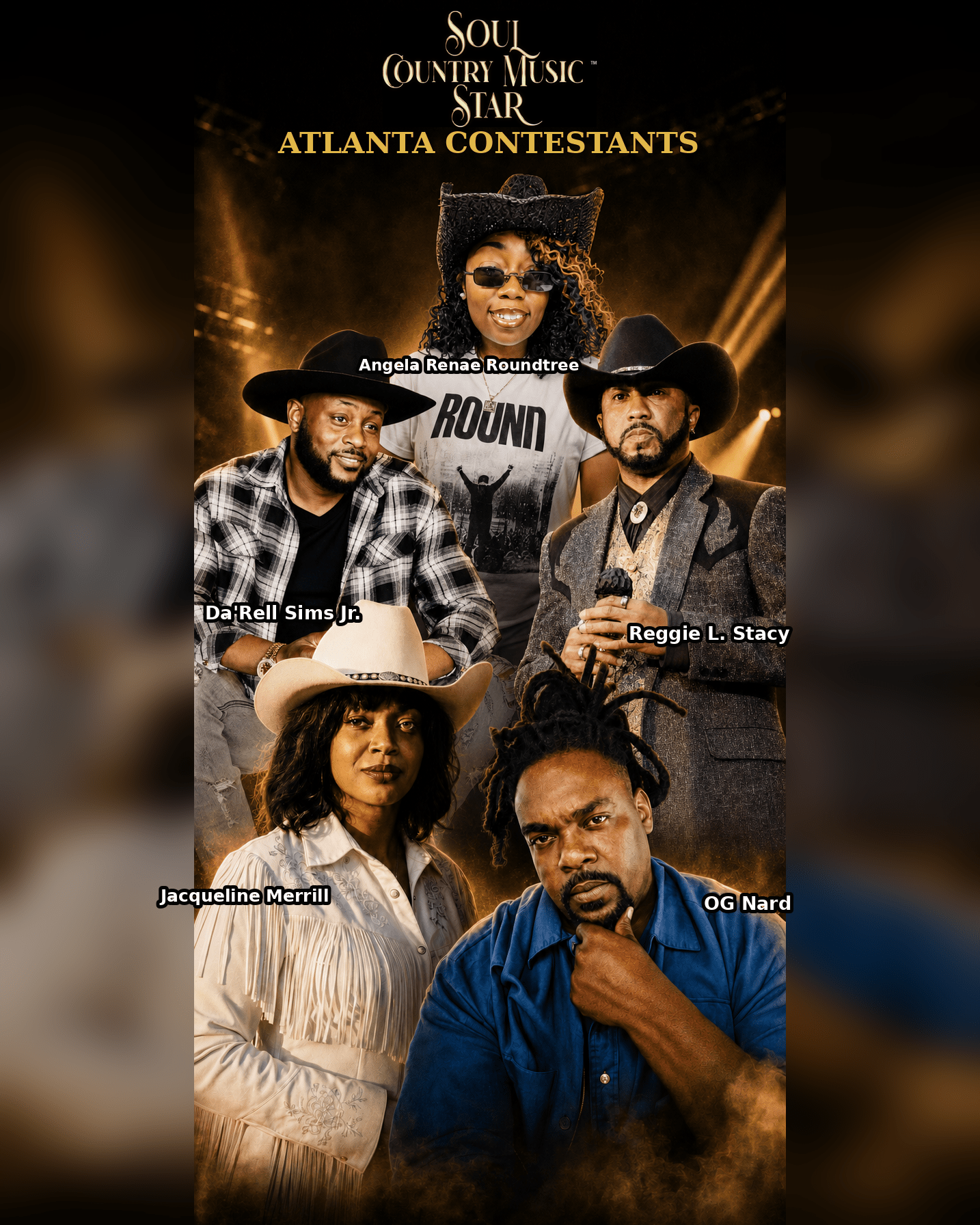
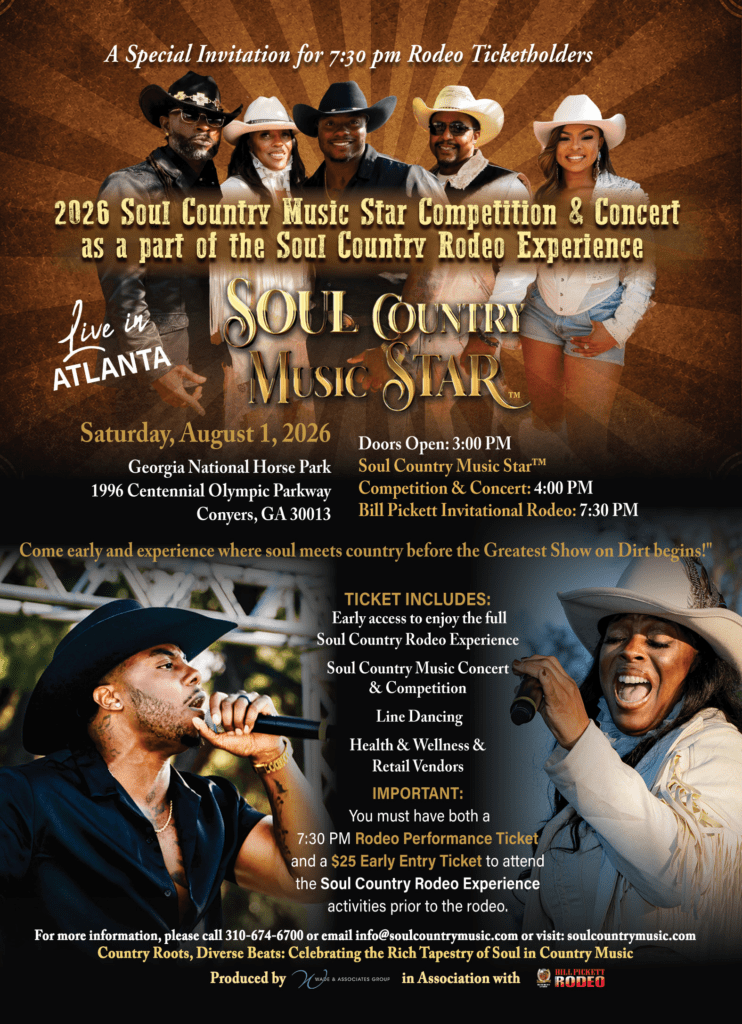
On August 1, at the Georgia International Horse Park in Conyers, five artists will compete for the chance to become the next regional champion and earn a coveted spot in the Los Angeles finals and Festival. The competition is part of the Bill Pickett Invitational Rodeo’s Soul Country Rodeo Experience.
OG NARD, Angela Roundtree, Da’Rell Sims Jr., Reggie Stacy, and Jacqueline Merrill each bring distinct musical styles, backgrounds, and aspirations. Yet, after speaking with each of them, one thing became remarkably clear.
This competition is about far more than selecting the next winner.
It is about discovering artists who are redefining what Soul country music can be.
Some draw from gospel traditions that first shaped their voices in church pews. Others blend country with Southern soul, hip-hop, Americana, or contemporary storytelling. Some speak openly about grief, redemption, and perseverance. Others see music as a bridge connecting generations, cultures, and communities.
Together, they represent a movement that is steadily expanding both the sound and the story of country music.
As the road to Los Angeles continues, The Truth Seekers Journal spoke with three regional winners from Memphis, Dallas–Fort Worth, and Los Angeles who have already secured their places in the finals, as well as the five Atlanta regional contestants preparing for their opportunity. Their conversations reveal not only why they sing, but also what they hope their music will leave behind long after the final note fades.
More than a competition, Soul Country Music Star has become a window into the next generation of Black Soul Country artists, each carrying a unique story to the stage.
More Than a Singing Competition
For more than four decades, the Bill Pickett Invitational Rodeo (BPIR) has celebrated the often overlooked history and legacy of Black cowboys and cowgirls, preserving a chapter of the American West that many people never learned in school. Alongside the excitement of rodeo competition, the organization has steadily expanded its cultural programming to showcase the music, traditions, and creative voices that have long been part of that heritage.
One of its newest and fastest growing programs is Soul Country Music Star.
Far more than a traditional talent competition, Soul Country Music Star provides emerging performers with a national platform to showcase their artistry before live audiences while introducing new voices to one of America’s oldest musical traditions. Regional competitions are held across the country, with each winner advancing to the national finals and festival, where one artist will ultimately earn the title of Soul Country Music Star, a $10,000 cash prize and a chance to tour with the BPIR in 2027.
This year’s journey has already produced regional winners in Memphis, Dallas–Fort Worth, and Los Angeles. Atlanta will select its finalist on August 1, followed by the final regional competition on September 19 at The Show Place Arena in Upper Marlboro, Maryland. The four out of state regional winners will then travel to Los Angeles for the Soul Country Music Festival & National Finals, taking place October 31 and November 1 at the Autry Museum of the American West in Griffith Park.
The competition is also helping reshape public perceptions of country music.
For generations, Black artists have played a foundational role in the evolution of country music, from its earliest influences rooted in gospel, blues, and folk traditions to today’s expanding blend of Southern Soul, Americana, and contemporary country. Yet many of those contributions have remained underrecognized.
The artists participating in Soul Country Music Star are helping change that narrative.
Some arrive with decades of performing experience. Others are taking their first major step onto a national stage. Their musical styles differ widely, but each brings an authentic perspective shaped by family, faith, hardship, perseverance, and community.
After speaking individually with the three regional winners, and the five Atlanta Regional contestants, one theme surfaced again and again.
None of them spoke first about winning.
Instead, they spoke about purpose.
For some, music became a way to preserve family traditions. For others, it offered healing after personal loss, redemption after difficult seasons, or the freedom to express themselves without being confined by expectations. Nearly every conversation returned to faith, perseverance, and the belief that music could touch lives beyond the stage.
That may be the competition’s greatest achievement.
Before judges score a single performance, audiences are introduced to artists whose stories are every bit as compelling as the songs they perform.
The Road Already Traveled
Long before the Atlanta Regional contestants step onto the stage, three artists have already secured their places in the Soul Country Music Star Finals. Their victories came hundreds of miles apart, in different cities and before different audiences, yet their stories reveal that there is no single path to success.
Brenda Guy earned top honors in the Fort Worth-Dallas Regional by doing what she has always believed music should do: bring people together.
Her performances are rooted in connection. Whether singing before longtime country music fans or audiences experiencing Soul Country for the first time, Guy believes every performance should create a relationship between the artist and the listener. That ability to connect has become one of her greatest strengths and helped carry her to a regional championship.
In Memphis, Silas Reed took a different road.
A musician, educator, and student of Black musical history, Reed views every performance as an opportunity to preserve a legacy that stretches across generations. His appreciation for country music is grounded in research, faith, and a deep understanding of the Black artists whose influence helped shape the genre long before many of them received recognition. Rather than simply entertaining audiences, Reed hopes every performance encourages listeners to better understand the music’s history while inspiring the next generation of artists to carry that tradition forward.
Thousands of miles away in Los Angeles, Glenn Stanton emerged from a very talented pool of Soul Country artists at the California Regional with yet another perspective.
An actor, Americana artist, and storyteller, Stanton speaks openly about music as a source of healing. His songs often reflect life’s difficult seasons, reconciliation, and hope. Rather than separating country music from personal experience, Stanton embraces both, believing that authentic storytelling has the power to comfort people who may be carrying struggles of their own.
Although their musical styles differ, Guy, Reed, and Stanton share something larger than a regional title.

Each views music as a calling rather than simply a career.
Each spoke about faith, purpose, and service before discussing trophies or recognition.
And each now waits for October 31, when regional champions from across the country will gather in California to compete for the Soul Country Music Star national title.
Their journeys have reached the next chapter.
Atlanta’s is just beginning.
A New Stage. Five New Dreams.
When the Soul Country Music Star competition arrives in Atlanta on August 1, five artists will step onto the stage carrying very different stories, but sharing one common goal: to become the next regional champion and earn a place alongside Brenda Guy, Silas Reed, Glenn Stanton, and the other regional winners awaiting the national finals in California.
For some, the competition represents the culmination of decades spent performing before live audiences. For others, it is an opportunity to introduce audiences to a new sound or to share deeply personal stories through music. Together, they represent a cross-section of today’s Black country music landscape, where gospel harmonies, Southern Soul, Americana, traditional country, and contemporary influences exist side by side.
Their names are Bernard Stephens aka OG NARD, Angela Roundtree, Da’Rell Sims Jr., Reggie Stacy, and Jacqueline Merrill.
Over the course of several conversations with The Truth Seekers Journal, each answered the same basic questions about music, inspiration, and purpose.
None gave the same answers.
And that may be what makes this year’s Atlanta Regional one of the most compelling stops on the Road to Los Angeles.
Five Artists. Five Different Dreams.
By the time the Soul Country Music Star competition reaches Atlanta on August 1, the judges will already know what a regional champion looks like.
What they will not know is whose story will emerge next.
The five artists preparing to compete in Atlanta come from different backgrounds, different musical traditions, and different walks of life. Some have spent years performing before live audiences. Others have built loyal followings while waiting for an opportunity to introduce themselves to a larger stage.
What unites them is not a common sound.
It is a common belief that country music still has room for voices that reflect their own experiences.
OG Nard (Bernard Stephens): A Story of Redemption
For OG Nard (Bernard Stephens), music represents something larger than entertainment.
It represents another chance.
The Atlanta artist openly acknowledges that life has included difficult chapters, but he refuses to allow those experiences to define his future. Instead, they have become the foundation of his music and his desire to encourage others facing similar struggles.
OG describes his music as “Trapp Kountry,” a style that blends country storytelling with the sounds and experiences of contemporary urban life. Rather than trying to fit into someone else’s definition of country music, he has created a style that reflects where he comes from, what he has lived through, and people he hopes to reach.
His music carries a message of perseverance.
During our conversation, OG spoke repeatedly about giving back to young people, helping others avoid mistakes he has already made, and using music to demonstrate that redemption remains possible regardless of a person’s past.
For him, the Atlanta Regional is more than another performance.
It is another opportunity to prove that second chances can become new beginnings.
Angela Roundtree: Singing from the Heart
If OG’s music speaks through redemption, Angela Roundtree’s begins with authenticity.
Raised in a family where gospel music was part of everyday life, Roundtree says she has been singing for as long as she can remember. Yet despite her remarkable voice and growing audience, she remains remarkably humble, often describing herself as someone who simply wants listeners to feel what she feels.
Her songwriting rarely begins with commercial trends or radio formats.
Instead, it begins with life.
Sometimes the inspiration arrives while driving alone.
Sometimes it grows from personal experiences that eventually become songs capable of touching complete strangers.
Roundtree admits she has battled self-doubt and even describes herself as someone who occasionally gets in her own way. That honesty may be one of her greatest strengths. Rather than presenting herself as a polished celebrity, she allows audiences to see both her confidence and her vulnerability.
When she steps onto the stage in Atlanta, she is not trying to become someone else.
She is simply trying to be herself.
And for many artists, that may be the hardest performance of all.
Da’Rell Sims Jr.: Building an Atlanta Sound
While some artists spend years trying to fit comfortably inside an established genre, Da’Rell Sims Jr. is focused on creating space for something new.
He calls it Atlanta Country.
Growing up in Atlanta with family roots that stretch into rural Georgia, Sims believes country music should reflect the places and experiences that shaped him. Rather than choosing between country, hip-hop, Southern Soul, or gospel influences, he embraces all of them, creating a sound that reflects the city he calls home.
“I’m the bridge,” he said during our conversation, explaining that his music connects traditions that many people mistakenly view as separate.
For Sims, authenticity matters more than stereotypes.
He has little interest in performing a version of country music that doesn’t feel genuine. His songs are built on real experiences, real people, and real emotions. Whether writing about relationships, everyday life, or personal growth, he believes audiences recognize honesty long before they recognize polish.
That same philosophy extends beyond the stage.
An entrepreneur as well as a musician, Sims thinks about music as part of a larger vision that includes education, branding, film, television, and community impact. He has even developed music designed to help children learn reading, mathematics, history, and life skills, demonstrating that entertainment and education can exist together.
His long-term vision reaches well beyond recording songs.
He wants to build something lasting.
If Atlanta Country becomes part of the national conversation, Sims hopes it will not simply introduce audiences to another musical style. He hopes it will encourage listeners to recognize that country music continues to grow because artists are willing to bring their own communities, cultures, and experiences into the genre.
For Da’Rell Sims Jr., the Atlanta Regional represents more than a competition.
It is an opportunity to introduce audiences to a new way of thinking about country music.
Reggie Stacy: Prepared for the Moment
If Da’Rell Sims Jr. is introducing something new, Reggie Stacy is building upon a foundation that has taken decades to establish.
Long before arriving at the Soul Country Music Star competition, Stacy had already built a reputation as a polished performer. He has appeared in singing competitions across the country, performed the National Anthem at sporting events, entertained audiences in restaurants and live music venues, and earned recognition as both Country Vocalist of the Year and Country Entertainer of the Year at a major competition in Pigeon Forge, Tennessee.
Yet despite those accomplishments, he speaks less about success than preparation.
Every performance begins with prayer.
Every rehearsal is approached with purpose.
Every appearance is treated as an opportunity to represent himself, his band, and his faith with professionalism.
“It’s not on my timing,” he explained while discussing his career. “It’s on God’s time.”
That quiet confidence runs throughout his story.
Rather than measuring progress by trophies alone, Star believes every performance is another step toward the larger stage he has envisioned since childhood. He speaks openly about trusting the process, remaining patient, and continuing to improve while waiting for the next opportunity.
His musical influences reflect that same respect for tradition.
Inspired by artists including Charlie Pride and Chris Stapleton, Stacy embraces the soulful storytelling that has long defined country music while adding his own warmth and vocal style. His original song, Livin Life, celebrates the balance between hard work and enjoying the moments that make life meaningful.
As he prepares for the Atlanta Regional, Stacy is not trying to reinvent country music.
He simply wants to honor it through excellence.
For him, the greatest performance is not measured by applause alone.
It is measured by leaving the stage knowing he gave audiences everything he had.
Jacqueline Merrill: Music Without Boundaries
If there is one artist in the Atlanta Regional who refuses to be confined by labels, it is Jacqueline Merrill.
Singer.
Songwriter.
Rapper.
Performer.
Those titles describe what she does.
They do not fully explain who she is.
Merrill describes herself as an artist who refuses to be placed in a box. During our conversation, she spoke passionately about studying vocal techniques, listening carefully to the phrasing and breathing of legendary performers, and challenging herself to master different musical styles. That curiosity has made her one of the competition’s most versatile performers, comfortable moving between gospel, soul, country, and contemporary music without losing her own identity.
Her introduction to music began in church.
At just five years old, she led her first song in the Church of God in Christ, discovering both her voice and her confidence before a congregation that recognized her gift almost immediately. That early foundation continues to shape every performance today.
Faith remains at the center of everything she does.
Throughout our conversation, Merrill repeatedly described moments in her life that she believes were guided by God, from opportunities that appeared unexpectedly to doors that opened at precisely the right time. She views the Soul Country Music Star competition not as coincidence, but as confirmation that she is walking the path prepared for her.
For Merrill, Soul Country represents freedom.
Freedom to sing.
Freedom to rap.
Freedom to tell stories.
Freedom to express herself without allowing traditional genre boundaries to define her artistry.
She believes audiences should leave every performance feeling something.
Sometimes that feeling is joy.
Sometimes it is laughter.
Sometimes it is reflection.
The emotion matters less than the connection.
“If I made you feel something,” she said, “then I’ve done my job.”
That perspective has been shaped by life’s deepest challenges.
Merrill spoke openly about personal loss, health struggles, and the responsibilities of motherhood. Rather than allowing those experiences to silence her, she has transformed them into purpose. Her children remain her greatest motivation, inspiring her to keep moving forward and demonstrating through her own life that perseverance can outlast disappointment.
As she prepares for the Atlanta Regional, Merrill carries more than songs to the stage.
She carries a testimony.
One built on faith, resilience, and the belief that music has the power to change lives.
More Than Eight Voices
After conversations with three regional winners and five Atlanta Regional contestants, one conclusion became impossible to ignore.
No two artists described country music in exactly the same way.
Brenda Guy spoke about creating connections.
Silas Reed viewed every performance as an opportunity to preserve history.
Glenn Stanton found healing through storytelling.
OG embraced redemption through what he proudly calls Trapp Kountry.
Angela Roundtree sang with disarming honesty and vulnerability.
Da’Rell Sims Jr. envisioned a future shaped by Atlanta Country.
Reggie Stacy built his career on preparation, professionalism, and faith.
Jacqueline Merrill celebrated artistic freedom without boundaries.
Their musical styles differ.
Their life experiences differ.
Even their reasons for standing on stage differ.
Yet every conversation returned to the same foundation.
Family.
Faith.
Perseverance.
Purpose.
None of the artists spoke first about trophies, prize money, or recognition.
Instead, they spoke about making meaningful music, encouraging others, honoring those who came before them, and leaving audiences better than they found them.
Perhaps that is what makes Soul Country Music Star different.
The competition may crown one regional winner in Atlanta.
But before the judges make their decision, audiences will have the opportunity to hear five artists who represent five distinct visions of where Soul country music is headed.
And beyond Atlanta, three regional champions already await them in California, each carrying a different story but sharing the same dream of becoming the next Soul Country Music Star.
The Road Continues
When the lights come up in Atlanta on August 1, one performer will move one step closer to the national title.
But regardless of who advances, the competition is accomplishing something that reaches far beyond a single evening of music.
It is introducing audiences to artists whose stories challenge long-held assumptions about country music while celebrating the Black traditions that helped shape the genre from its earliest beginnings.
The Road to Los Angeles is about more than selecting a champion.
It is about discovering voices that deserve to be heard.
On October 31, another chapter in that journey will be written when regional winners from across the country gather in California for the Soul Country Music Star Finals.
By then, Atlanta will have added another name to that growing list.
Until then, the music continues.
The Road to Los Angeles
Regional Winners
Already qualified for the Soul Country Music Star Finals
Fort Worth-Dallas Regional
Brenda Guy
Memphis Regional
Silas Reed
Los Angeles
Glenn Stanton
Upcoming Regional Competitions
Atlanta, Georgia
August 1, 2026
Washington, DC/Maryland
September 19, 2026
The Show Place Arena
Upper Marlboro, Maryland
Soul Country Music Festival & National Finals
Saturday, October 31, 2026
Los Angeles, California
Sunday, November 1, 2026
12:00 p.m. to 6:00 p.m.
Autry Museum of the American West
Griffith Park
National Finals & Soul Country Music Festival
October 31-Novemebr 1
California
Eight Conversations. One Discovery.
After speaking individually with each artist, one thing became increasingly clear. Although every conversation began with music, none remained there for long. Discussions quickly turned toward faith, family, perseverance, loss, healing, service, and purpose. The artists differed in style, personality, and performance, but they shared a common belief that music should leave people better than it found them.
That may ultimately become the lasting impression of this year’s Soul Country Music Star competition. While audiences will remember the performances, they may remember the stories behind those performances even more.
The Road to Los Angeles Continues
On August 1, one more artist will earn the right to continue the Road to Los Angeles. But regardless of who advances, every performer who steps onto the Atlanta stage will bring something that cannot be measured by judges’ scores alone: a story shaped by faith, family, perseverance, and a belief that music still has the power to connect people. In the end, that may be Soul Country Music Star’s greatest accomplishment.
Support open, independent journalism. Your contribution helps us tell the stories that matter most.
Great read, as always!!
Thank you, Michelle. We truly appreciate your continued support and engagement with The Truth Seekers Journal. Reader participation helps affirm that our work matters — and encourages us to keep telling stories that deserve attention. We hope you’ll keep reading and sharing your thoughts.