
By Florita Bell Griffin, Ph.D. | Houston, TX | September 22, 2026
Most patients do not walk into a doctor’s office expecting to meet artificial intelligence. They expect to see a physician, nurse, technician, receptionist, or other healthcare professional. Yet AI may already be involved in parts of the healthcare experience without appearing as a separate machine at all.
Artificial intelligence can assist with medical imaging, record review, risk assessment, scheduling, documentation, monitoring, and other tasks. Software may help identify patterns in scans, organize large amounts of clinical information, or flag something that deserves a professional’s attention. The FDA maintains a public list of AI-enabled medical devices that have met applicable premarket requirements, illustrating that AI is already part of regulated medical technology in the United States.
For patients, this can be encouraging. Healthcare produces enormous amounts of information, and no human being can process every data point instantly. A computer system capable of examining images or recognizing patterns quickly may help clinicians notice something sooner, reduce repetitive work, or bring useful information together before a decision is made.
Consider medical imaging. Radiologists may examine large numbers of X-rays, CT scans, MRIs, mammograms, and other images. AI-assisted systems can help identify patterns or areas that may deserve closer examination. The purpose is not necessarily to remove the radiologist from the process but to provide another analytical tool.
The distinction between assisting and deciding is important. Patients should not imagine healthcare AI as one giant machine that determines whether someone is sick. Many systems perform narrow tasks. One may analyze a particular kind of image, while another helps organize records or predict a specific risk.
AI may also help reduce a less visible burden in medicine: documentation. Doctors and nurses spend significant time recording visits, completing forms, reviewing histories, and navigating electronic medical records. Generative AI tools are increasingly being explored for summarizing conversations and preparing clinical notes, potentially allowing healthcare professionals to spend more of the visit interacting with patients rather than typing.
That could improve the patient experience if it works well. A physician who can maintain eye contact and listen carefully instead of focusing on a computer screen may have a better conversation with the person seeking care. At the same time, a generated medical note must accurately reflect what occurred. A polished summary that leaves out a symptom or incorrectly records a medication could create problems later.
Patients already have a practical tool for dealing with this possibility: read their medical records when they are available. If the summary of a visit contains an error, ask for it to be corrected. This was good advice before AI entered healthcare and becomes even more important as documentation grows more automated.
Personal health devices are another part of the story. Smartwatches and other consumer technologies can collect information about heart rate, movement, sleep, exercise, and other patterns. Some people may discover useful changes and bring them to a doctor’s attention. Others may become anxious about numbers they do not fully understand.
More data is not automatically the same as better health. A device may produce information without understanding the full medical context. Patients should distinguish between wellness information, a medical-device function, and an actual clinical diagnosis.
AI chatbots have added another layer because people increasingly ask them medical questions before speaking with a healthcare professional. Someone may describe a symptom, ask about a laboratory result, or request an explanation of a medical term. This can be enormously helpful when the goal is understanding.
The risk appears when explanation becomes diagnosis or when general information is treated as personalized medical advice. An AI system cannot necessarily examine the patient, feel an abdomen, listen to breathing, observe subtle physical behavior, confirm every medication, or know the entire history unless that information has been reliably provided.
A useful approach is to use AI to become better prepared for medical care. Ask it to explain unfamiliar vocabulary in plain English. Use it to create a list of questions for the doctor. Ask what information might be useful to bring to an appointment. After a visit, use it to help organize instructions while verifying anything important against the official medical record.
Privacy is especially important with health information. A person may be comfortable telling an AI system intimate medical details because the conversation feels private and nonjudgmental. Different services, however, may handle data differently, and not every consumer AI tool operates under the same privacy rules as a physician’s office or hospital.
Before uploading complete medical records, users should understand the service they are using and consider whether names, addresses, dates of birth, identification numbers, and other unnecessary details can be removed. The AI may need the laboratory value to explain what it means, but it usually does not need the patient’s Social Security number.
Patients should also become comfortable asking whether AI played a role in important medical decisions. The question does not need to be confrontational. Someone might simply ask, “Was software used to help interpret this scan?” or “Was this recommendation generated or assisted by an automated system?” Understanding the role of technology can help the patient understand the decision-making process.
The FDA has continued developing regulatory approaches for AI-enabled medical devices and, in August 2026, specifically sought public feedback about generative AI-enabled medical devices, including questions involving risk assessment, premarket evaluation, and monitoring after products reach the market. The fact that regulators are actively examining these systems reflects both their promise and their growing importance.
AI systems can also change over time. Traditional medical equipment may perform essentially the same function each time it is used. Software can be updated, and certain AI systems may be designed to evolve or be modified. This creates important questions about how changes are tested, documented, and monitored.
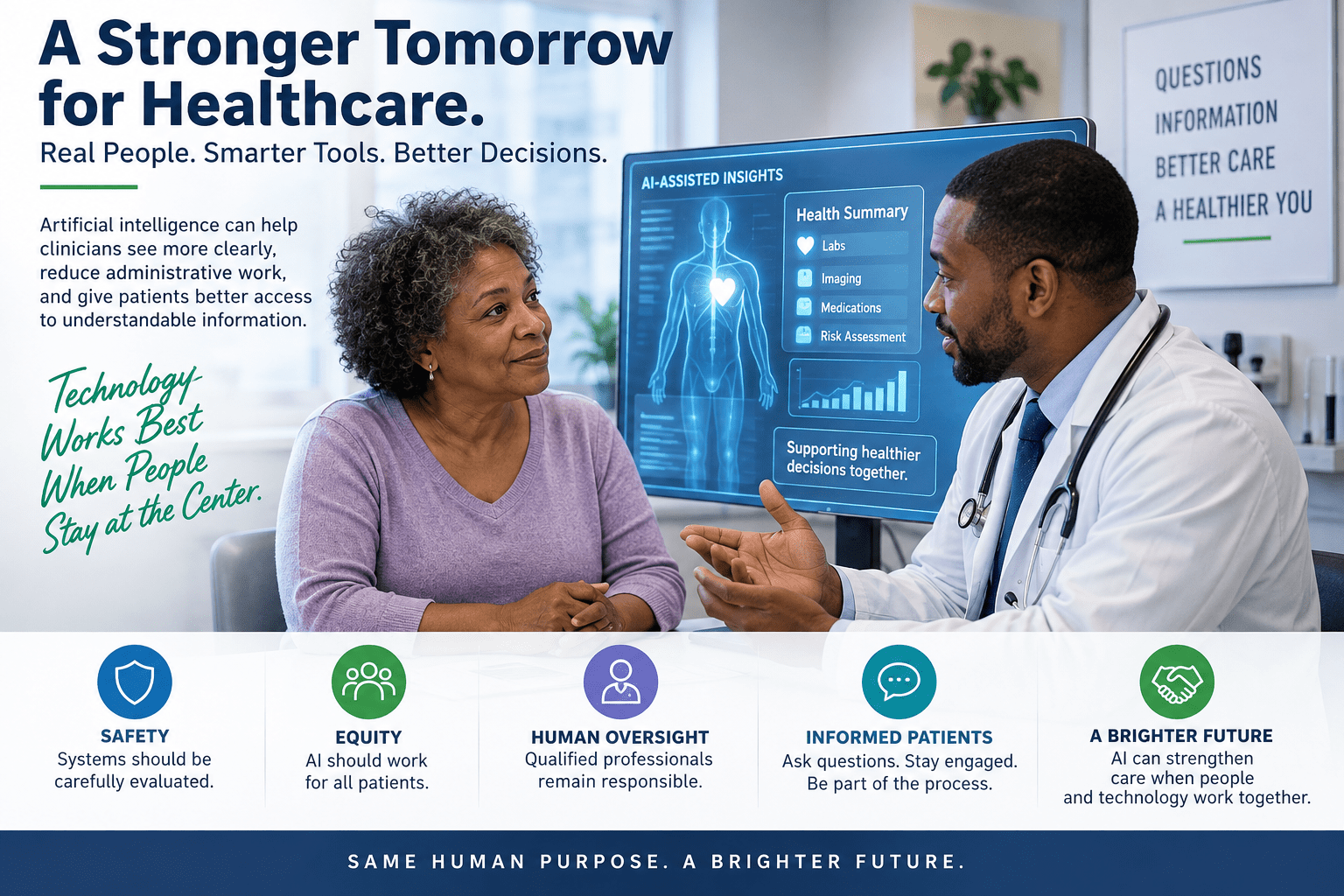
Patients do not need to understand software engineering to care about the answer. They simply need confidence that the tool influencing their healthcare has been appropriately evaluated and that qualified professionals remain responsible for how it is used.
Bias is another concern because medical data reflects real populations, and populations do not always receive equal care or appear equally in research datasets. An AI system trained on incomplete or unrepresentative information may perform differently across groups. Healthcare professionals and regulators therefore need to evaluate not just whether a system works on average but whether it works reliably for the kinds of patients who will actually depend on it.
The presence of AI does not automatically make a medical decision better or worse. A highly skilled clinician using a well-designed tool may make a better-informed decision. A poorly designed system used without sufficient oversight could create new problems.
The patient’s role remains important. Ask questions. Keep accurate medication lists. Review test results. Correct errors in the medical record. Seek another professional opinion when a major decision remains uncertain. AI does not eliminate any of these traditional forms of patient participation.
It may eventually strengthen them. A patient who once left an appointment confused by unfamiliar language can now receive an explanation in ordinary terms. Someone preparing for surgery can organize questions in advance. A caregiver managing information for an older relative can create a clearer timeline of appointments and instructions.
The best future for healthcare AI is not one in which machines quietly make decisions while patients simply accept them. It is one in which technology helps clinicians see more clearly, reduces unnecessary administrative work, gives patients better access to understandable information, and leaves responsibility where it belongs.
Medicine has always combined science with judgment. Artificial intelligence adds a powerful new source of analysis, but it does not change the basic truth that healthcare involves a real human being whose body, history, fears, goals, and circumstances cannot be reduced to a collection of data points.
Patients do not need to fear the machine entering healthcare, and they should not worship it either. They need to understand when it is present, what role it plays, and who remains responsible for the final decision. That knowledge can help ensure that artificial intelligence becomes a tool that strengthens medical care rather than something that quietly separates patients from the people caring for them.
© 2026 Truth Seekers Journal. Published with permission from the author. All rights reserved.
Related articles
Can You Trust What You See? Deepfakes, Altered Images, and the New Reality of Digital Evidence
Living With AI: How It Is Changing Work, Family, and Community
What Happens to Your Information After You Type It Into an AI Chatbot?
AI Can Save You Time, but Can It Make You Smarter?
Living With AI: How It Is Changing Work, Family, and Community
When Systems Forget Who They Were Built For
Why Familiarity Is Not the Same as Understanding
Truth Seekers Journal thrives because of readers like you. Join us in sustaining independent voices.

