
By Florita Bell Griffin, Ph.D. | Houston, TX | October 20, 2026
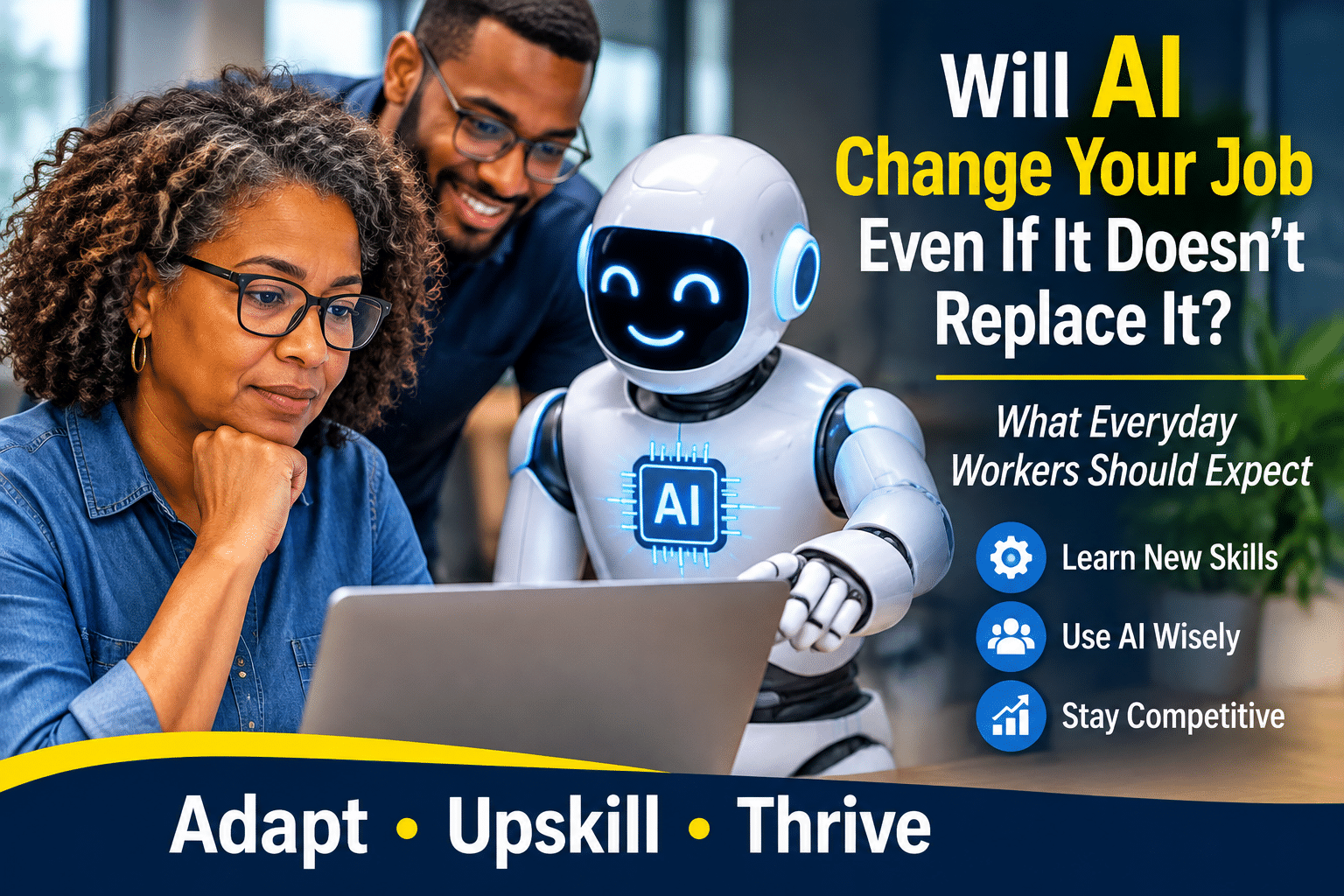
Much of the public discussion about artificial intelligence and employment begins with one frightening question: Will AI take my job? It is understandable that workers would worry about that possibility. New technology has always raised concerns about which kinds of work will disappear. Yet for millions of people, a more immediate question may be more useful: How will AI change the job I already have?
Technology has changed work repeatedly without eliminating every profession it touched. Office workers once prepared letters on typewriters and stored records in filing cabinets. Accountants performed calculations that spreadsheets now complete instantly. Airline tickets were once written by hand. Stores relied on paper inventories. Mechanics worked without computerized diagnostic systems. Architects drew plans manually. Doctors depended on paper medical files. Those occupations did not all disappear when computers arrived, but the way people performed them changed dramatically.
Artificial intelligence is beginning another transformation. An administrative employee may use AI to draft routine correspondence, organize meeting notes, summarize a long document, or prepare a first version of a report. A salesperson may use it to prepare follow-up messages or organize information about customers. A teacher may use it to develop sample questions or create explanations for students at different reading levels. A small-business owner may use AI to create promotional ideas, organize expenses, write product descriptions, or prepare customer communications.
The important point is that many of these examples involve tasks rather than entire jobs. A job is usually a collection of responsibilities. Some are repetitive, some require judgment, some depend on experience, and others depend on relationships. AI may become very good at one portion of a job without being capable of performing everything the worker does.
A nurse, for example, spends time documenting information, reviewing records, communicating with patients, observing physical conditions, coordinating care, responding to unexpected situations, and exercising professional judgment. AI might help summarize records or reduce paperwork, but that does not make the entire role of the nurse disappear. A construction professional may use automated estimating tools, but someone still has to understand the building, conditions, materials, workers, and customer. A teacher may use AI to help prepare a lesson, but the technology does not replace the human relationship between teacher and student.
In many occupations, the human part of the job may become more valuable as routine preparation becomes automated. If AI produces the first draft, someone must know whether the draft is correct. If it summarizes a customer complaint, someone must decide how to respond. If it analyzes a set of numbers, someone must understand whether the conclusion makes sense. If it recommends an action, someone must take responsibility for the consequences.
This creates an interesting possibility. Expertise may become more important rather than less important. An experienced accountant is more likely to recognize when an AI-generated financial analysis contains something unusual. A mechanic understands whether a suggested diagnosis makes sense given what the vehicle is actually doing. An attorney can recognize when a legal summary leaves out a critical issue. A teacher knows when an explanation is technically correct but unsuitable for a particular group of students. People who know their work well are in a stronger position to use AI because they can evaluate what the system produces. Someone with little understanding of a subject may be impressed by a polished answer and fail to notice that it is wrong.
Communication skills may also become increasingly valuable. AI can generate words, but workplaces still depend on trust, negotiation, persuasion, leadership, empathy, and judgment. A machine can draft an email to an unhappy customer, but it does not necessarily understand the history of the relationship. It can suggest how to handle a disagreement between employees, but a good manager still needs to listen to both people and understand what is happening beyond the written facts.
Workers who use their hands will encounter AI as well. Mechanics increasingly work with computerized diagnostic information. Farmers can use technology to analyze soil, crops, weather, and equipment. Construction companies can use AI-assisted tools for scheduling and estimating. Manufacturing workers may operate increasingly intelligent equipment. Electricians, technicians, and repair professionals may use systems that help identify problems before they begin work. This is important because the discussion about AI sometimes creates the impression that only office workers need to pay attention. In reality, artificial intelligence is likely to reach almost every major industry in some form.
Workers should begin observing which parts of their jobs are repetitive, predictable, or heavily based on processing information. Those are often the types of tasks that new technology affects first. If someone spends several hours each week transferring information from one document to another, summarizing routine reports, scheduling standard activities, or producing nearly identical communications, AI may eventually reduce the time required. That does not automatically mean the worker becomes unnecessary. It may mean the employer expects that person to accomplish more, focus on higher-level responsibilities, or develop new skills.
This is why waiting until an employer announces an AI transition may not be the best approach. Workers can begin learning now. They do not need to become computer programmers. They can explore tools related to their profession, experiment with low-risk tasks, and learn how to evaluate AI output. Someone who understands both the occupation and the new technology may have an advantage.
Young workers should think about this as they plan careers. Instead of simply asking which jobs AI cannot perform, they might ask which human abilities will remain valuable even as technology improves. Critical thinking, communication, leadership, creativity, practical experience, ethical judgment, relationship-building, adaptability, and deep subject knowledge are likely to remain important because they help people decide what should be done rather than merely complete a standard task.
There will undoubtedly be disruption. Some jobs will shrink. Certain tasks that once required many employees may require fewer. New occupations will emerge, and some familiar occupations will change substantially. The transition may be uncomfortable in some industries. Pretending otherwise would not help workers prepare.
At the same time, history shows that people repeatedly adapt to new tools. Few office workers today would want to give up email and return to carbon copies, filing cabinets, and typewritten correspondence. Few accountants would abandon spreadsheets. Few architects would insist on producing every drawing by hand. Tools that once seemed threatening often become ordinary parts of the profession.
AI may follow a similar path. The strongest position may belong to workers who neither fear the technology nor trust it blindly. They will learn how to use it, understand its limitations, and remain better at their profession because the technology handles some of the work that used to consume their time.
The future of employment may therefore be less about humans competing directly against machines and more about people learning how to work intelligently alongside them. AI may change your job even if it never replaces you. Understanding that distinction is one of the best ways to prepare for what comes next.
© 2026 Truth Seekers Journal. Published with permission from the author. All rights reserved.
Related articles:
Your Children Are Growing Up With AI: What Parents and Grandparents Need to Understand
What Happens When Your Car Starts Thinking for You? AI, Driving, and the Road Ahead
AI Can Save You Time, but Can It Make You Smarter?
Living With AI: How It Is Changing Work, Family, and Community
When Systems Forget Who They Were Built For
Why Familiarity Is Not the Same as Understanding
Truth Seekers Journal thrives because of readers like you. Join us in sustaining independent voices.

