Florita Bell Griffin, Ph.D.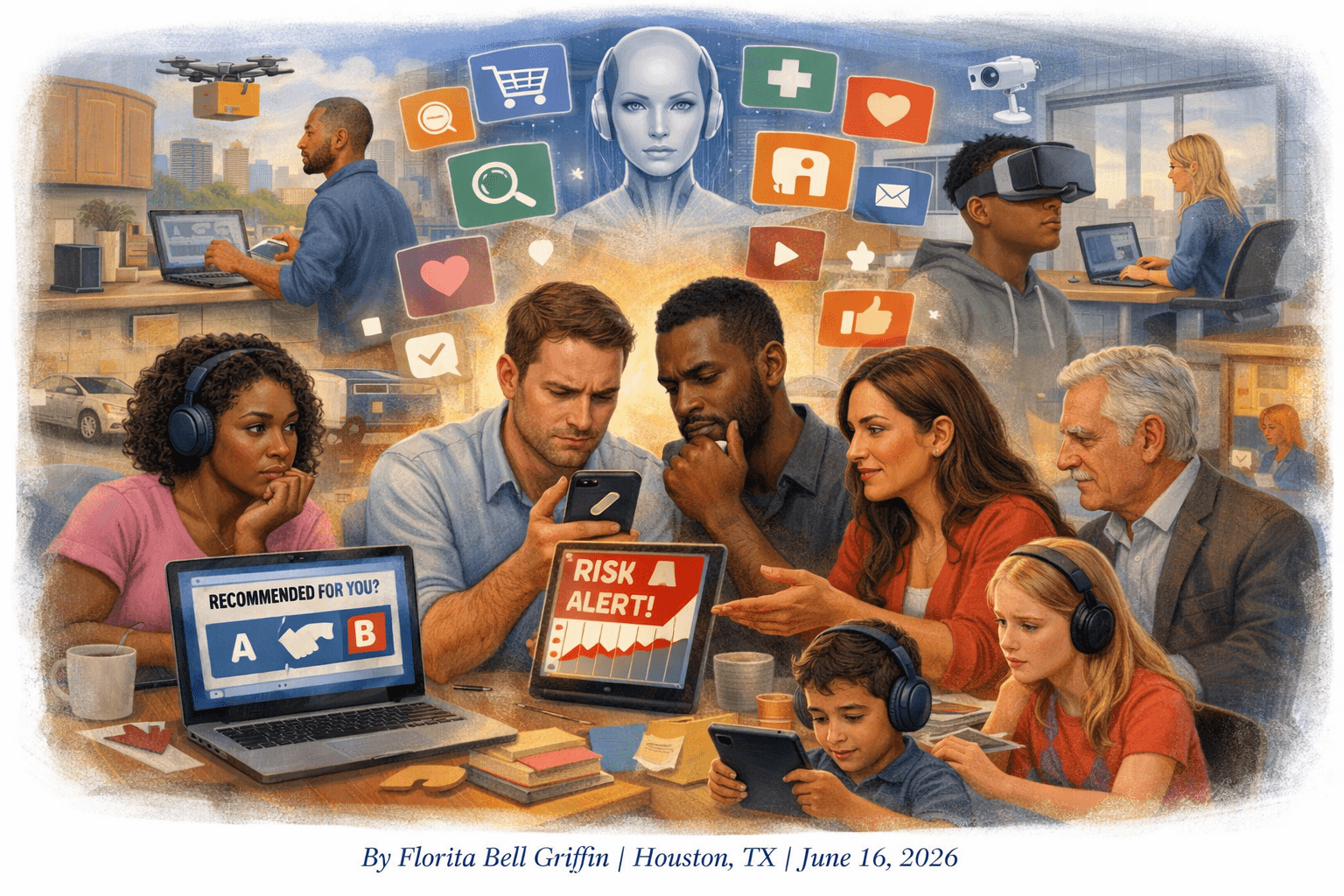
By Florita Bell Griffin | Houston, TX | June 16, 2026
Artificial intelligence is moving into everyday life with a speed that many people are still trying to understand. For years, AI sounded like a distant subject, something tied to engineers, research labs, major technology companies, and futuristic machines. Today it is part of the ordinary systems people use every day. It appears in search tools, shopping platforms, banking alerts, customer service channels, school software, health systems, workplace tools, social media feeds, and digital assistants. Because of that shift, AI is no longer a subject for specialists alone. It has become part of public life, and that means everyday people need clear judgment, steady awareness, and strong common sense.
Common sense matters here because AI often arrives wrapped in ease. It feels helpful. It saves time. It offers summaries, recommendations, shortcuts, and ready-made answers. It can draft messages, suggest products, rank choices, flag unusual activity, and guide people through complex systems. Many of these uses are genuinely useful. They can reduce strain and help people handle the overload of modern life. Yet ease can also soften attention. When a system feels smooth, people may stop asking what is shaping the answer, whose interests are guiding the result, and how much influence the system is quietly exercising.
That is where staying awake becomes important. AI does more than respond. It increasingly interprets, predicts, sorts, frames, and guides. It helps decide what people see first, what receives emphasis, what appears relevant, and what fades from view. In that sense, AI is becoming part of the environment in which human judgment takes place. A person still chooses, yet the setting around that choice is being shaped more and more by systems built to influence attention and behavior.
For everyday people, this carries real consequences. A recommendation can shape a purchase. A ranking can shape an opinion. A generated summary can shape understanding. A flagged risk score can shape how an institution responds to a person. In many cases, the machine does issue the final decision. Its influence is already present upstream, organizing what gets noticed, what gets prioritized, and what seems reasonable. That kind of influence can feel invisible precisely because it blends into ordinary routines.
This is why common sense has become a civic skill in the age of AI. People need the simple wisdom to pause and ask basic questions. Where did this answer come from? Why am I seeing this recommendation? What is this system trying to optimize? Is this result serving my interests, or someone else’s? Is this output reliable, or does it only sound polished and confident? These questions are plain, human, practical questions. They do demand technical expertise. They require alertness.
One of the biggest risks in everyday life is confusing fluency with truth. AI can speak in complete sentences, polished language, and calm tones that create an impression of authority. Human beings naturally respond to confidence. A system that sounds sure of itself can feel trustworthy, even when the underlying reasoning is shallow, incomplete, or skewed. Common sense helps protect against that trap. Everyday people need the confidence to remember that a smooth answer and a sound answer are two different things.
The same issue appears in shopping, media, finance, and information. When people search online, browse products, watch videos, or scroll through content, AI is often helping organize the order of what they see. That means the system is shaping visibility itself. Some things are elevated. Some things are buried. Some things are tailored to a person’s habits, history, or likely reactions. The user still sees choices, yet the menu has already been arranged. Common sense means remembering that convenience and neutrality are two separate matters.
Work is another area where ordinary people need to stay alert. AI tools can help workers write faster, summarize meetings, handle repetitive tasks, and move through information more efficiently. That can be a real advantage. Yet these tools also change expectations. Once a system speeds up output, employers may expect more production in less time. Pace increases. Pressure increases. Monitoring may increase as well. Workers need common sense here too, because every gain in efficiency can also reshape the terms of labor, judgment, and autonomy.
Families face similar pressures. Children are growing up in environments where AI shapes search, entertainment, recommendations, and educational tools. Parents therefore need awareness about what kinds of influence are entering the home. A system that recommends the next video, suggests the next product, or answers a child’s question is also shaping perception and habit. The issue is larger than screen time. It concerns who or what is increasingly helping guide curiosity, attention, and trust inside family life.
Education raises its own questions. AI can support learning by explaining concepts, helping students organize information, and widening access to assistance. Yet real education also involves concentration, struggle, authorship, and disciplined thought. Common sense tells us that instant help carries both value and risk. A student can receive support and still lose some of the effort that deep learning requires. Teachers, parents, and students all need a grounded understanding of this tradeoff.
The broader public issue is that AI is changing decision environments. People often think of decision-making as a moment when someone chooses between options. In reality, decisions are shaped long before that final moment arrives. They are shaped by what is shown, what is hidden, what is emphasized, and how the options are framed. AI increasingly operates inside those earlier stages. That means common sense now involves awareness of the environment itself, not just the final choice.
Staying awake also means resisting passive trust. Modern life already depends heavily on digital systems, and that dependence makes it easy to slide into acceptance. A map gives directions. A feed shows content. A bank flags unusual activity. A school platform organizes assignments. A retailer suggests a product. A customer service bot answers a question. Each of these interactions may seem small on its own. Together, they create an environment where machine-guided systems are steadily shaping ordinary life. People need awareness because repeated reliance can quietly become dependence.
This does call for panic. It calls for maturity. AI can bring real benefits. It can improve access, reduce burdens, support research, strengthen logistics, and help people manage complexity. The issue is that useful tools still deserve human oversight and public seriousness. Everyday people should feel empowered to ask strong questions and keep their judgment intact. A healthy society uses advanced tools without surrendering common sense to them.
In the end, the title of this moment is larger than innovation. It is about discernment. AI is becoming part of the fabric of modern life, and that means ordinary people need more than curiosity. They need attention. They need skepticism where skepticism is earned, trust where trust is justified, and the wisdom to tell the difference. Common sense remains one of the strongest protections a society has when powerful systems begin guiding how people see, choose, and respond.
AI is here, and its influence is expanding through everyday routines that can seem harmless simply because they are familiar. That is exactly why everyday people must stay awake. The issue is deeper than technology alone. It concerns judgment, freedom, trust, and the quality of human choice in a world where machines increasingly help shape what people think they see.
© 2026 Truth Seekers Journal. Published with permission from the author. All rights reserved.
Support open, independent journalism. Your contribution helps us tell the stories that matter most.



 Milton Kirby