Florita Bell Griffin, Ph.D.
By Florita Bell Griffin, Ph.D. | Houston, TX | October 27, 2026
Scams have always depended on a simple idea: convince someone that a false story is real long enough for that person to act. The story may involve an overdue bill, a frightened grandchild, a suspicious bank transaction, an unexpected prize, a romantic relationship, or an urgent message from a government agency. What artificial intelligence is changing is not the basic purpose of the scam. It is changing how convincing the deception can become.
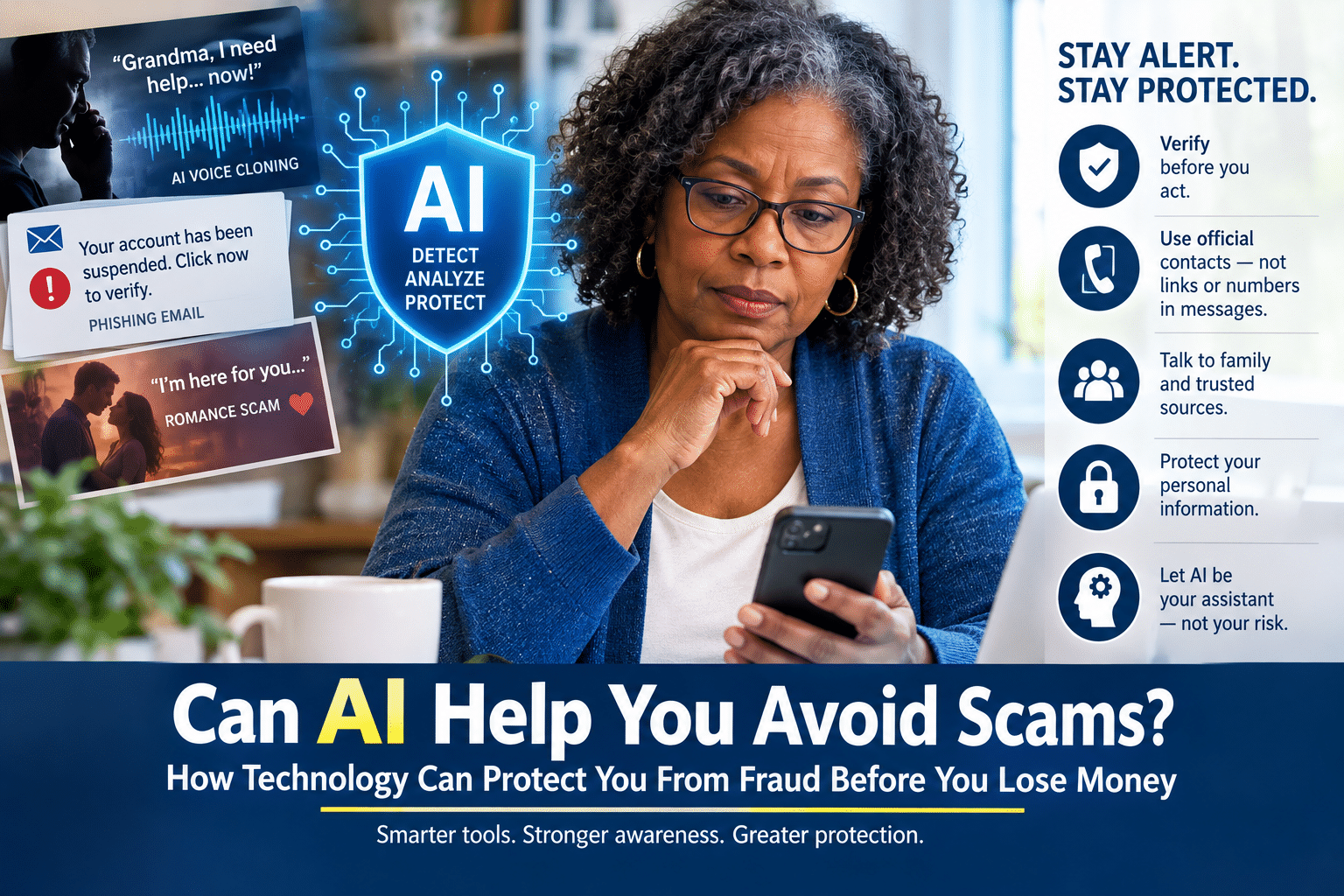
A fraudulent email once gave itself away through strange grammar, obvious spelling errors, or an awkward message that did not sound like the company it claimed to represent. Today, AI can help criminals create polished messages in seconds. A scammer can produce professional-looking correspondence, imitate the tone of a business, translate a message into several languages, create realistic photographs, and even reproduce a familiar voice. The Federal Trade Commission warns that scammers can use a short audio sample to clone the voice of a family member, creating an emergency call that may sound frighteningly real.
This is not a minor problem. The FTC reported that consumers said they lost about $3.5 billion to imposter scams in 2025, and imposter scams remained the most frequently reported category of fraud. The large financial losses matter, but the emotional design of these scams matters just as much. Scammers deliberately create fear, urgency, embarrassment, affection, or confusion because a person who is emotionally overwhelmed is less likely to slow down and verify what is happening.
Consider the family emergency scam. A person receives a telephone call and hears what sounds exactly like a son, daughter, grandchild, or close friend. The caller says there has been an accident, an arrest, a medical emergency, or some other crisis. Money is needed immediately, and there is always a reason the victim should not call anyone else. In an earlier era, recognizing that the voice did not sound quite right might have been enough to stop the scam. Voice cloning makes that form of reassurance less dependable.
The best defense is therefore changing. Instead of asking only, “Does this sound like the person?” we now need to ask, “Can I independently verify that this is the person?” If someone claiming to be a relative asks for money, hang up and call that person on a number you already know. If the person cannot be reached, contact another family member. Families can even agree on a private question, phrase, or detail that can be used during an emergency. A few minutes of independent checking can interrupt the emotional pressure on which the scam depends.
Bank impersonation scams use a similar method. A message may claim that suspicious activity has been detected and that money must be moved to a “safe” account. The caller may know the name of the bank, use a realistic-looking telephone number, or send a text that resembles an actual security alert. The FTC notes that some of the costliest impersonation scams begin with false bank security warnings designed to convince consumers to move their own money.
The safest response is to stop communicating through the message that created the alarm. Do not call the number in the suspicious text, click its link, or follow instructions from the caller. Instead, use the telephone number printed on the back of the bank card, enter the bank’s website manually, or open the institution’s official application. If there is real a problem with the account, it can be handled through a channel you know belongs to the bank.
Artificial intelligence can also help consumers investigate suspicious communications. A questionable email can be examined for unusual requests, inconsistencies, or pressure tactics. AI can help explain what a technical-looking message is asking the recipient to do. It can compare the wording of a suspicious invoice with a genuine one or help someone create a list of questions to ask before sending money. Used in this way, AI becomes part of the defense rather than part of the deception.
People should still avoid placing sensitive information into an AI system merely to investigate a scam. An entire bank account number, Social Security number, password, or security code is rarely necessary. The suspicious wording can often be examined after personal information has been removed. The goal is to use technology to understand the situation without exposing additional private information.
Romance scams present a different challenge because they develop slowly. A stranger met online may spend weeks or months building trust before asking for financial help. AI can make the deception more sophisticated by helping a criminal maintain long conversations, create believable photographs, or produce messages that seem caring and personal. A person who believes a genuine relationship has developed may be far more willing to overlook warning signs when money eventually enters the conversation.
The most important rule remains remarkably simple: do not send money to someone you have never met and independently verified merely because the relationship feels emotionally real. A photograph is no longer enough to prove identity, and even a live-looking digital interaction may not tell the whole story. Affection should not eliminate verification, particularly when investment opportunities, loans, emergencies, cryptocurrency, gift cards, or financial transfers suddenly become part of the relationship.
Artificial intelligence can also help criminals create fake businesses and false online identities. A professional website can be built quickly. Product photographs can be generated. Customer testimonials can be fabricated, and fake profiles can make a company appear established. This means consumers need to look beyond appearance. A beautiful website is not evidence that a business is legitimate.
Before making an unfamiliar purchase or investment, look for independent information about the company rather than relying exclusively on what the company says about itself. Search the business name along with words such as “complaint,” “scam,” or “review.” Verify professional licenses where relevant. Check whether the contact information leads to an established organization, and be especially cautious when the payment method makes recovery difficult.
Payment methods themselves provide clues. Scammers frequently prefer methods that are fast and difficult to reverse, including wire transfers, cryptocurrency, payment applications, and gift cards. The FTC repeatedly warns consumers that requests to purchase gift cards and provide the numbers are a common sign of fraud. A legitimate government agency, utility company, or business should not require someone to rush to a store, buy gift cards, and read the codes over the telephone.
The ability to slow down may become one of the most valuable skills in the AI age. Scammers want immediate action because time works against them. The longer a person thinks, calls someone else, checks a website, contacts a bank, or asks a family member for a second opinion, the greater the chance that the deception will collapse.
This is particularly important for families. Talking about scams before one occurs can remove some of the embarrassment that causes victims to remain silent. Older adults should not be treated as though they are incapable of protecting themselves, and younger people should not assume they are immune. Intelligent, educated, technologically experienced people are scammed every day because the fraud reaches them at the right emotional moment.
AI may make scams more convincing, but it can also help people become better prepared. The strongest protection is a combination of technology and human judgment: good spam filters, fraud alerts, identity verification, careful use of AI tools, family communication, and a willingness to stop when something feels urgent.
The most important change may be learning that familiar appearances no longer guarantee familiar identities. A voice can be copied, an email can be beautifully written, a photograph can be generated, and a caller ID can be falsified. In this new environment, trust should increasingly be based on verification rather than appearance.
Artificial intelligence is making deception more sophisticated, but sophistication does not make a scam unbeatable. Most scams still depend on the same human weaknesses they always have: urgency, secrecy, fear, greed, loneliness, and the desire to help someone we love. When people recognize those pressures and create the habit of checking before acting, technology can become part of the protection rather than simply another tool in the hands of the scammer.
© 2026 Truth Seekers Journal. Published with permission from the author. All rights reserved.
Related articles:
Will AI Change Your Job Even If It Doesn’t Replace It? What Everyday Workers Should Expect
Your Children Are Growing Up With AI: What Parents and Grandparents Need to Understand
What Happens When Your Car Starts Thinking for You? AI, Driving, and the Road Ahead
AI Can Save You Time, but Can It Make You Smarter?
Living With AI: How It Is Changing Work, Family, and Community
When Systems Forget Who They Were Built For
Why Familiarity Is Not the Same as Understanding
Truth Seekers Journal thrives because of readers like you. Join us in sustaining independent voices.