Ted Knorr
By Ted Knorr | Harrisburg, PA | July 28, 2026
This column exists for only one purpose: that is to answer your questions on Negro League baseball history. To that end, we need your help … if you are reading this column, enjoy it, want it to continue, and do not already know everything about Negro League history … then please submit a question on any aspect of Negro League history. Your questions are the lifeblood of Shadow Ball—they shape where we go next … players, teams, events, and more – and, in so doing, you will direct where this column goes moving forward. Your participation is important and appreciated. The very existence of this column depends on you. Submit your questions to shadowball@truthseekersjournal.com.
Given the level of talent in the Negro Leagues and so few slots opened in the major leagues, why and when did the Negro League collapse? Elston Hoskins, Saint Charles, Missouri
Before getting to the “why and when” I want to recognize the astute preamble to your query which correctly notes that the available, unfettered by recognized contracts, talent of Negro League represented the greatest source of talent in the history of the game. Simultaneously, with 15 franchises in opposition to the thought of integration in this moment of time due to racism, ignorance, poor judgement or whatever rationale one wants to invent the process of bringing talent of color to the Majors was painfully slow despite a demonstrated high reward as the below illustration shows:
One would think such slow movement from the Negro Leagues would postpone, as Mr. Hoskins’ question implies, the inevitable collapse, sic, of the Negro Leagues. The reality was that Negro League baseball fans for several reasons – racial pride, quality of play, media attention (and lack thereof) – almost immediately began an exodus from a viable entertainment source and major African American business to the American and National Leagues
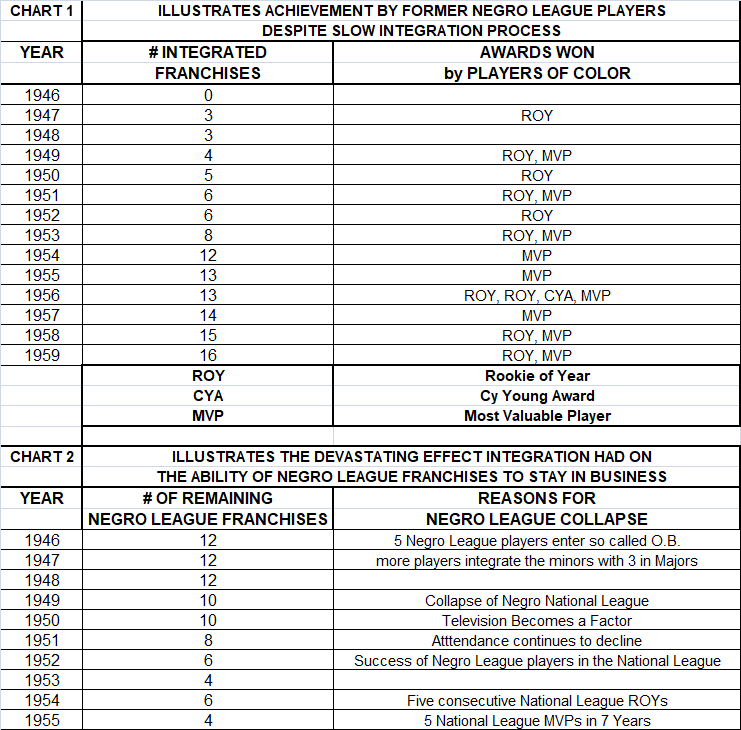
I think the “Why” has been covered. For me, the “When” is simultaneous with Jackie Robinson’s final exit from the Kansas City Monarch locker room in August 1945. However, with no players of color on Major League rosters in 1946 I count that year as the last where the Negro Leagues should be considered major.’. Major League itself is a little more forgiving in its definition, by edict on December 16, 2020, of Major Leagues includes the Negro National and Negro American League through 1948. The Society for American Baseball Research extends its Major league imprimatur through the 1950 season. All three of us (MLB, SABR and myself) recognize that the Negro Leagues specifically the Negro American League sputter on, descending in quality and quantity until 1960 or ’61.
Last Week’s Shadow Ball Significa Question of the Week
Which former Memphis Red Sox player worked in various roles at the Peabody Hotel after his baseball career ended? Nat Rogers, himself a veteran of over twenty years at the highest level of baseball permitted, hit .305 with an OPS+ of 111 and better than average fielding percentage and range factor in all three outfield positions, who must be considered a solid Major League outfielder. After his playing days were over, he worked in various capacities at the Peabody Hotel in Memphis and was as much a favorite with that clientele as with baseball fans. No reader submitted a guess so this week’s question, hopefully, will be a bit more inviting.
This Week’s Shadow Ball Significa Question of the Week

Which pitcher won the last “Major League” Negro League World Series game? Send your answer, along with your comments/questions about the Negro Leagues, to
shadowball@truthseekersjournal.com or mail them to:
Shadow Ball
3904 N. Druid Hills Road, Suite 179
Decatur, GA 30033

 Milton Kirby