Milton Kirby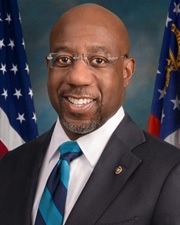
By Milton Kirby | Atlanta, GA | September 18, 2026
At first, some of the images were almost funny.
One showed Georgia U.S. Sen. Raphael Warnock with a full head of hair. Another claimed he had become the grandfather of twins.
Neither was true.
“I should be so lucky,” Warnock joked about the hair. “I checked the mirror this morning. Not true.”
But other posts appearing on a Facebook page carried claims that were harder to laugh away.
One falsely claimed Warnock had collapsed on stage. Another said he had undergone surgery and was recovering from cancer.
Those stories were convincing enough that some people apparently believed them.
“Some well-meaning constituents and friends, well-wishers, actually called, saying that they were praying for my speedy recovery,” Warnock said.
Warnock had not suffered the health problems described in the posts.
Instead, the fabricated images and stories became the basis for a warning from the Georgia senator about artificial intelligence, misinformation and what could happen when false content becomes increasingly difficult to distinguish from authentic information.
On Sept. 15, Warnock released a video discussing the posts. His Senate office issued a statement the following day.
“What if hours before an election, someone created a page with AI-generated images, fake stories about the candidates?” Warnock asked. “How will voters know what’s true and what’s not true?”
From the Absurd to the Serious
Warnock said he recently encountered a Facebook page containing numerous AI-generated images and stories about him.
Some were strange enough for him to joke about.
There was the newly grown hair.
There were the nonexistent twin grandchildren.
Then came the health claims.
Warnock said posts suggesting that he was experiencing major health problems and had undergone surgery received “thousands of likes, thousands of views.” His Senate office said other fabricated material claimed he had collapsed on stage and was recovering from cancer.
The Facebook page was later taken down after Warnock’s team notified Facebook, according to The Atlanta Journal-Constitution.
Available public reporting has not identified who operated the page or established why the false material was created.
“As these tools become increasingly powerful, it will get harder and harder to distinguish fact from fiction,” Warnock said.
What Happens Just Before an Election?
Warnock’s warning focused particularly on timing.
False information about a public official can be corrected. An artificial image can be identified. A fabricated story can be debunked.
But Warnock raised the possibility of false AI-generated information appearing only hours before voters go to the polls.
That could leave journalists, campaigns, technology companies and voters with limited time to determine whether rapidly circulating information is authentic.
Warnock called on social media companies to move quickly to label AI-generated material. He also called for congressional action.
“We need guardrails. We need regulations. We need to figure this out,” Warnock said. “The future is already here.”
He did not identify a specific piece of legislation in the video or detail precisely what regulations he wants Congress to adopt.
That leaves a larger policy debate unresolved.
Determining whether an image was generated by artificial intelligence is one question. Determining when and how government should regulate AI-generated political material raises additional questions involving technology, enforcement and free expression.
Warnock’s position is that additional safeguards are needed.
AI Concerns Extend Beyond Social Media
The false Facebook posts are not Warnock’s only recent encounter with questions surrounding artificial intelligence.
Weeks earlier, he visited the proposed site of OpenAI’s 3.2-gigawatt data center in Effingham County. After meeting with residents, Warnock announced his support for a statewide moratorium on new data center construction unless projects meet safeguards involving utility costs, transparency and pollution. His Senate office also referenced the data-center issue when announcing his response to the false AI posts.
The issues are different.
One concerns the physical infrastructure needed to support artificial intelligence and large-scale computing.
The other concerns information produced with AI and how that information reaches the public.
Warnock acknowledged that artificial intelligence is already part of everyday life and said policymakers must also address questions involving jobs and safety.
But the false reports about his health gave him another issue to raise: what happens when something created by artificial intelligence is accepted as real.
When the False Story Looks Real
There is still much that is unknown about the Facebook page.
Publicly available reporting has not established who created it, whether the operator had a political or financial motive, or whether the material was produced simply to attract online traffic.
Those distinctions matter.
Without that information, there is no basis to conclude that the posts were created specifically to influence an election or damage Warnock politically.
What is known is more straightforward.
The page contained fabricated images and stories about a sitting United States senator.
Some of the posts attracted thousands of likes and views.
Some falsely said he was seriously ill.
And some people who encountered the claims apparently believed them.
They called.
They offered prayers for his recovery.
That real-world reaction is what Warnock pointed to when he raised a larger question about artificial intelligence and elections.
“What if hours before an election,” he asked, “someone created a page with AI-generated images, fake stories about the candidates?”
Truth Seekers Journal thrives because of readers like you. Join us in sustaining independent voices.


 Florita Bell Griffin, Ph.D.