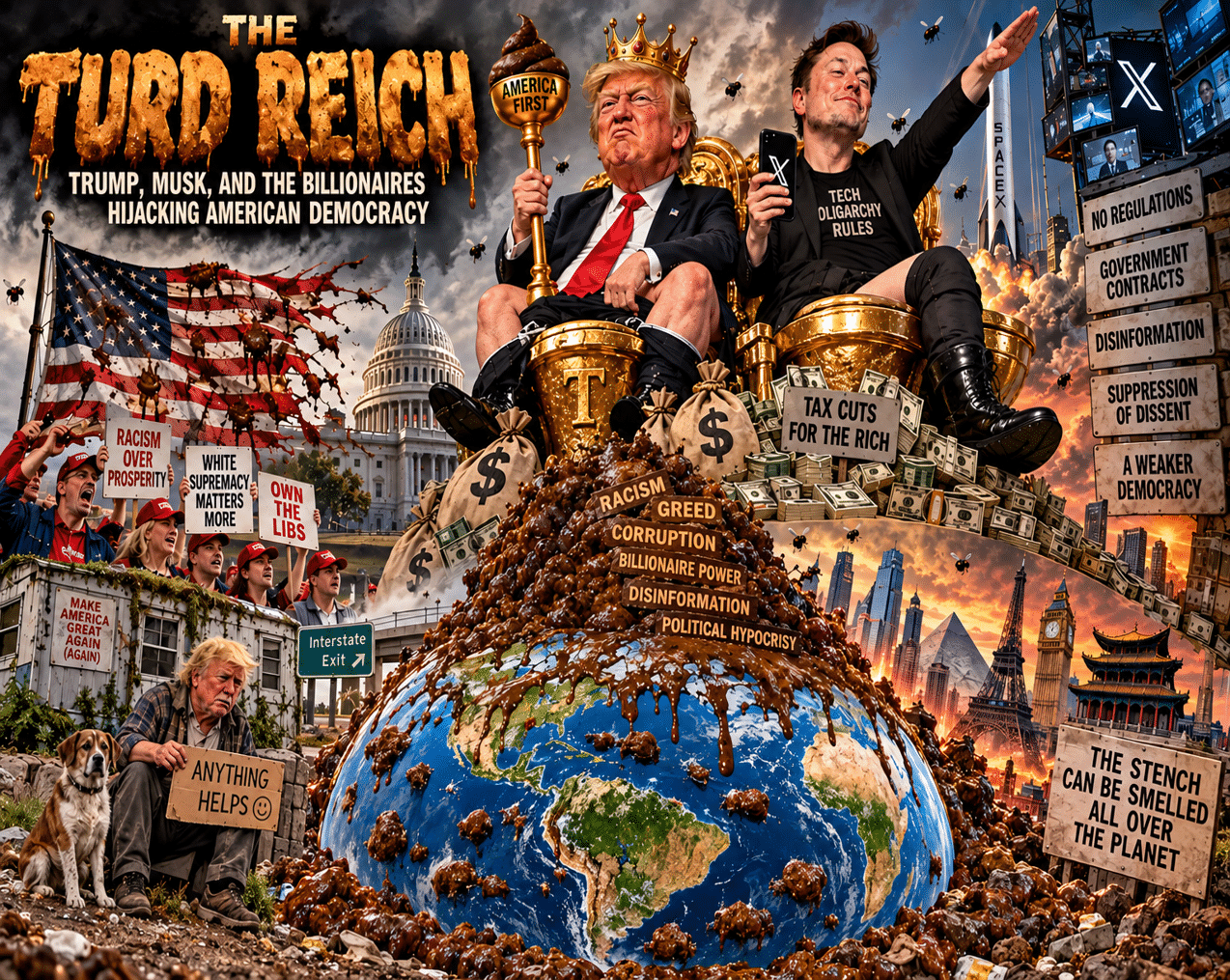
The Turd Reich: Trump, Musk, And the Billionaires Hijacking and Assassinating American Democracy

Lola Renegade examines Donald Trump, Elon Musk, billionaire political influence, racial inequality, and constitutional contradictions threatening American democracy in this provocative commentary on power and accountability.

By Lola Renegade | Atlanta, GA | October 30, 2026

“Something is rotten in the state of Denmark,” Shakespeare warned more than four centuries ago in Hamlet. But the stench today is not coming from Denmark. It is rising from America, a nation whose moral and political decay of the Trump Administration has become so pervasive that its scattered feces  has contaminated the very ideals of democracy it claims to champion. And the foul odor no longer respects national borders. It has traveled across oceans, crossed continents, and reached the nostrils of a world watching America’s contradictions unfold under a Hitleresque, racist, anti-intellectual kakistocracy.

The question is no longer whether something is rotten in America. The question is how much longer more than half of Americans will willingly smell, chew on, swallow, and digest the very excrement poisoning our democracy before finally confronting those responsible for producing it.

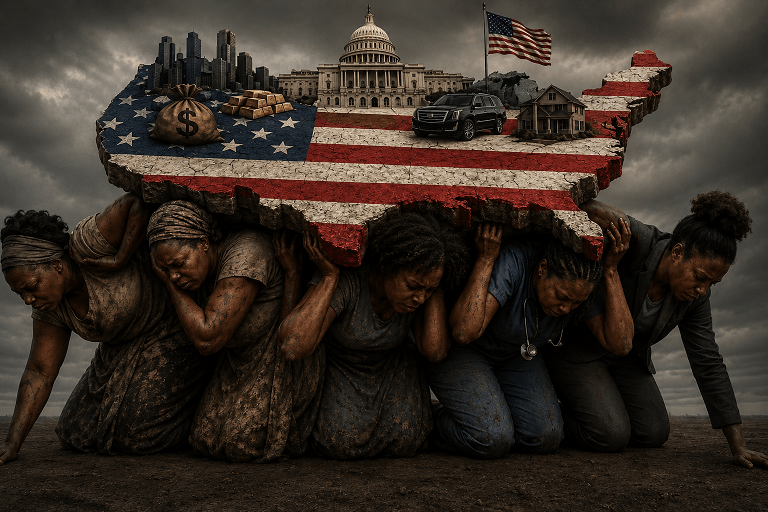
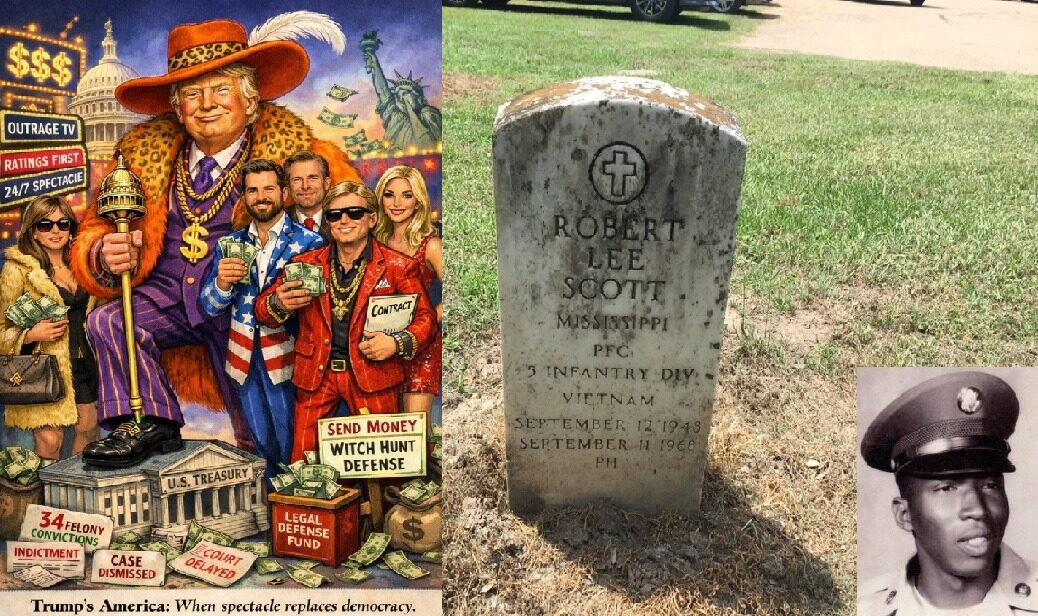
Suffice it to say, without the financial foundation provided by Daddy’s fortune, (p)Resident Donald Trump might well have been just another impoverished old white man standing at an interstate exit, clutching a cardboard sign and begging for spare change before returning to a dilapidated, mildewed, moss-covered trailer. Yet in America, wealth can be mistaken for extraordinary intelligence, financial privilege for personal genius, and bullying arrogance for leadership.

America has spent nearly 250 years proclaiming itself the greatest democracy on Earth. Yet the American experiment has always contained a profound contradiction: a nation founded upon the language of liberty while embracing and jerking off to slavery, celebrating equality while enforcing racial hierarchy, and proclaiming government of, by, and for the people while maintaining institutions that can prevent the candidate receiving the most presidential votes from occupying the White House.

Today, those contradictions collide with another enduring American reality: the extraordinary political influence of concentrated wealth and a menacing, self-important cadre of political Foghorn Leghorns – loudmouthed, blustering, grievance-fueled demagogues whose arrogance, authoritarian impulses, and spectacular hypocrisy threaten to turn the American Experiment into a cautionary tale of a democracy undone by its own contradictions.

And therein lies one of the most damning contradictions of the American Experiment: a nation that can summon billions of dollars to finance the pursuit of political power yet struggles to muster the political will to liberate its children from the suffocating grip of poverty. During the 2022 and 2024 federal election cycles alone, approximately $24.3 billion was spent on political campaigns and related election activities, with billions more flowing through the 2026 election cycle.

Meanwhile, research has estimated that an annual investment of approximately $90 billion could substantially reduce childhood poverty, while a more ambitious investment of approximately $179 billion annually could drive the childhood poverty rate below 1 percent. These figures expose a fundamental question of national priorities. America has perfected the machinery of political fundraising, transformed the acquisition of power into a multibillion-dollar enterprise, and demonstrated an extraordinary capacity to mobilize wealth whenever political dominance is at stake. Yet millions of children remain imprisoned by circumstances that extinguish their dreams before they have even had the opportunity to imagine them.

What does it say about a nation’s moral compass when the ambitions of politicians and their wealthy benefactors generate such enormous financial urgency while the futures of impoverished children remain negotiable? Perhaps the greatest indictment of the American Experiment is not that America lacks the resources to end childhood poverty, but that it has repeatedly failed to summon the collective conscience, courage, and political will to make the liberation of every child from poverty a nonnegotiable national imperative.

Donald Trump, Elon Musk, the bootlicking tech owners, and the other increasingly visible involvement of billionaires in national politics have intensified questions about the relationship between private fortunes and public power. Their political activities also provide an opportunity to examine how racial identity, economic security and insecurity, corporate influence, and allegiance to political leaders shape American democracy.

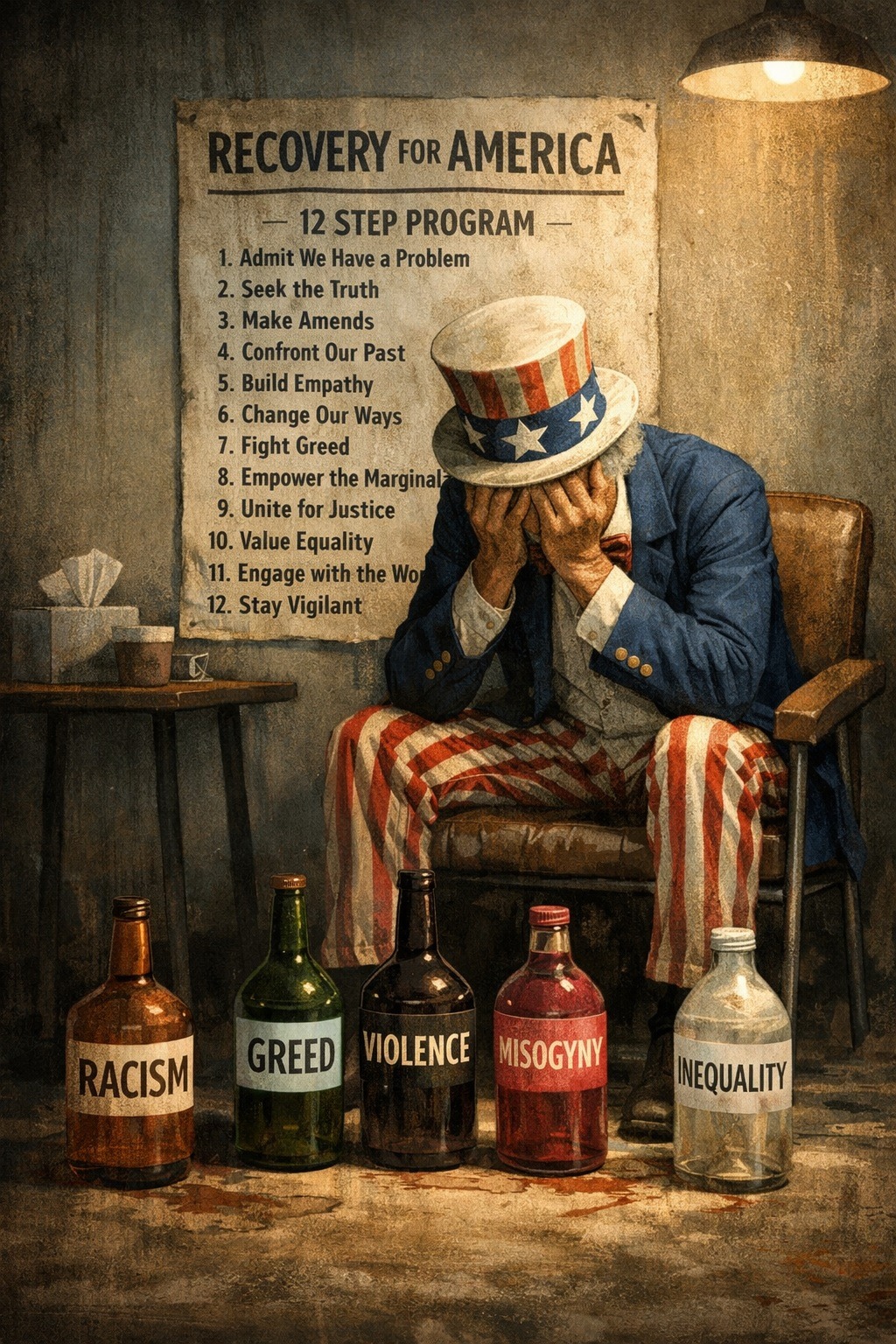
I call this political phenomenon The Turd Reich – it isa deliberately provocative expression of my concern about the convergence of racial resentment, billionaire influence, and the erosion of democratic accountability. Though the phrase is political satire, it is also an assertion that many in contemporary America, particularly among Republican white men and women, is identical to Nazi Germany. It is an invitation to examine the warning signs that history teaches us to recognize excessive concentration of power, the glorification of political personalities and brutes, hostility toward independent institutions, and the temptation to confuse loyalty to a leader with loyalty to a nation. This is a warning that the ideologies that enabled one of history’s darkest chapters are neither confined to the past nor immune from resurfacing in America.

The Billionaires, the Bigots, and the Betrayal of American Democracy

The alliance between Donald Trump, Elon Musk and other wealthy political donors illustrates the increasingly complicated relationship between concentrated private wealth and public authority.

Elon Musk poured hundreds of millions of dollars into Donald Trump’s 2024 election effort and subsequently assumed a prominent role in the administration’s Department of Government Efficiency (DOGE), an initiative whose sweeping personnel reductions, disputed savings claims, and disruption of federal operations generated considerable controversy. Meanwhile, Musk’s companies continued operating in industries deeply intertwined with federal contracts, regulatory decisions, and government policy, including aerospace, transportation, telecommunications, and artificial intelligence. His political spending and government role raise an unavoidable question: Where should the boundaries lie when a billionaire who helps finance a president’s election subsequently participates in an administration whose decisions can affect his own business empire?

And while billionaires navigate the corridors of political power, ordinary Americans confront the escalating costs of gasoline, diesel, groceries, housing, and other necessities. The September 2026 inflation report showed consumer prices rising 3.7 percent over the preceding year, with gasoline prices increasing particularly sharply. These economic pressures invite another examination of the American political landscape: How do economic insecurity, racial resentment, cultural identity, and political loyalty intersect when Americans enter the voting booth?

Donald Trump’s first election, following eight years of the first African American president, Barack Obama, raised profound questions about the role of race and racial backlash in American politics. But Trump’s return to the White House in 2024, after defeating Vice President Kamala Harris – a highly accomplished Black and South Asian woman – demands an even deeper examination. Twice, America was presented with a historic opportunity to confront its racial and gender hierarchies, and twice, the political outcomes revealed how complicated and deeply entrenched those divisions remain. Although no single election can establish the motivations of millions of individual voters, the sequence of these presidencies raises an unsettling question: To what extent do racial resentment, identity, and the preservation of established social hierarchies influence political allegiance, even when economic security and material well-being hang in the balance?

These circumstances raise profoundly troubling questions about conflicts of interest and the increasingly blurred boundaries between private wealth, corporate influence, and governmental responsibility. America’s constitutional system was designed around checks and balances, yet the Trump Administration’s expansive claims of executive authority have placed those safeguards to be either nonexistent or under extraordinary strain. Even the United States Supreme Court, whose fundamental responsibility includes upholding constitutional limits on governmental power, has issued decisions expanding presidential immunity and strengthening executive authority. To critics, these rulings have helped create an environment in which Trump – the useful idiot of powerful interests seeking to advance their own political and economic agendas – can exercise extraordinary authority while the institutions entrusted with restraining presidential overreach struggle to impose meaningful accountability.

What happens to a constitutional republic when the separation of powers becomes little more than a ceremonial declaration, when institutional loyalty threatens to supersede constitutional duty, and when the principle that no person is above the law appears increasingly difficult to enforce for wealthy white men? A democracy does not cease to exist only when its Constitution is abolished. It can also be weakened when the institutions entrusted with defending that Constitution fail to exercise their powers of accountability.

Business leaders have every right to participate in politics. They may advocate for policies, support candidates, and advise public officials. But when individuals possess extraordinary wealth, influential communications platforms, major government contracts, and direct access to national leaders, the public has a legitimate interest in knowing whether decisions are being made for the benefit of the country or for particular private interests.

The central question is not whether billionaires should have political rights. It is whether their wealth gives them access and influence so disproportionate that ordinary citizens become spectators in a democracy supposedly governed by them.

From Liberal Techies to Trump’s Lap Dogs

Silicon Valley once cultivated an image of itself as a center of intellectual independence, technological liberation, and socially progressive thinking. Its executives spoke enthusiastically about innovation, inclusion, diversity, and the democratization of information. Technology was presented as an instrument through which ordinary people could challenge entrenched institutions and gain access to knowledge previously controlled by powerful gatekeepers.

Yet the political relationship between several major technology companies and Trump changed markedly as he prepared to return to the presidency in 2025. Prominent executives attended his inauguration, and major corporations contributed substantial sums to the inaugural fund as well as to many of his upcoming vanity projects. Some companies also reconsidered and ended policies involving content moderation, diversity initiatives, and their relationships with federal regulators.

Critics interpreted these developments as evidence of corporate accommodation to political power. Supporters argued that technology companies must maintain working relationships with elected administrations regardless of political differences. From my perspective, however, this transformation invites a far more disturbing description: many of the once-liberal techies have become Trump’s obedient lapdogs, eagerly sucking at the tits of a grotesque beast nourished by political opportunism, corporate greed, and the insatiable appetite for wealth and influence.

These are the same corporate titans who once wrapped themselves in the language of innovation, progress, diversity, and social responsibility. Yet when their financial empires and access to political power appeared to be at stake, some discovered that their professed principles were remarkably negotiable. What good are declarations of corporate conscience when that conscience can be surrendered at the first whiff of political advantage?

But the underlying issue deserves serious examination. When technology companies control major channels of public communication, their relationships with government officials can affect far more than their shareholders. Decisions about information access, artificial intelligence, competition, and digital privacy have consequences for the entire population.

The question is whether the industry that promised to democratize information can maintain its independence while seeking favorable treatment from the very political institutions it once celebrated challenging.

When White Supremacy and Mediocracy Matters More Than Economic Survival

For generations, political commentators have asked why economically struggling white Americans sometimes support candidates and policies that appear inconsistent with their financial interests.

Perhaps that question is incomplete.

Economic security is not the only interest people consider when making political decisions. Racial attitudes, cultural identity, religious convictions, immigration policy, and perceived social status also influence political choices.

The historical relationship between whiteness and economic class is especially revealing.

During slavery, wealthy plantation owners accumulated enormous fortunes while many poor white Southerners possessed little property or financial security. Yet the racial hierarchy established by slavery offered white people a legal and social status denied to enslaved Black Americans.

That history raises an uncomfortable contemporary question: Can the preservation of presumed racial advantage become more important to some voters than their own material prosperity?

This is an assertion that most economically disadvantaged white voters are motivated by racism, and I must include misogyny. A mythical diversity of opinion must not become an excuse for refusing to confront the enduring influence of racial resentment and the psychological rewards of perceived racial and patriarchal superiority in American politics.

In the 2024 presidential election, approximately 60 percent of white men who cast ballots voted for Donald Trump, and white women were not far behind at 53 percent. I believe that racism motivated every vote, and these Americans must perform a serious examination of how their racial identity, economic disparity, cultural grievance, and political allegiance intersect. The more troubling question is whether, for some economically struggling white Americans, the preservation of a socially constructed racial advantage carries greater psychological value than the pursuit of their own economic security. If so, what does that reveal about a society in which the promise of racial superiority can compete with the promise of economic opportunity?

A society that encourages citizens to measure their standing by the disadvantage of another group perpetuates inequality across racial and economic lines. Racial superiority cannot pay a mortgage, provide affordable healthcare, rebuild a struggling business, or guarantee a child’s education. And yet the preservation status of whiteness can remain politically meaningful even when material conditions deteriorate.

How Racism, Greed, and the Worship of Wealth Shape the American Dream

America has long celebrated financial success as the ultimate testament to personal achievement, discipline, intelligence, ingenuity, and ambition. Conveniently omitted from this self-congratulatory narrative are the genocide of Indigenous peoples, the brutality and uncompensated labor of enslaved Africans, the systematic theft of land and resources, and the centuries of exploitation, dispossession, and economic plunder, both at home and abroad, that helped build the nation’s extraordinary wealth.

America’s prosperity was not forged by individual brilliance and honest enterprise alone, as many wealthy white people profess. It was also built upon stolen land, stolen labor, stolen resources, and stolen opportunities, while generations of those who bore the greatest human costs were systematically denied an equitable share of the wealth their suffering and labor helped create. What America so proudly celebrates as the triumph of individual achievement is inseparable from a history of collective exploitation that its mythology of meritocracy has too often sought to erase. Wealth also reflects inherited advantages, market conditions, access to capital, public infrastructure, favorable policies, and historical inequalities.

The danger emerges when financial success is treated as proof of superior political judgment.

A billionaire may possess exceptional expertise in building a corporation without possessing comparable expertise in constitutional government, public education, healthcare administration, or the needs of economically vulnerable communities.

A successful business leader can contribute valuable ideas to public policy. But a democratic government cannot be operated solely according to the priorities of a private corporation. Corporations answer to owners, shareholders, customers, employees, and regulators. Governments have constitutional obligations to an entire population, including citizens who possess little economic power.

Efficiency matters. So do fairness, due process, transparency, equal protection, and the preservation of essential public services. A government that measures success only through financial calculations risks overlooking the human consequences of its decisions.

The Electoral College: America’s Constitutional Contradiction

The Electoral College remains one of the most consequential institutional debates in American democracy. Established through the Constitution of 1787, it emerged from a political system in which slavery shaped representation and political power.

The Three-Fifths Compromise increased the population counts used to allocate representation to slaveholding states, despite denying enslaved people the political rights enjoyed by free citizens. Because electoral votes were connected to congressional representation, that compromise also affected presidential electoral power.

The institution has changed significantly over time, but its fundamental structure remains state-based rather than a direct national popular vote.

In 2000, George W. Bush was handed the presidency by the Supreme Court, despite receiving fewer votes nationally than Al Gore. In 2016, Trump won the Electoral College despite Hillary Clinton receiving nearly 2.9 million more popular votes.

In 2024, Trump won both the Electoral College and the national popular vote.

These outcomes illustrate the institution’s central controversy: it permits a presidential candidate to win without receiving the largest number of votes nationwide, even though that result does not occur in every election.

Defenders argue that the Electoral College preserves federalism and protects the role of states in presidential elections. Critics argue that it weakens the principle of equal individual voting power and directs disproportionate campaign attention toward competitive states.

The critical question is whether the constitutional role of states should continue to outweigh the advantages of a single nationwide popular vote. An institution’s historical longevity does not eliminate the need to examine its contemporary consequences.

The National Anthem, LeBron James, and the Contradictions of Patriotism

Earlier this month, President Donald Trump called basketball superstar, LeBron James “a TOTAL DISGRACE” and demanded that he apologize to American military service members after James appeared to practice a golf swing during the national anthem. Yet Trump himself received five deferments during the Vietnam War and never served a single day in the military. The contrast raises an obvious question: By what standard does a president who never wore the uniform presume to judge another American’s respect for those who did?

And consider his choice of Pete Hegseth, a former weekend Fox News television host, to lead the Department of Defense. Hegseth did serve in the Army National Guard, including deployments to Iraq and Afghanistan, but his appointment nevertheless raised questions about the qualifications required to oversee one of the world’s largest military institutions. If patriotism is to be measured by public displays of reverence for the flag, should it not also be measured by consistency, accountability, and respect for the sacrifices made in its name?

For many Americans, the national anthem represents the sacrifices of military personnel and the ideals of the republic. They regard respectful conduct during its performance as an important civic tradition. Others emphasize that constitutional freedom includes the right to express oneself in ways that challenge conventional expectations of patriotic behavior. The controversy provides an opportunity to compare public demands for symbolic patriotism with the obligations of constitutional governance.

Trump’s criticism of James can be considered together with several documented episodes from his own political career.

First, respect for the flag and respect for election results. Trump demanded respect for a national symbol, but after losing the 2020 presidential election, he repeatedly advanced claims of widespread election fraud that were not substantiated by the evidence presented in court or by election officials.

Second, honoring military sacrifice and accepting constitutional limits. Trump invoked service members who died defending the country, while his efforts to challenge the 2020 election included pressure on state officials and attempts to alter the outcome of certified electoral results.

Third, condemning ceremonial disrespect and examining January 6. Trump’s criticism concerned a gesture during the national anthem. The events of January 6, 2021, involved a violent attack on the United States Capitol, incited by Trump, while Congress was meeting to certify the presidential election. The congressional investigation examined Trump’s conduct before and during that attack.

If America had even a semblance of the fairness, equality, and equal justice under the law that it so sanctimoniously preaches to the rest of the world, Donald Trump would be facing the full weight of criminal accountability rather than enjoying the privileges of a second term in the White House. His conduct warrants the harshest punishment the law could justifiably impose – a life sentence behind the walls of ADX Florence, America’s most restrictive federal supermax prison, where inmates can spend approximately 23 hours a day confined to their cells.

 Instead, he occupies the Oval Office, surrounded by the trappings of presidential power, while the nation continues hemorrhaging and debating whether its most powerful citizens should be held to the same standards as everyone else. In America, the distance between a prison cell and the Oval Office can apparently depend first on if you will promise to keep a white racial hierarchy intact, on who you are, how much power you wield, and whether the institutions entrusted with delivering justice have the courage to hold you accountable.

You really can’t make this sh*t up!

Fourth, demanding public accountability while challenging institutional scrutiny. Trump has repeatedly criticized investigations and proceedings involving his own conduct. His supporters argue that some of those investigations were politically motivated; critics argue that independent scrutiny is indispensable when allegations concern powerful public officials.

Fifth, celebrating national greatness while questioning the institutions through which the nation governs itself. Trump frequently invokes American exceptionalism, yet his disputes with courts, election officials, federal agencies, and other institutions have prompted recurring debates about the appropriate limits of presidential authority.

Is patriotism principally a matter of gestures, symbols, and public declarations? Or should it also be measured through adherence to constitutional procedures, respect for lawful election outcomes, and acceptance of institutional accountability?

Americans can disagree about the meaning of a gesture during the national anthem while still recognizing that questions involving presidential authority and constitutional governance carry far-reaching public consequences.

The Democracy America Has Yet to Build

American democracy did not emerge fully formed in 1776 or 1787. And it is not fully formed in 2026. Its expansion required generations of struggle. Enslaved Africans resisted bondage. Abolitionists challenged slavery. Black Americans fought for political rights during Reconstruction. Women organized for suffrage. Civil Rights activists confronted segregation, intimidation, and disenfranchisement.

Martin Luther King, Jr., Ida B. Wells, Medgar Evers, Fannie Lou Hamer, James Earl Chaney, The Freedom Riders in 1961, Supreme Court Justice Thurgood Marshall, Jackie Robinson, and countless others demonstrated through their lives that democratic rights often require extraordinary sacrifice. Their work was not merely about gaining access to political institutions. It was about forcing those institutions to honor principles they had long proclaimed but failed to uphold. That unfinished work continues through contemporary debates about voting rights, representation, executive power, campaign finance, economic inequality, and the role of wealth in government.

Reforming democracy requires more than condemning particular personalities. It requires examining the institutions that distribute power and determining whether they adequately protect political equality and public accountability.

America Must Decide What It Values – or Abandon the Pretense of Being the Greatest Country in the World

The controversies surrounding Trump, Musk, Silicon Valley, racial politics, and the Electoral College raise questions that extend beyond any single administration.

How should a republic prevent private wealth from exercising disproportionate public influence? How should presidential elections balance federalism with equal voting power? How should citizens distinguish respect for national symbols from adherence to constitutional responsibilities? How should the public evaluate policies that may benefit one group while imposing costs on another?

And how can Americans preserve the independence of institutions that must sometimes investigate, constrain, or disagree with those holding political power?

These questions cannot be answered through slogans or personal allegiance. They require historical understanding, reliable evidence, public participation, and consistent constitutional standards.

The American experiment remains unfinished. Its future depends upon the willingness of citizens to examine its contradictions without abandoning its democratic aspirations.

A nation cannot measure its commitment to freedom solely by the flags it displays, the anthems it sings, or the wealth its most successful citizens accumulate. It must also measure that commitment by the equality of its political institutions, the integrity of its elections, the accountability of its leaders, and the opportunities available to its people – all of its people!

Truth Seekers Journal thrives because of readers like you. Join us in sustaining independent voices.

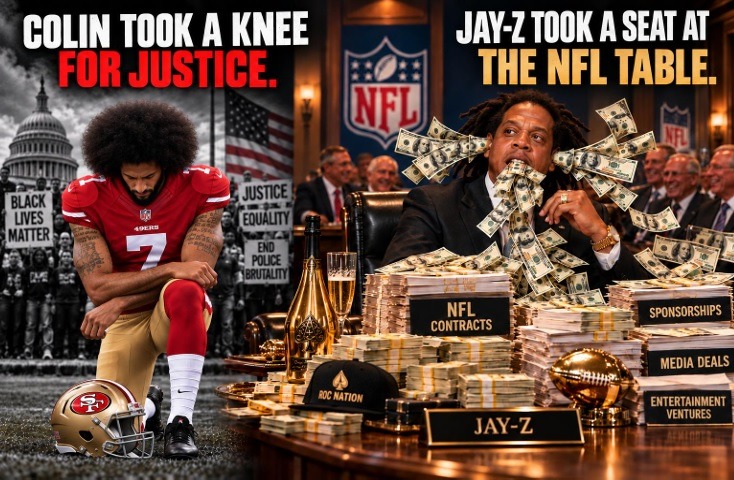
Colin Took a Knee for Justice. Jay-Z Took a Seat at The NFL Table of White Supremacy.

Lola Renegade examines Colin Kaepernick’s sacrifice, Jay-Z’s NFL partnership, racial justice, power, protest, and the true cost of solidarity in America.cal Commentary
Lola Renegade

What Are You Willing to Lose for Justice?

By Lola Renegade | Atlanta, GA | September 24, 2026

I recently had the opportunity to meet Colin Kaepernick at his book signing in Atlanta, Georgia.
Afterward, I read his book overnight, The Perilous Fight, a must read. I came away quite
impressed by this young man because he demonstrates something increasingly rare in America,
especially Black America: he was willing to lose something for what he believed.

And lose he did. Colin lost the career he had spent most of his life preparing for and potentially
millions of dollars in future earnings. He endured ridicule, death threats, political attacks and
accusations that he hated the very country he was challenging to live up to its professed ideals.
Colin wasn’t protesting America because he hated America. He was demanding that America
confront the killing and mistreatment of Black people and the enormous distance between this
nation’s promise of liberty and justice for all and the lived reality of too many of its citizens.

Ten years ago, he peacefully lowered himself onto one knee, and America lost its damn mind.
Racist white America, and the coloreds who love them, always lose their effing minds when the
subject comes up that everyone deserves to be treated as human beings with equal rights and
opportunities.

Years later, however, the question that troubles me isn’t merely what America did to Colin
Kaepernick. It is what some Black people with the illusion of power failed to do afterward. Too
many discovered that their access, influence, and even their voices could be bought cheaply, and apparently with change left over. They had wealth without independence, proximity without courage, and seats at tables where they mistook being welcomed to drink glasses of expensive liquor for actually possessing power. The cost of this liquor is nothing compared to the return for selling out Black people and our culture.

At times, their willingness to accommodate the very structures Colin challenged makes D. W. Griffith’s movie, The Birth of a Nation, seem less like a century-old piece of racist propaganda and more like an audition script they were handed and willingly performed. Colin’s sacrifice exposed an uncomfortable truth: there is a profound difference between having money, having access, and having the courage to exercise power when exercising it might actually cost you something.

But what should we expect from some who sold crack in the Black community, destroying
children, youth and families, a pure sense of consciousness? Not hardly.

In 2019, Jay-Z’s Roc Nation entered into a partnership with the NFL (National Football League)
involving entertainment and the league’s Inspire Change social-justice initiative. When the
inevitable question arose about Colin Kaepernick, Jay-Z argued that we had moved beyond
kneeling and needed actionable change.

That statement has bothered me ever since. How in the hell do we get “past kneeling” while the
man who took the knee is still paying the price for taking it? How do we get “past kneeling”
when people of color are dying in ICE custody, families torn apart in massive deportations,
700,000 and counting Black women who have lost their careers when Donald Trump and his
Project 2025 kakistocracy took office, white immigrants being flown in from South Africa to
take up residency in America while people of color are forcibly sent to unfamiliar countries?

Who created the urgency that made all this supposed action necessary? Who forced professional
football, and America, to confront a conversation it desperately wanted to avoid? Colin did.

If Jay-Z had any sensitivity or clout with the NFL, he would have demanded Colin’s career back.
But those of us who have seen this syndicated movie before know that the League was simply
looking for an influential Black face – someone who could effectively lead a minstrel show.
Someone who would willingly run into the white masters’ burning houses to save the furniture.

We still don’t know what Jay-Z and Roc Nation were paid to take that seat at the NFL table. The
financial terms of the deal were never publicly disclosed. But we certainly know what Colin
Kaepernick paid for taking a knee.

That is the contradiction I cannot ignore. Colin Kaepernick took a knee for justice; Jay-Z took a
seat at the NFL’s collection of racists white billionaires’ table. One challenged institutional power and accepted the consequences. The other chose to work with institutional power and told us it was time for actionable change. We are still waiting for that change but won’t hold our breath.

If only Black people would stop holding up these vacuous buffoons as though they are some
semblance of Dr. Martin Luther King, Jr., Ida B. Wells, Malcolm X, Stokley Carmichael, Fannie
Lou Hamer, and those of that ilk.

Forty Million Dollar Slaves

William C. Rhoden warned us about this contradiction years ago in Forty Million Dollar Slaves
The Rise, Fall, and Redemption of the Black Athlete
. We can also add the cockroaches in the
other entertainment industries – the Stephen character in Django Unchained. One of Rhoden’s
most important concepts is wealth without control. A Black athlete (entertainer) can earn $40
million, $100 million or $300 million. He can even be a billionaire. He can buy mansions,
Bentleys, private jets, jewelry and virtually every luxury imaginable. But who owns them? Who
controls the league, negotiates the television contracts and writes the rules? Who decides who
gets hired, who gets fired and who gets another opportunity?

More importantly, what happens when the highly compensated Black athlete stops entertaining
the institution and starts challenging it?

Colin gave us the answer. So did Curt Flood, Mahmoud Abdul-Rauf, Muhammad Ali, and others.

Suddenly the multimillion-dollar athlete discovers exactly where the real power remains. That is
why Rhoden’s thesis remains so important. Wealth is not necessarily power; access is not
ownership; proximity is not control; representation is not liberation. And having a seat at
somebody else’s table does not mean you own the damn table.

To Jay-Z and the rest of you Step-and-Fetchit Black folks, a golden shackle is still a shackle.

Where Were the Rest of the Players?

There is another uncomfortable question Black America should ask: Where were Colin’s fellow
NFL, NBA (National Basketball Association), and other professional sports players? The NFL
player workforce was predominantly Black—roughly two-thirds of the league around the time
Colin began his protest. The NBA is 80% Black. To be fair, Colin was not entirely alone. Eric
Reid knelt beside him. Brandon Marshall knelt. Arian Foster, Kenny Stills and others
participated in protests, while some players raised fists or demonstrated in other ways. Their
courage deserves acknowledgment.

But they represented only a fraction of professional leagues overwhelmingly powered by Black
athletic talent. Many others remained standing and many remained silent. Contemporary
accounts indicated that some players who sympathized with Colin feared the consequences of
joining him.

Afraid of what? Losing a contract, playing time, an endorsement, an owner’s approval or the
adoration of fans? Afraid the less-than average white women would no longer want them? If
some of the wealthiest and most physically powerful Black men in America believed peacefully
joining another Black man in protest could jeopardize their livelihoods, then Rhoden’s argument
about wealth without control becomes painfully real.

The NFL could depend upon Black bodies on Sunday afternoon, but could those Black men
safely exercise their consciences, if they were in possession of one? Colin became the face of the
protest, absorbed the hatred, became the political target and ultimately lost his NFL career while
the machine kept humming.

And Where Are We Ten Years Later?

The rest of Black America doesn’t escape this examination either. We kept watching. We bought
jerseys, purchased season tickets, paid for sports packages, tailgating at games, watched the
commercials and held Super Bowl parties. We continued financing the machine that hates us
even while debating what had happened to the man who challenged it. Self-hatred is real.
Perhaps Colin’s protest remains uncomfortable because it exposes not merely the courage, or
lack thereof, of professional football. It exposes ours.

It is easy to admire courage from the safety of your living room and backyard, or with a bunch of
family and friends over eating chicken wings and drinking liquor. It is considerably harder to
stand beside the courageous person while the stones are still flying. That is the difference
between admiration and solidarity: admiration applauds the person taking the risk; solidarity
takes the risk with him/her.

When Equality Feels Like Oppression

There is an observation frequently made about privilege: when people become accustomed to
privilege, equality can feel like oppression. Equality isn’t actually oppressing anyone; it is simply
removing an advantage someone has become accustomed to possessing simply because of the
color of their white skin. When someone accustomed to having the entire table is finally asked to
share it, sharing can feel like loss. When someone accustomed to always being heard is finally
required to listen, listening can feel like silencing.

The same dynamic becomes visible when an institution accustomed to Black athletes and their
minstrel shows entertaining white America encounters a Black athlete demanding that America
listen to him. The Black football player is celebrated when he runs, cheered when he catches,
rewarded when he tackles and marketed when he entertains. But what happens when he thinks?
What happens when he speaks? What happens when he says, “I am not merely your
entertainment. I am a citizen. I possess a conscience, and I will use my platform to demand that
this country live up to its promises”?

Suddenly protest becomes disrespect, patriotism requires silence, and the multimillion-dollar
Black athletes discovers the limits of their perceived power.

Don’t forget, America had the felonious (p)Resident of the White House screaming, “Get that
son-of-a-bitch off the field.” Donald Trump, someone who has proven to be even God’s reject,
someone who checks every page in the DSM (Diagnostic and Statistical Manual of Mental
Disorders).

And then, there was that empty-headed Carolyn Bryant, look-alike (woman who lied
on Emmett Till) Fox News host, Laura Ingraham, yelling at LeBron James to, “shut up and
dribble” when he made political comments. These are the types of women who have resigned
themselves to existing to gain favor and power with racist white men, especially if they are
considered powerful. They are plain and simple unconscionable semen receptacles.

Stephen and the Seduction of Proximity

Which brings me to an intentionally uncomfortable metaphor: Stephen, the fictional character
from Quentin Tarantino’s Django Unchained.

Stephen is disturbing because he represents something larger than himself. He is enslaved, yet he
has achieved unusual proximity to the master. He understands the plantation, its hierarchy and
where the power resides. Rather than using that proximity to undermine the system, he becomes
deeply invested in protecting the hierarchy that gives him elevated status within it.

That is the metaphor. I am asking whether Black America sometimes produces modern versions
of the dilemma Stephen represents: What happens when proximity to power becomes more
valuable than solidarity with those without it? What happens when being invited into the house
becomes more important than remembering the people still outside? What happens when access
itself starts masquerading as liberation?

So, Stephen—I mean, Jay-Z—where are those actionable actions now?

Support open, independent journalism. Your contribution helps us tell the stories that matter most.

Why Independent Journalism Must Speak Out on the White House Media Ban

White House, Press Freedom, Independent Journalism, First Amendment, Media Access, Freedom of the Press, Journalism, CNN, Politico, Democracy

By Milton Kirby | Atlanta, GA | September 24, 2026

When the White House barred reporters from CNN, MS NOW, and Politico from entering the grounds, revoking or deactivating their press credentials overnight, it was more than a dispute between a president and three major outlets. It was a direct challenge to the principle that the government does not decide what the press may report, a principle those outlets immediately defended through legal action.

For small independent publications like The Truth Seekers Journal, the implications are even more profound. If we had attempted to secure White House media credentials and they were denied or revoked, we would not have the institutional resources to mount a lawsuit, mobilize national legal teams, or wage a public fight for reinstatement. We would simply be silenced.

That reality is precisely why we must lend our voice to this moment.

A Dangerous Precedent

According to multiple reports, the journalists were denied entry the morning after President Trump declared their reporting “fake news,” and security personnel confiscated or disabled their credentials. Legal scholars and press‑freedom advocates have warned that the danger is not only the act itself, but the precedent it sets: if a president can ban coverage he dislikes today, what prevents a future administration from expanding that power tomorrow?

We have seen this pattern before. When President Trump wins a small victory, whether in media conflict, administrative maneuver, or public narrative, he often elevates that moment into a broader justification for further action. This is not speculation; it is a documented pattern of behavior across multiple episodes of press conflict.

Why Independent Outlets Must Speak

Independent journalism is not a luxury in American democracy; it is a cornerstone of First Amendment protections. When large outlets are targeted, smaller ones must recognize that the threat is not isolated. It is structural.

If the White House can remove CNN today, it can ignore or erase independent voices tomorrow, voices that lack the legal, financial, and institutional armor of national networks.

Our publication may not have the reach of CNN or Politico, but we have something equally important: the freedom to speak without fear of government retaliation. That freedom is only real if we defend it when it is threatened, even when the threat is directed at others.

The Stakes for Democracy

A government that chooses which journalists may enter its halls is a government that chooses which truths may be told. That is incompatible with a free society.

The banning of these outlets is not merely a media story—it is a civic story, a constitutional story, and a warning. If independent journalism does not respond, we risk normalizing a future in which access to power is granted only to those who praise it.

Our Position

As a small, independent publication, The Truth Seekers Journal stands firmly against the White House’s decision to ban CNN, MS NOW, and Politico. We stand with every journalist whose credentials were confiscated, every newsroom forced to defend its right to report, and every reader who depends on a free press to understand the world.

Silencing one outlet endangers all outlets. Silencing major outlets endangers the smallest ones first. And silencing the press endangers democracy itself.

Support open, independent journalism. Your contribution helps us tell the stories that matter most.

Twenty-Five Years After 9/11, Georgia Still Knows What Service Means

By Brigadier General (Retired) Shawn Harris, Candidate for Congress, Georgia’s 14th Congressional District | Rockmart, GA | September 11, 2026

Twenty-five years ago, our nation was attacked on September 11, 2001. Like millions of Americans, I remember the shock, grief, and uncertainty that followed. We watched our fellow citizens murdered at the World Trade Center, the Pentagon, and aboard United Airlines Flight 93. We watched first responders run toward danger. We watched ordinary Americans come together in an extraordinary time of need.

For those of us who wore the uniform in the years that followed, September 11 was not simply a date on a calendar, but a call to service.

I had already spent years serving our country, first as an enlisted Marine and later as an Army National Guard officer. After the attacks of 9/11, I commanded an Embedded Training Team (ETT) in combat in the mountains of Kapisa, Afghanistan as part of our nation’s prosecution of the Global War on Terror. I saw firsthand the commitment of American service members, young men and women from every background and every corner of the nation who carried out difficult missions far from home because they believed in their oath, their fellow soldiers, and the country they served.

A commander in combat makes decisions knowing that the lives of soldiers, families, and innocent civilians may hang in the balance. The most difficult part of military leadership is not the ceremony, the rank, or the recognition. It is caring for the people entrusted to you, and at times, having to tell a family that someone they love will not be coming home. 

Georgia understands the values of service and sacrifice, because Georgia is a state that supports the military. Our state is home to service members, veterans, military families, National Guard members, Reservists, and civilian employees who support America’s defense every day. From Fort Benning and Fort Stewart to Hunter Army Airfield, Robins Air Force Base, Moody Air Force Base, Dobbins Air Reserve Base, Naval Submarine Base Kings Bay, Fort Gordon, and Marine Corps Logistics Base Albany, Georgia’s military communities are woven into the life of our state. 

That spirit of service is familiar to me because I grew up on a farm in Blakely, Georgia. I learned early that work must be done, promises must be kept, and people must look after one another. Those lessons carried me from the Marine Corps to the Army, from combat in Afghanistan to senior leadership assignments and eventually to my retirement forty years later as an Army Brigadier General. Today, my wife Karla and I operate a grass-fed cattle farm back home in Rockmart, Georgia, where our neighbors understand that service is not a slogan. It is a way of life.

The lesson of September 11 is not only in how America was attacked. It is in how Americans responded.

We responded when firefighters entered buildings from which others were fleeing. They responded when police officers, medical professionals, construction workers, volunteers, and neighbors came to Ground Zero. We responded when Americans donated blood, raised flags, prayed for strangers, and comforted families they had never met. We responded when more than 250,000 young patriotic Americans joined the military in the year after September 11. In the two decades that followed, millions of Americans served in Afghanistan and Iraq. And thousands never returned home.

Their service is part of the story of September 11. So are the families who waited through deployments, the veterans who came home with visible and invisible wounds, and the Gold Star families who continue to live with an absence no words can fill.

On this anniversary, Georgia should remember that our veterans are not distant figures from history. They are part of every community in the 14th Congressional District and throughout our state.

We honor them best not only with ceremonies, flags, and speeches, but by keeping our promises to them. That means ensuring that veterans receive the health care, benefits, job opportunities, education, and support they earn through their service. It means respecting military families and recognizing the burdens that deployments place on spouses, children, and caregivers. It means sending leaders to Washington who understand the consequences of war, the value of peace, and the lifelong responsibility our nation owes to those who served.

Georgia has always produced citizens willing to serve something greater than themselves. That is who we are. It is what our military communities represent. It is the legacy we must preserve for the next generation.

On September 11, we remember. We honor and recommit ourselves to the country and the people for whom so many have sacrificed.

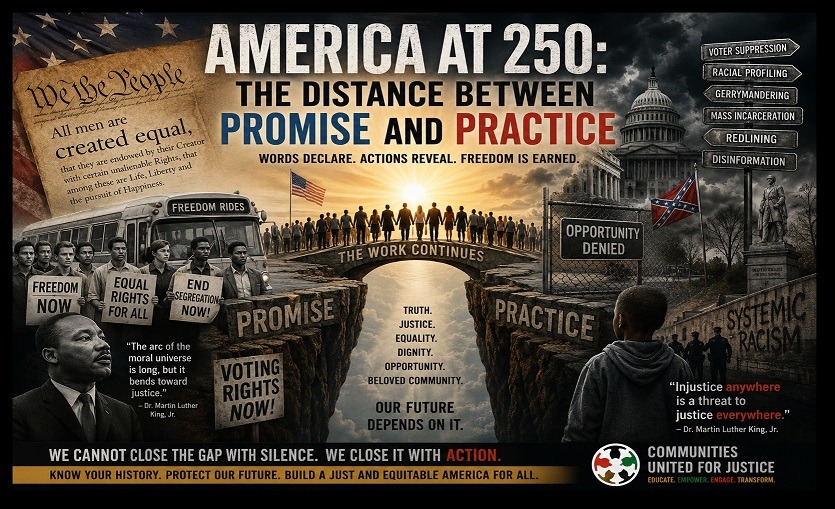
America at 250: The Distance Between Promise and Practice

By Richard Rose, President of Communities United for Justice | Atlanta, GA | July 6, 2026

As much of America celebrates the 250th anniversary of the Declaration of Independence, racial oppression of sub-Saharan Africa and Native descendants continues. The president leads a revival of hate with white evangelicals constituting the amen corner.   Although the bigotry-fueled oppressive conditions that have been systematically enforced upon black and brown American citizenry have diminished, “making progress” means that the destination of full citizenship has not been reached.

Even if “all men are created equal,” equal treatment under the law is yet a poet’s dream in the United States of America. Not only is the 250th American milestone celebrated without a commitment to fulfill the lofty words enshrined in the declarative document of 1776, the current White House occupant, assisted by a collection of sycophants, is intent on sharpening the swords of repression by usurping established policy and regulation that have slowly bent toward justice. 

The destruction of the Federal civil service system will allow a bigoted bloodbath of HBCU graduates who had more limited corporate opportunities in previous generations. Policies and regulations that denied Native Americans promised relief from 400 years of post-invasion genocidal conditions can be expected to be discarded. Treaties between the USA and various Native Tribes, not worth the paper written on, will remain empty promises of equity and respect. 

The welcoming nation described in Emma Lazarus’ sonnet is but a figment of righteous imagination.  Instead, we are the nation of my baby boomer childhood that was infested with declarations of white supremacy proclaiming,  “whites only” and “colored entrance.”  Executive orders have declared that neither poor nor huddled masses can find freedom on our shores. We are still that nation, without apology.

The states of the former Confederacy lead the way. Gerrymandering of legislative districts uses race flimsily disguised as political differentiation to reduce the voting power of non-whites with Black Americans as the bullseye. Redlining by banks, insurance companies and local councils maintain limited access to healthcare and other life essentials. Southern attitudes see no conflict with American patriotism and waving flags that celebrate the failed insurrection against America, commemorated with assembly-line Confederate soldiers in front of southern courthouses.

 Georgia is home to the largest shrine to white supremacy in the history of the world, yet thousands of Black men and women visit the surrounding park daily, having been acclimated to racial oppression through subliminal messaging such that obvious signs of hate and oppression have been normalized. The Civil War has not ended.  It’s cornerstone that “the negro is not equal to the white man” is still a presumption. 

Knowledge of our true American history can save us. Neither Columbus or anyone else could have discovered a land where millions already lived and thrived.  This fable supports the current myth that America belongs to the paleskins, that there was no American genocide that continues in a modified version, that the enslavement of stolen Africans does not have bearing on the poverty that infects Black communities and that our governments are not currently invested in bigotry. We can do better if we face the realities of America today.

The Declaration of Independence gave America its words. The next 250 years will reveal whether we have the courage to live them.

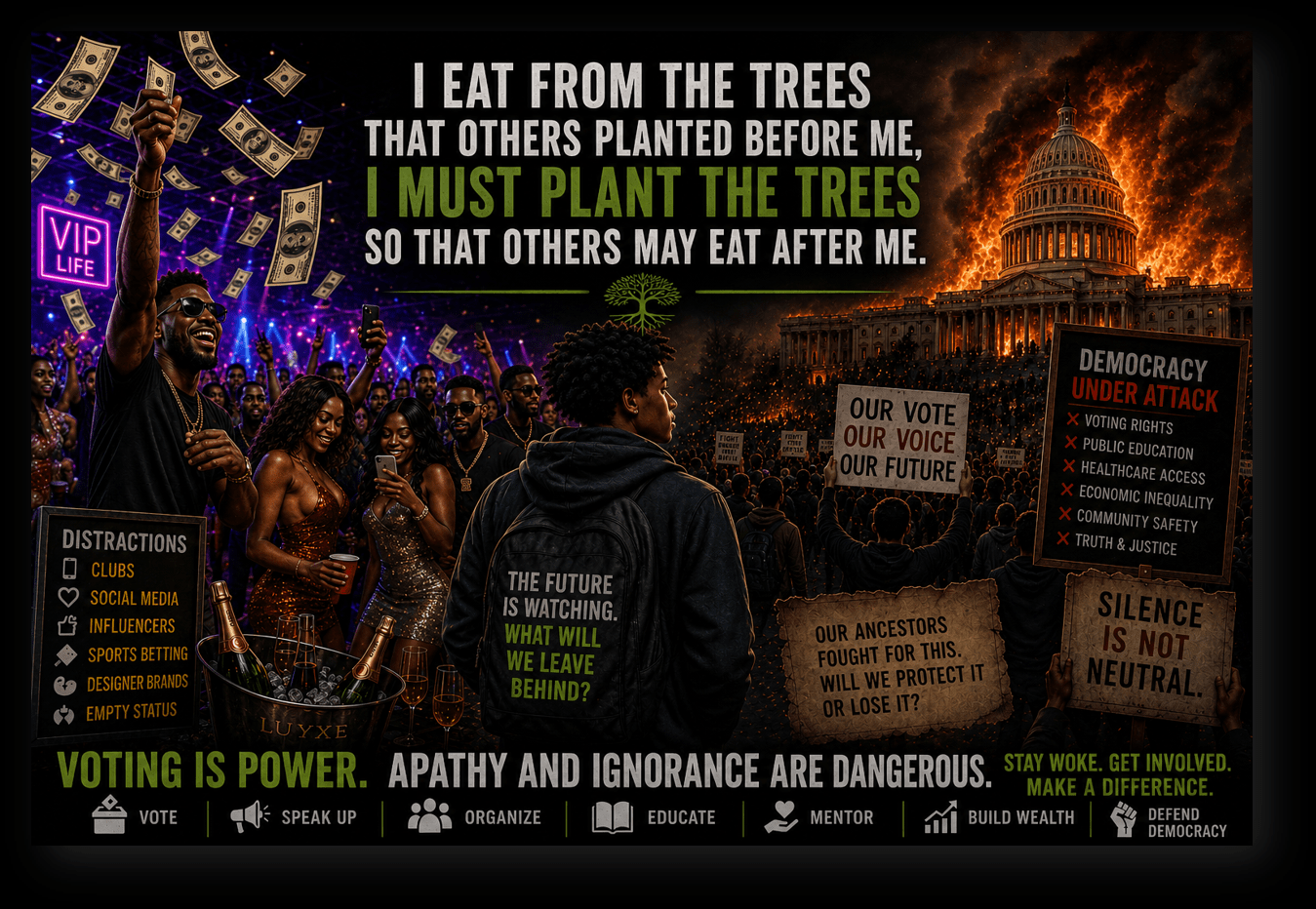
Are African American Millennials and Gen Zers Too Busy Partying While Democracy Burns?

By Lola Renegade | Atlanta, GA | June 25, 2026

Too many Black Millennials and Gen Zers are partying, twerking, and shopping us back into slavery all while being distracted by an endless parade of entertainment, celebrity culture, social media validation, consumerism, and moments of performative outrage when another Black man or woman is gunned down by the police. Seemingly, George Floyd, Breonna Taylor, and Ahmaud Arbery are long forgotten.

And it’s not just them. Many older African Americans are also sleepwalking through one of the most consequential political, economic, and social moments in modern American history. They are so afraid of white folks they will not embrace messages of liberation. Those that are doing nothing now did not do anything earlier in their lives. Once an activist, always an activist.

While our ancestors risked their lives to learn to read, register to vote, own property, attend school, challenge segregation, and secure opportunities for future generations, many of our young are being encouraged to invest their time, attention, and resources elsewhere. Social media algorithms reward spectacle over substance. Celebrity culture celebrates consumption over joining those of us who continue the fight. Influencers teach them how to go viral but rarely how to build institutions, organize communities, create businesses,  acquire political power, or defend democracy.

At the very moment when voting rights are under attack, economic inequality is widening, public education is being politicized, healthcare remains unevenly accessible, and democratic institutions face mounting challenges, millions are being sold a different vision of success. They are encouraged to pursue likes, followers, luxury brands, designer labels, sports betting, slave chains around their necks, expensive vacations, strip clubs, and temporary fame. They are taught to consume, react, and entertain rather than take on and disrupt the negative forces shaping all of our futures.

Too many African Americans of all ages have become spectators in a struggle that demands participants. While powerful interests debate voting rights, criminal justice reform, economic opportunity, public education, and the future of democracy itself, voter turnout remains inconsistent, particularly in local elections where decisions affecting schools, housing, policing, economic development, healthcare, and public safety are actually made. So many of our young people know the lyrics to every trending song but cannot name their city council member, county commissioner, state representative, state senator, school board member, or congressional representative.  They know who is dating whom, who is feuding with whom, and who released the latest album, yet remain uninformed about legislation that directly affects our communities, our children, and our economic futures.

This conversation must also include the influence of portions of modern rap culture. Not all hip-hop is destructive. Hip-hop has produced extraordinary artists, scholars, entrepreneurs, activists, storytellers, and visionaries who have illuminated the Black experience with honesty, creativity, and brilliance. However, it is equally true that some of the most celebrated figures in popular culture built their brands glorifying drug dealing, violence, misogyny, hyper-materialism, and self-destruction. Many proudly recount how they sold drugs in Black neighborhoods to anyone willing to buy them, helping fuel addiction, family instability, incarceration, and despair in communities already struggling under the weight of poverty, discrimination, and disinvestment. The very activities that damaged neighborhoods became the foundation of entertainment empires worth millions and billions of dollars. Meanwhile, the communities left behind continue to bear the social and economic consequences. They helped the colonizers destroy our families and communities. 

The irony is painful. Previous generations marched so that we could vote. They risked their lives so that we could attend integrated schools, go through the front doors of establishments, sit in whatever seats were available, use any bathrooms, and stay in any hotel. They endured beatings, arrests, police dogs, fire hoses, bombings, economic retaliation, imprisonment, and even death so that future generations would have opportunities they never enjoyed.

Yet too often our younger generations behave as though freedom is permanent, democracy is on auto-renewal and is self-sustaining, and that progress is inevitable. Many consume the sacrifices of our ancestors without investing in the future of our descendants. They enjoy rights they did not earn while failing to protect them for those who will come after them. They spend billions of dollars each year on entertainment and consumption while too many schools struggle, too many worthy Black-founded nonprofits close for lack of funding, too many neighborhoods decline, too many young people lack mentors, and too many families remain economically vulnerable.

There is nothing wrong with partying and enjoying the life you have built. There is nothing wrong with enjoying music, fashion, sports, nightlife, or entertainment. Black joy has always been a form of resistance and survival. Our music, humor, creativity, and culture have sustained us through slavery, segregation, Jim and Jane Crow, discrimination, and injustice. The danger arises when entertainment becomes your primary identity, when consumption replaces solid citizenship, when celebrity replaces leadership, and when distraction becomes a substitute for civic engagement.

History has never been changed by those who were merely entertained by it. History is changed by those willing to organize, vote, build institutions, create businesses, educate children, mentor youth, challenge injustice, and make sacrifices for causes greater than themselves. Frederick Douglass did not free himself and speak out against slavery through entertainment. Harriet Tubman did not lead enslaved people to freedom through social media influence or how many likes she received from the plantations’ cottonfields. The Freedom Riders did not board buses headed into danger because it was convenient. All of them acted because history called and they unselfishly answered.

The question before Black Millennials and Generation Z is not whether they deserve to party. The question is whether they will party and still answer history’s call. The question is whether they can enjoy life while remaining committed to protecting democracy, strengthening communities, building wealth, educating children, supporting institutions, and defending freedoms won through the sacrifices of those who came before them.

One day, future generations will read about what all of us did with the freedom we inherited. They will not ask how many followers were accumulated, how many luxury vehicles owned, how many concerts attended, how many viral videos created, how many nights spent in clubs, or how many designer labels filled closets.

They will ask whether we strengthened democracy or weakened it. They will ask whether we expanded opportunity or merely consumed it. They will ask whether we invested in future generations or focused exclusively on ourselves.

Perhaps the most haunting and powerful question they will ask is, “What were you all doing when democracy was whipped beyond recognition, burned on a cross, and hung on a tree?” 

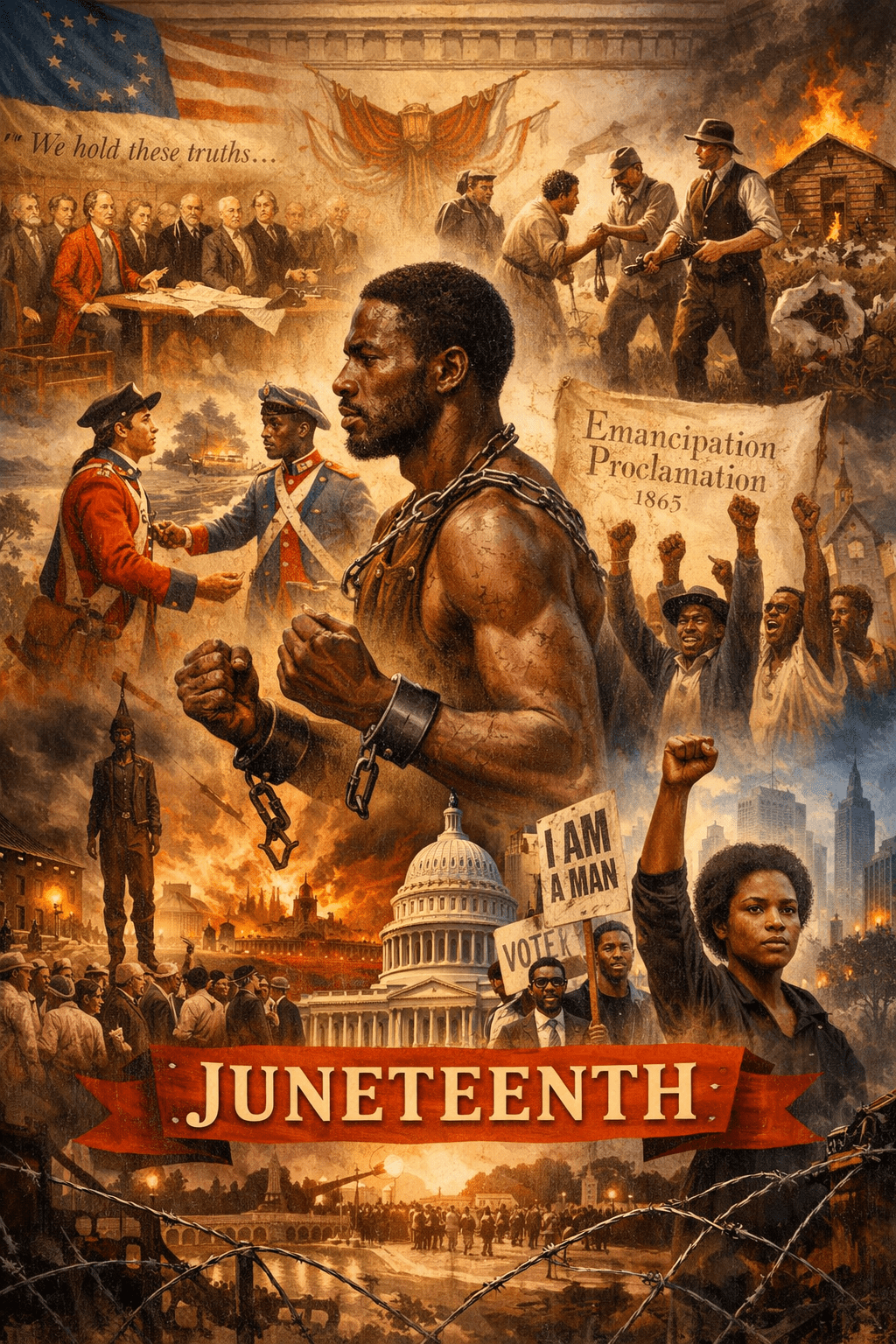
The Unfinished Journey: Why We Commemorate Juneteenth—NOT THE FOURTH OF JULY

Dr. Marilyn Barnett Waters | Atlanta, GA | June 25, 2026 |

To truly understand why we must speak directly to our truth today, we have to look back to July 4, 1776. While the founders of this nation penned grand words about unalienable rights and liberty, those words rang hollow for the hundreds of thousands of African Americans held in brutal, systemic bondage. We were enslaved people.  (Listen to Frederick Douglas’ Speech on the Fourth of July)

The American Revolution was not a war for black liberation; in fact, the promise of freedom often wore a British uniform. Lord Dunmore’s Proclamation of 1775 and the Philipsburg Proclamation of 1779 offered liberty to any enslaved person who fled their rebel masters to fight for the Crown. Estimates suggest that tens of thousands of African Americans risked everything to escape behind British lines, seeking the freedom America denied them. For our ancestors, the Fourth of July was a day that marked the birth of a nation built on their unrequited labor.

True freedom did not arrive with a single declaration, nor did it end when the last enslaved people in Galveston, Texas, finally learned of their emancipation on June 19, 1865—two and a half years after the Emancipation Proclamation. Because of this long, painful delay, Juneteenth is not a holiday for simple celebration; it is a sacred day of commemoration. It is a time to remember that freedom was delayed then, just as justice is delayed now.

From the broken promises of Reconstruction and the terror of Jim Crow lynchings, to the systemic barriers we still confront in 2026, our struggle for true equality has never ceased. Today, we are witnessing a profound cultural and political pushback—an intentional effort to rewrite our history, ban our books, stop us from voting, and silence our truths. By choosing to commemorate Juneteenth, we honor the resilient spirits of those who fought before us, we acknowledge the chains that were broken, and we fiercely confront the modern struggles we still face as America works even now to celebrate its 250-year Anniversary.  We speak directly to this truth because a community that remembers its past cannot be stripped of its future.  We must wake up to this truth.

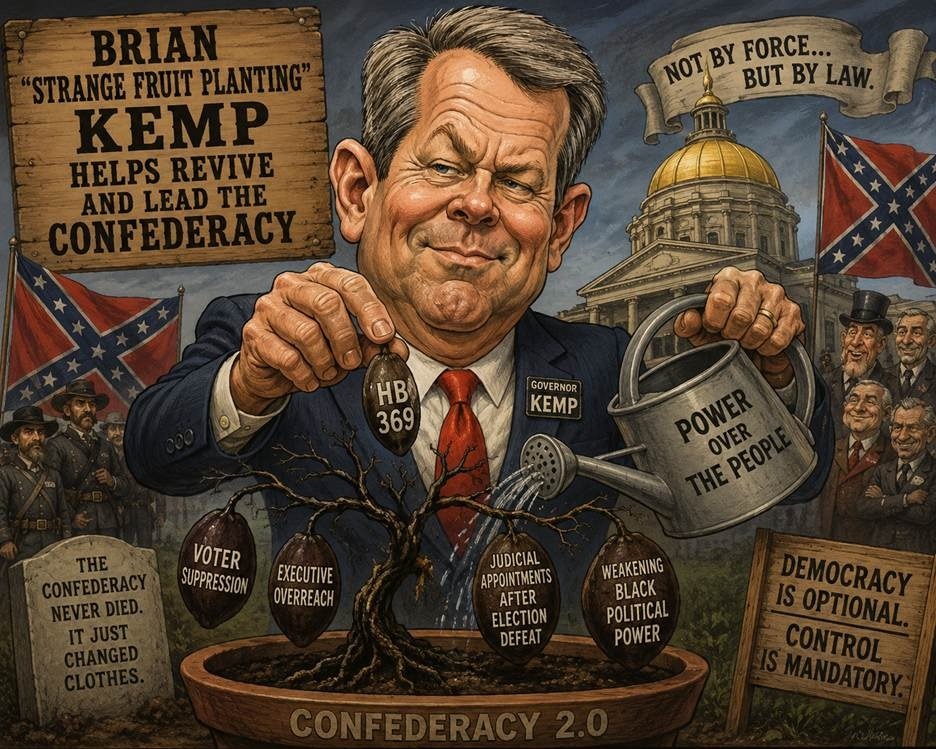
Georgia Governor Brian “Strange Fruit Planting” Kemp Helps Revive and Lead the Confederacy

A provocative opinion essay argues that recent actions by Georgia Governor Brian Kemp, including a judicial appointment and election law changes, raise concerns about voting rights, representation, and the future of democracy in Georgia.

By Lola Renegade | Atlanta, GA | June 14, 2026 |

Billie Holiday’s haunting song Strange Fruit described the bodies of Black Americans hanging from Southern trees, the gruesome harvest of a nation determined to preserve White supremacy and mediocracy at any cost. The song was never merely about lynching. It was about race and power. It was about a system willing to steal Black votes, Black labor, elect should-be-prison-bound felons to local, state, and federal government, manipulate laws, institutions, courts, customs, and public opinion to maintain control. It was about a cockroach Confederacy that refuses to die. While the trees may have changed and the methods may appear more sophisticated, many Black Georgians and other states across Ameri-KKK see familiar racist fruit still being harvested from the same ancestral poisonous roots.

Last month, Fulton County voters participated in a nonpartisan election and made a choice. Judicial newcomer Nikia Smith Sellers defeated incumbent Fulton County Superior Court Judge Paige Reese Whitaker. In a democracy, elections are intended to settle questions of representation and public service. Citizens vote. Winners win. Losers lose. The people speak, and government is expected to listen. Yet, through a series of events made possible by Georgia law, Governor Brian “Strange Fruit Planting” Kemp appointed Whitaker to the Georgia Court of Appeals after her electoral defeat. That appointment creates a vacancy on the Fulton County Superior Court before Whitaker’s elected term expires, thereby giving Kemp the authority to appoint someone to a seat that many voters believed they had already filled through the democratic process.

Legally, the governor may possess the authority to make such an appointment. That is not the issue. The deeper question is whether the spirit of democracy is being honored when the outcome of an election can effectively be altered through executive appointment. Democracy requires more than legal maneuvering. It requires legitimacy. It requires respect for the will of the people. It requires public confidence that elections matter and that the voices of voters are not diminished by procedural technicalities. These are humanistic traits the unwashed in the Confederacy do not possess.

For many Georgians, particularly Black Georgians whose ancestors bled, marched, organized, and died for the right to vote, this development raises troubling concerns. It feels less like democracy in action and more like a familiar Southern tradition of finding new mechanisms to preserve political power when democratic outcomes prove inconvenient. Throughout American history, whenever Black political participation expanded, new obstacles often emerged.  With the two-term election of a Black man, President Barack Obama, the Republicans have lost their minds. They are bound and determined that this will never happen again.

Following the Civil War came Black Codes. Following Reconstruction came Jim Crow. Following the Voting Rights Act came voter suppression efforts disguised as administrative reforms. The methods evolved, but the objective frequently remained the same: limiting the political impact of communities that challenged existing power structures.

Governor Kemp’s appointment of Whitaker does not stand in isolation. It comes amid broader debates about voting rights, representation, and political power in Georgia. Earlier this year, Kemp signed HB 369 into law, legislation that removes party labels from key local offices in Fulton, DeKalb, Gwinnett, Cobb, and Clayton counties beginning in 2028. Supporters argue the measure will reduce partisanship and encourage voters to focus on candidates rather than political affiliations. Critics, however, contend that the law selectively targets some of Georgia’s largest, most diverse, and heavily Democratic counties while leaving the remaining 154 counties untouched. To those critics, HB 369 represents more than election reform; it represents an effort to reshape the political landscape of metropolitan Atlanta and diminish the electoral influence of Black voters and communities of color whose participation has transformed Georgia politics in recent decades.

Whether one agrees with that assessment or not, many voters see a troubling pattern. When election rules are changed exclusively for counties with large Black and other communities of color populations, questions naturally emerge about whose political power is being targeted and whose interests are being protected. Viewed alongside actions such as the governor’s appointment of a white judge who had just been rejected by voters for a Black judge, many Blacks have seen this syndicated movie before. We see a government increasingly willing to use legal mechanisms to influence political outcomes after citizens have already spoken. For communities whose ancestors endured poll taxes, literacy tests, grandfather clauses, White primaries, and other barriers designed to dilute Black political power, such actions are not viewed as isolated events. They are viewed through the long shadow of history and as reminders that the struggle over who gets to participate fully in democracy is far from over.

Governor Brian “Strange Fruit Planting” Kemp is a racist and a pivotal part of the unwashed Confederacy. If Burt “Fake Elector” Jones or Rick “Just Another Old Ass Racist” Jackson ascend to the governor’s office in November, it will be more of the same.

The Confederacy lost the Civil War, but many would argue that it never surrendered its determination to preserve white privilege, patriarchy, hierarchy and control. Instead, it adapted. It exchanged uniforms and KKK hoods and sheets for suits, plantations and burning crosses for institutions, and overt racism for policies that often produce similar outcomes without using the same language. What once required violence now frequently relies on legislation (but violence is still on the table), court decisions, administrative procedures, and strategic appointments. The result is often the same: power remains concentrated in the hands of those who already possess it. The language is different. The mechanisms are different. The outcomes, however, often feel painfully familiar. After the (s)election of the felon Donald Trump to the presidency, racists are coming out of the woodworks, from under rocks, and from bottom feeding to boldly shout the once quiet parts out loud.

Black supporters of this racist governor should either hide their faces or plan strategies to take him down in a major way. It is evident that he played and used them like old tools. History teaches that every struggle for justice produces both freedom fighters and collaborators. While some answer history’s call with courage, others answer it with calculation. They see injustice, recognize it for what it is, and nevertheless choose personal advancement over collective liberation. Their reward may be temporary comfort, but history rarely remembers them kindly.

Some Blacks, of the Clarence Thomas, Candace Owens, and Tim Scott variety, will argue that Kemp is simply exercising powers granted to him under Georgia law. They are correct. However, legality and morality are not always the same thing. Throughout American history, many injustices were perfectly legal. Segregation was legal. Disenfranchisement was legal. Exclusion was legal. The question is not whether Governor Kemp had the authority to sign HB 369 or appoint a replacement judge. The question is whether these actions strengthen democracy, expand public trust, and honor the will of voters, or whether they reinforce a perception that political power increasingly supersedes popular sovereignty.

These controversies arrive at a moment when confidence in democratic institutions is already fragile. Across America, citizens are witnessing insurrectionists, election deniers and fake electors seeking office and winning as well as avoiding accountability, voting rights under attack, and growing distrust in public institutions. Many Americans fear that democratic norms are being weakened by a cabal of reprobates entrusted to protect them. Against this backdrop, actions that appear to circumvent the will of voters carry consequences that extend far beyond a single judicial appointment.

The struggle for Black political participation has always been a struggle to force America to honor its own promises. Voting rights were not freely given. Civil rights were not freely given. Equal access to public institutions was not freely given. Each advance required ordinary people to challenge extraordinary systems of resistance. Every generation has been called upon to defend democracy against forces seeking to narrow its reach. This time is no different.

The larger issue before Georgia is not merely who occupies a judicial seat in Fulton County. The larger issue is whether democratic outcomes will be respected when they produce results that powerful people do not prefer. Future generations will study moments like this. They will ask whether elected officials strengthened democratic institutions or weakened them. They will ask whether leaders honored the spirit of representative government or merely complied with its technical requirements. They will ask whether public office was used to expand democracy or to manage and contain it.

History will ultimately determine how this moment is remembered. The question is whether Georgia’s leaders are planting seeds that strengthen democracy or planting strange fruit that future generations will once again be forced to confront.

“When you see something that is not right, not fair, not just, you have a moral obligation to say something, to do something.” Civil Rights Activist and Congressman John Lewis

And do something we must. It is time to deliver a decisive deathblow and defeat to the lingering ideology of the Confederacy and consign it permanently to the ash heap of history. We must make sure that it never raises its ugly, vile head again.

Let us start with the rumblings of economic disturbances. Consider buying all of your gas at Costco, if possible.

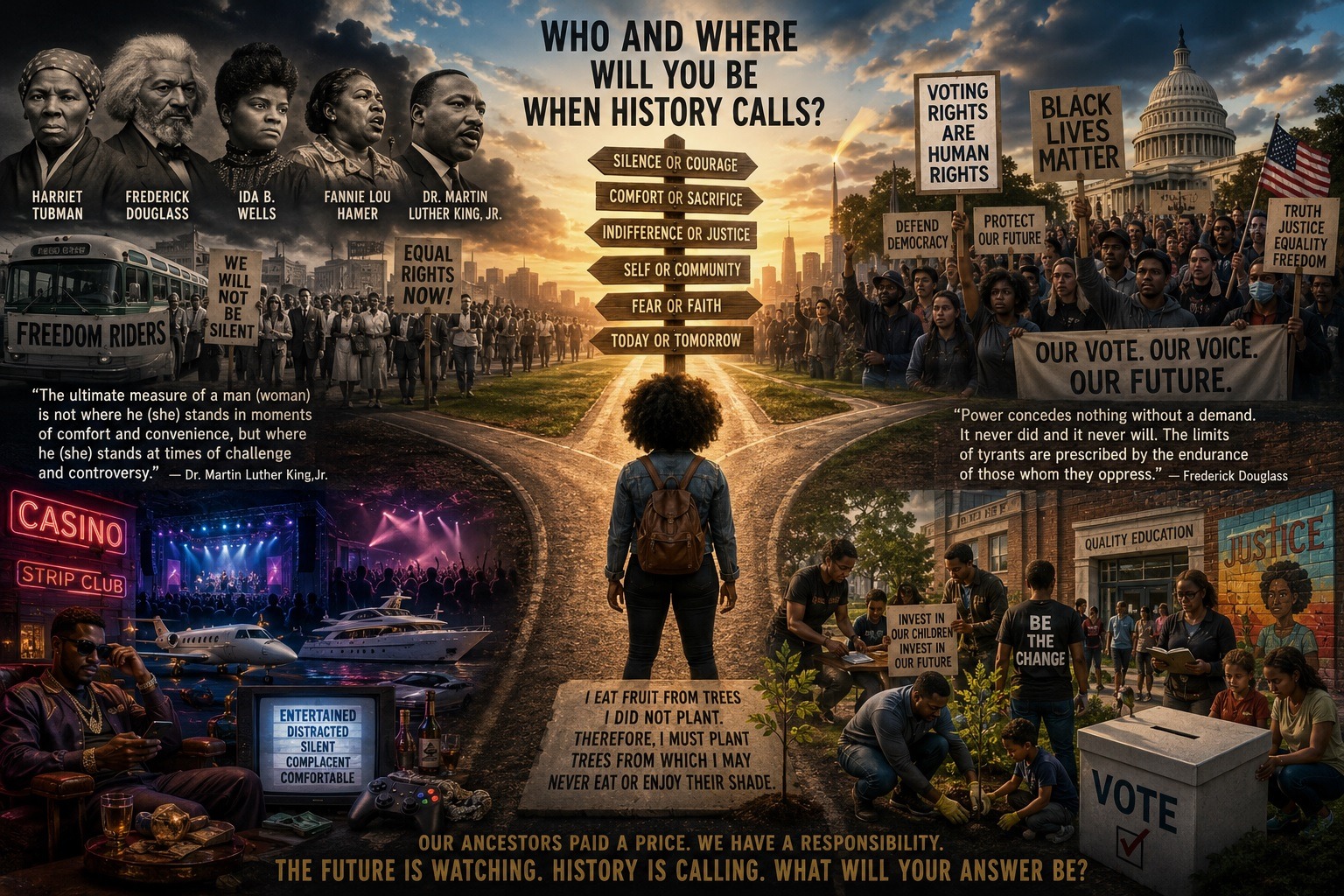
Who and Where Will You Be When History Calls?

By Lola Renegade | June 9, 2026

“The ultimate measure of a man (woman) is not where he (she) stands in moments of comfort and convenience, but where he (she) stands at times of challenge and controversy.”

 — Dr. Martin Luther King, Jr.

I watched Trevor Noah Netflix special Joy in the Trenches over the weekend. He posed a question that refuses to vacate my thoughts: Who will you be when history calls? I added “where.”

It is a simple question, yet it may be one of the most important questions any generation can answer. History is not merely a record of people, places, events, presidents, wars, elections, and legislation. History is a record of who stood up, who sat down, who spoke out, and who remained silent. Every generation eventually arrives at a moment when saying and doing nothing becomes impossible.

For people of color in America and our allies, that moment has arrived once again. Under the Trump Administration, hard-fought gains in civil rights, voting rights, diversity initiatives, economic opportunity, and equal protection are under unprecedented attack. The stakes are high and the consequences will be felt for generations. It is long past the time that each of us must decide whether to stand idly by watching and benefitting while others do all the heavy lifting. Or it is time to step up to do your part to help shape history and to deal the final deathblow to injustice in a way that this part will never need to be revisited again.

In 1961, a group of extraordinarily brave Americans – both Black and white, the Freedom Riders, boarded buses bound for the Deep South to challenge segregation and force this nation to confront its lack of conscience. Many were barely out of their teens. Some were college students. Some were clergy. Before departing, many wrote their wills and letters to loved ones, fully aware they might never return home alive.

They faced firebombs, beatings, imprisonment, and the very real possibility of death, not for personal gain, but for the promise of a more just America. They challenged segregated seats on buses, at lunch counters, and helped change the course of history. More than six decades later, the buses are different, but the destination for full equality remains the same.

Many others before us made tremendous sacrifices and answered the call and because of them, many of our lives are better.

History called Harriet Tubman, and she answered by risking her freedom and her life to lead others out of bondage. History called Ida B. Wells, and she answered by exposing the horrors of lynching when much of America preferred ignorance over truth. History called Frederick Douglass, and he answered by standing before a nation celebrating liberty and asking what the Fourth of July meant to millions who remained enslaved. History called Fannie Lou Hamer, and she answered by exposing before the nation the violence and terror inflicted upon Black citizens who dared to exercise their constitutional right to vote. History called Dr. Martin Luther King Jr., and he answered from a Birmingham jail cell, reminding America that injustice anywhere is a threat to justice everywhere and warning that the silence of good people often proves more dangerous than the actions of the openly wicked.

Every generation inherits unfinished work. Today, history is calling once again. It is calling in an era marked by fierce debates over voting rights, education, immigration, access to medical care, judicial power, economic inequality, and the future of democratic institutions. It is calling as election deniers and fake electors continue to seek and win positions of influence. It is calling as public trust in elections has eroded and facts themselves are increasingly filtered through partisan loyalties. It is calling amid debates surrounding Project 2025, presidential immunity, executive power, and the return of Donald Trump to the presidency despite felony convictions that, in previous eras, might have ended a political career. It is calling as participants in the January 6 insurrection are viewed by some as criminals and by others as patriots. It is calling as America wrestles once again with old questions about race, power, citizenship, and whose voices matter in a democracy.

Your children, grandchildren, and generations yet unborn will one day ask a question that no amount of wealth, status, influence, or self-justification will be able to avoid: Who were you, where were you, and what did you do when history called? They will not ask how many luxury vehicles, airplanes, and yachts you owned. They will not ask how many formerly colonized countries you visited, how many mansions you purchased, how many designer labels filled your closets, how many concerts or sporting events you attended, how many casinos you visited, how many strip clubs you visited, how many times you attended church as a false witness, how many violent and vulgar video games you played, how many degrading rap lyrics you wrote and produced, how many followers admired your social media accounts, or how many photographs documented your comfort and success. They will not care how much money you spent being entertained while the future of Black freedom and progress was on the line and being written around you.

They will ask where you stood. They will ask whether you defended democracy when democracy was being tested. They will ask whether you defended truth when lies became profitable. They will ask whether you defended the vulnerable when doing so was unpopular. They will ask whether you challenged injustice or accommodated it. They will ask whether you spent your resources merely pursuing comfort, consumption, and entertainment while future generations inherited the consequences of your indifference. They will ask whether you invested in education, justice, opportunity, and freedom or whether you invested only in yourself. They will ask whether your faith transformed communities or merely sustained institutions. They will ask whether you sought proximity to power or whether you spoke truth to power.

I am reminded of a simple truth: I eat fruit from trees I did not plant. I enjoy freedoms secured by sacrifices I did not make. I benefit from struggles, beatings, and deaths that I did not endure. The question before us is whether we will do the same. Will we plant trees from which we may never eat or enjoy their shade? Will we defend freedoms whose full benefits we may never see? Will we invest in a democracy that our children, grandchildren, and generations yet unborn will inherit?

Remember, “Power concedes nothing without a demand. It never did and it never will. The limits of tyrants are prescribed by the endurance of those whom they oppress.” — Frederick Douglass

Who and where will you be when history calls?

Join Communities United for Justice in the fight for freedom and full equality!  

Black Women Nannies and White Babies: Loving, Nurturing, and Caring for the Children Who May One Day Grow Up to Hate You Simply Because of the Color of Your Skin

By Lola Renegade | Atlanta, GA | May 30, 2026 |

A couple of days ago, while visiting the Atlanta History Center with my great niece and nephew – my proxy grandchildren –  I noticed something that stayed with me long after I left.

Everywhere I turned, I saw several Black women caring for little white children.

Some carried babies on their hips. Others pushed strollers through the museum corridors and gardens. Some held tiny white hands as curious toddlers wandered through exhibits laughing, pointing, and exploring the world with complete innocence and trust.

At first, seeing one Black nanny seemed unremarkable.

But after witnessing it again and again, I felt history pressing against and piercing my spirit. I found myself thinking, “I know this story personally.”

I recall my mother,  along with several of my aunts, and countless other Black women, worked as domestics in Mississippi during the brutal decades of Jim and Jane Crow throughout the 1950s, 1960s, and 1970s. They cared for white children whose parents were often half their age or younger, and eventually the children themselves, called them by their first names, as though these grown Black women were perpetual children themselves, undeserving of the dignity and respect automatically granted to white adults.

In the South of that era, Black women and men were rarely addressed with basic respect. White children were taught early that Black adults – even elderly Black adults – did not deserve titles such as “Miss,” “Mrs.,”  or “Mr.”

Imagine the psychological violence and trauma of that. Imagine helping to raise a child, pouring love, patience, and tenderness into their life, only to see many grow into adults who embraced the same prejudices, racial hatred, and moral corrosion that had been passed down to them for generations by grandparents, parents, institutions, and an America determined to preserve racial hierarchy.

What greater tragedy is there than witnessing a child’s humanity slowly poisoned by the very parents entrusted to nurture it?

We have Child Protective Services (CPS) to rescue children from physical abuse, neglect, and dangerous homes. But who rescues children from inherited hatred? Who intervenes when racism, bigotry, and dehumanization become family heirlooms passed from one generation to the next?

Where is CPS when a child’s conscience is being corrupted, their empathy diminished, and their humanity stolen by the very parents, grandparents, and trusted adults charged with shaping their moral character?

Shouldn’t society be equally concerned and ready to remove children from their homes when they are taught to hate, fear, and to devalue the humanity of others?

Perhaps one of the greatest tragedies of racism is not only the damage it inflicts upon its victims, but the moral injury it inflicts upon the children taught to carry it forward. Teaching a child to hate another human being, not only diminishes the humanity of the hated, but also the humanity of the hater.

It was witnessing my mother and other Black women navigate those humiliations that shaped me in ways I did not fully understand at the time. Even as a child,  I made a vow to myself: no matter how poor, hungry, or desperate I might ever become, I would never become a domestic worker for white America. In the words of singer Lou Rawls, “I’d rather drink muddy water and sleep out in a hollow log.”

The relationship between Black women and white children in America did not begin with modern-day nannies or domestic workers. Its roots stretch back into slavery itself, when kidnapped, enslaved Black women were often forced to nurse white babies from their breasts while their own children waited nearby, sometimes hungry, neglected, or handed off to others. Few images capture the emotional and moral contradictions of America more painfully than a Black mother coerced to using her body to nourish the child of those who claimed ownership over her body, her humanity.

That contradiction has echoed through generations of Black women in America. What struck me most at the museum was not simply the presence of Black nannies caring for white children. It was the realization that, despite all America’s claims about progress, its incestuous kinship to slavery still exists in painfully familiar ways.

At The Gathering Spot in Atlanta, I have met several young Black women – brilliant, highly educated, accomplished women with advanced degrees – who lost professional opportunities during the chaos, instability, and cruelty unleashed within the early months of President Donald Trump’s attack on diversity, equity, and inclusion (DEI). In fact, it is stated that more than 300,000 Black women lost their jobs within the first few months under this racist, tyrannical administration. One can safely bet that if America stated that number, double it. This nation has long suffered from a pathology of lies – sanitizing and erasing its history, minimizing its crimes, and demanding the oppressed to forget what these modern-day robber barons would rather not remember.

Some of these young women now work as nannies for affluent white families, not because they lack intelligence, ambition, or qualifications, but because survival leaves little room for pride. Mortgages and rents still have to be paid, car notes still arrive, and student loans still demand payment.

I understand that for many survival does not and cannot wait for justice. It never has and it never will. Especially, if you are waiting for justice to live in America with any chance of longevity. And so these women, extraordinarily gifted beyond measure, have found themselves stepping into one of the oldest labor roles historically assigned to Black women in America: caring for white children.

That reality forced me to think differently about one of Trump’s most infamous statements during the presidential campaign when he warned Black Americans about immigrants “taking your Black jobs.” At the time, many dismissed the statement as ignorance, racism, or political theater from the man who would soon become one of America’s most corrupt, greedy, heartless, stupid, ignorant, morally and intellectually bankrupt presidents. But perhaps there was an uncomfortable historical truth buried inside that language. Because throughout American history, some of the “Black jobs” this country has consistently reserved for Black women have involved caregiving, domestic labor, emotional labor, and service to white families.

America’s and Trump’s replacements for our best and brightest have been mediocre to less-than mediocre white men and women. Amazingly, it took Trump less than ten years to turn America into a truly “shithole country” – the very name he has given to countries of color who refuse to be exploited by him and will not bribe him, his family, colleagues, and administration.

Black women have long been expected to nurture America while America simultaneously withholds full dignity from us. And what makes this history even more painful is the emotional intimacy involved. These are not distant transactions. These women rock white babies to sleep, celebrate first words, first steps, prepare meals, read bedtime stories, soothe nightmares, wipe tears, snot, and asses.

They become trusted figures in the emotional development of children who oftentimes grow up absorbing the same racial animus and systemic biases that diminishes the very women caring for them. How do Black women continue loving the soon to be unlovable under those conditions? How do you pour tenderness into children who may, more than likely, eventually inherit a worldview that sees you as inferior, threatening, or invisible?

Perhaps the answer lies in something both heartbreaking and extraordinary about Black women in America: despite centuries of degradation, exploitation, exclusion, and disrespect, many have refused to surrender their humanity and capacity to love unconditionally.

We all know that babies are not born racist. No infant instinctively hates Black people. Hatred is learned carefully and intentionally over time. It comes through family attitudes, political rhetoric, segregated systems, coded language, media imagery, fear, silence, and societal conditioning.

For a brief and innocent season of life, many white children experience unconditional safety, affection, and nurturing through Black hands before the world begins teaching them racial hierarchy and hate.

That truth sat heavily with me as I walked through the museum with my late sister’s grandchildren, thinking about her boundless capacity to love. She was a hospital executive and registered nurse. She, too, belonged to a long line of Black women who gave of themselves freely to family, work, community, and often to a nation that rarely returned the favor. Her capacity to love the unlovable was so much greater than mine. I can count on one hand, with fingers remaining, the number of white people I can or have called “friend” in my sixty-nine years on the planet.

In the movie, The Help, I am constantly reminded of a nation that never grows tired of exploiting the labor of Black women who are still carrying America’s children and America itself on our hips and our backs.

And if this America truly is the greatest country in the world – the very best the planet has to offer – then Lord knows the world is in desperate need of a better alternative.

Truth Seekers Journal thrives because of readers like you. Join us in sustaining independent voices.

It’s Time for Cooperstown to Catch Up

Data and history confirm Negro League teams matched Major League talent. Ted Knorr urges Cooperstown to honor their rightful place in baseball’s Hall of Fame legacy.

By Ted Knorr | Harrisburg, PA | May 26, 2026

“In small cities and small towns across the country, there were other teams and other stars that may have been the greatest of the century, but whose deeds would live only in the memory of those who saw them play. Over the years, Black baseball stars played against White Major League stars at least 438 times in off-season exhibition games. The Whites won 129 of those postseason games. The Blacks won 309 (70.5%).” – Baseball, 5th Inning, Shadow Ball, Ken Burns, 1994

Appendix II of “The Negro Leagues were Major Leagues,” edited by Todd Peterson, pp. 214-226, lists 503 games, dates, and opponents, depicting games between Negro League teams and Major League teams. Negro League teams won 268 (54.6%), while losing 222, with 13 ties.

In addition to Burns and Peterson, I have seen compilations by historians William McNeil (69.8% in the California Winter League) and John Holway (57.1%), and researchers Scott Simkus (52.7%) and bench5 (54.5%). Every one of them finds the “so-called” Negro League teams holding their own (winning as often as losing) against “so-called” Major League teams. Comparable results are reported from both my interpretation of Seamheads Negro League Database (where 67 Negro League pitchers won 54.1% of their decisions against teams made up of Major League players) and Retrosheet’s Database (58.0%), with both showing an edge to the Negro League teams.

I have never seen a compilation showing the Negro League teams losing more than they win. While each of these compilations have their own circumstances (such as, the California Winter League usually featuring one Black team and three or four White teams meaning the White talent was diluted; and Ken Burns compilation is admittedly culled from oral history with few if any box scores.), my claim is unquestionably supported by these compilations and that is the record shows “so called” Negro League teams held their own against “so called” Major League teams.

Further factual evidence supporting my claim is provided with the following data:

Major League and Negro League Regular Season Slash Lines 1920-1948                    

                                   AVG    OBP    SLG    OPS                

Major League              .275     .340     .388     .728              

Negro League             .270     .331     .372     .703    

The 29-season slash lines on both sides of the color line are virtually identical.

Source: “The Negro Leagues were Major Leagues,” p. 19, edited by Todd Peterson, McFarland & Company, 2020. Major League data is from baseball-reference.com. Negro League data is from Seamheads.com, NL/RAG, and the Center for Negro League Baseball Research.

In concert with the  compilations of games between Negro League and Major League and the regular season data over 29 years being identical, the argument – accepted by Major League Baseball on December 16, 2020 – that the Negro Leagues were (indeed) Major Leagues has now been accepted by those who matter and by a growing number of informed baseball writers, researchers, and fans.

This editorial celebrates that December 2020 decision and advocates for a positive, logical, and similar decision by the National Baseball Hall of Fame and Museum, a 501 (c) (3) educational institution with the responsibility of educating the populace on the history of the National Pastime. In the next issue of Shadow Ball, I hope to be more specific in my “advice” for the National Baseball Hall of Fame and Museum. Here are some points for your pondering over the next couple of weeks:

  1. The National Baseball Hall of Fame & Museum has done spectacular work in telling the history (and quality) of the Negro Leagues in a compelling fashion (as noticed, in my view, by most everyone but themselves).

— In 2021, they reinstalled a procedure, flawed but at least it is an improvement, once again providing the possibility by which Negro League players, executives, managers, and umpires could be elected and, in 2022, for the first time since 2006, successfully inducted two “executives,” Buck O’Neill and Bud Fowler

— In 2022, the Museum launched a Black Baseball Initiative, which involved partnering with Major League Baseball, Major League Baseball Players Association, Negro League Baseball Museum, Jackie Robinson Foundation, and others. This new initiative bore fruit in 2024 with

— in 2024, the Hall erected a new Hank Aaron statue entitled “Keep Swinging”, the new exhibit “The Souls of the Game: Voices of Black Baseball”, the integration of Black baseball accomplishments into existing exhibits throughout the museum was instituted, established an interactive youth activity “We Play” involving K-4 students in baseball history, celebrated the Negro Leagues East-West Classic, in collaboration with Dr. Gerald Early the Hall jointly published a book on, and inviting the Society for American Baseball Research’s Negro League Committee to convene its annual research conference in the Hall.

Ted Knorr – photo by Milton Kirby

— This litany tells us that the Hall’s heart is in the right place.

  1. In the right place in every corner of the museum except for its “namesake” Hall of Fame plaque gallery which honored 29 Negro League players twenty years ago and now includes only 28 – Frank Grant’s role having been inexplicably reassigned from player to executive … with no new Negro League players even eligible until the December 2027 election … only 17% of all Hall of Fame players debuting under segregation in that gallery are Negro Leaguers … this contrasts starkly with the parallel fact that just over 45% are players of color (i.e. Negro Leaguers) among players debuting since April 15, 1947. It is time for the Hall of Fame to match achievements with the rest of the museum.
  2. My recommendation to the National Baseball Hall of Fame & Museum is to induct additional Negro League players to the Hall of Fame. I recommend that we once again be focused on the 20 remaining Negro League players, executives, and managers on the 2006 ballot, plus Vic Harris. There is no need to wait until December 2027 … an election should be held in December 2026 with a qualified expert panel – as was done in 2006, a segregated Negro Leaguers only ballot (as in 1971-1977, 1995-2001 and in 2006), with a 75% affirmative vote requirement, but like in 2006 with an up/down vote on all 21 personages and no limit on the number of affirmative votes case by each voter.

If enacted, I can guarantee a great step will have been taken by the Hall and its mission will have been furthered immensely in keeping with the Black Baseball initiative begun in 2022.

Dear Readers, if you agree with my recommendation, please let the Hall of Fame know. It has been long demonstrated that they will not advance without a gentle nudge every now and then. Let them know 28 Negro League players is not enough. They can be reached at:

National Baseball Hall of Fame & Museum * 25 Main Street * Cooperstown, New York 13326

Truth Seekers Journal thrives because of readers like you. Join us in sustaining independent voices.
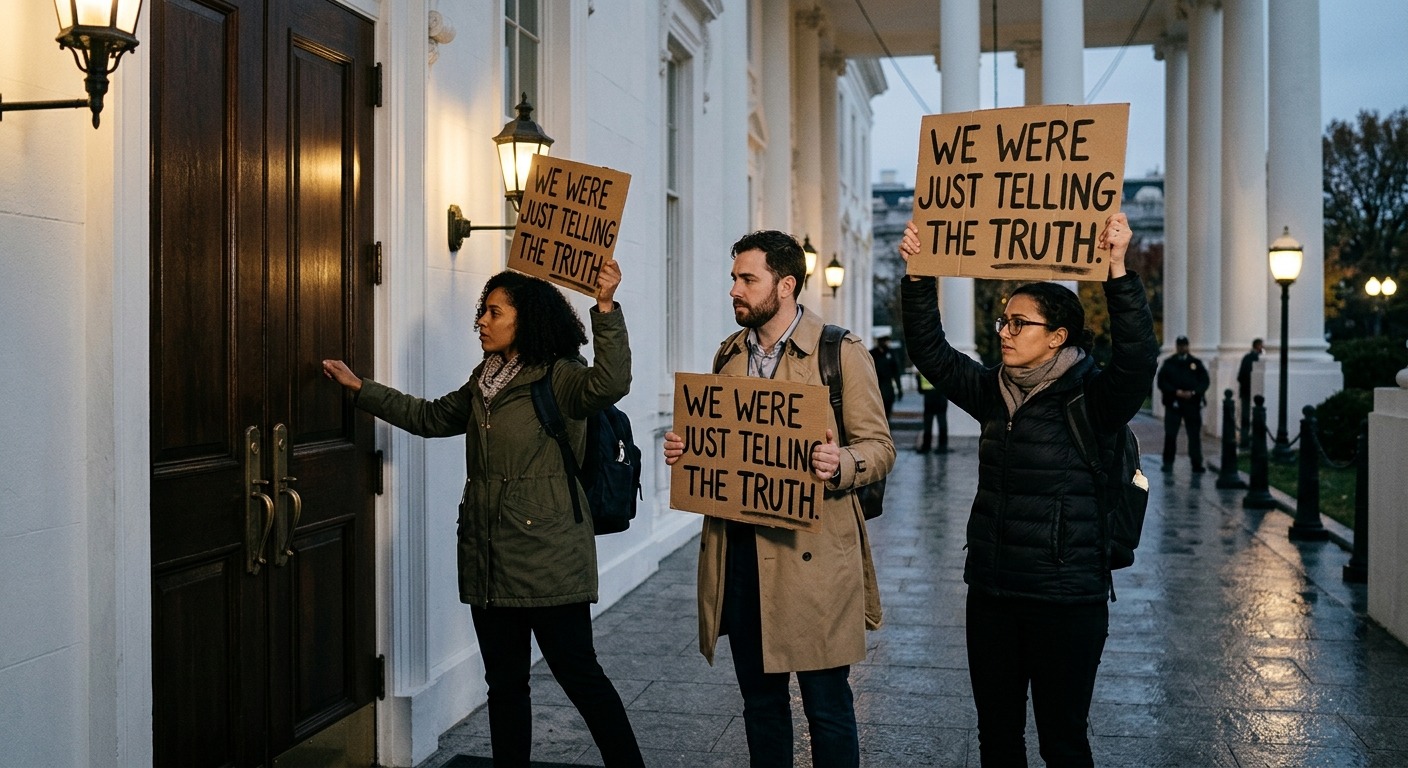
Donald Trump’s America: Why Over 77 Million Americans Chose a Draft-Dodging, Racist, Misogynist, Convicted Felon, Conman, and Old Orange Demented Pimp to Become Their President

By Lola Renegade | March 17, 2026

“We have a system of justice in this country that treats you much better if you’re rich and guilty than if you’re poor and innocent. Wealth, not culpability, shapes outcomes.”

Bryan Stevenson, Esq. (Founder of the Equal Justice Initiative and Legacy Museum in Montgomery, AL)

In this quote, attorney Bryan Stevenson should have included that white skin privilege also shapes outcomes. If life were fair and American democracy real for every citizen, PFC Robert Scott, and the sixty-two other soldiers who were killed in Vietnam on September 11, 1968, would be somewhere enjoying their families and racist, insurrectionist, misogynist, bully, conman, vote-stealing felon Donald Trump would be on his way either to prison or the pimps Players Ball Convention. He would not be residing in the White House! Perhaps that’s a major problem, calling it the White House and not the Peoples’ House. 

In the picture next to the caricature of Trump in his grifting family is the picture of the gravestone of 19-Year-Old African American PFC Robert Lee Scott from Redwood, Mississippi. Robert began his tour of duty on August 28, 1968. Just fifteen days later, on September 11th, one day before his twentieth birthday – he was killed in Quang Tin Province, 9,133 miles from the Ballground Plantation in Redwood where he had grown up. Meanwhile, five-times draft-dodging Donald “Bone Spurs” Trump decades later ascends to the presidency – not once, but TWICE!

After fifty-eight years, I can still remember my daddy coming into the dilapidated shack we called home in Redwood, Mississippi, and delivering the heartbreaking news to Mama:

“Darlin’, Pat and Minnie’s boy got killed in ’Nam.”

I wrote another article about Robert in The Truth Seekers Journal on September 24, 2024, the link is below:

Former Georgia State Senator and Senate Majority Leader Charles W. Walker Sr. once stood as one of the most powerful Black political figures in Georgia. He was a trailblazer who rose from rural Georgia’s poverty and relocated to Augusta to become the first African American Senate Majority Leader since Reconstruction. He built influence not only in politics, but as a businessman and publisher of the Augusta Focus, a free newspaper serving the Black community.

Then came his orchestrated fall.

In 2005, Walker was indicted on federal charges including mail fraud, tax evasion, and conspiracy. Prosecutors claimed he inflated circulation numbers in his FREE newspaper to increase advertising revenue. How can a guestimate of how many people read a free newspaper be criminal? Though notably, he was not convicted on the scholarship-related charges.

Charles Walker served eight years of a ten-year sentence in prison while the nation’s homemade virus, Donald Trump, is serving his second term as president of the United States of Ameri-KKK.

But even before the verdict of Walker, questions of justice were already hanging in the air.

During jury selection, Walker’s defense raised a challenge under Batson v. Kentucky, arguing that prosecutors were systematically striking Black jurors. In a case involving a high-profile Black leader in the Deep South, the racial makeup of the jury was no small matter. It was everything. The prosecution offered so-called “race-neutral” explanations, and the court allowed the jury to stand. But the deeper question lingered: was justice being administered or engineered?

The contradictions only deepen from there.

Richard S. Thompson – the republican U.S. Attorney who led aggressive investigations targeting Walker and other Democratic leaders  was later convicted himself. He went to prison for stalking a former girlfriend and repeatedly violating restraining orders. The prosecutor became the criminal. Surprisingly, and unlike Trump and many of his government appointees, he did not get away with his abuse of women.

And then there is John Jay Fitzgerald Johnson, known as Grandmaster Jay. He was in Louisville, Kentucky, in 2020 as part of nationwide protests following the unlawful police killing of Breonna Taylor. Leading members of the Not Fucking Around Coalition (NFAC), he stood in armed protest exercising the same Second Amendment rights so often celebrated in other contexts. Yet, during a nighttime demonstration, he was accused of pointing a rifle toward federal agents. No shots were fired. No one was injured. Still, he was prosecuted, convicted, and sent to prison for seven years.

His case underscores a troubling reality: protest in America is not experienced equally. When Black leadership shows up organized, armed, and unapologetic, the response is swift, severe, and unforgiving – raising profound questions about who is protected by the Constitution and who is punished under it.

Now place these realities alongside Donald J. Trump.

Trump – a twice-impeached president and convicted felon who faced multiple cases tied to his efforts of an insurrection to overturn the 2020 election. Yet case after case has been delayed, weakened, or dropped – including the case in Fulton County, Georgia, where evidence showed he pressured officials to “find votes” in an attempt to overturn the will of the people. Now, in a stunning display of audacity, he is seeking to have Fulton County reimburse him for his legal fees, despite the overwhelming evidence surrounding his conduct.

This is not just irony. It is the history of Ameri-KKK.

Walker was imprisoned for financial misconduct. Thompson, who prosecuted him, was later imprisoned for his own crimes. Grandmaster Jay was imprisoned in a case where no physical harm occurred. Yet Trump and the January 6th insurrectionists, whose actions struck at the very foundation of American democracy, have evaded accountability and received pardons for their illegal actions. And, in Trump’s case, returned to power as president.

What emerges is not coincidence. It is a pattern. It is a pattern of who is pursued and who is punished and protected. And even before the verdicts are handed down and oftentimes before the trial even begins, the question is already in the room: Who gets to sit on the jury, who gets prosecuted, and who gets away even though there is a preponderance of evidence of their guilt?  Because in today’s America, it is not just justice that is on trial – it is democracy itself. And the most dangerous force of all is not just the man at the center of it, but the legion of supporters who excuse it, defend it, and enable it.

Instead, a kakistocracy has emerged – led by a shameless, criminal “old orange demented pimp” and his dangerous sycophants, sustained by a movement that has become an infectious, exhaustive, and deadly virus on American democracy. If life were fair – it’s not – and justice truly applied to all – again, not – Trump would be in prison, sitting on the lap of P. Diddy, getting his hair braided by R. Kelly, and a pedicure from Ghislaine Maxwell.

In the words of famed artist, Kendrick Lamar, “They Not Like Us!”

America Needs an Intervention: A 12-Step Program for Its Addiction to Racism, Violence, Misogyny, Inequality, and Greed

America faces deep-rooted addictions to racism, violence, misogyny, inequality, and greed. True greatness demands an honest national intervention, structural reform, and a courageous commitment to truth and justice.

By Lola Renegade | March 10, 2026

America will never be great until (S)he checks itself into rehab.

For generations, this nation has wrapped itself in the language of exceptionalism—the land of opportunity, the beacon of freedom, the greatest country in the world, blah, blah, blah, etc. But myths are powerful narcotics. They dull the pain of truth. They allow a nation to avoid confronting the damage it has done and continues to do—to others and to itself.

Strip away the mythology and the reality becomes unavoidable: America is a nation struggling with longstanding addictions—racism, violence, misogyny, inequality, and greed. These are not temporary lapses in judgment. They are structural and systemic habits, embedded in institutions, culture, and political life since the country’s violent and genocidal birth.

Like every addiction, these habits have consequences. And like every addiction, they will persist until the addict admits there is a problem.

America has experienced moments of greatness but has never been genuinely great. There have been flashes of moral clarity—Reconstruction, the New Deal,  the Civil Rights Movement, notable first-time elections of President Barack Obama, Vice President Kamala Harris and other people of color—periods when the country briefly attempted to live up to its highest ideals. But those moments have often been followed by backlash, denial, retreat, and violence. 

The truth is uncomfortable but unavoidable: greatness has never been America’s permanent condition. At best, it has been an aspiration.

Now the country stands at another crossroads.

The rise of Trumpism and his cult of MAGA (Make America Great Again) did not invent America’s demons; it exposed them. It pulled the curtain back on forces that had always existed but were often somewhat politely ignored, especially by the so-called mainstream media. Racial resentment, authoritarian impulses, contempt for democratic norms, and an open hostility toward women, immigrants, countries of color, and marginalized communities were no longer whispered—they were amplified from podiums and television screens.

Trumpism became less a political movement than a mirror reflecting unresolved truths about the nation itself.

And the reflection is not flattering, it is downright ugly as homemade sin because that is what it is.

To understand the depth of America’s addiction, one must begin with its historical foundation. The nation was born through the displacement and destruction of Indigenous peoples and built in large part through the forced labor of enslaved Africans. The Confederacy—an armed rebellion fought to preserve slavery—lost the Civil War but never fully lost the violent cultural war that followed.

Its symbols remain scattered across the American landscape: statues, flags, and monuments that celebrate a rebellion against democracy itself. These artifacts are not simply relics of history. They are declarations of whose history matters and whose suffering can be ignored.

Trumpism breathed new life into these symbols. The refusal to unequivocally condemn white supremacists, the defense of Confederate monuments, and the rhetorical flirtation with authoritarian nationalism revealed how unfinished America’s reckoning with its past truly remains.

But acknowledging the past is only the first step. Recovery requires transformation. In the language of addiction recovery, healing begins with admission.

Step One: Admit the problem.
America must acknowledge that racism, misogyny, inequality, and greed are not isolated incidents—they are systemic and structural forces woven into the nation’s political and economic fabric. This is best explained by Professor Tricia Rose, Ph.D.   https://www.youtube.com/watch?v=X3KsVRkbnn4

 Step Two: Educate honestly.

A nation cannot heal from a history it refuses to teach. Honest education about slavery, colonialism, and structural inequality is not divisive—it is necessary.

Step Three: Demand accountability.
Policies that target vulnerable populations—such as the so-called Muslim ban, family separations at the border, attacks on diversity initiatives, and efforts to erase the contributions of people of color from public narratives—illustrate how political power can be used to reinforce inequality.

Step Four: Confront the mythology.
Confederate symbols and historical distortions must be confronted, not romanticized. Nations mature when they confront their past honestly.

Step Five: Rebuild empathy.
Democracy cannot function without the ability to recognize one another’s humanity.

Step Six: Reform institutions.
Systems that perpetuate racial and gender inequality—from criminal justice to economic policy—must be fundamentally reexamined.

Step Seven: Address economic inequality.
Extreme disparities of wealth undermine democracy itself. When policy consistently favors the affluent, the social contract begins to collapse.

Step Eight: Restore public trust.
Trust cannot be demanded; it must be earned through transparency, fairness, and accountability.

Step Nine: Build coalitions for justice.
Progress has always required alliances across race, gender, and class.

Step Ten: Elevate art, culture, and truth.
Artistic expression and cultural dialogue help societies confront their deepest wounds.

Step Eleven: Reengage with the world responsibly.
Isolationism and militarized nationalism weaken moral leadership. Global cooperation strengthens it.

Step Twelve: Commit to vigilance.
Recovery is never permanent. It requires continuous effort and moral courage.

None of this will be easy. Addicts resist intervention. They deny the severity of their condition. They lash out at those who attempt to help them confront it. Nations behave no differently.

But the alternative to intervention is decline.

When societies refuse to confront injustice, inequality deepens. When greed overrides the common good, democracy erodes. When violence becomes normalized, the social fabric begins to rot.

America stands at a moment that demands honesty. The nation can continue clinging to comforting myths about its past, or it can finally confront the contradictions that have haunted it since its founding.

Rehabilitation is possible. But only if the country is willing to do the hardest thing of all: Tell the truth about itself. Until then, the slogan of greatness will remain just that—a slogan.

Because greatness is not something a nation proclaims. It is something a nation proves.

Another Ring for Michael Jordan — and a Quiet Bill NASCAR Didn’t Have to Pay

Michael Jordan’s NASCAR settlement delivered evergreen charters—but by settling, NASCAR avoided public scrutiny of how much revenue teams may still be shielded from.

Truth Seekers Journal Opinion | December 18, 2025

Michael Jordan has won championships in packed arenas, in boardrooms, and now—quietly—in a federal courthouse.

The Dec. 11 settlement between NASCAR, 23XI Racing, and Front Row Motorsports didn’t come with confetti or a trophy presentation. But make no mistake: this was another ring. And like many of Jordan’s biggest wins, it came from knowing when to press—and when to take the points and walk away.

The public story is stability. NASCAR’s joint statement leaned hard on words like “growth,” “alignment,” and “the future of the sport.” The headline change was the introduction of evergreen charters, a long-sought concession that turns teams from renters into something much closer to franchise owners.

The quieter story is what didn’t happen.

Because this case settled, NASCAR did not have to answer—under a jury verdict—for how much money it may have kept from teams over the past several years. And that may be the most expensive silence in the garage.

During the trial, sworn testimony put real numbers on what team owners have whispered for years. An economist testified that NASCAR owed the plaintiffs roughly $364.7 million in damages. More striking, he estimated that chartered teams as a whole were underpaid by more than $1 billion from 2021 to 2024 based on comparative revenue models used in other major motorsports and professional leagues.

A verdict doesn’t just award damages. It creates a public record. It creates precedent. And it invites follow-on lawsuits.

By settling, NASCAR capped its legal exposure and sealed off discovery that might have gone even deeper into revenue allocation, internal strategy, and contingency planning. The confidential settlement check—whatever the number—may end up being a bargain compared to what a full verdict could have exposed.

This is where the “Another Ring” framing really matters.

Jordan didn’t need to win by knockout. He needed to change the geometry of the court.

By forcing NASCAR to the table and extracting evergreen charters, Jordan and his partners permanently increased the value of every chartered team. That alone is a long-game victory worth far more than a one-time damages award. Team valuations rise. Financing gets easier. Sponsors gain confidence. And ownership groups now hold an asset NASCAR can’t casually claw back.

But the settlement also allowed NASCAR to keep one advantage: opacity.

No public verdict means no court-ordered accounting of exactly how much revenue teams should have received, how internal distribution decisions were justified, or how much leverage NASCAR exercised behind closed doors. The sport avoided a public spreadsheet moment—one where every team owner, sponsor, and potential investor could point to a judge’s findings and say, this is what the teams were denied.

From NASCAR’s perspective, that matters. Revenue sharing is the third rail of sports governance. Once a court defines it, control shifts fast.

From the teams’ perspective, the question now becomes strategic, not legal: how much money remains shielded by the absence of a verdict?

The new charter structure creates leverage for future negotiations, but it does not automatically rebalance every dollar flowing through the sport. International media rights. Intellectual property. Digital and data revenue. Those streams are growing, and the settlement language suggests progress—but not full transparency.

Jordan’s win, then, is both decisive and incomplete.

He secured permanence where there was uncertainty. He forced governance changes where there was unilateral control. And he reminded NASCAR that “take-it-or-leave-it” only works until someone powerful enough refuses.

But by settling, NASCAR avoided the kind of judicial reckoning that could have reset revenue sharing overnight. The sport lives to negotiate another day—and that means the real financial fight may not be over. It’s just been postponed.

That may be the final lesson of this case.

Championships aren’t always about domination. Sometimes they’re about leverage, timing, and knowing which battles to end before the clock hits zero. Jordan didn’t just win another ring. He changed the rules of the game—and left open the question of how much more value teams are still chasing.

In NASCAR, that’s a quiet kind of victory. And for now, a very expensive kind of peace.

Lindsey Halligan should have re-read the Constitution before going after Letitia James

By Ray Brescia | October 13, 2025

In the same jurisdiction in which the Trump Justice Department indicted former FBI Director James Comey more than a week ago, the same prosecutor who brought that case has now gone after another Trump enemy: New York Attorney General Letitia “Tish” James. (Disclosure: I worked as a volunteer member of James’ transition team after her election in 2018.)

The reason for the indictment? James is accused of having falsified a mortgage application on a property purchased in Virginia. The extent of the harm she is alleged to have caused? About $18,000.

Whether the prosecution will ultimately be able to prove the case against James remains to be seen. What seems more likely is that James will be able to get the case dismissed, because it could be classified as an unconstitutional selective prosecution.

James is charged with having engaged in mortgage fraud and making false statements to a financial institution. The case appears to rest on flimsy and conflicting evidence at best, has been brought on grounds that are rarely prosecuted and was filed over the objection of career lawyers within the Justice Department who did not think there was probable cause to bring the case.

What the government will have to prove in establishing the charges before a jury is that James knowingly lied when she claimed that she intended to use the home as a secondary residence at the time of the application. That is something the prosecution will have to prove beyond a reasonable doubt. Other evidence that James appears to be able to present will likely contradict that case. It will be up to the jury to decide if the prosecution can meet that burden. But there is a good chance a jury will never hear this case.

Donald Trump has railed against and threatened to prosecute James once he retook power, after she brought a civil action against him for … mortgage fraud. James won that case in New York and secured a nearly $500 million judgment against Trump, several members of his family and some of his businesses. That damages award has been overturned on appeal, and what damages should be paid is an issue that is pending final resolution. The underlying verdict that Trump committed fraud still stands, however.

While James has professed her innocence, she has another potential response to this indictment: that the prosecution itself violates the constitutional prohibition against what is known as selective prosecution.

The concept of selective prosecution is one recognized by the U.S. Supreme Court. It occurs when a prosecution is brought for an improper purpose and an improper discriminatory effect. Courts generally recognize that prosecutors have wide discretion to prosecute cases as they see fit — but that discretion is not without limits. Still, establishing a claim of selective enforcement requires the defendant to meet a fairly high bar. From the publicly available information about her case and others, James would appear to be able to make out a good case that this action against her qualifies as a selective — and therefore unconstitutional — prosecution.

According to the Supreme Court, a selective prosecution claim is available to someone who says that the prosecution “had a discriminatory effect” and “was motivated by a discriminatory purpose.” For example, that the prosecution was brought based on the defendant’s race or gender, or as a form of punishment for asserting a protected constitutional right.

It is hard to escape the conclusion that James is being prosecuted simply because, in carrying out her functions as a state attorney general, she enforced the law against the person who is currently president.

A prosecution of a state official for doing their job in enforcing federal law would fly in the face of critical free speech and federalism principles — in violation of the 1st and 10th Amendments to the U.S. Constitution.

Again, a claim of selective prosecution is hard to establish. Still, the evidence for James to try to make out this claim is in plain sight, but even that evidence may be but the tip of the iceberg. In September, the president took to Truth Social to implore Attorney General Pam Bondi to commence prosecutions against several of his enemies. (It seems quite possible that this message was not meant to be a public communication.)

Are there more communications like that that were not made public? What was the scope of the investigation into mortgage fraud by James and others? Why were these investigations even commenced? Was it simply a case of presenting a list of individuals to the Justice Department with the directive to find a crime, any crime? What steps has the administration taken to investigate the allegations that others in the administration engaged in similar conduct?

If James can present some initial evidence that the case against her constitutes an unconstitutional selective prosecution, she will then be able to explore some of these other factual questions.

From publicly reported information, the criminal case against James appears to rely on a somewhat flimsy evidentiary basis. At the same time, what we do know already from publicly available information, with some of it containing the public statements and missives of the president himself, the evidence that this was a selective prosecution may be overwhelming.

This article was originally published on MSNBC.com

Related stories:

Trump’s Trend of targeting prominent Black women

Please consider supporting open, independent journalism – no contribution is too small!

The Tyranny of White Racism and Rage: Why America Will Never Be Great

America’s greatness is a myth built on racism, slavery, and genocide. From MAGA chants to Stone Mountain, white rage ensures the nation will never be truly great.

By Lola Renegade | September 24, 2025

“Make America Great Again” is not a mere slogan. It is an ancestral curse and love song to racism, a requiem to hate, a demon spirit disguised as patriotism, shouted by the faithful of racism, bankrolled by millionaires and billionaires, paraded by politicians, and stitched into the very skin of those who cannot imagine a world where whiteness does not reign supreme. It is a sales pitch—proof that in America, hate is not merely ideology, it is merchandise. It is a brand stamped on cheap red hats and t-shirts made in China, a bumper-sticker lie sold to the willfully ignorant, and the hateful alike.

But strip away the slogans and the pageantry, and the truth is unavoidable: America will never be great. It has entertained moments of unsustainable greatness. It was never designed to be fully great. Racists and misogynists will make certain it never will be.

Even before the moment America declared independence, it strangled its own promise. George Washington, Thomas Jefferson, James Madison names are etched in marble, their faces carved into mountains. But their hands were never clean. They owned men, women, and children as property. Jefferson could pen the words “all men are created equal” with one hand while raping Sally Hemings with the other, keeping her and the children born of his rape enslaved. Washington could lead a revolution for liberty and then unleash dogs and bounty hunters to drag back those who sought their own freedom. Yet, he was marketed as never telling a lie. All of them were mythologized into saints and branded as paragons of virtue.

Twelve U.S. presidents owned slaves at some point in their lives, with eight of them being slave owners while in office. Some had children by their enslaves and became the first absentee “fathers” of Black children. 

The idea of America’s exceptionalism and the phrase “shining city on a hill” was drenched in murders, sweat, blood, and the cries of enslaved Africans. The greatness they preached was always greatness and wealth for the few, built upon the backs of the many. Before slavery’s chains, there was another crime written in rivers of blood: the genocide of Native peoples. The continent’s first nations were starved, massacred, and driven onto barren reservations. Andrew Jackson—the man Donald Trump idolizes—did not merely sign the Indian Removal Act; he enforced it with satanic smiles, watching families stagger down the Trail of Tears. Sand Creek, Wounded Knee, broken treaties, poisoned water. It is today’s caging of “immigrant” families and separating children from their parents. 

The list of America’s atrocities is endless. Its landscape has been ruined and littered from its inception until now with racist, narcissistic, power-drunk psychopathic and sociopathic white men, the women who support them, and their colored allies.

This is never any great nation’s destiny. It was the extermination of anyone not like them, waged with rifles in one hand and the Bible in the other, baptized in the counterfeit holiness of patriotic Christianity. The soil beneath our feet is still stolen, crying out with the blood of those who first walked it. And yet, the very thieves who built their empire on genocide and chains dare to demonically sneer, “Go back to your country.” What arrogance! The irony rolls across centuries, and we must never be lulled into silence, never forget the truth written in the earth itself: the trespassers are the ones shouting at others to leave.

Fast-forward to January 6, 2021, when the Confederate flag once again marched proudly into battle—this time through the U.S. Capitol. Donald Trump, the barely literate reality-TV demagogue turned tyrant-in-chief, summoned his followers to overthrow democracy. He told them to fight like hell, and they obeyed. Windows shattered, police were beaten and killed, and elected officials fled for their lives. The Republican Party—the self-proclaimed party of law and order—stood by in silent complicity.

That day did not just globally disgrace America—it unmasked and revealed it. A felon, a twice-impeached president, a self-professed sexual predator, a tax cheat, a fraud who built his empire on lies, bankruptcies, and racism—Donald Trump carried every scandal like badges of honor. And still, racist white America crowned him president not once, but twice. Twice, they chose corruption over character. Twice, they elevated a man who bragged about assaulting women, who caged children, who mocked the disabled, who praised dictators, who desecrated democracy itself.

The insurrection was not an aberration. It was not a crack in the system. It was the system laid bare. The Confederate flag flying through the Capitol was not a symbol of the past—it was the present, a banner of white rage and entitlement, carried by racists who refuse to loosen their grip on power. The mob was not a departure from the American project; it was the American project in its purest form: whiteness armed, enraged, and unwilling to yield.

And now we witness the grotesque theater of the absurd, the martyrdom of Charlie Kirk. Kirk, a man who spewed venom about immigrants, women, and Black people, was gunned down by another white man. Yet his death is being blamed on “the left,” polished into sainthood, marketed as if he were some fallen soldier fighting for freedom. America loves nothing more than to crown its hatemongers with halos once they are gone. A racist in life becomes a “patriot” in death, his ideology sanitized and packaged for sale.

Here’s Kirk, the community college dropout in his own words. Many of his comments were documented by Media Matters for America, a progressive non-profit that tracks conservative (aka racists) media.

On race, he said:

If we would have said that Joy Reid and Michelle Obama and Sheila Jackson Lee and Ketanji Brown Jackson were affirmative action picks, we would have been called racists. Now they’re coming out and they’re saying it for us … You do not have the brain processing power to otherwise be taken really seriously. You had to go steal a white person’s slot to go be taken somewhat seriously.

– The Charlie Kirk Show, 13 July 2023

If I see a Black pilot, I’m going to be like, boy, I hope he’s qualified.

– The Charlie Kirk Show, 23 January 2024

If you’re a WNBA, pot-smoking, Black lesbian, do you get treated better than a United States marine?

– The Charlie Kirk Show, 8 December 2022

Happening all the time in urban America, prowling Blacks go around for fun to go target white people, that’s a fact. It’s happening more and more.

– The Charlie Kirk Show, 19 May 2023

If I’m dealing with somebody in customer service who’s a moronic Black woman, I wonder is she there because of her excellence, or is she there because of affirmative action?

– The Charlie Kirk Show, 3 January 2024

Kirk truly believed that his whiteness alone placed him on the same level as Supreme Court Justice Ketanji Brown Jackson—a Harvard University and Harvard Law School graduate—and Michelle Obama, who excelled and graduated from both Princeton University and Harvard Law School. Joy Reid was also a Harvard graduate. Sheila Jackson Lee was a graduate of Yale University and University of Virginia School of Law. In his twisted worldview, their brilliance could only be explained away as “DEI hires,” stealing opportunities that rightfully belonged to mediocre white men like him.

His rise had nothing to do with either education or merit; it was bankrolled by racist millionaires and billionaires eager to underwrite his racism, misogyny, and hate. Strip away their money and his privilege, and Kirk was exposed for what he was—so shallow in intellect that even college freshmen routinely outmatched him in debates. Now the U.S. ( p)Resident felon-in-thief, Donald Trump, squatting at the white house, will posthumously bestow the presidential medal of freedom on Kirk (yes, I am aware some words are not capitalized, both the office and medal are so degraded, elevation is not deserved). Trump also gave another devout racist, Rush Limbaugh, the same medal. Hate speech is lauded as courage, ignorance is achievement, and bigotry is given a standing ovation.

What is America’s true genius? It is not freedom, nor democracy, nor justice. It is advertising. America knows how to brand lies so well that even those poor whites crushed beneath its boot have decided they are better than all people of color. It sells genocide as destiny. It sells slavery as heritage. It sells Trump as a savior. It sells Charlie Kirk as a martyr. It sells racism as conservative. And it sells “greatness” as though it were ever more than a fairy tale written by white supremacists. In a land ruled by lies, hatred is dressed as virtue, and racist traitors are crowned with medals of freedom they never earned.

Greatness requires truth, but America thrives on delusion. Greatness requires justice, but America builds prisons instead and populates them with people of color while white insurrectionists go free. Greatness requires healing, but America only knows how to wound. From plantations to reservations, from lynching trees to prison cells, from drowning and destroying Black thriving cities, from the Oval Office to the riot on the Capitol steps, America has chosen violence as its signature and hypocrisy as its creed.

If you need proof that America prefers its lies monumental, look to Georgia’s Stone Mountain. There, blasted into granite, loom the figures of Jefferson Davis, Robert E. Lee, and Thomas “Stonewall” Jackson—Confederate traitors carved larger than life. It is not history. It is propaganda. Built during Jim Crow and unveiled during the Civil Rights Movement, Stone Mountain is a permanent sneer, a towering reminder to Black America that white supremacy still writes the story.

And so the monument stands: a mountain of lies, visible from miles away, impossible to ignore. America carries that mountain on its back every day, dragging it forward, whistling the song, Dixie, while insisting it is free.

“I wish I was in the land of cotton,
Old times they are not forgotten;
Look away! Look away! Look away! Dixie Land.”

Until this wretched country tears down not only the stone but the systems of structural racism it symbolizes, America will remain what it has always been—powerful, yes. Ruthless, yes. But great? Nah. Never.

Exit mobile version