Milton Kirby
By Milton Kirby | Atlanta, GA | November 14, 2025
When Jim Alexander picked up a camera in Navy boot camp in 1952, he wasn’t thinking about history. He was thinking about hustle.
The 17-year-old from Waldwick, New Jersey, had just won a camera in a friendly dice game at Bainbridge, Maryland. He started taking pictures of fellow sailors and selling the prints for fifty cents apiece. It was a simple exchange at first — a snapshot for some loose change — but it set the course for one of the most crucial documentary photography careers of the last century.
Over more than 60 years, Alexander turned that chance roll of the dice into a body of work that chronicles Black life, culture, struggle, and joy across America. His work has covered protests in Boston and Washington to jazz stages in Atlanta and New Orleans. Now, thanks to a new Getty Foundation grant, his vast archive at Emory University’s Stuart A. Rose Manuscript, Archives, and Rare Book Library is being carefully processed and preserved so future generations can see what he saw.
From a New Jersey Childhood to a Navy Darkroom
James “Jim” Alexander was born August 7, 1935, in Waldwick, New Jersey, one of 12 children of David and Frances James Alexander. Jobs were scarce, and opportunities for Black families to build wealth were even scarcer. The Navy offered a way out — a paycheck, a trade, a chance to see the world.
In Charleston, South Carolina, after boot camp, Alexander asked the base photographer to look at his pictures. The older man recognized his talent and began teaching him 35mm and large-format photography. The darkroom became another classroom, and the craft slowly began to take root.
After his service ended in 1956, Alexander put the camera aside for a while. He worked everyday jobs, but the pull of photography never really left. By the early 1960s, he enrolled at the New York Institute of Photography (NYIP), from which he earned a degree in commercial photography in 1968. He also earned a certificate in business organization and management from Rutgers University, equipping him with both the artistic and practical skills to build a successful career.
The Year Everything Changed: 1968
The year 1968 became a hinge in Jim Alexander’s life. It was the year he graduated from NYIP. The year he had his first exhibition. The year he met the legendary photographer Gordon Parks and began a friendship that would shape his thinking.
It was also the year Dr. Martin Luther King Jr. was assassinated. In the grief and anger that followed, Alexander started what would become his life’s signature project: SPIRITS/MARTYRS/HEROES.
The series, which he has continued to add to for more than 40 years, documents the impact of African Americans on politics, art, religion, culture, and everyday life — from civil rights marches and prisoner justice campaigns to concerts, community meetings, and quiet moments of ordinary people refusing to give up.
Parks listened as Alexander explained his plan to devote ten years to documenting human rights and the Black experience. Parks respected the vision, but warned him bluntly that nobody would pay him just to “run around shooting anything that interests you.” The solution Alexander arrived at became his life model: he would teach to support the work, and he would let the work speak for the people.
A “Participant Observer” with a Purpose
Alexander calls himself a “participant observer.” He never pretends that his presence has no impact on the scene. But he also refuses to become the story. He stands close enough to feel the heat, yet far enough to let the subject breathe.
His intention is clear in the way he photographs Black people. In a media environment that often distorted or demonized African Americans, Alexander insisted on images that carried dignity, complexity, and truth. He understood that a photograph could build or destroy — and that the responsibility lies in the hands of the person holding the camera.
Even before he fully named his mission, he was already working in that spirit. In the mid-1960s, he documented anti-war marches and peace rallies across the North and the Southeast. He photographed civil rights and human rights protests, school desegregation marches in Boston, rallies for the Wilmington 10, and demonstrations against apartheid and the Ku Klux Klan. His camera followed not just the famous faces at the microphone, but the people in the crowd who carried the risk and the hope.
Building Community Spaces for Art and Action
Alexander’s career has never been limited to taking pictures. Over and over, he has built spaces where artists, organizers, and everyday people could meet.
On a bus from Ridgewood, New Jersey, to New York, he struck up a conversation with fellow photographer Eric Maristany. That encounter led him to a video studio making educational filmstrips on the civil rights movement. Alexander volunteered there, sharpening his documentary eye and deepening his connection to movement work.
In 1970, Yale University’s School of Art and Architecture hired him as a consultant and photography instructor for the Black Environmental Studies Team and The Black Workshop. In New Haven, he opened Jim-Alex Studio Gallery in 1971, showcasing his own work as well as that of other photographers. The studio quickly turned into a hub. Community meetings were held there, and the Connecticut Black Media Coalition took shape within its walls.
True to his belief in “art for people’s sake,” he founded the Freedom Arts Communications Team (F.A.C.T.) in 1972 — a collective of musicians, visual artists, poets, media workers, and community advocates. FACT launched community arts festivals, worked with schools and the Police Athletic League, and ran a visiting-artist program serving youth and adults across New Haven.
Atlanta, the Black Arts Movement, and the Neighborhood Arts Center
Atlanta became home in 1976, when Alexander accepted a job as director of audiovisual communications for the Federation of Southern Cooperatives. The organization focused on saving and expanding the landholdings of Black farmers across the South — another front in the struggle for economic and human rights.
He arrived just as the Black Arts Movement was reshaping the city’s cultural landscape. In 1975, Mayor Maynard Jackson’s administration helped launch the Neighborhood Arts Center (NAC), which became the beating heart of Atlanta’s Black arts scene. Alexander joined as photographer-in-residence in 1977 and set about documenting everything that moved — dance rehearsals, writing workshops, political meetings, children’s classes, and legendary visitors.
One of those visitors was artist and author Romare Bearden, whose appearance at the NAC Alexander captured in a series of photos that now sit in major collections. His images from the NAC years form a visual diary of a moment when Black Atlanta declared its art, culture, and people beautiful on their own terms.
From 1984 to 1990, he served as photographer-in-residence at Clark College, which later merged with Atlanta University to become Clark Atlanta University. He mentored students who worked on the yearbook and campus newspaper, and he documented the meetings and ceremonies that led up to the AU/CC merger.
Framing the Soundtrack: Jazz, Blues, and Black Music
At some point, Alexander realized that almost every event he photographed began with music. In churches, community centers, protest marches, and festivals, someone would sing, play, or lead a chant before anything else happened. That pattern prompted him to examine musicians more closely — and to make Black music a central thread in his work.
For the inaugural National Black Arts Festival in 1988, he produced Blues Legacy, an exhibit honoring the musicians who turned pain into poetry. That same year, he created Duke and Other Legends: Jazz Photographs by Jim Alexander, a touring exhibit and monograph featuring 50 classic jazz musicians. Supported by the National Endowment for the Arts and the Southern Arts Federation, the show traveled to 13 cities in the South.
Over the decades, Alexander has photographed an extraordinary roster of performers, including Duke Ellington, Count Basie, Ella Fitzgerald, Miles Davis, and many others. His jazz and blues images capture not only the stars under the lights, but the quiet concentration between songs, the closed eyes and furrowed brows that speak to the weight of the music.
Teaching the Next Generation and Building Institutions
Alexander has always made time to teach. He has led photography classes and workshops at Yale University, Emory University, Clark Atlanta University, Spelman College, Morris Brown College, Atlanta Metropolitan College, and in community programs across the city.
In the mid-1990s, he coordinated and taught “As Seen By Teens,” a summer photojournalism program at the Nexus Contemporary Art Center in Atlanta. The program helped young people learn to see their neighborhoods — and themselves — in a different light, while building practical skills in storytelling and media.
Beyond classrooms, he has helped build institutions. In 1988, he co-founded First World Bookstores, a chain specializing in African American books, art, and gifts that grew to five locations before closing in 1994. He has been a member and leader in organizations such as the Atlanta Photography Group, the National Alliance of Artists from HBCUs, and African Americans for the Arts.
His contributions have been recognized repeatedly. In 1995, Atlanta’s City Gallery East selected him as the first “Atlanta Master Artist” for its new Masters Series and mounted a 200-image retrospective, Jim Alexander: Telling Our Story, timed with the 1996 Olympic Games. He was inducted into The HistoryMakers in 2006 and has received lifetime achievement honors for his photojournalism and service.
The Emory Archive and a Getty Grant for the Future
Today, a major portion of Jim Alexander’s life work is housed at Emory University’s Stuart A. Rose Manuscript, Archives, and Rare Book Library. The collection first arrived in 2014, with additional deposits in 2016, 2018, and 2022. It includes prints, negatives, slides, and contact sheets — thousands of images from roughly 1960 to 2022.
The photographs span civil rights and anti-apartheid marches, Klan rallies and counterprotests, the March for Sisterhood and Brotherhood in Forsyth County, African Liberation Day, the Wilmington 10 demonstrations, and school desegregation marches in Boston. They also feature an extraordinary lineup of Black leaders and artists, including Romare Bearden, Angela Davis, Ralph Abernathy, John Lewis, Julian Bond, James Baldwin, Andrew Young, Jean Childs Young, and many more.
In 2025, the Getty Foundation’s Black Visual Arts Archives initiative awarded Emory a three-year, $280,000 grant to process and preserve the Jim Alexander collection. The project will fund a visiting archivist to organize and describe the materials in greater detail and will support an in-depth oral history with Alexander himself.
N’Kosi Oates, curator of African American collections at Rose Library and the project’s lead investigator, has said the grant recognizes how central the Alexander archive is to visual culture, Atlanta’s history, and the broader American story. Emory leaders describe the collection as a gift — a resource that will allow researchers, students, and community members to learn from
Alexander’s images for generations.
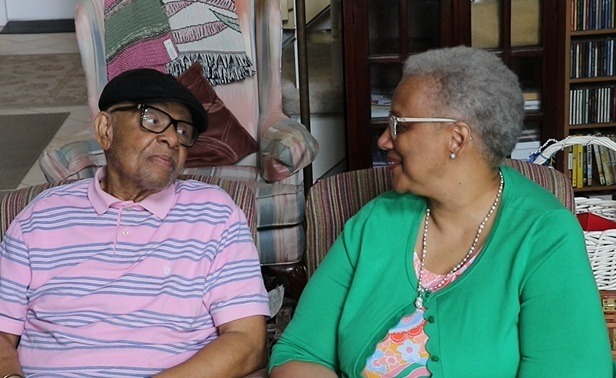
Even at 90, Alexander is still shooting. In the summer of 2025, his historical images were on view at multiple Atlanta venues, including The Sun ATL Gallery and the Fulton County Central Library. His camera remains focused on the same subjects that first drew him in: Black life, human rights, and the everyday courage of people who refuse to be erased.
A Living, Breathing Archive of Black America
The Jim Alexander Collection is more than a stack of boxes in a climate-controlled room. It is a visual progression through African American music, struggle, art, and love — and through the life of a man who chose to stand with his people and tell the truth.
From that first Navy dice game to the Getty-funded archive now being processed at Emory, Alexander has insisted that Black people deserve to be seen in their full complexity. His pictures hold the grief and the glory, the marches and the dances, the front-row legends and the folks in the back of the room who keep showing up.
As archivists work through thousands of prints, negatives, and slides — and as Alexander continues to step into rooms, lift his camera, and press the shutter — his role as a “participant observer” only grows more important. In an era of rapid images and fleeting memories, his work stands as a profound, steady record of Black life in motion.
And now, with his archive secured and opening wider to the public, the world will be able to see what Jim Alexander saw — and perhaps, learn to see Black America with the same care, respect, and clarity.
See Jim Alexander’s work at The Jim Alexander Collection
Related articles
Related video



 Ted Knorr