
By Florita Bell Griffin, Ph.D. | Houston, TX | October 6, 2026
For most of automotive history, the relationship between a person and a car was straightforward. The driver steered, accelerated, braked, watched the road, and made nearly every important decision. The vehicle responded mechanically to human commands. Modern vehicles are changing that relationship because computers increasingly watch the road alongside the driver and, in some situations, intervene before the person does.
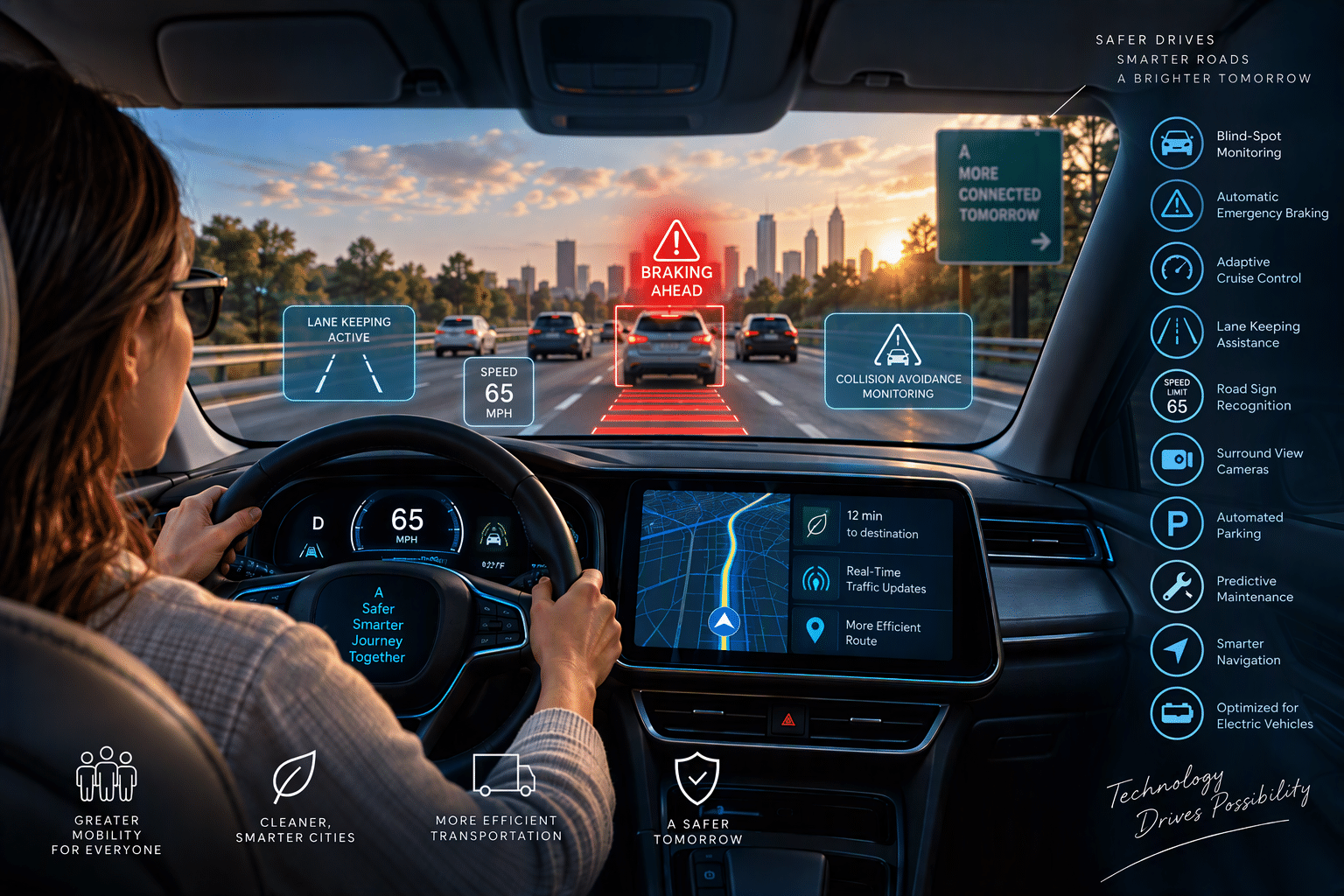
Many drivers already own vehicles with technology that would have sounded futuristic a generation ago. A car may warn that another vehicle is in the blind spot, apply the brakes when a collision appears likely, maintain a selected distance behind traffic, help keep the vehicle centered in a lane, recognize road signs, monitor tire pressure, display a camera view of the surroundings, or guide the driver into a parking space. None of these features requires a humanoid robot sitting behind the steering wheel. Artificial intelligence in transportation often appears quietly through sensors, cameras, software, and automated assistance.
The distinction between driver assistance and self-driving is important because the terms are often blurred in advertising and everyday conversation. The National Highway Traffic Safety Administration says that the driver remains responsible at the lower levels of automation used in consumer vehicles today. Level 1 systems may assist with either steering or acceleration and braking, while Level 2 systems can assist with both at the same time, but the human driver is still expected to remain fully engaged and attentive.
That means a vehicle capable of maintaining speed, following traffic, and helping steer on the highway is not automatically a fully autonomous car. The technology can reduce workload, particularly during long highway drives, but the person behind the wheel remains responsible for monitoring conditions and being prepared to respond. The difference matters because a driver who misunderstands what the system can do may stop paying enough attention precisely when attention is still required.
Automatic emergency braking provides a good example of how these technologies can be valuable without replacing the driver. Sensors may detect that the vehicle is closing rapidly on an obstacle and apply the brakes when the driver has not reacted quickly enough. The system may reduce the severity of a collision or help avoid one altogether. Blind-spot monitoring can warn that another vehicle is difficult to see, while rear cross-traffic warnings can alert a driver backing out of a parking space.
These features are essentially extra sets of electronic eyes, but electronic eyes are not perfect. Cameras can be affected by darkness, glare, weather, dirt, road markings, or unusual conditions. Sensors can misunderstand an environment, and software works within the limits established by its design. Human beings also make mistakes, of course, which is one reason driver-assistance technology exists. The safest relationship may be one in which the machine and the driver support one another rather than either being treated as infallible.
Navigation has already demonstrated how quickly people can become comfortable allowing technology to influence driving decisions. Few drivers now think twice about following a route suggested by a phone or dashboard system. Traffic data can identify congestion, accidents, road closures, and faster alternatives in real time. AI can help estimate arrival times and continually adjust the route as conditions change.
Yet anyone who has used navigation for long enough has also experienced its limitations. The system may direct a driver toward an inconvenient entrance, recommend a route through an uncomfortable neighborhood, fail to understand temporary construction, or insist on a turn that local knowledge says makes no sense. Most people eventually learn the right relationship: appreciate the assistance but remain willing to disagree.
The same lesson applies to more advanced vehicle intelligence. Drivers need to understand what their particular car can actually do rather than relying on a general impression created by the name of the feature. Terms such as “pilot,” “assist,” or other branded language can sound more capable than the underlying technology. Reading the owner’s manual may not be exciting, but understanding when a system works, when it may disengage, and what the driver must continue monitoring is part of safely using the vehicle.
AI is also changing what happens before a car breaks down. Modern vehicles generate enormous amounts of diagnostic information. Sensors monitor engines, batteries, emissions, tire pressure, electrical systems, and other components. Increasingly intelligent diagnostic tools can help technicians identify patterns and narrow down likely problems faster than older methods allowed.
For electric vehicles, software plays an especially central role because battery management, charging, energy efficiency, temperature control, and range prediction depend heavily on computerized systems. The vehicle may learn from driving patterns and adjust estimates based on conditions. Over time, cars may become better at predicting maintenance needs before a component fails, giving owners an opportunity to address problems earlier.
Parking is another area where the relationship between driver and machine is changing. Cameras now create overhead views that appear to look down on the vehicle from above. Parking sensors measure distance from nearby objects, while automated systems may steer into a space with limited input from the driver. Features that once appeared only on expensive luxury vehicles have gradually moved into more ordinary models.
The longer-term future goes further. Higher levels of automated driving are designed for situations in which the system performs more of the driving task, eventually reaching the point where occupants may function as passengers rather than drivers. NHTSA currently distinguishes these advanced levels from the driver-assistance technology available in ordinary consumer vehicles and notes that full automation is not currently something consumers can simply purchase for unrestricted use on all roads.
If truly autonomous vehicles become common, the consequences could extend far beyond convenience. Older adults who no longer drive might retain greater mobility. People with certain disabilities could gain new transportation independence. Long-distance freight could change, parking needs might decline in some places, and cities could eventually reconsider how roads, curbs, garages, and transportation systems are designed.
There are also everyday questions about responsibility. If a vehicle assists with steering and the driver stops paying attention, who is responsible when something goes wrong? What happens when software behaves differently after an update? How should drivers be told when a feature changes? These questions become increasingly important as vehicles begin to resemble computers on wheels.
Privacy enters the discussion as well. Connected vehicles can generate information about location, driving behavior, vehicle performance, and use of onboard services. Drivers should become more accustomed to asking what information a vehicle collects, which services receive it, and what controls are available. Buying a car increasingly involves accepting a digital relationship with the manufacturer as well as purchasing a physical machine.
The most important point for everyday drivers is that artificial intelligence in cars is not arriving all at once. It is arriving one feature at a time. A warning light becomes a predictive alert, cruise control becomes adaptive, a rearview mirror is supplemented by cameras, and steering assistance becomes more sophisticated. Each improvement feels small until we look back and realize how much of the driving experience has changed.
Drivers do not need to fear these developments, and they do not need to pretend the technology is more capable than it is. The wisest approach is to understand exactly what the vehicle is doing and remain engaged wherever human responsibility remains necessary.
Cars are becoming more intelligent, but intelligence in a machine does not automatically eliminate the need for intelligence from the person using it. The safest future may depend on drivers who understand both sides of that relationship and know when to accept assistance, when to remain alert, and when to take control.
© 2026 Truth Seekers Journal. Published with permission from the author. All rights reserved.
Related articles:
AI Can Save You Time, but Can It Make You Smarter?
Living With AI: How It Is Changing Work, Family, and Community
When Systems Forget Who They Were Built For
Why Familiarity Is Not the Same as Understanding
Truth Seekers Journal thrives because of readers like you. Join us in sustaining independent voices.

