Milton Kirby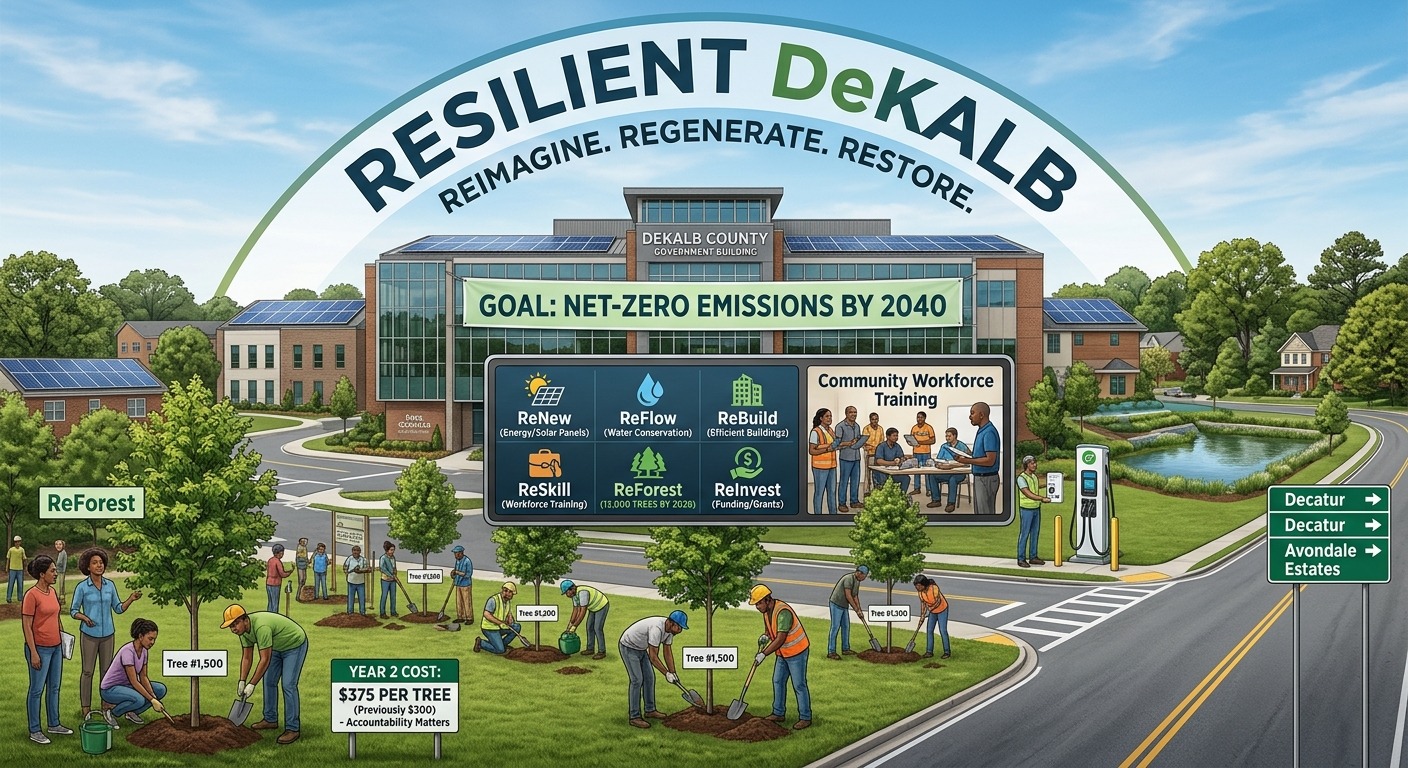
By Milton Kirby | Decatur, GA | October 6, 2026
A storm can arrive in a matter of hours.
A power outage can last for days.
Extreme heat can push temperatures to dangerous levels, while flooding can overwhelm streets and neighborhoods with little warning.
DeKalb County officials call those events shocks.
But some of the problems that determine how well a community withstands an emergency develop much more slowly.
Aging buildings. Rising utility bills. Lost tree canopy. Deferred maintenance. Household energy costs that leave families with less financial room when something goes wrong.
DeKalb calls those stresses.
A new countywide initiative called Resilient DeKalb is designed to address both.
Supported by DeKalb County Chief Executive Officer Lorraine Cochran-Johnson and led by Chief Resilience Officer Liza Milagro, Resilient DeKalb brings energy, water, buildings, transportation, tree canopy, workforce development and other areas under a long-term strategy aimed at making county operations and communities better able to withstand disruption.
Its goal is ambitious: move DeKalb County operations toward net-zero emissions by 2040 while strengthening the systems residents rely on every day.
The initiative carries the theme: “Reimagine. Regenerate. Restore.”
But underneath the branding is a larger question.
How does a county prepare not only for the emergency it can see coming, but also for the everyday pressures that make recovery harder when the emergency arrives?
Resilience Before the Emergency
At its core, resilience is about preparation.
But under DeKalb’s approach, preparation does not begin when a storm appears in the forecast.
A county building that wastes energy costs taxpayers money every day.
A neighborhood that has lost tree canopy can become hotter during the summer before an extreme heat event arrives.
Deferred maintenance can eventually turn an ordinary repair into an emergency.
Families already struggling with high utility bills may have fewer resources available when a prolonged outage or other disruption occurs.
That is why operational efficiency is central to the county’s approach.
“Every dollar taken out of a utility bill is a dollar available when conditions turn,” the initiative’s planning materials state.
The argument is straightforward: efficiency can reduce everyday operating costs while creating additional financial capacity when something unexpected happens.
In that sense, Resilient DeKalb is attempting to define resilience as more than emergency preparedness or environmental policy.
It is also about how the county manages money, buildings, infrastructure and other resources before the emergency arrives.
A Roadmap to 2040
Resilient DeKalb is the county’s first coordinated resilience program and is organized around the 2040 Resilient Management Plan.
The plan serves as a roadmap for projects involving environmental stewardship, operational efficiency, infrastructure, economic sustainability and community well-being.
Its long-range goal is net-zero county operations by 2040.
The work is organized through a series of themed “flagships,” each beginning with “Re.”
They include ReNew for energy, ReFlow for water, ReBuild for buildings, ReForest for tree canopy, ReSkill for workforce development and ReInvest for financing.
Other areas address emissions, waste, materials, mobility, electric-vehicle charging and storage, equity and health.
Together, the framework illustrates how broadly DeKalb is defining resilience.
A resilience project could involve solar energy or LED streetlights.
It could involve water systems, electric-vehicle infrastructure or a county building in need of improvements.
It could also involve workforce training or efforts aimed at making environmental and economic investments more accessible across the county.
The plan is intended to track projects from planning through implementation.
But a long-range plan is not the same thing as a completed project.
Some initiatives remain in development, and funding, schedules, baseline measurements and approval by the Board of Commissioners will help determine which proposals move forward and how quickly residents see results.
12,000 Trees — and the Cost of Planting Them
One of the most tangible examples is ReForest DeKalb.
The plan calls for planting at least 1,000 trees annually for 12 years, creating a goal of 12,000 additional trees across DeKalb County.
Tree canopy provides more than aesthetics.
Trees can reduce summer surface temperatures, slow stormwater before it reaches drainage systems and help filter air along heavily traveled corridors.
But ReForest also demonstrates the financial challenge of turning a long-term goal into reality.
The program is expected to draw on the DeKalb County Tree Fund, which receives money under the county’s tree ordinance for planting and tree care, along with philanthropic contributions and other program revenue.
Since 2018, the Tree Fund has received $1,282,696 and invested $440,170 in planting and tree care, according to information provided with the resilience plan. That leaves a reported balance of $842,526.
At the same time, planting costs are increasing.
The price of a 15-gallon tree is expected to rise from $300 to $375 for the 2026-27 planting season, with another increase proposed for the following season.
That means the same amount of money will buy fewer trees.
The math illustrates one of the central challenges facing the entire resilience plan.
Setting a goal is one step.
Paying for it year after year is another.
Milagro Takes the Lead
Responsibility for turning the broader vision into measurable projects falls largely to DeKalb’s Office of Resilience and Milagro, the county’s first Chief Resilience Officer.
Milagro brings more than 15 years of experience in sustainability, resilience, climate initiatives and environmental programs across the public and private sectors.
Before joining DeKalb County, she held leadership positions at Hartsfield-Jackson Atlanta International Airport, worked with the Georgia House of Representatives and served with international sustainability organizations.
Her experience at Hartsfield-Jackson is particularly relevant to her new assignment.
An airport operates much like a small city, with buildings, transportation systems, energy demands, waste streams, infrastructure and millions of people moving through it.
At Hartsfield-Jackson, Milagro created the #GreeningATL initiative. According to DeKalb County, programs developed during her tenure helped the airport achieve a 58 percent waste-diversion rate and redirect more than one million meals to families in need.
Her work also included energy performance, emissions reduction, renewable energy and infrastructure planning.
Now the scale is different.
Instead of applying those principles to an airport, Milagro is helping apply them across a county of neighborhoods, government buildings, roads, utilities and public services.
She presented the 2040 Resilient Management Plan to the DeKalb County Board of Commissioners’ Committee of the Whole on Sept. 10.
One Name, an Important Distinction
The name Resilient DeKalb predates the current countywide rollout.
Earlier in 2026, Commissioner Ted Terry introduced an initiative under the Resilient DeKalb name that grew from work associated with the DeKalb Green New Deal.
That effort emphasized environmental justice, sustainable land use, utility protections and community participation.
The countywide program now being advanced through the Office of the CEO and Office of Resilience reaches more directly into county government operations and infrastructure while also incorporating environmental, economic and equity goals.
The relationship between those efforts deserves clarification as the new program develops.
That distinction matters because residents trying to follow Resilient DeKalb should be able to understand who is responsible for individual projects, where funding comes from and which proposals have received county approval.
From Vision to Results
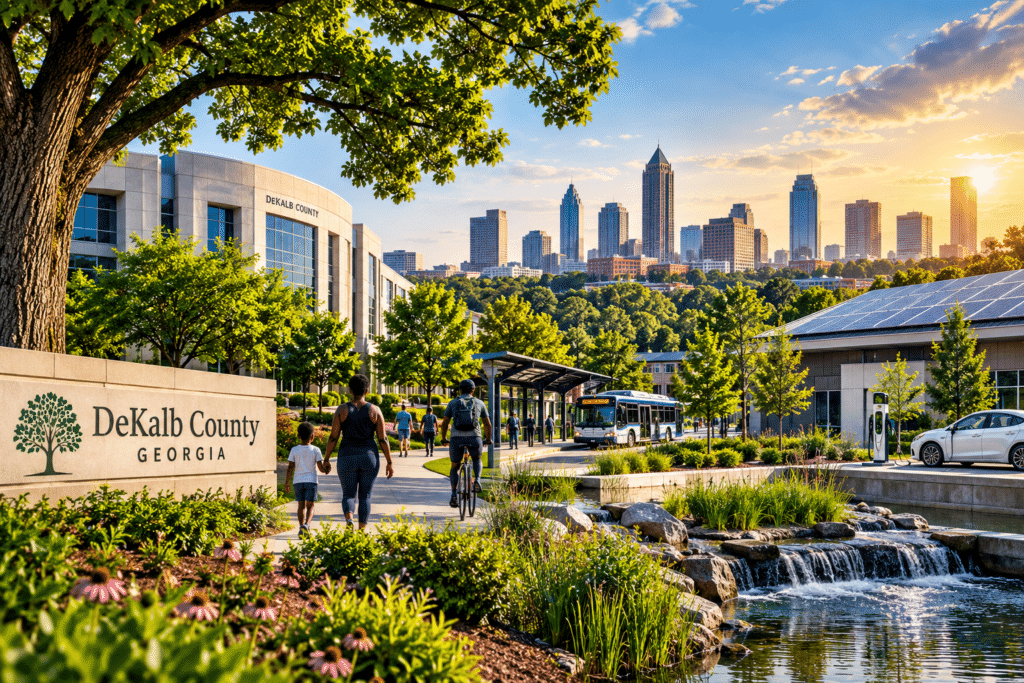
Resilient DeKalb presents an expansive vision.
The harder work comes next.
Over the coming years, residents will have ways to judge whether that vision is becoming reality.
How many trees actually get planted?
How much money does DeKalb save through energy efficiency?
Which county buildings are upgraded?
How much do those improvements cost?
Where will new infrastructure be located?
Who receives workforce training?
Which neighborhoods receive investments first?
And how will the county pay for it?
Those questions are particularly important for a plan extending to 2040.
Administrations will change. Commissioners will change. Economic conditions will change. Technology will change.
The resilience plan will have to survive those changes if its long-term goals are to be reached.
That may ultimately be the most meaningful test of Resilient DeKalb.
A storm, flood, heat wave or prolonged outage will eventually test the county’s physical systems.
Long before that happens, however, budgets, implementation decisions and measurable results will test the plan itself.
Resilience is difficult to measure when nothing has gone wrong.
Its value becomes clearer when something does.
DeKalb County’s premise is that the work required to withstand that moment should begin long before it arrives.
Truth Seekers Journal thrives because of readers like you. Join us in sustaining independent voices.