Florita Bell Griffin, Ph.D.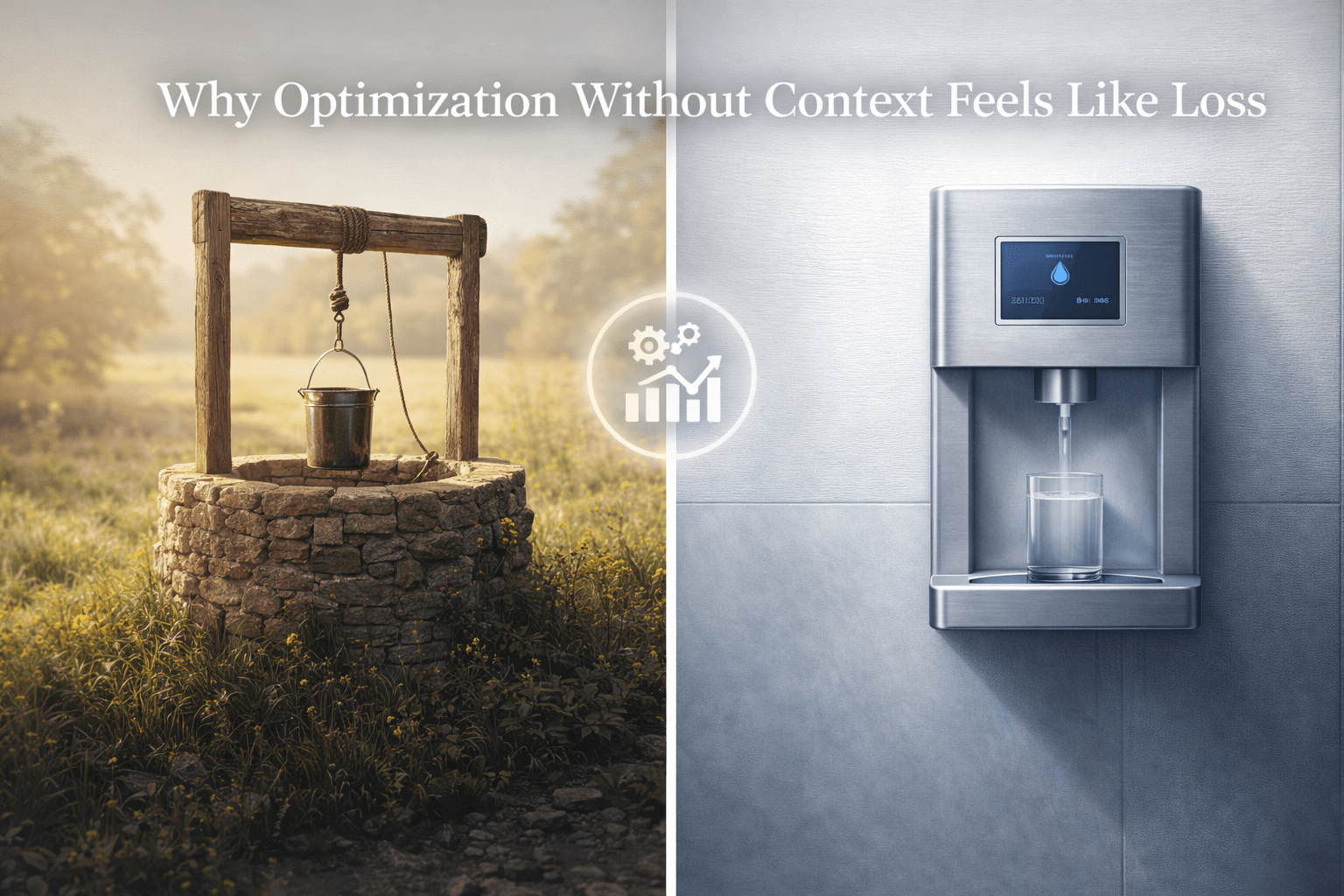
By Florita Bell Griffin, Ph.D. | Houston, TX | March 24, 2026
Optimization is usually presented as improvement. Processes become faster. Costs are reduced. Outputs become more consistent. From a technical perspective, optimization appears neutral, even beneficial. It is framed as refinement rather than change.
Yet many people experience optimization differently. Instead of feeling helped, they feel diminished. Something familiar disappears. Interactions become thinner. Choice narrows. What was once flexible becomes rigid. Optimization begins to feel like loss. This reaction is often dismissed as sentimentality or resistance. In reality, it is a response to missing context.
Optimization works by isolating variables. It simplifies complexity so that systems can be measured, tuned, and controlled. In doing so, it necessarily strips away elements that are harder to quantify: judgment, nuance, exception, and local knowledge. These elements are not remembered unless they are explicitly preserved. When they disappear, people notice.
Consider a workplace that optimizes workflows to eliminate inefficiency. Tasks are standardized. Timelines tighten. Decision paths are clarified. Productivity increases. Yet employees feel less trusted. Their discretion shrinks. Work becomes predictable but less meaningful. What has been optimized is output. What has been lost is agency.
The same pattern appears in consumer systems. A service streamlines its interface to reduce steps. Defaults are chosen automatically. Recommendations replace exploration. The experience becomes easier, yet also narrower. Users reach outcomes more quickly, but they lose the sense of navigating on their own terms. Optimization has removed friction, but it has also removed participation.
Loss emerges when optimization forgets what the system once accommodated. Early versions of systems often include space for improvisation. Users adapt tools to fit their needs. Workarounds emerge. Informal practices develop. These are signals of human engagement, not inefficiency. When optimization erases them, it erases evidence of how people actually live with systems.
Context explains why this matters. Context carries meaning across time. It holds the reasons certain choices existed, why exceptions were allowed, and how people compensated for system limitations. When optimization proceeds without carrying this context forward, it creates discontinuity. The system may improve internally while becoming less inhabitable externally.
This is especially visible to people with experience. They remember what the system used to allow. They recognize when flexibility has been replaced by constraint. They understand that what appears cleaner on paper can feel harsher in practice. Their response is not nostalgia. It is pattern recognition.
Optimization also changes how systems treat difference. Variability is often treated as noise to be eliminated. Edge cases become burdens. Diversity of use becomes inefficiency. Over time, systems optimize toward the average while marginalizing those who fall outside it. The system performs well for many while quietly excluding some.
Consider an automated eligibility system designed to speed up approvals. Clear rules reduce processing time. Decisions become consistent. Yet applicants with non-standard circumstances struggle to fit. Appeals are difficult. Explanations are limited. The system optimizes for throughput while losing the ability to respond humanely to complexity. For those affected, optimization feels like erasure.
Context restores balance. Systems that retain context recognize why variation exists. They preserve space for exception. They document rationale alongside rules. They allow optimization to proceed without flattening lived reality. Context ensures that improvement does not require forgetting.
Loss is felt when people no longer recognize themselves in the system. When familiar ways of working vanish without explanation. When judgment is replaced by enforcement. When speed replaces consideration. These shifts accumulate quietly, creating distance between system and user.
Optimization without context accelerates this distance. It privileges internal coherence over external meaning. It improves metrics while weakening trust. Over time, systems become harder to live with even as they become easier to measure.
This does not mean optimization should stop. It means optimization should remember. Systems must carry forward the context that made earlier versions workable. They must treat human adaptation as information, not inefficiency. They must recognize that not everything valuable can be optimized away.
Context is what allows systems to evolve without hollowing out. It anchors improvement to purpose. It preserves continuity between what a system does and why it exists. Without it, optimization feels subtractive.
When optimization includes context, improvement feels supportive. Change remains intelligible. People stay oriented. Loss is avoided not by preserving the past unchanged, but by carrying forward what mattered.
In an era of accelerating automation and data-driven decision-making, this distinction becomes critical. Systems that optimize without context will continue to function while alienating those they serve. Systems that optimize with context retain legitimacy.
Optimization is powerful. Context makes it humane.
© 2026 Truth Seekers Journal. Published with permission from the author. All rights reserved.
Truth Seekers Journal thrives because of readers like you. Join us in sustaining independent voices.



 Milton Kirby