Florita Bell Griffin, Ph.D.
By Florita Bell Griffin, Ph.D. | Houston, TX | November 10, 2026
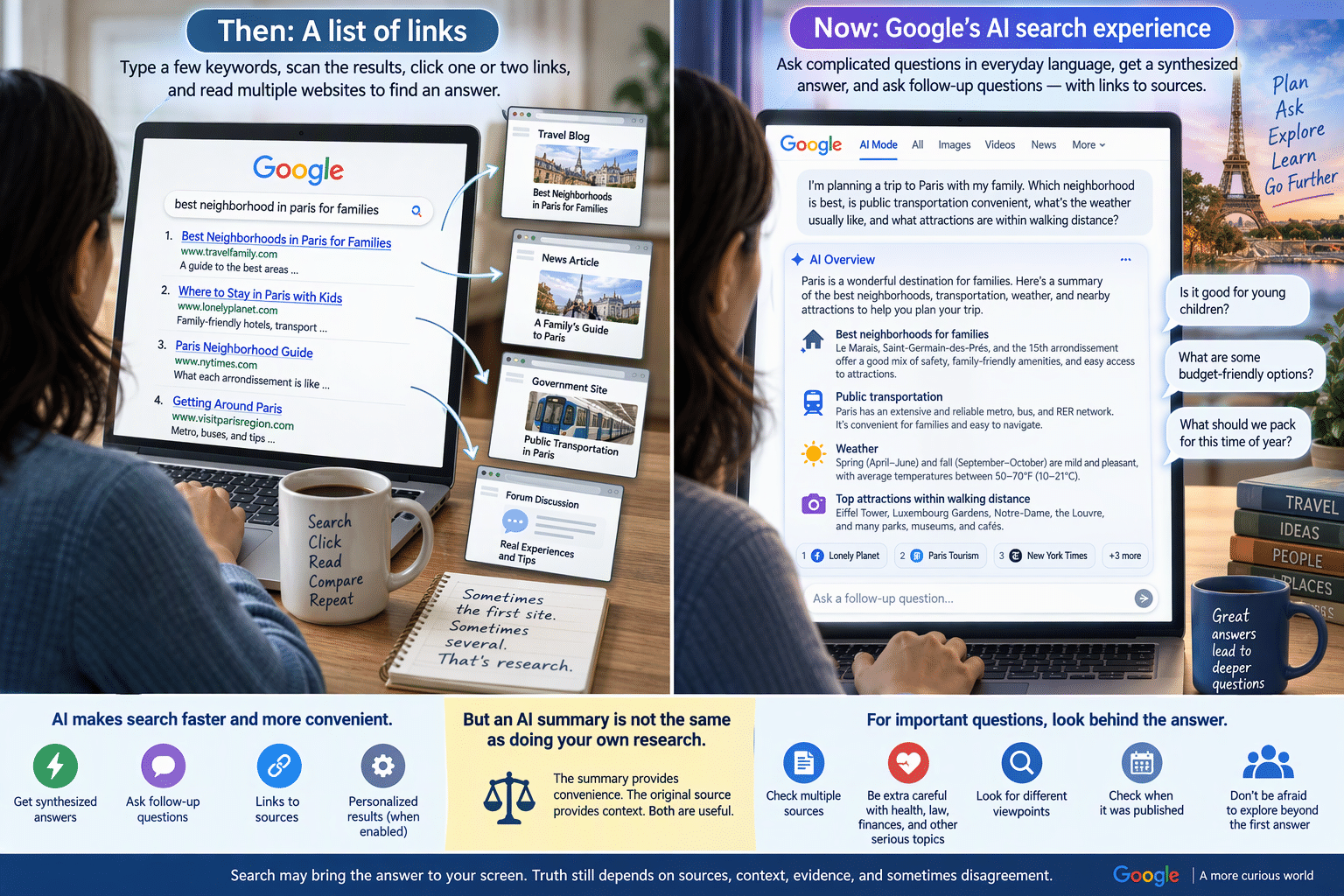
For many years, searching the internet followed a familiar pattern. A person typed a few words into Google, received a page filled with links, selected one or two that looked promising, and began reading. Finding an answer required leaving the search results and entering the websites where the information actually lived. Sometimes the first website provided what was needed, while other times a reader moved through several sources before reaching a conclusion.
That familiar experience is changing rapidly. Google now incorporates generative artificial intelligence directly into Search through AI Overviews and AI Mode. In 2026, Google has moved even further toward a conversational search experience in which people can ask complicated questions, receive synthesized responses, and continue with follow-up questions while still being provided links to sources across the web. Google describes AI Mode as its most powerful AI search experience and says it can divide complicated questions into subtopics and search across them simultaneously.
For everyday users, the appeal is obvious. Imagine planning a trip and wanting to know which neighborhood is best for a family, whether public transportation is convenient, what the weather is usually like, and which attractions are within walking distance. Traditional search might require several separate searches and visits to multiple websites. AI search can attempt to organize that information into one response and allow the traveler to ask a follow-up question immediately.
The same convenience applies to household questions, shopping, hobbies, school research, travel, technology, and thousands of everyday subjects. Instead of trying to determine which keywords will produce the best results, users can increasingly ask questions in ordinary conversational language. Traditional search primarily helped people find information, while AI search increasingly attempts to understand, organize, and explain the information before the person ever visits the source.
That distinction matters because the traditional search model made the existence of different sources obvious. A person might see a government agency, newspaper, university, business, discussion forum, nonprofit organization, and personal blog all listed on the same page. Even without opening every link, the reader could see that information came from different places and might represent different perspectives.
An AI-generated summary can make that diversity less visible because information from several sources may be blended into one smooth explanation. The result may sound like a single authoritative answer even when the underlying subject contains disagreement, uncertainty, exceptions, or changing information. This is one of the biggest changes in the way people will need to think about internet research in the age of artificial intelligence.
Google has acknowledged that AI responses can make mistakes, and its own guidance encourages users to check important information in more than one place and follow the supporting links when needed. That is especially important for health, law, finances, politics, breaking news, and other areas in which a missing detail or incorrect statement could have serious consequences. The appearance of an answer at the top of a search page does not make verification unnecessary.
Consider a medical question. An AI overview may help explain an unfamiliar term, but someone making an important health decision should still examine reliable medical sources and speak with an appropriate professional. The same principle applies to taxes, legal rights, investments, government benefits, and other subjects where exceptions and changing rules can substantially affect the answer.
There is also an important difference between information and its source. Suppose AI summarizes a new scientific study. The summary may explain the major finding, but the original research paper might contain limitations, qualifications, and uncertainties that disappear in a few sentences. A news article may explain how reporters verified a claim, while a government webpage may contain eligibility rules and exceptions that a short summary does not fully capture.
The original source provides context, while the summary provides convenience. Both can be useful, but they serve different purposes. The danger arises when readers begin to treat the summary as though it contains everything worth knowing about the subject.
Google has also been adding more ways for users to reach websites and original content from its AI-generated experiences, including direct links, article suggestions, previews, and features intended to surface original and preferred sources. This suggests that the future of search may not eliminate websites so much as change how users discover and enter them.
The habits of users will still matter. When the first answer looks complete, many people may decide they have learned enough and never click farther. Over time, that can change the way people understand research because instead of asking, “Where can I learn about this?” the habit becomes, “Tell me about this.” Those two approaches are related, but they are not identical.
There is also an effect on the people and organizations producing information. Websites require readers, and journalists, independent publishers, researchers, nonprofit organizations, small businesses, educators, bloggers, and other creators invest time and money in publishing information online. If users receive everything they believe they need from an AI-generated summary, fewer may visit the original work, which can affect how information is funded, discovered, and sustained.
Search is becoming more personalized as well. Google has introduced features that can tailor AI Mode suggestions to a user’s previous searches and other saved activity when those settings are enabled. Personalization can make search feel more useful because the system may anticipate what a person is interested in, but it also means two people may not receive exactly the same search experience.
This personalization creates a familiar tradeoff. The more a service knows about what someone likes, searches for, and does, the better it may become at predicting what that person wants. At the same time, highly personalized information can narrow discovery. Sometimes the most valuable source is not the one a system predicts we will prefer.
There is an intellectual benefit to exploring beyond the first answer. Traditional searching sometimes created useful accidents because a person looking for one thing found something unexpected. One article led to another, a disagreement between two sources encouraged deeper investigation, or a reader discovered a writer, publication, institution, or idea that had not been part of the original question.
AI can remove some of that friction, and removing friction is usually considered an improvement. Yet not all friction is useless. The effort involved in comparing sources can help people understand why experts disagree, where uncertainty exists, and how evidence is interpreted differently.
The best response is not to reject AI search because it is extremely useful. The better habit is to recognize the difference between receiving an answer and conducting an investigation. For everyday questions, the AI response may be sufficient, but for subjects that affect health, money, rights, reputation, or important decisions, clicking through to the source remains worthwhile.
People should pay attention to who produced the information, when it was published, and whether another reliable source agrees. If the AI response makes a surprising claim, follow the supporting link. If the issue is controversial, deliberately look for more than one viewpoint. If an exact quotation matters, find the original words rather than relying only on a summary.
Google Search has always changed. The simple list of blue links evolved into maps, images, videos, shopping results, instant answers, knowledge panels, and many other features. AI is another transformation, but this one is especially significant because the search engine is becoming more active in explaining the information it finds.
The future of searching may therefore require a new habit: read the answer, but remember to look behind it when the subject matters. Artificial intelligence can make finding information dramatically faster, but it cannot decide for us how deeply we should understand that information. Search may increasingly bring the answer directly to our screens, while truth still depends on sources, context, evidence, and sometimes disagreement.
© 2026 Truth Seekers Journal. Published with permission from the author. All rights reserved.
Related articles:
Will AI Change Your Job Even If It Doesn’t Replace It? What Everyday Workers Should Expect
Your Children Are Growing Up With AI: What Parents and Grandparents Need to Understand
What Happens When Your Car Starts Thinking for You? AI, Driving, and the Road Ahead
AI Can Save You Time, but Can It Make You Smarter?
Living With AI: How It Is Changing Work, Family, and Community
When Systems Forget Who They Were Built For
Why Familiarity Is Not the Same as Understanding
Truth Seekers Journal thrives because of readers like you. Join us in sustaining independent voices.