The Consumer Financial Protection Bureau (CFPB) has changed the terms of a previous enforcement order against the international money transfer company Wise. On May 15, the CFPB announced an amended consent order that reduces the company’s fine and updates how Wise must repay harmed customers.
Wise, which is based in the United Kingdom, lets people send, store, and receive money using a mobile app, prepaid accounts, and debit cards. More than three million U.S. customers use Wise to transfer money internationally. The company does not operate any physical locations in the United States.
In January 2025, the CFPB found that Wise had misled its customers about ATM fees and failed to properly show the actual cost of sending money, including exchange rates. Wise also broke the rules by not refunding fees quickly when money transfers didn’t arrive on time.
The earlier order, issued on January 30, required Wise to pay $450,000 to customers and a $2.025 million fine to the CFPB’s victims’ relief fund. That order has now been replaced.
Under the new May 15 order, Wise will still have to pay harmed customers, but the fine has been cut to about $45,000. The CFPB said the change was made to follow consumer protection laws better and reflect Wise’s cooperation with the investigation.
The revised order also considers new rules under Executive Order 14219 and the Bureau’s recent decision to cancel specific older guidelines, including one about how companies advertise remittance fees and delivery speeds.
Wise operates in 48 states, Washington D.C., Puerto Rico, Guam, and the U.S. Virgin Islands. It uses U.S. bank accounts to move money to and from other countries. It offers services for customers who send money entirely outside the U.S.
The CFPB is a government agency that protects consumers by enforcing financial laws and making sure financial markets are fair and open.
Centennial Yards selects Live Nation to operate a new 5,300-seat music venue, anchoring Downtown Atlanta’s $5B entertainment district near State Farm Arena and the Mercedes-Benz Stadium
Live Music Powerhouse to Anchor $5 Billion Sports and Entertainment District
By Milton Kirby | Atlanta, GA | May 15, 2025
Centennial Yards Company has officially selected Live Nation to operate a 5,300-seat state-of-the-art music and entertainment venue at the heart of its sprawling Downtown Atlanta development. The long-term lease deal, announced on Wednesday, marks a significant milestone for the $5 billion, 50-acre project, which aims to transform underutilized rail yards into a vibrant hub of culture, sports, and commerce.
The new venue, adjacent to State Farm Arena and Mercedes-Benz Stadium, will serve as a cornerstone of the emerging Centennial Yards entertainment district. It joins a roster of high-profile projects already underway or planned for the area, including the immersive experience space Cosm, Hotel Phoenix, and The Mitchell apartment tower.
“Centennial Yards is poised to be the epicenter of sports and entertainment for the Southeast,” said Brian McGowan, President of Centennial Yards Company. “This partnership with Live Nation brings us one step closer to creating a thriving hub where unforgettable experiences happen.”
With Live Nation at the helm, the venue is set to host a wide array of performances—from global touring acts to local up-and-comers—adding depth to Atlanta’s already rich music scene. The facility promises premium sound, fan-first design, and elevated food and drink options.
The venue is expected to fill a strategic gap between larger stadiums, such as Mercedes-Benz, and mid-sized halls, like the Tabernacle and Buckhead Theatre. According to Jordan Zachary, President of Global Venues at Live Nation, the partnership will bolster Atlanta’s stature as a cultural and economic heavyweight.
“Atlanta has long been a cornerstone of American music and live entertainment,” said Zachary. “We’re proud to help write its next chapter downtown with this new venue at Centennial Yards.”
The announcement drew praise from key stakeholders, including Tony Ressler, principal owner of the Atlanta Hawks and a lead partner in the Centennial Yards development.
“As owners rooted in Atlanta, we are committed to shaping a Downtown that is dynamic, inclusive, and vibrant,” said Ressler. “Live Nation’s presence helps us fulfill that promise.”
CIM Group, the development firm behind several transformational urban projects across the U.S., is the primary partner alongside Ressler’s group. “This venue brings people together through transformative experiences,” said Shaul Kuba, CIM Co-Founder and Principal.
Upon completion, Centennial Yards will feature 8 million square feet of new space, comprising residential, hotel, office, retail, and entertainment uses. Centennial Yards South—home to student-friendly Lofts at Centennial Yards and Wild Leap Brewery — has already opened. Community-driven activations, such as food trucks, live music, and tailgating parties, are already drawing crowds to the site.
The Live Nation venue is expected to open in 2027, becoming a pivotal part of the district’s 24/7 live-work-play experience. The project is also supported by strong transit connections, with multiple MARTA stations nearby and access to the Atlanta Beltline.
In a city known for producing music legends and iconic performances, this partnership aims to expand Atlanta’s live entertainment legacy well into the future.
Please consider supporting open, independent journalism – no contribution is too small!
DeKalb CEO Lorraine Cochran-Johnson outlines bold plans to improve public safety, infrastructure, economic inclusion, and homelessness in her 2025 State of the County Address.
By Milton Kirby | Atlanta, GA | May 9, 2025
In her first State of the County address, DeKalb County CEO Lorraine Cochran-Johnson delivered a powerful message of transformation, transparency, and urgency.
Speaking from the red carpet backdrop of Assembly Studios, Cochran-Johnson — the county’s first Black woman to serve as CEO — laid out a bold four-pillar plan centered on public safety, infrastructure, housing, and economic development.
“DeKalb County is not just reimagined,” she said. “It’s awakened.”
A Fast Start and a Bold Vision
Since taking office in January, Cochran-Johnson has moved swiftly. Within her first 100 days, she replaced the police chief, installed an interim leader, and committed more than $10 million to raise officer salaries, making DeKalb’s department one of the best paid in the region.
She also proposed a $2 million real-time crime center and announced a pilot program to use drones for emergency response.
“When it comes to public safety and water, water is a matter of public health – you can’t move slowly,” she said. “Give me grace and time, but know that urgency is necessary.”
Cochran-Johnson emphasized that public safety is more than policing — it’s the foundation for economic development. She called on DeKalb’s 12 city mayors to join her in fighting crime, building infrastructure, and ensuring opportunity.
DeKalb County CEO & Board of Commissioners
Infrastructure Investment: “The Decision of My Life”
“After analyzing the data and evaluating the risks, it was one of the best decisions of my life,” she said. The CEO also addressed the county’s aging water and sewer system, which is under federal oversight. She backed a tough but necessary decision: a 10% annual increase in water rates over the next decade to support a $4.27 billion overhaul.
Atlanta Regional Commission, under the direction of Executive Director, Anna Roach, reinforced the urgency, noting metro Atlanta has one of the nation’s smallest water supplies for a major urban area.
Cochran-Johnson added that infrastructure is not just about pipes — it’s about quality of life, public health, and future growth.
Small Businesses and Economic Equity
Cochran-Johnson pledged to ensure that local, small, and minority-owned businesses are equipped to compete for government contracts. Her administration will focus on strategic economic development that attracts top-tier companies and creates jobs, particularly in underserved communities.
“We must build a more connected and transparent government,” she said. “We are being responsible stewards of taxpayer dollars and innovative in our approach.”
To foster better communication and cooperation, she appointed an intergovernmental liaison to help align priorities across the county’s 12 cities.
Tackling Homelessness and Building Community
In the months ahead, Cochran-Johnson will unveil a comprehensive framework to reduce homelessness. She hinted at wraparound services and stronger partnerships with nonprofits and health agencies.
She also shared personal stories to highlight the commitment of county employees, including a Roads and Drainage crew that cleared snow for an ambulance so a pregnant woman could safely deliver her baby.
“That’s the spirit of DeKalb,” she said.
Fiscal Discipline and Innovation
Despite financial uncertainty due in part to potential federal funding cuts, Cochran-Johnson presented a balanced budget to the Board of Commissioners just 15 days after taking office. A temporary hiring and spending freeze is in effect as departments review cost-saving and revenue-generating ideas.
While acknowledging the challenges, she was resolute:
“Aggressive and bold moves are necessary,” she said. “Government may be a slow-moving vehicle, but there are times when you simply cannot move slowly.”
A County Reimagined
Throughout the address, Cochran-Johnson emphasized collaboration, accountability, and bold leadership. She expressed gratitude for past CEOs and vowed to lead with vision and courage.
“I’ve learned from those who came before me. But now is the time for bold action,” the CEO said. “The mission is possible — and DeKalb’s future starts now.”
The Consumer Finance Protection Bureau finalized the rule last year as part of the Biden administration’s efforts to do away with what it called junk fees. It was paused by the courts before it could take effect.
At the time, the CFPB estimated that American families would have saved more than $10 billion in late fees annually had the fees been capped at $8, significantly less than the $32 average.
Banks and industry groups argued that the rule didn’t allow card issuers to charge fees high enough to deter late payments and discourage repeat violations.
The Texas judge’s ruling earlier this month came a day after a collection of major industry groups and the CFPB under President Donald Trump announced that they had reached an agreement to throw out the rule.
Here’s what to know about credit card late fees:
What is the average credit card late fee?
The average late fee for major issuers has steadily ticked up since the 2010s, going from $23 at the end of 2010 to $32 in 2022, according to the CFPB. WalletHub, which tracks financial data, found the average late fee in 2025 to be $30.50, with the maximum $41.
A September 2023 Consumer Reports study estimated that 1 in 5 American adults, or about 52 million people, paid a credit card late fee in the previous year. People with lower incomes pay proportionately bigger fees, according to the CFPB, with the highest burden falling on communities of color and those living paycheck to paycheck.
How can consumers avoid the fees?
Enrolling in auto-pay for your credit cards can help you avoid making late payments, and there are some credit cards that don’t charge late fees at all (though it’s important to note that these cards may have other fee or penalty structures, or higher interest rates.)
Citi Simplicity and the Apple card do not currently charge late fees, and Discover offers a card that will automatically waive the first late fee.
It’s also possible to appeal credit card late fees charged by your credit card company by calling them directly. The companies will often reverse the fees, especially if it’s your first late payment.
You may also want to consider making payments on your credit card balances during the month. That means you’ll have paid more of the balance by the time the amount comes due, and keeping your balance low relative to your credit limit can improve your credit score.
If you’re having trouble making ends meet, you can ask your credit issuers about hardship programs. These are typically available to people affected by job loss, illness or medical conditions, natural disasters, or other emergencies.
What was the CFPB credit card late fee cap rule about?
Concerned that credit card companies were building a business model based on high penalties, Congress passed the Credit Card Accountability Responsibility and Disclosure Act of 2009 (CARD Act), which banned the companies from charging excessive late fees and established clearer disclosures and consumer protections.
In 2010, the Federal Reserve Board of Governors voted to issue a regulation implementing the CARD Act, which said that banks could only charge fees to recover costs associated with late payment.
However, the rule included an “immunity provision” that let some banks charge $25 for the first late payment and $35 for subsequent late payments, adjusted for inflation each year. Those amounts subsequently grew to $30 and $41.
After a review of market data, the CFPB finalized a rule that would have capped late fees at $8 and ended automatic inflation adjustments. Based on records analyzed by the CFPB, a late fee of $8 would be sufficient for card issuers, on average, to cover collection costs incurred as a result of late payments.
How have banking groups responded to the court decision?
Industry groups, including the Consumer Bankers Association, American Bankers Association, the U.S. Chamber of Commerce, and others, said they welcomed the court’s decision eliminating the cap.
The groups said that the rule would have led to higher interest rates and reduced credit access for card holders. The groups also said the rule would have “reduced important incentives for consumers to manage their finances.”
The CFPB has estimated that banks bring in roughly $14 billion in credit card late fees a year.
How have consumer advocates responded?
Horacio Méndez, president and CEO of Woodstock Institute, an organization for advancing economic equity, called the ruling a “devastating blow.”
“By tossing out the CFPB’s common-sense rule to cap these predatory late fees — some as high as $41 — a federal judge is putting corporations over the lives of everyday consumers,” he said. “The CFPB’s rule was borne out of clear evidence: the credit card industry was using inflated late fees as a profit engine, forcing families with the least financial cushion to pay.”
Méndez said that while consumers have come to expect fees for services, those fees needn’t be punitive to be effective.
Please consider supporting open, independent journalism – no contribution is too small!
Rev. Al Sharpton met with Target CEO Brian Cornell to address the company’s DEI rollback, amid ongoing boycott efforts and activist concerns over corporate accountability.
By Milton Kirby | Atlanta, GA | April 21, 2025
On Thursday, April 17, 2025, Rev. Al Sharpton met with Target CEO Brian Cornell at the National Action Network (NAN) headquarters in Harlem to discuss the company’s recent rollback of its diversity, equity, and inclusion (DEI) initiatives. NAN’s National Board Chair, Dr. W. Franklyn Richardson, and Senior Adviser Carra Wallace attended the meeting
Courtesy NAN – Al Sharpton
Following the meeting, Sharpton described the discussion as “very constructive and candid,” as reported by the National Action Network and The Guardian. He stated, “I am going to inform our allies, including Rev. Dr. Jamal Bryant, of our discussion and my feelings, and we will go from there.”
Rev. Dr. Jamal Bryant, senior pastor at New Birth Missionary Baptist Church, Lithonia, GA, who initiated a 40-day boycott of Target during Lent through his campaign TargetFast.org, confirmed his attendance at the meeting. Sharpton emphasized their alignment, stating, “We must make it clear, on the record, that he and I are aligned, especially as those seeking to dismantle DEI will sow divisions to advance their cause.”
However, some local activists expressed concerns about the meeting. Nekima Levy Armstrong, a Minneapolis-based civil rights attorney and one of the initial organizers of the Target boycott, questioned Sharpton’s involvement. She told the Minnesota Star Tribune, “Sharpton had absolutely zero involvement in the Target boycott,” suggesting that Target’s outreach to Sharpton might be an attempt to “control the narrative.”
In January, Target announced significant changes to its DEI policies, including ending its three-year DEI goals, withdrawing from external DEI surveys, and concluding its Racial Equity Action and Change (REACH) program by 2025. The company also plans to shift from “supplier diversity” to a broader “supplier engagement” approach.
Sharpton has been vocal about corporate accountability regarding DEI commitments. In a statement, he remarked, “If an election determines your commitment to fairness, then fine—you have a right to withdraw from us. But we have a right to withdraw from you.”
As of now, Target has not indicated any changes to its DEI policies following the meeting. The National Action Network has not released additional details. Activists and consumers continue to monitor the situation, emphasizing the importance of sustained corporate commitment to diversity, equity, and inclusion.
Please consider supporting open, independent journalism – no contribution is too small!
The 2025 Masters highlighted golf’s evolving legacy—spotlighting Black pioneers, Augusta’s exclusivity, and a $140M economic impact—while diversity efforts continue to reshape the sport.
By Milton Kirby | Atlanta, GA | April 18, 2025
As the 89th Masters Tournament concluded Sunday, April 13, 2025, the storylines that emerged weren’t just about the iconic green jacket or record-breaking putts. Behind the meticulously groomed fairways of Augusta National Golf Club lies a deeper story—one that speaks to the history of exclusivity, the slow march toward diversity, and the staggering economic footprint of one of America’s most prestigious sporting events.
Black Golfers in America: Progress and Persistence
Golf in the United States is still largely dominated by white players, but Black athletes have made important strides—though the road remains steep. As of 2024, about 3% of the 28.1 million on-course golfers in the U.S. were Black, totaling roughly 843,000 players. This marks a decline from 1.1 million Black golfers in 2015, highlighting ongoing struggles with access, affordability, and representation.
Despite these challenges, a number of Black golfers have not only made it to the PGA Tour but also achieved remarkable success:
Charlie Sifford became the first African American to earn a PGA Tour card in 1961, later winning two events and earning a place in the World Golf Hall of Fame.
Pete Brown was the first Black golfer to win a PGA Tour event in 1964.
Lee Elder made history in 1975 as the first Black player to compete in the Masters Tournament.
Calvin Peete, known for his accuracy, won 12 PGA Tour events, including the 1985 Players Championship.
Jim Thorpe secured three PGA Tour wins and 13 on the Champions Tour.
Modern Black golfers continue to carry the torch:
Tiger Woods, with 82 PGA Tour wins and 15 majors, remains one of the most dominant and influential golfers of all time.
Harold Varner III made history as the first Black golfer to advance to the PGA Tour via the Web.com Tour.
Joseph Bramlett became the first Black player to graduate from PGA Tour Q-School since Tiger.
Cameron Champ, a rising star, is known for his long drives and advocacy for racial equity in the sport.
Cheyenne Woods, Tiger’s niece, has competed on the LPGA Tour and earned international victories.
Organizations like the Advocates Professional Golf Association (APGA) Tour are also working to provide competitive platforms for aspiring Black professionals, seeking to increase diversity at golf’s highest levels.
Inside Augusta National: Membership and Milestones
Perhaps no course is more symbolic of golf’s complex relationship with race than Augusta National Golf Club, home of the Masters since its debut in 1934. Known for its tightly guarded membership and tradition-heavy culture, the club did not admit its first Black member—Ron Townsend, a television executive—until 1990. This move came amid national pressure after a similar exclusion scandal at Alabama’s Shoal Creek Club drew widespread backlash.
Since then, Augusta has added other Black members, including Condoleezza Rice, who also broke barriers as one of the club’s first two female members in 2012, and former NFL great Lynn Swann. The exact number of Black members today remains confidential, in line with Augusta’s longstanding policy of secrecy. Still, reports suggest several African Americans now hold roles in membership and business operations.
Augusta’s exclusivity persists: membership is by invitation only, with estimated initiation fees between $100,000 and $300,000, and annual dues under $30,000. The club typically hosts around 300 members, often referred to as “green jackets.”
Masters Champions: Legends of the Tournament
In its 89-year history, only a few players have won the Masters multiple times—a rare achievement that cements their place in golf legend.
Jack Nicklaus leads with 6 victories (1963, 1965, 1966, 1972, 1975, 1986).
Tiger Woods, the most dominant Black golfer in history, has won 5 times (1997, 2001, 2002, 2005, 2019).
Arnold Palmer claimed 4 wins (1958, 1960, 1962, 1964).
Tiger Woods’ historic 1997 win not only redefined the sport but also symbolized a new chapter in its racial history. His enduring legacy continues to inspire young golfers of color across the globe.
The 2025 Masters added yet another chapter to the tournament’s historic legacy when Rory McIlroy won after a dramatic sudden-death playoff against Justin Rose. With the victory, McIlroy became the sixth player—and the first European—to complete the modern career Grand Slam, doing so on his 11th attempt. His long-awaited triumph underscored the global prestige of the Masters and highlighted how the event continues to shape the narratives of golf’s greatest champions.
By Milton Kirby East Lake Golf Course Atlanta, GA – Location of Ryder Cup 1963
The Masters and Georgia’s Economy: A Championship Boost
The Masters isn’t just a sporting event—it’s an economic juggernaut. Held each April, the tournament injects between $120 million and $140 million into Augusta’s local economy. From luxury rentals to booming restaurant business, the city transforms into a hub of global commerce during Masters Week.
Across Georgia, golf drives even larger gains. In 2022, the industry generated a $5.3 billion statewide economic impact, supporting over 55,000 jobs and contributing $2.7 billion in wages.
Hospitality rates spike dramatically during the tournament:
Hotel rates surge up to 800%, averaging $500 per night.
Local hotels generate about $26 million in revenue.
Short-term rentals average $5,300 per week, with some homeowners earning up to $28,000, often enough to pay a year’s mortgage.
Transportation sees a bump too. Augusta Regional Airport handles over 2,100 private flights during Masters Week—more than five times its normal daily volume.
And then there’s merchandise. Augusta National’s iconic shop generates an estimated $50 million in sales annually during the event, with items like Masters-themed gnomes becoming collector’s favorites.
The Legacy and the Future
Despite Augusta National’s secretive culture and its late adoption of inclusive practices, the club and the Masters remain fixtures in American sport and business. But the story of Black golfers—past, present, and future—is still being written.
The legacy of exclusion still casts a long shadow. Yet with champions like Tiger Woods, pioneers like Charlie Sifford and Lee Elder, and grassroots efforts like the APGA Tour pushing for change, the fairways are slowly becoming more welcoming.
Golf, like America, is a work in progress—full of tradition, potential, and the constant challenge to do better.
Please consider supporting open, independent journalism – no contribution is too small!
Douglas County celebrated zero debt, $97M in grants, and Amazon’s $11B investment at a sold-out State of the County event in Douglasville.
By Milton Kirby | Douglasville, GA| April 17, 2025
More than 300 people filled the Douglasville Conference Center on Wednesday, April 16, for the 2025 State of Douglas County Address. The event was sold out and brought together business leaders, residents, and elected officials. It was hosted by the Council for Quality Growth and the Douglas County Chamber. Amazon was the presenting sponsor.
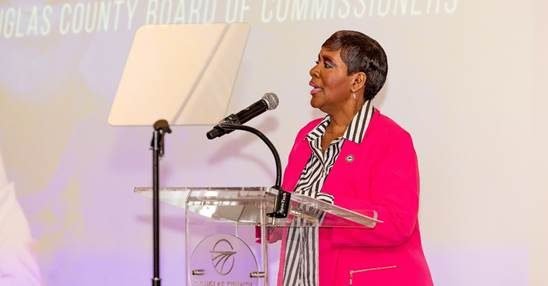
Douglas County Chairwoman Dr. Romona Jackson Jones gave the annual speech. Her theme was “Why Not Douglas.” She spoke proudly about the county’s location near the airport and its role as the western gateway to metro Atlanta. She said these qualities help attract both small companies and big corporations.
Dr. Jackson Jones also discussed new plans to update the county’s image. This includes changes to its social media, website, and logo. A new strategic plan is coming soon. It will replace Douglas Forward 2025 and include goals and performance measures shaped by community input.
One major highlight: the county has no debt. The Chairwoman said Douglas County is using $97 million in grants and has raised over $55 million through a special purpose local option sales tax (SPLOST). These funds support public safety, parks, transportation, and other county services.
She also shared updates on $200 million worth of current infrastructure projects. These include new bus routes, connections to MARTA, and replacing 11 buses. “Transit improvements take time,” she said, “but they are worth it as the county grows.”
Economic development was another key focus. The Chairwoman said new homes are going up along Highway 92, thanks to better transit. The county is also growing its film industry. It earned a “Camera Ready” status and opened a Film and Entertainment Office.
In tech news, Douglas County has become a hub for data centers. Companies like T5, Stack, and Switch have invested in the area. The biggest news: Amazon Web Services will invest $11 billion in the county and create 550 jobs focused on artificial intelligence. It is the largest corporate investment in Georgia’s history.
Michael Paris, President of the Council for Quality Growth, said partnerships like these help guide the county’s future. “Working together ensures that we all have a voice in how we grow and thrive,” he said.
Sara Ray, President of the Douglas County Chamber, added, “Together, we inspire leadership and boost our economy.”
Other speakers included Yvette Jones, Chief Communications Officer for Douglas County, and Trevor Quander of Georgia Power. Amazon’s Terreta Rodgers also spoke, along with Danny Johnson from the Atlanta Regional Commission.
This was the sixth of eight “State of the County” events planned across metro Atlanta this year. Each one brings together local leaders, governments, and businesses to shape the future of their communities.
Please consider supporting open, independent journalism – no contribution is too small!
Target faces growing financial and reputational fallout, losing $12.4B in revenue, stock dropping $27, and facing lawsuits after reversing diversity, equity, and inclusion policies.
By Stacy M. Brown | Washington, DC | March 31, 2025
Target continues to face mounting financial and reputational fallout after reversing course on diversity, equity, and inclusion (DEI) initiatives. The retail giant has lost more than $12.4 billion in revenue, seen its stock plunge by $27.27 per share, and is grappling with multiple lawsuits linked to its shifting DEI policies. Separate but powerful actions from Black-led organizations and faith leaders have intensified pressure on the company. Rev. Jamal Bryant launched a national Target Fast, calling for continued community mobilization. Meanwhile, the National Newspaper Publishers Association (NNPA) and the NAACP initiated public education and selective buying campaigns. While distinct in approach, the collective efforts have amplified scrutiny and economic consequences for Target. “Black consumers helped build Target into a retail giant, and now they are making their voices heard,” said Benjamin F. Chavis Jr., president and CEO of the NNPA. “If corporations believe they can roll back diversity commitments without consequence, they are mistaken.”
Photo by Milton Kirby
Early data from analytics firms Placer.ai and Numerator confirms a decline in consumer support. Numerator found that Black and Hispanic households are reducing their visits to Target at the highest rates. Placer.ai reported that on the national blackout day last month, Target saw an 11 percent decline in store traffic compared to average Friday visits. Since the company’s January 24 DEI reversal, Placer.ai data shows Target’s overall foot traffic has fallen every week. In contrast, Costco has gained ground. The warehouse chain rejected a shareholder proposal to weaken its diversity programs and stayed firm in its DEI stance. Analysts say Costco’s consistency and longstanding commitment to high wages and strong employee benefits may attract consumers frustrated with Target’s retreat. Costco’s shares have outperformed those of Walmart and Target over the same period. Walmart has also seen a dip in foot traffic, though not as sharp as Target.
While grassroots boycotts are not always financially damaging in the long term, Target’s situation may prove different. “Boycotts put a ‘negative spotlight’ on the company that can have reputational consequences,” Brayden King, professor at Northwestern University’s Kellogg School of Management, told Forbes. He noted that consumer trust, closely tied to corporate reputation, plays a critical role in shopping habits. In addition to its woes, Target issued a string of recalls in 2025 involving products sold on shelves due to undeclared allergens and injury hazards. Affected items included Gerber Soothe N Chew Teething Sticks, Dorel Safety 1st Comfort Ride and Magic Squad child car seats, Nuby stroller fans, Baby Joy highchairs, Chomps beef and turkey sticks, and Pearl Milling Company pancake mix. Rev. Bryant said Target Fast has now mobilized more than 150,000 participants and persuaded over 100 Black vendors to withdraw their products from Target. He urged continued focus and unity in holding the company accountable. “It is critical that Black people can’t afford to get A.D.D; we can’t taper off and lose synergy. It’s important that people stay the course and keep amplifying our voices because it is being heard from Wall Street to Main Street,” Bryant said. He added, “No, I’m now committed and grateful.”
Photo by Milton Kirby
According to the Birmingham Times, the New Birth Baptist Church pastor recently reported that the campaign he helped launch against Target has received robust national support.
From the Times:
The fast-selective-buying campaign, which began during the Lent Season from March 5 to April 17, targets what Bryant describes as the company’s neglect of the Black community. According to Bryant, the boycott has mobilized over 150,000 participants and persuaded over 100 Black vendors to withdraw their products from Target. The movement has led to a $12 drop per share in Target’s stock and a $2 billion decrease in its overall value.
“We just hit 150 thousand people who have signed up to be part of it, with over 100 black vendors that pulled out of Target, so the momentum is going steadily,” Bryant explained.
The NAACP and the National Newspaper Publishers Association (NNPA), representing the Black Press of America, have simultaneously announced the planning and implementation of a national public education and selective buying campaign in response to Target and other corporations that have dismantled their respective Diversity, Equity, and Inclusion (DEI) commitments, programs and staffing.
“Now is the time for the Black Press of America once again to speak and publish truth to power emphatically,” NNPA Chairman Emeritus Danny Bakewell Sr. explained.
“We are the trusted voice of Black America, and we will not be silent or nonresponsive to the rapid rise of renewed Jim Crow racist policies in corporate America,” said NNPA Chairman Bobby R. Henry Sr. “The Black Press of America continues to remain on the frontline keeping our families and communities informed and engaged on all the issues that impact our quality of life.”
Senate repeals CFPB rule capping overdraft fees, blocking future reforms. Move favors big banks, harms low-income families, and undermines consumer protections championed by Senator Warnock.
By Milton Kirby | Atlanta, GA | March 27, 2025
In a blow to consumer advocates and working families, the U.S. Senate voted 52-48 on Thursday to repeal a landmark Consumer Financial Protection Bureau (CFPB) rule that capped overdraft fees at major banks. The rule, finalized in December 2024, aimed to rein in predatory banking practices that disproportionately affect low-income and minority communities.
The resolution now heads to the House of Representatives, where a companion bill already passed the Financial Services Committee on a 30-19 vote. Passed under the Congressional Review Act (CRA), the measure not only invalidates the CFPB regulation—it also bars future administrations from implementing any “substantially similar” protections. If the House passes the resolution, it will permanently strip away guardrails meant to shield consumers from exorbitant overdraft fees.
A Hard-Fought Reform Reversed
At the heart of the controversy is the CFPB’s now-overturned rule, which targeted financial institutions with more than $10 billion in assets. Under the regulation, large banks had three choices when it came to charging overdraft fees: impose a modest $5 fee, charge only enough to cover actual costs or losses, or treat overdraft as a loan—subject to standard lending laws and consumer disclosures.
The CFPB estimated the rule would have saved Americans up to $5 billion annually, or approximately $225 per household that incurs overdraft fees. Currently, banks charge an average of $35 per overdraft transaction.
Photo by Milton Kirby
But financial industry lobbyists—backed by Republicans and some moderate Democrats—mobilized quickly to kill the rule, arguing it would limit consumer access to overdraft services. In the hours after the rule was finalized, banks filed lawsuits, and by February, Republican leaders in Congress had introduced CRA resolutions to overturn it.
Senate Banking Committee Chair Tim Scott (R-SC), who led the effort, framed the rollback as a victory for “consumer choice,” claiming that the rule was part of President Biden’s “politically motivated ‘junk fee’ agenda” meant to distract from inflation. Yet critics argue the real beneficiaries are the banks—many of which have posted record profits from overdraft fees.
Warnock’s Fight for Fairness
Today’s vote is a bitter setback for Senator Reverend Raphael Warnock (D-GA), who has championed consumer protections since taking office. In March 2023, Warnock, alongside Senator Cory Booker (D-NJ), launched a campaign demanding accountability from the ten U.S. banks that generated the most revenue from overdraft and insufficient fund fees in 2021. The senators sent formal inquiries to institutions including JPMorgan Chase, Bank of America, Wells Fargo, Truist Bank, and PNC Bank, pressing them on how they justified such steep fees.
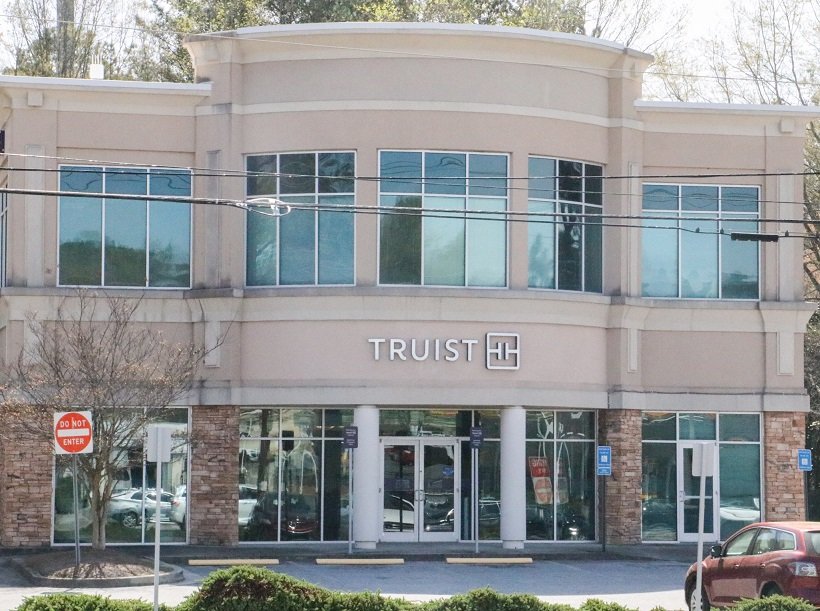
Photo by Milton Kirby – Truist Bank
Later that year, Senator Warnock chaired a Senate Banking Subcommittee hearing on the harmful impacts of overdraft fees. In his opening remarks, he laid bare the inequities baked into the system:
“One-third of unbanked households cite high fees as the reason they remain without a bank account. These types of fees affect people of color at a disproportionate rate. Banks with branches in predominantly Black neighborhoods charge more for overdraft services. And the customers hit hardest are often low-income, have poor credit, and are disproportionately Black and Hispanic.”
Warnock’s advocacy helped pave the way for the CFPB’s December 2024 rule, which sought to close an outdated regulatory loophole that had long exempted overdraft loans from lending laws. The rule was hailed by consumer advocates as one of the most meaningful financial protections in over a decade.
A Rare Break in the Ranks
While the Senate vote fell largely along party lines, one Republican Senator Josh Hawley of Missouri broke ranks and voted to uphold the rule. “I do not want to give big banks the ability to charge people outrageous sums of money,” he said on the Senate floor, noting that the regulation would save the average working-class household about $265 a year.
His lone vote of dissent highlights the stark contrast between political rhetoric around working families and legislative action that directly impacts their wallets.
What’s Next?
With the House poised to vote on the resolution, the future of overdraft fee protections hangs in the balance. If the CRA is passed by both chambers and signed into law, it will permanently block the CFPB from revisiting the issue, leaving consumers vulnerable to high, often unexpected, fees at a time when many families are still struggling to recover from the economic shocks of inflation and housing costs.
For Senator Warnock, the fight is far from over.
“Today’s vote puts corporate profits above working people,” Warnock said in a statement. “I will continue to advocate for financial fairness and dignity, especially for those who are too often left behind by our banking system.”
In 2022, predatory payday lenders drained $2.4B in fees from low-income, largely Black and Latino borrowers through high-interest, deceptive loans, Center for Responsible Lending report finds.
By Charlene Crowell | Washington, DC | March 28, 2025
New research from the Center for Responsible Lending (CRL) finds that in just one year – 2022 – cash-strapped borrowers took out over 20 million predatory loans totaling nearly $8.6 billion. The triple-digit annual percentage rates (APRs) and high costs attached to these loans – whether payday, single-payment or installment loans – drained more than $2.4 billion in fees from low-income borrowers.
CRL’s Down the Drain, report provides an update on the effects of payday lending, including online and app-based lending, that remains dominant in low-wealth, largely Black and Latino neighborhoods. Many of these lenders use misleading advertising to lure working people into a cycle of repeat borrowing and growing fees that can leave them struggling for months to repay a debt that reduces each subsequent paycheck.
Photo By Milton Kirby TitleMax Store Front
“Payday loans are designed to trap people in debt and this report shows the scale of the harm,” said report co-author Yasmin Farahi, CRL’s deputy director of state policy and senior policy counsel. “Predatory lending is a public policy choice. Congress and policymakers in states without common sense interest rate limits should enact these usury laws and the executive branch has a duty to enforce them – that is how to keep payday loan sharks at bay.”
Predatory high-cost lenders that offer loans with triple-digit APRs and high, often hidden fees, are trying to evade responsible interest rate limits that currently are in place in 20 states and the District of Columbia.
But these consumer-oriented reforms still leave 30 states where triple-digit interests rates remain legal, including Texas (662%), California (460%), Mississippi (572%), Alabama (456%), and Wisconsin (537%).
These abusive lenders often target working households and communities of color. A 2020 poll by CRL found that Black consumers were twice as likely as white consumers to live within a mile of either a payday lender or a pawnshop. The targeting of these communities can worsen longstanding racial economic disparities.
“Although payday loan fee volume declined early in the pandemic, the Down the Drain report shows a $200 million rebound from 2021 to 2022, reflecting increased strain on consumers’ finances,” said report co-author Lucia Constantine, senior researcher at CRL. “Especially considering changes in the market toward online and longer-term loans, storefront payday lenders in 2022 continued to drain a massive amount of wealth from people and communities with very little wealth.”
Among the report’s notable findings:
• Between 2021 and 2022, payday loan fee volume increased in California by 20%, Texas by 22%, and Florida by 17%. All are bigger percent increaes than the national fee volume experienced;
• States where payday lenders took in highest fee volumes are: Texas at over $1.3 billion, Florida at over $252 million, California over $224 million, Mississippi at over $149 milion, and Michigan at over $78 million. Mississippi’s payday fee total, the fourth highest, is out of proportion to its population size, which is the 35th largest; and
• In the only two states that collect and report statistics on online lending, the share of online payday lending increased from 2019 to 2022: Alaska from 55% to 57% and in California from 25% to 49%.
“As national payday lenders have continued to close storefronts across the country, the market share of online payday lending has increased. By 2019, online lending accounted 41% of single-payment payday loan volume nationally,” states the report.
“Beyond the impacts of the pandemic, the alternative financial services market has shifted online and expanded to include underregulated products like installment loans, earned wage advance, and buy now pay later”, the report continues. “Rent-a-bank’ schemes, in which a non-bank company uses an out-of-state bank offer loans that evade state usury caps, have also made payday lending more readily available even in states with legal protections.”
Small businesses must file beneficial ownership reports under the Corporate Transparency Act to combat financial crimes—though enforcement is paused as of March 2025.
All the latest updates about the Beneficial Ownership Information reporting requirement.
Under the Corporate Transparency Act (CTA), which went into effect on January 1, 2024, many U.S. small business owners are required to file corporate transparency reports with beneficial ownership information.
The CTA was enacted in 2021 to combat illicit activity including tax fraud, money laundering, and financing for terrorism by capturing more ownership information for specific U.S. businesses operating in or accessing the country’s market. Under the new legislation, businesses that meet certain criteria must submit a Beneficial Ownership Information (BOI) Report to the U.S. Department of Treasury’s Financial Crimes Enforcement Network (FinCEN). This report provides details identifying individuals who are associated with the reporting company.
The CTA was established to prevent individuals with malicious intent from hiding or benefitting from the ownership of their U.S. entities to facilitate illegal operations which, according to Congress, is a widely-used tactic that affects national security and economic integrity.
Who is considered a beneficial owner of a company?
According to the CTA, an individual qualifies as a beneficial owner if they directly or indirectly have a significant ownership stake in a company. This person either has a major influence on the reporting company’s decisions or operations, owns at least 25% of the company’s shares, or has a similar level of control over the company’s equity.
What information must be reported about a company’s beneficial owners?
All reporting companies must provide their legal name and trademarks, as well as their current U.S. address, which could be either the address of its main business site or, for foreign-based companies, their U.S. operational location. They’ll also need to provide a taxpayer identification number and specify the jurisdiction where they were formed or registered.
Businesses registered or established post-January 1, 2024, must provide information regarding the business, its beneficial owners, and its company applicants — including owners’ and applicants’ names, addresses, birthdays, and identification numbers (such as a license or passport number), and the jurisdiction of the documents. Businesses established before that date can omit information regarding company applicants, and must only submit information on the business and beneficial owners.
While the CTA does not require businesses to submit annual reports, the initial filing period may not be the only time you’ll be required to submit information.
“In addition to the required initial filing, there are requirements to update the original filing when things change,” explained Roger Harris, President of Padgett Business Services. “Some of the things that require an updated filing are not things a business owner has ever thought were important to track, and the timeline to report these changes can be as short as 30 days.”
Harris noted that business owners may be surprised by some requirements for updated filings. For instance, if a beneficial owner changes their address, legally changes their name due to marriage or divorce, or obtains a new driver’s license, it may necessitate an update to a company’s BOI report. Operational changes or a new delegation of authority could also qualify.
“If you make changes in the operation and delegation of duties within your business that could be considered to give a new person substantial control of your business, you could be required to update your filings, even if the person performing those duties did not own any of the business,” said Harris.
While the CTA does not require businesses to submit annual reports, the initial filing period may not be the only time you’ll be required to submit information.
Are businesses required to file with FinCEN as well as their financial institutions?
Many financial institutions require small businesses to submit beneficial ownership information, which protects the institution from being used for illegal activity. However, these are two distinct reporting requirements, and sharing beneficial ownership information with a financial institution does not fulfill a small business’s federal requirements.
Keep in mind, however, that FinCEN can share beneficial ownership information with other entities — including government agencies, law enforcement agencies, and some financial institutions.
What is the beneficial ownership information reporting process?
Two types of reporting companies will be required to submit BOI reports: domestic reporting companies, including LLCs, corporations, and other entities formed through filing with a secretary of state or a comparable office in the U.S.; and foreign reporting companies that are registered to conduct business in the United States through filing with a secretary of state or an equivalent office.
Businesses will not incur a fee for submitting their reports, and electronic forms are available on FinCEN’s website.
Where can business owners get help with their beneficial ownership information reports?
Though companies may opt to file their own BOI reports without legal assistance, Harris advised business owners against this.
“It may not be difficult to complete the forms, but with everything a small business owner must do to operate a successful business, I fear this is something that could be missed or not done [promptly],” Harris explained.
Instead, he recommends consulting a knowledgeable advisor, such as an attorney or an accountant, when filing the initial and/or updated reports to ensure they’re completed on time and to FinCEN’s standards.
“There are some issues in the law that could require an interpretation of certain facts to determine who is a beneficial owner that must be included in the filings,” Harris said. “If you find yourself in this situation, … consult with an attorney to help you decide how your set of facts fits within this law.”
For those with a straightforward path, Harris believes an accountant or tax preparer may be sufficient. However, he cautioned that not all accounting and tax professionals will offer this service due to potential insurance policy limitations.
“Some in the accounting and tax profession are not going to offer this service to their clients because the errors and omission policies these firms have will not cover these services,” Harris explained. “We are already seeing companies pop up that claim to be specialists in this area. If a business wants to go in this direction, they should make sure they choose a legitimate firm with the proper expertise and reasonable fees that will stand behind their work.”
CO— aims to bring you inspiration from leading respected experts. However, before making any business decision, you should consult a professional who can advise you based on your individual situation.
CO—is committed to helping you start, run and grow your small business. Learn more about the benefits of small business membership in the U.S. Chamber of Commerce, here.
US President Trump’s tariffs threat sparks fear in Europe’s drinks industry, with wine and spirits producers warning of devastating impact on jobs and exports, potentially crippling key markets.
Alcohol producers are reeling after the US president threatened retaliation against EU whiskey tariffs, leaving a key export market ‘dead in the water’
By David Chazan, Tom Kington, Isambard Wilkinson, Bruno Warfield | Friday, March 14, 2025
From picturesque vineyards that produce Côte de Beaune fit for Manhattan supper soirées to Belgian breweries whose beers delight blue-collar Americans, one question is on the minds of Europe’s drinks industry: how do we survive Trump’s tariffs?
Fear is rising that the president’s trade war will have a devastating impact and many have expressed fury at Brussels over what they perceive as a failure to accommodate Trump’s demands or, worse, a hostility towards the president that has exacerbated the situation.
With the president declaring that he would hit European alcohol exports with tariffs of up to 200 per cent, we meet the manufacturers who are on the front line of an existential fight they neither wanted nor expected.
Battle will take a lot of bottle
Thiébault Huber had a simple message for a teetotal president who has taken aim at wine and champagne. “Trump ought to relax and have a glass of burgundy to calm himself down,” said the head of the winemakers’ confederation in the region that produces what many people regard to be the world’s greatest wines.
However, he had little sympathy for Brussels bureaucrats, who he accused of starting the transatlantic war of words. Trump’s threat came after the European Commission said it would impose a 50 per cent surcharge on US whiskey imports in response to tariffs on steel and aluminium. “The European Commission shouldn’t have retaliated like this,” Huber said.
“We met a huge number of MEPs before they took the decision to increase the charge on imported bourbon. We told them not to do it, that the reaction from the US would be terrible, but despite all our warnings, here we are, threatened by tariffs that will annihilate the wine and spirits trade.”
Nicolas Ozanam of the Federation of French Wine and Spirits Exporters agreed. “We’ve been telling the European Commission for months that targeting American bourbon and whiskey serves no purpose,” he said. “No one wins from trade wars, they’re idiotic. Business will dry up completely.”
Burgundy exports nearly a quarter of its wines to the US but Huber said vintners were working on increasing their sales to other parts of the world. “Demand is rising in a lot of African countries, as it is in eastern European countries too. Asia is still an attractive market and Scandinavia is very active,” he said.
However, Christine Sévillano, head of the Federation of Independent Champagne Producers, warned that finding new markets was time-consuming and expensive. “It can take years to develop a market in a particular country. If we have to redirect our investment into other countries, it will be very costly,” she said.
France’s wine and spirits industry is one of its biggest employers. Hundreds of thousands of jobs could be jeopardised by disruption to trade with the US, which is the sector’s biggest export market, worth €3.8 billion a year.
Time to fortify the spirits
Until recent developments with the Diet Coke-drinking president, the sherry producers of southern Spain had been primarily focused on the drought that had left them fearing for crops.
The prospect of tariffs had a chilling effect on companies such as Barbadillo, for whom the US market represents a great hope for the future of its best wines. “It would be disastrous for business,” said Tim Holt, the international area director of the company, which is based in Sanlucar de Barrameda. He said the tariffs would leave one of his principal export markets “dead in the water”.
Fear has gripped wine businesses across Spain, particularly in the rioja and cava-producing regions of the north. Over the border in Portugal too, port and madeira are reeling from the possible impact.
“[It] would clearly and effectively remove Spanish wines and European wines in general from the entire US market,” said José Luis Benítez, director-general of the Spanish Wine Federation (FEV). Wine exports from Spain to the US reached a total value of 390 million euros last year. For cava producers, such as Cordoniu and Freixenet, the US accounts for 10 per cent of total sales.
The US market is important for Barbadillo sherry as an outlet for its premium wines. “I have just come back from a visit and there is a great appetite for premium sherry across the generations,” Holt said. “The US has huge potential for sherry and tariffs would destroy that.”
Feud over beer gets bitter
Benjamin Franklin, the founding father of the United States, knew a good pint when he saw one, once memorably noting: “Beer is proof that God loves us and wants us to be happy.”
The Americans who drink some 80 million litres of Belgian beer every year would agree. Their thirst is not limited to relatively upmarket offerings, with large quantities of cheap, mass-produced Dutch lager, such as Heineken, consumed.
Alain De Laet of Belgium’s Brouwerij Huyghe makes the famous Delirium Tremens beer, which has an intimidating alcohol content of 8.5 per cent, and carries the symbol of pink elephant. “We are immediately sending our entire stock of Delirium, two months’ production, to the US,” he told Het Laatste Nieuws. “About twenty containers, good for about 300,000 litres of Delirium in bottles, barrels and cans, will leave next week.
“Almost a quarter of our turnover comes from America. If Trump continues, our Delirium will no longer be saleable there.”
Dolf van den Brink, chief executive of Heineken, one of the biggest brewers in the world, criticised the uncertainty triggered by Trump’s announcement. “A trade war is in no one’s interest,” he said, stressing that companies can “stand up to the American trade whims together”.
He added: “We are the beer men and women. We are always a bit optimistic.”
Not so lovely bubbly
In recent years the Italians who grow grapes for prosecco have expanded to cover a planting area between Venice and the Alps. Many farmers have abandoned arable crops to switch to grapes as the sparkling wine appeared set to conquer the world. The boom times, however, may be over.
Trump’s tariffs may halt the sparkling wine’s triumphant conquest of the US. After prosecco’s invasion of the UK, North America has been the next target for north Italian producers, who have seen US sales soar by 51 per cent in the last four years.
“It would be absolutely unsustainable, it would ruin all the efforts we have made in the US to create a market and culture for our wines,” the prosecco producer Elvira Maria Bortolomiol told La Repubblica.
The 124 million bottles of prosecco sold in the US in 2024, for which American drinkers paid $1.86 billion, accounted for 19 percent of the entire Italian production of 660 million bottles last year.
Federica Boffa, who produces high-priced barolos, was defiant, claiming that American lovers of the wine would rebel against the US government. “This could be a boomerang — the Americans love our wines and I don’t believe they will keep quiet and swap Italian or French wines for a Napa Valley chardonnay or cabernet,” she told La Stampa.
Jonathan Clements reflects on the life changes driven by his terminal cancer diagnosis at age 61. Despite his prior focus on frugality and saving for retirement, he now prioritizes enjoying daily life, simplifying finances, and ensuring his family’s financial security. His philosophy embraces making meaningful memories while managing his health challenges.
I Saved And Planned For A Long One. Then I Heard From My Doctor.
By Jonathan Clements
This won’t come as a big surprise: Dying makes you look at the world in a different way—the world of money included. Among friends and family, I’m known for hard work and self-discipline. I spent almost two decades at The Wall Street Journal, churning out personal finance columns every week. I saved so diligently that I could have retired at age 51, but instead opted to write books and launch a personal finance website. My self-control extends to exercise: I’ve run or bicycled pretty much every day since 1995.
Courtesy – Jonathan Clements
What was my reward for this life of industry, frugality and clean living? In May 2024, at age 61, I got an out-of-the-blue diagnosis of cancer, the result of a defective gene. The cancer had metastasized from my lung to my chest, liver and brain. My oncologist said I might have a year to live. I’m hoping for a tad longer because my body has responded well to treatment. Still, it’s only a matter of time before cancer gets the upper hand.
In the meantime, I find myself wandering through life with a different mindset from almost everybody else. How so? Here are 19 ways that my thinking and my finances have been transformed by my diagnosis.
1. I spent nearly my entire adult life saving like crazy so I could retire in comfort—and yet, faced with my terminal illness, I have no plans to retire. Instead, I want to keep doing what I’ve been doing for years: getting up early, making coffee, exercising, writing and editing, napping after lunch, taking an afternoon walk, enjoying an evening glass of wine. These are the things that bring me pleasure each day, and I have no desire to stop now.
2. Do I regret my decades of frugality, including previously living for 20 years in a modest house I never much liked? Far from it. The money I saved won’t go toward my retirement, but it still bought me a lot of happiness—because it allowed me to avoid financial worries for much of my adult life.
3. I could spend with reckless abandon now, but my old frugality persists. My partner, Elaine, and I had been living together for four years and were already engaged when I got my diagnosis. We married four days later, partly because she won’t qualify for Social Security survivor benefits unless I’m still alive nine months after our wedding. Since then, we’ve taken a few special trips, and we have a few more planned. But I’ll only open up my wallet so far. You won’t find me paying $5,000 to fly business class to Europe.
4. Never an enthusiastic shopper, I’m now even less inclined to buy new things. Last fall, Elaine insisted I purchase new shoes for my son’s December 2024 wedding. I wear those shoes whenever I get the chance—because it’s the only way I could justify the cost.
5. Gifting has become a top financial goal. One reason I’m not spending like crazy: I want to make sure I bequeath a healthy sum to Elaine and my two children, now in their 30s, from my previous marriage. I also made some financial gifts right away, including writing large checks to my kids and funding 529 college savings plans for my two grandsons.
6. I’ve long invested aggressively, keeping 80 percent or more of my portfolio in stock-index funds. Now that I know it’s likely I won’t live more than another year or two, I’m even more aggressive. Why? I’m no longer investing for my retirement. Instead, I’m investing for my heirs, and their time horizon is far longer than mine.
7. Because old age is no longer in the cards, all kinds of issues are off the table. I don’t have to fret over future long-term care costs, or whether to choose original Medicare or Medicare Advantage, or how to minimize my retirement tax bill. Instead, my top priority is making sure everything is in good shape for my heirs.
8. As of my 62nd birthday in January of this year, I could have applied for Social Security. But I won’t. My goal is to get Elaine a healthy stream of Social Security benefits. After much research—including a consultation with the developer of opensocialsecurity.com, a free Social Security strategy calculator—I figured out that in our situation, I should skip claiming. Instead, Elaine will claim survivor benefits based on my earnings record when I die. Once she turns 70, she’ll swap to a benefit based on her own record.
9. I thought my financial affairs were well organized. I was kidding myself. I’ve spent months shredding old tax returns, ripping up investment statements and organizing what remains. I fear that if I don’t throw out unneeded paperwork, my family will think it’s important—and I will have bequeathed them unnecessary confusion.
10. There’s always more to throw away. I’ve moved four times since 2011, shedding possessions on each occasion. Yet I keep finding more things to toss or give away. My 13 years of downsizing have taught me to be ruthless. The fact is, there’s nothing that I’ve unloaded over the past 13 years that I wish I could have back.
11. For years, I’ve been carting around a box of old mail: notes from old girlfriends, Christmas cards from 1986, letters I got while at college. Mixed in there was some really bad poetry I wrote. Did I carefully review everything in the box? Hardly. I tore up most items after a quick glance and added them to the recycling bin. Am I glad my kids will never see all this stuff? You bet.
12. My finances were pretty simple, but I’ve been simplifying them even more. I’ve closed two of my four credit cards, liquidated a small IRA I inherited from my father, and folded a solo Roth 401(k) into my Roth IRA. All this is a whole lot easier for me to do now than it will be after my death, when family members will have to produce death certificates and prove they have the authority to act.
13. I’ve added Elaine to my various insurance policies and made her the joint account holder on my two checking accounts. One of those checking accounts is debited for all utilities—gas, water, electricity, inter-net, cell phones—so it’ll be easy for her to take over the household finances.
14. Two days after I was diagnosed with cancer, I sat down with Elaine and my children to walk them through my estate plan. I quickly realized one conversation wouldn’t be enough. Stuff that was second nature to a financial nerd like me was baffling to them—things like the difference between traditional and Roth IRAs and what a “step-up in cost basis” means. Since then, I’ve fielded countless questions from Elaine and my kids.
15. Even as I tidy up my affairs, I’m also getting the house fixed up, including taking on a two-month bathroom remodeling project. I’ve learned that this is an affliction that often hits men confronting their mortality: They want to make sure all is in good order for their spouse or partner.
16. Time has always been more valuable than money, and never more so than right now. I want to devote each day to the things that I really care about, while minimizing annoyances. What if contractors or customer service reps are being unresponsive? If necessary, I’ll play the C card, telling them I don’t have long to live. Yes, it’s surprisingly effective.
17. As news of my cancer has spread, I’ve been inundated with countless messages. If I read every book about cancer that’s been recommended to me or agreed to meet with everybody who wanted to visit, I’d have no time for the things that matter to me. The good news: When a dying man says “No,” people tend to listen.
18. I still want to make a difference in the lives of others. That’s why I continue to write and edit every day. In return, I end each day feeling fulfilled and with that pleasant sense of progress that makes me happy.
19. I refuse to feel angry about my bad luck or despondent over the years I’ll never enjoy. Instead, I’m determined to make the most of each day. I’ve long thought happiness has three key ingredients: a sense of financial security, time with family and friends, and doing work I love. My diagnosis has made me even more focused on those three things.
Every few months, I have a brain MRI and a body scan to see whether the cancer has spread. Every three weeks, I get blood drawn, which may offer a warning sign of trouble. Someday—maybe next month, maybe next year—the results won’t be in my favor.
Until then, Elaine and I will continue to make plans for the four or five months that lie ahead, but no more than that. It’s the frugality thing again. We can cancel hotel rooms and rental cars without penalty. But changing airline tickets and cruises can be costly. And I sure don’t want to be confronted by both death and cancellation fees.
Jonathan Clements is the founder of www.HumbleDollar.com and the former personal finance columnist for The Wall Street Journal.
Donald Trump has spent over $18 million in taxpayer money on golfing since his second term began, playing at his Florida courses on 13 occasions out of 48 days in office. This spending could surpass the $151.5 million spent during his first term, raising concerns about the associated costs and security measures.
Donald Trump has played golf at his own courses in Florida on six of the seven weekends since his second term began.
By S. V. Date | Washington, DC | March 8, 2025
Donald Trump’s insistence on playing golf at his Florida courses has now cost American taxpayers more than $18 million since he regained the presidency, setting him on a pace to exceed the $151.5 million he spent in his first term, according to a HuffPost analysis.
On Saturday, Trump is playing golf for the 13th day of his 48 in office. It was his 10th day playing at his course in West Palm Beach, across the Intracoastal Waterway from his Mar-a-Lago country club home and adjacent to the Palm Beach County Jail.
He spent another three days at his course in Doral, just east of the main runways at Miami International Airport.
According to a 2019 Government Accountability Office report examining the first four trips Trump took to Mar-a-Lago during his first administration, each one costs $3,383,250 — a sum based on 2017 dollars that is likely higher now.
Trump and his entourage fly down on Air Force One while the military brings down the vehicles for his motorcade on C-17 transports. Because Mar-a-Lago, in Palm Beach, straddles the width of the barrier island, police boats with machine guns mounted on the bows patrol the Intracoastal while a Coast Guard vessel is stationed off the beach in the Atlantic. Additional costs include law enforcement and explosive-sniffing dogs.
On his first trip after retaking office to California, Nevada, and, ultimately, his Doral golf resort, reporters aboard Air Force One asked Trump if he would be playing golf on that trip. “No. I don’t think so. I’m busy,” he said.
Two days later, a Fox News reporter posted photos of him playing golf at his Doral course.
According to Board of Commissioners Chairman Robb Pitts in his annual State of the County address, Fulton County continues to thrive as a cornerstone of Georgia’s economy, education, and cultural life. Delivered on February 18, 2025, the address highlighted the county’s impressive achievements across various sectors and outlined a bold vision for the future.
Photo by Milton Kirby Robb Pitts
A Leader in Education and Workforce Development
Home to 1.2 million residents, Fulton County serves as an educational hub, with 136,000 students enrolled in Fulton County Schools and Atlanta Public Schools. Additionally, 120,000 students attend higher education institutions, including the county’s renowned Historically Black Colleges and Universities (HBCUs) such as Spelman College, Morehouse College, Morris Brown College, Interdenominational Theological Center Morehouse School of Medicine, and Clark Atlanta University.
Another accolade in education is that Dr. Mike Looney, Superintendent for Fulton County Schools, was named Georgia’s Superintendent of the Year for 2025, an honor bestowed by the Georgia School Boards Association and the Georgia School Superintendents Association.
Economic Powerhouse and Business Hub
Fulton County continues to be the economic engine of metro Atlanta. One-third of all wages paid in the metropolitan area are earned in Fulton County. According to Site Selection Magazine, the county also boasts the highest concentration of Fortune 500 companies in the nation, ranking fourth among U.S. counties. Delta Airlines, Georgia’s largest employer, is headquartered in the county.
The county’s economic strength extends to the arts, Georgia’s most significant public contributor to cultural programs. With over 200 parks, nature preserves, and walking trails, Fulton County provides a high quality of life for residents and visitors alike.
The county will play a significant role on the global stage, hosting eight matches during the 2026 FIFA World Cup.
In November 2024, media worldwide reported on Fulton County’s elections from the newly constructed, state-of-the-art Elections Center, which consolidated all election activities under one roof. Secretary of State Brad Raffensperger praised the county for conducting a flawless election.
Investments in Infrastructure and Public Services
Fulton County has made significant strides in infrastructure, particularly in water and sewer management. The recently completed $350 million Big Creek Water Treatment Facility represents one of the most significant infrastructure projects in county history, and an additional $500 million facility is planned for the City of South Fulton.
Healthcare access is also improving, with the launch of the Fulton County Health and Human Services Campus in Alpharetta, which provides public health, behavioral health, senior services, and developmental disability support. A similar facility is in the planning stages for South Fulton. Additionally, a Mental Health Crisis Center opened on Metropolitan Parkway in October 2024, a collaboration between Fulton County, the State of Georgia, and Grady Hospital.
The attack on Fulton County and others prompted new legislation that now prevents the use of taxpayer funds to pay ransoms to cybercriminals, serving as a deterrent for future attacks.
A Vision for Continued Growth
The State of the County event was hosted by the Council for Quality Growth, an advocacy organization that represents the interests of developers, contractors, engineers, planners, and other stakeholders in metro Atlanta’s growth and development. Chairman Pitts reaffirmed the county’s commitment to fostering economic prosperity while ensuring the well-being of all residents.
As Fulton County continues to expand and innovate, its status as Georgia’s economic, cultural, and educational hub remains unchallenged, setting a standard for progress in the region and beyond.
While corporations retreat, Black entrepreneurs continue to build, innovate, and thrive. According to NBC Select, over three million Black-owned brands are in the U.S., spanning every industry imaginable.
By Stacy M. Brown | NNPA Newswire Senior National Correspondent |@StacyBrownMedia
While corporations retreat, Black entrepreneurs continue to build, innovate, and thrive. According to NBC Select, over three million Black-owned brands are in the U.S., spanning every industry imaginable. As corporate America abandons its DE&I commitments, the power shifts to conscious consumers who invest in businesses that uplift and sustain marginalized communities.
Here are just a few standout Black-owned brands leading the charge:
Clothing & Accessories
Telfar – The brand that revolutionized luxury fashion with its motto: “Not for you—for everyone.”
Hanifa – A trailblazing womenswear brand founded by Anifa Mvuemba, known for its stunning digital fashion shows.
Pyer Moss – Founded by Kerby Jean-Raymond, this label merges activism and high fashion.
Grayscale – A streetwear brand bringing bold aesthetics and social commentary to the forefront.
Sassy Jones – A standout accessories brand built on bold, unapologetic self-expression.
Beauty & Skincare
Fenty Beauty – Rihanna’s globally inclusive beauty empire that set a new standard for shade diversity.
Mented Cosmetics – Beauty products created specifically for deeper skin tones.
The Lip Bar – A Black-woman-owned brand disrupting the beauty industry with bold, non-toxic lipstick shades.
Pattern Beauty – Founded by Tracee Ellis Ross, specializing in products for textured hair.
Alikay Naturals – Natural haircare products with a devoted following.
Home & Lifestyle
Estelle Colored Glass – Hand-blown glassware that brings Black excellence to fine dining.
Jungalow – A home décor brand from designer Justina Blakeney, blending culture and bohemian flair.
Linoto – Luxury linen bedding made with sustainability in mind.
Yowie – A modern design studio curating unique home goods from independent artists.
Food & Beverage
Partake Foods – A Black-owned snack company offering allergen-friendly cookies and treats.
McBride Sisters Wine Collection – The largest Black-owned wine company in the U.S., run by two sisters redefining the industry.
Uncle Nearest Whiskey – Honoring Nathan “Nearest” Green, the Black distiller behind Jack Daniel’s original recipe.
Capital City Mambo Sauce – The D.C. favorite taking over the condiment industry.
Meanwhile, corporate America’s performative commitment to diversity, equity, and inclusion (DE&I) is unraveling at an alarming rate. In the years following the murder of George Floyd, corporations made bold promises to support marginalized communities, pledging billions in investments to level the playing field. But as the political landscape shifts and accountability wanes, those commitments are being discarded. A staggering number of major corporations have scaled back or eliminated DE&I programs: Amazon, Target, Amtrak, Goldman Sachs, Disney, Deloitte, PBS, Google, Pepsi, General Motors (GM), GE, Intel, PayPal, Chipotle, Comcast, Accenture, The Smithsonian Institution, the FBI, Meta, Walmart, Boeing, Molson Coors, Ford Motor Co., Harley-Davidson, and John Deere have all abandoned or severely reduced their diversity efforts. The very companies that once paraded their commitment to racial equity in multimillion-dollar ad campaigns are now quietly erasing those initiatives from their bottom lines.
Not everyone is staying silent. Dr. Jamal Bryant, the influential pastor of New Birth Missionary Baptist Church in metro Atlanta, is leading a 40-day economic fast—or boycott—of Target in direct response to the retailer’s decision to phase out its DE&I initiatives. Target, headquartered in Minneapolis—the city where George Floyd was murdered in 2020—originally pledged $2 billion in investments toward Black-owned businesses. That commitment was due in December 2025, but on January 24, Target announced it would end its DE&I efforts, effectively abandoning that financial commitment. Bryant, appearing on the Black Press’ Let It Be Known news program, condemned the move. “After the murder of George Floyd, they made a $2 billion commitment to invest in Black businesses,” he said. “When they pulled out of the DE&I agreement in January, they also canceled that $2 billion commitment.”
Target is just the beginning. Bryant calls for 100,000 people to halt their spending at the retail giant as a direct challenge to corporate America’s retreat from racial equity. “Black people spend $12 million a day at Target,” he said. “Because of how many dollars are spent there and the absence of commitment to our community, we are focusing on Target first.” The boycott, designed to coincide with Lent, aims to leverage Black economic power to hold corporations accountable. Within just one week, 50,000 people had already signed the petition at targetfast.org, signaling the growing momentum behind the movement.
Advertisement
Bryant’s demands go beyond reinstating DE&I. “White women are the number one beneficiary of DE&I,” he noted. “What I am asking for is a quarter of a billion dollars to be invested in Black banks so that our Black businesses can scale.” He also called for Target to partner with HBCUs by integrating their business departments into its supply chain infrastructure. Meanwhile, the National Newspaper Publishers Association (NNPA)—the nation’s largest Black-owned media organization—has announced its own national public education and selective buying campaign in response to corporate America’s retreat from DE&I. “We are the trusted voice of Black America, and we will not be silent or nonresponsive to the rapid rise of renewed Jim Crow racist policies in corporate America,” said NNPA Chairman Bobby R. Henry Sr.
NNPA President and CEO Dr. Benjamin F. Chavis Jr. reinforced the need for financial realignment. “Black Americans spend $2 trillion annually. We must evaluate and realign to question why we continue to spend our money with companies that do not respect us. These contradictions will not go unchallenged.” In response, Bryant has partnered with Ron Busby, president and CEO of the U.S. Black Chambers, to provide consumers with a directory of 300,000 Black-owned businesses. “You can’t tell people what not to do without showing them what to do,” Bryant said. “If you’re not going to Target or Walmart but need essentials like toilet paper, soap, or detergent, we’ll show you where to get them and reinvest in Black businesses.”
And the impact of the boycott is already felt. Since Black consumers began boycotting Target, the company’s stock has dropped by $11, Bryant noted. Stockholders are now suing Target due to the adverse effects of the boycott on its stock value. Bryant said the question is no longer whether corporate America will keep its promises—it’s clear that it won’t. He said the same companies that plastered Black squares on social media and made grand statements about inclusion are now proving where their true priorities lie. “America has shown us time and time again: if it doesn’t make dollars, it doesn’t make sense,” Bryant stated.