ATLANTA — On Saturday, October 18, hundreds of seniors filled the Wolf Creek Amphitheater for a joyful and determined attempt to set a new Guinness World Record. The goal: the largest senior health awareness fitness class ever organized.
Led by energetic fitness coach DaShaun Johnson, the crowd stretched, stepped, and moved in sync for nearly an hour. The effort came just 83 participants shy of setting a new global mark, but the day was far from a loss.
“What we did here today was bigger than any record,” Johnson said. “We moved together — as one community — and that’s what this is all about.”
The event, presented by the City of South Fulton in partnership with The Guru of Abs, drew seniors, caregivers, and family members from across metro Atlanta. Volunteers, sponsors, and local wellness organizations filled the amphitheater with energy, resources, and encouragement.
A Day of Movement and Motivation
The day began with warm ups and motivational music before Johnson led a full-body session designed to be inclusive for all mobility levels. From chair-based stretches to low-impact cardio, participants showed that age is no barrier to movement.
“While we did not break the Guinness record, to see all of these seniors here investing in their health is truly amazing,” said Leslie McGuffie, Chief Operating Officer of Axxess Benefit Consultants.
Many seniors said they came not for a record, but for connection.
“It feels good to know we’re part of something that celebrates us,” said participant Margaret Allen of East Point. “You’re never too old to take care of yourself.”
Why Senior Fitness Matters
According to the Centers for Disease Control and Prevention (CDC), adults aged 65 and older need at least 150 minutes of moderate physical activity each week, along with muscle-strengthening exercises twice a week. Regular activity helps reduce the risk of chronic diseases such as diabetes, heart disease, and certain cancers.
The popular SilverSneakers program, which provides free gym access for many older adults through Medicare, reports that consistent exercise improves balance, boosts mood, and reduces falls — the leading cause of injury among seniors.
“Events like this do more than raise awareness,” said wellness coordinator Tasha Greene. “They remind our elders that they are seen, valued, and capable.”
Building a Culture of Wellness
Organizers say the near-record turnout has inspired plans for a larger attempt next year. The City of South Fulton plans to continue promoting senior wellness programs throughout 2026, including walking clubs, nutrition workshops, and free exercise classes.
“We may have missed the record this time,” Johnson said with a smile, “but next year, we’ll make sure the world knows Atlanta’s seniors are unstoppable.”
No matter your age, the fitness journey can continue. With proper guidance and a consistent regimen, movement at any stage of life can improve health outcomes and quality of living.
Senior Fitness by the Numbers
150 minutes of weekly activity recommended for adults 65+.
28% of adults over 65 are inactive, per CDC.
25% reduction in risk of early death for active seniors.
40% fewer falls reported among seniors who exercise regularly.
The Power of Community Wellness
Social engagement improves mental health and reduces isolation.
Group exercise increases consistency and motivation.
Community-based programs can improve local health outcomes by up to 20%, according to public health studies.
Atlanta’s explosive growth is slowing after decades of expansion, as families move to surrounding suburbs for space and affordability while the city grows denser and pricier.
By Krystal Nurse | General Assignment Reporter | October 20, 2025
Quinn Arnau was thoughtful in his decision to plant his roots in the Atlanta metro area 20 years ago. He sought a space with an up-and-coming airport, major corporations’ headquarters and room to breathe.
“I feel like Atlanta is a cool place to live,” Arnau, president of the Atlanta Realtors Association, told Straight Arrow News. “It’s seen as an alternative to some of the larger cities like Chicago, Los Angeles and New York.”
He isn’t the only one who feels this way. Atlanta has grown steadily for the past two decades. But as that sought-after available space becomes harder to find, the boomtown’s growth is slowing.
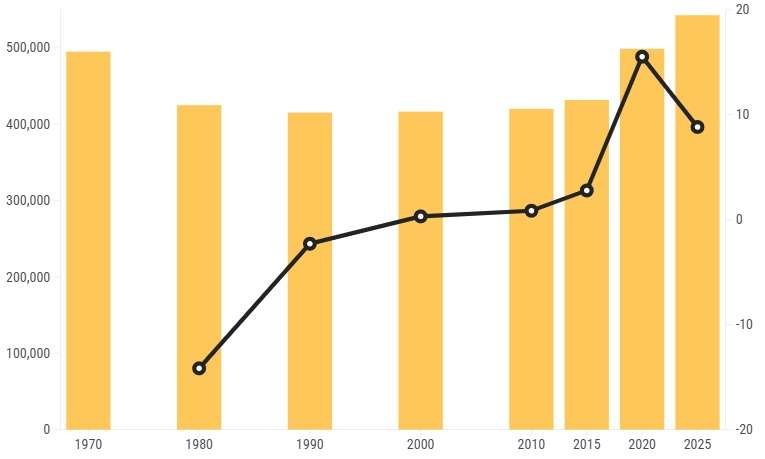
Between 1990 and 2025, Atlanta’s population grew an average of 2.2% every five years, according to an SAN analysis of data from the Atlanta Regional Commission, a regional planning organization that tracks trends for the city and surrounding counties. The city’s most rapid growth occurred from 2015 to 2020, during which the number of residents increased by 15.5%, or 67,015 people. The city is no stranger to population losses, as its worst was by 4.84% from 2000 to 2005, when it lost 20,163 residents.
Ann Carpenter, head of research and analytics at the commission, told SAN her team reviews results of the decennial census and then uses information about new homes being built to calculate a weighted population change.
On an annual basis, the growth looks more incremental. Data from the Census Bureau’s annual population estimates showed that Atlanta’s growth slowed from 1.5% between 2021 and 2022 to 1.3% from 2023 to 2024.
John Floresta, chief strategy and accountability officer at the Cobb County School District, which serves 100,000-plus students in the Atlanta metro, told SAN that he believes the stalled national birth rate is the cause. According to the Federal Reserve Bank of St. Louis, the national rate has been falling since 2007 with a small spike in 2021.
“Over the course of the last five years or so, we have seen a stable birth rate across the county,” he said.
Yet even as the birth rate has held steady, school enrollment has decreased in Cobb County. The number of incoming kindergarteners has dropped from 7,720 students six years ago to 6,803 as of March 6, according to Georgia Department of Education enrollment data.
Despite it, people have relocated from the city’s confines to the suburbs where they can access more land for as much, sometimes less, than what they pay in Atlanta. The movement hit cities across the nation for decades. This urban flight proliferated during the COVID-19 pandemic, as places like Atlanta accepted more multifamily developments to accommodate a rising population, pushing single-family homes to the suburbs.
What’s led to the growth?
Lloyd Potter, professor of sociology and demography at the University of Texas at San Antonio, told SAN that cities often see more people move in when a transportation system is built. That happened in places like Knoxville, Tennessee, Dallas and Houston.
Atlanta followed a relatively steady growth after the 1990s, mimicking the expansion of major companies like Delta Air Lines, UPS, Coca-Cola Company and Equifax. The region became a great place to work: The Atlanta-Sandy Springs-Roswell region had an unemployment rate of 4.9% in 1990 and 3.4% in 2024, according to data from the Bureau of Labor Statistics.
Since 1990, the region has added a net of 45,827 employees. The largest addition was in 2021 when 146,300 people joined the region’s workforce — a rebound after the area saw 142,000 people lose their jobs during the COVID-19 pandemic.
Still, the promise of good jobs helps keep the region humming. At Cobb County schools, Floresta said the district has worked with several businesses to embed staff at Career Innovation and Technology Academy, a magnet high school that focuses on providing students hands-on learning experiences and career opportunities. Through the academy, Floresta said students graduate trained in their industries and could be hired quicker than others.
“Employers are confident that they’re hiring a skilled employee when a graduate walks in their door,” he said.
He added families are noticing the options suburban school districts like Cobb County offer and are either moving to those counties or sending their kids to the districts.
Suburbs enjoy the constraints of Atlanta
Floresta, like Arnau, moved to the Atlanta area nearly 25 years ago. He chose a home in Cobb County, which was growing slowly, starting in the parts neighboring Atlanta.
Soon enough, that development extended up to the city of Marietta, then to the town of East Cobb, over to the city of Kennesaw and down the county’s western side.
That’s evident in the sprawl of building permits the Atlanta Regional Commission has tracked. Its map revealed that single-family housing building permits in 2024 clustered in Forsyth, Gwinnett, Hall and Jackson counties.
Those new homes are likely being filled with younger families, Arnau said.
According to the commission’s yearly population report, the Atlanta Metro’s population grew by 26.3% from 1970 to 1980 and by 34.9% from 1980 to 1990. Gwinnett County experienced the largest jump, exploding from 72,349 residents in 1970 to just over 1 million as of this year.
The commission uses an 11-county region in the population estimates over the Census Bureau’s 29-county metro.
Arnau has noticed a trend of younger people moving out of the city of Atlanta to take advantage of the space a home in the suburbs can offer for their budgets.
“We have a lot of people looking for a large flat backyard,” Arnau said, “and I’m not sure how Atlanta is perceived from the outside, but once you get especially north of the city, there are creeks and rivers and hills and things everywhere.”
The lack of open space in Atlanta has, however, made way for multifamily buildings such as apartments, condominiums and townhomes. The city has approved nearly nine times more multifamily permits than it did for single-family homes in 2024, according to the Atlanta Regional Commission.
It’s the only area in the region with such a large discrepancy between the housing types.
“Some of those rentals are coming at the expense of would-be development for single-family homes,” Arnau said.
Throughout the region, home sales aren’t closing as quickly as they once did, Arnau told SAN. As a result, Arnau deems the area part of a “neutral” real estate market, which means neither buyers nor sellers have an advantage. This has allowed homeowners to stay put for longer as their homes build equity.
And that, in turn, promotes smaller towns to build their own downtown or city center areas to entice people to stay, Arnau said. That’s happened in Alpharetta, where in 2015, leaders created a downtown master plan to address Fulton County’s 365,000-resident increase between 1970 and 2015.
Growth in Atlanta hasn’t stopped. It’s only slowed after years of explosive growth that has become the expectation: People are still moving in and calling it home.
“The future is bright,” Arnau said. “Atlanta will continue to keep growing and we’ll see people continue to want to live here.”
Tristan Peterson (Creative Director) and Devin Pavlou (Digital Producer) contributed to this report.
Please consider supporting open, independent journalism – no contribution is too small!
The Tau Pi Omega Chapter of Alpha Kappa Alpha Sorority, Incorporated hosts “The Power of Our Legacy” on October 25, featuring Jini Thornton’s practical roadmap for financial clarity, organization, and generational wealth transfer.
By Milton Kirby | Stone Mountain, GA | October 22, 2025
The Tau Pi Omega Chapter of Alpha Kappa Alpha Sorority, Incorporated is gearing up for a day-long workshop this Saturday designed to help families take control of their future through intentional planning and organization.
The program, “The Power of Our Legacy (Planning today for tomorrow’s success),” will feature nationally syndicated financial empowerment guru and Certified Public Accountant (CPA) Jini Thornton, whose mission is to make legacy planning simple, approachable, and life changing.
Courtesy – Jini Thornton
“This workshop is about making legacy planning simple,” Thornton told The Truth Seekers Journal in an interview Tuesday. “People focus on wills and trusts, and that’s important. But so much of legacy work has nothing to do with documents. It’s the roadmap—what people need to know and where to find it.”
Thornton said the goal is to help families move from overwhelmed to organized. “When someone gets sick or passes away, who cares if you have documents no one can find?” she said. “Organization is the game-changer.”
The message: organize your life so your love shows up on time
Thornton previewed the workshop’s agenda, which will walk participants through practical, no-cost actions:
Build a “legacy dream team.” Choose people who can carry out real responsibilities, not just relatives by default.
Name who’s in charge and clearly define the roles.
List key contacts. Accountant, realtor, insurance agent, benefits and HR at work, even the handyman.
Document workplace details families often overlook: manager’s name, close co-workers, and benefit elections.
When Thornton’s mother passed away, she said, the entire process ran smoothly because everything was already organized. “I knew who did her taxes. I knew the realtor she wanted to handle the sale of her home. I even knew her handyman,” she recalled. “That clarity gave me space to grieve instead of spending months searching.”
She also stressed that the workshop will empower attendees with simple, immediate steps: designating Payable-on-Death (POD) and Transfer-on-Death (TOD) beneficiaries on accounts, and updating life insurance and retirement plans. “You don’t need a lawyer or money to start doing this,” she said. “You just need intention.”
Normalizing the hard conversations
Thornton said part of the work is cultural. “For good historical reasons, we learned to hide things,” she said. “But we’ve taken hiding too far. Your loved ones don’t need to know your checking or savings account balances—they need to know where you bank.”
She wants families to bring these discussions into the open before a crisis. “Death is hard,” she said. “Don’t rob your family of the time to be present and grieve by forcing them to search for months.”
Legacy Life Organizer
The Legacy Life Organizer
Saturday’s workshop will also introduce participants to Thornton’s comprehensive workbook, the Legacy Life Organizer, a tool that provides prompts, checklists, and conversation starters for managing critical information. It’s meant for both individuals and those helping parents or grandparents get organized. A purchase link for the guide will be made available after the event.
Practice what you preach
Thornton’s own company, Envision Business Management Group, embodies the same discipline and organization she advocates. With a staff of 12, she leverages professional networks and trusted partners to maintain efficiency and confidentiality for her clients.
“Jini practices what she preaches.” Her firm relies heavily on reputable consultants and payroll companies to manage transactions and data securely. “Any of my clients who have employees,” Thornton said, “we ensure every person is paid on time, every time, by leveraging payroll services. It keeps operations smooth, protects client privacy, and makes sure employees are taken care of.”
Envision operates as a true fiduciary for its clients. “All of their revenue is collected by us,” Thornton explained. “We handle the payments, the bills, the reporting — everything. That way, clients can focus on what they do best while knowing their finances are protected.”
Trusted by the best
When asked if she could share the names of any clients, Thornton was cautious — but did mention one. “I’ve worked with Ludacris for many years,” she said. “We earned each other’s trust a long time ago, and he remains one of our thriving clients today.”
Thornton is quick to deflect credit for his financial success. “I don’t take credit for anyone’s accomplishments,” she said. “But I do know our firm provides road maps and feedback that have helped our clients make excellent financial decisions.”
Intentional wealth transfer in Black communities
For Thornton, legacy planning is deeply personal. Adopted by a single mother in 1969, she grew up in a home that valued independence and preparation. “My mom was committed to empowerment,” she said. “When she passed, everything was in order. I didn’t have to chase paperwork — she left me space to grieve.”
That experience drives her message today. “We work so hard,” she said. “We must be intentional about transferring what we have — no matter how much it is. You don’t have to be Oprah to have something to transfer.”
Sidebar: What Attendees Will Do This Saturday
Create a Legacy Dream Team with clear roles and backups
Compile a master contact list (tax preparer, realtor, insurance, HR, trusted trades)
Record workplace details (manager, HR contact, benefits)
Set POD/TOD designations on accounts
Update beneficiaries on life insurance and retirement plans
Centralize all key information in one secure place
Sidebar: Conversation Starters at Home
“If something happened, who should we call first at work?”
“Which bank and branch do you use?”
“Who handled the last insurance claim?”
“Who’s your tax preparer or Certified Public Accountant?”
October marks 40 years of Breast Cancer Awareness Month. Know the signs, close the gaps, and act early. Every story is unique. Every journey matters. Get screened
By Milton Kirby | Decatur, GA | October 19, 2025
Why This Month Still Matters
This October marks 40 years of Breast Cancer Awareness Month — four decades of breakthroughs, bravery, and a global pink movement.
The 2025 theme, “Every Story Is Unique, Every Journey Matters,” is both a reflection and a rallying cry. Behind every pink ribbon is a story of survival, strength, and ongoing struggle.
According to the National Cancer Institute (NCI), breast cancer remains the most common cancer among women in the United States. About 316,000 new invasive cases are expected this year. Earlier detection, modern therapies, and awareness campaigns have improved survival rates, saving over half a million lives since 1989.
Understanding Breast Cancer
Breast cancer begins when cells in the breast grow out of control. Most cases (70–80%) start in the milk ducts, while others begin in the lobules (10–15%).
When cancer spreads into nearby tissue, it becomes invasive breast cancer. If it reaches distant parts of the body — such as the lungs, liver, or bones — it becomes metastatic breast cancer (MBC).
Today, about 170,000 women in the U.S. live with MBC. Though not curable, it can be managed with targeted therapies and compassionate care. Organizations like Susan G. Komen, Breastcancer.org, and the National Breast Cancer Foundation offer trusted information and support networks for patients and caregivers.
When Breast Cancer Affects Men
Breast cancer in men is rare — less than 1% of all cases — but it does occur. The lifetime risk is about 1 in 1,000 for men, compared with 1 in 8 for women. Symptoms include a painless lump, nipple changes, or redness.
The Breast Cancer Research Foundation (BCRF) notes that men are often diagnosed later because they’re less likely to recognize the signs.
Black men have the highest incidence and mortality rates, a disparity that experts say demands greater awareness and screening equity.
Inflammatory Breast Cancer: Fast and Fierce
Inflammatory breast cancer (IBC) represents 1–5% of all diagnoses and is one of the most aggressive forms. It typically appears as redness or swelling rather than a lump. According to the NCI, IBC progresses rapidly and is more common among younger and African American women.
Treatment involves a multimodal approach — chemotherapy, surgery, and radiation. Foundations like the Dr. Susan Love Research Foundation and Lynn Sage Cancer Research Foundation are leading targeted studies to better understand and treat this form of the disease.
The Power of Progress
Since 1989, U.S. breast-cancer deaths have declined 44%, according to the National Breast Cancer Foundation, Inc.
That progress reflects improved screenings, expanded research, and the courage of survivors who share their stories. Still, racial and economic disparities persist — Black women are 40% more likely to die from breast cancer than white women. Closing that gap remains a central goal of the awareness movement.
Screenings Save Lives
Early detection changes everything. The American Cancer Society and Living Beyond Breast Cancer (LBBC) recommend individualized screening schedules based on age and risk.
Know the signs:
New lump or thickening in the breast or underarm
Change in breast shape or size
Dimpling, puckering, or redness
Nipple inversion or unusual discharge
Pain or swelling in the breast or chest
A Survivor’s Voice: “It’s Going to Be Alright”
For Beverly, a 24-year breast cancer survivor from North Carolina, Breast Cancer Awareness Month is far more than an annual observance — it’s a celebration of endurance, faith, and family.
She was first diagnosed in 2002 at just 48. “The mammogram caught it early,” she recalled. “I was afraid of everything — the diagnosis, the treatment, the unknown.” Before surgery, she remembers hearing her late grandmother’s voice say softly, “It’s going to be alright.”
“When I told my mother, who had also survived breast cancer, she said, ‘That’s nothing,’” Beverly laughed, remembering that first round of treatment. “My family has lived this — my mother, grandmother, my aunt, who’s now less than 30 days from 85 years strong, and even my great-grandfather. We’ve all faced it.”
Twelve years later, Beverly discovered a small lump under her arm. “I was just looking and feeling my armpits when I noticed it,” she said. “It had come back — same side, left side.” Her oncologist confirmed the cancer had returned in her lymph nodes.
This time, the treatment was more aggressive — chemotherapy, radiation, and years of medication. She credits her husband, Ted, as her constant support. He’s been my listener, my quiet presence, and my driver. When I didn’t need words, he just stayed close — and he’s become an expert tea brewer” she smiled.
One of her hardest moments came when she had to tell her then nine-year-old son. “He saw the calls and cards and said, ‘I hope you don’t have cancer.’ That opened the door for us to talk openly — to face it together.”
It has now been ten years since Beverly completed her second bout with breast cancer, including the aggressive treatment and follow-up medication regimen. This past August, her care team finally permitted her to discontinue the inhibitors.
Since that first diagnosis, Beverly has made gratitude and wellness her daily focus. “Every day, I try to live with intention and thankfulness,” she said. “Even on tough days, I remind myself: I’m still here — and that’s reason enough.”
The 10 Screenings Women Should Know
(Source: National Breast Cancer Foundation, Inc.)
Health Screening
Who Needs It
Why You Need It
Well-Woman Exam
Women 18+
Preventive check-up for overall and reproductive health.
Breast Cancer Screening
Women 40+*
Mammograms detect breast cancer early, when treatment is most effective.
Cervical Cancer Screening
Women 21+*
Detects abnormal cervical cells before they become cancerous.
Colorectal Cancer Screening
Women 45+*
Identifies and removes precancerous polyps to prevent colorectal cancer.
Lung Cancer Screening
Women 50+* at high risk
Detects lung cancer early, when it’s most treatable.
Skin Cancer Screening
Women at high risk*
Detects early skin cancers for prompt treatment.
Cholesterol Screening
Women 40+* (can start in 20s)
Detects high cholesterol linked to heart disease and stroke.
Blood Pressure Screening
Women 18+*
Identifies hypertension, a leading risk for heart attack and stroke.
Diabetes Screening
Women with risk factors*
Detects diabetes or prediabetes before symptoms appear.
Bone Density Screening
Women 60+*
Measures bone strength to prevent fractures and osteoporosis.
Certain factors such as family history, prior cancer, gene mutations, or other risks may require earlier or more frequent screenings. Always consult your healthcare provider for personalized recommendations.
Beyond Medicine: The Human Side of Healing
A breast-cancer diagnosis tests both body and spirit. Emotional and financial support are vital. CancerCare offers free counseling and grants. Living Beyond Breast Cancer connects survivors through education and peer support. Clinical partners like Medpace Oncology continue advancing therapies to improve quality of life worldwide.
Research and Clinical Trials
Clinical trials are shaping the future of breast cancer care. The National Cancer Institute Clinical Trials Database lists open studies nationwide. Participation helps move science forward — for patients today and those yet to be diagnosed.
Every Story Matters
From lab breakthroughs to late-night conversations in waiting rooms, every act of awareness is an act of care.
This October, honor the survivors, remember the lost, and encourage someone you love to schedule their screening. Because after 40 years, the message still holds true: every story is unique, every journey matters.
Thousands marched from Atlanta’s Civic Center to the State Capitol in the nationwide “No Kings” protests opposing Trump-era policies and calling for renewed democratic accountability
By Milton Kirby | Atlanta, GA | October 18, 2025
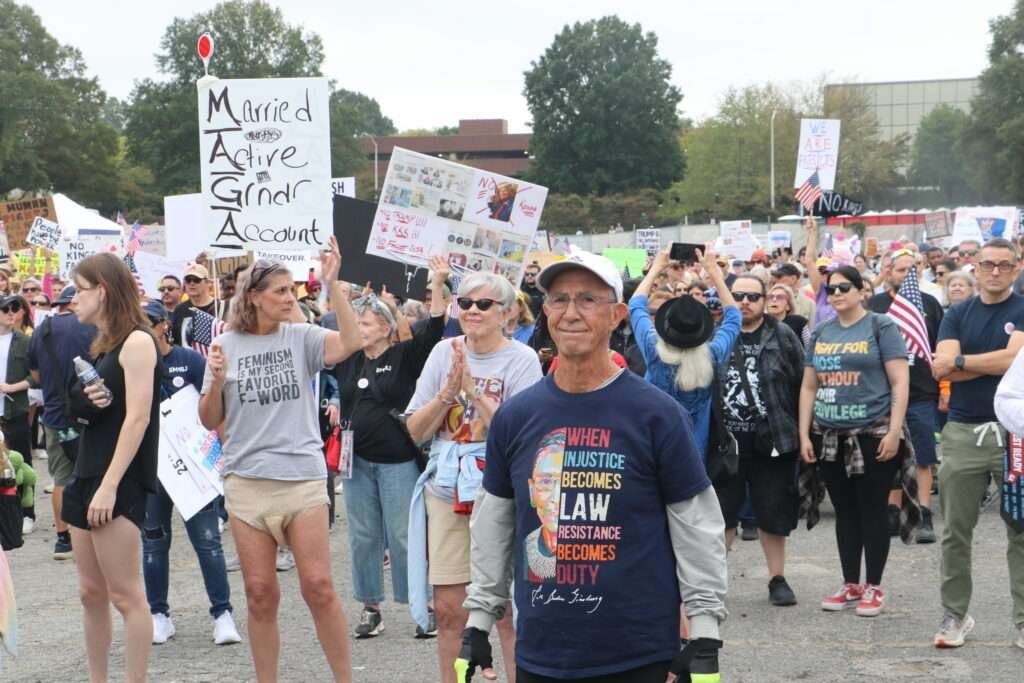
Thousands of demonstrators filled downtown Atlanta on Saturday for the city’s third “No Kings” protest of the year — part of a nationwide wave of rallies opposing what organizers describe as authoritarian overreach by the Donald Trump administration.
The march began at the Atlanta Civic Center, where an estimated 15,000 to 20,000 people gathered before marching roughly 1.2 miles to the Georgia State Capitol. Participants carried handmade signs, waved flags, and chanted slogans like “We the People Will Rule.” The phrase — central to the “No Kings” movement — represents a rejection of monarchical power and a demand for democratic accountability.
Photo by Milton Kirby – Atlanta Civic Center
A Peaceful, Powerful Day
City officials confirmed permits had been issued for the event and described the protest as a peaceful and safe gathering. Atlanta police reported no arrests or major incidents. The atmosphere, witnesses said, felt part rally, part block party, providing a sense of security to the participants and the public.
Senator Raphael Warnock (D-GA) addressed the crowd, urging attendees to “stand firm for democracy” and condemning recent remarks by President Trump to military leaders. Other speakers focused on a wide range of issues, from immigration and voting rights to local housing concerns, providing a comprehensive understanding of the societal challenges being addressed.
Part of a National Movement
Saturday’s demonstration was one of more than 2,700 “No Kings” events held across the United States — and even abroad — with organizers estimating nearly seven million total participants. In Georgia alone, at least 35 affiliated protests were reported in cities including Athens, Marietta, Gainesville, Rome, and Tucker.
The Tucker rally drew roughly 8,000 people, beginning at the Lavista Festival Shopping Center and looping across the I-285 overpass. Congressman Hank Johnson (D-4) addressed that crowd, telling participants, “This is what democracy looks like — people standing up together, not bowing down to power.”
Protest Against Policies and Shutdown
The “No Kings” movement, which has its roots in protests that began earlier this year, is primarily focused on opposing Trump-era policies related to immigration, education, and health care, as well as environmental rollbacks and ICE raids. The latest wave of demonstrations came amid a prolonged federal government shutdown, with Congress deadlocked over funding and the administration facing growing criticism over governance paralysis.
Despite partisan tensions — with some Republican officials labeling the events “Hate America rallies” — major cities reported largely peaceful gatherings and no widespread disruptions.
A Growing Coalition
The Atlanta rally was organized by a coalition of grassroots organizations, including Indivisible Georgia, the ACLU of Georgia, and the 50501 Movement. These groups, along with many others, have come together to express their deep concern about democratic backsliding and civic erosion.
“We need to use the rights we still have to bring our voices together,” one demonstrator told The Truth Seekers Journal. “We can’t let fear or fatigue silence us.”
DeKalb residents packed the Porter Sanford Center to learn how data centers impact energy, water, and community life—and what new policies could mean for local neighborhoods.
By Milton Kirby | Decatur, GA | October 17, 2025 (Updated October 21, 2025)
On Wednesday evening, a packed house at the Porter Sanford III Performing Arts & Community Center bore witness to an important community discussion: the town hall event titled “Helping Residents Understand Data Centers”, hosted by DeKalb County Government in collaboration with County CEO Lorraine Cochran Johnson, Commissioner Mereda Davis Johnson and Commissioner Dr. LaDena Bolton. The goal — to shed light on data-center development across metro Atlanta and engage residents directly in shaping policy and zoning.
In her opening remarks, CEO Cochran Johnson emphasized the event’s purpose: “Our goal is to ensure residents have access to accurate information and can engage in meaningful discussion before decisions are made,” she said, stressing that the conversation was “about education, transparency, and community understanding.” With the meeting also live-streamed on DCTV to reach broader audiences, it underscored the County’s intention to leave no stone unturned.
The timing is telling. In July the DeKalb County Board of Commissioners approved a temporary moratorium on new data-center approvals, citing the need for deeper research, policy development and public engagement — extended recently through December 2025. The town hall forms part of that process: a chance for residents to hear from experts directly, ask questions, weigh the potential benefits and pitfalls of data-center development in their communities, and help shape the regulatory framework that will guide what comes next.
Photo by Milton Kirby – DeKalb CEO Lorraine Cochran-Johnson
What is a data center—and why does it matter?
It may sound technical, but the concept is clearer when you break it down. A data center is fundamentally a physical facility where computing equipment, storage systems, networking gear and infrastructure are housed to store, process and manage data and applications. According to Cisco Systems, “at its simplest, a data center is a physical facility that organizations use to house their critical applications and data.” This includes the servers, storage drives, routers and switches, firewalls, as well as the power, cooling and backup infrastructure that keeps everything running — often 24/7.
In practice, the modern facility is an industrial-scale enterprise. It might host cloud-computing platforms, serve as the backbone for AI and machine-learning workloads, support massive “hyperscale” operations (for companies like Google, Amazon, Microsoft) or even serve as regional hubs, connecting telecommunications infrastructure.
Because nearly every service you use—online banking, streaming video, storing and sharing images, remote work, emergency services—runs through some portion of this infrastructure, data centers are essential to our digital lives. They are the silent—but massive—buildings behind the scenes.
As the panel at the Porter Sanford meeting made clear, the reason data centers are increasingly under scrutiny is that, while they provide digital backbone benefits, they also raise real questions about land use, infrastructure stress, environmental impact, community equity and local benefits.
The Town Hall Discussion: Experts, Residents & Real Questions
To assist residents and officials in considering these questions, the County brought together an array of specialists:
Demond Mason of Newton County
Shane Short of the Walton County Development Authority
Ahmed Saeed of Georgia Tech
Céline Benoît of the Metropolitan North Georgia Water Planning District
Danny Johnson of the Atlanta Regional Commission
Juliana Njoku of DeKalb’s Department of Planning and Sustainability
Under the guidance of CEO Cochran Johnson, the panel addressed core topics such as: energy and water use; required infrastructure (power grid, water, cooling, fiber and roads); economic impact and job creation; community benefit and quality-of-life concerns; and the evolving role of data centers in a world of AI, cloud computing and remote everything.
Residents asked pointed questions: how many jobs will actually be created? Will their electricity bills go up? What about the noise, the land-use conversion, the water demand? Many admitted they came to the event unsure of how a data center operates yet left with a clearer understanding of the mechanics and implications.
The Upsides: Why Data Centers Can Be Good for Local Communities
During the discussions, several clear benefits emerged.
Economic development and tax revenue Data-center construction can bring substantial investment into a region. Some counties have seen increased property values, boosted infrastructure spending, and attraction of technology-sector ecosystem growth. The panel cited examples such as Loudoun County in Virginia, where data-centers supported these spill-over benefits.
Infrastructure-upgrade spillover Because data centers require robust utilities—electricity grids, fiber-optic networks, road access—they can serve as catalysts for broader infrastructure improvements that benefit whole communities: better broadband, improved roads, enhanced power reliability.
Foundational digital backbone As noted above, data centers are critical for cloud computing, artificial intelligence, digital entertainment, remote work, telehealth and emergency services. Local proximity to such infrastructure can help position a region for the future economy.
Community partnership opportunities Some operators are increasingly conscious of their role as community partners: training programs, community benefit agreements, technological access, local hiring efforts. When these partnerships are handled proactively, the hosting community sees more than just a facility in its backyard.
In short: with the right planning, regulation and transparency, a data-center project can be more than an industrial site—it can become an asset for a community.
The Concerns: Real Risks that Need Guarding Against
However, the discussion also surfaced multiple legitimate concerns—several of which resonated with many residents.
Massive energy consumption Data centers are extremely energy intensive. Analysts project that U.S. data-center power demand could triple by 2030 if current trends continue, driven in large part by AI workloads. That means pressure on local grids, higher utility infrastructure costs, potential for increased electricity costs for residents, and stronger reliance on fossil-fuel generation in some cases.
High water usage and cooling demands In many facilities, water is used for cooling (evaporative systems, cooling towers). One study found that a single 100-megawatt data center could use up to two million liters (more than half a million gallons) per day in water-stressed regions. In drought-prone areas this becomes a key local water-resource risk.
At the town hall, panelists explained that not all data centers cool the same way. Some rely on open, or free-flowing, water systems—in which water continuously cycles through equipment and then exits the facility, often as warm discharge into municipal systems. While cheaper to build, these systems consume far more water and can increase strain on local supplies.
By contrast, closed-loop cooling systems recirculate water within sealed pipes or tanks, losing only small amounts through evaporation. Though more expensive upfront, they dramatically reduce total water consumption and are now considered a best practice in water-sensitive areas. Experts noted that some advanced centers are moving toward hybrid or air-cooled designs that reduce or eliminate water use entirely.
Understanding which system is being proposed for any new facility, several panelists said, should be one of the first questions local residents and zoning boards ask. “The type of cooling system tells you a lot about the facility’s environmental footprint,” one expert explained. “A closed-loop system signals a commitment to sustainability.” These distinctions matter deeply for regions like metro Atlanta, where droughts and high summer demand already put pressure on shared water resources.
Pollution, noise and land-use impacts
Backup diesel generators, used for power outages and often regularly tested, release pollutants (particulate matter, nitrogen oxides) that affect air quality and health, particularly in nearby communities. (businessinsider.com)
Noise from cooling fans, servers, power infrastructure and HVAC systems can disturb neighborhoods. One source put it this way: “It’s like being on a tarmac with an airplane engine running constantly … Except that the airplane keeps idling and never leaves.” (en.wikipedia.org)
Large data-center campuses require significant land—sometimes in competition with housing, agriculture or conservation. Zoning change and land-use conversion may alter neighborhood character and environmental justice concerns.
Job and benefit-share questions While data-center construction may bring many temporary jobs, once operational the facility often requires relatively few permanent employees (security, maintenance, facility management). Critics argue that the number of long-term, well-paid jobs may be low compared with the scale of incentives offered and the local infrastructure costs borne.
Infrastructure and regulatory burdens Upgrading the local power grid, improving transmission lines, reinforcing water systems, may require large investments—sometimes partially funded by local utility customers. Without strong policy frameworks, the host community may bear disproportionate share of cost or risk. There is also concern that data centers are sometimes located in communities that already face higher pollution burdens—raising environmental-justice flags.
Unequal distribution of benefits and burdens Some research suggests that while benefits concentrate (large corporations, landowners, utility companies), many of the burdens (environmental impact, utility cost increases, land conversion) fall on less-advantaged communities. (businessinsider.com)
What the Experts Emphasised: Keys for DeKalb County to Watch
From the town-hall panel, several watch-points and recommendations stood out.
Promised local benefits must be specific and enforceable. What are the actual jobs, training programs, property-tax contributions, community-benefit agreements?
Who bears the costs? Not just jobs and tax revenue, but what about added strain on the grid, water usage, infrastructure upgrades, noise mitigation, environmental monitoring?
Transparency, community engagement and ongoing monitoring. Projects must not just be approved and forgotten; ongoing oversight, community liaison and impact measurement matter.
Strong regulatory framework. Zoning, environmental review, utility oversight, noise/air-quality mitigation—all must be in place before large-scale approval.
Local context matters. The impact varies depending on water-stress region, grid capacity, land-use pressures, community vulnerability, equity considerations. A data center in one region can be far more challenging than in another.
Balance of economic opportunity and sustainability. It’s not simply “data centers good = jobs”; the full spectrum of benefits, burdens and trade-offs must be weighed.
Back to DeKalb: What Happens Next
For DeKalb County, the town hall was a milestone in a broader process. With the moratorium in place through December 2025, county staff, planners and officials will be synthesizing resident input, expert findings, fiscal and infrastructure impact studies, and crafting zoning and operational standards tailored for data-centers. Residents were encouraged to stay engaged: future meetings, updates and resources will be posted through official County channels.
Many attendees left the event expressing appreciation. One resident noted that she had arrived “not sure how a data center worked or why we should care” but departed with “a much clearer understanding of the issues, the trade-offs, and what questions I now want to ask.” Another stressed the importance of “making sure our neighborhood doesn’t get the downsides while someone else reaps the benefits.”
In the coming months the County will need to reconcile competing priorities: attracting investment and economic opportunity, preserving infrastructure capacity, protecting environmental and community health, ensuring fairness and equity, and shaping land use in a way that serves residents’ interests.
Final Thoughts: A Balanced Outlook
Data centers are undeniably a critical part of the 21st-century digital economy. They support cloud services, remote work, streaming, AI, healthcare, financial systems — indeed, much of modern life. If well-located, well-regulated and community-integrated, they can bring growth, infrastructure upgrades and strategic advantage to a region.
But the side-effects are non-trivial. Massive power draw, high water usage, potential air-quality and noise impacts, infrastructure cost burdens, limited long-term job gains, and land-use conversion all demand thoughtful planning and hard questions. The research is clear: impacts vary greatly depending on region, regulatory strength, benefit-sharing and community engagement. For example, while global studies show data centers may account for over 1 % of global electricity use currently and could double in the next few years, localized effects on utility grids, water systems and neighborhoods can be acute.
For DeKalb County, the next phase is crucial. The conversation has begun; now comes the work of translating dialogue into policy. The County will need to ensure that the benefits of any data-center project genuinely accrue to residents, that the costs are clearly allocated, and that long-term quality of life—environmental, infrastructural, social—is protected.
As CEO Cochran Johnson said in her opening remarks: this is about education, transparency, and community understanding. The residents of DeKalb have signalled they intend to be part of the process — and the success of future data-center development will depend on that engagement being genuine, sustained and meaningful.
In the end, the question isn’t simply whether to approve data centers—it’s how, under what terms and with what safeguards such a facility sits in a community. If DeKalb County can insist on rigorous criteria, clear community benefits, and strong oversight, it may capture the promise of 21st-century digital infrastructure while avoiding its pitfalls. The town hall was a strong first step in that direction.
Early voting in Georgia runs through November 1, with local and statewide races on the ballot, including mayoral and Public Service Commission elections.
By Milton Kirby | Decatur, GA | October 14, 2025
Early voting began today in Georgia and in several states across the country, marking the start of a critical three-week stretch before the November 4th General Election.
In DeKalb County, residents can now cast ballots for a range of key races — from statewide offices to local leadership posts that will shape the future of communities across metro Atlanta.
On the ballot this year is the Statewide Special Election for the Public Service Commission, along with municipal general elections in numerous cities, including Atlanta, Avondale Estates, Brookhaven, Chamblee, Clarkston, Decatur, and Doraville.
Atlanta voters will select a Mayor, City Council President, City Council members, Board of Education representatives, and Municipal Court Judges. These races are expected to draw strong turnout as city leaders continue to navigate housing affordability, infrastructure expansion, and public safety reform.
Election officials across Georgia are encouraging voters to take advantage of early voting to avoid long lines on Election Day. Polling places and sample ballots are available through the state’s My Voter Page.
Georgia’s 17-day early voting period will run through Friday, November 1, with mandatory Saturday voting in every county.
This year’s election season arrives as lawmakers and advocacy groups continue to debate possible adjustments to Georgia’s early voting laws — a discussion that could shape voter access and participation for years to come.
Please consider supporting open, independent journalism – no contribution is too small!
Arthur M. Blank Family Foundation will invest $50 million over 10 years to help nearly 10,000 Atlanta HBCU students complete degrees through need-based “gap scholarships.”
The initiative, beginning in 2026, aims to close financial gaps that often prevent students from completing their degrees. The foundation estimates the funding will help nearly 10,000 students earn their diplomas over the next ten years.
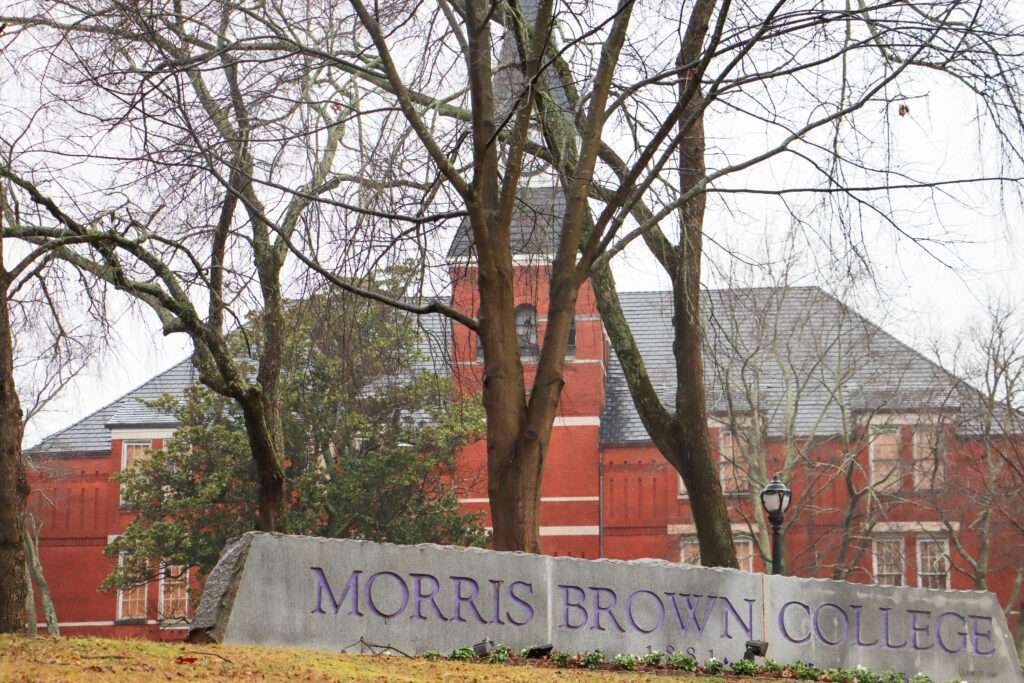
Photo by Milton Kirby Morris Brown College
“These grants are a material investment in hope,” said Fay Twersky, president of the foundation. “Our goal is to help more students earn their degrees, launch successful careers, and become alumni who give back — creating a cycle of opportunity that benefits young people and communities across the nation.”
Closing the Financial Gap
Each of the four institutions will distribute the funds independently. Clark Atlanta, Morehouse, and Spelman are expected to receive about $16 million each, while Morris Brown, which currently enrolls about 350 students, will receive a smaller share.
Scholarship awards will range from $500 to $10,000, depending on financial need. The funds will primarily support juniors and seniors in good academic standing who have exhausted all other sources of aid, including federal Pell Grants, state programs, and loans.
A Legacy of Giving
Founded in 1995 by Arthur M. Blank, co-founder of The Home Depot and owner of the Atlanta FalconsandAtlanta United, the foundation has donated more than $1.5 billion to date. Blank, who has signed The Giving Pledge and holds a net worth of more than $11 billion, has long focused his philanthropy on education, health, and community development.
Past contributions to historically Black colleges and universities (HBCUs) include$10 million for the Arthur M. Blank Innovation Lab at Spelman College; $6 million to improve athletic fields at Clark Atlanta, Albany State University, Miles College, and Savannah State University; $3 million to help Morris Brown digitize a hospitality credential; and $400,000 for Morehouse College’s golf program and new football helmets at both Clark Atlanta and Morehouse.
Broad Economic and Social Impact
According to the foundation, Atlanta’s HBCUs collectively contribute more than $1 billion annually to the region’s economy and outperform other institutions in helping students from lower-income families move into higher-income brackets.
“This monumental investment will empower our students to remain focused on their academic studies and ensure that their talent, ambition, hard work, and integrity — not financial hardship — will determine their futures,” said Dr. F. DuBois Bowman, president of Morehouse College.
Rooted in Values
Blank traces his philanthropic philosophy to his mother, Molly Blank, who taught him the Jewish principle of tikkun olam — repairing the world through kindness. “You only pass through life once, so make it count,” she often told him — words that continue to shape the foundation’s mission.
The Arthur M. Blank Family Foundation, headquartered in Atlanta, supports initiatives across Georgia and Montana, as well as programs for veterans, mental health, democracy, youth development, and environmental sustainability. Its leadership reaffirmed in 2023 a commitment to accelerate philanthropy over the next decade to address urgent social challenges.
Through strategic giving and community engagement, the foundation continues to embody its founder’s guiding principle: repair the world, one opportunity at a time.
MARTA closes Five Points’ Peachtree entrance October 13 as part of its $230 million transformation to enhance safety, connectivity, and community space in downtown Atlanta.
By Milton Kirby | Atlanta, GA | October 12, 2025
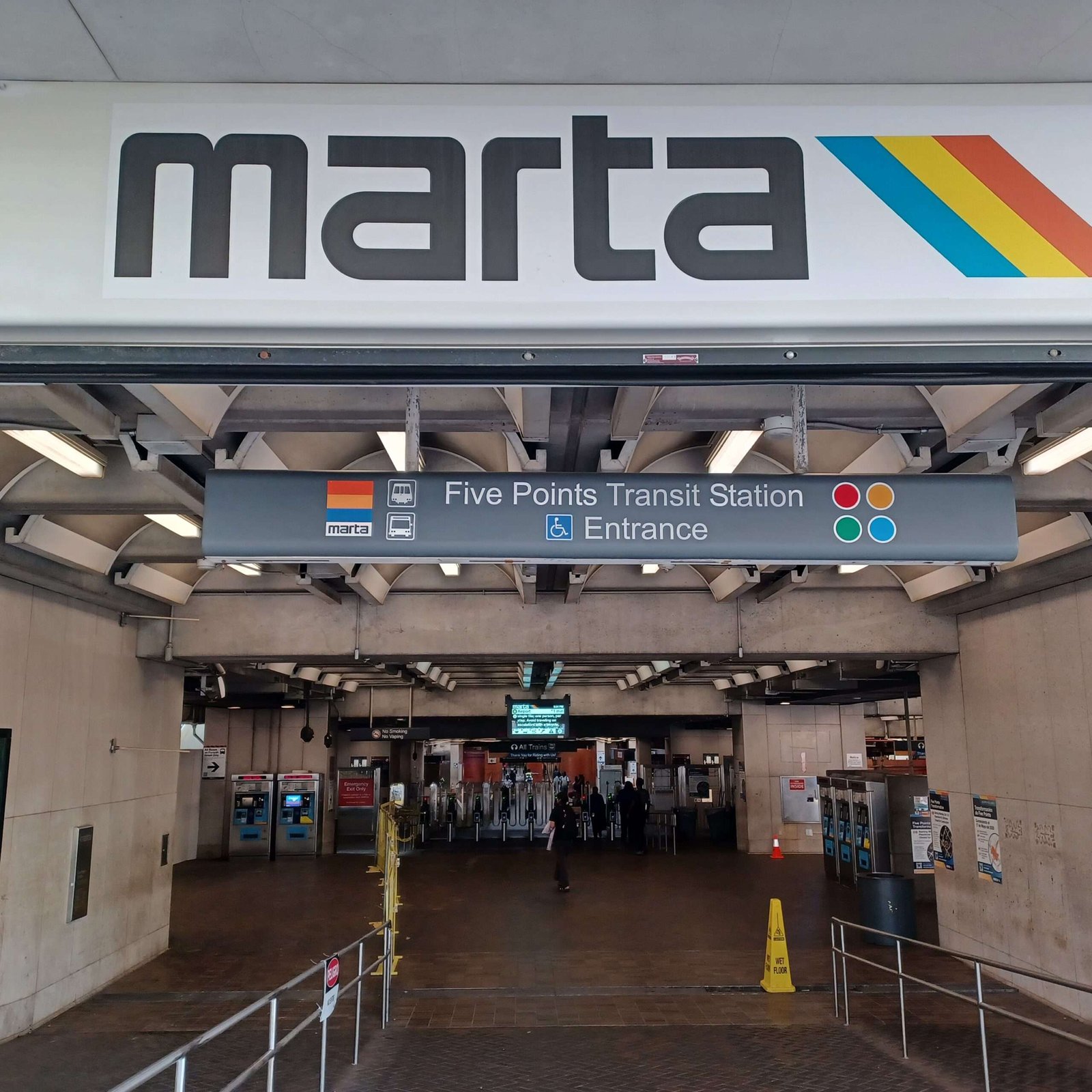
The Metropolitan Atlanta Rapid Transit Authority (MARTA) will take another major step in its ongoing Five Points Station transformation project this Monday, October 13, as crews close the Peachtree Street entrance and the federal employee tunnel to prepare for demolition of the concrete canopy.
Starting October 13, all passengers will need to use the Forsyth Street entrance, which will serve as the only access point to the city’s central transit hub during this phase of construction.
What Riders Need to Know
The following service changes remain in place:
Alabama Street and Broad Street Plaza entrances remain closed.
Restrooms are closed.
Customer service offices have temporarily relocated and will eventually reopen at Ashby Station.
All bus routes continue boarding on Forsyth Street.
Rail service and transfers remain unchanged.
Elevators will stay open for passenger access and transfers.
While elevators will continue to operate, riders should expect temporary escalator and stair closures in the coming weeks as MARTA crews install scaffolding and overhead protection. Signs will be posted throughout the station to direct customers during the transition.
A $230 Million Rebuild in Motion
MARTA officials describe the closure as a key step toward transforming Five Points into a modernized, vibrant city center with improved transit connectivity, enhanced safety, and expanded community spaces.
The first phase involves removal of the aging concrete canopy, followed by the construction of a new, open-air canopy designed to brighten and expand the station. Later stages will include a centralized bus hub, a new pedestrian connection to Broad Street, and community-oriented features such as public art and urban agriculture spaces.
The total project cost is estimated at $230 million, funded primarily through the More MARTA Atlanta half-penny sales tax, with additional support from a $25 million Federal RAISE Grant, $13.8 million from the state of Georgia, and the MARTA core penny.
MARTA says the upgrades are aimed at strengthening the system’s role in downtown revitalization while improving daily experiences for thousands of riders.
For updates and construction details, visit itsmarta.com.
By Milton Kirby | Birmingham, AL | October 12, 2025
The National Black Farmers Association (NBFA) will convene its 2025 Annual Conference in Birmingham, Alabama, from October 31 to November 1, uniting farmers, policymakers, and civil rights advocates from across the country for two days of education, empowerment, and strategy.
This year’s theme focuses on building capacity and identifying resources for small-scale, limited-resource, and socially disadvantaged farmers, ranchers, and landowners. The conference’s hands-on training sessions and educational workshops are designed to provide practical tools, proven techniques, and access to vital programs that strengthen the economic resilience of Black farmers and rural communities.
Prominent Voices in Attendance
Among the confirmed attendees are civil rights attorney Ben Crump, NBFA President John Wesley Boyd Jr., and Kara Brewer Boyd, the organization’s First Lady and national outreach coordinator.
John Boyd Jr., a fourth-generation farmer, civil rights activist, and founder of the NBFA, lives in Boydton, Virginia, with his wife Kara. He operates a 1,500-acre family farm cultivating soybeans, corn, wheat, and produce, while raising beef cattle, American Guinea Hogs, Nigerian Dwarf goats, and chickens.
A lifelong farmer and advocate, Boyd spent 14 years as a Perdue Farms breeder and many more as a tobacco farmer before forming the NBFA in the early 1990s. His leadership has brought him to the table with national and international agricultural leaders, working to eliminate discrimination in federal farm programs and expand opportunities for underserved farmers. Boyd’s story has been featured in the History Channel docuseries The American Farm, chronicling his fight to sustain his family’s land against the odds.
Conference Highlights
Hosted at the Birmingham–Jefferson Convention Complex, the 2025 event celebrates the 35th anniversary of the NBFA’s founding. Over two days, attendees will participate in sessions focused on climate resilience, federal lending access, rural broadband expansion, hemp and specialty crops, and youth engagement in agriculture.
Workshops will be paired with a Farm Expo, women’s leadership roundtables, and networking receptions designed to connect attendees directly with USDA officials, lenders, and private sponsors.
“The NBFA has been the voice of our community for 35 years,” said Boyd. “This conference is about more than policy—it’s about passing on the tools and land that sustain us.”
Opportunities and Deadlines
The Annual NBFA Conference offers marketing, exhibitor, and sponsorship opportunities for partners who share its mission to build an equitable agricultural future.
For sponsorship, exhibitor, or advertiser information, contact Kara Boyd at nbfa.kara@gmail.com. Reservation deadline: Tuesday, September 30, 2025.
Uncle Nearest’s receiver plans to sell its Cognac, France château amid questions over asset value, investor stakes, and whether creditors aim to recover—or acquire—the brand itself.
By Milton Kirby | Shelbyville, TN | October 11, 2025
A French Estate on the Market
The court-appointed receiver overseeing Uncle Nearest, Inc. says the company’s French estate—known as Domaine Saint Martin—will be sold to satisfy debt, calling the Cognac property “non-income-producing” and estimating that it would require $15 million to $25 million in new investment to launch a viable product line.
Domaine Saint Martin Signature – Beverage Journal
In a 19-page quarterly report filed October 1, Receiver Phillip G. Young Jr. described the château, vineyards, and related intellectual property as “non-core assets” and confirmed he has already received one offer and two additional inquiries for the French holdings. The report also identified real estate in Martha’s Vineyard and Bedford County, Tennessee among other non-income-producing assets now under review for possible liquidation.
Young’s team has begun domesticating the U.S. receivership order in France, a legal step required before any sale or transfer of the Cognac property. Until a French court recognizes that order, control of the local bank accounts and property remains limited.
The Numbers Behind a Billion-Dollar Brand
Public filings confirm that Uncle Nearest raised more than $220 million from roughly 163 individual investors, with founder Fawn Weaver retaining about 40 percent ownership and 80 percent of voting rights.
Pre-receivership valuations placed the company between $900 million and $1.1 billion—figures drawn from investor briefings and industry profiles that underscore why the brand’s fate now carries implications well beyond a simple debt workout.
The receiver’s report portrays a company that remains operational and cooperative, with employees and management assisting in stabilization efforts. Payroll has been restored, distribution channels reopened, and new product releases are expected this quarter.
Still, the report makes clear that cash flow remains tight, and that lender Farm Credit Mid-America has advanced $2.5 million in emergency funding under a forbearance agreement.
Photo by Milton Kirby Uncle Nearest Trio
Receivership and Race: What the Data Show
Receivership is a court-ordered process in which a neutral third party assumes control of a company to preserve its value for creditors. It differs from bankruptcy in that operations often continue and the goal—at least in principle—is rehabilitation or an orderly sale, not liquidation.
While direct, specific statistics detailing the comparative success rates of minority-owned versus white-owned companies emerging from formal receivership are difficult to find in public reports from universities, banking regulators, or the SBA, there is extensive research highlighting disparities in business outcomes, access to capital, and failure rates that contribute to such financial distress.
General Business Outcome Disparities Research indicates that minority-owned businesses generally start smaller, have lower revenues and profits, and have lower survival rates compared to white-owned businesses—conditions that make financial distress or receivership more likely.
• Closure/Survival Rate: A 1992–1996 study found that the average probability of closure was 26.9% for Black-owned firms, compared to 22.6% for white-owned firms. • Revenue Disparity: Over half of Black-owned businesses have annual revenue below $100,000, compared to only 13% of white-owned firms. • Financial Distress: In 2019, 58% of Black-owned and 49% of Hispanic-owned firms were categorized as financially at risk or distressed, compared to 29% of all small businesses. • COVID-19 Impact: During the pandemic, Black-owned businesses closed at more than twice the rate of white-owned firms.
Disparities in Access to Capital
• Loan Approval Rates: Black-owned firms apply for new funding more often but are approved 19 percentage points less frequently than white-owned firms. • Full Financing Received: Among low-credit-risk applicants, 48% of white-owned, 25% of Latino-owned, and only 46% of Black-owned firms received none of the financing they sought. • Credit Risk Perception: Black-owned businesses are 3–5 times more likely to be labeled “high credit risk.” Only 33% of Black-owned businesses had low credit risk, compared to 72% of white-owned firms.
These statistics were compiled from publicly available research by the Federal Reserve, the U.S. Small Business Administration (SBA), and multiple peer-reviewed academic studies. They have been independently reviewed and summarized by The Truth Seekers Journal for inclusion in this publication.
General Outcomes in Receivership and Bankruptcy
Restructuring and receivership processes tend to lead to one of three outcomes: 1. Successful Emergence/Reorganization (Going Concern) 2. Sale as a Going Concern 3. Liquidation
While specific comparative data are limited, the broader research on capital access and survival rates strongly suggests that minority-owned companies face greater barriers to achieving the more favorable outcomes—successful reorganization or sale as a going concern—due to longstanding inequities in lending, collateral valuation, and investment access.
Assets Under Scrutiny
The Receiver’s First Quarterly Report states plainly that Uncle Nearest’s non-income-producing assets “should be liquidated.” That includes Domaine Saint Martin in France—acquired in 2023 as part of the company’s planned Cognac expansion—and property in Martha’s Vineyard reportedly purchased for $2.25 million through UN House MV LLC.
Industry observers note that the Cognac estate’s sale would unwind the company’s most ambitious international venture—an African-American-owned whiskey label expanding into the ancestral home of cognac production.
What the Receiver Did Not Investigate
In his 19-page report, the Receiver concluded that Uncle Nearest “lacks the ability to make that investment at this time,” referring to the $15–$25 million required to bring the Cognac operation to market.
However, the report does not analyze alternative scenarios—such as whether a strategic capital infusion, investor partnership, or lender-backed financing package could preserve the asset and enhance the company’s value over time.
The Receiver did not address whether a coordinated plan between Uncle Nearest’s ownership and its primary lender, Farm Credit Mid-America, could fund the launch of the Cognac line within a 36-month horizon, potentially transforming a dormant holding into a global revenue stream. Nor does the report estimate the annual cost of maintaining the French estate, or compare that expense against the projected value of an operating Cognac division. These omissions raise a key question: is the sale of the French property a necessary financial remedy—or a missed opportunity to strengthen a billion-dollar brand’s international expansion?
Who We’re Asking Next
As part of The Truth Seekers Journal’s continuing coverage of the Uncle Nearest receivership, we first reached out to Receiver Phillip G. Young Jr. at Thompson Burton PLLC for comment and clarification regarding several key findings in his October 1 report.
Our questions—emailed on October 10, 2025—included requests for information about asset valuations, operating benchmarks, professional fees, and any offers for the company as a whole. As of publication, no response or acknowledgment has been received.
In the coming days, we plan to reach out to additional individuals and organizations connected to the receivership and company operations, including Justin T. Campbell, Counsel for the Receiver, Thompson Burton PLLC; Newpoint Advisors Corporation, financial advisors to the Receiver; Thoroughbred Spirits Group, LLC, operational consultants; Farm Credit Mid-America, PCA, the senior secured lender; Fawn and Keith Weaver, company founders and principal stakeholders; and Tennessee Distilling Group (TDG), Uncle Nearest’s contract distiller and warehousing partner.
These inquiries will focus on valuation methodology, asset strategy, and possible restructuring options—particularly whether viable paths exist for the company to emerge stronger from receivership without selling the French Cognac estate.
If responses are received, The Truth Seekers Journal will publish a dedicated follow-up feature and reader update, continuing our commitment to factual, transparent coverage of this developing case.
More than 1,400 business and civic leaders will gather Thursday, October 16, 2025, to honor Tommy Holder—Chairman and former CEO of Holder Construction—at the Council for Quality Growth’s 36th Annual Four Pillar Tribute. The black-tie-optional gala begins at 6 p.m. with a cocktail reception, followed by dinner and a formal program in the Georgia Ballroom of the Georgia World Congress Center.
The tribute, presented by the Arthur M. Blank Family Foundation, Delta Air Lines, Georgia Power, and Norfolk Southern, recognizes Holder’s lifetime of leadership and civic engagement that has shaped Atlanta’s skyline and business community.
Program Highlights
Governor Brian P. Kemp will share remarks via video, with Atlanta Mayor Andre Dickens delivering the evening’s welcome. The invocation will be offered by the Very Reverend Sam Candler of the Cathedral of St. Philip. Doug Hertz, Chairman and CEO of United Distributors and a 2020 Four Pillar honoree, will serve as master of ceremonies.
Tribute speakers will highlight the event’s guiding values—Quality, Responsibility, Vision, and Integrity—through reflections from:
Beth Lowry, President & CEO, Holder Construction
Donna Hyland, CEO, Children’s Healthcare of Atlanta
Dr. Ángel Cabrera, President, Georgia Institute of Technology
The Very Reverend Sam Candler, Dean, Cathedral of St. Philip
Musical performances will feature a 60-piece Georgia Tech Yellow Jacket Marching Band ensemble and Atlanta-native Slater Nalley, a 2025 American Idol finalist. Other featured speakers include Clyde Higgs, President and CEO of Atlanta BeltLine Inc. and current Council Chairman, and Michael E. Paris, President and CEO of the Council for Quality Growth.
Continuing a 36-Year Tradition
The Four Pillar Tribute has become one of Atlanta’s most prestigious honors, celebrating leaders who embody the Council’s mission of balanced and responsible growth. Each year’s honoree is recognized for upholding the Four Pillars of Leadership—Quality, Responsibility, Vision, and Integrity—principles that mirror Holder’s career and community impact.
Founded in 1985, the tribute event provides a platform for the region to celebrate the individuals whose work advances economic development and quality of life across Georgia.
Press RSVP: Anna Frances Gardner | ag@councilforqualitygrowth.org | 770-813-3388
About the Council for Quality Growth
For four decades, the Council for Quality Growth has championed policies that support responsible development, infrastructure investment, and economic vitality throughout metro Atlanta and Georgia. Its members include leaders from construction, engineering, real estate, and public service who work together to promote balanced growth for future generations. Learn more at www.councilforqualitygrowth.org.
Please consider supporting open, independent journalism – no contribution is too small!
Mayor Andre Dickens appoints Amanda Rhein as Chief Housing Officer and Chatiqua Ellison as Deputy, strengthening Atlanta’s affordable housing and homelessness response.
By Milton Kirby | Atlanta, GA | October 9, 2025
Mayor Andre Dickens has announced a new housing leadership team that is committed to shaping the City’s next chapter in affordable housing, homelessness response, and community development, instilling hope for a better future.
At the top of that team is Amanda Rhein, appointed Chief Housing Officer, effective January 2026. Rhein currently serves as Executive Director of the Atlanta Land Trust, where she has built one of the nation’s most successful community land trust models. Under her leadership, the organization has placed more than 100 homes into trust and has 100 more under development.
Amanda Rhein – Courtesy City of Atlanta
Rhein brings over two decades of experience in equitable development, affordable housing, and community revitalization. She previously led transit-oriented development (TOD) at MARTA, where she redeveloped more than 35 acres of underused surface parking at eight rail stations. Before that, she spent nearly a decade at Invest Atlanta, managing more than 30 projects that generated $3.5 billion in investment for underserved neighborhoods.
A native of Cincinnati, Ohio, Rhein earned a Bachelor’s degree in Sociology from Boston College and a Master of City and Regional Planning from the Georgia Institute of Technology.
“Amanda is a nationally respected leader whose experience, innovation, and track record of execution will serve the city well,” said Mayor Dickens. “With her leadership, we will continue to set national standards for how cities can tackle housing affordability with innovation and compassion.”
Strengthening the City’s Homelessness Response
Joining Rhein is Chatiqua Ellison, appointed Deputy Chief Housing Officer and Senior Advisor to the Mayor on Homelessness. An Atlanta native, Ellison has led several of the City’s most transformative housing efforts — including the Forest Cove Relocation, which successfully moved 193 families into safe, stable homes.
Chatiqua Ellison – Courtesy City of Atlanta
She also oversees the Rapid Housing Initiative, which has already created more than 300 of a targeted 500 quick-delivery homes for unhoused residents, including The Melody, Atlanta’s first container home community.
Ellison earned a Bachelor’s degree in Political Science from Spelman College and a Master of Public Policy in Urban Planning and Policy from Georgia State University’s Andrew Young School of Policy Studies.
Her leadership extends to chairing the City’s Homelessness Taskforce, where she helped establish coordinated encampment closure policies, and to partnering with Invest Atlanta to launch the Grocery Initiative, which expands access to fresh food in underserved neighborhoods and supports projects like The Azalea Market.
A Comprehensive Housing Leadership Team
The new housing leadership team will report directly to Chief of Staff Courtney English, aligning the City’s affordable housing, homelessness, and revitalization goals.
Other key appointments include:
William Tucker, Director of the Housing Innovation Lab, leading creative housing affordability strategies.
Katie Molla, Director of Special Projects, overseeing food access programs and Tax Allocation District implementation.
Colin Delargy, Assistant Director, focusing on housing finance, planning, and policy.
Carolyn Kovar, Assistant Director of Housing Delivery, coordinating affordable housing projects on public land.
Matt Delicata, Senior Real Estate Advisor, specializing in large-scale real estate development.
Chanel Ziesel, continuing as Director of Housing Policy, leading anti-blight and downtown revitalization initiatives.
“This team represents the best housing leadership in the country,” said Dickens. “Together, we’re not just building housing — we’re building pathways to stability, dignity, and opportunity for all.”
By Stacy M Brown | BlackpressUSA Newsiwre | October 9, 2025
Across America, families are being broken not by illness alone, but by the quiet cruelty of denial letters from insurance companies. Patients in crisis are told their care is not medically necessary. Others learn too late that their coverage has been canceled. The denials come swiftly, the appeals take months, and the system often feels rigged against the very people it was built to protect.
A ProPublica investigation revealed just how devastating those denials can be. In North Carolina, Teressa Sutton-Schulman and her husband, identified as “L” to protect his privacy, endured escalating mental health crises. After two suicide attempts in 11 days, Highmark Blue Cross Blue Shield repeatedly denied payment for psychiatric treatment. Hidden on page seven of a denial letter was a single line about a right to an external review. Desperate, Sutton-Schulman filed for that review. An independent physician overturned the insurer’s decision and forced the company to pay for more than $70,000 in care, ProPublica reported. “Appeal, appeal, appeal, appeal,” said Kaye Pestaina, a vice president at the nonprofit health policy group KFF, who has studied external appeals. “That’s all you have,” she told ProPublica.
The right to an external appeal was expanded by the Affordable Care Act in 2010, but the protections are uneven. Karen Pollitz, who helped draft the federal regulations under the Obama administration, told ProPublica that insurance lobbyists weakened the process. She said only a fraction of denials are eligible for external review and, in most cases, insurers still choose the reviewers who decide the fate of patients’ appeals. “There are all kinds of ways they could strengthen the laws and the regulations to hold health plans more accountable,” she said. Even when laws exist, few Americans know where to turn. That is why state-based consumer assistance programs, established under the Affordable Care Act, have become a vital safety net — though many states never created them, and others have defunded theirs. About 30 states still operate programs that guide patients through internal and external appeals, while the rest leave families largely alone.
“Every state needs one of these programs,” said Cheryl Fish-Parcham, director of private coverage at Families USA. “Health care is so complicated, and people really need experts to turn to,” she told ProPublica. Those experts are often housed in attorney general offices, state insurance departments, or nonprofit agencies. Maryland’s Health Education and Advocacy Unit, for example, has been a lifeline for residents struggling with denied care. “The numbers are low because some people just give up. They’re frustrated. They’re tired. They’re battling cancer,” said Kimberly Cammarata, the unit’s director. “And sometimes the information about why the claim was denied or about how to appeal is terribly unclear. A lot of these outcome letters will say you have a right to an external appeal, but they don’t exactly tell you where to go,” she told ProPublica.
In New York, the Community Service Society operates a similar program, where advocates draft detailed appeals on behalf of patients. “We can help people write their appeals,” said Elisabeth Benjamin, vice president of health initiatives at the Community Service Society. “We write appeals for them, sometimes going through thousands of pages of medical records and writing 15- to 20-page appeals,” she told ProPublica. Across the nation, CMS documents show an uneven patchwork of help. In California, consumers can call the Department of Insurance Ombudsman at 1-800-927-4357 for help with denied claims. In Georgia, the Office of Insurance and Fire Safety Commissioner fields appeals and complaints from residents at 1-800-656-2298. In Illinois, the Department of Insurance maintains a consumer hotline at 1-866-445-5364. New York’s Department of Financial Services handles cases through its consumer division, while Pennsylvania residents can reach the state Insurance Department at 1-877-881-6388. Maryland, Virginia, and the District of Columbia all continue to run active programs through their respective attorney general or ombudsman offices.
Still, millions of Americans remain in states without fully funded consumer assistance programs. For those individuals, even knowing that an external appeal exists is a struggle. ProPublica found that the process is buried under jargon, hidden in small print, or placed deep within denial letters that few patients have the time or emotional strength to decode. Experts say one step can make a difference: persistence. “Appeal, appeal, appeal” has become a mantra not only for patients but for advocates who have watched insurers exploit confusion and fatigue to wear people down.
For urgent cases, the law allows expedited reviews that must be resolved within 72 hours. If the independent reviewer overturns the denial, the insurer is required by law to pay. When that happens, the victory is binding. But the system was never designed for easy victories. Most patients never reach that point. Many die waiting. And yet, despite the exhaustion and the heartbreak, people keep fighting. From North Carolina to California, from New York to Georgia, they continue to challenge billion-dollar corporations that have learned to profit from denial. What unites them is not just the pursuit of care, but a demand for fairness — a demand that too often goes unanswered. “Every state needs one of these programs,” Fish-Parcham said again. “Health care is so complicated, and people really need experts to turn to.”
Please consider supporting open, independent journalism – no contribution is too small!
Mayor Andre Dickens appoints Courtney English as permanent Chief of Staff, names Greg Clay and Gabrielle Slade deputies, and launches a national search for Chief Policy Officer.
By Milton Kirby | Atlanta, GA | October 9, 2025
Mayor Andre Dickens has appointed Courtney English as the permanent Chief of Staff for the City of Atlanta, solidifying leadership within his administration as it advances major housing, infrastructure, and equity priorities. English, who had served in the role on an interim basis, will now officially oversee operations of the Mayor’s Executive Office, intergovernmental coordination, and the strategic rollout of citywide initiatives.
English has been a key architect of several high-impact programs under Mayor Dickens. He led the $5 billion Neighborhood Reinvestment Initiative, a sweeping plan to strengthen housing, infrastructure, and community development across Atlanta. He also helped secure the $60 million Homeless Opportunity Bond—Atlanta’s largest-ever investment in homelessness solutions—and spearheaded the Affordable Housing Strike Force, credited with delivering nearly 12,000 affordable units in less than four years.
Under his direction, the city launched Azalea Market, Atlanta’s first municipal grocery store, expanding access to healthy food and stimulating neighborhood revitalization. English also helped shape rapid housing projects such as The Melody and Ralph David’s House, providing critical shelter and stability for unhoused residents. His leadership on the Year of the Youth initiative expanded programs that have already reached more than 30,000 young Atlantans.
“Courtney English has consistently demonstrated exceptional leadership and a steadfast commitment to the residents of Atlanta,” said Mayor Dickens. “His strategic vision and dedication to public service will continue to guide this administration as we advance our mission of building a City of Opportunity for All.”
Alongside English’s appointment, Dickens named Greg Clay and Gabrielle Slade as Deputy Chiefs of Staff.
Clay, an Atlanta native and former Executive Director of Constituent Services, brings decades of experience as a nonprofit executive, community advocate, and public administrator. His past leadership includes service in five Georgia municipalities, including East Point and College Park. A graduate of Florida A&M University and the University of Kansas, Clay has earned recognition including the Atlanta Business Chronicle’s 40 Under Forty Award and President Obama’s Drum Major for Service Award.
Slade, a 19-year veteran of Atlanta city government and Spelman College graduate, most recently served as Deputy Chief Equity Officer in the Mayor’s Office of Equity, Diversity, and Inclusion. Her tenure includes five years in legislative affairs, 20 successful city annexations, and leadership in the Department of Parks and Recreation, which achieved national accreditation under her guidance.
“With the addition of Greg and Gabrielle to our leadership team, Atlanta is well-positioned to advance our mission of building a city that works for everyone,” said English. “Their expertise and commitment will ensure residents and neighborhoods remain at the heart of everything we do.”
A national search is now underway to fill the Chief Policy Officer position previously held by English. The new role will report directly to the Chief of Staff and help coordinate the administration’s policy and strategic initiatives across departments.
Please consider supporting open, independent journalism – no contribution is too small!
MARTA’s $230 million transformation of Five Points Station enters a major new phase next week. Beginning Monday, October 13, the Peachtree Street entrance and the federal employee tunnel will close to the public as crews begin the safe demolition and removal of the aging concrete canopy.
The Forsyth Street entrance will be the only way in and out of the station during this period. MARTA says the closure is essential to keep workers and passengers safe while the structure above the station is dismantled.
What Stays the Same
Rail service, transfers, and elevators will remain open. All buses will continue boarding on Forsyth Street. However, customers should plan for temporary escalator and stair closures in the coming weeks as scaffolding and overhead protection are installed. Clear signage will be in place to guide riders through the changes.
Ongoing Impacts
Other service adjustments will remain in effect:
The Alabama Street and Broad Street Plaza entrances are still closed.
Restrooms remain closed.
Customer service offices have been temporarily relocated and will move permanently to Ashby Station at a later date.
A Reimagined Downtown Hub
Once complete, the reimagined Five Points Station will serve as a modernized urban centerpiece — designed to improve safety, connectivity, and the rider experience. Plans include a new open-air canopy, redesigned bus hub, a pedestrian link to Broad Street, and new community spaces featuring public art and even urban agriculture.
The project is being funded primarily through the More MARTA Atlanta half-penny sales tax, with contributions of $13.8 million from the State of Georgia, a $25 million Federal RAISE Grant, and additional support from MARTA’s core penny fund.
For more details and project updates, visit itsmarta.com.
Please consider supporting open, independent journalism – no contribution is too small!