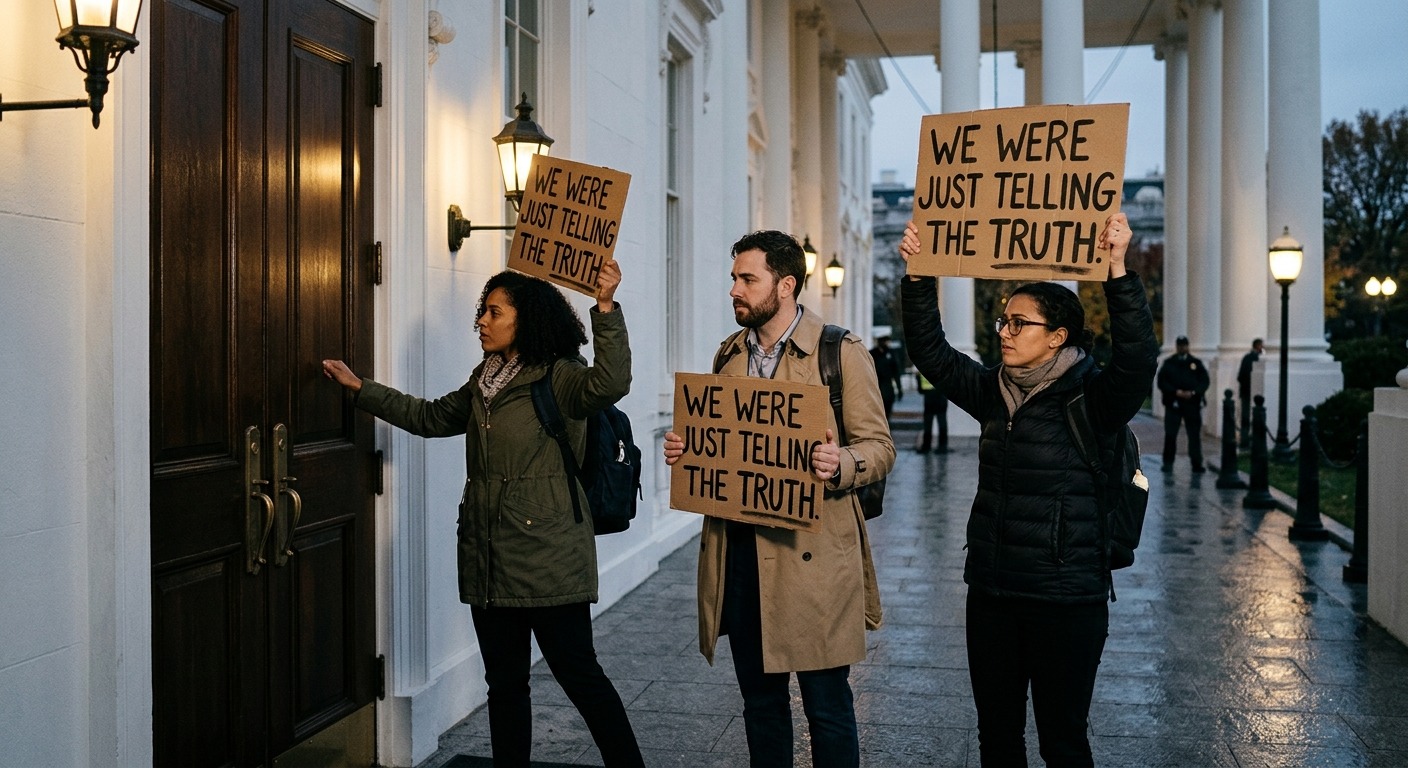
When we launched The Truth Seekers Journal (TSJ), our mission was simple: to restore trust in local journalism by focusing on verified facts, transparency, and the stories that truly shape our community.
Today, I am proud to share that the “pulse” of this journal is stronger than ever. This past week, we reached a significant turning point in our growth. Our page views have tripled, and most importantly, our Returning Visits have grown by over 1,000%. This tells me that TSJ isn’t just a site you stumble upon. It is becoming a trusted resource you rely on.
National Recognition
I am also honored to announce that The Truth Seekers Journal has been awarded a prestigious rural reporting grant from Grist, following a highly competitive national selection process. Grist is a national leader in environmental and justice journalism.
Furthermore, to ensure we maintain the highest ethical standards, we have been formally accepted as members of the Society of Professional Journalists (SPJ), the Online News Association (ONA), the National Association of Black Journalists (NABJ), and the Atlanta Press Club. These affiliations are our “gold standard” promise to you that our reporting is independent, ethical, and professional.
Expanding Our Expertise
Growth isn’t just about numbers; it’s about the depth of the stories we can tell. I am thrilled to highlight two key pillars of our expanded editorial team:
Dr. Florita Bell Griffin has joined us as a Contributing Writer and Systems Analyst. Dr. Griffin will lead our coverage in the AI, Science, and Technology sectors. Her expertise allows us to move beyond the headlines, providing our readers with deep-dive analysis on how emerging technologies and infrastructure projects impact our local economy and daily lives..
Ted Knorr, our resident historian, continues to bridge the gap between our past and present through his twice-monthly column, “Shadow Ball: Learning More About Negro League History.” Many of you have already engaged with Ted by submitting questions and sharing family stories, making “Shadow Ball” a true cornerstone of our community dialogue.
The Road Ahead
We are no longer just a news site; we are a growing civic institution. Whether we are investigating DeKalb data centers or documenting the rich history of the South, our goal remains the same: to give you the information you need to understand your community and shape your future.
Thank you for being the most important part of this journey. We are just getting started.
French photographer Cyril Bailleul brings Black cowboy history to Normandy through photographs celebrating the Bill Pickett Invitational Rodeo, family traditions, and African American heritage.
An unexpected encounter with the Bill Pickett Invitational Rodeo became a photographic journey connecting Black Western heritage, family, and civil rights
By Milton Kirby | Atlanta, GA | October 13, 2026
In 2012, French photographer Cyril Bailleul arrived at a rodeo outside Atlanta expecting to see the cowboys he had known from American movies.
Instead, he discovered a part of American history he never knew existed.
His mother-in-law had surprised him with tickets to the Bill Pickett Invitational Rodeo (BPIR). Bailleul had been fascinated by American culture since his first visit to the United States in 2007. He wanted to experience the motels, drive-in theaters, and cowboys he had seen on screen.
Cyril Bailleul
But when he and his family approached the rodeo arena, something immediately caught his attention.
The crowd was overwhelmingly African American.
In a written statement accompanying his upcoming photography exhibition in France, Bailleul recalled that he had not known Black cowboys existed.
What began as a family outing became a journey of discovery that has continued for more than a decade.
This October, Bailleul’s exhibition, In the Footsteps of Bill Pickett – American Cowgirls & Cowboys, will be presented at Château de Pontécoulant in Normandy as part of Equidays, a regional celebration of horses and equestrian culture.
The exhibition introduces French audiences to the people, traditions, and overlooked history of Black cowboys and cowgirls in America.
Discovering the Cowboys Hollywood Overlooked
During an October 12 interview with The Truth Seekers Journal, Bailleul recalled that his first rodeo experience was unlike anything he expected.
Instead of finding only rugged competitors and dangerous sporting events, he encountered families, children, and a welcoming community.
Spectators sitting nearby explained the rules of the competition.
He enjoyed the rodeo but left wanting to know more about the people and the history behind it.
As he began researching, Bailleul learned that Black cowboys had played an important role in developing the American West.
Historians commonly estimate that roughly one in four cowboys working the cattle trails after the Civil War was African American. Many were formerly enslaved people who found opportunities working with horses and cattle.
Yet Hollywood Westerns largely excluded Black cowboys, helping create an image of the American frontier that failed to reflect its diversity.
Established by the late Lu Vason, BPIR was created to celebrate the contributions of Black cowboys and cowgirls and provide a national platform for African American rodeo competitors.
Today, under the leadership of Valeria Howard Cunningham, the rodeo continues that mission while emphasizing families, education, and community engagement.
For Bailleul, BPIR represents something much larger than competition.
Throwing a Lasso – BPIR Atlanta, GA 2018 (Cyril Bailleul)
Portraits Tell a Different Story
Unlike many rodeo photographers, Bailleul does not concentrate primarily on bucking bulls, racing horses, or dramatic action inside the arena.
He prefers portraits.
During our interview, I asked why so much of his photography focuses on the people surrounding the competition rather than the sporting events themselves.
Bailleul explained that he enjoys watching the action but finds greater meaning in conversations, personal details, and moments before and after the competition.
He walks around the rodeo grounds observing people, their clothing, expressions, and interactions.
Sometimes he asks someone to remain exactly where they are while he captures a photograph.
His approach reveals the pride, dignity, and personal connections that help define the rodeo community.
One photograph he particularly values show three generations of cowgirls: a grandmother, mother, and daughter.
The image captures more than a family resemblance. It reflects how Black Western traditions are passed from one generation to another.
Bailleul’s relationships with rodeo participants have also deepened over time. He returns with prints for people he previously photographed and looks forward to reconnecting with familiar faces.
For him, the project is as much about friendships and learning as it is about creating photographs.
History Within History
Bailleul’s photographs of Black cowboys and cowgirls have previously appeared at cultural and equestrian venues in Normandy.
In September and October 2020, his work was exhibited at the Pôle International du Cheval Longines in Deauville, during the period of the American Film Festival.
In 2021, his photographs were presented at Château de Thury-Harcourt as part of Equidays Calvados.
Now, in 2026, Equidays is again bringing his work to French audiences, this time at Château de Pontécoulant in southern Calvados, near Suisse Normande.
Bufalo Soldier Atlanta, GA 2021 (Cyril Bailleul)
The setting holds special meaning for Bailleul. The château’s history dates to the 14th century, placing photographs of African American Western heritage inside a centuries-old French landmark.
In his exhibition statement, Bailleul describes the opportunity as displaying “History within History.”
The setting creates an unexpected meeting between European heritage and a chapter of American history that many visitors may know little about.
Bailleul has deliberately chosen not to identify his subjects as Black in the exhibition’s title. He wants visitors to experience something similar to his own discovery in Atlanta.
They arrive expecting American cowboys. The photographs invite them to reconsider what that image means.
From Rodeo Heritage to Civil Rights
The exhibition also includes photographs connecting Black Western traditions with contemporary civic participation.
On January 4, 2021, Bailleul photographed riders associated with the Atlanta Saddle Club during the Ride for Change demonstration encouraging participation in Georgia’s U.S. Senate runoff elections.
The riders traveled from the Georgia Capitol toward the National Center for Civil and Human Rights.
Two photographs from that event hold particular meaning for Bailleul.
One depicts a Buffalo Soldier, recalling the African American soldiers who served in the U.S. Army after the Civil War.
Displayed in the château’s armory, the photograph connects military service, the expansion of the American West, and the struggle for equal citizenship.
Deja Atlanta, GA 2021 (Cyril Bailleul)
Another photograph features a young woman named Deja, raising her fist while seated on horseback near the Georgia Capitol.
Her image closes the exhibition in the château’s Blue Room.
For Bailleul, Deja represents a younger generation committed to education, activism, and social change.
She also represents the important role women play in a culture often portrayed as predominantly male.
Together, the photographs show that Black Western heritage is not confined to the past. It remains connected to contemporary American life.
Photography as a Bridge Between Cultures
Bailleul’s interest in cultural understanding extends far beyond the rodeo.
His professional experiences have included photography associated with UNESCO and work in Senegal, Mali, Burkina Faso, and other countries.
Those travels helped shape his appreciation for the ways history, identity, and culture intersect.
During our interview, he repeatedly emphasized the importance of approaching unfamiliar communities with curiosity and respect.
He hopes his photographs will encourage visitors to learn more about Black cowboys, challenge their assumptions, and perhaps experience a rodeo themselves.
That philosophy also explains why he continues returning to BPIR.
He hopes eventually to follow the rodeo to additional American cities, photograph more participants, and document new aspects of their lives.
But his greatest interest remains the people he encounters and the relationships that develop.
A Journey Dedicated to His Father
There is a personal story behind the exhibition’s historical message.
Bailleul’s father often told him there was no such thing as chance.
Yet the photographer’s journey has been filled with unexpected encounters.
His marriage connected him to an American family. A gift from his mother-in-law introduced him to the Bill Pickett Invitational Rodeo. His curiosity led him to learn about Black Western history and build lasting friendships.
Now those experiences have brought his photographs to a centuries-old château in Normandy.
Bailleul has dedicated the exhibition to his father.
For a photographer who once searched for the cowboys he remembered from Hollywood, the journey has revealed something far more meaningful.
The American West was never the story of one group of people.
And through Bailleul’s photographs, another part of that history is finding its way into view.
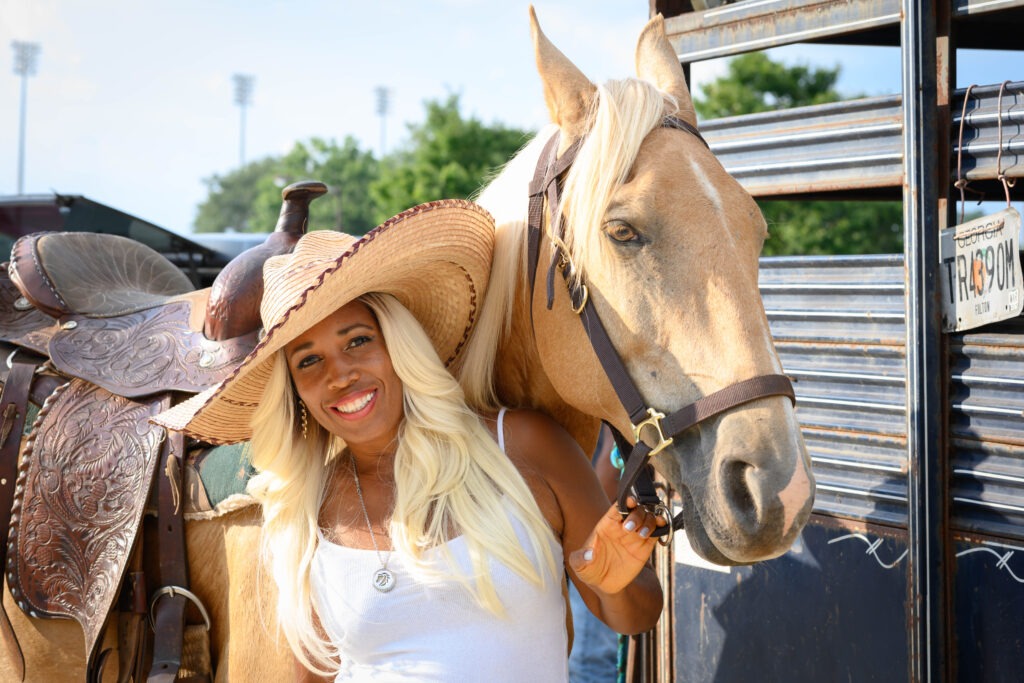
Michelle and Her Horse, Corona – BPIR Atlanta, GA 2019 (Cyril Bailleul)
Exhibition Information
In the Footsteps of Bill Pickett – American Cowgirls & Cowboys
Château de Pontécoulant, Calvados, Normandy, France
October 17, 18, 20 and 21, 2026
2:30–5:30 p.m. | Free admission
Presented during Equidays 2026.
Truth Seekers Journal thrives because of readers like you. Join us in sustaining independent voices.
President Trump shared a fabricated Denzel Washington endorsement, raising questions about misinformation, celebrity influence, social media credibility, and the responsibility of public officials to verify.
By Milton Kirby | Atlanta, GA | October 13, 2026
President Donald Trump shared a glowing endorsement attributed to Academy Award-winning actor Denzel Washington on social media Monday, October 12.
There was one problem.
Washington never said it.
The fabricated quotation portrayed Washington as a devoted Trump supporter who praised the president’s courage, intelligence, and commitment to America. Trump shared a screenshot of the claim on Truth Social, bringing the false endorsement to a much larger audience.
The incident raises a question that extends beyond celebrity politics: What happens when the president of the United States shares information that has already been identified as false?
A Celebrity Endorsement That Never Happened
The controversy began with a post on X from an account called Red Eagle Updates on Saturday, October 10. The post claimed Washington had described Trump as exceptionally brave, intelligent, and devoted to the country.
The fabricated statement also portrayed Washington as calling Trump a close friend and declaring himself a committed supporter of the president.
The post invited readers to respond to a question: “Do you agree with Denzel? YES or NO?”
Trump shared a screenshot of the message on Truth Social on Monday morning.
However, the fact-checking organization Snopes had already investigated the quotation on October 10 and found no credible evidence that Washington had ever made the statement.
The Washington Post subsequently contacted Washington’s representatives. Alan Nierob, president of PMK Entertainment, confirmed that the statement was fabricated.
“Not real,” Nierob told the newspaper. “No idea where it came from.”
The White House did not respond to The Washington Post’s request for comment.
A Familiar Pattern Involving Washington
This was not the first time Washington’s name had been attached to a fabricated political endorsement.
In 2016, a false story circulated claiming that the actor supported Trump’s presidential campaign. Other misleading statements attributed to Washington appeared in subsequent years.
In 2021, FactCheck.org investigated another social media claim suggesting that Washington had abandoned the Democratic Party to support Trump. Washington’s representative described that story as a fabrication.
The latest false endorsement also contained language previously attributed to actor Matthew McConaughey and Rolling Stones singer Mick Jagger.
The repetition illustrates how fabricated quotations can circulate for years, sometimes with little more than a change in the celebrity’s name.
Celebrity endorsements can carry influence because familiar names attract attention and may lend credibility to political messages. A statement attributed to a respected actor, athlete, or musician can reach audiences who might otherwise pay little attention to political commentary.
That helps explain why fabricated endorsements continue to circulate.
Washington has generally avoided making prominent partisan endorsements. Federal Election Commission records show that he previously contributed to Democratic presidential candidates Barack Obama and Hillary Clinton. Those donations, however, do not establish his current political preferences.
When False Information Reaches the White House
False celebrity endorsements are not new. Social media platforms have long provided opportunities for misleading statements, altered images, and fabricated quotations to spread rapidly.
What makes this incident significant is who shared the information.
A claim no longer needs to be true to gain attention. It can spread when a widely followed account shares it, regardless of whether the underlying information has been verified.
When inaccurate information moves from an ordinary social media account to the president’s platform, it can gain visibility and an appearance of credibility that it otherwise might not receive.
The Denzel Washington incident also was not an isolated example of Trump sharing an invented quotation.
In May 2026, Trump circulated a statement falsely attributed to Republican Sen. John Kennedy of Louisiana. The quotation concerned former President Barack Obama and the Affordable Care Act. Kennedy confirmed that he had not made the statement.
CNN has also documented a 2019 incident in which Trump shared a fabricated quotation attributed to former President Ronald Reagan.
These incidents raise concerns about how information is verified before being distributed by public officials.
There is an important distinction between deliberately creating false information and sharing something without recognizing that it is false.
In the Washington case, the available reporting establishes that Trump shared a fabricated endorsement. It does not establish whether he knew the quotation was false when he posted it.
That distinction matters. So does the responsibility to verify information before passing it along.
The Broader Challenge of Misinformation
The Washington incident comes at a time when Americans are confronting increasingly sophisticated forms of misleading online content.
Fabricated quotations can be created in seconds. Images can be altered to suggest that events occurred when they did not. Artificial intelligence can generate realistic-looking photographs, videos, and audio recordings that make false claims more difficult to identify.
There is no verified evidence that AI was used to create the Washington quotation.
The larger problem is that information can spread widely before its accuracy is established.
Whether misinformation benefits Republicans or Democrats, the consequences extend beyond party politics. Repeated exposure to false claims can undermine confidence in legitimate information sources and make it more difficult for citizens to distinguish verified reporting from political messaging.
For Washington, the latest incident is another example of his name being used to communicate a political position that he did not publicly express.
For the public, it is a reminder that a recognizable name attached to a quotation does not make the quotation authentic.
The Responsibility to Verify
Journalists have a professional obligation to check quotations, identify sources, and correct errors. Those standards are essential to maintaining public trust.
Public officials face a similar expectation when communicating with the people they represent.
The speed of social media does not eliminate the need for accuracy. In fact, the ability to reach millions of people almost instantly makes verification even more important.
Readers also have a role to play.
Before accepting a surprising quotation, particularly one involving politics, they can look for an original interview, video, speech, or statement from the person involved. Established news organizations and independent fact-checkers can provide additional context.
A screenshot is not proof that a statement is authentic. Neither is the number of times it has been shared.
More Than a False Endorsement
The fabricated Denzel Washington endorsement may appear to be a relatively small incident compared with the major policy debates and international challenges facing the country.
But its significance goes beyond whether a Hollywood actor supports a particular president.
It demonstrates how easily an invented statement can move from an online account into a much larger public conversation, even after fact-checkers have questioned its authenticity.
The central issue is not whether Washington supports Trump, another political figure, or no candidate at all. Those are decisions Washington is entitled to make and express for himself.
The issue is whether Americans can rely on information shared by people in positions of public trust.
In this case, the reported evidence establishes that the endorsement was fabricated and that the president shared it.
The larger question is what standards of verification the public should expect from its leaders.
Truth Seekers Journal thrives because of readers like you. Join us in sustaining independent voices.
Before beginning today’s essay, I want to take a little time to thank readers of this twice-monthly column. I’ve been told it is one of the most read features in The Truth Seekers Journal. For your time and loyalty, I thank you and let you know that I very much appreciate your readership. Further, I’d be remiss if I didn’t take the time to remind you that this column exists for only one purpose and that is to answer your questions on Negro League baseball history. Your questions are the lifeblood of Shadow Ball—they shape where we go next. So, your participation is important. Send questions, comments, or Significa answers to Shadowball@truthseekersjournal.comor to Shadow Ball, 3904 N Druid Hills Rd, Ste 179, Decatur, GA 30033. As much as I appreciate your taking the time to read the column, I’d like it even more if you exchanged your thoughts, questions, areas of interest.
Now, not being a writer I have few original thoughts … this is why I need reader questions so I have something to write about … on occasion, thankfully, serendipity steps in … such was the case on October 9th when Kevin Jognson did what he does every day … marking the birth or death anniversary of a Negro Leaguer in a Facebook post. October 9, 2026, turned out to be the 131st birthday of Saint Louis Star outfielder Branch Russell. I knew he was a member of one of the best outfields in Negro League history The Stars outfield, 1925-29, included left fielder Frog Redus, Hall of Fame centerfielder Cool Papa Bell and Branch Russell in right.
No right fielder played more games in rightfield than Branch Russell (under the Seamheads Data Base Negro Leagues filter). Russell hit .308 over his career with an OPS+ of 117 (meaning he was 17% better hitter than average). He was an average fielder with a better than average arm.
After retiring from baseball, Russell worked as a supervisor in the Saint Louis Parks and Recreation for 17 years with a focus on youth baseball. The late James A. Riley provides that nugget in his Biographical Encyclopedia of the Negro Baseball Leagues. For Russell’s life before baseball, we get some clues in the Seamheads statistical database where it reveals Russell’s burial in Jefferson Barracks National Cemetery and from the fact that he doesn’t break into the Major Leagues until age 26.
Neither proves anything but they do direct a search to military experience. To fill in those blanks I turned to the writing of Ellen Knight writing in Daily Times Chronicle, Winchester, MA, 2018; Paul D. White in his Lost in Left Field, Substack, 2025; and Connie Nisinger who published a short bio with a gravesite picture in Find A Grave website. Based on those three sources Branch Russell had an 8-year career in the U.S. Army during which he ran track and played baseball for the famous 25th Infantry Wreckers. He also served during World War I along the Mexican border.
Branch Russell is a fitting example of what makes all of us among the last victims of the segregation of baseball prior to the integration of the game in April 1947.
Last Week’s Shadow Ball Significa Question of the Week
In 1937, Monte Irvin joined the Newark Eagles under an assumed name. What was it? In 1942, Larry Doby joined the Newark Eagles under an assumed name — what was it? Will Clark, Shadow Ball’s top trivia, provided Jimmy Nelson as Monte Irvin’s assumed name. No one provided Larry Doby’s assumed name which was Larry Walker.
This Week’s Shadow Ball Significa Questions of the Week
“What yet to be inducted Hall of Fame caliber Negro League shortstop was nicknamed “King Richard”?
Ted Knorr
Ted Knorr is a Negro League baseball historian, longtime member of the Society for American Baseball Research’s Negro League Committee, and founder of the Jerry Malloy Negro League Conference and several local Negro League Commemorative Nights in central Pennsylvania.
Beyond his research and organizing work, Ted is frequently invited to speak at sporting events, community programs, family gatherings, and educational forums, where he brings Negro League history to life. His deep knowledge of the players, teams, and cultural impact of Black baseball has made him a trusted voice for audiences who want to understand the legacy and significance of the Negro Leagues.
Send questions or Significa answers to shadowball@truthseekersjournal.com or Shadow Ball, 3904 N Druid Hills Rd, Ste 179, Decatur, GA 30033.
Support open, independent journalism, your contribution helps us tell the stories that matter most.
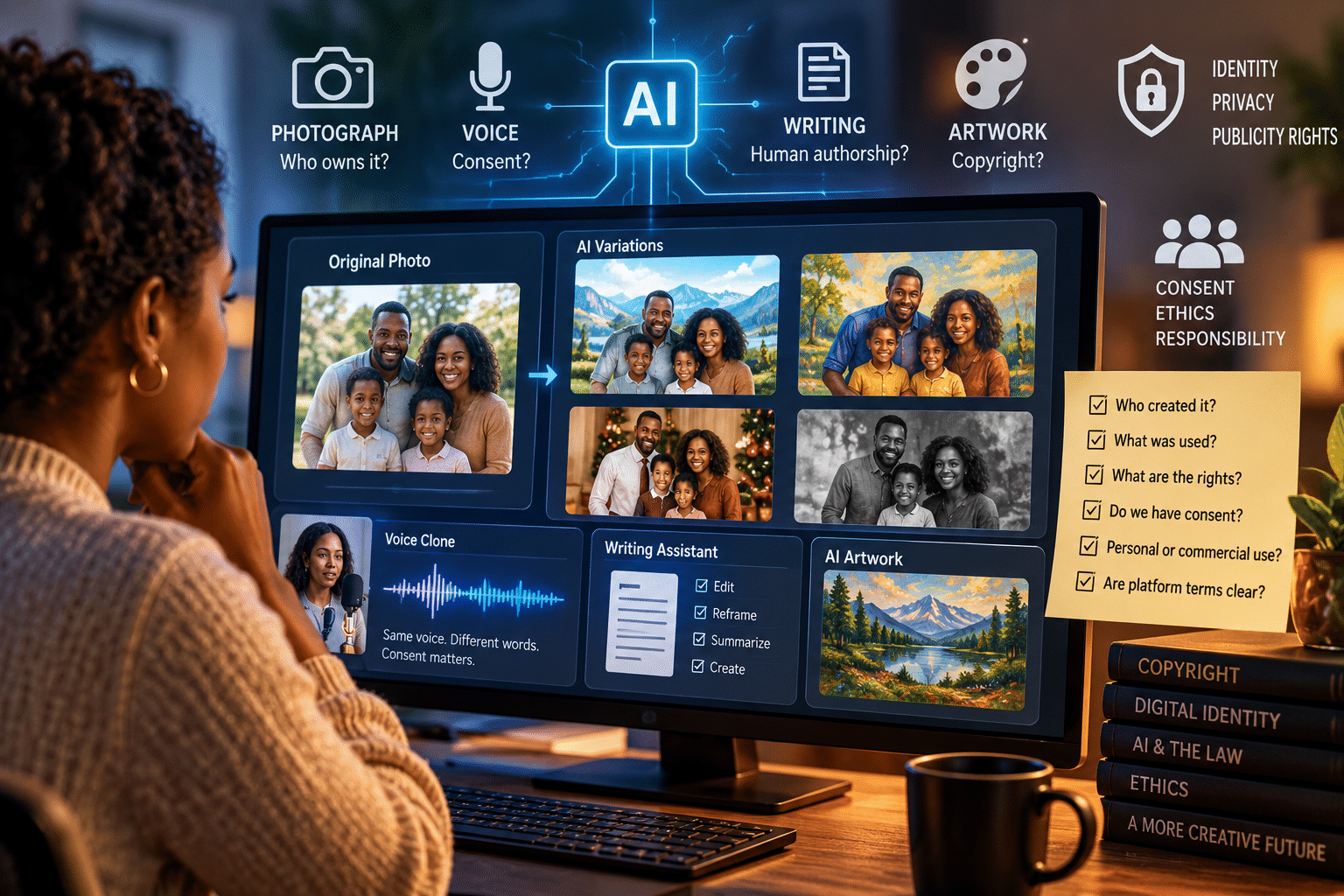
As artificial intelligence reshapes childhood, parents and grandparents must help children balance learning, creativity, privacy, critical thinking, and healthy relationships with technology and others.
By Florita Bell Griffin, Ph.D. | Houston, TX | October 13, 2026
Children growing up today may never remember a world without artificial intelligence. They can already ask AI to explain homework, create pictures, write stories, answer questions, suggest games, translate languages, produce music, and carry on conversations. For adults who grew up with encyclopedias, libraries, handwritten school reports, and early search engines, the change can be difficult to fully appreciate. For a child, asking a machine for an immediate personalized answer may soon feel as ordinary as asking Google does today.
This creates extraordinary educational possibilities. A child struggling with fractions can ask for the idea to be explained in another way. A student who does not understand a paragraph in a textbook can request a simpler explanation. A young person curious about dinosaurs, astronomy, African history, architecture, agriculture, music, or robotics can continue asking questions as long as curiosity lasts. AI can respond without embarrassment, impatience, or the pressure some children feel when they are afraid of asking what they think is a “stupid” question.
For students with different learning needs, this can be especially valuable. One child may understand a concept best through an example. Another may need a step-by-step explanation. Someone learning English may want unfamiliar words translated. A student with reading difficulties may benefit from a simpler version of complicated material. When used thoughtfully, AI can provide a level of individual assistance that teachers and parents may not always have time to provide immediately.
The concern begins when assistance replaces learning. A child can now ask AI to write an essay, solve a homework assignment, answer questions, create a book report, or prepare a presentation. The work may look excellent even though the student has learned very little. A beautifully written essay is not evidence that the student understands how to develop an idea, organize an argument, examine evidence, or express an original thought.
Parents and grandparents therefore need to help children understand the difference between using AI to learn and using AI to escape learning. Asking, “Can you explain this math problem another way?” supports understanding. Asking, “Give me the answer so I can turn it in,” usually does not. Asking for feedback on a paragraph the student wrote can improve writing. Asking AI to write the entire assignment may prevent the child from developing the skill the assignment was intended to teach. The technology is the same. The purpose makes the difference.
Children also need to know that AI can be wrong. This may be one of the most important lessons adults can teach. AI often communicates in polished, confident language. A young person may naturally assume that an answer presented so clearly must be correct. Yet AI can misunderstand a question, provide outdated information, invent details, or state something inaccurately.
Adults can turn these mistakes into lessons. Ask a child to verify an AI answer using a textbook, reliable website, or another trustworthy source. Ask, “How do we know this is true?” Encourage the child to identify where the information came from. This develops a habit of verification that will be useful far beyond AI.
Children also need to understand that not everything online represents a real person or real event. AI-generated images, voices, videos, influencers, and social-media accounts are becoming more convincing. A child may encounter a realistic image of something that never happened or communicate with an account operated partly or entirely by software. Media literacy now requires more than knowing that photographs can be edited. Young people must understand that complete digital realities can be manufactured.
Privacy deserves equal attention. Children and teenagers may speak casually with AI because conversation feels personal. They may share their names, schools, locations, family details, fears, friendships, or personal problems without thinking about how digital information is handled. Parents should teach children that an AI conversation is still an interaction with a computer system. Personal information deserves the same care it would receive elsewhere online.
The issue becomes more complicated with AI companions. Some systems are designed to converse over long periods, respond emotionally, remember preferences, and behave like supportive friends. A young person who feels lonely or misunderstood may form a strong attachment to such a system. The interaction may provide comfort, but the child should understand what the relationship actually is.
An AI system can simulate interest and empathy through language. It does not experience friendship as another human being does. It does not share a childhood, have feelings, carry responsibility for the child’s welfare, or participate in the real community surrounding that young person. Children should not be taught that every emotional response generated by a machine represents an emotional experience inside the machine.
This does not mean parents need to prohibit every AI tool. Complete prohibition may leave children less prepared for technology they will encounter throughout education, employment, and adult life. Guided use is likely to be more effective. Parents and grandparents can explore AI with children, ask questions together, compare answers, and discuss what the system does well and where it fails.
Adults can also encourage children to use AI creatively without allowing it to consume creativity. A child might write a story first and then ask AI for ideas about how to improve it. Someone interested in art can create original drawings and also experiment with image-generation tools. A student planning a science project can brainstorm with AI but still design and understand the project independently.
Children should continue having experiences that do not involve intelligent assistance. They should read books without immediately requesting summaries, solve problems before asking for answers, draw pictures from imagination, play outdoors, talk with other people, build things, make mistakes, become bored, and figure out what to do next. Boredom itself can be productive because it forces the mind to invent.
The ability to work through frustration is also important. Learning often involves moments when the answer is not immediately available. If AI removes every difficult step, children may lose opportunities to develop persistence. There is value in struggling with a problem for a while before receiving help.
Schools and families will continue debating appropriate rules, but one principle can remain simple: children should know what they themselves are capable of doing. If AI completes every difficult intellectual task, a student may receive good grades without developing confidence in his or her own abilities.
Parents and grandparents have an important role because AI literacy is not merely a school subject. It involves values, judgment, privacy, honesty, relationships, and understanding when technology should be used at all.
The children growing up today will likely interact with increasingly capable artificial intelligence throughout their lives. Knowing how to operate those systems will probably become easy. Knowing when to question them, when to verify them, when to turn them off, and when another human being matters more may prove much more important.
We are not simply teaching children how to use a new technology. We are helping them decide what kind of relationship they will have with intelligent machines. If adults teach curiosity without dependence, openness without gullibility, and technological skill without surrendering independent thought, AI can become a powerful educational tool while the child remains firmly at the center of the learning.
Atlanta Dream sweep New York Liberty 85-83, advancing to their first WNBA Finals since 2013 behind standout performances from Angel Reese and Rhyne Howard.
Reese and Howard lead Atlanta’s offense, while Bonner’s late rebound and free throws seal an 85-83 victory in Brooklyn.
By Milton Kirby | Brooklyn, NY | October 10, 2026
The Atlanta Dream are going back to the WNBA Finals.
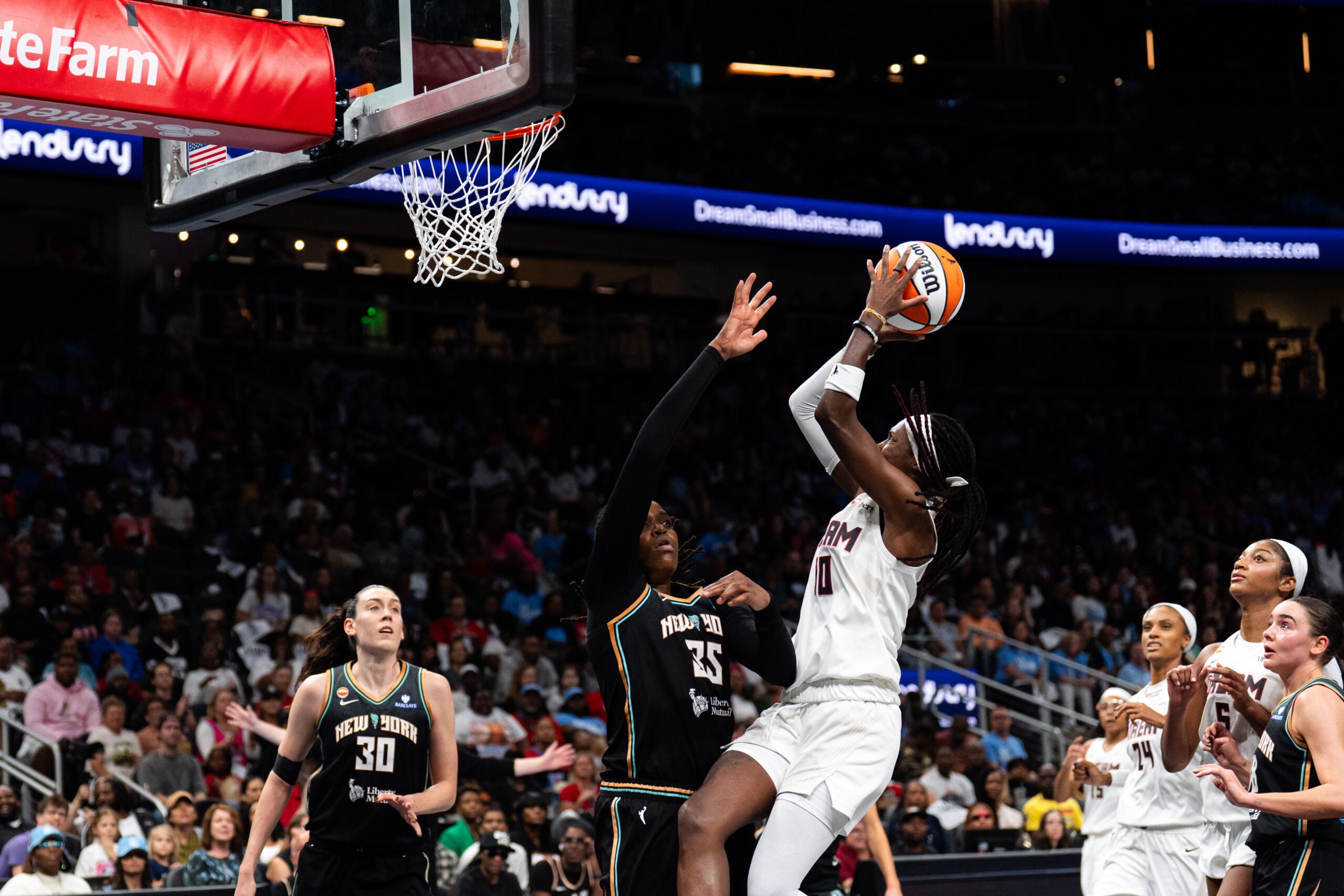
Thirteen years after their last appearance in the championship series, the Dream defeated the New York Liberty 85-83 Friday night at Barclays Center, completing a three-game sweep and earning another opportunity to pursue the first WNBA title in franchise history.
Atlanta’s fourth trip to the Finals came after a tense game that was not decided until the closing seconds. The Dream built a 12-point lead, watched New York fight back, and then relied on defense and two free throws from DeWanna Bonner to secure the victory.
“We put a lot of work in for this moment,” Angel Reese said following the game. “We can’t shy away from knowing that.”
Reese led Atlanta with 22 points and nine rebounds. Rhyne Howard added 21 points, while Jordin Canada finished with 19 points and 11 assists. Bonner recorded 13 points and 13 rebounds, and Isobel Borlase contributed 10 points off the bench.
Five players scored in double figures as Atlanta advanced without injured leading scorer Allisha Gray and Brionna Jones.
The Dream will face the Golden State Valkyries in the best-of-seven WNBA Finals beginning October 17.
Bonner Makes the Final Plays Count
The final minute captured the determination that carried Atlanta through the series.
With approximately one minute remaining, the Dream held an 83-79 lead. New York’s Jonquel Jones scored inside to reduce the advantage to two points.
Atlanta then committed a turnover, giving the Liberty another opportunity.
Following a timeout with fewer than 18 seconds remaining, New York put the ball in Breanna Stewart’s hands.
Stewart drove toward the basket and attempted a contested layup that would have tied the game.
The shot missed.
Bonner grabbed the rebound and was fouled.
With 6.2 seconds left, she stepped to the free-throw line and made both attempts, pushing Atlanta’s lead to 85-81.
Stewart scored on a putback as time expired, but the final basket only narrowed the margin.
The Dream had survived, 85-83.
“We feel really great that we were able to make the last couple of plays,” head coach Karl Smesko said. “I’m really proud of the way our players competed, pulled together, and held on to win.”
The victory completed Atlanta’s sweep of a New York team that had entered the playoffs hoping to return to the championship round.
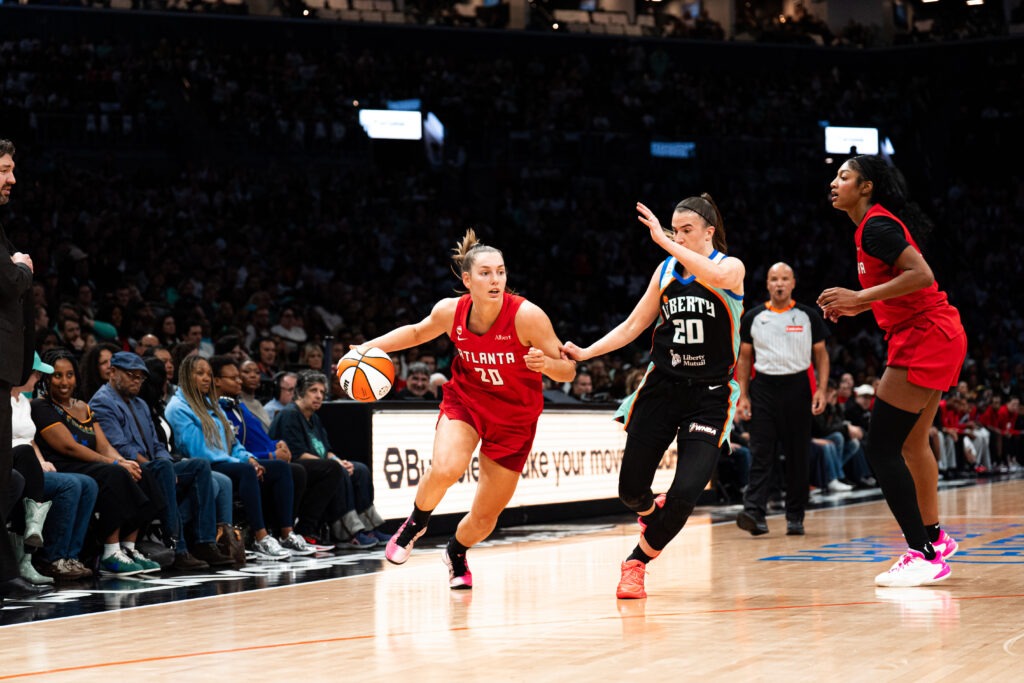
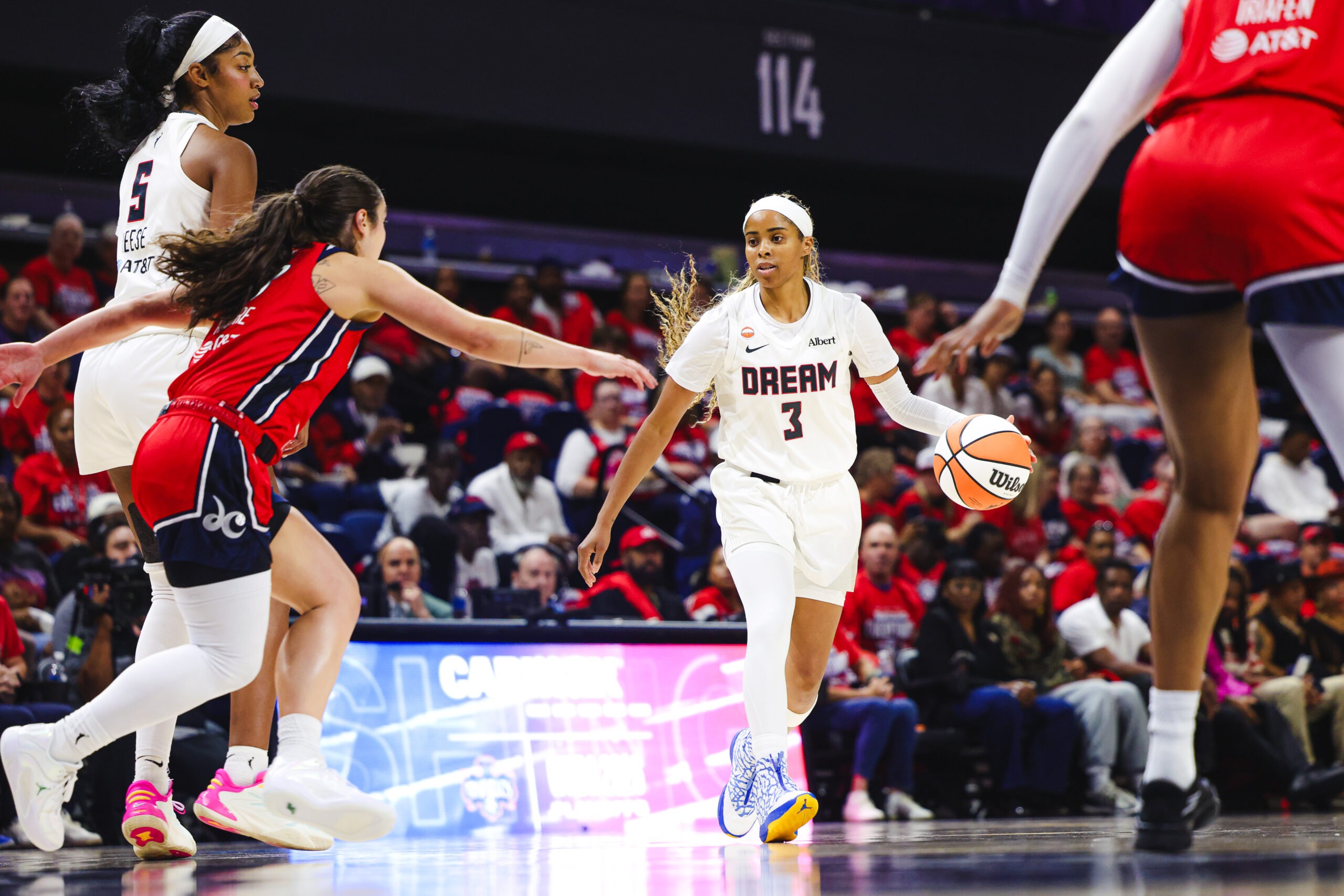
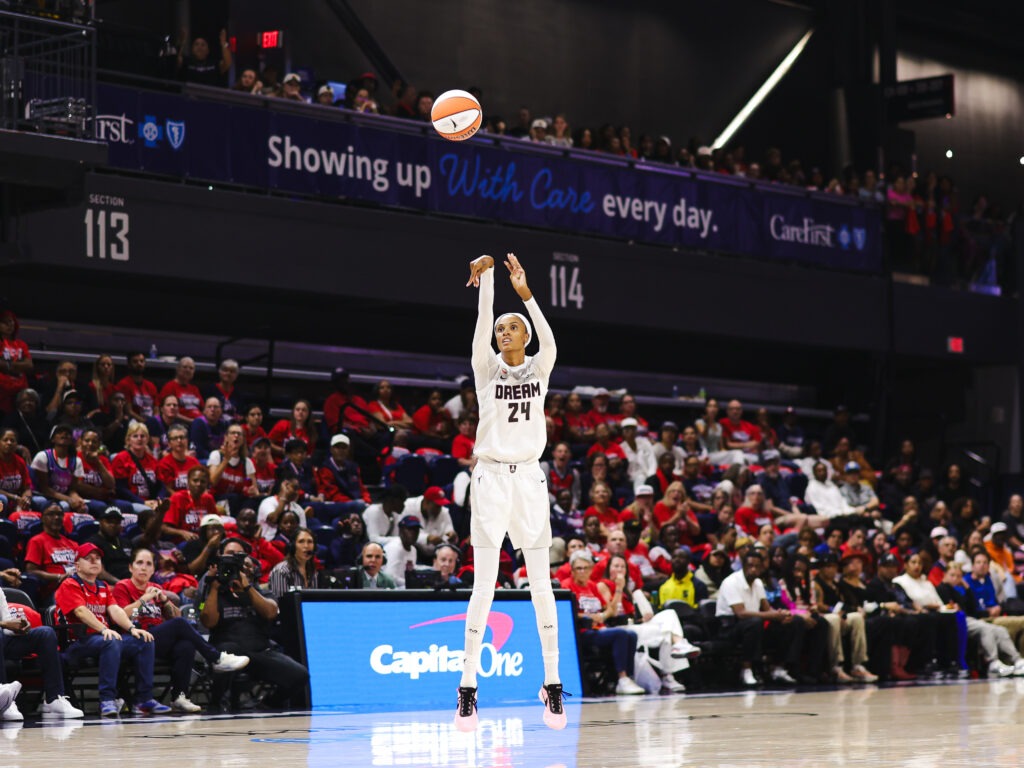
Isobel Borlase drives on Sabrina Ionescu’s during Atlanta Dream vs NY Liberty game 3 (Courtesy photo)
Atlanta Establishes an Early Advantage
The Dream opened the game with the confidence of a team carrying a 2-0 series lead.
Howard scored 11 points in the first quarter. Reese added 10, including two three-pointers, while Canada directed the offense with five early assists.
Atlanta led 25-18 after the opening period.
The second quarter became more physical as the Liberty attempted to slow the Dream’s offense.
New York closed the gap to one point late in the half, but Reese scored Atlanta’s final four points before intermission.
The Dream led 44-39 at halftime.
Atlanta opened the third quarter with seven unanswered points, extending its lead to 51-39.
For a moment, the Dream appeared ready to pull away.
New York responded with a 16-4 run that erased the advantage and shifted momentum toward the home team.
Canada helped keep Atlanta in the game, scoring nine consecutive Dream points during a critical stretch.
Still, the Liberty entered the fourth quarter leading 68-66.
Atlanta had lost its double-digit lead and now needed another comeback of its own.
Jordin Canada drives to basket on Marine Fauthoux during Atlanta Dream vs NY Liberty game 3 (Courtesy photo)
A Fourth Quarter of Defensive Stops
New York extended its advantage early in the fourth quarter, but Atlanta answered with eight consecutive points to move ahead 75-71 with 4:55 remaining.
During that stretch, the Dream held the Liberty without a field goal for more than six minutes.
The teams continued trading baskets and defensive stops as the clock moved toward the final minute.
Neither side could establish a comfortable advantage.
Atlanta eventually moved ahead 83-79 before New York made its final push.
The decisive possession belonged to Bonner, whose defensive rebound and free throws ensured the Liberty would not get another opportunity to tie the game.
The Dream made 22 of 24 free throws, including their final 20 attempts, finishing at 91.7 percent from the line.
In a game decided by two points, those opportunities mattered.
Five Players Help Carry the Dream
Friday’s victory reflected the depth that has become an important part of Atlanta’s postseason success.
Reese scored at least 20 points for the second consecutive game. Her 10-point first quarter was the first double-digit quarter of her playoff career.
Howard recorded her second 20-point game of the postseason, helping Atlanta establish its early advantage.
Canada’s 19 points and 11 assists gave her a fourth career postseason double-double. Her nine consecutive points in the third quarter helped prevent New York from taking complete control.
Bonner’s 13-point, 13-rebound performance demonstrated the value of experience in a close playoff game.
Her final rebound and two free throws were the most important moments of her evening.
Borlase contributed 10 points and two steals off the bench.
The Dream’s balanced attack helped offset the absence of Gray, who remained sidelined with a hand injury, and Jones, who was also unavailable.
For New York, Stewart and Jonquel Jones scored 26 points apiece, but the Liberty could not extend the series.
Thirteen Years Between Finals Appearances
Atlanta’s return to the Finals carries special significance for a franchise that has come close to a championship but has never claimed the title.
The Dream first reached the WNBA Finals in 2010, losing to the Seattle Storm.
They returned in 2011, falling to the Minnesota Lynx, and made another appearance in 2013, again losing to Minnesota.
Each championship series ended in a three-game sweep.
Since then, Atlanta has experienced roster changes, coaching transitions, and seasons in which reaching the playoffs was itself a challenge.
The current team has now moved beyond those earlier disappointments to earn another opportunity.
This postseason run also reflects the work of a new group of players, including Reese, Howard, Canada, Hillmon, Bonner, and Borlase, along with Smesko’s coaching staff.
The Dream have advanced through the playoffs without a loss.
Their latest victory came on the road against a Liberty team featuring experienced championship players.
For Atlanta’s basketball community, the result ends a 13-year absence from the WNBA’s biggest stage.
The Championship Challenge Awaits
The Dream will meet the Golden State Valkyries, who completed their own semifinal sweep with an overtime victory over the Las Vegas Aces.
Golden State will have home-court advantage when the best-of-seven Finals begin Saturday, October 17, at Chase Center in San Francisco.
Both franchises are seeking their first WNBA championship.
Atlanta’s players can celebrate reaching a destination that has eluded the franchise since 2013.
But Reese made clear that the team has not reached its ultimate goal.
“The job isn’t done,” she said. “Happy where we are right now. We’re not satisfied.”
The Dream needed one more victory when they left State Farm Arena Wednesday night.
They earned it Friday in Brooklyn.
Now they need four more to become WNBA champions.
Statistical sidebar
WNBA SEMIFINALS · GAME 3
Atlanta Dream 85, New York Liberty 83
Series result
3–0
Finals appearance
4th
Attendance
17,991
Dream player
PTS
REB
AST
Angel Reese
22
9
3
Rhyne Howard
21
2
—
Jordin Canada
19
3
11
DeWanna Bonner
13
13
1
Isobel Borlase
10
2
1
Free throws
22 of 24 (91.7%)
Lead changes
7
New York leaders
Stewart & Jones: 26 each
Next game
Oct. 17 vs. Golden State
Statistics: WNBA official game report.
Truth Seekers Journal thrives because of readers like you. Join us in sustaining independent voices.
Atlanta Dream defeat New York Liberty 101-98 in overtime, taking a 2-0 series lead behind Angel Reese, Jordin Canada, and a thrilling finish.
Reese and Canada lead Atlanta past New York as a dramatic finish and an electric State Farm Arena crowd bring the Dream closer to a championship appearance.
By Milton Kirby | Atlanta, GA | October 8, 2026
The Atlanta Dream are one victory away from playing for the WNBA championship.
Behind 23 points each from Angel Reese and Jordin Canada, the Dream survived a thrilling 101-98 overtime battle against the New York Liberty Wednesday night at State Farm Arena, taking a 2-0 lead in their best-of-five semifinal series.
It was a game filled with fouls, lead changes, clutch baskets, and moments that kept fans on their feet until the final buzzer.
Atlanta overcame a 35-point performance from New York’s Breanna Stewart, several late Liberty rallies, and the absence of injured leading scorer Allisha Gray.
“I think our team always rises to the occasion,” Reese said. “Our team is always fearless. We stayed together and played together, and that’s how we won it.”
No team in WNBA history has overcome a 2-0 deficit in a best-of-five playoff series. Atlanta will have its first opportunity to close out New York on Friday, when the series moves to the Liberty’s home court.
A Physical First Half Gives Way to a Thriller
The game was physical from the opening minutes, with officials calling 29 personal fouls in the first half alone.
Howard was whistled for four fouls before halftime, while Reese, Stewart, and New York’s Leonie Fiebich each collected three.
Stewart carried much of New York’s offense, scoring 25 points in the opening two quarters. Despite her performance, Atlanta took a 56-54 lead into halftime.
The Dream countered with balanced scoring.
By the middle of the third quarter, all five Atlanta starters had reached double figures. Rookie Isobel Borlase then connected on consecutive three-pointers, becoming the sixth Dream player to score at least 10 points.
Her shooting helped Atlanta build an eight-point advantage before New York narrowed the margin.
The Dream entered the fourth quarter leading 75-74.
Neither team was prepared to give ground.
A Shot That Wouldn’t Fall
With Atlanta leading by three and 31.2 seconds remaining in regulation, New York called timeout.
Stewart took the ball, drove past Reese, and scored a layup to cut the Dream’s lead to 86-85 with 26 seconds left.
Reese was fouled and calmly made both free throws, restoring Atlanta’s three-point advantage with 14.5 seconds remaining.
New York answered again.
Marine Fauthoux came off a screen and buried a three-pointer to tie the game at 88 with 10.3 seconds on the clock.
Atlanta had one final opportunity to win in regulation.
Howard drove into the lane and released a running jumper. The ball rolled around the circumference of the rim, appeared to pause, and then slipped out.
The crowd had to wait.
The game was going to overtime.
Hillmon Delivers When It Matters Most
Dream head coach Karl Smesko told his players to focus on being the better team over the final five minutes.
Veteran DeWanna Bonner reminded her teammates that the first team to score in overtime often wins.
Atlanta scored first, but the Liberty continued to respond.
A three-pointer by Jonquel Jones gave New York a 96-93 lead with 2:01 remaining, its first advantage since the second quarter.
Canada and Reese helped Atlanta regain the lead before Stewart drove through the lane for another basket, putting New York ahead 98-97 with 33 seconds remaining.
Then came the play that decided the game.
Howard controlled the ball near the top of the three-point arc. As the Liberty defense focused on her, Naz Hillmon slipped behind the defenders and cut toward the basket.
Howard delivered the pass.
Hillmon finished the layup.
Atlanta led 99-98 with 20.8 seconds remaining.
“It was great teamwork,” Smesko said.
The Dream’s defense then pressured Sabrina Ionescu into a difficult cross-court pass that sailed out of bounds.
Reese was fouled and converted two more free throws, extending Atlanta’s lead to 101-98.
Stewart’s final attempt missed.
After a physical game and a tense overtime finish, Atlanta finally had its victory.
A City Shows Up for Its Dream
The excitement surrounding the Dream extended well beyond the basketball court.
State Farm Arena welcomed 9,574 fans for a playoff contest that drew elected officials, entertainers, longtime supporters, and basketball enthusiasts eager to witness a potentially historic moment for the franchise.
Before the game, the Dream placed rally towels on every seat. Throughout the evening, fans waved them, cheered, and responded to nearly every basket.
Atlanta Mayor Andre Dickens was seated near center court, where he was repeatedly seen enthusiastically cheering for the home team.
Former Atlanta Mayor Keisha Lance Bottoms, a Democratic candidate for Georgia governor, was also in attendance, wearing a red suit and joining the crowd in supporting the Dream.
Atlanta rapper and actor T.I., whose given name is Clifford Joseph Harris Jr., was among the notable attendees. Wearing a black Magic City sweatshirt, he joined other entertainment figures courtside.
Kirsten Potts of Douglasville, GA has already purchased 2027 season tickets (Milton Kirby)
The evening also featured an appearance by Atlanta entertainer Belly Gang Kushington, reflecting the connection between the city’s music community and its professional basketball team.
But the strongest voices came from the fans who have followed the Dream’s journey.
“The energy was there. Everyone showed up,” said Alexis Woodley. “Let’s finish it on Friday.”
Kirstie Potts traveled from Douglasville to support the Dream. She has signed up for a 27/7 Atlanta Dream season-ticket package and counts Bonner among her favorite players.
Potts believes Atlanta can win the championship.
“The Dream will go all the way,” she said.
She also had a message for fans who have yet to experience a Dream game in person.
“They are missing out. You gotta come out and support our team. This is the home team. You gotta be here, show up because they are showing out.”
Annie Edmonds, who attends games regularly but is not a season-ticket holder, has watched the franchise’s support grow.
“Attendance has been growing over the last few years,” Edmonds said. “They have the team to win the championship.”
For those who filled the arena, Wednesday’s victory was more than another playoff win. It was an opportunity to see their team move closer to a championship appearance.
A Team Effort Without Its Leading Scorer
Although Reese and Canada led the Dream with 23 points apiece, Atlanta’s victory reflected contributions throughout the lineup.
Howard scored 18 points, Hillmon added 12, Borlase finished with 11, and Bonner contributed 10.
Canada also handed out eight assists, while Hillmon collected eight rebounds and five assists.
Reese scored six of Atlanta’s 13 overtime points.
Smesko singled out Hillmon for the work that does not always attract attention.
“She does so much dirty work for us,” he said. “The defense was just exceptional. The extra possessions were exceptional. She played a ton of minutes and just was fantastic today.”
Her game-winning layup was the most visible contribution, but her rebounding, defense, and willingness to do the difficult work helped Atlanta withstand New York’s challenges.
The Dream also made the most of their defensive opportunities, forcing 17 turnovers and converting them into 28 points.
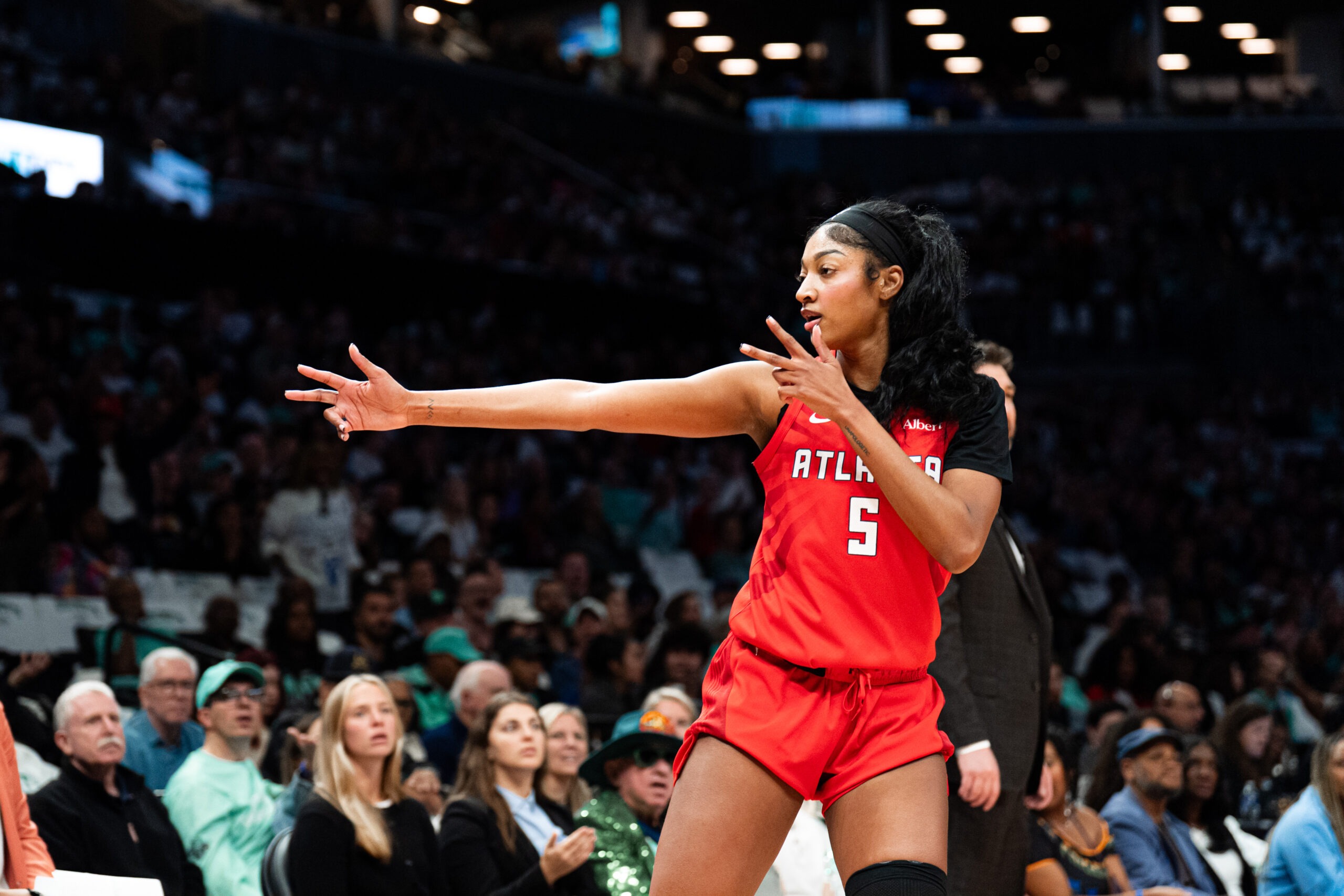
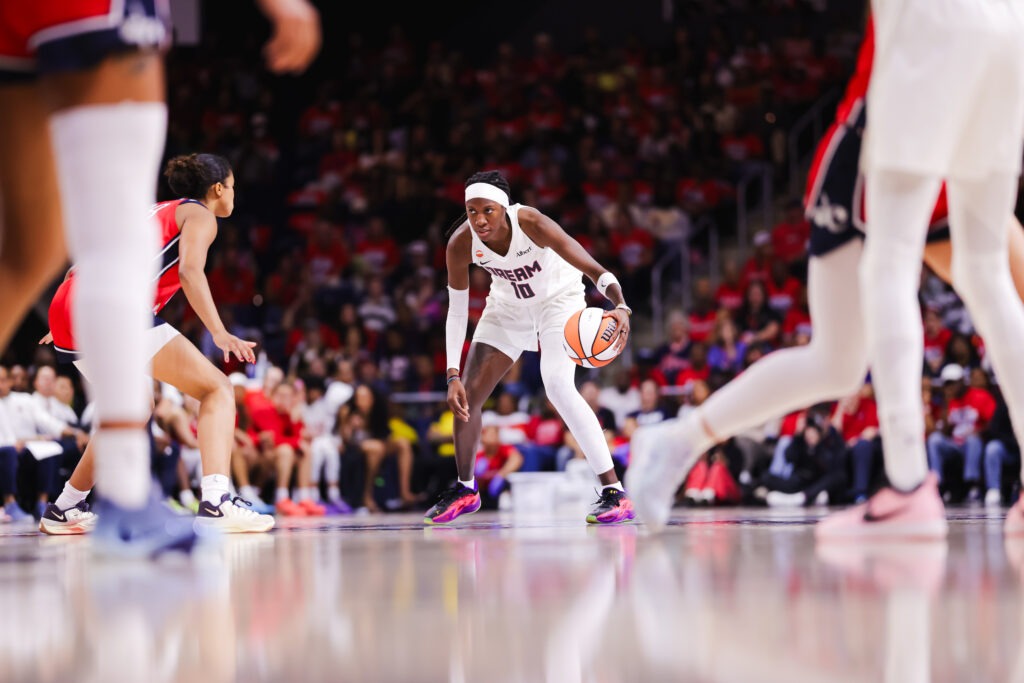
Angel Reese during game 2 – Courtesy photo
One Victory Remains
Atlanta will travel to New York for Game 3 on Friday with an opportunity to end the series and advance to the championship round.
The Dream have demonstrated that they can win without their leading scorer, withstand an exceptional performance by an opposing star, and execute under pressure when every possession matters.
Still, New York has no intention of conceding.
“The series isn’t over,” Liberty coach Chris DeMarco said.
Reese offered a similar reminder that the Dream cannot afford to look ahead.
“New York is a really good team,” she said. “As long as we continue to be who we are, continue to do the things that have gotten us here, and stick together, I think we will be fine.”
For the thousands of fans who waved their towels, cheered through overtime, and celebrated one of the Dream’s most dramatic playoff victories, the possibility of a WNBA championship appearance has moved closer.
Atlanta needs one more win.
Statistical sidebar — By the Numbers
WNBA SEMIFINALS · GAME 2
Atlanta Dream 101, New York Liberty 98 (OT)
Series lead
2–0
Attendance
9,574
Lead changes
17
Dream player
PTS
REB
AST
Angel Reese
23
7
2
Jordin Canada
23
5
8
Rhyne Howard
18
7
4
Naz Hillmon
12
8
5
Isobel Borlase
11
4
—
DeWanna Bonner
10
4
3
Three-point shooting
40%
Free-throw shooting
91.3%
Turnovers forced
17
Points off turnovers
28
Individual milestones: Canada reached 100 postseason assists; Howard surpassed 200 playoff points and moved into fourth place on Atlanta’s postseason steals list.
Truth Seekers Journal thrives because of readers like you. Join us in sustaining independent voices.
DeKalb County launches Resilient DeKalb, a long-term strategy addressing infrastructure, energy, tree canopy and economic resilience while targeting net-zero county operations by 2040.
By Milton Kirby | Decatur, GA | October 6, 2026
A storm can arrive in a matter of hours.
A power outage can last for days.
Extreme heat can push temperatures to dangerous levels, while flooding can overwhelm streets and neighborhoods with little warning.
DeKalb County officials call those events shocks.
But some of the problems that determine how well a community withstands an emergency develop much more slowly.
Aging buildings. Rising utility bills. Lost tree canopy. Deferred maintenance. Household energy costs that leave families with less financial room when something goes wrong.
DeKalb calls those stresses.
A new countywide initiative called Resilient DeKalb is designed to address both.
Supported by DeKalb County Chief Executive Officer Lorraine Cochran-Johnson and led by Chief Resilience Officer Liza Milagro, Resilient DeKalb brings energy, water, buildings, transportation, tree canopy, workforce development and other areas under a long-term strategy aimed at making county operations and communities better able to withstand disruption.
Its goal is ambitious: move DeKalb County operations toward net-zero emissions by 2040 while strengthening the systems residents rely on every day.
The initiative carries the theme: “Reimagine. Regenerate. Restore.”
But underneath the branding is a larger question.
How does a county prepare not only for the emergency it can see coming, but also for the everyday pressures that make recovery harder when the emergency arrives?
Resilience Before the Emergency
At its core, resilience is about preparation.
But under DeKalb’s approach, preparation does not begin when a storm appears in the forecast.
A county building that wastes energy costs taxpayers money every day.
A neighborhood that has lost tree canopy can become hotter during the summer before an extreme heat event arrives.
Deferred maintenance can eventually turn an ordinary repair into an emergency.
Families already struggling with high utility bills may have fewer resources available when a prolonged outage or other disruption occurs.
That is why operational efficiency is central to the county’s approach.
“Every dollar taken out of a utility bill is a dollar available when conditions turn,” the initiative’s planning materials state.
The argument is straightforward: efficiency can reduce everyday operating costs while creating additional financial capacity when something unexpected happens.
In that sense, Resilient DeKalb is attempting to define resilience as more than emergency preparedness or environmental policy.
It is also about how the county manages money, buildings, infrastructure and other resources before the emergency arrives.
A Roadmap to 2040
Resilient DeKalb is the county’s first coordinated resilience program and is organized around the 2040 Resilient Management Plan.
The plan serves as a roadmap for projects involving environmental stewardship, operational efficiency, infrastructure, economic sustainability and community well-being.
Its long-range goal is net-zero county operations by 2040.
The work is organized through a series of themed “flagships,” each beginning with “Re.”
They include ReNew for energy, ReFlow for water, ReBuild for buildings, ReForest for tree canopy, ReSkill for workforce development and ReInvest for financing.
Other areas address emissions, waste, materials, mobility, electric-vehicle charging and storage, equity and health.
Together, the framework illustrates how broadly DeKalb is defining resilience.
A resilience project could involve solar energy or LED streetlights.
It could involve water systems, electric-vehicle infrastructure or a county building in need of improvements.
It could also involve workforce training or efforts aimed at making environmental and economic investments more accessible across the county.
The plan is intended to track projects from planning through implementation.
But a long-range plan is not the same thing as a completed project.
Some initiatives remain in development, and funding, schedules, baseline measurements and approval by the Board of Commissioners will help determine which proposals move forward and how quickly residents see results.
12,000 Trees — and the Cost of Planting Them
One of the most tangible examples is ReForest DeKalb.
The plan calls for planting at least 1,000 trees annually for 12 years, creating a goal of 12,000 additional trees across DeKalb County.
Tree canopy provides more than aesthetics.
Trees can reduce summer surface temperatures, slow stormwater before it reaches drainage systems and help filter air along heavily traveled corridors.
But ReForest also demonstrates the financial challenge of turning a long-term goal into reality.
The program is expected to draw on the DeKalb County Tree Fund, which receives money under the county’s tree ordinance for planting and tree care, along with philanthropic contributions and other program revenue.
Since 2018, the Tree Fund has received $1,282,696 and invested $440,170 in planting and tree care, according to information provided with the resilience plan. That leaves a reported balance of $842,526.
At the same time, planting costs are increasing.
The price of a 15-gallon tree is expected to rise from $300 to $375 for the 2026-27 planting season, with another increase proposed for the following season.
That means the same amount of money will buy fewer trees.
The math illustrates one of the central challenges facing the entire resilience plan.
Setting a goal is one step.
Paying for it year after year is another.
Milagro Takes the Lead
Responsibility for turning the broader vision into measurable projects falls largely to DeKalb’s Office of Resilience and Milagro, the county’s first Chief Resilience Officer.
Milagro brings more than 15 years of experience in sustainability, resilience, climate initiatives and environmental programs across the public and private sectors.
Before joining DeKalb County, she held leadership positions at Hartsfield-Jackson Atlanta International Airport, worked with the Georgia House of Representatives and served with international sustainability organizations.
Her experience at Hartsfield-Jackson is particularly relevant to her new assignment.
An airport operates much like a small city, with buildings, transportation systems, energy demands, waste streams, infrastructure and millions of people moving through it.
At Hartsfield-Jackson, Milagro created the #GreeningATL initiative. According to DeKalb County, programs developed during her tenure helped the airport achieve a 58 percent waste-diversion rate and redirect more than one million meals to families in need.
Her work also included energy performance, emissions reduction, renewable energy and infrastructure planning.
Now the scale is different.
Instead of applying those principles to an airport, Milagro is helping apply them across a county of neighborhoods, government buildings, roads, utilities and public services.
She presented the 2040 Resilient Management Plan to the DeKalb County Board of Commissioners’ Committee of the Whole on Sept. 10.
One Name, an Important Distinction
The name Resilient DeKalb predates the current countywide rollout.
Earlier in 2026, Commissioner Ted Terry introduced an initiative under the Resilient DeKalb name that grew from work associated with the DeKalb Green New Deal.
That effort emphasized environmental justice, sustainable land use, utility protections and community participation.
The countywide program now being advanced through the Office of the CEO and Office of Resilience reaches more directly into county government operations and infrastructure while also incorporating environmental, economic and equity goals.
The relationship between those efforts deserves clarification as the new program develops.
That distinction matters because residents trying to follow Resilient DeKalb should be able to understand who is responsible for individual projects, where funding comes from and which proposals have received county approval.
Resilient DeKalb
From Vision to Results
Resilient DeKalb presents an expansive vision.
The harder work comes next.
Over the coming years, residents will have ways to judge whether that vision is becoming reality.
How many trees actually get planted?
How much money does DeKalb save through energy efficiency?
Which county buildings are upgraded?
How much do those improvements cost?
Where will new infrastructure be located?
Who receives workforce training?
Which neighborhoods receive investments first?
And how will the county pay for it?
Those questions are particularly important for a plan extending to 2040.
Administrations will change. Commissioners will change. Economic conditions will change. Technology will change.
The resilience plan will have to survive those changes if its long-term goals are to be reached.
That may ultimately be the most meaningful test of Resilient DeKalb.
A storm, flood, heat wave or prolonged outage will eventually test the county’s physical systems.
Long before that happens, however, budgets, implementation decisions and measurable results will test the plan itself.
Resilience is difficult to measure when nothing has gone wrong.
Its value becomes clearer when something does.
DeKalb County’s premise is that the work required to withstand that moment should begin long before it arrives.
Truth Seekers Journal thrives because of readers like you. Join us in sustaining independent voices.
Explore how AI is transforming driving with smart assistance, predictive safety, navigation, diagnostics, and autonomous technology, while keeping drivers informed, engaged, and responsible.
By Florita Bell Griffin, Ph.D. | Houston, TX | October 6, 2026
For most of automotive history, the relationship between a person and a car was straightforward. The driver steered, accelerated, braked, watched the road, and made nearly every important decision. The vehicle responded mechanically to human commands. Modern vehicles are changing that relationship because computers increasingly watch the road alongside the driver and, in some situations, intervene before the person does.
Many drivers already own vehicles with technology that would have sounded futuristic a generation ago. A car may warn that another vehicle is in the blind spot, apply the brakes when a collision appears likely, maintain a selected distance behind traffic, help keep the vehicle centered in a lane, recognize road signs, monitor tire pressure, display a camera view of the surroundings, or guide the driver into a parking space. None of these features requires a humanoid robot sitting behind the steering wheel. Artificial intelligence in transportation often appears quietly through sensors, cameras, software, and automated assistance.
The distinction between driver assistance and self-driving is important because the terms are often blurred in advertising and everyday conversation. The National Highway Traffic Safety Administration says that the driver remains responsible at the lower levels of automation used in consumer vehicles today. Level 1 systems may assist with either steering or acceleration and braking, while Level 2 systems can assist with both at the same time, but the human driver is still expected to remain fully engaged and attentive.
That means a vehicle capable of maintaining speed, following traffic, and helping steer on the highway is not automatically a fully autonomous car. The technology can reduce workload, particularly during long highway drives, but the person behind the wheel remains responsible for monitoring conditions and being prepared to respond. The difference matters because a driver who misunderstands what the system can do may stop paying enough attention precisely when attention is still required.
Automatic emergency braking provides a good example of how these technologies can be valuable without replacing the driver. Sensors may detect that the vehicle is closing rapidly on an obstacle and apply the brakes when the driver has not reacted quickly enough. The system may reduce the severity of a collision or help avoid one altogether. Blind-spot monitoring can warn that another vehicle is difficult to see, while rear cross-traffic warnings can alert a driver backing out of a parking space.
These features are essentially extra sets of electronic eyes, but electronic eyes are not perfect. Cameras can be affected by darkness, glare, weather, dirt, road markings, or unusual conditions. Sensors can misunderstand an environment, and software works within the limits established by its design. Human beings also make mistakes, of course, which is one reason driver-assistance technology exists. The safest relationship may be one in which the machine and the driver support one another rather than either being treated as infallible.
Navigation has already demonstrated how quickly people can become comfortable allowing technology to influence driving decisions. Few drivers now think twice about following a route suggested by a phone or dashboard system. Traffic data can identify congestion, accidents, road closures, and faster alternatives in real time. AI can help estimate arrival times and continually adjust the route as conditions change.
Yet anyone who has used navigation for long enough has also experienced its limitations. The system may direct a driver toward an inconvenient entrance, recommend a route through an uncomfortable neighborhood, fail to understand temporary construction, or insist on a turn that local knowledge says makes no sense. Most people eventually learn the right relationship: appreciate the assistance but remain willing to disagree.
The same lesson applies to more advanced vehicle intelligence. Drivers need to understand what their particular car can actually do rather than relying on a general impression created by the name of the feature. Terms such as “pilot,” “assist,” or other branded language can sound more capable than the underlying technology. Reading the owner’s manual may not be exciting, but understanding when a system works, when it may disengage, and what the driver must continue monitoring is part of safely using the vehicle.
AI is also changing what happens before a car breaks down. Modern vehicles generate enormous amounts of diagnostic information. Sensors monitor engines, batteries, emissions, tire pressure, electrical systems, and other components. Increasingly intelligent diagnostic tools can help technicians identify patterns and narrow down likely problems faster than older methods allowed.
For electric vehicles, software plays an especially central role because battery management, charging, energy efficiency, temperature control, and range prediction depend heavily on computerized systems. The vehicle may learn from driving patterns and adjust estimates based on conditions. Over time, cars may become better at predicting maintenance needs before a component fails, giving owners an opportunity to address problems earlier.
Parking is another area where the relationship between driver and machine is changing. Cameras now create overhead views that appear to look down on the vehicle from above. Parking sensors measure distance from nearby objects, while automated systems may steer into a space with limited input from the driver. Features that once appeared only on expensive luxury vehicles have gradually moved into more ordinary models.
The longer-term future goes further. Higher levels of automated driving are designed for situations in which the system performs more of the driving task, eventually reaching the point where occupants may function as passengers rather than drivers. NHTSA currently distinguishes these advanced levels from the driver-assistance technology available in ordinary consumer vehicles and notes that full automation is not currently something consumers can simply purchase for unrestricted use on all roads.
If truly autonomous vehicles become common, the consequences could extend far beyond convenience. Older adults who no longer drive might retain greater mobility. People with certain disabilities could gain new transportation independence. Long-distance freight could change, parking needs might decline in some places, and cities could eventually reconsider how roads, curbs, garages, and transportation systems are designed.
There are also everyday questions about responsibility. If a vehicle assists with steering and the driver stops paying attention, who is responsible when something goes wrong? What happens when software behaves differently after an update? How should drivers be told when a feature changes? These questions become increasingly important as vehicles begin to resemble computers on wheels.
Privacy enters the discussion as well. Connected vehicles can generate information about location, driving behavior, vehicle performance, and use of onboard services. Drivers should become more accustomed to asking what information a vehicle collects, which services receive it, and what controls are available. Buying a car increasingly involves accepting a digital relationship with the manufacturer as well as purchasing a physical machine.
The most important point for everyday drivers is that artificial intelligence in cars is not arriving all at once. It is arriving one feature at a time. A warning light becomes a predictive alert, cruise control becomes adaptive, a rearview mirror is supplemented by cameras, and steering assistance becomes more sophisticated. Each improvement feels small until we look back and realize how much of the driving experience has changed.
Drivers do not need to fear these developments, and they do not need to pretend the technology is more capable than it is. The wisest approach is to understand exactly what the vehicle is doing and remain engaged wherever human responsibility remains necessary.
Cars are becoming more intelligent, but intelligence in a machine does not automatically eliminate the need for intelligence from the person using it. The safest future may depend on drivers who understand both sides of that relationship and know when to accept assistance, when to remain alert, and when to take control.
The Atlanta Dream opened the 2026 WNBA Semifinals with a statement 92-82 victory over the New York Liberty, forcing 21 turnovers and tying a WNBA postseason record with 32 points off turnovers. Led by 25 points from Jordin Canada, 23 from DeWanna Bonner, and a dominant all-around effort from Angel Reese, Atlanta seized a 1-0 series lead before Game 2 at State Farm Arena.
By Milton Kirby | Atlanta, GA | October 5, 2026
The Atlanta Dream opened their WNBA semifinal series in emphatic fashion Sunday afternoon, riding a dominant second-half defensive effort to a 92-82 victory over the New York Liberty at State Farm Arena.
For much of the first half, Atlanta struggled to find its rhythm offensively and trailed 40-37 at the break. But the Dream once again proved why they have become one of the league’s hottest teams, turning a close contest into a commanding lead with a suffocating third-quarter performance that changed the course of the game.
“We knew the first three minutes would be really important,” said guard Jordin Canada, who delivered one of the most impressive postseason performances of her career despite battling foul trouble for much of the game.
Atlanta forced 21 turnovers and converted them into 32 points, tying the WNBA postseason record for most points scored off turnovers in a playoff game. The Dream’s relentless defensive pressure produced 14 steals and four blocked shots, overwhelming the Liberty throughout the second half.
The Starting Five of Jordin Canada, Allisha Gray, Rhyne Howard, Naz Hillmon, and Angel Reese improved to 3-0 in postseason play together, continuing to establish themselves as one of the league’s most effective lineups.
Canada led the charge with a game-high 25 points while adding four assists, five steals, one block, and a rebound. Her fifth steal tied the record for most steals in a postseason game, and her ninth point of the evening marked the 200th postseason point of her career.
“She’s the head of the snake on offense and defense,” veteran forward DeWanna Bonner said following the victory.
Bonner provided a massive spark off the bench, scoring 23 points and grabbing nine rebounds. The scoring total set a new personal high for Bonner in postseason play with Atlanta. Her energy proved pivotal during the Dream’s decisive third-quarter run.
The Dream bench contributed 27 points overall, providing valuable depth after a concerning injury scare involving Allisha Gray. The All-Star guard exited in the second quarter with a hand injury and did not return. Despite losing one of their top scorers, Atlanta responded by elevating its defensive intensity and sharing the offensive load.
Howard once again demonstrated her versatility, finishing with 16 points, eight rebounds, eight assists, and a steal while taking on additional ball-handling responsibilities. Reese added another standout postseason performance with 17 points, seven rebounds, two assists, four steals, and three blocks.
The forward delivered one of the game’s biggest baskets when she converted a hook shot late in the fourth quarter to halt a Liberty rally and extend Atlanta’s lead.
Meanwhile, Hillmon impacted the game beyond the box score, contributing four rebounds, four assists, and a steal while helping anchor Atlanta’s defensive schemes.
The Dream’s third-quarter explosion ultimately decided the contest. After entering the half down three points, Atlanta opened the third period with a 13-0 run fueled by aggressive defense and transition scoring opportunities. The Dream outscored New York 32-15 during the quarter, turning nine Liberty turnovers into 16 points.
Despite several late pushes by New York, Atlanta repeatedly answered in clutch moments. Canada punctuated the victory with a corner three-pointer and a late layup that effectively sealed the win.
With the triumph, Atlanta improved its all-time playoff record against New York to 3-2 and seized a 1-0 advantage in the best-of-five semifinal series.
“It’s great to be up 1-0,” Dream head coach Karl Smesko said. “But there’s still a lot of work to be done.”
The Dream will look to take a commanding 2-0 series lead when they host Game 2 on Wednesday night at State Farm Arena.
Support open, independent journalism. Your contribution helps us tell the stories that matter most.
Egbert Perry receives the Four Pillar Award, honoring a career that reshaped urban development while expanding opportunity, innovation and community investment across Atlanta and beyond.
By Milton Kirby | Atlanta, GA | October 2, 2026
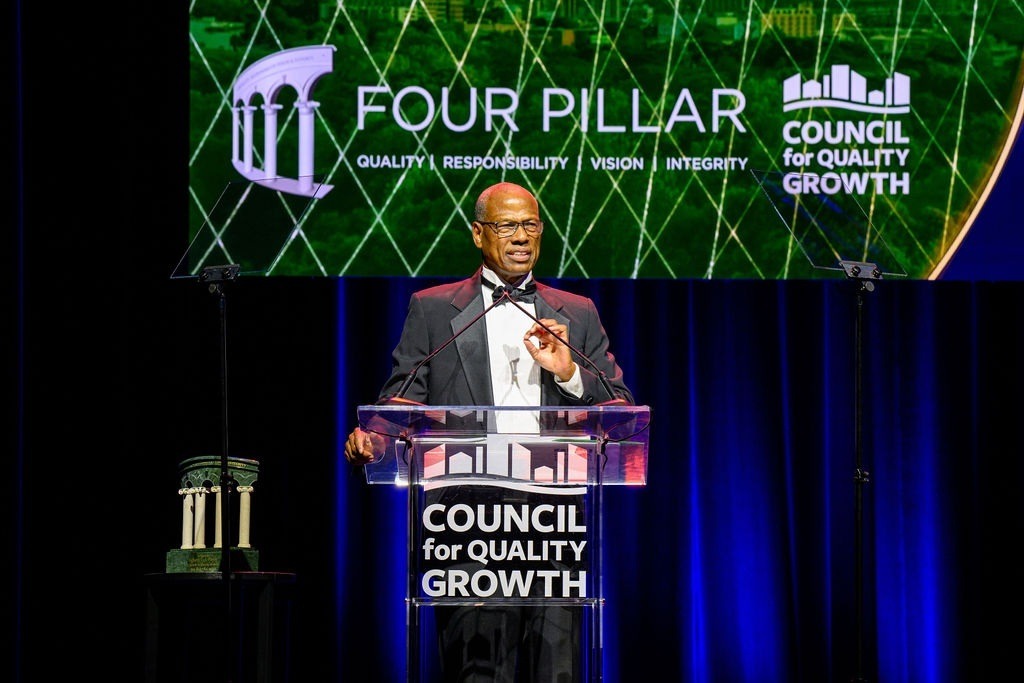
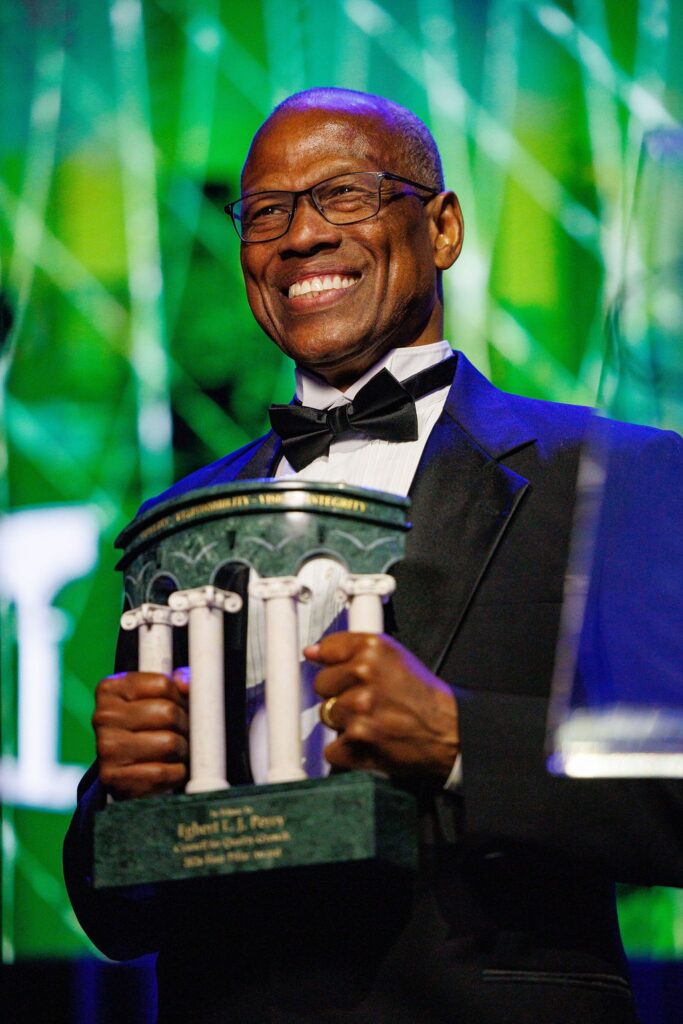
More than 1,300 business, civic and community leaders gathered at the Georgia World Congress Center on Oct. 1 to honor developer and entrepreneur Egbert Perry, who received the Council for Quality Growth’s 2026 Four Pillar Award for a career that has helped reshape Atlanta and influence urban redevelopment efforts across the nation.
The award, presented during the Council’s 37th annual Four Pillar Tribute, recognizes leaders who exemplify the principles of quality, responsibility, vision and integrity in their professional and civic lives.
Perry, chairman and co-founder of The Integral Group, accepted the honor before an audience of colleagues, family members, elected officials and business leaders. The evening’s theme, “Integrity. Innovation. Impact.”, reflected the values that have guided Perry’s work for more than four decades in real estate development, finance and community building.
“Atlanta became stronger because more people were allowed to participate in building it,” Perry said during his acceptance speech. Reflecting on the city’s history of expanding economic opportunity, he challenged the audience to continue creating pathways for broader participation and leadership.
Perry’s story is closely tied to Atlanta’s rise as a center for business, entrepreneurship and urban revitalization. Originally from Antigua, he built a career that merged engineering, finance and community development. An honors graduate of the University of Pennsylvania, Perry earned bachelor’s and master’s degrees in civil engineering and an MBA from the Wharton School before beginning a career in real estate development.
Before founding Integral in 1993, Perry spent 13 years helping grow an Atlanta-based real estate and construction company into what became the nation’s third-largest African American-owned business.
Over the last three decades, however, it is his work through Integral that has had perhaps the most lasting impact. Co-founded with a mission to “create value in cities and rebuild the fabric of communities,” the Atlanta-headquartered firm has grown into a national development and investment company with approximately 300 employees and active projects in more than 25 U.S. cities.
Under Perry’s leadership, Integral has developed more than 10,000 housing units through mixed-use developments, master-planned communities, transit-oriented projects and multifamily housing developments. The company has become nationally known for advancing development strategies that combine economic growth with community investment.
One of Integral’s most influential projects was Centennial Place, a redevelopment initiative launched in 1996 in partnership with the Atlanta Housing Authority and other collaborators. Conceived by Integral, the project transformed a distressed public housing site into the nation’s first urban mixed-use, economically integrated community, combining mixed-income housing with educational, health, recreational and social services.
Egbert Perry – Council for Quality Growth
The U.S. Department of Housing and Urban Development later recognized Centennial Place as a national model for neighborhood revitalization. Its framework has since been replicated more than 250 times across the country, helping establish what is now widely viewed as a standard approach to holistic community redevelopment.
Speakers throughout Thursday’s ceremony highlighted how Perry’s work has consistently sought to balance economic development with community advancement.
Council for Quality Growth Chair Gerald McDowell said Perry’s influence can be measured not only in buildings and developments but also in opportunities created for others.
“His visionary leadership and unwavering commitment to building stronger communities have helped shape our region’s growth and continue to inspire the next generation of leaders,” McDowell said.
In remarks centered on the award’s four pillars, several longtime colleagues and family members reflected on Perry’s legacy.
Renee Lewis Glover, chief strategy officer and co-founder of Coretto Associates, spoke about Perry’s commitment to quality and his belief that successful communities begin with recognizing the value and dignity of every individual.
“For Egbert, quality begins with one fundamental truth: Every human being has God-given value,” Glover said. “It shapes the standard he brings to what we build, how we lead and what we ask of ourselves.”
Commercial real estate executive T. Dallas Smith described Perry as a mentor, business partner and friend whose sense of responsibility extends long after projects are completed. He pointed to Perry’s continued involvement in community and educational initiatives connected to developments he helped create, arguing that business responsibility and community responsibility are inseparable.
Perry’s daughter, Rian Smith, highlighted her father’s vision, describing his willingness to challenge accepted assumptions and imagine new possibilities for cities and neighborhoods.
“My father’s vision is about refusing to accept that the future must be limited by what we inherited,” she said. “Not simply seeing what does not yet exist, but believing, and then proving, that what exists today does not have to define what comes next.”
Perry’s influence has extended beyond development projects. Following the 2008 financial crisis, he joined the board of mortgage finance giant Fannie Mae and later served as chairman from 2014 to 2018, helping guide the organization during a pivotal period in the nation’s housing recovery.
From left to right: Gerald McDowell, Larry Gellerstedt III, Renee Lewis Glover, Egbert Perry, Rian Smith, Miguel Southwell, T. Dallas Smith, and Michael Paris – Courtesy photo
Throughout the evening, speakers returned to the theme Perry selected for the tribute.
For Perry, integrity means maintaining trust and commitment through long and often complex development projects. Innovation has meant advancing ideas such as mixed-income housing and large-scale public-private partnerships long before they became mainstream practices. Impact, he has said, is measured not simply by buildings constructed but by whether communities are stronger, more resilient and better positioned for future prosperity.
“History tends to reward those who inherit advantage, but it is changed by those who question it,” Perry reflected in tribute materials distributed at the event. “Integrity is the clarity to see what is wrong, innovation is the resolve to try something different, and impact is the quiet proof that a different path was always possible.”
The Four Pillar Award is widely regarded as one of metro Atlanta’s highest civic honors. Previous recipients include former Atlanta Mayor Shirley Franklin, businessman Arthur M. Blank, Ambassador Andrew Young, former Gov. Nathan Deal, Delta Air Lines CEO Ed Bastian and the H.J. Russell Family.
In recognizing Perry, the Council for Quality Growth added another influential figure to a list of leaders whose work has helped define modern Atlanta and shape the future of urban development across the United States.
As Perry closed his remarks, he reminded attendees that the future of the city remains a collective responsibility.
“Atlanta, the region and the world are shared projects,” he said. “It is time for us to get back to work on our group projects.”
Truth Seekers Journal thrives because of readers like you. Join us in sustaining independent voices,
Atlanta Dream sweep Washington Mystics behind a decisive fourth-quarter surge, advancing to the WNBA semifinals for the first time since 2018.
By Milton Kirby | Washington, D.C. | October 1, 2026
The Atlanta Dream spent much of Wednesday night battling foul trouble, a rebounding deficit and a Washington Mystics team that kept threatening to take control.
Each time, Atlanta found an answer.
The biggest came in the fourth quarter.
The Dream responded to Washington cutting its lead to three with 13 unanswered points and pulled away for a 93-75 victory at CareFirst Arena, completing a two-game sweep and advancing to the WNBA semifinals for the first time since 2018.
The victory also marked Atlanta’s first playoff series win since 2016.
“All we cared about was winning and advancing, and everyone did their part,” Dream Head Coach Karl Smesko said.
They did.
All five Atlanta starters scored in double figures, led by Allisha Gray with 22 points.
Jordin Canada finished with 19 points, 11 assists and seven rebounds for her third career postseason double-double. More importantly, she scored 13 points in the fourth quarter when Atlanta needed them most.
“JC hit a lot of big baskets for us tonight,” Gray said. “She’s really our engine. She played so great for us.”
The final score did not reflect how challenging the night became for Atlanta.
Washington Keeps Coming
The Dream built a 13-point lead during the first half, but Washington closed the second quarter with a run that cut Atlanta’s advantage to 41-35 at halftime.
Atlanta shot just 34.4 percent in the first half and was being dominated on the boards.
Defense kept the Dream in control.
Washington committed 11 first-half turnovers, which Atlanta converted into 15 points.
Then foul trouble complicated matters.
Angel Reese picked up her third foul with 8:30 remaining in the third quarter and her fourth a little more than two minutes later.
Canada picked up her fourth with 3:53 remaining in the period.
Rhyne Howard was called for her fourth with 44 seconds left.
Washington took advantage, closing the quarter on a 10-2 run and cutting Atlanta’s lead to 65-58.
Howard and Reese returned to begin the fourth quarter. On Washington’s first possession, Howard was called for her fifth foul.
She stayed in the game.
Then the Mystics grabbed two offensive rebounds to extend a possession that ended with a layup.
Atlanta’s lead was down to three.
The Dream had reached the kind of moment that had caused problems before.
“I think last year we would get big leads, and then we would lose them, and then we would lose the game,” Canada said. “And I think this season we really put an emphasis on making sure we’re doing the things that we need to do to close out games.”
On Wednesday, Atlanta closed.
DeWanna Bonner takes a jump shot during playoff game against the Washington Mystics at the CareFirst Arena in Washington, D.C. on Wednesday, September 30, 2026. (Casey Sykes for the Atlanta Dream)
The Run That Changed the Game
Reese started the response with a layup.
Naz Hillmon followed with four points. Reese made two free throws. Howard knocked down a long jumper.
Then Canada buried a 3-pointer.
In a matter of minutes, a three-point Atlanta lead had become a 16-point advantage.
The Dream had scored 13 unanswered points.
Washington’s comeback was over.
Canada’s fourth-quarter performance helped turn what had become a tense road playoff game into an 18-point victory.
Howard and Reese each finished with 15 points, while Hillmon added 10.
Reese also had seven rebounds and three blocks. Howard added four assists and two steals.
Atlanta found ways to win despite being outrebounded 42-27. Washington’s Kiki Iriafen grabbed 16 rebounds, while Sonia Citron led the Mystics with 25 points.
But the Dream made Washington pay for its mistakes.
Atlanta forced 19 turnovers and converted them into 23 points while committing only eight turnovers of its own.
The Dream also made 13 3-pointers while shooting 40.6 percent from behind the arc, tying the franchise postseason record for 3-pointers in a game. Atlanta shot 90.9 percent from the free-throw line.
The numbers told the story of a team that did not need everything to go right to win.
Finishing the Series
Atlanta entered Washington with a chance to close the series after winning Game 1, 92-77, at State Farm Arena.
That opening victory was powered largely by defensive pressure. The Dream overcame an 11-point deficit, forced 23 turnovers and recorded a franchise postseason-record 16 steals.
Game 2 presented a different challenge.
This time, Atlanta had the lead and had to protect it.
Washington won the rebounding battle. The Mystics attacked while Atlanta’s starters accumulated fouls. And when the Dream appeared ready to pull away, Washington repeatedly worked its way back into the game.
But Atlanta never surrendered the lead.
The Dream won the first quarter 24-17, carried a six-point advantage into halftime and entered the fourth ahead by seven.
When Washington made its final push, Atlanta answered with its biggest run of the night.
That response completed the sweep.
Rhyne Howard looks for a gap during playoff game against the Washington Mystics at the CareFirst Arena in Washington, D.C. on Wednesday, September 30, 2026. (Casey Sykes for the Atlanta Dream)
Back to the Semifinals
Atlanta will now face New York in a best-of-five semifinal series beginning Sunday at State Farm Arena.
The Dream will host Games 1 and 2 and, if necessary, Game 5.
It is another milestone in a season that has already included 30 regular-season victories, tying the franchise record, and home-court advantage in the opening round.
But Wednesday’s victory may have demonstrated something that will matter even more as the competition gets tougher.
Atlanta showed it could win when the game became uncomfortable.
The Dream was outrebounded.
Three starters battled serious foul trouble.
A double-digit advantage dwindled to three.
And with its season not yet in danger but its control of the game suddenly threatened, Atlanta responded with 13 straight points.
Canada had seen the alternative before.
This time was different.
The Dream had learned how to close.
And for the first time since 2018, Atlanta is headed to the WNBA semifinals.
Support open, independent journalism. Your contribution helps us tell the stories that matter most.
Angel Reese becomes the first Atlanta Dream player named WNBA Defensive Player of the Year after a historic season defined by defense and record-setting rebounding.
By Milton Kirby | Atlanta, GA | October 1, 2026
Atlanta Dream forward Angel Reese said it before the regular season was over.
“The Defensive Player of the Year is in Atlanta!”
On Thursday, the league made it official.
Reese has been named the 2026 Kia WNBA Defensive Player of the Year, becoming the first player in Atlanta Dream history to earn the league’s top individual defensive honor.
The award caps a historic first season in Atlanta for Reese, who helped anchor one of the WNBA’s most disruptive defensive units while putting together one of the most productive rebounding seasons the league has seen.
Reese received 46 of 74 votes from a national panel of sportswriters and broadcasters. Golden State Valkyries forward Gabby Williams finished second with 20 votes.
But when Reese received the trophy, she quickly turned the attention toward two of her teammates.
“I have the trophy, but I definitely want Jordin and Rhyne to sign it because I think they deserve it just as much as I do,” Reese said, referring to Jordin Canada and Rhyne Howard. “I’m grateful for Atlanta, I’m grateful for my teammates and my coaches and all the supporting staff that supports us.”
Her reaction reflected the collective nature of Atlanta’s defense.
Reese, Canada and Howard gave the Dream three high-level defensive playmakers capable of pressuring ballhandlers, disrupting passing lanes, switching across positions and creating turnovers.
Reese’s individual impact, however, was difficult to overlook.
She finished the regular season first in the WNBA in Defensive Win Shares at 3.39 and ranked among the league leaders in several other defensive categories.
Atlanta allowed 7.9 fewer points per 100 possessions with Reese on the floor than when she was off it, the largest defensive on-off differential among Dream rotation players.
Reese also averaged 1.8 steals per game, ranking third in the WNBA.
But some of her most important defensive work occurred after opponents missed.
Reese’s ability to end possessions became one of the defining elements of her season.
She averaged 7.3 defensive rebounds per game, ranking fourth in the league, and helped Atlanta limit opponents to a WNBA-low 9.5 second-chance points per game.
Her performance on the defensive glass was part of a record-setting rebounding season.
Reese became the first player in WNBA history to collect 500 rebounds in a single season. She finished with 521 total rebounds and set league records for total rebounds and offensive rebounds.
She also established a WNBA single-game record when she grabbed 26 rebounds against the Los Angeles Sparks in August.
Rebounding was hardly her only contribution.
Reese finished the regular season averaging a career-high 16.4 points and a league-leading 12.1 rebounds per game. She also set a WNBA record with 32 double-doubles.
Those numbers earned Reese WNBA Peak Performer honors as the league’s leading rebounder. She was selected to her third consecutive WNBA All-Star Game and became the first player in Dream history to earn Eastern Conference Player of the Week honors in three consecutive weeks.
The Defensive Player of the Year award, however, carries particular significance for a Dream franchise that entered the WNBA in 2008.
No Atlanta player had won it before.
Reese changed that in her first season with the organization.
She did it while playing alongside Canada and Howard, whose pressure and activity helped establish defense as a defining part of Atlanta’s identity.
The Dream finished the regular season 30-14, tying the franchise record for victories and earning the No. 4 seed in the WNBA playoffs.
For Reese, the individual recognition provides another milestone in a season already filled with them.
But her first reaction to receiving the trophy may say as much about Atlanta’s defensive success as the statistics themselves.
The trophy belongs to Reese.
One of the first things she wanted to do with it was have Canada and Howard sign it.
For a player whose individual honor grew out of Atlanta’s collective defensive identity, it is a fitting way to mark the first Defensive Player of the Year award in Dream history.
And Reese made clear that she does not consider the award an ending.
“This is just the beginning.”
Support open, independent journalism. Your contribution helps us tell the stories that matter most.
What Happens When AI Becomes Part of Healthcare? What Patients Should Know Before the Machine Helps Make the Decision
By Florita Bell Griffin, Ph.D. | Houston, TX | September 29, 2026
For most of modern creative history, people had a reasonably intuitive understanding of authorship. A writer wrote a book, a photographer took a photograph, a musician composed a song, and an artist painted a picture. Questions of ownership could still become complicated, particularly when employers, publishers, contracts, or collaborations were involved, but the connection between human creator and creative work was usually easy to see.
Generative artificial intelligence has made that connection far more complicated. A person can now type a few sentences and receive an original-looking image, song, essay, voice recording, video, logo, or design. The result may never have existed before, yet the person who requested it may not have physically drawn, photographed, performed, or written most of what appears. This raises a simple-sounding question with a surprisingly complicated answer: Who owns it?
In the United States, copyright protection has traditionally been based on human authorship. The U.S. Copyright Office stated in its 2025 report on AI and copyrightability that material produced by generative AI can receive copyright protection when sufficient human-authored expression is involved, but purely AI-generated material is not protected merely because a person supplied prompts. The Office also explained that using AI as a tool does not automatically prevent a larger human-created work from qualifying for copyright.
For everyday users, the easiest way to understand this is to think about creative control. If someone asks an AI system to “create a beautiful sunset over the ocean” and simply accepts the first image, the human contribution may be limited. If a person creates original material, repeatedly modifies elements, combines AI-generated portions with substantial human work, edits the composition, and makes creative choices about the final result, the analysis becomes different.
The exact legal outcome can depend on the particular work and circumstances, so people creating valuable commercial material should seek appropriate legal advice. The broader principle, however, is useful for everyone: asking a machine to make something and personally authoring the creative expression are not necessarily the same thing.
The issue becomes even more interesting with photography. Suppose someone uploads a family photograph to an AI system and asks it to change the background, improve the lighting, alter clothing, or create a painting based on the image. The original photograph may already have a human photographer whose copyright exists independently of the AI-generated version.
People often assume that because they appear in a photograph, they automatically own the photograph. Copyright generally belongs initially to the photographer unless some other legal arrangement changes that result. This is one reason professional photography agreements often specify what the customer may reproduce, publish, or distribute.
Voice raises another set of questions because a voice is not simply a piece of creative content. It is part of a person’s identity. AI voice-cloning technology can reproduce the sound of someone speaking words that person never said. This creates issues involving consent, impersonation, privacy, publicity rights, fraud, contracts, and other laws that go beyond ordinary copyright.
The U.S. Copyright Office devoted the first part of its AI report to digital replicas and recommended federal legislation addressing unauthorized replicas of a person’s voice or appearance. That demonstrates how quickly the idea of digital identity is becoming a serious legal and social issue.
Everyday people should begin thinking of their voices as digital assets. A recording posted publicly can potentially become material from which technology learns vocal characteristics. The same is true of video. People who once thought nothing of posting long recordings of themselves online may increasingly want to consider how those recordings could be reused.
This is especially relevant to performers, speakers, teachers, musicians, influencers, actors, executives, and anyone whose voice or appearance has professional value. A contract allowing a company to use a recorded performance may need to address whether the material can also be used to generate future synthetic performances.
Writing creates another interesting boundary. Many people now use AI to improve emails, articles, reports, books, advertising copy, and social-media posts. If the person begins with original ideas and writing and uses AI mainly for editing, restructuring, or assistance, the human creative contribution remains clear. If the machine generates nearly everything and the user merely accepts it, the situation becomes less straightforward.
The safest practice for creators who want to maintain a strong record of human authorship is to preserve their own contribution. Keep drafts, notes, outlines, revisions, source materials, photographs, sketches, or other evidence showing how the work developed. These records can demonstrate that AI functioned as a tool within a broader human creative process rather than serving as the only source of expression.
Ownership also depends on the terms of the AI service being used. A platform may allow users broad rights to use outputs while imposing other conditions through its terms of service. Those terms can change, and commercial users should understand them rather than assuming every AI service operates under the same rules.
Businesses face additional concerns when employees create material with AI. A worker may use a generative system to create a company logo, advertisement, training manual, presentation, or design. The company should understand what tool was used, what source material was entered, and what rights exist in the resulting work.
There is also the question of what was used to train generative AI systems in the first place. Writers, artists, publishers, photographers, and other creators have raised significant questions about whether copyrighted works can be used for AI training and under what circumstances. The Copyright Office has separately examined those issues, which remain part of an evolving legal and policy landscape.
For ordinary users, the important point is that “AI made it” does not answer every ownership question. One must still ask what human material went in, who contributed creative expression, what platform terms apply, whether another person’s image or voice was used, and whether the final work will be used privately or commercially.
Consent may become as important as ownership. A person might legally possess a photograph of a friend but still create serious ethical problems by using that photograph to generate embarrassing or deceptive material. The ability to create something does not automatically create the right to use another person’s identity however we choose.
Families will face these questions too. Parents may use AI to create imaginative pictures of children. Relatives may animate old family photographs or recreate the voice of someone who has died. These uses can be meaningful and emotionally powerful, but they also introduce questions about dignity, consent, memory, and the line between preserving history and manufacturing events that never happened.
Technology has made creation easier than ever before, but easier creation requires more thoughtful decisions about authorship and responsibility. We are entering a period in which people may possess thousands of digital objects that were partly created by humans and partly created by machines. The most useful question may therefore be larger than “Who owns this?” We may also need to ask who authored it, who consented to it, what source material contributed to it, what rights were granted, and how honestly the final work is being presented.
Artificial intelligence has opened extraordinary creative possibilities to people who may never have considered themselves artists, writers, musicians, or designers. That expansion of creativity can be exciting. It also means that ordinary people now encounter questions once reserved for publishers, lawyers, studios, and professional creators.
In the AI era, creativity is becoming easier to produce while authorship is becoming harder to define. Understanding that difference will be increasingly important for anyone who wants to create, publish, sell, share, or protect digital work.
Atlanta Dream defense forced 23 turnovers and a postseason-record 16 steals in a 92-77 Game 1 playoff victory over the Washington Mystics.
By Milton Kirby | Atlanta, GA | September 28, 2026
For much of the first half Sunday, the Atlanta Dream did not look like the team that had surged into the WNBA playoffs with home-court advantage.
Shots were not falling. Washington was finding open looks. Atlanta fell behind by double digits.
Then the Dream turned to the part of its game that did not require the ball to go through the basket.
Defense
Atlanta forced 23 turnovers, recorded a franchise postseason-high 16 steals and overcame an 11-point deficit to defeat the Washington Mystics 92-77 at State Farm Arena in Game 1 of their best-of-three first-round playoff series.
“A good way to start the series, but we know we have to get another win,” Dream head coach Karl Smesko said. “That’s what we plan to do.”
The victory gave Atlanta a 1-0 series lead heading into Game 2 Wednesday in Washington and improved the Dream’s all-time postseason record against the Mystics to 7-4.
Rhyne Howard led Atlanta with 26 points and five steals. Allisha Gray added 22 points, while Angel Reese recorded 13 points and 12 rebounds in her playoff debut.
DeWanna Bonner scored 13 points off the bench, and Jordin Canada finished with 10 points and 10 assists.
But the numbers that told the story were 23 and 27.
Atlanta forced Washington into 23 turnovers and converted those mistakes into 27 points.
Howard dribbles up court – courtesy photo
Those extra possessions helped the Dream overcome a difficult start.
Atlanta missed nine of its first 10 shots and trailed 14-5 with 5:14 remaining in the first quarter. Washington eventually pushed its advantage to 11 before the Dream began working its way back into the game.
“We realized that they were getting too many easy looks,” Howard said. “We didn’t show up with the aggressiveness that we’ve had the last four games before this.”
Atlanta recovered enough to cut Washington’s lead to 26-21 by the end of the first quarter but still trailed by five at halftime.
Reese and Gray combined to shoot 4-of-22 during the first half, leaving Atlanta searching for another way to change the game.
It found it on defense.
The Dream opened the third quarter with seven unanswered points to take a 43-41 lead.
Then Bonner helped change the energy of the game.
The veteran forward scored 11 of her 13 points during the third quarter as Atlanta turned a halftime deficit into control of the game. Bonner’s ninth point of the night also pushed her past 1,300 career postseason points.
“She made so many big plays for us, and the enthusiasm she played with, the joy of playing basketball, was huge for us,” Smesko said.
Atlanta kept coming
Gray’s layup pushed the lead to 10. Reese completed a three-point play to make it 61-48, and Gray followed with a jumper in the lane as Atlanta took control.
By the end of the third quarter, the Dream led 65-53.
Washington made just three of 15 shots during the period. Six Mystics turnovers became 14 Atlanta points.
“We let them get comfortable offensively,” Washington guard Sonia Citron said. “We let some of our discipline slip. Once they get going, it’s really hard to stop them.”
Smesko gave Washington another challenge early in the fourth quarter when he put Reese and rookie center Madina Okot on the floor together, a combination Atlanta rarely used during the regular season.
Okot responded immediately.
She scored on a layup assisted by Reese, then made a steal and found Howard for a 3-pointer that extended Atlanta’s lead to 70-53.
“We hoped she would be an X-factor for us,” Smesko said.
Okot finished with four points, five rebounds, a steal and a block in her first postseason appearance. Reese, Okot and Isobel Borlase all made their WNBA playoff debuts Sunday.
Washington, however, was not finished.
The Mystics took better care of the basketball as the fourth quarter progressed, forcing Atlanta to operate more frequently in the half court. The Dream’s offense again began to slow, and Washington cut what had been a 17-point Atlanta lead to 81-74 with 3:26 remaining.
Smesko called timeout.
He returned with Canada, Reese, Bonner, Gray and Howard.
This time Atlanta closed the door.
Reese grabbed an offensive rebound to keep one possession alive. Canada extended it again with a steal. Gray completed the sequence with a three-point play that restored Atlanta’s lead to 10 with 2:41 remaining.
Bonner stopped Washington’s next possession with a defensive rebound, drew a foul and made both free throws to extend the lead to 86-74 with 2:29 left.
The threat was over
Atlanta’s 16 steals established a franchise high for a postseason game, surpassing the previous mark set in 2011. Howard’s five steals tied the Dream record for a playoff game and moved her into sixth place on the franchise’s postseason steals list.
Canada moved into fifth place on Atlanta’s postseason assists list. Her 10-point, 10-assist performance was the second playoff double-double of her career.
Reese delivered one of her own in her postseason debut, finishing with 13 points, 12 rebounds, two steals and a block.
The Dream also made Washington pay at the free-throw line, shooting 96.2 percent.
For Atlanta, the victory demonstrated how its defense can change a game even when its offense struggles.
That may become increasingly important as the postseason moves forward.
The Dream has not advanced beyond the first round of the playoffs since 2018. One more victory would change that.
But Atlanta leaves State Farm Arena knowing that the first half Sunday also offered Washington a blueprint for what the Dream cannot afford to repeat.
“We realize the next game is going to be harder than this one,” Howard said. “What we did in the first half, we can’t have again.”
The Dream has its first playoff victory.
Now it needs one more to advance.
Truth Seekers Journal thrives because of readers like you. Join us in sustaining independent voices.
Lola Renegade examines Colin Kaepernick’s sacrifice, Jay-Z’s NFL partnership, racial justice, power, protest, and the true cost of solidarity in America.cal Commentary
Lola Renegade
What Are You Willing to Lose for Justice?
By Lola Renegade | Atlanta, GA | September 24, 2026
I recently had the opportunity to meet Colin Kaepernick at his book signing in Atlanta, Georgia. Afterward, I read his book overnight, The Perilous Fight, a must read. I came away quite impressed by this young man because he demonstrates something increasingly rare in America, especially Black America: he was willing to lose something for what he believed.
And lose he did. Colin lost the career he had spent most of his life preparing for and potentially millions of dollars in future earnings. He endured ridicule, death threats, political attacks and accusations that he hated the very country he was challenging to live up to its professed ideals. Colin wasn’t protesting America because he hated America. He was demanding that America confront the killing and mistreatment of Black people and the enormous distance between this nation’s promise of liberty and justice for all and the lived reality of too many of its citizens.
Ten years ago, he peacefully lowered himself onto one knee, and America lost its damn mind. Racist white America, and the coloreds who love them, always lose their effing minds when the subject comes up that everyone deserves to be treated as human beings with equal rights and opportunities.
Years later, however, the question that troubles me isn’t merely what America did to Colin Kaepernick. It is what some Black people with the illusion of power failed to do afterward. Too many discovered that their access, influence, and even their voices could be bought cheaply, and apparently with change left over. They had wealth without independence, proximity without courage, and seats at tables where they mistook being welcomed to drink glasses of expensive liquor for actually possessing power. The cost of this liquor is nothing compared to the return for selling out Black people and our culture.
At times, their willingness to accommodate the very structures Colin challenged makes D. W. Griffith’s movie, The Birth of a Nation, seem less like a century-old piece of racist propaganda and more like an audition script they were handed and willingly performed. Colin’s sacrifice exposed an uncomfortable truth: there is a profound difference between having money, having access, and having the courage to exercise power when exercising it might actually cost you something.
But what should we expect from some who sold crack in the Black community, destroying children, youth and families, a pure sense of consciousness? Not hardly.
In 2019, Jay-Z’s Roc Nation entered into a partnership with the NFL (National Football League) involving entertainment and the league’s Inspire Change social-justice initiative. When the inevitable question arose about Colin Kaepernick, Jay-Z argued that we had moved beyond kneeling and needed actionable change.
That statement has bothered me ever since. How in the hell do we get “past kneeling” while the man who took the knee is still paying the price for taking it? How do we get “past kneeling” when people of color are dying in ICE custody, families torn apart in massive deportations, 700,000 and counting Black women who have lost their careers when Donald Trump and his Project 2025 kakistocracy took office, white immigrants being flown in from South Africa to take up residency in America while people of color are forcibly sent to unfamiliar countries?
Who created the urgency that made all this supposed action necessary? Who forced professional football, and America, to confront a conversation it desperately wanted to avoid? Colin did.
If Jay-Z had any sensitivity or clout with the NFL, he would have demanded Colin’s career back. But those of us who have seen this syndicated movie before know that the League was simply looking for an influential Black face – someone who could effectively lead a minstrel show. Someone who would willingly run into the white masters’ burning houses to save the furniture.
We still don’t know what Jay-Z and Roc Nation were paid to take that seat at the NFL table. The financial terms of the deal were never publicly disclosed. But we certainly know what Colin Kaepernick paid for taking a knee.
That is the contradiction I cannot ignore. Colin Kaepernick took a knee for justice; Jay-Z took a seat at the NFL’s collection of racists white billionaires’ table. One challenged institutional power and accepted the consequences. The other chose to work with institutional power and told us it was time for actionable change. We are still waiting for that change but won’t hold our breath.
If only Black people would stop holding up these vacuous buffoons as though they are some semblance of Dr. Martin Luther King, Jr., Ida B. Wells, Malcolm X, Stokley Carmichael, Fannie Lou Hamer, and those of that ilk.
Forty Million Dollar Slaves
William C. Rhoden warned us about this contradiction years ago in Forty Million Dollar Slaves The Rise, Fall, and Redemption of the Black Athlete. We can also add the cockroaches in the other entertainment industries – the Stephen character in Django Unchained. One of Rhoden’s most important concepts is wealth without control. A Black athlete (entertainer) can earn $40 million, $100 million or $300 million. He can even be a billionaire. He can buy mansions, Bentleys, private jets, jewelry and virtually every luxury imaginable. But who owns them? Who controls the league, negotiates the television contracts and writes the rules? Who decides who gets hired, who gets fired and who gets another opportunity?
More importantly, what happens when the highly compensated Black athlete stops entertaining the institution and starts challenging it?
Colin gave us the answer. So did Curt Flood, Mahmoud Abdul-Rauf, Muhammad Ali, and others.
Suddenly the multimillion-dollar athlete discovers exactly where the real power remains. That is why Rhoden’s thesis remains so important. Wealth is not necessarily power; access is not ownership; proximity is not control; representation is not liberation. And having a seat at somebody else’s table does not mean you own the damn table.
To Jay-Z and the rest of you Step-and-Fetchit Black folks, a golden shackle is still a shackle.
Where Were the Rest of the Players?
There is another uncomfortable question Black America should ask: Where were Colin’s fellow NFL, NBA (National Basketball Association), and other professional sports players? The NFL player workforce was predominantly Black—roughly two-thirds of the league around the time Colin began his protest. The NBA is 80% Black. To be fair, Colin was not entirely alone. Eric Reid knelt beside him. Brandon Marshall knelt. Arian Foster, Kenny Stills and others participated in protests, while some players raised fists or demonstrated in other ways. Their courage deserves acknowledgment.
But they represented only a fraction of professional leagues overwhelmingly powered by Black athletic talent. Many others remained standing and many remained silent. Contemporary accounts indicated that some players who sympathized with Colin feared the consequences of joining him.
Afraid of what? Losing a contract, playing time, an endorsement, an owner’s approval or the adoration of fans? Afraid the less-than average white women would no longer want them? If some of the wealthiest and most physically powerful Black men in America believed peacefully joining another Black man in protest could jeopardize their livelihoods, then Rhoden’s argument about wealth without control becomes painfully real.
The NFL could depend upon Black bodies on Sunday afternoon, but could those Black men safely exercise their consciences, if they were in possession of one? Colin became the face of the protest, absorbed the hatred, became the political target and ultimately lost his NFL career while the machine kept humming.
And Where Are We Ten Years Later?
The rest of Black America doesn’t escape this examination either. We kept watching. We bought jerseys, purchased season tickets, paid for sports packages, tailgating at games, watched the commercials and held Super Bowl parties. We continued financing the machine that hates us even while debating what had happened to the man who challenged it. Self-hatred is real. Perhaps Colin’s protest remains uncomfortable because it exposes not merely the courage, or lack thereof, of professional football. It exposes ours.
It is easy to admire courage from the safety of your living room and backyard, or with a bunch of family and friends over eating chicken wings and drinking liquor. It is considerably harder to stand beside the courageous person while the stones are still flying. That is the difference between admiration and solidarity: admiration applauds the person taking the risk; solidarity takes the risk with him/her.
When Equality Feels Like Oppression
There is an observation frequently made about privilege: when people become accustomed to privilege, equality can feel like oppression. Equality isn’t actually oppressing anyone; it is simply removing an advantage someone has become accustomed to possessing simply because of the color of their white skin. When someone accustomed to having the entire table is finally asked to share it, sharing can feel like loss. When someone accustomed to always being heard is finally required to listen, listening can feel like silencing.
The same dynamic becomes visible when an institution accustomed to Black athletes and their minstrel shows entertaining white America encounters a Black athlete demanding that America listen to him. The Black football player is celebrated when he runs, cheered when he catches, rewarded when he tackles and marketed when he entertains. But what happens when he thinks? What happens when he speaks? What happens when he says, “I am not merely your entertainment. I am a citizen. I possess a conscience, and I will use my platform to demand that this country live up to its promises”?
Suddenly protest becomes disrespect, patriotism requires silence, and the multimillion-dollar Black athletes discovers the limits of their perceived power.
Don’t forget, America had the felonious (p)Resident of the White House screaming, “Get that son-of-a-bitch off the field.” Donald Trump, someone who has proven to be even God’s reject, someone who checks every page in the DSM (Diagnostic and Statistical Manual of Mental Disorders).
And then, there was that empty-headed Carolyn Bryant, look-alike (woman who lied on Emmett Till) Fox News host, Laura Ingraham, yelling at LeBron James to, “shut up and dribble” when he made political comments. These are the types of women who have resigned themselves to existing to gain favor and power with racist white men, especially if they are considered powerful. They are plain and simple unconscionable semen receptacles.
Stephen and the Seduction of Proximity
Which brings me to an intentionally uncomfortable metaphor: Stephen, the fictional character from Quentin Tarantino’s Django Unchained.
Stephen is disturbing because he represents something larger than himself. He is enslaved, yet he has achieved unusual proximity to the master. He understands the plantation, its hierarchy and where the power resides. Rather than using that proximity to undermine the system, he becomes deeply invested in protecting the hierarchy that gives him elevated status within it.
That is the metaphor. I am asking whether Black America sometimes produces modern versions of the dilemma Stephen represents: What happens when proximity to power becomes more valuable than solidarity with those without it? What happens when being invited into the house becomes more important than remembering the people still outside? What happens when access itself starts masquerading as liberation?
So, Stephen—I mean, Jay-Z—where are those actionable actions now?
Support open, independent journalism. Your contribution helps us tell the stories that matter most.
White House, Press Freedom, Independent Journalism, First Amendment, Media Access, Freedom of the Press, Journalism, CNN, Politico, Democracy
By Milton Kirby | Atlanta, GA | September 24, 2026
When the White House barred reporters from CNN, MS NOW, and Politico from entering the grounds, revoking or deactivating their press credentials overnight, it was more than a dispute between a president and three major outlets. It was a direct challenge to the principle that the government does not decide what the press may report, a principle those outlets immediately defended through legal action.
For small independent publications like The Truth Seekers Journal, the implications are even more profound. If we had attempted to secure White House media credentials and they were denied or revoked, we would not have the institutional resources to mount a lawsuit, mobilize national legal teams, or wage a public fight for reinstatement. We would simply be silenced.
That reality is precisely why we must lend our voice to this moment.
A Dangerous Precedent
According to multiple reports, the journalists were denied entry the morning after President Trump declared their reporting “fake news,” and security personnel confiscated or disabled their credentials. Legal scholars and press‑freedom advocates have warned that the danger is not only the act itself, but the precedent it sets: if a president can ban coverage he dislikes today, what prevents a future administration from expanding that power tomorrow?
We have seen this pattern before. When President Trump wins a small victory, whether in media conflict, administrative maneuver, or public narrative, he often elevates that moment into a broader justification for further action. This is not speculation; it is a documented pattern of behavior across multiple episodes of press conflict.
Why Independent Outlets Must Speak
Independent journalism is not a luxury in American democracy; it is a cornerstone of First Amendment protections. When large outlets are targeted, smaller ones must recognize that the threat is not isolated. It is structural.
If the White House can remove CNN today, it can ignore or erase independent voices tomorrow, voices that lack the legal, financial, and institutional armor of national networks.
Our publication may not have the reach of CNN or Politico, but we have something equally important: the freedom to speak without fear of government retaliation. That freedom is only real if we defend it when it is threatened, even when the threat is directed at others.
The Stakes for Democracy
A government that chooses which journalists may enter its halls is a government that chooses which truths may be told. That is incompatible with a free society.
The banning of these outlets is not merely a media story—it is a civic story, a constitutional story, and a warning. If independent journalism does not respond, we risk normalizing a future in which access to power is granted only to those who praise it.
Our Position
As a small, independent publication, The Truth Seekers Journal stands firmly against the White House’s decision to ban CNN, MS NOW, and Politico. We stand with every journalist whose credentials were confiscated, every newsroom forced to defend its right to report, and every reader who depends on a free press to understand the world.
Silencing one outlet endangers all outlets. Silencing major outlets endangers the smallest ones first. And silencing the press endangers democracy itself.
Support open, independent journalism. Your contribution helps us tell the stories that matter most.