Florita Bell Griffin, Ph.D.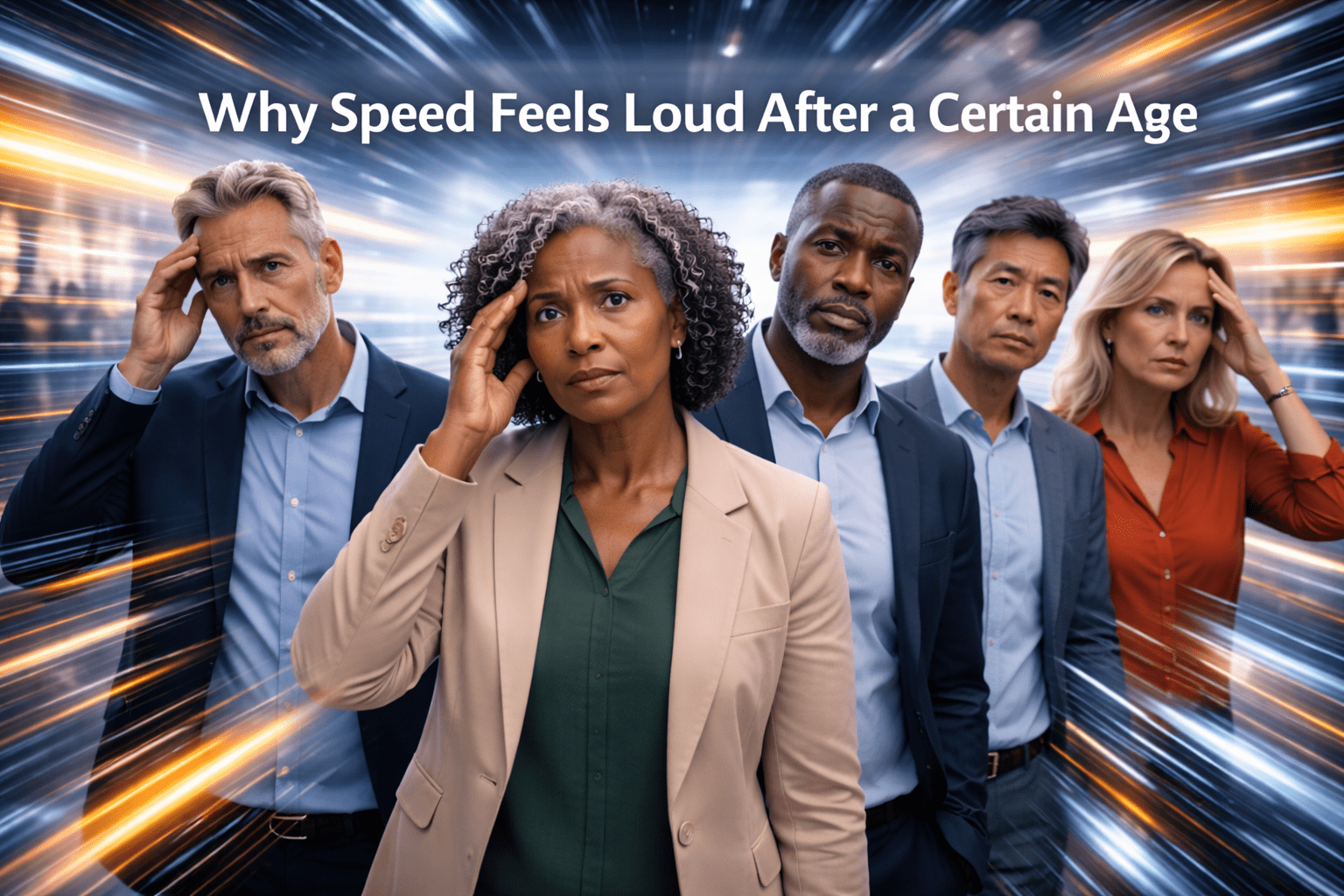
By Florita Bell Griffin, Ph.D | Houston, TX | July 21, 2026
Speed is often treated as a universal good. Faster systems are praised as smarter. Quicker decisions are framed as better decisions. Acceleration becomes synonymous with progress, efficiency, and relevance. In many technological environments, speed is positioned as the primary signal of advancement.
Yet for people who have lived long enough to observe patterns repeat, speed begins to register differently. It does not simply feel fast. It feels loud.
This sensation is not about age in a biological sense. It is about exposure. People who have moved through multiple eras of change have learned that speed amplifies whatever already exists inside a system. When structure is sound, speed can feel exhilarating. When structure is thin, speed becomes destabilizing. Experience sharpens the ability to sense the difference.
Earlier in life, speed often feels forgiving. Consequences are lighter. Recovery is easier. Decisions can be reversed with minimal cost. The environment absorbs error. Over time, people experience situations where rapid movement produces lasting effects. They witness reorganizations that move too quickly to integrate learning. They see technologies deployed at scale before their implications are understood. Speed stops feeling neutral and starts feeling consequential.
Consider an organization that prioritizes rapid iteration above all else. Decisions are made quickly. Features ship continuously. Feedback loops shorten. On the surface, the system appears agile. Yet employees who have lived through previous cycles of acceleration notice familiar signals. Documentation lags behind implementation. Context disappears between iterations. Rationales change without record. The organization moves faster, but understanding struggles to keep pace. Speed becomes noise.
The same pattern appears in communication systems. Messages arrive instantly. Channels multiply. Expectations compress. Response time becomes a proxy for competence. Those with experience recognize how this alters judgment. Faster communication encourages premature conclusions. It rewards reaction over reflection. It fills available attention without increasing clarity. Over time, people begin to experience speed not as efficiency, but as constant interruption.
Speed also changes how systems handle error. Rapid environments often assume mistakes can be corrected quickly. What this overlooks is how errors propagate when systems are tightly coupled. A fast decision made without sufficient context can ripple outward before it is detected. Those who have lived through system failures understand that speed without buffers magnifies impact. What feels agile in the moment can become fragile over time.
This sensitivity grows after people have witnessed consequences unfold slowly. A policy change whose effects appear years later. A technology adoption that reshapes incentives long after rollout. A restructuring that improves metrics while hollowing culture. Memory teaches that not all outcomes reveal themselves at the pace of implementation. Speed feels loud because it drowns out signals that only emerge over time.
Consider a public institution that adopts an automated decision system to increase efficiency. Processing time drops dramatically. Backlogs clear. The improvement is immediate and measurable. Yet experienced observers notice what the system does not capture. Edge cases disappear into averages. Appeals become harder to navigate. Accountability blurs as decisions move faster than explanation. The institution appears more efficient, while trust quietly erodes. Speed has outpaced understanding.
Human lives do not operate at constant velocity. Learning unfolds unevenly. Insight often arrives after delay. Judgment benefits from pause. People with experience recognize that certain forms of knowledge require time to surface. When systems eliminate pause entirely, they eliminate the conditions under which deeper understanding forms.
This does not mean speed is inherently harmful. It means speed requires structure. Without continuity, acceleration becomes overwhelming. Signals blur together. Prior lessons are bypassed. People lose the ability to locate themselves within the system’s movement. The result is not resistance, but withdrawal. Individuals continue to function while disengaging from meaning.
Speed also alters how authority is perceived. In fast systems, authority tends to reside with those who respond quickest rather than those who understand most deeply. Decision-making shifts toward immediacy. Reflection is reframed as delay. Over time, this devalues experience not because it lacks relevance, but because it operates on a different timescale.
People who have lived long enough to feel this shift are not rejecting speed. They are responding to its volume. Speed feels loud when it leaves no room for context to settle. It overwhelms the internal processes that integrate new information with prior understanding. What once felt energizing begins to feel abrasive.
Continuity offers a way to recalibrate. Systems designed with continuity acknowledge that not all intelligence arrives instantly. They create space for sequence, explanation, and integration. They allow speed where it strengthens coherence and slow where it preserves understanding. They recognize that pace is not a single setting, but a variable that must align with consequence.
Consider a system that introduces deliberate checkpoints during rapid change. Decisions move quickly, but rationales are recorded. Transitions are documented. Feedback is contextualized rather than immediately acted upon. In such systems, speed remains present, but it is no longer overwhelming. People stay oriented because the system remembers itself as it moves.
Over time, this distinction becomes critical. Systems that prioritize speed alone tend to burn through trust. Systems that balance speed with continuity gain durability. They move quickly without becoming disorienting. They remain responsive without becoming chaotic.
Why speed feels loud after a certain age is not a mystery. It is a signal. It reflects accumulated awareness of consequence, propagation, and delayed impact. It indicates that the observer has learned how systems behave beyond the moment of action.
As technology continues to accelerate, this perspective becomes increasingly valuable. Systems that dismiss it will continue to optimize for immediacy while destabilizing those inside them. Systems that listen to it gain access to a deeper form of intelligence, one that understands how movement unfolds across time.
Speed will always matter. The question is whether it is governed by structure or allowed to dominate it. The answer determines whether progress remains inhabitable, or whether it becomes something people endure rather than inhabit.
© 2026 Truth Seekers Journal. Published with permission from the author. All rights reserved.
Support open, independent journalism, your contribution helps us tell the stories that matter most.