Florita Bell Griffin, Ph.D.

Part Two of a twelve-part series
By Florita Bell Griffin, Ph.D. | Houston, TX | November 24, 2026
A telephone call is one of the most familiar forms of communication in modern society. A person dials a number, someone answers, a question is asked, and the conversation ends. For generations, consumers have understood telephone communication primarily as an exchange between two people. Although telephone networks have always required technical systems to establish and maintain connections, the ordinary caller has rarely had reason to consider what happens beyond the conversation itself. Today, however, corporate telephone systems operate within increasingly sophisticated digital environments that can collect, associate, process, and retain information generated by an interaction long after the caller has disconnected.
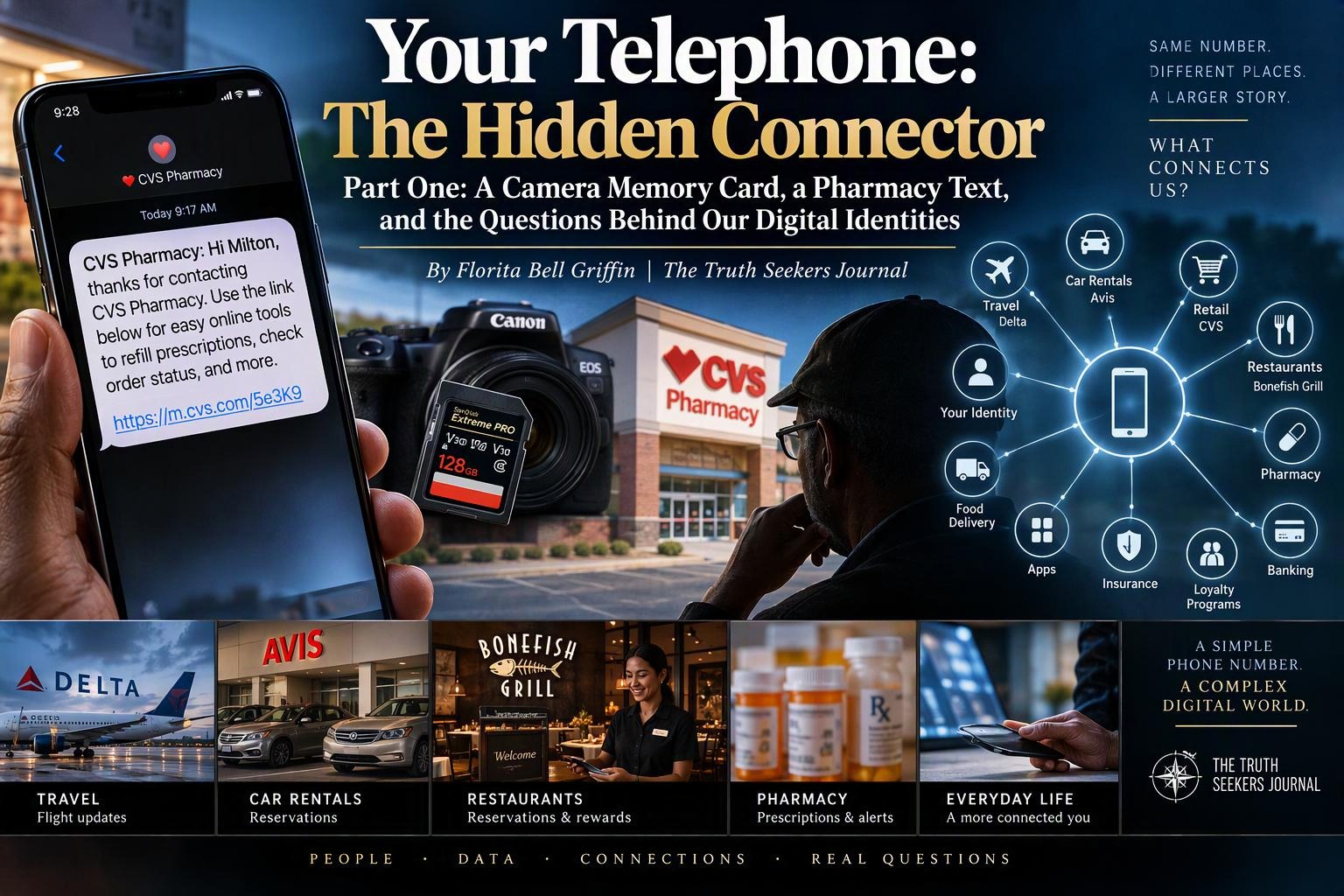
The incident that prompted this Truth Seekers Journal series illustrates why the technological environment surrounding an ordinary telephone call deserves greater public attention. One of my colleagues contacted a retail store to inquire about the availability of a memory card compatible with a Canon camera. The employee who answered confirmed that several options were available, and the conversation ended without any apparent complication. Less than an hour later, my colleague received an automated pharmacy-related text message from the same company on a cellular telephone number that he reports was not provided during the conversation. The precise circumstances responsible for that message remain unknown, and there is insufficient evidence to identify the system or process involved. Nevertheless, the experience raises important questions about the information available to corporations when consumers initiate what they reasonably believe are simple, limited interactions.
The Information That Accompanies a Telephone Call
Every telephone call involves information beyond the words the participants exchange. When a call enters a communications network, systems responsible for routing and processing it ordinarily have access to certain technical information. Depending on the network and its configuration, this may include the originating telephone number, the destination number, the time of the call, and other signaling information. Caller identification technology has made some of this information visible to recipients for decades, but the broader communications infrastructure can process considerably more information than what appears on a telephone display.
The significance of caller identification becomes more apparent when telephone systems are integrated with corporate databases. A telephone number may serve as a searchable reference that allows software to locate information already associated with a customer. If that number exists in a loyalty program, pharmacy account, purchasing history, online profile, customer-service record, or another accessible database, an organization may have the technical ability to connect the incoming call with an existing record. Such a connection does not necessarily require the caller to provide identifying information verbally during the conversation.
The ability to associate a telephone number with stored information should not be confused with evidence that every corporation performs this process. Businesses differ substantially in their communications technology, internal databases, customer identification practices, and privacy safeguards. Some systems may do little more than display the incoming number, while others may conduct automated searches across integrated customer records. The important distinction is between what modern systems are capable of doing and what any particular organization actually does. Understanding that distinction is essential to evaluating the incident that initiated this series without making unsupported assumptions.
How Customer Information Becomes Connected
Corporate customer-service technology increasingly relies on systems designed to bring information from different interactions into a unified environment. Customer relationship management systems, commonly called CRM systems, allow businesses to organize information about customers, transactions, support requests, communications, and service histories. When integrated with telephone platforms, these systems may help employees identify existing customers and retrieve relevant records while a conversation is underway. The stated business objective is generally to improve efficiency, reduce repetitive questions, and provide more consistent service across multiple points of contact.
The convenience associated with integrated customer information can offer meaningful benefits to consumers. An airline may be able to locate a passenger’s reservation during a call about a delayed flight. A utility company may recognize that an account is associated with an address experiencing an outage. A retailer may quickly retrieve an earlier purchase or identify an unresolved customer-service request. In these situations, the ability to connect information can reduce inconvenience and allow employees to respond more effectively to legitimate customer needs.
The same integration that improves service can also make corporate information practices difficult for consumers to understand. A person may regard a visit to a retail store, an online purchase, a pharmacy transaction, and a telephone inquiry as separate activities undertaken for different purposes. A corporation, however, may operate systems intended to bring those activities together under a single customer relationship. As a result, information provided during one interaction may become available within another part of the organization, depending on the company’s technology, policies, and applicable legal restrictions.
One important process underlying these connections is known as identity resolution. Identity resolution refers to methods used to determine whether information appearing in different records relates to the same individual or household. A company may possess a telephone number in one database, an email address in another, purchase information in a third, and a customer account in a fourth. Software may attempt to associate these records through shared identifiers or other matching methods, creating a more comprehensive view of the customer’s relationship with the organization.
Telephone numbers are especially useful in identity-resolution processes because people frequently use the same number across many different services. A cellular number may appear in banking records, medical offices, pharmacy accounts, insurance documents, shopping platforms, travel reservations, delivery applications, and authentication systems. Many consumers retain the same telephone number for years, making it a relatively persistent identifier. This widespread reuse increases the potential for a number to connect records that were originally created through unrelated interactions.
The difference between providing a telephone number for communication and having that number function as an identifier is central to the consumer privacy discussion. A customer may provide a cellular number to receive a prescription notification, believing the information will be used for that specific purpose. Within a corporate information system, the same number may also be stored as part of a customer account and potentially used for other authorized functions. Whether those additional uses are appropriate depends on the circumstances, including the purposes involved, the company’s disclosures, consumer choices, and applicable privacy requirements.
The Role of Automated Corporate Systems
Modern corporate communications platforms are capable of processing incoming interactions without requiring every action to be initiated by an employee. Depending on how a system is designed, software may log an incoming call, record technical information about the interaction, search for an associated customer record, or initiate an automated workflow. These functions can operate independently of the employee who answers the telephone. Consequently, the visible conversation may represent only one part of the technological activity associated with the call.
The separation between local employees and centralized information systems can make unusual communications particularly difficult to investigate. A store associate may have access only to the information needed to answer customer questions, complete transactions, or perform other assigned duties. Corporate messaging systems, pharmacy platforms, account services, customer analytics, and communications infrastructure may be managed through entirely different departments or external technology providers. An employee may therefore be unaware of an automated process that occurs elsewhere within the organization.
Automated workflows can also produce communications based on information or conditions unrelated to the immediate conversation. Some systems are configured to send reminders, notifications, confirmations, service updates, or other messages when specified conditions are met. Those conditions may involve account activity, stored communication preferences, previously scheduled events, or other records. The existence of such technology does not establish that a particular incoming call triggered a message. It does, however, demonstrate why determining the cause of an automated communication may require examining more than the employee’s account of the telephone conversation.
The expansion of cloud-based communications technology has increased the number of systems that may participate in corporate telephone interactions. Businesses can use integrated platforms that manage voice calls, text messages, customer records, automated responses, analytics, and security functions. Communications that once appeared to involve a single telephone connection may now pass through interconnected software services operating in different technical environments. The greater the level of integration, the more important it becomes to understand which systems receive information, what they do with it, and how those activities are governed.
Why Information About a Call Matters
Communications metadata can reveal meaningful information even when the content of a conversation is not available. Metadata generally refers to information describing an interaction rather than the words spoken during it. Telephone-related metadata may include the numbers involved, the time and duration of a call, and certain network or service details. Although the significance of any individual record varies, patterns of communication can reveal relationships, routines, service interests, and other information about personal or professional activities.
The sensitivity of communications information has long been recognized in telecommunications policy. Federal rules provide protections for certain categories of customer information held by telecommunications carriers, including information relating to the use of communications services. These protections do not mean that every record created by a retail corporation is governed by the same requirements. They do demonstrate that information surrounding communications can have privacy implications independent of the conversation itself.
Corporate information systems may generate additional records after a call reaches the business. Depending on the technology involved, a telephone platform may create an interaction log, a customer-service record, an internal notification, or other operational information. When customer databases are integrated with communications platforms, these records may become associated with information already held by the organization. The consumer may be unaware that such records exist, particularly when the interaction consists of nothing more than a brief inquiry answered by a store employee.
The distinction between information actively supplied by a consumer and information generated through an interaction is especially important. People generally recognize information collection when a website asks them to complete a form, a cashier requests a telephone number, or a mobile application seeks permission to access a device feature. Information can also be generated through ordinary activity without an explicit request for additional personal details. Making a telephone call, visiting a website, using an application, or completing a purchase can create records as part of the systems required to support those activities.
The existence of automatically generated information does not, by itself, indicate improper conduct. Businesses require operational records to process transactions, prevent fraud, protect accounts, respond to service requests, and maintain reliable systems. Telecommunications providers must process information to connect calls, just as financial institutions require transaction records to maintain accounts. The privacy question is not whether every form of information collection should be eliminated, but whether the collection and subsequent use of information are appropriate, understandable, and reasonably limited to legitimate purposes.
Transparency and Consumer Expectations
Transparency is one of the most important considerations in evaluating corporate information practices. Consumers should have a reasonable opportunity to understand what information is collected during an interaction, how that information may be associated with existing records, and what subsequent activities may result. The challenge is that corporate privacy explanations often describe broad categories of information use without explaining the specific technical processes that make those uses possible.
General privacy disclosures may state that information is collected to improve services, personalize experiences, prevent fraud, or communicate with customers. These explanations can serve legitimate disclosure purposes, but they may not answer the practical questions consumers have after an unexpected event. A person who receives an unfamiliar automated message following a telephone call is unlikely to find a satisfactory explanation in broad language about customer experience or operational efficiency. The consumer wants to understand what occurred, why it occurred, and whether the information involved was used appropriately.
Consumer expectations also depend on the purpose of the original interaction. Someone calling a retail store to inquire about a camera accessory may reasonably expect the employee to answer questions about merchandise. That consumer may not anticipate that the call could be associated with an existing account or become part of a broader information-processing environment. The possibility of such connections does not establish that they occurred, but it highlights the potential difference between the consumer’s understanding of the interaction and the corporation’s technological capabilities.
The ability to question and correct information is another essential part of meaningful transparency. Consumers may need to know which telephone numbers are associated with their accounts, how automated communications are initiated, and whether stored contact information is accurate. They may also want to understand the choices available for limiting certain communications or correcting outdated records. Clear explanations and accessible customer-service procedures can help reduce confusion while strengthening confidence in legitimate corporate operations.
Artificial Intelligence and the Expansion of Automated Decisions
Artificial intelligence introduces additional capabilities into systems that already collect and organize customer information. AI technologies can assist organizations in analyzing large volumes of records, identifying patterns, categorizing interactions, detecting potentially fraudulent activity, and determining which types of assistance may be appropriate. When combined with established customer databases and automated workflows, these capabilities can support processes that previously required substantial manual review.
AI-enabled customer service can provide advantages when its functions are clearly related to the consumer’s needs. An airline could use relevant account and flight information to help identify a disrupted itinerary. A utility provider could use service records to recognize that a caller may be affected by an existing outage. A healthcare organization could use an appropriately authorized system to direct a patient to the correct department. In these examples, automation can help employees and consumers navigate complex information more efficiently.
The privacy implications become more significant when consumers cannot distinguish between a helpful automated process and an unexpected use of their information. A person may appreciate a system that quickly locates a requested account while feeling uncomfortable about receiving an unrelated message after a routine inquiry. Both situations can involve information processing, but the consumer’s perception depends heavily on the purpose, transparency, and apparent connection between the activity initiated and the response received.
Artificial intelligence should not automatically be assumed to explain every unexplained communication generated by a corporation. Traditional databases, scheduled notifications, messaging platforms, and rule-based automation have operated for years without requiring AI. An automated text message may result from any number of technical or administrative processes, including one unrelated to a recent telephone call. Identifying AI as the cause of a particular event requires evidence that the relevant system actually used AI in producing that result.
The larger concern is that increasing technical sophistication can make accountability more difficult when the underlying processes are not visible to consumers. Whether an action is initiated by artificial intelligence, conventional automation, or a human employee, the organization should be able to explain the general basis for the activity when appropriate. Consumers need not understand the programming behind every corporate platform to expect accurate information about how their accounts and communications are managed.
What the Original Incident Reveals
The retail telephone call that prompted this series remains an important illustration of the gap between consumer experience and corporate information systems. The known sequence involves a call about a camera memory card followed by a pharmacy-related text message from the same company within a relatively short period. The recipient reports that the cellular number receiving the message was not provided during the conversation. Those observations justify further questions, but they do not establish that the call caused the message or that the company’s systems linked the two events.
Several explanations could potentially account for the sequence without involving the precise mechanism a consumer might initially suspect. The message could have resulted from an existing pharmacy record, a previously scheduled notification, a communication preference, a database association, or another administrative process. It is also possible that the timing was coincidental. Without access to the relevant records, system logs, or an authoritative explanation from the organization, these possibilities cannot be evaluated conclusively.
The inability to establish the precise cause does not diminish the value of examining the underlying technology. A significant part of responsible public inquiry involves identifying what is known, acknowledging what remains uncertain, and investigating the systems capable of producing an observed result. In this instance, the unanswered question creates an opportunity to explore how telephone identifiers, customer databases, automation, and corporate communications platforms may interact in contemporary business environments.
The incident also demonstrates why a consumer’s direct experience may provide only limited insight into the broader system. The employee answering a telephone may perform the assigned task correctly and courteously while having no knowledge of information processing conducted elsewhere. A message received after the call may originate through a corporate service entirely separate from the local store. Understanding the event therefore requires attention to the distinction between the visible human interaction and the less visible technological operations surrounding it.
The Responsibility to Explain Corporate Information Practices
Corporations have an opportunity to improve consumer trust by explaining information practices in language that ordinary people can understand. When incoming calls are routinely associated with customer records, businesses can describe the circumstances under which those associations occur. When automated communications are generated, organizations can provide meaningful information about their purpose and the account activity or other conditions that prompted them, subject to appropriate security and privacy safeguards.
Clear explanations can also help distinguish legitimate operations from technical errors or unexpected system behavior. A consumer who understands why a message was sent is better positioned to determine whether the communication was appropriate. If the message resulted from incorrect account information, the organization can provide a process for correction. If a notification was unrelated to a recent telephone call, explaining that distinction may resolve concerns that would otherwise remain unanswered.
The growing complexity of corporate technology makes these practices increasingly important. Modern consumers interact with organizations through telephone calls, websites, mobile applications, physical stores, messaging services, and automated platforms. Information may move among these environments in ways that are not obvious to the people generating it. As the connections become more sophisticated, the responsibility to make their purposes and consequences understandable becomes correspondingly greater.
Consumers also have a role in asking informed questions about the systems they encounter. They can inquire whether a company associates incoming telephone numbers with customer accounts, whether automated notifications are connected to particular activities, and how communication preferences can be reviewed. Such questions do not imply that wrongdoing has occurred. They reflect a reasonable interest in understanding how personal information is handled in an increasingly interconnected commercial environment.
The Larger Meaning of an Ordinary Telephone Call
An ordinary telephone call in 2026 may involve considerably more technology than the consumer realizes. The conversation itself may last only a few minutes, but the interaction can generate technical records and enter systems designed to organize customer communications. Depending on the corporation’s infrastructure, information associated with the call may remain within a telephone platform or become connected with other operational records. The precise activities vary, and their existence must be established rather than assumed in any individual case.
The important lesson is that digital interactions can continue to have informational consequences after the visible exchange has ended. A caller may hang up believing the interaction is complete, while records generated by the communication remain available within the systems that processed it. Some records may be necessary for legitimate business operations, while others may be retained or used according to additional organizational practices. Understanding these distinctions is essential to meaningful discussions about consumer privacy, transparency, and accountability.
The event that inspired this Truth Seekers Journal investigation began with a simple question about a camera memory card. It developed into a much broader examination of the relationship between consumers and the information systems operating behind familiar corporate services. Although the cause of the subsequent pharmacy-related message remains unverified, the questions raised by the experience are important in their own right. They concern the ways information is collected, connected, interpreted, and acted upon within organizations whose technological capabilities are often invisible to the public.
Ultimately, the future of consumer privacy will depend not only on what corporations are technically capable of doing, but also on how responsibly those capabilities are governed and explained. Consumers should not have to become telecommunications specialists, database administrators, or artificial intelligence engineers to understand the basic consequences of ordinary interactions. They should be able to obtain meaningful explanations, exercise appropriate choices, and expect reasonable accountability when questions arise about their information.
A telephone conversation may end the moment a caller disconnects, but the information associated with that interaction may continue to exist within corporate systems. Recognizing this reality is not an accusation against technology or the organizations that use it. It is an acknowledgment that modern communication involves more than the spoken exchange, and that public understanding must keep pace with the systems increasingly shaping everyday life.
© 2026 Truth Seekers Journal. Published with permission from the author. All rights reserved.
Related articles:
Your Telephone: The Hidden Connector
Will AI Change Your Job Even If It Doesn’t Replace It? What Everyday Workers Should Expect
Your Children Are Growing Up With AI: What Parents and Grandparents Need to Understand
What Happens When Your Car Starts Thinking for You? AI, Driving, and the Road Ahead
Truth Seekers Journal thrives because of readers like you. Join us in sustaining independent voices.