Milton Kirby
By Milton Kirby | Morrow, GA | October 30, 2026
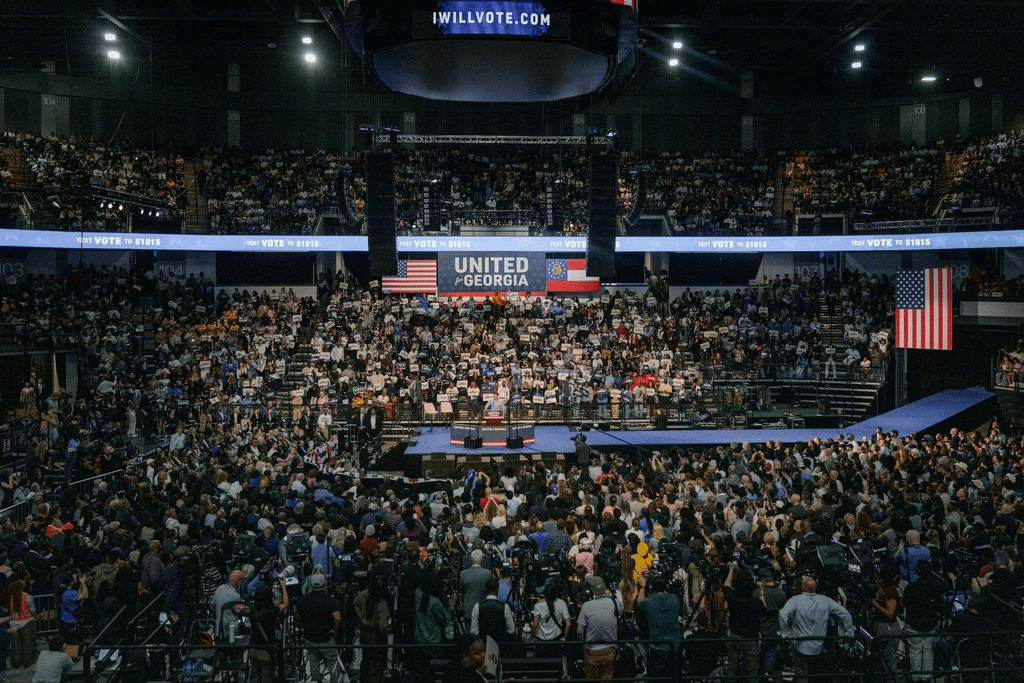
Hours before former President Barack Obama took the stage Wednesday evening at a Democratic campaign rally supporting U.S. Senator Jon Ossoff and gubernatorial candidate Keisha Lance Bottoms, crowds were already gathering outside the Arena at Southlake.
Lines began forming around noon for the October 28 event, scheduled to begin at 6 p.m. By approximately 5 p.m., parking had reached capacity, and police officers were turning arriving vehicles away from the venue.
Attendees wearing campaign T-shirts and caps joined the growing lines, while members of the news media faced lengthy security inspections. Secret Service personnel examined equipment and bags before allowing entry.
Inside, the 8,000-seat arena was filled with supporters who came to hear Obama and a slate of Democratic candidates make their case ahead of the November 3 midterm elections.
The former president’s appearance brought national attention to two closely watched Georgia contests: Ossoff’s reelection campaign against Republican Congressman Mike Collins and Bottoms’ gubernatorial race against Republican businessman Rick Jackson.
But Obama’s message extended beyond the candidates sharing the stage. He portrayed the election as an opportunity for Americans to address economic pressures, demand greater government accountability, and reconsider the values shaping the nation’s political future.
Obama: An Election That Feels Different
“When you’ve campaigned in as many elections as I have, you can tell when an election comes along that feels a little different,” Obama told the audience, describing voters as hungry for change.
The former president criticized President Donald Trump’s administration over the rising cost of living, tariffs, healthcare policies, and the war involving Iran.
He argued that Americans had been promised economic relief but continued to face financial pressures involving groceries, housing, utilities, and healthcare.
Obama also questioned whether Republican lawmakers had exercised sufficient oversight of the administration, arguing that Congress has a constitutional responsibility to hold the executive branch accountable.
He described the election as an opportunity to activate a “circuit breaker in the system,” emphasizing that voters could change the composition of Congress even though Trump would remain president.
The former president mixed criticism with humor, recalling the controversy surrounding the tan suit he wore during his presidency and joking about the attention given to political personalities rather than substantive issues.
He also acknowledged frustrations with the Democratic Party, suggesting that opposition to Trump alone would not address the concerns of families struggling to make ends meet.
Obama urged political leaders to offer practical solutions involving affordable housing, expanded healthcare access, education, and economic opportunity.
Bottoms: Georgia’s Political Transformation Is Not Over
Former Atlanta Mayor Keisha Lance Bottoms used the rally to emphasize Georgia’s changing political landscape and the importance of sustained voter participation.
“We are showing America that the wave we saw in Georgia that sent Senator Jon Ossoff and Senator Warnock to the United States Senate was not a fluke, it was just the beginning,” Bottoms told supporters.
Her remarks recalled the historic Senate victories that helped establish Georgia as a closely contested state in national politics.
Bottoms outlined several priorities of her gubernatorial campaign, including expanding Medicaid, increasing teacher salaries, broadening access to prekindergarten education, and creating pathways to free technical and community college education.
She also pledged to expand affordable and workforce housing, provide property tax relief, and give local governments greater authority to eliminate certain taxes on groceries, diapers, and feminine hygiene products.
Bottoms proposed pausing construction of new data centers, linking the issue to environmental protection and concerns about rising electricity costs.
Her campaign proposals also included protecting reproductive rights and expanding access to mental healthcare.
In one of the evening’s more personal moments, Bottoms recalled childhood trips through Buckhead when her family would pass the Georgia governor’s mansion.
As a young girl, she remembered wanting to enter the mansion one day. Decades later, she described her candidacy as an opportunity to fulfill a calling that began long before she entered public office.
Bottoms criticized Jackson’s alignment with Trump and contrasted her approach to governing with that of her Republican opponent.
Jackson’s campaign has challenged Bottoms’ record as Atlanta mayor, particularly regarding public safety and affordability.
Georgia Early Voting Surpasses 2.5 Million Ballots
Voter participation was a recurring theme throughout the evening.
Bottoms told supporters that more than two million Georgians had already voted and encouraged continued engagement during the campaign’s final days.
By Friday, October 30, that figure had climbed substantially.
According to figures reported by The Atlanta Journal-Constitution, citing the Georgia Secretary of State’s Election Data Hub, 2,513,770 ballots had been cast statewide as of October 30, the final day of early voting.
The figure reflects ballots cast across Georgia and does not indicate support for any particular political party or candidate.
With Election Day approaching, both major parties have emphasized turnout as a central component of their statewide campaigns.
Ossoff Emphasizes Service Beyond Party Lines
Senator Jon Ossoff delivered a forceful defense of his record while criticizing the Trump administration and his Republican opponent, Congressman Mike Collins.
Ossoff argued that elected officials should be judged by their ability to solve problems for the people they represent, regardless of political affiliation.
He described working with Republican mayors and local officials throughout Georgia to secure assistance for hospitals, infrastructure improvements, disaster recovery, and other community needs.
“Hurricanes and diabetes and gas leaks don’t check your party affiliation,” Ossoff said. “And when it comes to serving Georgia, I don’t either.”
The senator cited his work with local leaders in Valdosta, Tifton, and Toccoa, including assistance following Hurricane Helene, funding for dialysis equipment, and improvements to aging natural gas infrastructure.
He also raised concerns about healthcare access in rural Georgia, particularly the availability of maternity services and the financial pressures facing hospitals.
Ossoff criticized federal healthcare reductions and questioned the administration’s handling of the Iran conflict.
Beyond his criticism of Trump, Ossoff argued that the influence of wealthy donors and corporations had weakened public confidence in government.
He called for broader political reforms, including changes intended to reduce the influence of money in elections.
“Our victory is near at hand,” Ossoff told supporters as he emphasized the importance of the campaign’s remaining days.
Warnock Frames Election as a Moral Question
U.S. Senator Raphael Warnock brought a different perspective to the rally, connecting the political debate to questions of morality, compassion, and the responsibilities Americans have toward one another.
Warnock, who also serves as senior pastor of Atlanta’s historic Ebenezer Baptist Church, criticized proposed reductions in Medicaid and the Supplemental Nutrition Assistance Program, commonly known as SNAP.
He argued that decisions affecting healthcare and food assistance should be evaluated not only through budget calculations but also through their consequences for vulnerable families.
“This is about the character of the country,” Warnock told supporters. “This is about who we are and whether we are here for one another.”
Warnock expressed concern about what he described as the nation’s spiritual condition, arguing that political divisions and government policies reflect deeper questions about national priorities.
His remarks reinforced the evening’s recurring theme that public leadership involves more than winning elections.
For Warnock, the debate also concerned whether government institutions would respond to the needs of children, families, and communities facing economic hardship.
Statewide Candidates Make Their Case
The rally also provided a platform for Democratic candidates seeking other statewide offices.
Attorney general candidate Tanya Miller, drawing on her experience as a prosecutor and civil rights attorney, pledged to serve as “the people’s lawyer.”
Miller emphasized protecting voting rights, pursuing public corruption, and addressing violent crime.
Secretary of state candidate Penny Brown Reynolds focused on election integrity and civic participation, describing voting as “an act of self-love and an act of self-respect.”
Lieutenant governor candidate Josh McLaurin also participated in the event, joining the broader Democratic effort to highlight statewide races beyond governor and U.S. Senate.
Pastor Jamal Bryant of New Birth Missionary Baptist Church emphasized Georgia’s role in national political affairs and encouraged younger voters to participate in the election.
Singer and actress Janelle Monáe also performed, adding an entertainment component to the campaign gathering.
John Lewis, Voting Rights, and Future Generations
Ossoff invoked the legacy of the late Congressman John Lewis, whose portrait, he said, hangs above his desk in his Senate office.
He described Lewis’ belief in shared responsibility and the importance of defending the democratic principles advanced through the civil rights movement.
“When voting rights and civil rights that heroes died to secure are under attack, we defend those rights by using them,” Ossoff declared.
The senator connected that history to concerns about the future, including environmental protection, technological change, artificial intelligence, and the responsibilities of government toward younger generations.
Speaking about his daughters, Ossoff argued that elected leaders have an obligation to confront long-term challenges rather than leave them unresolved.
The themes reinforced the rally’s broader emphasis on voting rights and the role of citizens in holding government accountable.
Obama Closes With an Appeal to American Values
Obama concluded his remarks by shifting from campaign disputes to the moral principles he believes should guide American public life.
Invoking the legacy of the Rev. Dr. Martin Luther King Jr., he called attention to what he described as “mighty precious values,” including honesty, integrity, compassion, and service to others.
The former president acknowledged that Americans disagree about policies and political leadership, but argued that those disagreements should not erase their shared responsibilities.
“We also need to rediscover our North Star,” Obama said. “We also need to rediscover what’s best in us.”
He called for a return to friendship, neighborliness, generosity, and cooperation, arguing that the nation’s future depends on more than political victories.
His closing message echoed themes that helped define his earlier presidential campaigns, including the belief that political participation can bring about meaningful change.
The rally also highlighted the competing messages being presented to Georgia voters.
Trump has campaigned in the state for Republican candidates, including Collins and Jackson, while Democrats have brought Obama and other prominent party figures to metro Atlanta.
For Georgia voters, the November 3 election will determine the state’s next governor, its representation in a closely watched U.S. Senate race, and the leadership of several other statewide offices.
For Obama, the stakes extended beyond any individual campaign.
His message was that elections provide Americans with a means of holding elected officials accountable while deciding which policies and principles should guide their government.
As Georgia’s early voting period concludes and Election Day approaches, the candidates’ arguments now move from campaign stages to the ballot box.
Truth Seekers Journal thrives because of readers like you. Join us in sustaining independent voices.